In a windowless basement laboratory at the Institut Català de Paleontologia Miquel Crusafont on the outskirts of Barcelona, paleontologist Oscar Castillo-Visa flicked off the overhead fluorescent tubes. The room sank into near-total darkness, save for the faint green indicator light of a digital camera rig.
Castillo-Visa reached for a handheld ultraviolet lamp, clicked the trigger, and pointed the beam downward at a flat slab of cream-colored limestone. The stone had been extracted from a quarry in Catalonia’s Montsec range more than a century ago. For 122 years, paleontologists had examined it under magnifying lenses, daylight, and incandescent bulbs, logging it as a tidy, if unspectacular, articulated skeleton of an early reptile.
Under the ultraviolet radiation, the limestone slab underwent an eerie metamorphosis.
The dull white bone skeleton—a 50-centimeter creature roughly the length and weight of a domestic cat—receded into the background. In its place, shining in high-contrast luminescence, were soft biological structures that no human had seen since the Early Cretaceous: delicate webs of pebbled skin, fingernail-like claw sheaths, the ghostly silhouettes of respiratory cartilage bracing the ribs, and tiny sensory pits.
Then came the detail that brought the team’s work to an abrupt halt.
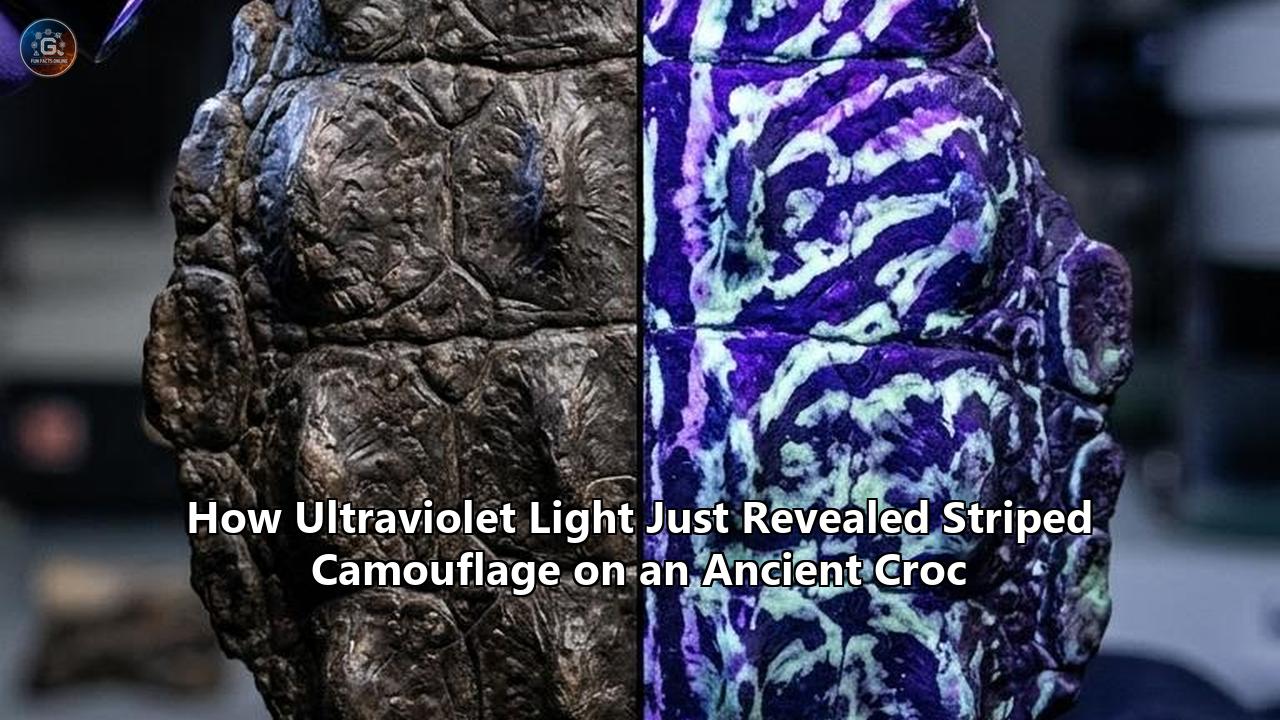
Tracing the vertebrae down into the tail, the UV light struck a series of alternating luminous bands. Wide, repeating stripes of light and dark chemical residues swept transversely across the fossilized skin.
The team was looking directly at the biological remnants of pigmentation: the oldest documented physical evidence of color patterns in the crocodilian fossil record. The cat-sized predator had possessed a boldly banded tail, a classic disruptive marker engineered to dissolve the animal’s silhouette against the sun-dappled shallows of an ancient lake.
The discovery, published in the Zoological Journal of the Linnean Society by Castillo-Visa, Jesús Serrano, and Albert Sellés, has transformed a cold-case museum specimen into an unexpected forensic window into Mesozoic ecology. By revealing functional ancient crocodile camouflage stamped directly into the chemistry of the stone, the study demonstrates that the sophisticated visual deception used by living marsh predators was already fully operational 125 million years ago.
The Cold Case in Drawer 1902
The fossil in question belongs to Montsecosuchus depereti, an extinct neosuchian atoposaurid that prowled the wetland margins of the Iberian Peninsula during the Barremian stage of the Early Cretaceous. At the time, what is now northern Spain was part of an archipelago bathed in subtropical warmth, characterized by shallow freshwater lakes, brackish lagoons, and dense thickets of ferns and conifers.
The specimen’s human history began in 1902. Lluís Marià Vidal, a prominent Catalan mining engineer and geologist, was conducting field surveys in the limestone quarries of La Pedrera de Meià, nestled within the southern slopes of the Montsec mountains. Workers in the quarry were cleaving thin, fine-grained sheets of lithographic limestone—a dense, highly uniform stone prized across Europe for commercial printing.
Wedged between two splitting planes of rock, Vidal spotted the dark, articulated skeleton of a tiny reptile. Recognizing its rarity, he acquired the slab and added it to his collection.
In 1915, French paleontologist Charles Depéret carried out the initial formal description. He assigned the animal to the genus Alligatorium, believing it to be a miniature, archaic alligator. For decades, the slab remained largely dormant in the collections of the Museum of Natural Sciences of Barcelona. In 1988, Spanish paleontologists Ángela Buscalioni and José Luis Sanz re-examined the material, recognized its unique anatomical position outside true alligators, and erected the new genus Montsecosuchus.
Yet throughout all these handoffs and revisions, the scientific consensus remained fixed: the fossil preserved the animal's bones and virtually nothing else.
"When you examine the holotype under ordinary white light, your eyes register bone and beige limestone," Castillo-Visa explained during an interview detailing the investigation. "The skeleton is clean and relatively complete, but there is no obvious relief that suggests soft tissue. Generations of specialists looked right at it. But human vision is limited to a narrow slice of the spectrum. The rock was keeping secrets that only specific photons could shake loose."
The decision to dim the lights was not part of an elaborate new analytical plan. Rather, it grew out of an investigative hunch.
"We knew that La Pedrera de Meià was an exceptional Conservation-Lagerstätte," Castillo-Visa said. "Other organisms from the exact same quarry—insects, feathers, small amphibians—regularly show carbonaceous films and exquisite soft-part preservation. We looked at Montsecosuchus and asked a very basic question: why would this crocodile relative be any different? We brought in a UV lamp just to see. When we turned it on, the specimen seemed to wake up."
The Physics of the Glow
To understand why the stripes on Montsecosuchus remained hidden for 122 years requires unpacking the physics of ultraviolet-induced visible fluorescence (UVF).
When sunlight or a laboratory incandescent bulb strikes a fossil, it floods the surface with broad-spectrum white light. The light bounces off the rock and reaches our eyes as reflected color. If the fossilized bone, the surrounding matrix, and any degraded organic traces share a similar refractive index and pale mineral composition, they appear monochromatic. Under standard lighting, the mineralized skin of Montsecosuchus matched the surrounding limestone so closely that it was indistinguishable to the naked eye.
Ultraviolet light operates through an entirely different physical mechanism.
UV radiation carries higher energy and shorter wavelengths (typically 365 nanometers in paleontology rigs) than visible light. When high-energy UV photons collide with electrons within certain mineral matrices or surviving polycyclic aromatic hydrocarbons, they knock those electrons into higher orbital energy states.
As those electrons fall back to their ground state, they release that surplus energy in the form of lower-energy, longer-wavelength visible photons. The stone does not merely reflect light; it glows.
Crucially, different chemical compounds fluoresce in different colors and intensities. Pure calcium carbonate (calcite), which forms the fine mud matrix of La Pedrera de Meià, typically exhibits a dull, weak fluorescence or remains dark under 365-nm excitation. Hydroxyapatite, the calcium phosphate mineral that makes up fossilized bone and teeth, fluoresces with a bright, crisp yellow-white or pale blue signature.
Soft tissues, when they fossilize, do not turn into bone. Instead, through intricate biogeochemical processes known as taphonomy, decaying organic matrices are replaced molecule by molecule by authigenic minerals—principally microcrystalline apatite, francolite, and various iron- or manganese-bearing complexes.
When Castillo-Visa and his colleagues aimed their lamp at the slab, these mineral replacements reacted with pinpoint chemical specificity.
The bones lit up sharply. But across the torso, the legs, and the tail, vast sheets of faint, ghost-like luminescence bloomed across the flat stone where previous researchers had assumed there was only bare limestone.
"It is essentially forensic crime scene work applied to deep time," says Dr. Albert Sellés, co-author of the study and researcher at both the Institut Català de Paleontologia and the Museu de la Conca Dellà. "The criminal leaves behind fingerprints or bloodstains that cannot be wiped completely away because traces of biological molecules alter the surface chemistry. In the case of Montsecosuchus, the animal left its entire external anatomy imprinted in mineral traces that were simply waiting for the proper excitation wavelength."
Layer One: A Skin Without Armor
As the team moved their instruments systematically across the specimen, they documented the creature's anatomy from the outside in. What emerged was a portrait of a reptile that subverted the standard pop-culture image of a crocodile.
Modern adult crocodilians—alligators, caimans, and true crocodiles—are armored fortresses. Their bodies are cloaked in heavily cornified, rectangular scales underlaid by thick, bony plates called osteoderms. Their backs are covered in jagged, raised ridges, and their tails bear tall, paired vertical scutes that merge into a high, fin-like swimming paddle.
Under the UV beam, the skin of Montsecosuchus depereti looked shockingly delicate.
The best-preserved patches appeared across the thoracic cavity, the forelimbs, and the tail base. The individual scales were small, rounded, and non-overlapping, forming a pebbled, bead-like mosaic rather than an interlocking suit of heavy plate armor. On the forelimbs, the skin was exceptionally thin and flexible, lacking the sharp, keeled ridges that modern Nile or saltwater crocodiles use to deflect bites from conspecifics or heavy brush.
Even more surprising was the tail.
Modern crocodilians rely on a deep, laterally compressed tail topped with a conspicuous fringe of raised scales that acts as a rudder and propulsion motor. Montsecosuchus possessed no such crest. Its tail was rounder in cross-section, sleek, and finished with uniform rows of smooth scales.
"The silhouette was entirely different," Castillo-Visa observed. "It was not a lumbering, heavily armored river monster scaled down to miniature proportions. It was a streamlined, low-profile animal. When you strip away the massive bony osteoderms and high tail fins of modern crocs, you realize that Montsecosuchus was built for speed and agility in shallow margins rather than deep-water underwater power-cruising."
At the tips of the fossil’s digits, the UV light highlighted another soft-tissue relic: intact rhamphothecae, or keratinous claw sheaths. While bones record the skeletal framework of an animal's toes, claw sheaths define their actual functional curvature, sharpness, and length in life.
The sheaths on Montsecosuchus were slender and gently curved, confirming that the limbs were not purely adapted for open-water swimming. Yet, paradoxically, the digits themselves were strikingly elongated—a trait commonly found in aquatic paddlers. The animal seemed suspended between two worlds, comfortable running along wet mudflats and darting through shallow weeds.
Layer Two: The Mechanics of a High-Output Breath
Continuing their UV sweep along the animal's torso, the researchers encountered a series of faint, hook-like structures arcing backward from the posterior margin of each rib.
In living animals, these structures are known as uncinate processes. They are thin, blade-like projections of bone or cartilage that overlap the subsequent rib, forming a linked truss system around the rib cage.
To an evolutionary biologist, their presence on a 125-million-year-old crocodile relative is profoundly telling.
Uncinate processes are famous for their role in avian physiology. Birds use these bony levers to dramatically increase the mechanical advantage of their respiratory muscles. When a bird inhales, muscles attached to the uncinate processes pull the entire rib cage outward and forward with minimal energetic cost, driving their ultra-efficient, one-way flow lung system.
In modern crocodilians, cartilaginous equivalents exist, serving as vital anchors for the complex muscular machinery—including the diaphragmaticus muscle—that pulls the liver backward like a piston to inflate the lungs.
In Montsecosuchus, the uncinate processes were preserved not as bone, but as faint mineralized cartilage.
"Seeing uncinate structures preserved in cartilage inside a fossil this old is extraordinary," Sellés said. "Cartilage is one of the first tissues to rot away upon death. Its survival here tells us that the chemical conditions at the bottom of the ancient Montsec lake were nearly sterile. But functionally, it tells us that this animal possessed a sophisticated ventilatory pump."
The discovery complicates the traditional narrative of ancient crocodylomorphs as sluggish, low-metabolism ambush hunters who spent their lives basking passively on logs.
The presence of a reinforced thoracic basket, combined with a lightweight, unarmored body plan, suggests an active animal capable of sustained aerobic exertion. It could dart after fast-moving prey—small fish, crustaceans, and insects—in the dense, vegetation-choked shallows without quickly collapsing into lactic acidosis.
Layer Three: Microscopic Domes in the Dark
The deeper the team pressed their UV investigation, the smaller the scale of discovery became.
Modern crocodilians are equipped with one of the most sophisticated tactile systems in the animal kingdom: Integumentary Sensory Organs, commonly abbreviated as ISOs.
If you examine the jaw of an alligator or the entire body of a saltwater crocodile, you will spot thousands of tiny, pinpoint domes. Each dome is packed with mechanoreceptors, thermoreceptors, and pH sensors wired directly to the trigeminal nervous system. These organs can detect surface ripples with an amplitude smaller than a single hair's width. They allow a modern crocodile resting with its eyes above water to detect the trajectory of a swimming fish yards away in pitch-black, sediment-choked water.
Paleontologists have long debated when and how this sensory array evolved. Did it originate all at once across the entire body, or did it begin in specialized patches?
Under the UV lamp, Castillo-Visa noticed tiny, distinct circular pits set directly into the centers of specific scales on Montsecosuchus.
Crucially, the pits were not distributed uniformly. They did not blanket the torso or the back. Instead, they were strictly confined to smaller, peripheral scales located around the extremities and flanks.
"This is an evolutionary smoking gun," Castillo-Visa said. "In modern true crocodiles, ISOs are scattered across virtually every single scale on the body, from head to tail. In alligators, they are restricted to the head. Here in Montsecosuchus, we see them exclusively on peripheral scales. This demonstrates that the crocodilian sensory network did not evolve in a single leap. It began as localized sensory nodes on the outward-facing edges of the animal, where they were most likely to brush against vegetation or sense water currents, before spreading across the entire body in later lineages."
The animal was, in effect, a sensory perimeter. As it stalked through the reeds of its Early Cretaceous lagoon, its extremities acted as antenna arrays, monitoring the hydrodynamic churn of the water while its body remained stock-still.
Layer Four: The Tail That Split the Light
Then came the observation that pushed the paper beyond anatomical description and into the realm of paleobiological color reconstruction.
The researchers directed their UV lamp along the caudal section of the skeleton. The tail of Montsecosuchus is remarkably well preserved, extending in a graceful curve across the limestone slab.
As the 365-nm light washed over the tail's scales, the researchers did not see a uniform fluorescent sheet.
Instead, the scales exhibited a rhythmic, alternating pattern: broad bands of high-intensity luminescence separated by equally wide bands of dark, non-fluorescent tissue. The bands crossed the entire width of the tail transversely, repeating in a predictable cadence down its length.
The team ruled out mineral artifacts, uneven preparation, or fracture planes in the stone. The banding matched the anatomical borders of scale rows perfectly.
They were looking at the chemical ghosts of original color patterns.
[Tail Vertebrae Column]
   │
   ├── [Band A: High UV Fluorescence]  --> Low-pigment/calcified zone (light stripe)
   ├── [Band B: Quenched Fluorescence] --> Melanin-rich organic zone (dark stripe)
   ├── [Band A: High UV Fluorescence]  --> Low-pigment/calcified zone (light stripe)
   └── [Band B: Quenched Fluorescence] --> Melanin-rich organic zone (dark stripe)
In modern vertebrates, skin patterns are dictated by the distribution of pigment-bearing cells, primarily melanophores containing eumelanin (black/brown pigments) and pheomelanin (red/yellow pigments). When an animal dies and begins to fossilize, melanin is one of the very few biological pigments tough enough to endure. Its complex, cross-linked polymeric structure resists bacterial digestion far longer than proteins like keratin or collagen.
However, melanin interacts with ultraviolet light in a very specific way: it absorbs UV radiation without re-emitting it, effectively acting as an optical sponge that quenches fluorescence. Where high concentrations of melanin survived in the skin of Montsecosuchus, the UV fluorescence was snuffed out, leaving dark bands.
Where the skin originally contained less melanin—corresponding to lighter scales in life—the surrounding authigenic minerals and calcium phosphate complexes were free to fluoresce brightly.
The alternating bands were physical evidence of ancient crocodile camouflage, stamped into the rock via differential pigment preservation.
"At the moment, we cannot state the exact chromatic hue of the tail," Sellés explained carefully. "We cannot say whether the bands were olive-green and black, or tan and dark brown, or yellow and charcoal. What the fossil preserves is the spatial contrast—the distribution of pigment density. But looking at modern reptiles that inhabit identical ecological niches, the pattern is unmistakable. It is classic disruptive coloration."
The Optics of Ambush
To understand why a 50-centimeter Early Cretaceous reptile needed a banded tail, one must look at the optical physics of water.
In terrestrial environments, camouflage often relies on matching the background color—a brown bird against oak bark, or a green tree frog against a broad leaf. In shallow, sunlit wetlands, however, background matching is rarely enough.
Shallow water is an optically volatile environment. Sunlight passing through moving surface ripples is focused and refracted into dancing, chaotic ribbons of light and shadow, a phenomenon known as caustic networks. At the same time, vertical reed stems, floating mats of algae, and submerged roots create high-contrast linear stripes of light and dark.
In this environment, an animal with a uniform, solid body outline stands out like a beacon. A predator or prey animal glancing across the shallows does not process every individual scale; its visual cortex searches for continuous edges—the unbroken outline of a head, a torso, or a long, tapering tail.
This is where disruptive ancient crocodile camouflage comes into play.
High-contrast, alternating bands break up the continuous visual boundary of an animal's body. When light hits a banded tail resting half-submerged in a reed bed, the viewer's eye does not register a single, 30-centimeter-long tail. Instead, the visual cortex breaks the image apart into disjointed segments. The dark bands appear to belong to background shadows or decaying submerged wood; the light bands blend with caustic sun flecks or pale sand.
The tail ceases to exist as a recognizable geometric object.
Visual Perception in Mesozoic Wetlands:

Uniform Tail:       [=========================]  --> Continuous outline detected
Disruptive Pattern: [███   ███   ███   ███   ███]  --> Outline broken; reads as
                                                     disjointed patches of light/shadow
For Montsecosuchus, this disruptive ancient crocodile camouflage served a dual purpose.
First, it was an offensive weapon. Modern juvenile crocodilians use their banded tails to sit motionless in shallow nursery waters, allowing small fish, tadpoles, and insects to swim within striking distance without realizing that the dark form beside them is a living animal. Montsecosuchus, being no larger than a juvenile modern alligator, hunted similarly sized prey.
Second, and perhaps more importantly, the camouflage was a defensive shield.
In the Early Cretaceous lakes of Montsec, Montsecosuchus was nowhere near the top of the food chain. The fossil beds of La Pedrera de Meià and nearby formations have yielded the teeth and bones of massive spinosaurid dinosaurs, dromaeosaurid theropods, giant pterosaurs with six-meter wingspans, and predatory teleost fish large enough to swallow a half-meter atoposaurid whole.
For Montsecosuchus, slipping into the edge of a reed marsh and letting its disruptive tail dissolve into the aquatic background was the only way to avoid being eaten.
Deep Roots: Why Modern Babies Look Like Mesozoic Adults
The discovery of tail banding in Montsecosuchus introduces a compelling evolutionary riddle: why does a 125-million-year-old adult fossil look so much like a modern hatchling alligator?
Anyone who has ever observed a nest of newly hatched American alligators (Alligator mississippiensis) or Nile crocodiles (Crocodylus niloticus) will recognize the pattern found on Montsecosuchus. Hatchling crocodilians do not possess the uniform, muddy-olive or slate-black hides of their 14-foot parents. They are born with bold, brilliant transverse stripes of golden-yellow and pitch-black running from their necks to the tips of their tails.
As modern crocodilians grow and transition from vulnerable, 20-centimeter hatchlings into apex predators weighing hundreds of kilograms, their disruptive stripes slowly fade. The high-contrast bands blur, meld together, and are eventually subsumed by dark, heavy osteoderms. An adult Nile crocodile has no natural predators; it has little need to hide its tail from aerial attack.
Yet here was Montsecosuchus, a fully mature adult atoposaurid—as evidenced by fused cranial sutures and ossified limb joints—bearing the exact same high-contrast striped pattern preserved on its tail scales.
"This raises fascinating questions about the evolutionary history of coloration in the Archosauria," Castillo-Visa mused during discussions of the lineage. "Is the banded tail of modern baby crocodilians a retained ancestral condition? Did the earliest neosuchians establish this genetic program for ancient crocodile camouflage back in the Jurassic or Early Cretaceous, with modern species retaining it exclusively during their vulnerable juvenile stages?"
In evolutionary biology, the retention of juvenile ancestral traits in modern descendants—or conversely, the adult expression of traits that later become restricted to early ontogeny—is a well-documented phenomenon.
It is entirely plausible that the banded tail is the foundational, basal pattern of the entire crocodilian lineage. In this view, Montsecosuchus never outgrew its stripes because its adult body size never exceeded the size of a modern one-year-old alligator. It remained permanently locked into the ecological bracket where disruptive camouflage is an absolute prerequisite for survival.
The finding underscores an evolutionary paradox: while the ancestors of modern birds—the sister group to crocodylomorphs—were busy modifying their integument into flamboyant, iridescent, and aerodynamic feathers, crocodilians hit upon a structural and pigmentary blueprint 125 million years ago that was so effective it has remained largely unaltered across deep time.
The Reconstruction of a Lost World
The revelation of Montsecosuchus’s soft tissues allows researchers to construct an unusually vivid paleoecological reconstruction of Early Cretaceous Catalonia.
Picture a quiet, sun-baked inlet along the margins of the Montsec lake system, 125 million years ago.
The water is remarkably still, stratified by temperature and salinity. Along the shoreline, horsetails and bennettitalean cycads lean out over the shallows. Dragonflies with 15-centimeter wingspans hover over mats of floating freshwater algae.
At the edge of a mud bank, half-submerged in warm, clear water, rests Montsecosuchus depereti.
Its body is held low, nearly flush with the substrate. Because it lacks the heavy, jagged armor and high tail scutes of later crocodilians, its dorsal profile creates almost no wake as it shifts position.
Its limbs, tipped with delicate, curved claws, grip the soft silt. Along its flanks and paws, microscopic sensory pits monitor the water, translating every hydrodynamic ripple into a real-time spatial map of the shallows.
Its uncinate processes allow its chest to expand smoothly, drawing in air without disturbing the water's surface. And trailing behind it into the dappled sunlight, its tail—ringed with bold, alternating bands—melts completely into the fractured shadows of the overhanging vegetation.
It is a masterpiece of Cretaceous micro-predation: small, efficient, aerated, sensitive, and virtually invisible.
┌────────────────────────────────────────────────────────────────────────┐
│               ANATOMICAL MOSAIC OF MONTSECOSUCHUS DEPERETI              │
├─────────────────────┬──────────────────────────────────────────────────┤
│ Preserved Structure │ Biological & Evolutionary Significance           │
├─────────────────────┼──────────────────────────────────────────────────┤
│ Non-Keeled Scales   │ Sleek, unarmored silhouette; adapted for agility │
│                     │ rather than defense against heavy apex biting.   │
├─────────────────────┼──────────────────────────────────────────────────┤
│ Claw Sheaths        │ Curved keratinous tips defining precise claw     │
│                     │ morphology; suited for wet-substrate traction.   │
├─────────────────────┼──────────────────────────────────────────────────┤
│ Uncinate Processes  │ Cartilaginous respiratory lever system; proves   │
│                     │ efficient thoracic ventilation in early taxa.    │
├─────────────────────┼──────────────────────────────────────────────────┤
│ Peripheral ISOs     │ Sensory pits restricted to body edges; shows the │
│                     │ evolutionary modularity of crocodilian sensing.  │
├─────────────────────┼──────────────────────────────────────────────────┤
│ Banded Tail Scales  │ Alternating melanin-rich/poor zones; represents   │
│                     │ the oldest evidence of disruptive body coloring. │
└─────────────────────┴──────────────────────────────────────────────────┘
The death of this particular individual was swift and quiet. It was likely swept into deeper, hypersaline bottom waters during a seasonal storm.
There, in an anoxic benthic zone devoid of scavengers, bottom-feeding fish, or burrowing worms, its carcass settled onto a floor of ultra-fine lime mud.
Before microbial decay could dismantle its skin, calcium carbonate and phosphate minerals infiltrated the soft tissues, precipitating within hours or days around the organic matrices.
Over the next 125 million years, the mud hardened into the lithographic limestone of La Pedrera de Meià, locking the animal's skeleton, cartilage, sensory domes, and camouflage stripes into a chemical vault.
The Ghost Fleet in Museum Drawers
The broader implications of the Castillo-Visa study extend far beyond the taxonomy of Montsecosuchus depereti. The paper represents a wake-up call for museum curation and historical fossil collections around the globe.
For nearly two centuries, the discipline of vertebrate paleontology was defined by the chisel, the needle, and white light.
When historical fossils were extracted from the earth during the Victorian era or the early 20th century, preparators worked under intense pressure to expose clean white bone for exhibition and anatomical description.
In thousands of cases, anything that was not hard bone was treated as unsightly rock matrix. Preparators mechanically chiseled away thin, amorphous carbonaceous films or scraped away soft mineralized patinas, unwittingly destroying skin, feathers, gut contents, and musculature that were dismissed as blemishes.
Even when specimens were prepared with extreme care—as Vidal’s Montsecosuchus was in 1902—they were categorized strictly by what was visible under ordinary daylight.
"There are millions of fossils residing in wooden museum drawers across Europe, North America, China, and South America that have never been seen under anything other than standard room lighting," Sellés pointed out. "We tend to imagine that the great discoveries of paleontology happen solely out in the Gobi Desert, the badlands of Montana, or the Patagonia steppes. But there is an entire second wave of discovery waiting in the archives. We don't necessarily need to dig new holes in the ground. We need to turn off the lights and re-examine the stones we already have."
The study of Montsecosuchus provides an undeniable proof of concept.
Ultraviolet-induced fluorescence is entirely non-destructive. It requires no chemical stripping, no particle bombardment that could damage the specimen, and no high-vacuum sample chambers that require cutting the fossil down to microscopic size. A researcher can walk through a museum collection with an emission-controlled UV torch and survey hundreds of slabs in an afternoon.
Where UV light detects anomalies, more advanced analytical techniques can follow.
Castillo-Visa’s team is already contemplating the next step in the forensic trail: micro-sampling the dark and light bands of Montsecosuchus’s tail for Time-of-Flight Secondary Ion Mass Spectrometry (ToF-SIMS) and Pyrolysis-Gas Chromatography-Mass Spectrometry (Py-GC-MS).
These ultra-sensitive chemical tools can identify the precise molecular fragmentation patterns of organic melanin compounds. If molecular biomarkers for eumelanin and pheomelanin can be isolated directly from the fluorescent and quenched zones, researchers might finally be able to assign real-world colors to the stripes—moving from spatial patterns to actual hues.
What Comes Next
The forensic recovery of Montsecosuchus’s tail stripes has opened several immediate research fronts that will occupy vertebrate paleontologists over the coming years:
- Systematic UV Audits of Lithographic Limestones: Research institutions housing specimens from renowned Lagerstätten—such as the Solnhofen limestone of Germany (home of Archaeopteryx), the Crato Formation of Brazil, and the Jehol Biota of China—are ramping up systematic darkroom surveys. If a 122-year-old Spanish crocodile can hide its skin, sensory organs, and stripes in plain sight, how many pterosaurs, early birds, and marine reptiles are sitting in drawers with invisible soft tissue waiting to be mapped?
- The Ontogeny of Archosaurian Coloration: Developmental biologists studying living alligators and crocodiles are being pressed to locate the specific regulatory genes that switch tail banding on during embryonic development and shut it down as the animals reach sexual maturity. By comparing these modern genetic switches with the anatomy of Early Cretaceous fossils, researchers hope to determine whether juvenile banding is an ancient, conserved archosaurian ground state that dates back to the Triassic ancestor of crocodilians and dinosaurs.
- High-Resolution Micro-CT and Cartilage Mapping: The discovery of preserved uncinate processes in Montsecosuchus proves that non-mineralized respiratory structures can survive in fine-grained lacustrine stones. Paleontologists are preparing synchrotron phase-contrast micro-tomography scans to model the three-dimensional architecture of the animal's thoracic cavity, aiming to build a computational fluid dynamics model of how early crocodylomorphs breathed.
Back in the Barcelona laboratory, the lights are switched back on. The handheld UV lamp clicks off.
On the workbench, the holotype of Montsecosuchus depereti instantly reverts to its century-old guise: a quiet, static arrangement of pale bones set into a dull limestone slab.
To the casual visitor walking past the desk, the slab looks identical to the day Lluís Marià Vidal carried it out of the Montsec quarry in 1902.
Yet everything about how science perceives the creature has changed. It is no longer just a catalog number or an anatomical placeholder in a phylogenetic tree. It is an animal restored to three dimensions: an agile, sensory-driven hunter, wrapped in delicate skin, breathing through an efficient thoracic lever system, and vanishing into the ancient Cretaceous reeds behind an impenetrable wall of striped camouflage.
Reference:
- https://www.iflscience.com/oldest-ever-crocodile-soft-tissue-reveals-the-color-pattern-in-an-exquisite-125-million-year-old-fossil-84136
- https://www.facebook.com/DeepInScience721/photos/125-million-year-old-crocodile-fossil-reveals-hidden-skin-color-patterns-and-res/1004469435975547/
- https://economictimes.indiatimes.com/us/science-tech/125-million-year-old-crocodile-fossil-reveals-shocking-details-uv-light-exposes-traces-of-skin-sensory-structures-and-possible-color-pattern/articleshow/133644645.cms?from=mdr
- https://www.sci.news/paleontology/montsecosuchus-depereti-14858.html
- https://www.earth.com/animals/125-million-year-old-crocodile-fossil-montsecosuchus-depereti-preserves-skin-cartilage-and-tail-markings-eric-does-images/
- https://a-z-animals.com/articles/a-122-year-old-fossil-hid-stripes-until-uv-light-struck/
- https://malaysia.news.yahoo.com/122-old-fossil-hid-stripes-123200397.html
- https://dailygalaxy.com/2026/06/under-rock-crocodile-skin-well-preserved/
- https://www.sciencedaily.com/releases/2026/09/260914102436.htm