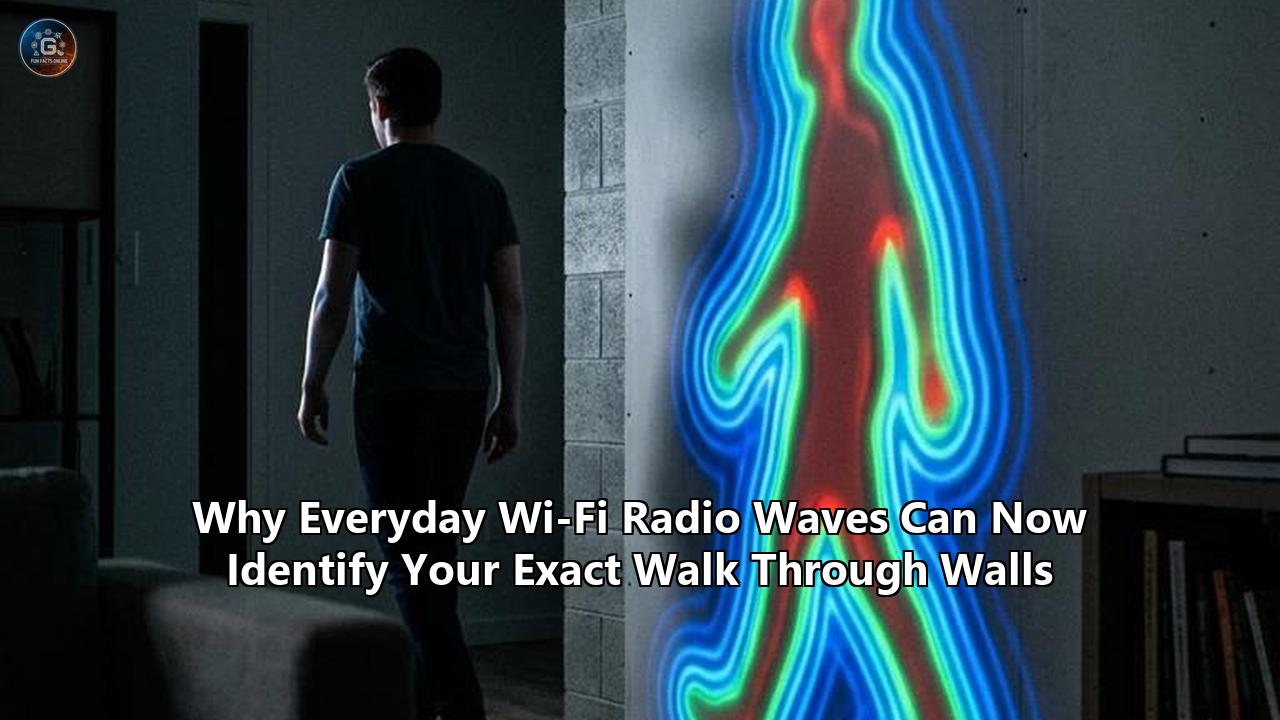
When an individual walks through a room, the invisible electromagnetic fields cast by everyday home routers deform, scatter, and reflect. Over the past several months, the formal publication of the IEEE 802.11bf amendment alongside laboratory advances from institutions including Carnegie Mellon University and Tsinghua University has converted that physical reality into a turnkey biometric scanner. By analyzing the microscopic phase and amplitude shifts of ambient radio frequencies, off-the-shelf consumer routers can now reconstruct human skeletal movement through solid drywall and identify individuals by the biomechanical signature of their walk—without cameras, microphones, or wearables.
The capability represents a leap from basic motion detection to high-resolution through-wall biometric identification. While commercial marketing pitches wi-fi sensing technology as an innocent tool for home automation, smart security, and elder care, the underlying mechanics expose an intricate convergence of electromagnetic physics, silicon firmware, and deep neural networks that operates silently inside standard domestic hardware.
+-----------------------------------------------------------------------------------------+
|                                    TRANSMITTER (Tx)                                     |
|                       Sends multi-carrier OFDM subcarrier packet                         |
+-----------------------------------------------------------------------------------------+
                                             |
                                             v
               ==================== SOLID DRYWALL / WALL ====================
                                             |
                                             v
                     +-----------------------------------------------+
                     |               MOVING HUMAN BODY               |
                     |   - Dielectric scattering (70% water)         |
                     |   - Micro-Doppler limb velocity shifts        |
                     |   - Torso mass displacement                   |
                     +-----------------------------------------------+
                                             |
                                             v
               ==================== SOLID DRYWALL / WALL ====================
                                             |
                                             v
+-----------------------------------------------------------------------------------------+
|                                     RECEIVER (Rx)                                       |
|                       Captures CSI Matrix: H(f, t) = |H| e^(j*phi)                      |
+-----------------------------------------------------------------------------------------+
                                             |
                                             v
+-----------------------------------------------------------------------------------------+
|                               DEEP LEARNING PIPELINE                                    |
|   1. Phase Sanitization (CFO / SFO Removal)                                             |
|   2. Micro-Doppler Spectrogram Extraction (CWT / STFT)                                  |
|   3. 2D/3D DensePose Mapping (UV coordinates across 24 body regions)                    |
|   4. Biometric Gait Feature Extraction (Stride, Cadence, Hip-Ankle Pendulum)            |
+-----------------------------------------------------------------------------------------+
                                             |
                                             v
                 [ HIGH-CONFIDENCE INDIVIDUAL IDENTITY & SKELETAL POSE ]
The Physics of Penetration: How Channel State Information Exposes the Room
To understand how an ordinary Wi-Fi router acts as an imaging radar, one must look at the physical layer of modern wireless communications. Standard Wi-Fi operates predominantly across the 2.4 GHz, 5 GHz, and 6 GHz spectrum bands. At these frequencies, electromagnetic waves possess wavelengths measuring roughly 12.5 cm, 6 cm, and 5 cm, respectively. When these waves encounter typical interior partitions—drywall, plywood, insulation, and glass—the dielectric constant and conductivity of the barriers cause modest attenuation, but allow a significant portion of the radio wave to pass straight through.
                    PROPAGATION ACROSS TYPICAL FREQUENCIES
+---------------+-----------------+------------------+-----------------------------+
| Band          | Wavelength      | Wall Attenuation | Spatial Resolution Detail   |
+---------------+-----------------+------------------+-----------------------------+
| 2.4 GHz       | ~12.5 cm        | Low (3-5 dB)     | Coarse Torso & Broad Motion |
| 5.0 GHz       | ~6.0 cm         | Moderate (6-9 dB)| Limb Velocity & Gait Rhythm |
| 6.0 GHz (6E/7)| ~5.0 cm         | Higher (8-12 dB) | Fine Articulation & Joints  |
+---------------+-----------------+------------------+-----------------------------+
Once inside an enclosed space, the radio signal splits into hundreds of distinct paths, bouncing off floors, ceilings, furniture, and human bodies before arriving at the receiver's antenna array. In wireless communications, this is known as multipath propagation. Historically treated as unwanted interference that degrades data rates, modern Orthogonal Frequency Division Multiplexing (OFDM) chips must constantly measure this multipath distortion to decode transmissions accurately.
                           MULTIPATH SCATTERING GEOMETRY

                        [ Tx Router ]
                         /    |    \
                        /     |     \  (Multipath Echoes)
                       /      |      \
     [ Static Furniture ]     |     [ Moving Person ]
              \               |      (Dynamic Doppler Shift)
               \              |              /
                \             |             /
                 v            v            v
                        [ Rx Receiver ]
The data structure responsible for recording this environment is Channel State Information (CSI). Unlike the coarse Received Signal Strength Indicator (RSSI), which merely registers overall signal power, CSI provides fine-grained, complex-valued measurements for every individual subcarrier channel within an OFDM signal. In a 160 MHz Wi-Fi 6 channel, the spectrum is carved into 1,960 discrete subcarriers.
Mathematically, the transmission channel is expressed for every subcarrier frequency $f$ and time point $t$ as:
$$H(f, t) = |H(f, t)| e^{j \angle H(f, t)}$$
Where:
- $|H(f, t)|$ represents the amplitude attenuation of the wave along that specific subcarrier.
- $\angle H(f, t)$ captures the precise phase shift (the rotation of the wave's crests and troughs) caused by path length delays.
A human body consists of approximately 70% water, giving it a relative permittivity ($\epsilon_r \approx 50$) that contrasts sharply with the ambient air ($\epsilon_r \approx 1$). When a person stands or moves inside a room, their body acts as a massive reflector and scatterer of radio frequency energy. As they step across the room, they cross multiple Fresnel zones—concentric ellipsoidal regions of electromagnetic interference between the transmitting and receiving antennas.
Every step changes the flight path length of the reflected waves by fractions of a centimeter, inducing instantaneous phase rotations and amplitude drops across specific subcarriers. CSI matrices continuously log these microscopic disruptions at sampling rates often exceeding 1,000 packets per second, creating a high-density digital readout of physical disturbance behind solid barriers.
The Biometric Fingerprint of a Walk
Capturing a dynamic disturbance is one challenge; translating that disturbance into a specific person's identity is another. The breakthrough relies on human gait dynamics.
In biomechanics, human walking is a complex kinetic chain governed by an individual's unique skeletal proportions, limb lengths, muscle mass distribution, pelvic tilt, and neuromuscular habits. When an individual walks, different parts of their anatomy move at distinct, varying velocities:
- The torso moves forward with relatively constant velocity and small vertical oscillations.
- The thighs swing forward with moderate angular speed.
- The lower legs (shins) and feet accelerate rapidly during the swing phase, reaching instantaneous velocities more than double the walking speed of the torso, before dropping to zero velocity during the stance phase (heel strike).
- The arms swing in anti-phase oscillation relative to the legs to cancel angular momentum.
               MICRO-DOPPLER VELOCITY PROFILES ACROSS ANATOMY

    Velocity (m/s)
         ^
     3.0 |                     /\                   (Foot Swing Peak)
         |                    /  \
     2.0 |       /\          /    \          /\     (Knee / Shin)
         |      /  \  /\    /      \  /\    /  \
     1.0 | ----+----+----+--+------+----+--+----+-> (Torso Baseline)
         |      \  /  \/    \      /  \/    \  /
     0.0 +-------v------------v--------------v-----> (Stance Phase Foot Strike)
         +-----------------------------------------> Time (Seconds)
As each of these anatomical components moves through a Wi-Fi field, it induces a distinct Doppler frequency shift on the reflected subcarriers according to the Doppler equation:
$$\Delta f = \frac{2 v}{\lambda} \cos(\theta)$$
Where:
- $v$ is the instantaneous velocity of the specific body segment.
- $\lambda$ is the radio wavelength.
- $\theta$ is the angle between the trajectory of the body segment and the line of sight of the antenna array.
Because the legs, arms, and torso travel at different instantaneous speeds, they generate a complex composite frequency spectrum known as a micro-Doppler signature.
+----------------------------------------------------------------------------------------+
|                          RAW CSI TO BIOMETRIC IDENTITY FLOW                            |
+----------------------------------------------------------------------------------------+
| Raw CSI Packet Stream  --> [ Amplitude / Phase Extraction across subcarriers ]        |
|                                                     |                                  |
| Hardware Phase Noise   --> [ Linear Transformation & Ratio Sanitization ]              |
|                                                     |                                  |
| Time-Domain Variations --> [ Continuous Wavelet Transform (CWT) Spectrograms ]         |
|                                                     |                                  |
| Dynamic Signatures     --> [ Micro-Doppler Gait Separation (Torso vs. Limbs) ]         |
|                                                     |                                  |
| Deep Feature Embeddings--> [ CNN-LSTM Feature Fusion / Biometric Vector ]             |
|                                                     |                                  |
| Final Output           --> [ 95%+ Target Identification Match Through Wall ]           |
+----------------------------------------------------------------------------------------+
An individual cannot easily disguise this signature. Even if someone deliberately alters their cadence or exaggerates their step length, the physical conservation of angular momentum between their torso mass, leg length, and hip-joint mechanics preserves fundamental harmonic ratios in the reflected radio waves.
Recent research architectures, such as Tsinghua University's GaitID and academic implementations using Intel 5300 and Atheros CSI platforms, apply Continuous Wavelet Transforms (CWT) and Short-Time Fourier Transforms (STFT) to map these subcarrier fluctuations into time-frequency spectrograms. When fed into spatial-temporal neural networks, these micro-Doppler spectrograms achieve biometric user identification accuracies consistently exceeding 92% to 98% in closed cohorts—even when the test subjects traverse different walking angles and paths behind walls.
The AI Transformation: DensePose Meets CSI Matrices
The leap from statistical gait matching to rendering visible human bodies moving through walls occurred when computer vision models collided with RF signal processing. The most prominent example is the integration of CSI streams with dense pose estimation algorithms, popularized by computer science teams at Carnegie Mellon University.
                     CMU DENSEPOSE FROM WI-FI PIPELINE

  [ 3x Transmit Antennas ]                     [ 3x Receive Antennas ]
             \                                      /
              \                                    /
               v                                  v
       +--------------------------------------------------+
       | Raw CSI Channels (Sanitized Phase & Amplitudes)  |
       +--------------------------------------------------+
                                |
                                v
       +--------------------------------------------------+
       | Multi-Scale Encoder-Decoder Network              |
       | Translates 1D/2D RF time series to 2D latent maps|
       +--------------------------------------------------+
                                |
                                v
       +--------------------------------------------------+
       | DensePose-RCNN Model Architecture                |
       | Predicts surface UV coordinates across 24 regions|
       +--------------------------------------------------+
                                |
                                v
       +--------------------------------------------------+
       | High-Fidelity 3D Body Surface Wireframe Render   |
       +--------------------------------------------------+
For years, DensePose—originally developed by researchers from Facebook AI Research (FAIR) and Imperial College London—was strictly an optical vision system. It took 2D RGB camera images and mapped every pixel to the 3D surface geometry of a human body model (SMPL model), assigning coordinates to 24 distinct surface body regions.
The CMU team bypassed the camera entirely. They engineered a dual-branch convolutional neural network designed to ingest raw, sanitized CSI phase and amplitude matrices collected from low-cost, off-the-shelf TP-Link routers.
The system operates through an explicit pipeline:
- Hardware Sanitization: Raw commercial Wi-Fi chips suffer from asynchronous timing artifacts: Carrier Frequency Offset (CFO) and Sampling Frequency Offset (SFO), caused by unsynchronized local oscillators between the transmitter and receiver. The software applies linear transformation algorithms across antenna pairs and computes CSI phase ratios to eliminate random phase drift.
- Latent Image Synthesis: The sanitized CSI time-series data is routed through a modified convolutional encoder-decoder network. This network reshapes the 1D and 2D frequency subcarrier domain variations into 2D spatial feature representations that simulate the spatial properties of an optical camera frame.
- Dense Pose Mapping: The generated spatial feature maps enter a customized DensePose-RCNN architecture. Using transfer learning trained on paired visual-and-RF datasets, the network estimates the body's bounding box, predicts limb segment classification, and outputs continuous UV surface coordinates for joints, torso, head, and limbs.
                THE 24 SURFACE REGIONS MAPPED BY RF SIGNALS

                              [ Head (1-2) ]
                                    ||
                 [ Chest (3) ]------+------[ Back (4) ]
                   /        |                |        \
        [ L-Upper Arm (5) ] |                |  [ R-Upper Arm (6) ]
                 |          |                |          |
        [ L-Lower Arm (7) ] |                |  [ R-Lower Arm (8) ]
                 |          |  [ Torso (9) ] |          |
          [ L-Hand (10) ]   |                |   [ R-Hand (11) ]
                            +--------+-------+
                                     |
                          [ Pelvis/Hips (12-13) ]
                           /                   \
                 [ L-Thigh (14-15) ]    [ R-Thigh (16-17) ]
                          |                      |
                  [ L-Calf (18-19) ]     [ R-Calf (20-21) ]
                          |                      |
                  [ L-Foot (22) ]        [ R-Foot (23-24) ]
Because radio waves penetrate visual barriers, this multi-antenna setup captures walking patterns, squatting, pacing, and hand gestures even when the subjects are separated from the transceivers by wooden boards, drywalls, or opaque glass partitions. The neural network reconstructs real-time 3D surface meshes of individuals moving inside an adjoining room with visual accuracy that rivals standard optical feeds.
Inside the Silicon and Standards: How IEEE 802.11bf Industrialized Sensing
Until recently, extracting CSI from consumer networking hardware required specialized kernel hacks, such as the open-source Linux 802.11n CSI Tool for Intel 5300 network cards, Atheros CSI Tool, or Nexmon firmware patches for Broadcom chips. These were research setups requiring modified drivers running on niche microcode.
That operational friction disappeared with the ratification and rollout of IEEE 802.11bf, the formal global wireless amendment titled Enhancements for Wireless LAN Sensing.
                        EVOLUTION OF WI-FI SENSING TOOLS

   2010 - 2017: Academic Hacks
   +-----------------------------------------------------------+
   | Intel 5300 / Atheros / Nexmon Broadcom Firmware Patches   |
   | - Required specialized Linux kernels                      |
   | - Hacky, unstable debug hooks                             |
   | - Non-standardized data outputs                           |
   +-----------------------------------------------------------+
                              |
                              v
   2020 - 2024: Proprietary Vendor Frameworks
   +-----------------------------------------------------------+
   | Qualcomm Wi-Fi Sensing / Cognitive Systems / Origin AI   |
   | - Proprietary CSI extraction APIs                         |
   | - Cloud-tethered motion processing                        |
   | - Limited interoperability                                |
   +-----------------------------------------------------------+
                              |
                              v
   2025 - Present: Native IEEE 802.11bf Standard
   +-----------------------------------------------------------+
   | Standardized MAC/PHY Sensing Layer across All Wi-Fi Chips |
   | - Native NDP sounding measurement frames                  |
   | - Interoperable multi-vendor CSI reporting                |
   | - Hardware-accelerated DSP pipelines in Wi-Fi 7 silicon  |
   +-----------------------------------------------------------+
The IEEE 802.11bf task group transformed commercial Wi-Fi hardware from a pure communication pipeline into a standardized, dual-purpose Joint Communication and Sensing (JCAS) radar system.
The technical specifications of 802.11bf detail how consumer routers run RF sensing natively:
+-----------------------------------------------------------------------------------------+
|                  IEEE 802.11bf MAC/PHY PROTOCOL SENSING MECHANISMS                      |
+-----------------------------------------------------------------------------------------+
| Parameter                   | Specification Detail                                      |
+-----------------------------------------------------------------------------------------+
| Supported Frequency Bands   | Sub-7 GHz (2.4, 5, 6 GHz) and 60 GHz (Millimeter-Wave)    |
| Dedicated Sounding Frames   | SENS NDP (Null Data Packet) and SENS NDPA Announcement     |
| Sensing Topologies          | Monostatic (Self-Tx/Rx), Bistatic, and Multistatic Mesh   |
| Reporting Modes             | Uncompressed CSI, Compressed Beamforming Feedback, Doppler|
| Bandwidth Support           | 20 MHz up to 320 MHz (Wi-Fi 7 channels)                   |
| Standardized APIs           | Unified CSI reporting from PHY directly to OS/Drivers     |
+-----------------------------------------------------------------------------------------+
1. Dedicated SENS Sounding Sequences
Under 802.11bf, routers do not have to wait for random web traffic to harvest CSI packets. The standard introduces dedicated Sensing Null Data Packet Announcements (SENS NDPA) and Sensing Null Data Packets (SENS NDP). These are lightweight physical-layer pilot sequences transmitted at microsecond intervals specifically to illuminate the physical environment and collect channel response feedback, completely uncoupled from data payloads.
2. Standardized Multistatic Topologies
The standard allows multiple access points, range extenders, and IoT stations to form a synchronized sensing mesh:
- Monostatic Sensing: A single station acts as both transmitter and receiver, measuring the radar backscatter of its own transmission.
- Bistatic Sensing: One AP transmits an NDP sounding frame, and a client device on the other side of the room calculates and returns the CSI response matrix.
- Multistatic Sensing: Multiple devices (e.g., a Wi-Fi 7 router, two mesh nodes, and a smart TV) coordinate simultaneous sounding frames, capturing multi-angle angular profiles (Angle of Arrival [AoA] and Angle of Departure [AoD]) that eliminate dead zones behind walls.
                          MULTISTATIC MESH SENSING TOPOLOGY

                               [ Mesh Node A (Tx) ]
                                    /        \
                                   /          \
                                  /            \
                       [ Room Barrier ]    [ Moving Target ]
                                /                \
                               /                  \
                              v                    v
                  [ Mesh Node B (Rx) ] <---> [ Router Master (Rx) ]
                                 \                  /
                                  \                /
                                   v              v
                           [ Synthesized 3D Mesh CSI Matrix ]
3. Native Silicon Accelerators
Silicon manufacturers—including Qualcomm, Broadcom, Intel, and MediaTek—have incorporated 802.11bf compliance into their Wi-Fi 6E and Wi-Fi 7 commercial chipsets. Instead of offloading computationally heavy CSI signal sanitization and matrix decomposition to an external CPU, modern radio chips handle real-time digital signal processing (DSP) and matrix operations directly on low-power, integrated baseband silicon.
As these standards penetrate commercial supply chains, every modern residential gateway, commercial access point, and IoT smart hub inherently ships with native hardware hooks designed to run wi-fi sensing technology out of the box.
The Asymmetric Threat: Surveillance Without Optics or Permissions
The technical attributes that make Wi-Fi sensing useful for non-invasive medical monitoring create significant physical privacy vulnerabilities. Optical surveillance faces distinct physical constraints: lenses require an unblocked line of sight, can be physically obstructed, need light to see, and are readily detected by inspection.
Radio-frequency tracking operates under entirely different rules.
                     SURVEILLANCE MODALITY COMPARISON
+-----------------------------+-----------------------+--------------------------+
| Operating Parameter         | Optical Camera (RGB)  | 802.11bf Wi-Fi Sensing   |
+-----------------------------+-----------------------+--------------------------+
| Through-Wall Operation      | No (Zero penetration) | Yes (Drywall, wood, glass|
| Ambient Light Dependency    | Yes (Fails in dark)   | No (Operates 24/7)       |
| Physical Visibility         | Lens visible          | Hardware fully concealed |
| Physical Lens Covers        | Completely blocked    | Completely unaffected    |
| Hardware Requirement        | Dedicated camera gear | Ubiquitous home router   |
| Passive Air-Gap Eavesdrop   | Impossible remotely   | Yes (Sniffing RF echoes) |
+-----------------------------+-----------------------+--------------------------+
The Rogue Sniffer and the "Wi-Peep" Attack Vector
Because Wi-Fi radio waves broadcast omnidirectionally and escape standard home perimeters, an individual does not need to compromise the router's software or crack its WPA3 encryption key to monitor the people inside.
In an attack demonstrated by researchers at the University of Waterloo dubbed "Wi-Peep," an adversary outside a structure uses a lightweight, low-cost drone or handheld rig equipped with an inexpensive directional Wi-Fi module. By exploiting the IEEE 802.11 standard's mandatory response behavior, the attacker transmits spoofed polite-response packets (such as RTS/CTS or standard probe requests) to devices inside the building.
                         THE "WI-PEEP" EXTRUSION VECTOR

    [ Outside Attacker ]                           [ Inside Building ]
   (Directional Antenna)                          (Protected Residence)
            |                                               |
            | --- Spoofed 802.11 Polling Packets ---------> | [ Smart TV / Phone ]
            |                                               |         |
            | <--- Mandatory Unencrypted PHY ACKs --------- | <-------+
            |      (Reflected through moving occupants)     |
            |                                               |
            v                                               v
   [ Compute Time-of-Flight ]                     [ Occupant Walking in ]
   [ & Multipath Alterations]                     [ Adjoining Bedroom   ]
            |
            v
   [ Precise 3D Layout & Occupant Position Extracted Through Exterior Walls ]
Even if the network is encrypted, standard Wi-Fi hardware is required by protocol to acknowledge packets at the physical layer within exact microsecond windows (Short Interframe Space, or SIFS). The attacker measures the time-of-flight (ToF) and multipath variations of these mandatory unencrypted physical-layer responses. As occupants move inside their private spaces, their bodies continuously modulate the backscattered signal received by the external antenna, exposing internal room layouts, real-time physical locations, and exact gait profiles through closed doors and exterior walls.
Passive De-Anonymization and Behavioral Extraction
Because a person's gait is an invariant biometric marker, long-term CSI aggregation allows automated systems to track individuals across different locations:
- Identity Mapping Without Consent: A system can match a walking profile collected in a commercial venue (e.g., a retail store or transit hub running 802.11bf) to the walking profile detected inside a private residence.
- Habit and Health Fingerprinting: The sensitivity of multi-subcarrier CSI is capable of detecting sub-centimeter movement, capturing changes in motor control, walking speed, asymmetry indicative of injury, and even micro-chest wall excursions corresponding to respiratory and cardiac rates without any physical contact.
- Occupancy and Intimacy Tracking: Real-time skeletal mapping reveals how many people are in a room, their exact physical postures (standing, laying down, sitting), and their physical proximity to one another through barriers that were previously considered complete visual shields.
Technical Countermeasures and Defensive Engineering
Countering through-wall RF tracking requires rethinking physical security and electromagnetic isolation. Standard software mitigations like rotating MAC addresses provide zero defense against physical-layer sensing, because CSI tracking measures the physical scattering of radio waves off human tissue, not software headers.
                    SPECTRUM OF SENSING COUNTERMEASURES

  Physical Isolation             Signal Obfuscation             Protocol Limits
+---------------------+        +---------------------+        +--------------------+
| - Copper/Aluminum   |        | - Artificial CSI    |        | - Disabling 802.11bf|
|   Faraday Shielding |        |   Noise Injection   |        |   SENS Frames      |
| - Carbon-Loaded     |        | - Active Beamforming|        | - Strict Hardware  |
|   Drywall Paint     |        |   Phase Jittering   |        |   CSI Access Gates |
| - Metal Window Mesh |        | - Dynamic Antenna   |        | - Local Air-Gap    |
|                     |        |   Polarization Rot. |        |   Firmware Locks   |
+---------------------+        +---------------------+        +--------------------+
1. Architectural Electromagnetic Attenuation
The only absolute physical mitigation against external RF gait sniffing is passive signal attenuation:
- Conductive Coatings: Carbon-loaded drywall and conductive paints infused with nickel or copper flakes create a reflective boundary layer that suppresses RF leakage below the signal-to-noise ratio (SNR) required for coherent phase extraction.
- Architectural Window Meshes: Standard low-emissivity (Low-E) architectural glass containing microscopic metal oxide layers provides moderate RF reflection, but standard window framing often leaves large RF leakage corridors.
2. Active Channel Obfuscation (Phy-Layer Jamming)
To defeat neural-network-based gait extraction without breaking data communications, engineers are experimenting with active RF obfuscation:
- CSI Phase Randomization: Firmware-level defenses introduce synthetic, non-linear phase noise onto the subcarriers of outgoing packets. While the intended receiver can decrypt and reverse this known pseudorandom noise using a shared cryptographic key, an unauthorized observer or passive listener sees randomized phase distributions that scramble gait and pose-estimation algorithms.
- Intelligent Reflecting Surfaces (IRS): Software-controlled metasurfaces mounted on walls dynamically alter their reflection phase profiles at high frequencies. By constantly shifting their surface impedance, they flood the room's multipath environment with synthetic Doppler noise, drowning out the subtle micro-Doppler signals created by human limb motion.
3. Firmware and Protocol Access Controls
At the operating system and firmware tier, strict controls must govern who can access CSI registries. Historically, CSI data registers on standard networking cards were accessible to local network applications with root privileges. Operating system architectures are beginning to classify raw CSI matrices as sensitive biometric inputs—similar to fingerprint readers or camera streams—requiring hardware-level permissions and cryptographically signed application access.
Regulatory Realities: The Widening Governance Gap
The acceleration of wi-fi sensing technology has outpaced global privacy regulations. Existing data protection frameworks rely heavily on traditional definitions of personal data and surveillance hardware:
                      REGULATORY JURISDICTION GAPS

+---------------------+---------------------------------------------------------+
| Legal Framework     | Current Enforcement Dilemma vs. Wi-Fi Sensing           |
+---------------------+---------------------------------------------------------+
| European Union      | Does not clearly classify ambient RF multipath data as  |
| GDPR                | "biometric" until after neural networks parse identity. |
+---------------------+---------------------------------------------------------+
| European Union      | Strictly regulates optical facial recognition in public |
| AI Act              | spaces, but contains exemptions for RF physical sensing.|
+---------------------+---------------------------------------------------------+
| United States       | Focuses primarily on spectral interference and power    |
| FCC Regulations     | limits, not physical surveillance capabilities of RF.   |
+---------------------+---------------------------------------------------------+
Under the European Union's General Data Protection Regulation (GDPR), biometric data is defined under Article 4(14) as personal data resulting from specific technical processing relating to physical, physiological, or behavioral characteristics. However, network equipment vendors argue that raw CSI packets are mere telemetry data necessary for optimizing link quality and beamforming performance. Because the raw data packet looks like random noise until it is parsed through a trained deep learning model, manufacturers can collect and transmit high-dimensional CSI telemetry without triggering initial regulatory red flags.
Similarly, in the United States, the Federal Communications Commission (FCC) regulates intentional radiators solely based on transmission frequency bands, spurious emissions, and maximum equivalent isotropically radiated power (EIRP). The FCC does not regulate whether an emitted and reflected communication wave can be ingested by an AI model to track the physical posture of a citizen inside their home.
The Converged Horizon: Wi-Fi 8, 6G, and Ambient Telemetry
As the wireless industry progresses beyond Wi-Fi 7 toward Wi-Fi 8 (IEEE 802.11bn Ultra High Reliability) and cellular networks shift into 6G standardizations, the convergence of sensing and communication will become permanent.
                           THE ROADMAP AHEAD

       Wi-Fi 6 / 6E               Wi-Fi 7 / 802.11bf               Wi-Fi 8 / 6G
   (Incidental Sensing)         (Standardized Sensing)          (Native Radar Mesh)
+------------------------+   +--------------------------+   +-------------------------+
| - Academic CSI hacks   |   | - Formal 802.11bf specs  |   | - Sub-centimeter spatial|
| - Uncalibrated tooling |-->| - Dedicated SENS frames  |-->|   point clouds          |
| - Basic presence &     |   | - Silicon DSP engines    |   | - Continuous ambient    |
|   crude gait matching  |   | - 3D DensePose wireframes|   |   biometric environment |
+------------------------+   +--------------------------+   +-------------------------+
Future wireless standards will not treat sensing as an optional side effect of multipath interference; they are explicitly designed around it:
- Millimeter-Wave Integration (60 GHz to 300 GHz): At extreme frequencies, Wi-Fi wavelengths drop below 5 millimeters, providing fine spatial resolutions capable of resolving individual finger movements, vocal cord vibrations, and eye blinks through thin partitions.
- Massive Distributed MIMO: Wi-Fi 8 access points will coordinate dozens of distributed spatial streams across homes and office floors, creating continuous spatial point-clouds of the indoor world.
- Ambient Ambient Assisted Living (AAL): In industrial and medical applications, this architecture will eliminate hospital wires, running continuous heart-rate, respiration, and fall-risk analytics purely from environmental Wi-Fi chatter.
The radio waves traversing walls and floors are no longer dumb data pipes. With the formalization of the IEEE 802.11bf standard, the integration of advanced DSP pipelines into consumer silicon, and the deployment of neural networks capable of mapping raw multipath reflections into 3D skeletal geometry, everyday Wi-Fi has crossed an engineering threshold. The subtle movements, cadences, and distinct dynamics of a human walk are now visible to the very routers providing access to the internet.
Reference:
- https://standards.ieee.org/ieee/802.11bf/11574/
- https://www.bgr.com/2173166/routers-can-track-movements-through-walls-according-report/
- https://syncedreview.com/2023/01/17/cmus-densepose-from-wifi-an-affordable-accessible-and-secure-approach-to-human-sensing/
- https://tns.thss.tsinghua.edu.cn/widar3.0/data/WASA20_GaitID_paper.pdf
- https://community.element14.com/technologies/sensor-technology/b/blog/posts/researchers-turn-wifi-router-into-a-device-that-sees-through-walls
- https://medium.com/@ajayverma23/wifi-can-see-you-now-carnegie-mellons-densepose-from-wifi-and-the-privacy-paradox-b0c61a850849
- https://www.nist.gov/publications/ieee-80211bf-enabling-widespread-adoption-wi-fi-sensing
- https://en.wikipedia.org/wiki/WiFi_Sensing
- https://github.com/itskalvik/WiFi-user-recognition
- https://drpress.org/ojs/index.php/HSET/article/download/26474/26017/36652
- https://www.ieee802.org/11/Reports/tgbf_update.htm