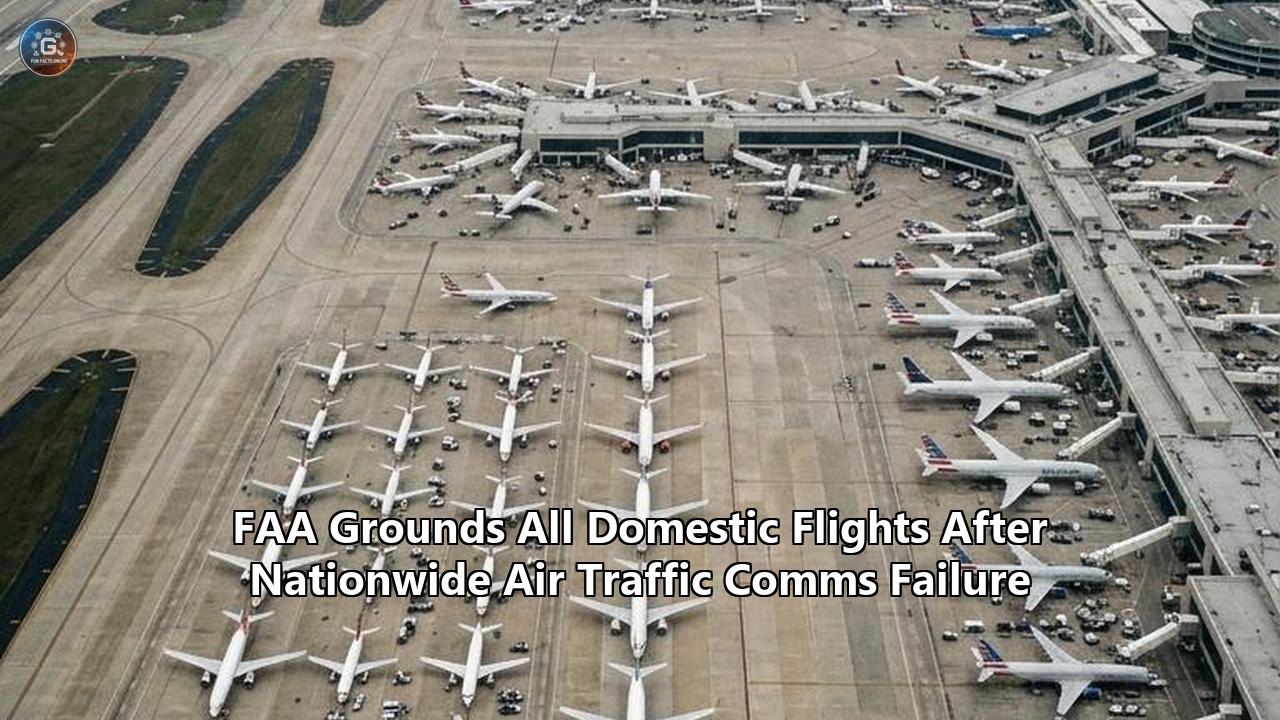
The Federal Aviation Administration ordered a full, nationwide ground stop for all departing commercial and general aviation flights on Friday afternoon after a catastrophic telecommunications failure severed critical data and voice links across all 22 of the country’s Air Route Traffic Control Centers. The emergency directive, broadcast from the FAA’s Air Traffic Control System Command Center in Warrenton, Virginia, halted takeoffs at every commercial airport across the United States. It marks only the third time in modern civil aviation history that the federal government has frozen the entire domestic departure system, following the terrorist attacks of September 11, 2001, and the January 2023 collapse of the Notice to Air Missions (NOTAM) database.
The order took effect during the height of the Friday afternoon travel peak. In a stark advisory distributed to airline dispatch offices and airport control towers, the Command Center cited "extraordinary circumstances and reasons for safety," directing that all departing traffic remain grounded until further notice. Air traffic controllers extended flight plan drop times to 240 minutes nationwide as technicians scrambled to diagnose a wholesale breakdown in the private communication infrastructure that links en-route traffic control centers with local towers, radar installations, and cockpit crews.
The disruption materialized at sudden speed. Aviation tracking services logged more than 4,000 aircraft airborne in domestic airspace at the moment the freeze was initiated. While flights already aloft were cleared to proceed and land at their scheduled destinations, ramp operations instantly backed up from Boston Logan to Los Angeles International. Within hours, more than 11,000 flights were delayed or outright canceled, stranding hundreds of thousands of travelers at terminals, holding tens of thousands on active taxiways, and stranding international flights across transatlantic and transpacific departure corridors.
Transportation Secretary Sean Duffy acknowledged the severity of the crisis in a public statement: "The FAA issued a nationwide ground stop for all U.S. airports following a communication issue impacting all Air Route Traffic Control Centers. FAA technicians are investigating the issue. We will provide immediate updates as we have them."
Homeland Security Secretary Markwayne Mullin addressed reporters on the White House North Lawn to tamp down immediate national security anxieties. "There is no indication as of yet that this was a nefarious attack against us," Mullin said. "It's just a telecommunications outage as of right now. Everybody’s safe. There is no reason to be concerned about your loved ones if they are flying. This isn't another 9/11."
Despite assurances from national security officials that the outage was not a cyberattack, the operational consequences were catastrophic. The unexpected FAA flight grounding revealed the alarming structural vulnerability of the federal government's aging National Airspace System (NAS), throwing airline balance sheets into turmoil, creating complex passenger rights disputes, and instigating immediate calls on Capitol Hill for a top-to-bottom inquiry into vendor performance and federal oversight.
Anatomy of the Collapse: Inside the FTI Network Crash
To understand how an entire nation's airspace went dark to departures requires examining the digital architecture of the Federal Aviation Administration's telecommunications backbone. The outage was traced directly to the FAA Telecommunications Infrastructure (FTI) network, a secure private communications fabric managed under federal contract by defense contractor L3Harris Technologies. FTI is the central circulatory system of the National Airspace System, providing voice, data, radar telemetry, and inter-facility links between all 22 Air Route Traffic Control Centers (ARTCCs), more than 160 Terminal Radar Approach Control (TRACON) facilities, and hundreds of airport traffic control towers.
The crisis originated during an operational maintenance update to the core routing layers of the private network. Preliminary information gathered by federal investigators and airline network operations centers indicates that an update sent to network switches triggered an uncommanded, cascading reboot cycle. Rather than cycling back online gracefully through designated redundant pathways, the core routing layer crashed.
The primary systems affected by the sudden transmission loss included:
- Voice Switching and Control Systems (VSCS): The mission-critical hardware and software that allow controllers at en-route centers to broadcast across ultra-high frequency (UHF) and very-high frequency (VHF) ground radio stations to communicate with flight decks.
- En Route Automation Modernization (ERAM) Inter-Center Links: The main data-processing platform that tracks high-altitude flights across the country. ERAM relies on constant digital handshakes between adjacent ARTCC sectors to pass flight plans, speed assignments, and altitude clearances.
- Radar Data Distribution: Digitized surveillance feeds from long-range radar installations that feed real-time aircraft positioning data to controller displays.
- System-Wide Information Management (SWIM): The secure enterprise data-sharing mechanism that pushes real-time aeronautical data, weather updates, and airspace restrictions from the FAA to commercial airline dispatch desks.
When the telecommunications infrastructure dropped, controller displays across facilities such as Chicago Center (ZAU), Cleveland Center (ZOB), Atlanta Center (ZTL), and Los Angeles Center (ZLA) lost synchronized inter-facility communication. In several locations, controllers experienced severe voice degradation, frequency overlap, or total dead-air conditions on high-altitude sectors.
Controllers operate under rigorous federal safety protocols governing minimum aircraft separation. In high-altitude domestic en-route airspace, commercial airliners cruising at speeds exceeding 500 knots must maintain a minimum horizontal separation of five nautical miles or a vertical separation of 1,000 feet under Reduced Vertical Separation Minimum (RVSM) rules. Maintaining that spacing requires absolute situational awareness and instantaneous voice communication. When frequencies began dropping out and radar telemetry started freezing or failing to transfer cleanly between sectors, controllers were forced to execute emergency contingency operations.
Controllers immediately halted new entries into their sectors. While airborne flights could be prioritized, stepped down to safe altitudes, and guided into terminal approach corridors using regional radar and local tower frequencies that remained intact, the system could not safely absorb a single new departing aircraft. The Command Center had no option but to throw the emergency switch, issuing a blanket ground stop to prevent the skies from becoming oversaturated with uncoordinated traffic.
Concentric Circles of Impact: Who Was Hit First
The imposition of an unscheduled nationwide ground stop produces immediate operational shockwaves that spread outward through every tier of transportation, commerce, and public safety. The effects split across distinct operational sectors, hitting some travelers and businesses with immediate paralysis and saddling others with severe residual complications.
Commercial Passengers and Airport Terminals
For passengers, the timing could hardly have been worse. Mid-Friday afternoon represents one of the weekly high points of domestic passenger volume, capturing both the end of the corporate travel week and the start of weekend leisure travel.
Airport terminals mutated into sprawling encampments within two hours of the order:
- Tarmac Gridlock: Thousands of aircraft that had already completed boarding, pushed back from gates, and queued along taxiways for departure were trapped in place. Under the Department of Transportation’s tarmac delay rules, airlines must provide food and water within two hours and must return to the gate within three hours for domestic flights (four hours for international flights) unless safety or air traffic control directives prohibit taxiing. At sprawling facilities like Dallas/Fort Worth, Charlotte Douglas, and Denver International, ramp congestion was so acute that taxiway gridlock prevented aircraft from accessing open gates, forcing passengers into prolonged hours-long waits inside sealed cabins.
- Terminal Overcrowding: Inside security checkpoints, departure halls overflowed. Gate agents were flooded with questions they could not answer as departure display boards displayed rows of "Delayed" notifications that soon transitioned into widespread cancellations.
- Stranded Connecting Passengers: Passengers who landed on the 4,000-plus airborne flights allowed to arrive discovered they had flown into operational black holes. With departing legs halted, connecting hubs became choke points. Luggage systems buckled under the weight of thousands of bags separated from owners, while airport hotels across major hub cities hit 100 percent capacity before nightfall.
Airline Operations and Network Operations Centers
Behind the secure doors of airline Network Operations Centers (NOCs)—including Delta’s facility in Atlanta, American’s Integrated Operations Center in Fort Worth, and United’s Operations Center in Chicago—flight dispatchers and network planners confronted logistical pandemonium.
A major airline network is an intricate web of rolling assets. A single narrowbody aircraft, such as an Airbus A321 or Boeing 737, often operates four to six distinct flight segments per day. When a plane assigned to fly from Boston to Chicago is held on the ground, that same aircraft is unable to operate subsequent flights from Chicago to Denver, Denver to Phoenix, and Phoenix to Seattle.
The cascading failure struck crew scheduling systems with equal ferocity. Under Federal Aviation Administration Part 117 flight and duty time limitations, pilots and flight attendants are strictly bound by maximum daily flight duty periods (FDP) and minimum rest requirements. As planes sat motionless on taxiways with engines idling, flight crews burned through their permissible duty hours without logging a single air mile. By 6:00 p.m. ET, thousands of cockpit and cabin crew members had "timed out," rendering aircraft legally grounded even if the communications backbone suddenly flickered back to full health.
International Flight Corridors and Foreign Gateways
The FAA’s directive applied strictly to domestic departures, but modern civil aviation is fundamentally interconnected. Inbound international flights were managed on a case-by-case basis, creating immense operational friction for foreign carriers and global air navigation service providers (ANSPs).
| Region / Airspace | Immediate Operational Impact | Secondary Complications |
|---|---|---|
| Transatlantic (Gander & Shanwick Oceanic) | Flights en route over the North Atlantic were assessed by speed and fuel reserves; several late departures from Western Europe were halted before oceanic entry. | Long-haul widebody aircraft arrived at U.S. East Coast gateways (JFK, EWR, IAD) only to face gate unavailability due to domestic planes pinned to terminals. |
| Canada (Nav Canada Airspace) | Cross-border flights from Toronto Pearson, Montreal Trudeau, and Vancouver were grounded at the departure gate. | Diverted airborne flights began filling apron space at secondary Canadian airfields. |
| Latin America & Caribbean | Northbound flights entering Miami and Houston ARTCC sectors were placed into extended holding patterns or diverted to regional alternates. | Massive disruption to evening redeye banks scheduled to reposition aircraft back to the U.S. interior. |
| Transpacific (Oakland Oceanic) | Inbound traffic from Japan, South Korea, and Australasia faced severe speed restrictions and routing adjustments. | Departure gates at Tokyo Haneda and Incheon held U.S.-bound aircraft on the ground to prevent fuel-critical holding on the American West Coast. |
Nav Canada, the private corporation managing civil air navigation across Canadian airspace, confirmed that while its internal tracking, radar, and communication systems were operating nominally, its controllers were forced to restrict all flights requesting entry into U.S. airspace. The inability of American en-route centers to accept automated handoffs severed normal air transit along the heavily trafficked Northeast and Midwest corridors.
Air Cargo, Freight Forwarders, and Supply Chains
The timing of the communications crash collided directly with the operational cadence of the global air cargo supply chain. Air freight networks operate on hyper-precise windows, particularly on Friday evenings when business documents, pharmaceuticals, perishable inventory, and high-value manufacturing components are pushed through domestic and international distribution pipelines.
Integrated logistics giants such as FedEx, UPS, and DHL depend on synchronized "sort" windows at primary air hubs, led by the FedEx SuperHub in Memphis and the UPS Worldport in Louisville. During these tightly orchestrated overnight operations, dozens of widebody freighter aircraft land within minutes of each other, transfer thousands of containers through automated sorting facilities, and launch back out to regional destinations before dawn.
With departures frozen across the country, outbound feeder freighters could not launch from coastal origins. The downstream effects immediately threatened:
- Time-Critical Pharmaceuticals and Medical Logistics: The domestic transport of radiopharmaceuticals, which have half-lives measured in hours and cannot survive prolonged transit delays, was halted. Life-saving organ transplants transported via scheduled commercial flights or on-demand charter operations were subjected to emergency coordination with regional air traffic facilities to secure special handling exceptions.
- Just-in-Time Industrial Manufacturing: Assembly lines in automotive, aerospace, and semiconductor manufacturing that rely on overnight delivery of critical tooling components faced impending idle shifts scheduled for the weekend.
- Perishable Shipments: High-value perishable goods, including fresh seafood and cut flowers, sat in unrefrigerated belly holds on grounded commercial airliners, spoiling cargo inventories and creating multi-million-dollar insurance liabilities.
General Aviation and Business Charters
The federal ground stop left no corner of the National Airspace System untouched. General aviation—comprising more than 200,000 aircraft operating under Federal Aviation Regulations Part 91 (private operations) and Part 135 (on-demand charter and air taxi)—was paralyzed instantly.
Business aircraft flying on instrument flight rules (IFR) flight plans were barred from taking off, idling thousands of corporate executives, sports franchises, and private charter travelers at fixed-base operators (FBOs) nationwide. With collegiate and professional sports schedules heavy on Friday travel, numerous university athletic teams were trapped at regional airports, throwing game weekend logistical planning into disarray.
Smaller regional airports lacking control towers, which rely entirely on regional TRACON or ARTCC facilities to open and close IFR flight plans via telephone or digital clearance delivery, found their communications with regional centers completely severed. Pilots attempting to file or activate flight plans met busy signals or automated disconnection messages as center phone switches were overwhelmed.
The Economic Toll: Counting the Cost of Systemic Inaction
The financial ramifications of a nationwide departure freeze compound rapidly, scaling not in a linear fashion, but exponentially with each elapsed hour. Aviation economists, assessing the scope of the disruption across domestic commercial carriers, calculate that a four-hour departure halt creates direct, cascading operational costs that run well into the hundreds of millions of dollars.
Direct Financial Impacts:
├── Fuel Burn (Extended idling & unexpected low-altitude vectoring)
├── Passenger Accommodations (Hotel vouchers, meals, ground transport)
├── Labor Costs (Crew overtime, deadheading, repositioning premiums)
└── Aircraft Maintenance (Engine cycle wear, irregular operations stress)

Indirect Economic Drag:
├── Lost Business Productivity (Missed meetings, severed professional engagements)
├── Supply Chain Disruptions (Spoiled perishables, delayed manufacturing inputs)
├── Hospitality & Tourism Losses (Unclaimed reservations, cancelled bookings)
└── Contractual Liabilities (Freight SLAs, missed charter commitments)
The primary cost driver for commercial carriers begins with fuel burn. With thousands of aircraft holding on active taxiways with Auxiliary Power Units (APUs) or primary engines operating, domestic carriers consumed hundreds of thousands of gallons of aviation kerosene without generating passenger seat miles. For airborne flights that were held in complex low-altitude vector patterns before landing, the fuel penalties were even steeper.
The secondary financial blow stems from passenger welfare mandates and logistical recovery costs. Under existing carrier customer service commitments and federal consumer protection oversight, airlines are saddled with substantial out-of-pocket costs during major irregular operations (IROPS), including:
- Providing tens of thousands of meal and hotel vouchers for passengers stranded overnight away from their home bases.
- Funding rebooking costs, including interline ticketing agreements when carriers are forced to transfer passengers to rival airlines or secondary ground transport.
- Absorbing massive labor overages, including overtime pay for gate agents, ramp workers, mechanics, and baggage handlers who must work through the night to process backlogged flights and misdirected luggage.
- Financing "deadhead" crew positioning—flying off-duty pilots and flight attendants on commercial flights or chartered ground transport to position them for flights operating 24 to 48 hours later.
When factoring in broader macroeconomic parameters—such as lost productive labor hours for millions of business travelers, hotel and conference cancellations, missed cargo delivery deadlines, and disrupted intermodal supply chains—the total economic cost easily exceeds $1 billion. This acute financial blow arrives at an unstable moment for the airline industry, which is grappling with volatile jet fuel prices, elevated wage settlements, and aircraft delivery delays from major manufacturers.
Regulatory and Legal Repercussions: Blame, Liability, and Passenger Rights
The operational fallout immediately transformed into a high-stakes legal, regulatory, and political dispute. The core legal question hinges on how the disruption is classified: Is a catastrophic telecommunications failure within the FAA's contracted infrastructure an "extraordinary circumstance" beyond airline control, or does the private management of the network open up specific venues for corporate and contractual liability?
The Department of Transportation and Passenger Entitlements
Under Department of Transportation regulations, passenger rights and compensation obligations depend heavily on whether a flight cancellation or delay is classified as "controllable" (within the airline's operational purview, such as maintenance issues or internal scheduling faults) or "uncontrollable" (such as severe weather, natural disasters, or air traffic control ground stops).
Historically, an FAA flight grounding shields airlines from mandatory cash compensation or punitive refund actions because the order is issued under sovereign federal safety authority. When the federal government tells an airline that its aircraft are legally prohibited from entering controlled airspace, the airline can point to force majeure clauses in its Contract of Carriage.
However, modern regulatory scrutiny has grown significantly sharper. In recent years, federal transportation authorities have expanded requirements demanding that airlines provide full cash refunds—rather than flight credits—whenever a flight is significantly delayed or canceled and the passenger chooses not to travel, regardless of fault. Furthermore, consumer protection advocates quickly mounted pressure on the Department of Transportation to scrutinize whether airlines acted swiftly enough to deplane passengers trapped on tarmac queues during the communications failure, warning that any violations of federal tarmac delay rules would draw substantial civil penalties.
Carrier Liability Assessment:
├── Controllable Delays (Maintenance, Crewing, Internal IT):
│   └── Mandatory hotel accommodations, meal stipends, cash compensation options.
└── Uncontrollable Delays (Air Traffic Directives, Force Majeure, Weather):
    └── Standard Contract of Carriage exemptions; mandatory refunds only if travel forfeited.
Contractor Scrutiny and Federal Service-Level Agreements
The focal point of executive and legal accountability rests on the relationship between the Federal Aviation Administration and its private-sector infrastructure vendors. The FAA Telecommunications Infrastructure has long operated under enterprise contracts with L3Harris Technologies.
Federal procurement contracts of this scale include strict Service-Level Agreements (SLAs) regarding system availability, network redundancy, and disaster recovery timelines. Under standard federal telecommunications standards, mission-critical aviation infrastructure is theoretically designed to adhere to "five nines" of availability—meaning the system must remain operational 99.999 percent of the time, translating to no more than a few minutes of unscheduled downtime across an entire calendar year.
The fact that an internal software update was capable of triggering a system-wide reboot that crashed the entire network and disabled all 22 regional ARTCCs points toward an astonishing architectural failure:
- Redundancy Mechanisms: Investigators will immediately probe why automated hot-standby systems did not take over the network load within milliseconds of the primary routers dropping out.
- Air-Gapped Maintenance Protocols: Regulators must examine why routine network updates were pushed during active operational hours across all en-route centers simultaneously, rather than being phased incrementally across individual facilities during minimal traffic windows.
- Contractual Indemnification: Airlines facing millions in losses are evaluating whether they have legal standing to pursue tortious interference or gross negligence claims against private vendors, although federal sovereign immunity and third-party contractor shields present formidable legal barriers.
Capitol Hill Demands Subpoenas and Hearings
Within hours of the ground stop, the political response ignited across Capitol Hill. Members of both the House Committee on Transportation and Infrastructure and the Senate Commerce, Science, and Transportation Committee announced intentions to launch bipartisan investigations.
Representative Ted Lieu was among the first lawmakers to vocally condemn the outage, branding the telecommunications breakdown completely unacceptable and calling for immediate, unsparing congressional hearings. "The agency needs to create systems that do not have a single point of failure," Lieu stated in an interview, urging the administration to execute a complete operational review. "I urge the FAA to make sure this never happens again."
Legislative leaders are signaling that upcoming hearings will focus on:
- Summoning executive leadership from L3Harris and the FAA to testify under oath regarding the specific engineering decisions that allowed a localized update to trigger a nationwide blackout.
- Auditing the deployment and validation procedures for third-party software updates touching the National Airspace System.
- Investigating whether the agency's parallel modernization initiatives—such as the recent rollout of the Strategic Management of Airspace, Routes and Trajectories (SMART) artificial intelligence tool—introduced unintended cross-platform software conflicts into legacy networks.
The Infrastructure Paradox: Bleeding-Edge Software on Deteriorating Foundations
The nationwide communications crash exposes the deep structural paradox at the heart of modern American civil aviation. While the aerospace sector routinely fields composite-fuselage airliners, autonomous trajectory systems, and satellite-based automatic dependent surveillance-broadcast (ADS-B) tracking, the underlying institutional infrastructure supporting these technologies remains profoundly brittle.
The Federal Aviation Administration finds itself trapped between two incompatible eras. On one hand, the agency faces explosive demands for airspace capacity, managing more than 44,000 flights per day while attempting to integrate commercial space launches, supersonic prototypes, and thousands of unmanned aerial systems (drones). On the other hand, much of the physical and digital core of the national airspace relies on hardware and communication protocols developed late in the twentieth century.
The agency only recently announced concrete timelines to phase out eight-inch and 3.5-inch floppy disks, which continue to be utilized to load critical weather data and aeronautical navigational databases at more than 400 aviation facilities across the nation, aiming to finally decommission the media by late 2028. Across hundreds of remote communication facilities and radar stations, miles of deteriorating, analog copper wiring are still being slowly transitioned to modern fiber-optic cable.
FAA Modernization Status (2026):
├── Deployed: Satellite ADS-B Out (Broad aircraft tracking integration)
├── Deployed: NextGen Data Comm (Text clearances replacing selected voice traffic)
├── In Transition: Copper-to-Fiber migration across remote radio installations
├── In Transition: Decommissioning legacy floppy disks at field offices (Target: 2028)
└── In Transition: Transitioning legacy TDM circuits to modern IP-based telecom backbones
This fragile technical reality is exacerbated by chronic workforce strains. The FAA has operated under a severe, well-documented deficit of certified professional air traffic controllers for over a decade. The agency remains thousands of controllers short of optimal operational staffing levels, requiring personnel at high-density facilities—including the New York TRACON and Miami Center—to work mandatory six-day workweeks and grueling overtime shifts to maintain system throughput.
When telecommunication backbones fail, the margin for human error shrinks to absolute zero. Under manual, degraded communication procedures, controllers can safely manage only a tiny fraction of normal traffic volume. In essence, when automation fails, there is no reservoir of surplus human controllers to step in and manage manual flight separations safely. The only defense against catastrophic collision risk is to shut down the sky.
The crisis has also ignited an intense political brawl over federal appropriations. Congress approved a $12.5 billion aviation modernization package intended to expedite technology overhauls, yet transportation officials have repeatedly warned that the figure is fundamentally inadequate to cover the staggering accumulated deferred maintenance of the National Airspace System. Transportation Secretary Sean Duffy and the White House formally petitioned lawmakers for an emergency $30.1 billion supplemental appropriation to accelerate the replacement of obsolete communications links, overhaul primary ARTCC mainframes, and build true multi-vendor network redundancy.
Friday's disaster provides the Department of Transportation with inescapable political leverage. Every legislative priority, commercial flight schedule, and freight supply chain is hostage to an infrastructure that can be completely brought down by a single routine network update.
Short-Term Operational Fallout: The 72-Hour Cascade
Even after technicians fully restore routing protocols and restore primary voice and radar feeds to the 22 en-route centers, the domestic air network does not simply reboot at the flick of a switch. The physical mechanics of civil aviation demand a complex, highly phased recovery process that will severely snarl travel for at least three to four consecutive days.
An unscheduled nationwide ground stop of this duration sets off an inescapable chain of operational crises:
Chronology of Systemic Failure:
T+0:00  Core FTI update crashes en-route telecommunications.
T+0:15  Controller frequencies drop; inter-center handoffs fail.
T+0:30  FAA Command Center issues blanket nationwide ground stop.
T+1:30  Ramps and taxiways freeze; airport gates reach saturation.
T+3:00  Flight crews exhaust Part 117 duty limits; cancellations mount.
T+4:00  FTI telecommunications links restored; staged departure releases begin.
T+24:00 Severe aircraft & crew displacement triggers secondary cancellations.
T+72:00 Normal operations reestablished as network hubs reset.
Staged Departure Metering
When the ground stop is lifted, thousands of airplanes cannot simultaneously spool up their engines and taxi to the runway. Doing so would instantly flood regional TRACON facilities and en-route sectors with catastrophic levels of traffic, overwhelming controllers and recreating the exact collision hazards the ground stop was intended to prevent.
Instead, the FAA’s Air Traffic Control System Command Center implements extensive Traffic Management Initiatives (TMIs):
- Ground Delay Programs (GDP): Airports experiencing acute congestion—such as Atlanta Hartsfield-Jackson, Chicago O’Hare, and Newark Liberty—are assigned controlled arrival rates. Aircraft across the country destined for those hubs are assigned precise, delayed departure slots (Calculated Departure Clearance Times, or EDCTs), stretching delays well into the night.
- Miles-in-Trail (MIT) Restrictions: Controllers space departing aircraft by mandatory physical intervals—such as requiring 20 to 30 miles between aircraft flying along the same jet route—drastically reducing the departure capacity of major runways.
- Airspace Flow Programs (AFPs): If specific en-route centers experience persistent technical instabilities or localized frequency issues following the crash, entire swaths of airspace are cordoned off, forcing airlines to reroute flights around the affected sectors, burning additional fuel and extending flight durations.
The Logistics of Aircraft and Crew Repositioning
The most enduring damage inflicted by the FAA flight grounding is the total dislocation of personnel and equipment. Hundreds of aircraft are parked at the wrong airports, while tens of thousands of pilots and flight attendants are stranded hundreds of miles away from their assigned aircraft.
Airlines must execute a complex, non-revenue puzzle to restore operational integrity:
- Operating "Ferry Flights": Carriers must scramble empty aircraft without passengers to reposition planes to major hubs to handle morning departure schedules.
- Deadheading Relief Crews: Flight crews who have rested must be prioritized aboard existing flights to reach stranded aircraft whose primary crews have legally timed out.
- Canceling Flights in Unbroken Sequences: Airline dispatch software will systematically cancel select lower-volume regional routes over the ensuing 48 hours to preserve resources for high-yield transcontinental and international trunk routes, sacrificing regional connectivity to preserve the core network.
For passengers, this means that even if clear skies and fully functional communications exist on Saturday and Sunday, departure boards will remain populated by cancellations and rolling multi-hour delays as the system works through its massive operational backlog.
Long-Term Structural Imperatives: Re-Architecting the Sky
The catastrophic failure of November 13, 2026, represents a clear dividing line for the management of the National Airspace System. A modern economy running on just-in-time inventories, mobile human capital, and international integration cannot safely anchor its skies to an infrastructure containing critical single points of failure.
To prevent a recurrence of this operational collapse, comprehensive systemic reforms must be instituted across federal policy, engineering architectures, and vendor contracts.
1. Eliminating Single Points of Failure through True Multi-Vendor Fabric
The foundational architectural flaw exposed by the outage is the over-reliance on a single contractor's private network backbone. The FAA can no longer allow the entire National Airspace System's communications infrastructure to run through an isolated, single-vendor implementation without a parallel, actively running alternative.
- Dual-Active Telecommunications Architecture: Rather than relying on primary and secondary pathways provided by the same telecommunications vendor, the FAA must mandate a dual-active system where separate, independent network providers (such as L3Harris operating parallel to an alternative provider like AT&T, Verizon, or Lumen) carry active payloads simultaneously. If one network executes a flawed update or suffers a physical fiber cut, traffic must dynamically reroute through the alternate infrastructure with zero packet loss or dropped voice frequencies.
- Decoupling ARTCC Centers: The 22 Air Route Traffic Control Centers must be architecturally isolated so that a failure or maintenance reboot at one facility cannot propagate through the core network to take down adjacent centers. Regional survivability must be engineered into the software stack, ensuring every center can operate autonomously in an offline mode.
2. Modernizing Change-Management and Software Deployment Protocols
The reported mechanism of the crash—an update causing a reboot cycle that collapsed the network—represents a classic breakdown in enterprise configuration and release management. The FAA and its vendors must be held to standards equal to or exceeding commercial hyperscale cloud operations.
- Immutable Staging and Canary Deployments: No maintenance patch, network routing update, or firmware flash should ever be pushed across the entire National Airspace System in a single execution. Updates must utilize strict "canary" deployment protocols—rolling out to a single non-critical testing node, running in parallel for weeks, before slowly rolling out to individual facilities during designated maintenance windows.
- Automated Failsafe Rollbacks: Hardware routing layers must feature hardened, firmware-level automated rollback capabilities. If a switch reboot detects abnormal latency, packet dropping, or routing table corruption, the system must immediately and autonomously revert to the previous known-good configuration without manual technician intervention.
3. Redefining the NextGen Mandate: Transitioning Beyond Legacy Voice
The crisis proved that the modern sky is still fundamentally shackled to analog voice communications. While the FAA has introduced Controller-Pilot Data Link Communications (CPDLC) under its NextGen Data Comm program, voice remains the required primary mechanism for separation instructions and immediate tactical maneuvers.
Future Communications Architecture:
├── Primary Layer: High-bandwidth IP satellite data link (Direct Cockpit-to-Center)
├── Secondary Layer: Multi-vendor terrestrial fiber-optic network (Dual-Active)
├── Emergency Tactical Layer: Decentralized direct VHF/UHF digital mesh
└── Autonomous Failover: Dynamic, automated aircraft separation protocols
The agency must expedite the transition toward a decentralized, high-bandwidth digital data-link network that operates directly between flight management computers and en-route automation systems, using satellite constellations as a redundant pathway that entirely bypasses terrestrial telecommunications chokepoints. When air traffic controllers and pilots can communicate tactical route alterations seamlessly through encrypted, multi-channel satellite and terrestrial data streams, the vulnerability of the entire system to localized terrestrial telecom crashes will diminish dramatically.
What to Watch Next
As the Federal Aviation Administration works through the immediate crisis, the focus of the aviation world shifts to the structural and political reckoning that must follow. In the coming days and weeks, several key developments will determine whether this systemic failure triggers meaningful reform or becomes merely another overlooked warning in the history of air traffic infrastructure:
- The Preliminary NTSB and FAA Technical Reports: Aviation safety analysts await the formal release of the joint technical investigative report, which will detail the precise line of code, hardware gateway, or routing table update that initiated the crash. Scrutiny will center on whether contractor personnel violated established deployment procedures or whether systemic flaws exist in FTI hardware redundancy.
- L3Harris Contractual Audits: Industry observers and Wall Street analysts will closely monitor the Department of Transportation’s audit of L3Harris Technologies' enterprise performance. The emergence of punitive financial penalties, contract clawbacks, or mandates to re-bid elements of the federal telecommunications infrastructure would fundamentally alter defense and aerospace IT contracting.
- Congressional Action on the $30.1 Billion Supplemental: The White House and Transportation Secretary Sean Duffy's pending $30.1 billion modernization request faces an urgent, transformative debate on Capitol Hill. Lawmakers who previously resisted expanded funding will face intense public and commercial pressure to provide the capital required to permanently excise legacy equipment, decommission historical media formats, and rebuild America’s air transit networks from the ground up.
- Airline Industry Litigation: Watch for whether major commercial carriers—absorbing tens of millions of dollars in unrecoverable losses—take unprecedented legal steps to challenge standard liability waivers, testing whether contractor gross negligence can penetrate traditional legal shields.
The nationwide departure freeze demonstrated with total clarity that the greatest vulnerability to American civil aviation is not always found in the skies, but buried beneath them: within the silent, unseen telecommunications switches that hold the nation’s economic mobility in their hands. Until those systems achieve true architectural resilience, the threat of another instantaneous, nationwide shutdown remains an inescapable reality.
Reference:
- https://www.inc.com/lucia-auerbach/faa-nationwide-ground-stop-communications-failure/91436879
- https://www.aljazeera.com/news/2026/11/13/us-grounds-all-flights-after-communication-issue
- https://en.philenews.com/international/us-grounds-all-flights-due-to-air-traffic-control-communication-failure/
- https://southpasadenan.com/faa-grounds-every-flight-in-the-nation-after-air-traffic-control-communications-failure-lax-burbank-all-southern-california-airports-halted/
- https://www.reddit.com/r/sysadmin/comments/1xvmtvj/faa_national_ground_stop_advisory_111_the/
- https://www.cbsnews.com/news/faa-issues-nationwide-ground-stop/
- https://www.aljazeera.com/news/2026/11/13/us-grounds-all-flights-after-communication-issue
- https://www.theguardian.com/world/2026/nov/13/faa-nationwide-ground-stop-flights
- https://www.pbs.org/newshour/nation/faa-grounds-all-flights-at-u-s-airports-due-to-air-traffic-control-communications-problems
- https://www.arabnews.com/world/us-grounds-flights-nationwide-after-air-traffic-control-communications-outage-3011738
- https://www.latimes.com/california/story/2026-11-13/faa-issues-nationwide-ground-stop
- https://www.mprnews.org/story/2026/11/13/national-ground-stop-issued-by-faa-for-us-airports
- https://www.ctvnews.ca/world/article/faa-issues-ground-stop-for-all-flights-across-the-us-due-to-safety-issue-live-updates-here/
- https://awfulannouncing.com/college-football/sports-media-world-reacts-to-nationwide-ground-stop-disrupting-college-football-schedule.html
- https://harrisondaily.com/2026/11/13/flights-grounded-across-the-u-s-hro-included/
- https://fedscoop.com/faa-nationwide-ground-stop-tech-telecommunications-issue/
- https://www.livenowfox.com/news/faa-issues-nationwide-ground-stop-due-to-extraordinary-circumstances