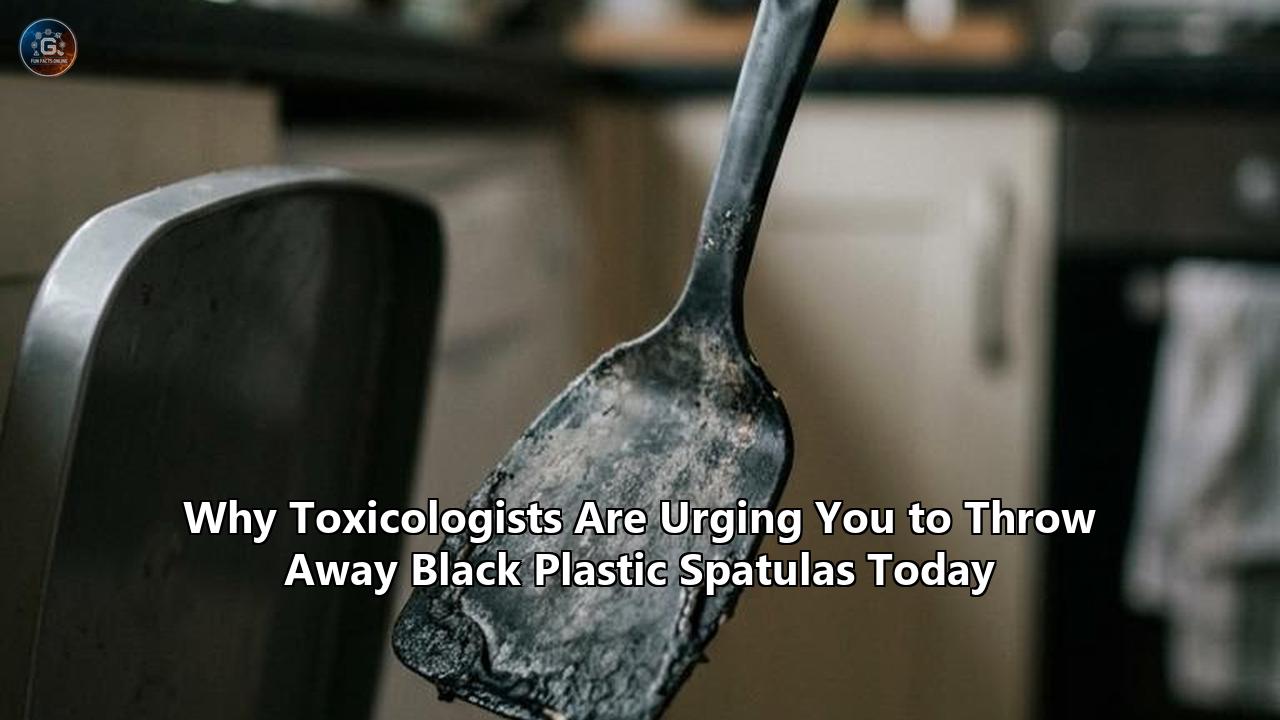
The directive from environmental toxicologists is unvarnished: walk into your kitchen, open the utensil drawer, find every black plastic spatula, and put it in the garbage.
This is not a vague wellness recommendation or a speculative precaution. It is the culmination of a decade-long scientific investigation that accelerated dramatically following landmark laboratory findings published in Chemosphere, subsequent testing across North American and European universities, and heated international debates over chemical safety standards in the food supply. Laboratory analyses have confirmed that black plastic cooking tools are systematically contaminated with banned brominated flame retardants, chlorinated organophosphates, and toxic heavy metals—chemicals originally engineered to prevent computer monitors, circuit boards, and television sets from bursting into flames.
When these utensils hit a hot frying pan coated with cooking oil, those chemical additives do not stay trapped in the polymer. They migrate directly into the food.
The controversy deepened when independent scientists identified an arithmetic error in the initial exposure modeling of the primary 2024 study. Yet rather than walking back their warnings, prominent toxicologists and environmental epidemiologists have escalated them. The issue does not hinge on a single statistical model; it rests on an inescapable physical reality: millions of consumer kitchens have become the unintended dumping ground for toxic electronic waste.
Tracing how electronic waste ended up on dinner plates requires looking at a cascading series of industrial shortcuts, analytical breakthroughs, and regulatory failures that unfolded over the past twenty years.
2002–2012: The Invisible Pipeline and the Near-Infrared Blindspot
The story begins not in kitchenware factories, but in the rapid rise and disposal of consumer electronics during the early 2000s.
As cathode-ray tube televisions, desktop computer towers, printers, and stereos were discarded by the tens of millions, environmental regulators in Europe and the United States moved to divert this tsunami of electronic waste (e-waste) from municipal landfills. The European Union introduced the Waste Electrical and Electronic Equipment (WEEE) Directive and the Restriction of Hazardous Substances (RoHS) Directive to enforce the recovery and recycling of commercial electronics.
Consumer electronic casings required rigid, fire-resistant polymers. Manufacturers relied heavily on high-impact polystyrene (HIPS), acrylonitrile butadiene styrene (ABS), and polycarbonate blends. To meet strict commercial fire safety standards, manufacturers dosed these plastics with heavy concentrations of brominated flame retardants (BFRs)—predominantly polybrominated diphenyl ethers (PBDEs), such as decabromodiphenyl ether (deca-BDE or BDE-209), alongside tetrabromobisphenol A (TBBPA) and antimony trioxide, an inorganic metal compound that acts as a flame-retardant synergist. In many electronic casings, flame retardants accounted for up to 15% to 20% of the plastic’s total weight.
These additives were not chemically bonded to the plastic’s molecular backbone. They were blended into the polymer melt as physical additives, held only by weak intermolecular forces.
[Consumer Electronics (TVs, Monitors, Printers)]
   │
   ├─► Loaded with Brominated Flame Retardants (deca-BDE, TBBPA) + Antimony (up to 20% by weight)
   │
[End of Product Life: Shredded for Recycling]
   │
   ▼
[Material Recovery Facilities (MRFs)]
   │
   ├─► Near-Infrared (NIR) Sorting: Carbon black absorbs infrared light; machine is blinded
   ├─► Result: Mixed domestic recycling drops black plastic into waste streams
   │
   ▼
[The Demand Paradox]
   │
   ├─► High commercial demand for cheap black plastic pellets
   └─► Shredded e-waste casings exported to informal/unregulated recyclers
   │
   ▼
[Contaminated Recyclate Blended into Consumer Goods]
   │
   ├─► Slotted spatulas, soup ladles, takeout trays, children's toys
As the recycling industry sought to turn discarded electronic casings into recycled plastic pellets, a fatal technical obstacle emerged: carbon black pigment.
Most electronic housings are black. Carbon black—a fine powder produced by the incomplete combustion of heavy petroleum products—is the primary pigment used to achieve this uniform dark shade. However, automated recycling sorting facilities rely on near-infrared (NIR) optical sensors. When infrared radiation strikes standard plastics (clear polyethylene terephthalate or translucent high-density polyethylene), the light reflects back in characteristic spectral wavelengths that allow optical scanners to identify the polymer type within milliseconds and route it using air jets.
Carbon black absorbs near-infrared light completely. The sensors detect no reflection, rendering the conveyor belts effectively blind. As a consequence, domestic curbside black plastics were routinely misidentified as residue and sent straight to incinerators or landfills.
This sorting failure created a structural supply crisis. Kitchenware manufacturers, fast-food packaging providers, and toy manufacturers wanted low-cost, durable black plastic. With municipal recycling streams incapable of supplying sorted black resin, an international market opened for shredded e-waste plastic.
Tons of flame-retarded electronic casings were pulverized, melted, and pelletized. Unscrupulous or unmonitored scrap brokers blended this cheap recyclate into raw manufacturing streams. The toxic additives engineered to suppress electrical fires inside cathode-ray televisions were quietly cast into slotted spatulas, soup spoons, sushi takeout trays, and cocktail stirrers.
2013–2018: Laboratory Signals and Early Forensic Detection
The first empirical warnings that e-waste had breached the human food chain came from European laboratories examining consumer plastic chemistry.
In 2013, Czech analytical chemists Jiri Samsonek and Franky Puype published an initial paper in Food Additives & Contaminants identifying the occurrence of brominated flame retardants in black thermo cups and kitchen utensils purchased on the European market. Samsonek and Puype documented that food-contact items, which should have contained virgin polymers free of industrial fireproofing chemicals, were displaying significant levels of bromine and antimony.
The issue remained confined to narrow academic circles until Dr. Andrew Turner, an environmental scientist at the University of Plymouth, began systematically tracking the movement of heavy metals and halogenated compounds across consumer products.
The 2018 Plymouth Breakthrough
Turner published a landmark study in Environment International titled "Black plastics: Linear and circular economies, hazardous additives and marine pollution". Using portable X-ray fluorescence (XRF) spectrometry, Turner screened over 600 black plastic consumer items across the United Kingdom, spanning children’s toys, office products, coat hangers, drink stirrers, thermos lids, and kitchen utensils.
Turner discovered that bromine was present in roughly 40% of the food-contact items tested, reaching concentrations as high as 6,010 parts per million (ppm). Alongside bromine, he repeatedly detected antimony (up to 3,200 ppm), lead, and cadmium—an elemental fingerprint unique to circuit boards, computer housings, and flame-retarded electrical systems.
"There is mounting evidence that the demand for black plastics in consumer products is partly met by sourcing material from the plastic housings of end-of-life waste electronic and electrical equipment," Turner wrote. "This has the potential to introduce restricted and hazardous substances into the recyclate, including brominated flame retardants, antimony as a synergist, and heavy metals".
The Birmingham Hot Oil Trials
That same year, researchers Jiangmeng Kuang, Mohamed Abou-Elwafa Abdallah, and Stuart Harrad at the University of Birmingham published critical evidence in Science of the Total Environment.
The Birmingham team collected 96 plastic kitchen utensils and screened them for bromine content. Utensils with high bromine levels were analyzed using gas chromatography-mass spectrometry (GC-MS) to identify specific flame-retardant congeners. BDE-209 dominated the profiles, but novel brominated flame retardants like 1,2-bis(2,4,6-tribromophenoxy)ethane (BTBPE) were also present, with one utensil registering a concentration of 1,000 micrograms per gram.
Critically, the Birmingham scientists simulated realistic cooking conditions. They placed the contaminated spatulas into cooking oil heated to 160°C (320°F) for typical cooking intervals.
The results were jarring: on average, 20% of the brominated flame retardants leached out of the utensils directly into the hot cooking oil.
Cooking oil, composed of hydrophobic lipids, acted as a powerful organic solvent. Flame retardants are lipophilic molecules—they dissolve readily in fats and resist water. The physics of cooking turned the standard black kitchen spatula into a direct delivery mechanism for lipophilic toxins.
Despite these clear laboratory warnings, regulatory bodies took little public action, and consumer awareness remained virtually nonexistent.
2019–2023: The Illusion of Regulation and the Substitution Trap
During the late 2010s, international chemical regulators moved to restrict legacy flame retardants.
Decabromodiphenyl ether (deca-BDE) had accumulated in arctic wildlife, human serum, and umbilical cord blood worldwide. The Stockholm Convention on Persistent Organic Pollutants listed deca-BDE under Annex A for global elimination. In 2021, the U.S. Environmental Protection Agency (EPA), acting under Section 6 of the Toxic Substances Control Act (TSCA), officially prohibited the processing and commercial distribution of deca-BDE and products containing it.
Yet the ban exposed the structural flaw in global chemical regulation: the cycle of regrettable substitution.
┌────────────────────────────────────────────────────────┐
│           THE REGRETTABLE SUBSTITUTION CYCLE           │
└────────────────────────────────────────────────────────┘
                           │
                           ▼
     Phase 1: High-Volume Industrial Use
     Legacy Chemical: Deca-BDE (BDE-209)
     Properties: Flame-retardant, bioaccumulative, persistent
                           │
                           ▼
     Phase 2: Scientific Consensus & International Ban
     Stockholm Convention & EPA TSCA prohibit deca-BDE
                           │
                           ▼
     Phase 3: The Unregulated Substitution
     Electronics industry swaps deca-BDE for:
       • TBBPA & Novel Brominated Flame Retardants (DBDPE, BTBPE)
       • Organophosphate Flame Retardants (TPHP, IPTPP)
       • Bromophenols (2,4,6-tribromophenol)
                           │
                           ▼
     Phase 4: The Closed-Loop Recycling Contamination
     Recycled e-waste now contains a cocktail of BOTH:
       • Legacy banned chemicals (decades of persistent waste)
       • Unregulated toxic replacement chemicals
                           │
                           ▼
     Phase 5: Entry Into Kitchenware
     Black spatulas molded from mixed resin pellets containing
     unscreened chemical mixtures
Instead of redesigning electronics to eliminate hazardous additives, chemical manufacturers replaced deca-BDE with alternative compounds that possessed similar chemical behavior:
- Decabromodiphenyl ethane (DBDPE): A structurally analogous brominated compound designed to bypass deca-BDE regulations.
- Organophosphate flame retardants (OPFRs): Compounds including triphenyl phosphate (TPHP), tris(2-chloroethyl) phosphate (TCEP), and isopropylated triphenyl phosphate (IPTPP).
- Bromophenols: Particularly 2,4,6-tribromophenol (2,4,6-TBP), an endocrine-disrupting intermediate.
Because electronics have lifespans ranging from five to twenty years, legacy products manufactured before the bans continued to flow into recycling yards alongside newer products treated with replacement chemicals. The recycled plastic feedstock did not become cleaner; it became a complex, unregulated chemical cocktail.
Throughout this period, regulatory enforcement focused almost entirely on the front end of production. Food contact authorities—including the U.S. Food and Drug Administration (FDA) and the European Food Safety Authority (EFSA)—assumed that food-contact plastics were manufactured from virgin, food-grade resins, or from carefully audited food-contact recycling streams (such as clear PET water bottles).
Neither agency conducted systematic, broad-scale testing of everyday kitchen tools imported from overseas to evaluate whether industrial electronic plastics were slipping through the supply chain. The oversight gap left the public exposed.
The Turning Point: Why Black Plastic Spatulas Safety Became an Urgent Kitchen Emergency
The issue erupted into public view following an exhaustive investigation published in Chemosphere by Megan Liu, science and policy manager at Toxic-Free Future, alongside analytical chemist Dr. Sicco Brandsma from Vrije Universiteit Amsterdam, with contributions from Dr. Heather Stapleton, an environmental chemist and professor at Duke University.
The research team set out to evaluate the real-world scale of black plastic contamination across the United States retail market.
They collected 203 black plastic consumer products from retail shelves, focusing heavily on items likely to come into contact with food or human skin:
- 109 food contact articles (including slotted spatulas, soup spoons, tongs, and takeout containers).
- Children’s toys and dress-up items (such as pirate swords and beaded necklaces).
- Hair accessories and office items.
The testing methodology was rigorous. The scientists screened all 203 items for elemental bromine using handheld XRF analyzers. The twenty items with the highest bromine levels were dissolved in toluene and dichloromethane, subjected to Fourier transform infrared spectrometry (FTIR) to identify polymer types, and evaluated using high-resolution quadrupole time-of-flight mass spectrometry (qTOF-MS).
The October 2024 Findings
The laboratory data confirmed the worst fears of environmental toxicologists:
- Widespread Contamination: Of the bromine-positive samples analyzed for specific compounds, 85% contained measurable levels of brominated flame retardants, organophosphate flame retardants, or both.
- Extreme Concentrations: Total concentrations of flame retardants in positive samples reached up to 22,800 milligrams per kilogram (mg/kg)—meaning hazardous chemicals accounted for up to 2.28% of the product’s total mass.
- Food-Contact Hotspots: The highest concentrations were not found in obscure mechanical parts; they appeared in a sushi takeout tray, a slotted cooking spatula, and a child’s plastic beaded necklace. The contaminated sushi tray tested positive for flame retardants at 1.2% of its total weight.
- Banned Legacy Chemicals: Despite being banned by the EPA in 2021, deca-BDE (BDE-209) was detected in kitchenware at levels ranging from 5 to 1,200 times higher than the European Union’s statutory limit of 10 ppm.
- Synergistic Cocktails: Individual items contained as many as nine distinct toxic flame retardants, alongside endocrine-disrupting bromophenols like 2,4,6-tribromophenol, a compound that independent researchers had recently identified in human breast milk.
Furthermore, FTIR analysis confirmed that products with the highest contamination levels were made of styrene-based polymers—the precise plastics used in televisions and computer monitor casings—rather than nylon or pure polypropylene, which are standard for high-heat cookware. The supply chain link was undeniable: electronic waste was being molded into kitchen spatulas.
The paper’s publication triggered immediate, sweeping coverage from major news organizations. "Throw Out Your Black Plastic Spatula," warned The Atlantic. Headlined warnings spread rapidly across social media, consumer advocacy newsletters, and morning broadcasts.
Then, a sharp mathematical dispute threatened to upend the entire narrative.
Late 2024: The Math Error, the Counter-Offensive, and the Toxicological Consensus
In December 2024, Dr. Joe Schwarcz, director of the Office for Science and Society at McGill University, identified a significant calculation error in the Chemosphere paper’s exposure modeling.
In their initial paper, Liu and her co-authors modeled hypothetical human exposure to BDE-209 from cooking with contaminated kitchen utensils. Based on transfer rates, they calculated a median daily adult intake of 34,700 nanograms per day.
To assess risk, the authors compared this intake to the EPA’s established chronic oral Reference Dose (RfD) for BDE-209, which is 7,000 nanograms per kilogram of body weight per day. For a standard 60-kilogram (132-pound) adult, the safe daily threshold is:
$$60\text{ kg} \times 7{,}000\text{ ng/kg/day} = 420{,}000\text{ ng/day}$$
In the original manuscript, the authors missed a zero during multiplication, writing that the EPA threshold for a 60-kilogram adult was 42,000 nanograms per day.
Because 34,700 nanograms appeared dangerously close to the miscalculated 42,000 nanogram threshold, the authors originally reported that using a contaminated spatula approached the maximum safe daily limit for an adult. In reality, 34,700 nanograms represents 8.3% of the EPA reference dose—an order of magnitude lower.
Industry advocates and plastics trade representatives moved quickly to capitalize on the mistake. Commentators dismissed the findings as "spatulageddon" and chemophobic hysteria, urging consumers to retrieve their spatulas from the garbage.
┌────────────────────────────────────────────────────────────────────────┐
│                   THE REFERENCE DOSE CALCULATION ERROR                 │
├────────────────────────────────────────────────────────────────────────┤
│ EPA Reference Dose (RfD) for BDE-209:      7,000 ng/kg body weight/day │
│ Body Weight Standard:                      60 kg                       │
├────────────────────────────────────────────────────────────────────────┤
│ ORIGINAL CALCULATION IN PAPER:                                         │
│   60 kg × 7,000 ng/kg/day = 42,000 ng/day (MULTIPLICATION TYPO)        │
│   Estimated Daily Exposure: 34,700 ng/day                              │
│   Claimed Exposure: ~83% of EPA Safe Limit (Approaching hazardous level)│
├────────────────────────────────────────────────────────────────────────┤
│ CORRECTED CALCULATION (Corrigendum Dec 2024):                          │
│   60 kg × 7,000 ng/kg/day = 420,000 ng/day                             │
│   Estimated Daily Exposure: 34,700 ng/day                              │
│   Actual Exposure Ratio: ~8.3% of EPA Safe Limit                       │
└────────────────────────────────────────────────────────────────────────┘
The authors acknowledged the arithmetic error and published a formal corrigendum in Chemosphere in December 2024. However, toxicologists and the authors remained resolute: the core conclusion had not changed.
"The math error does not impact the study’s analytical findings, conclusions, or recommendations," Liu stated. "The levels of flame retardants that we found in black plastic household items remain of high concern. These chemicals have no business being in food-contact items".
Mainstream toxicologists, including Dr. Andrew Turner at Plymouth, Dr. Heather Stapleton at Duke, and Dr. Linda Birnbaum, former director of the National Institute of Environmental Health Sciences (NIEHS) and the National Toxicology Program, backed the recommendation to eliminate black plastic cookware.
Their stance is grounded in four fundamental toxicological principles that go far beyond a single calculation.
The Toxicological Mechanics: Why Dilution Fails in Cooking
Assessing black plastic spatulas safety by measuring exposure to a single compound against an isolated reference dose misses how these chemicals behave in biology and cooking chemistry.
1. The Additive Multi-Chemical Cocktail
The EPA reference dose of 7,000 ng/kg/day was established strictly for deca-BDE in isolation. It does not account for cumulative exposure to multiple toxic chemicals acting simultaneously.
The Chemosphere testing demonstrated that contaminated spatulas do not contain only BDE-209. They release a complex mixture of novel brominated flame retardants, neurotoxic organophosphates, and antimony. Toxicologists evaluate these substances using cumulative risk assessment: when eight or nine distinct endocrine disruptors enter the body concurrently, they hit shared hormonal pathways and produce synergistic effects at levels far below their individual thresholds.
2. Bioaccumulation and Biological Half-Lives
Flame retardants like PBDEs are persistent organic pollutants. They do not clear the body through simple 24-hour renal excretion.
PBDEs accumulate in adipose (fat) tissue, liver cells, and breast tissue, with human biological half-lives estimated between two and twelve years. If a consumer absorbs 8% of the EPA reference dose from their spatula on Monday, that chemical burden remains in their lipids on Tuesday, Wednesday, and for years to come.
When daily spatula exposure stacks onto baseline background intake from indoor air, commercial carpet padding, electronic dust, meat, and dairy products, lifetime body burdens steadily rise toward toxic thresholds.
                       FATTY ACIDS / LIPIDS
                         (Butter, Olive Oil, Animal Fats)
                                   ▲
                                   │  Acts as lipophilic organic solvent
                                   │  at frying temperatures (150°C - 200°C)
                                   │
      ┌────────────────────────────┴────────────────────────────┐
      │                                                         │
[HEAT EXPANSION]                                      [CHEMICAL LEACHING]
Spatula polymer chains relax;                          Additives are physically,
weak van der Waals bonds release                       not covalently, bound;
unbonded flame retardants                              extract readily into hot oil
      │                                                         │
      └────────────────────────────┬────────────────────────────┘
                                   │
                                   ▼
                        INGESTION OF CONTAMINATED OIL
                                   │
                                   ▼
┌────────────────────────────────────────────────────────────────────────┐
│                        BIOLOGICAL PATHWAYS                             │
├────────────────────────────────────────────────────────────────────────┤
│  1. THYROID RECEPTOR DISPLACEMENT                                      │
│     BFR metabolites mimic thyroxine (T4), displace hormones from       │
│     transthyretin transport proteins → Endocrine and metabolic harm    │
├────────────────────────────────────────────────────────────────────────┤
│  2. ONCOGENIC TRANSFORMATION                                           │
│     High serum PBDE levels linked to a ~300% increase in cancer        │
│     mortality via oxidative stress and DNA damage                      │
├────────────────────────────────────────────────────────────────────────┤
│  3. CELLULAR MEMBRANE ABRASION                                         │
│     Microplastic and nanoplastic fragments shed from scraped spatula   │
│     edges, carrying high-concentration chemical payloads               │
└────────────────────────────────────────────────────────────────────────┘
3. Thermal Breakdown into Brominated Dioxins
Cooking introduces a dynamic that standard safety evaluations overlook: extreme heat.
When a black plastic spatula rests against a hot cast-iron or stainless steel skillet, localized contact temperatures regularly exceed 200°C to 260°C (400°F to 500°F). Deca-BDE undergoes thermal degradation (debromination) at elevated temperatures, shedding bromine atoms to form lower-brominated congeners (penta- and octa-BDEs) that are significantly more toxic, mobile, and bioaccumulative.
Under prolonged high heat in the presence of trace oxygen and metals, brominated flame retardants can transform into polybrominated dibenzo-p-dioxins and dibenzofurans (PBDD/Fs)—compounds that match the carcinogenicity of chlorinated industrial dioxins.
4. Direct Lipophilic Extraction
In laboratory food-contact testing, migration is often modeled using water or weak acid solutions (such as 3% acetic acid). But spatulas are rarely used in cool water; they are used to flip burgers, scramble eggs in butter, and turn vegetables in hot olive oil.
As demonstrated by the Birmingham trials, hot lipids strip lipophilic flame retardants out of a plastic polymer with high efficiency. The spatula acts like a chemical sponge releasing its additives directly into hot grease.
The Human Health Burden
Epidemiological and toxicological data detailing the health impacts of flame retardants have grown substantially over the last several years.
Carcinogenicity and Mortality
In early 2024, researchers analyzing long-term data from the National Health and Nutrition Examination Survey (NHANES) published an alarming finding in JAMA Network Open: individuals with the highest serum concentrations of PBDEs faced an estimated 300% higher risk of dying from cancer compared to those with the lowest exposure levels.
BDE-209 promotes oxidative stress, induces hepatic enzyme alterations, and damages cellular DNA. The U.S. EPA has formally classified deca-BDE as a "suggested human carcinogen," while the International Agency for Research on Cancer (IARC) classifies older polybrominated flame retardants as potential human carcinogens.
Endocrine Disruption and Thyroid Dysfunction
Brominated flame retardants share structural similarities with thyroid hormones, specifically thyroxine ($T_4$) and triiodothyronine ($T_3$).
Because bromine atoms mirror the spatial conformation of iodine atoms on the thyroid hormone rings, BFR molecules and their hydroxylated metabolites bind to thyroid transport proteins, particularly transthyretin (TTR). By displacing natural hormones from these carriers, flame retardants disrupt circulating thyroid levels. In adults, this disruption drives metabolic dysfunction, fatigue, and thyroid disease; in pregnant women, even mild thyroid disruption during fetal development can cause permanent deficits in neurodevelopment and IQ.
Reproductive and Developmental Harm
Flame retardants interfere with estrogen and androgen receptors, altering steroidogenesis. Human clinical studies link elevated flame-retardant body burdens with:
- Decreased sperm mobility and abnormal sperm morphology in men.
- Extended time-to-pregnancy, ovulatory disruption, and early menopause in women.
- Gestational diabetes and preeclampsia during pregnancy.
Organophosphate replacements like triphenyl phosphate (TPHP) bind to peroxisome proliferator-activated receptor gamma (PPAR$\gamma$), a master regulator of adipogenesis, promoting fat cell differentiation and contributing to metabolic disorders.
Evaluating Black Plastic Spatulas Safety: How to Clean Up Your Kitchen
The central problem for consumers is that contaminated black plastic looks identical to clean, virgin plastic.
There is no label on a spatula indicating whether its black resin originated from virgin nylon or from shredded computer monitors. The chasing-arrows recycling code stamped on the handle provides no safety guarantee; it denotes the base resin category (such as #7 "Other" or #5 Polypropylene), not whether the feedstock was contaminated during recovery.
For consumers evaluating black plastic spatulas safety, toxicologists offer straightforward advice: eliminate the uncertainty entirely by switching to non-plastic alternatives.
┌───────────────────────────┬──────────────────────────────────┬─────────────────────────────┐
│ Material                  │ Heat Resistance & Behavior       │ Health & Toxicity Profile   │
├───────────────────────────┼──────────────────────────────────┼─────────────────────────────┤
│ Black Recycled Plastic    │ Softens/melts at 150°C - 200°C;  │ High risk of BFRs, OPFRs,   │
│ (HIPS, contaminated nylon)│ abrades, sheds microplastics     │ antimony, lead, and dioxins │
├───────────────────────────┼──────────────────────────────────┼─────────────────────────────┤
│ 100% Platinum Silicone    │ Heat safe up to 230°C - 260°C    │ Chemically inert; zero BFRs │
│ (Food-Grade)              │ (450°F - 500°F); does not melt   │ or e-waste recyclate        │
├───────────────────────────┼──────────────────────────────────┼─────────────────────────────┤
│ Hardwood / Bamboo         │ Extremely durable; charred only  │ Zero synthetic chemicals;   │
│ (Beech, teak, olive wood) │ under direct, dry flame          │ naturally non-toxic         │
├───────────────────────────┼──────────────────────────────────┼─────────────────────────────┤
│ Stainless Steel           │ Indestructible under standard    │ Inert, zero synthetic       │
│ (18/10 or 304 food-grade) │ residential cooking temperatures │ additives; ideal cookware   │
└───────────────────────────┴──────────────────────────────────┴─────────────────────────────┘
The Safest Cookware Replacements
- Hardwood and Bamboo: Wooden spoons and turners carved from beech, maple, olive wood, or bamboo are completely free of synthetic chemical additives. They do not scratch cookware surfaces, do not soften under high heat, and cannot leach flame retardants into cooking fats.
- Stainless Steel: For cast-iron, carbon steel, and stainless steel cookware, stainless steel fish spatulas and slotted turners offer maximum durability. They are chemically inert, dishwasher-safe, and do not degrade over decades of high-heat cooking.
- 100% Platinum-Cured Silicone: If you cook with nonstick, enameled, or ceramic-coated pans that require a soft, non-scratch utensil, food-grade silicone is the toxicologist-approved option.
Important distinction: Silicone is a synthetic polymer composed of alternating silicon and oxygen atoms, not an organic petroleum-based hydrocarbon. It is not derived from e-waste recycling streams, does not require flame retardants, and tolerates continuous heat up to 230°C–260°C (450°F–500°F) without melting. Consumers should choose solid, high-purity, platinum-cured silicone tools rather than cheap plastic utensils coated with a thin silicone wash.
What About Other Black Plastics in the Kitchen?
While spatulas carry the highest exposure risk due to high heat and hot cooking oil, toxicologists recommend addressing the broader household footprint of black plastics:
- Takeout Containers: Never microwave food inside black plastic takeout containers or sushi trays. Transfer leftover food to glass, ceramic, or stainless steel dishes before heating. Microwaving accelerates polymer degradation and chemical migration into hot, fatty meals.
- Coffee Lids: Avoid drinking hot coffee through disposable black plastic sip lids. The combination of steam, hot liquid, and acidic coffee leaches additives from contaminated polymers. Bring a reusable stainless steel or glass travel mug.
- Children’s Toys: Inspect children’s play bins for cheap black plastic toys, dress-up jewelry, or electronics housings. Children absorb chemicals more rapidly than adults through mouthing behaviors, skin absorption, and hand-to-mouth dust ingestion.
The Path Forward: Global Policy and Regulatory Reform
The revelation that consumer kitchens have absorbed electronic waste has pushed chemical safety into the center of international policy negotiations.
At the United Nations Global Plastics Treaty negotiations in Busan, South Korea, environmental coalitions and high-ambition state delegates cited the Chemosphere* spatula data to argue for binding international caps on plastic production and strict bans on hazardous chemical classes in all polymers.
Advocacy groups are lobbying the FDA to overhaul its threshold of regulation exemptions for recycled food-contact materials. Under existing frameworks, manufacturers often operate under self-certified Generally Recognized as Safe (GRAS) determinations without submitting batch-testing data verifying the absence of electronic additives.
State-level policy is moving faster. Building on laws in New York and Washington restricting flame retardants in electronic enclosures, legislators are drafting measures to ban carbon black pigments in single-use food packaging and mandate traceable chain-of-custody documentation for all recycled food-grade polymers.
                                GLOBAL LIFECYCLE REFORM
                                           │
         ┌─────────────────────────────────┴─────────────────────────────────┐
         │                                                                   │
         ▼                                                                   ▼
[REGULATORY CONTROLS]                                              [DESIGN & RECYCLING]
• Enforce full bans on halogenated flame retardants in electronics • Mandate NIR-detectable black pigments
• Close FDA food-contact loopholes for recycled feedstock          • Establish verified chain-of-custody tracking
• Mandate independent chemical testing on imported cookware        • Shift toward circular, single-resin systems
Engineers are also developing technical fixes for recycling sorting lines. Several chemical manufacturers have introduced alternative black pigments that do not absorb near-infrared wavelengths, enabling optical sorting machines to identify black polypropylene and PET. Meanwhile, pilot recycling centers are testing artificial-intelligence-driven optical sorting systems paired with high-speed XRF screening to detect and remove bromine-bearing plastics from recycling streams before they can be pelletized.
Yet until industrial supply chains completely eliminate halogenated additives from electronic manufacturing and establish verified closed-loop recycling systems, contaminated polymers will continue slipping through the cracks.
Evaluating black plastic spatulas safety reveals a broader truth: the global recycling push, designed to curb environmental pollution, forged an unmonitored channel that moved industrial toxins straight into the domestic food supply.
Fixing international supply chains will take years of regulatory work and diplomatic negotiation. But removing the hazard from your home takes less than a minute. Toss out the black plastic spatula, swap it for wood or stainless steel, and permanently close the pathway connecting yesterday’s e-waste to tonight’s dinner.
Reference:
- https://www.latimes.com/california/story/2024-11-18/black-kitchen-utensils-health-risks-replacements
- https://toxicfreefuture.org/press-room/first-ever-study-finds-cancer-causing-chemicals-in-black-plastic-food-contact-items-sold-in-the-u-s/
- https://foodpackagingforum.org/news/hazardous-chemicals-in-black-plastic-food-containers
- https://backontrack2wellness.com/black-plastics/
- https://www.plasticstoday.com/medical/the-case-of-the-black-plastic-spatula
- https://www.latimes.com/california/story/2024-12-19/recycled-black-plastic-utensils-study-miscalculated
- https://www.reddit.com/r/Health/comments/1gfr61y/throw_out_your_black_plastic_spatula/
- https://www.latimes.com/california/story/2024-12-19/recycled-black-plastic-utensils-study-miscalculated
- https://goodasdirt.com/articles/black-plastic-toxicity
- https://www.healthandenvironment.org/resources/environmental-hazards/chemicals-and-materials/flame-retardants
- https://pmc.ncbi.nlm.nih.gov/articles/PMC6890894/
- https://www.nationalgeographic.com/science/article/black-plastic-recycling-health-concerns
- https://whyy.org/segments/what-that-one-study-on-black-plastic-got-wrong/
- https://forum.humanmicrobiome.info/threads/throw-out-your-black-plastic-spatula-its-probably-leaching-chemicals-i.682/
- https://www.plymouthherald.co.uk/news/plymouth-news/black-plastic-poison-warning-over-1622453
- https://www.beyondplastics.org/fact-sheets/black-plastic
- https://toxicfreefuture.org/blog/not-the-tv-dinner-i-wanted-new-study-reveals-toxic-flame-retardants-in-plastic-food-contact-materials-and-other-household-items/
- https://ipen.org/wp-content/uploads/2025/11/ipen-low-pops-factsheet-v1_5-en_web_0.pdf
- https://pure-oai.bham.ac.uk/ws/files/42922348/Authors_accepted_version.pdf
- https://pubmed.ncbi.nlm.nih.gov/28847134/
- https://pearl.plymouth.ac.uk/gees-research/170/
- https://www.researchgate.net/publication/26299173_Identifying_Transfer_Mechanisms_and_Sources_of_Decabromodiphenyl_Ether_BDE_209_in_Indoor_Environments_Using_Environmental_Forensic_Microscopy
- https://foodpackagingforum.org/news/black-kitchen-utensils-contain-banned-flame-retardants-study-finds
- https://backontrack2wellness.com/black-plastics/
- https://www.rdworldonline.com/pull-those-plastic-spatulas-out-of-the-trash/
- https://www.thekitchn.com/black-plastic-kitchen-utensil-study-math-mistake-23701042
- https://www.reddit.com/r/OptimistsUnite/comments/1hmnlw8/turns_out_your_black_plastic_spatula_is_not_going/
- https://midlandchemist.org/Midland-Chemist-2025-62-03-March.pdf
- https://pmc.ncbi.nlm.nih.gov/articles/PMC11124241/
- https://pubmed.ncbi.nlm.nih.gov/22846051/
- https://www.facebook.com/brutamerica/videos/a-recent-study-published-in-the-environmental-chemistry-journal-chemosphere-by-r/614450007672424/
- https://www.facebook.com/philip.lewis4/posts/throw-out-your-black-plastic-spatula-its-probably-leaching-chemicals-into-your-c/10161699511502460/
- https://exposome-explorer.iarc.fr/compounds/1221
- https://www.facebook.com/61552593490714/posts/check-your-kitchen-drawer-a-scientific-study-found-that-some-black-plastic-spatu/122276359514086449/
- https://www.fastcompany.com/91220295/why-you-should-get-rid-of-your-black-plastic-spatula-immediately
- https://www.recyclenow.com/news-and-campaigns/recycling-progress
- https://committees.parliament.uk/writtenevidence/100225/html/