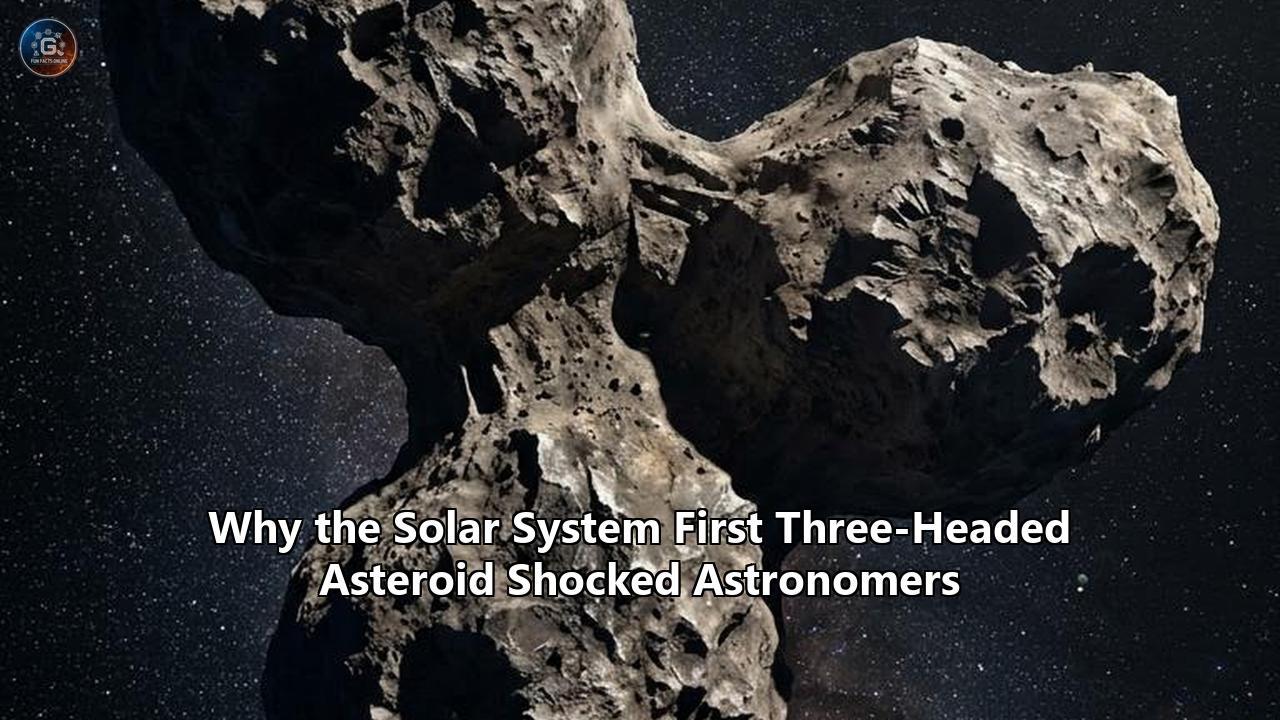
An international team of astronomers has confirmed the discovery of the first verified triple-lobed contact body in the Solar System, unmasking the 80-kilometer-wide asteroid (44) Nysa as a structure composed of three distinct rocky masses joined by two narrow necks.
The findings, published in Astronomy & Astrophysics by a research consortium led by Dr. Kate Minker of Lowell Observatory, fundamentally alter current models of small-body accretion and collisional physics. Utilizing visible-light adaptive optics from the Large Binocular Telescope (LBT) on Mount Graham in Arizona and the European Southern Observatory’s Very Large Telescope (VLT) in Chile, the researchers captured high-resolution direct imaging that resolved Nysa’s deep, waist-like concavities. In tandem with the shape determination, the team detected a previously unknown companion moon—provisionally designated S/2026 (44) 1—measuring roughly one kilometer in diameter and orbiting approximately 180 kilometers from the primary body.
For more than a century and a half following its 1857 discovery by Hermann Goldschmidt, Nysa was classified as a bright, highly reflective, but poorly resolved resident of the inner main asteroid belt. While lightcurve variations had long hinted at an irregular or potentially elongated shape, the new spatial reconstructions proved that the object is not a simple ellipsoid or even a classic two-lobed "contact binary". Instead, the Solar System's first confirmed three-headed asteroid presents a severe physical challenge to planetary dynamicists: explaining how three separate planetesimals merged at non-destructive relative velocities without shearing apart under subsequent rotational and gravitational stresses.
                (44) NYSA SYSTEM SCHEMATIC

       Lobe 1            Lobe 2            Lobe 3
    +----------+      +----------+      +----------+
   /            \    /            \    /            \
  |   Enstatite  |==|   Central    |==|  Terminal   |
   \  Silicate  /    \   Mass     /    \   Block    /
    +----------+      +----------+      +----------+
           \              /
         Neck 1        Neck 2
       (Collum A)    (Collum B)
                                              * Moon: S/2026 (44) 1
                                                (~1 km diameter)
  |<----------------- ~80 km ----------------->|      (~180 km orbit)
The Astronomical Breakthrough: Resolving (44) Nysa
Resolving an irregular, 80-kilometer object orbiting roughly 300 million kilometers from Earth requires spatial resolution approaching the limits of modern optical physics. To achieve this, the observational campaign brought together two of the world's most capable ground-based imaging suites:
- SHARK-VIS (System for Coronagraphy and High-Contrast Imaging at Visible Wavelengths): Mounted on the 2 × 8.4-meter Large Binocular Telescope Observatory in Arizona, this instrument operates in the visible spectrum where diffraction limits are sharpest. Paired with the telescope’s advanced adaptive secondary mirrors, it corrected for atmospheric turbulence thousands of times per second.
- SPHERE/ZIMPOL (Zurich Imaging Polarimeter): Installed on ESO’s 8.2-meter Very Large Telescope Unit Telescope 3 (Melipal) at Cerro Paranal, this instrument provided complementary visible and near-infrared differential imaging and polarimetry.
- ADAM (All-Data Asteroid Modeling) Code: To convert two-dimensional brightness profiles and ground-based lightcurves into a full three-dimensional volumetric model, the researchers deployed inversion algorithms that combined direct optical silhouettes with decades of photometric lightcurve databases.
The reconstructed morphology revealed an asteroid composed of three distinct sub-units aligned along a common longitudinal axis, punctuated by two pronounced, continuous latitudinal troughs referred to morphologically as colli (necks). The entire structure spans nearly 80 kilometers along its major axis, rotating with a periodicity of 6.42 hours.
+------------------------+-------------------------------------------------------+
| Physical Parameter     | Value / Measurement                                   |
+------------------------+-------------------------------------------------------+
| Target Object          | (44) Nysa                                             |
| Discovery of Asteroid  | May 27, 1857 (Hermann Goldschmidt)                    |
| Morphological Class    | Contact Trinary / Trilobate                           |
| Maximum Dimension      | ~80 km (Equivalent spherical diameter: ~74–75 km)   |
| Rotation Period        | 6.42 hours                                            |
| Spectral Classification| E-type (Enstatite-rich, Bus-DeMeo Xn-subclass)        |
| Albedo (Geometric)     | 0.55 (Highly reflective, iron-poor silicate surface)  |
| Satellite              | S/2026 (44) 1 (~1.0 ± 0.5 km diameter)                |
| Satellite Orbit Radius | ~180 km (projected)                                   |
| Primary Instruments    | LBT / SHARK-VIS, VLT / SPHERE-ZIMPOL                  |
+------------------------+-------------------------------------------------------+
"The images reveal a remarkably unusual object," stated Dr. Kate Minker in the Lowell Observatory release announcing the results. "The most likely explanation is that Nysa is either a contact trinary, consisting of three connected components, or an extremely irregular coherent body unlike anything we’ve previously observed."
The discovery of satellite S/2026 (44) 1 within the raw deconvolution residuals provided critical dynamic leverage. Because the companion is approximately nine magnitudes fainter than the blindingly reflective primary body, its detection required advanced point-spread-function subtraction techniques. By observing the orbital velocity and separation distance of this mini-moon, astronomers obtained the mathematical key needed to calculate the total system mass and determine Nysa’s bulk internal density.
The Physics of Contact Formations: From Binaries to Trinaries
Planetary science has documented dozens of contact binaries—two separate bodies resting against one another—across various regions of the Solar System. Spacecraft encounters have mapped several prominent examples:
- Comet 67P/Churyumov–Gerasimenko: Examined by ESA’s Rosetta mission, showing two unequal lobes connected by a narrow, volatile-depleted neck.
- Kuiper Belt Object (486958) Arrokoth: Imaged by NASA’s New Horizons probe in 2019, revealing a pristine, flattened, two-lobed primordial planetesimal.
- Asteroid (216) Kleopatra: A 130-kilometer main-belt "dog-bone" shaped asteroid accompanied by two outer satellites.
- Near-Earth Asteroid (4179) Toutatis: A multi-lobed, tumbling near-Earth object shaped by low-speed impacts.
                  STRUCTURAL ACCRETION COMPARISON

  [ ARROKOTH: Contact Binary ]            [ (44) NYSA: Contact Trinary ]
       2-Lobe Planetesimal                    3-Lobe Sequential Chain
          +---+   +-----+                    +---+    +-----+    +---+
         /     \=/       \                  /     \==/       \==/     \
        | Lobe | | Lobe 2 |                | Lobe |  | Lobe 2 |  | Lobe |
         \  1  /=\       /                  \  1  /==\       /==\   3   /
          +---+   +-----+                    +---+    +-----+    +---+
         1 Contact Neck (Collum)             2 Distinct Necks (Colli)
However, a contact trinary at the scale of Nysa represents an entirely different regime of mechanical and orbital complexity. A two-body contact structure can form through a relatively straightforward process: two independent planetesimals co-orbiting within a primordial cloud lose angular momentum through gas drag, tidal dissipation, or third-body gravitational perturbations, gently colliding at speeds below their mutual escape velocity (typically less than a few meters per second).
Forming a coherent three-headed asteroid requires one of two specific physical pathways:
1. Sequential Low-Velocity Accretion
In this scenario, a pre-existing contact binary was struck by a third body at a velocity low enough to prevent structural fragmentation. This third impactor had to dock precisely along the outer edge of one of the existing lobes without exerting enough torque to snap the primary neck. The impact velocity must not have exceeded the critical shear velocity $v_{\text{crit}} \approx \sqrt{2 G M / R}$, keeping collisional energies strictly within the non-destructive plastic deformation regime.
2. Catastrophic Hit-and-Run Excavation
Alternatively, Nysa was once a larger, differentiated proto-planet (roughly 150–200 km across) that underwent an oblique, high-energy graze with another planetesimal during the early dynamical clearing of the inner Solar System. Rather than completely pulverizing the body, the hydrodynamics of the collision stripped away outer layers and carved out massive, symmetric structural troughs, leaving behind a heavily sculpted three-lobed core.
Both pathways challenge long-held assumptions regarding structural survival in the main belt. Given Nysa's rapid rotation rate of 6.42 hours, centrifugal forces exert outward tension at its equatorial tips. If Nysa were a loose, low-cohesion "rubble pile" held together strictly by gravity, the structural torque concentrated across its narrow necks should have driven rotational fission, splitting the asteroid into an orbiting multiple system. Its continued existence as a bonded, coherent entity implies substantial tensile strength and internal mineral cohesion.
Stakeholder Impact Analysis: Who Is Affected?
The confirmation of a trilobate contact morphology in the main belt has immediate consequences across theoretical astrophysics, observational astronomy, and planetary defense.
+-------------------------------+--------------------------------------------------------------+-------------------------------------------------------------+
| Discipline / Sector           | Primary Impact                                               | Operational & Research Shift                                |
+-------------------------------+--------------------------------------------------------------+-------------------------------------------------------------+
| Planetesimal Dynamicists      | Accretion models must accommodate multi-stage gentle mergers | Updating N-body collisional codes for n-lobe docking        |
| Cosmochemists                 | Enstatite (E-type) reservoir link to Earth's precursors      | Reassessing protoplanetary disk thermal & migration history |
| Ground-Based Observers        | High-contrast AO rivals spacecraft flyby imaging data        | Refocusing instrument time on elongated asteroid targets    |
| Planetary Defense Engineers   | Structural modeling for deflection vectors on complex bodies | Calibrating kinetic impact physics on multi-lobed targets   |
| Space Exploration Missions    | Target prioritization for future asteroid reconnaissance     | Proposing dedicated flyby or rendezvous cubesat missions   |
+-------------------------------+--------------------------------------------------------------+-------------------------------------------------------------+
1. Planetesimal Dynamicists and Collision Modellers
Dynamicists who simulate the formation of the Solar System have primarily optimized numerical codes (such as $N$-body gravitational tree-codes and Smoothed Particle Hydrodynamics models) to track binary formations and catastrophic disruptions. The presence of an 80-kilometer three-lobed body indicates that multi-body, low-energy coalescence was more prevalent in the protoplanetary disc than previously recognized. Researchers must now determine the precise velocity envelopes and angular alignment conditions required for three large masses to dock sequentially without dismantling previously joined interfaces.
2. Cosmochemists and Terrestrial Planet Geologists
Nysa is the largest and brightest E-type asteroid known. E-type asteroids are characterized by surfaces rich in enstatite ($\text{MgSiO}_3$), an iron-poor magnesium silicate that creates an extraordinarily high geometric albedo (around 0.55).
Cosmochemically, enstatite asteroids are the only celestial bodies whose isotopic oxygen, chromium, titanium, and nickel signatures match those of terrestrial rocks and aubrite/enstatite chondrite meteorites. Because enstatite minerals require high temperatures and extremely reducing (oxygen-poor) chemical conditions to form, Nysa likely originated inside 1.0 Astronomical Unit (AU)—near the current orbits of Mercury and Earth—before being dynamically scattered outward into the main belt during early giant-planet migration.
Studying Nysa’s structural composition provides direct access to the pristine building blocks that aggregated to form Earth.
           PROTOPLANETARY DISK FRACTIONATION & NYSA IMPLANTATION

   [ Sun ] <--- 0.5 to 1.0 AU --->|<---------- 2.1 to 3.3 AU ---------->|
                INNER DISK ZONE                MAIN ASTEROID BELT
           High Temp / Reducing Zone        Volatile-rich / Carbonaceous

           (44) Nysa Formed Here:            Dynamical Migration
           • Enstatite Silicates (MgSiO3)    Scatters Nysa Outward
           • Metal/Sulfide Inclusions   ==========================> Implantation
           • Low FeO, Highly Reduced                                 into Inner Belt
           • Earth-like Isotopes                                     (Current Orbit)
3. Observational Astronomers and Optical Engineers
The resolution achieved by combining LBT’s SHARK-VIS and VLT’s SPHERE/ZIMPOL proves that visible-wavelength adaptive optics can resolve topographical details down to a few kilometers across Main Belt distances. This shifts the economics of planetary reconnaissance. While deep-space probes cost hundreds of millions of dollars and require decade-long mission timelines, ground-based optical suites can now conduct detailed shape-modelling surveys of dozens of candidate asteroids from Earth.
4. Planetary Defense and Impact Hazard Specialists
Understanding the internal coherence of multi-lobed bodies is vital for planetary defense architecture. When NASA's DART (Double Asteroid Redirection Test) spacecraft impacted the binary moon Dimorphos in 2022, it demonstrated kinetic deflection on a loosely bound rubble-pile satellite.
However, if an irregular three-headed asteroid or contact trinary were ever detected on an Earth-crossing trajectory, a kinetic impactor striking an outer lobe could induce structural fragmentation at the connecting neck rather than deflecting the center of mass. Deflection models must incorporate the complex rotational dynamics, mass distribution, and shear stresses inherent to multi-necked bodies.
The Enstatite Connection: Nysa’s Chemical Blueprint
Understanding why Nysa’s physical shape shocked astronomers requires exploring its unusual mineralogy. When Hermann Goldschmidt cataloged Nysa in the 19th century, its intense brightness immediately set it apart from its darker carbonaceous neighbors.
                     ASTEROID SPECTRAL DIVERSITY

  Albedo (Pv)
    ^
 0.6|          [ (44) NYSA: E-Type ]  (Pv ~ 0.55)
    |          High enstatite, iron-free silicates
 0.4|
    |                     [ S-Type: Siliceous ]  (Pv ~ 0.20)
 0.2|                     Olivine + Pyroxene + Metal
    |                                   [ C-Type: Carbonaceous ] (Pv ~ 0.04)
 0.0+----------------------------------- Hydrated silicates, organics, carbon
    0.4 μm (Visible)                           2.5 μm (Near-Infrared)
Nysa sits at the core of the broader Nysa-Polana complex, a dense dynamical clustering of asteroids in the inner main belt. However, detailed spectroscopic surveys revealed a striking paradox: while the majority of the surrounding Polana family members are low-albedo, carbon-rich C-type and B-type asteroids, Nysa itself is an E-type asteroid. It possesses almost no spectroscopic companions with matching enstatite mineral signatures in its immediate orbital vicinity.
+-------------------------+-----------------------+---------------------------------------+
| Asteroid Taxonomy Class | Surface Composition   | Typical Albedo | Terrestrial Analog   |
+-------------------------+-----------------------+---------------------------------------+
| C-Type (e.g., Bennu)    | Carbonaceous, Organics| 0.03 – 0.08    | Carbonaceous Chondrite|
| S-Type (e.g., Eros)     | Iron-Magnesium Silicate| 0.15 – 0.25    | Ordinary Chondrite    |
| M-Type (e.g., Psyche)   | Nickel-Iron Metal     | 0.10 – 0.30    | Metallic Iron-Nickel  |
| E-Type (e.g., (44) Nysa)| Pure Enstatite (MgSiO3)| 0.45 – 0.60    | Aubrite / Enstatite   |
+-------------------------+-----------------------+---------------------------------------+
This chemical isolation implies that Nysa is not the product of a recent in-situ collision that generated an orbital family inside the asteroid belt. If Nysa had shattered and reassembled locally, the surrounding orbital volume would be populated with millions of enstatite fragments.
The total absence of an enstatite family strongly reinforces the dynamical migration hypothesis: Nysa was forged in the ultra-hot inner solar nebula, assembled its three lobes during an ancient era of low-velocity collisions, and was subsequently kicked into the asteroid belt via gravitational resonance with the migrating gas giants. As a result, its trilobate structure serves as a physical fossil from the earliest epoch of planetesimal formation.
Decoding the Satellite: S/2026 (44) 1 and Mass Determination
Prior to the observations by Minker et al., estimates of Nysa’s bulk mass and volume relied entirely on indirect methods, yielding wide uncertainties. The visual confirmation of satellite S/2026 (44) 1 changes the entire analytical framework.
                     KEPLERIAN SYSTEM DYNAMICS

                                            Satellite S/2026 (44) 1
                                            (Mass: m_sat << M_nysa)
                                                 *
                                                /
                                               /  Orbital Radius:
                                              /   r ~ 180 km
                                             /
                       (44) Nysa            v
                    [ L1 - L2 - L3 ] <------+
                     (Mass: M_nysa)

       System Mass Equation:   M_total = (4 * π^2 * r^3) / (G * P^2)
In orbital mechanics, tracking a secondary companion provides a direct path to measuring the primary body’s mass through Kepler’s Third Law:
$$M_{\text{system}} = \frac{4\pi^2 a^3}{G P^2}$$
Where:
- $a$ is the semi-major axis of the moon's orbit (~180 km).
- $P$ is the orbital period of the satellite.
- $G$ is the universal gravitational constant ($6.67430 \times 10^{-11} \, \text{m}^3\,\text{kg}^{-1}\,\text{s}^{-2}$).
Once mass ($M$) is calculated, combining it with the precise 3D volumetric model ($V$) derived from the SHARK-VIS and SPHERE data yields the bulk density ($\rho$):
$$\rho = \frac{M}{V}$$
+------------------------------------+-----------------------------------------------------+
| Structural / Compositional Model   | Predicted Bulk Density Range & Characteristics      |
+------------------------------------+-----------------------------------------------------+
| Model A: Loose Macroporous Rubble  | Density: 1.8 – 2.4 g/cm³                            |
| (High porosity, 30–40% voids)      | Highly vulnerable to rotational shear; necks        |
|                                    | cannot sustain continuous 6.42-hour rotation.       |
+------------------------------------+-----------------------------------------------------+
| Model B: Coherent Igneous Silicate | Density: 2.8 – 3.4 g/cm³                            |
| (Solid enstatite rock matrix)      | Mechanically stable; colli withstand moderate       |
|                                    | rotational and tidal stresses.                      |
+------------------------------------+-----------------------------------------------------+
| Model C: Metallic-Silicate Matrix  | Density: > 4.5 – 5.2 g/cm³                          |
| (Differentiated core/crust mix)    | Exceptional tensile strength; high density locks    |
|                                    | three lobes into rigid, monolithic contact.         |
+------------------------------------+-----------------------------------------------------+
Initial dynamical estimates derived from the projected orbital separation indicate that Nysa has a high density, potentially exceeding 4.5 to 5.0 g/cm³. A density of this magnitude requires not just magnesium silicates, but a significant fraction of metallic nickel-iron intertwined throughout its internal matrix.
This high density explains how the three-lobed structure resists rotational fission: the gravitational binding energy and metallic-silicate cohesion across the two necks supply the tensile strength needed to maintain its arch-like, tripartite geometry against rotational stresses.
Ground-Based Adaptive Optics: The Technological Engine
The imaging of (44) Nysa marks a technical milestone in ground-based planetary observation. Resolving an object subtending less than 0.06 arcseconds on the sky has historically required dedicated space missions like NASA's Galileo, Dawn, or OSIRIS-REx. Ground-based optical telescopes are typically limited by atmospheric seeing—the turbulent mixing of warm and cool air in Earth’s atmosphere that blurs astronomical objects.
                  GROUND-BASED ADAPTIVE OPTICS SIGNAL CHAIN

   Incoming Distorted Wavefront (Atmospheric Turbulence)
                 |
                 v
   [ 8.4m LBT Primary Mirror / 8.2m VLT Mirror ]
                 |
                 v
   [ High-Speed Wavefront Sensor (WFS) ] ---> Analyzes phase errors (1–2 kHz)
                 |
                 v Real-time corrections calculated
   [ Deformable Secondary Mirror (DSM) ] <--- Actuators deform surface (nm scale)
                 |
                 v Corrected Parallel Light Beam
   [ SHARK-VIS / SPHERE-ZIMPOL Instruments ]
                 |
                 v
   Diffraction-Limited Optical Image (0.015–0.030 arcsec resolution)
The success of the Nysa campaign relied on several cutting-edge systems:
Extreme Adaptive Optics (ExAO)
The LBT uses adaptive secondary mirrors with 672 voice-coil actuators that adjust the mirror's shape up to 2,000 times per second, canceling out wavefront phase errors induced by atmospheric turbulence.
Visible Light Operation via SHARK-VIS
While most adaptive optics systems operate in the near-infrared (where atmospheric distortions are easier to correct), the Italian National Institute for Astrophysics (INAF) engineered SHARK-VIS to push these corrections into visible wavelengths (400–900 nm). Because the theoretical spatial resolution limit of a telescope is proportional to wavelength ($\theta \approx 1.22 \lambda / D$), imaging in the visible spectrum improves resolving power by a factor of three to four compared to standard infrared systems.
Advanced Speckle Deconvolution and Residual Subtraction
Astronomers applied specialized post-processing algorithms to strip away the intense halo of reflected light surrounding the primary body. This made it possible to resolve both the narrow structural necks of Nysa and the faint point source of satellite S/2026 (44) 1.
Short-Term Scientific Consequences
The direct visual confirmation of a three-headed asteroid has triggered an immediate series of observational and theoretical programs across the planetary astronomy community.
                     SHORT-TERM IMPACT TIMELINE

  [MONTHS 1 - 6]         [MONTHS 6 - 12]        [MONTHS 12 - 24]
  ====================   ====================   ====================
  • Orbit Refinement     • Re-inversion of      • Archival Survey
    Campaign for           Global Lightcurves     Screening
    S/2026 (44) 1          (ADAM / SAGE codes)    (DES, Gaia DR4)

  • VLT / LBT Targeted   • ALMA Thermal         • Laboratory High-
    Astrometry Runs        Inertia Mapping        Velocity Impact
    (Precise Mass Data)    (Surface Roughness)    Shear Experiments
1. Dedicated Satellite Tracking Campaigns
Astronomers have initiated follow-up astrometric campaigns across international facilities to monitor S/2026 (44) 1 throughout its orbital cycle. Pinning down its orbital eccentricity, inclination, and period will establish Nysa’s bulk mass and density to within a few percentage points, directly determining whether the body is an unfragmented igneous block or a high-density, impact-welded composite.
2. Algorithmic Re-Evaluation of Lightcurve Archives
For decades, lightcurve inversion codes automatically defaulted to two-lobed (bilobate) or convex solutions whenever an elongated asteroid was modeled. Planetary institutes are now updating automated modeling pipelines—such as SAGE (Shaping Asteroids with Genetic Evolution) and ADAM—to allow for three-lobed, multi-concave parameter spaces. Archival photometric data for thousands of main-belt asteroids are being reprocessed to search for previously overlooked contact trinaries.
                LIGHTCURVE INVERSION PARADIGM SHIFT

  Historical Default Model:                  Updated Physical Model:
     [ Convex / Bilobate ]                      [ Contact Trinary ]

        Lobe 1       Lobe 2               Lobe 1     Lobe 2     Lobe 3
       +------+     +------+             +----+     +----+     +----+
      /        \===/        \           /      \===/      \===/      \
     |  Single Collum (Neck) |         |  Two Distinct Colli (Necks)  |
      \        /===\        /           \      /===\      /===\      /
       +------+     +------+             +----+     +----+     +----+
  (Smoothed ellipsoidal fit)            (True physical concavity resolved)
3. Thermal Inertia and Roughness Mapping
Sub-millimeter arrays, led by the Atacama Large Millimeter/submillimeter Array (ALMA) in Chile, are scheduling thermal emission observations of Nysa. Measuring how the asteroid absorbs and re-emits solar radiation throughout its 6.42-hour rotation will determine the thermal inertia of its three individual lobes. If the lobes exhibit different thermal properties, it will prove they formed as distinct, separate planetesimals before merging. If the thermal signature is uniform, it will lend weight to the hit-and-run excavation hypothesis.
Long-Term Consequences for Planetary Science
The existence of a contact trinary in the main belt reshapes broader models of how planetary systems aggregate, evolve, and survive over billions of years.
                     LONG-TERM STRUCTURAL IMPACTS

  +-------------------------------------------------------------------------+
  | 1. SOLAR SYSTEM ACCRETION THEORY                                        |
  | Planetesimal growth models must account for multi-body gentle docking   |
  | regimes in early, high-density gas disks.                               |
  +-------------------------------------------------------------------------+
                                    |
                                    v
  +-------------------------------------------------------------------------+
  | 2. YORP EFFECT & ROTATIONAL DYNAMICS                                    |
  | Long-term thermal radiation torques (YORP) do not automatically destroy |
  | asymmetric, multi-necked bodies with high internal cohesion.            |
  +-------------------------------------------------------------------------+
                                    |
                                    v
  +-------------------------------------------------------------------------+
  | 3. TARGETING FUTURE DEEP SPACE EXPLORATION                              |
  | E-type asteroids and multi-lobed targets become priority candidates for |
  | upcoming planetary exploration decadal surveys and cubesat flybys.      |
  +-------------------------------------------------------------------------+
1. Rewriting Planetesimal Accretion Dynamics
Standard accretion models assume that when planetesimals collide, they either merge into roughly spherical bodies (if gravity dominates) or shatter into collisional fragments (if kinetic energy exceeds binding energy). Nysa demonstrates the existence of a third evolutionary path: sequential, non-destructive contact aggregation.
This mechanism requires very specific early nebular conditions:
- A dense gas disk that provided aerodynamic drag, damping the relative velocities of orbiting planetesimals down to walking speeds ($< 1\,\text{m/s}$).
- A high local number density of planetesimals, making multi-body gravitational interactions common.
- A rapid formation window (within the first 3–5 million years of the Solar System) before the primordial gas disk dissipated and orbital velocities were pumped up by giant planet migration.
2. Revising Long-Term YORP Evolution Models
Over millions of years, asteroids are subject to the Yarkovsky-O'Keefe-Radzievskii-Paddack (YORP) effect—a thermal torque caused by the uneven absorption and re-emission of sunlight across an irregular surface. The YORP effect continuously alters an asteroid's spin rate and spin-axis orientation.
For an asymmetric body like Nysa, YORP torques should theoretically spin the object up to its critical rotational breakup limit on timescales of tens to hundreds of millions of years. The survival of Nysa’s narrow connecting necks over billions of years indicates either:
- A stable balancing state where surface topographies cancel out continuous spin-up forces.
- Periodic spin-rate oscillations (YORP cycles) that avoid critical disruption thresholds.
- Exceptional structural strength in the enstatite-metal necks that withstands high rotational shear stress.
                    YORP THERMAL TORQUE DYNAMICS

   Incoming Sunlight (hv)
          \
           \       [ Lobe 1 ] === [ Lobe 2 ] === [ Lobe 3 ]
            \          /              |              \
             v        v               v               v
                 Thermal Re-radiation Forces (Asymmetric Photons)

                 Resulting Net Torque (τ_YORP)
                 Forces concentrated at structural necks (Colli)
3. Targeting Future Deep-Space Missions
The unmasking of Nysa makes it a priority target for future space agency mission proposals. With NASA’s Lucy mission exploring Jupiter Trojan asteroids and ESA’s Hera mission surveying the Didymos binary system, attention is turning to inner belt E-type bodies. A flyby or rendezvous mission to Nysa would provide direct, meter-scale imaging of the contact necks, revealing the geological faults, impact breccias, and physical joints where three independent worlds met and bonded into a single celestial body.
Upcoming Milestones and Observational Frontiers
The unmasking of (44) Nysa opens an active observational and theoretical frontier. Several major milestones will provide further insight into the nature of this triple-lobed system:
+------------------------------------+--------------------------+-------------------------------------------------------+
| Milestone / Campaign               | Target Date / Window     | Scientific Objective                                  |
+------------------------------------+--------------------------+-------------------------------------------------------+
| Multi-Chord Stellar Occultation    | Next Favorable Geometry  | Kilometric-accuracy direct profile mapping of colli   |
| Extremely Large Telescope (ELT) AO | First Light Campaigns    | Sub-milliarcsecond structural and surface mineralogy  |
| Rubin Observatory (LSST) Surveys   | Operational Sky Surveys  | Identifying population statistics for contact trinaries|
| Dynamical Mass-Refinement Analysis | Forthcoming Publications | Finalizing orbit and density calculations for moon     |
+------------------------------------+--------------------------+-------------------------------------------------------+- Multi-Chord Stellar Occultation Campaigns: When Nysa passes in front of distant background stars, networks of ground-based telescopes can record the exact timing of stellar disappearance and reappearance. These multi-chord shadow profiles will measure the width and depth of the connecting necks with kilometer-scale precision, independently validating the 3D optical models.
- The Next Generation of Extremely Large Telescopes: The upcoming commissioning of ESO’s 39-meter Extremely Large Telescope (ELT) in the Atacama Desert and the Thirty Meter Telescope (TMT) will offer unprecedented resolving power. Equipped with advanced optical systems like HARMONI and MICADO, the ELT will image Nysa’s surface features, resolving individual impact craters, structural fractures along the necks, and the precise shape of moon S/2026 (44) 1.
- Vera C. Rubin Observatory Discoveries: The Legacy Survey of Space and Time (LSST) conducted by the Vera C. Rubin Observatory in Chile will catalog millions of asteroids with high-precision, multi-band photometry. Automated anomaly-detection algorithms trained on Nysa’s lightcurve signature will screen the main belt to determine whether contact trinaries are rare anomalies or an established structural class of small bodies.
The confirmation of (44) Nysa as a contact trinary demonstrates that the physical processes governing planetesimal growth were far more varied than simple spheroids and binaries suggested. As ground-based telescopes continue to sharpen our view of the asteroid belt, the Solar System's first known three-headed asteroid stands as a pristine physical record of the delicate, low-velocity mergers that assembled the rocky foundations of the inner planets.
Reference:
- https://www.sci.news/astronomy/three-lobed-asteroid-nysa-14965.html
- https://arxiv.org/abs/2607.25786
- https://skyandtelescope.org/astronomy-news/astronomers-spot-weird-three-lobed-asteroid-with-a-moon/
- https://news.arizona.edu/news/three-lobed-asteroid-world-unlike-any-other
- https://en.wikipedia.org/wiki/44_Nysa
- https://science20.com/news_articles/20260729/44_nysa_an_asteroid_now_with_its_own_moon-300036
- https://tazanow.com/offbeat/scientists-discover-first-ever-three-headed-asteroid-in-our-solar-system/
- https://news.arizona.edu/news/three-lobed-asteroid-world-unlike-any-other
- https://arxiv.org/html/2607.25786v1
- https://www.prnewswire.com/news-releases/asteroid-44-nysa-may-be-the-first-known-three-lobed-world-302838268.html
- https://www.space.com/astronomy/asteroids/1st-three-headed-asteroid-found-in-our-solar-system-and-it-has-a-little-moon
- https://www.discovermagazine.com/strange-asteroid-may-be-the-first-known-with-three-lobes-and-its-own-moon-49492
- https://seti.ucla.edu/jlm/publications/Margot15.AIV.BinariesTriplesPairs.pdf
- https://www.universetoday.com/articles/the-asteroid-that-may-be-three-worlds
- https://www.eso.org/public/finland/images/potw2631a/?lang
- https://phys.org/visualstories/2026-08-asteroid-worlds.amp
- https://en.wikipedia.org/wiki/Binary_asteroid