The Gathering Shadows at Cerro Pachón (June 2026)
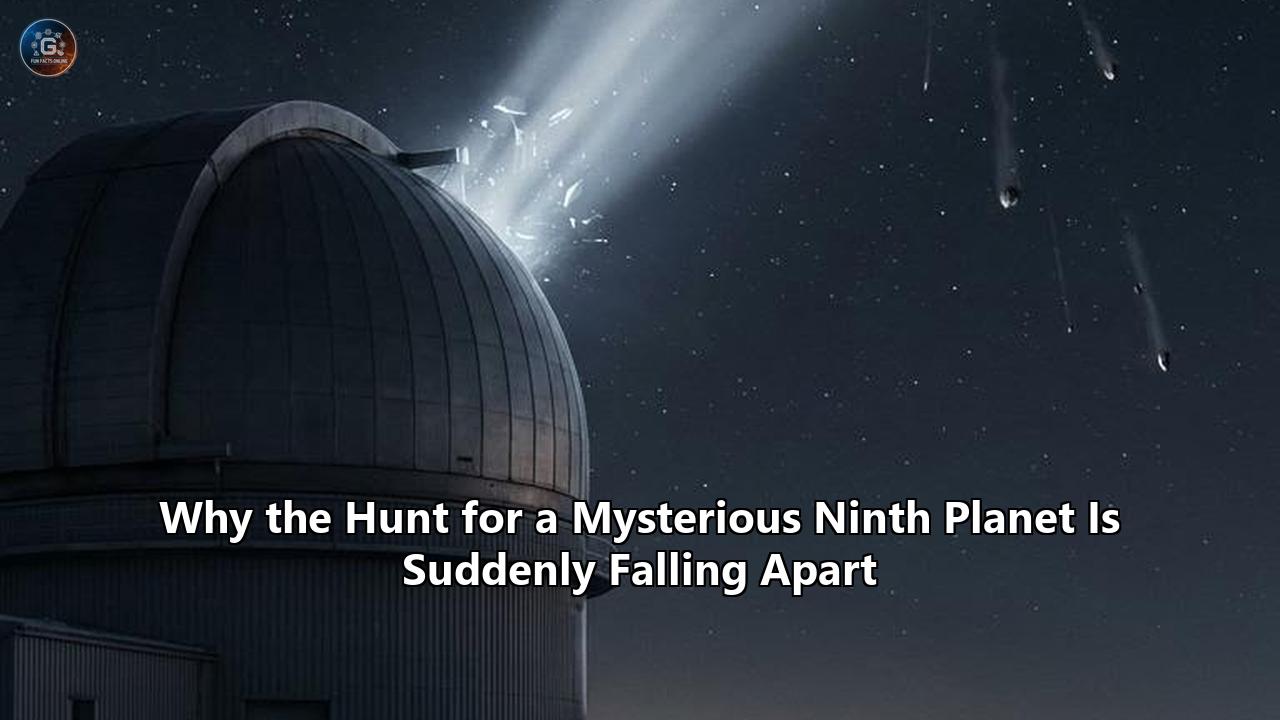
On the high-altitude desert ridge of Cerro Pachón in northern Chile, the giant eye of modern astronomy is turning its gaze toward the deepest, coldest recesses of our solar system. The Vera C. Rubin Observatory has officially entered its final commissioning phase. Equipped with the Simonyi Survey Telescope and a 3.2-gigapixel camera—the largest digital imaging device ever constructed—the facility is preparing to launch the Legacy Survey of Space and Time (LSST).
For nearly a decade, this moment was anticipated as the ultimate reckoning for one of the most polarizing hypotheses in planetary science: the existence of a massive, undiscovered world lurking far beyond the orbit of Neptune, colloquially known as Planet Nine.
The astronomical community, however, is not waiting in breathless, unified optimism. Instead, the intellectual edifice supporting the Planet Nine existence is experiencing a rapid, dramatic destabilization.
Over the last twelve months, a series of observational discoveries and dynamic simulations have systematically chipped away at the mathematical foundations of the hypothesis. The discovery of a bizarre, pristine outer-system object nicknamed "Ammonite" in July 2025 has thrown the expected orbits of the outer solar system into chaos. Concurrently, deep-archive searches that briefly promised direct infrared detection have dissolved into false alarms, while competing theories proposing smaller, closer, and dynamically incompatible "sibling" planets have fractured the once-monolithic search.
As the Rubin Observatory prepares to scan the southern sky, astronomers are quietly preparing for a reality where the outskirts of our solar system are not shepherded by a hidden giant, but are instead a silent, scattered wilderness. What began in 2016 as an elegant, mathematically compelling solution to a series of orbital anomalies is suddenly falling apart.
To understand how the hunt for this ghost world reached this breaking point, one must trace the timeline of its escalation—from the early, subtle clues in the deep dark to the current observational crisis.
+-----------------------------------------------------------------------------------+
|                           PLANET NINE TIMELINE                                   |
+-----------------------------------------------------------------------------------+
| 2014: Sheppard & Trujillo spot orbital clustering in a handful of ETNOs.          |
| 2016: Batygin & Brown publish formal Planet Nine model (0.007% coincidence).      |
| 2017-2018: OSSOS survey suggests clustering is a mirage of observational bias.    |
| 2021: Caltech team refines model to 5-6 Earth masses to keep hypothesis alive.     |
| May 2025: Phan et al. propose infrared candidate; quickly debunked as non-planet. |
| July 2025: Discovery of "Ammonite" (2023 KQ14) breaks the alignment model.       |
| Late 2025: Princeton's "Planet Y" model splits the scientific community.         |
| Mid-2026: Rubin Observatory begins final testing amidst growing skepticism.       |
+-----------------------------------------------------------------------------------+
The Ghost of Planet X (1846–2003)
The intellectual lineage of Planet Nine is steeped in both triumph and embarrassment. The precedent for discovering a planet using nothing but a pencil, paper, and the laws of gravity was established in 1846. French mathematician Urbain Le Verrier, troubled by unexplained anomalies in the orbit of Uranus, calculated that an undiscovered eighth planet must be exerting a gravitational tug from further out. He sent his coordinates to the Berlin Observatory, where astronomer Johann Gottfried Galle pointed his telescope and found Neptune within a single degree of the predicted location.
This spectacular success ignited a century-long obsession with finding yet another world. By the late 19th century, astronomers believed they detected further residual discrepancies in the orbits of both Uranus and Neptune.
Percival Lowell, a wealthy businessman and founder of the Lowell Observatory in Flagstaff, Arizona, dedicated the final years of his life to searching for what he termed "Planet X". Lowell calculated its position and launched a systematic photographic search.
Although Lowell died in 1916 without finding it, his observatory continued the campaign. In 1930, young astronomer Clyde Tombaugh discovered Pluto near the predicted region.
For decades, Pluto was celebrated as the ninth major planet, fulfilling Lowell's prophecy. However, as the decades rolled on, Pluto's estimated mass was repeatedly revised downward.
Originally assumed to be roughly as massive as Earth, astronomers eventually realized Pluto was a cosmic featherweight—possessing just 0.2% of Earth’s mass. It was far too small to exert any measurable gravitational influence on Uranus or Neptune.
The entire foundation of Planet X collapsed in 1989 when NASA’s Voyager 2 spacecraft flew past Neptune. Using the precise gravitational data gathered during the flyby, astronomer Myles Standish recalculated the masses of the gas giants.
The apparent "wobbles" in Uranus's orbit vanished. They were not caused by an invisible planet, but by a slight overestimation of Neptune's mass in early ground-based observations.
By the early 1990s, the solar system seemed clean, orderly, and entirely accounted for with eight major planets.
Then came the discovery of the Kuiper Belt. Beginning in 1992, astronomers began finding a vast, flat ring of icy bodies, dwarf planets, and comets orbiting beyond Neptune.
Most of these Kuiper Belt Objects (KBOs) behaved exactly as expected, their orbits sculpted by the gravitational dominance of Neptune. But in 2003, Mike Brown, Chad Trujillo, and David Rabinowitz discovered Sedna.
Sedna was a dynamic anomaly. It has a highly eccentric orbit that takes 11,400 years to complete, coming no closer to the Sun than 76 astronomical units (AU)—where 1 AU is the average distance between the Earth and the Sun.
At its furthest point, Sedna drifts out to nearly 1,000 AU. Because Sedna’s closest approach (perihelion) is so far beyond Neptune’s gravitational reach (30 AU), Neptune could not have scattered it into this elongated orbit.
Something else, hidden in the deep dark, had to have pulled Sedna’s orbit outward.
The 2014 Spark: Trujillo and Sheppard’s Accidental Clue
The true catalyst for the modern Planet Nine hypothesis arrived in March 2014. Astronomers Chad Trujillo and Scott Sheppard published a paper in Nature announcing the discovery of 2012 VP113.
Nicknamed "Biden," 2012 VP113 was only the second known object after Sedna to possess a perihelion greater than 50 AU and a semi-major axis greater than 150 AU. It was a second member of an extremely rare class of "detached" trans-Neptunian objects.
                Sun
                 *
                / \
               /   \
              /     \
   Sedna     /       \     2012 VP113
   Orbit    /         \    Orbit
  (Perihelion:         \  (Perihelion:
    76 AU)              \   80 AU)
As Trujillo and Sheppard plotted the orbital parameters of 2012 VP113 alongside Sedna and a handful of other extreme trans-Neptunian objects (ETNOs), they noticed a subtle, bizarre trend. The orbits of these distant bodies were not oriented randomly in space.
Specifically, they shared a similar "argument of perihelion" ($\omega$).
In orbital mechanics, the argument of perihelion describes the angle at which an elliptical orbit makes its closest approach to the Sun relative to the plane of the solar system. If these orbits were scattered randomly by passing stars or giant planets over billions of years, their arguments of perihelion should be distributed uniformly between $0^{\circ}$ and $360^{\circ}$. Instead, Trujillo and Sheppard's small sample of ETNOs clustered tightly around an angle of $0^{\circ}$.
Trujillo and Sheppard proposed a tentative, thrilling explanation: a massive, low-luminosity planet—potentially a super-Earth with a mass between 2 and 15 Earth masses—could be orbiting at several hundred AU. Its gravity, they suggested, was active in "shepherding" these distant icy rocks, keeping their orbital orientations locked in place.
The paper sparked immediate interest, but also widespread skepticism. The sample size was tiny. Many astronomers argued that the apparent clustering was a statistical fluke, a product of looking at too few objects through a handful of narrow telescopic surveys.
To turn this intriguing clue into a rigorous scientific case, someone needed to stress-test the orbital mechanics of the outer solar system.
The 2016 Caltech Manifest: The Birth of Planet Nine
That task fell to two researchers at the California Institute of Technology (Caltech): Konstantin Batygin, a brilliant young theorist, and Mike Brown, the seasoned planetary astronomer famous for discovering Eris and paving the way for Pluto's reclassification.
Initially, Batygin and Brown set out to prove that Trujillo and Sheppard’s proposed planet could not exist. They suspected that any massive perturber in the outer solar system would quickly destabilize the fragile orbits of the ETNOs, scattering them into interstellar space.
For 18 months, the duo ran advanced numerical N-body simulations, modeling how various outer-system architectures would affect the known ETNO population. What they found surprised them.
Instead of showing that a planet was impossible, their simulations revealed that a specific, highly eccentric, and tilted planet was the only physical mechanism that could preserve the observed orbits over the 4.5-billion-year history of the solar system.
In January 2016, Batygin and Brown published their landmark paper in The Astronomical Journal: "Evidence for a Distant Giant Planet in the Solar System".
                     Orbit of Planet Nine (Eccentric, Tilted)
                 =================================================
                /                                                 \
               /       Sun                                         \
              /         *                                           \
             |         / \   Aligned Orbits of ETNOs (Sedna, etc.)  |
              \       /   \_________________                        /
               \     /                      \                      /
                \___/                        ====================_/
Rather than focusing solely on the argument of perihelion, Batygin and Brown identified a far more profound "double clustering". They analyzed six pristine ETNOs—the most distant known bodies that never come close to Neptune—and demonstrated that their elliptical orbits were clustered in both physical space and tilt.
- Physical Alignment (Longitude of Perihelion): The elongated orbits of these six bodies all pointed in roughly the same direction in the sky, like a fan spread out on one side of the Sun.
- Orbital Inclination: The orbital planes of these objects were all tilted at approximately the same angle—roughly $30^{\circ}$ relative to the ecliptic plane (the flat disk where Earth and the other major planets orbit).
The probability of this double alignment occurring by sheer mathematical coincidence was calculated at just 0.007%, or approximately 1 in 14,000.
To explain this, Batygin and Brown proposed the formal model of Planet Nine. Their initial parameters described a world with the following characteristics:
| Parameter | Predicted Value (2016) |
|---|---|
| Mass | ~10 Earth masses |
| Semi-Major Axis | ~700 AU |
| Eccentricity | ~0.6 (highly elongated) |
| Inclination | ~30 degrees relative to the ecliptic |
| Orbital Period | 10,000 to 20,000 years |
According to their dynamic models, the Planet Nine existence was not just a passive presence; it was actively sculpting the outer solar system.
Through a mechanism known as secular gravitational resonance, Planet Nine’s eccentric orbit was positioned opposite to the ETNOs, preventing them from colliding with the giant planet while keeping their orbits dynamically confined to a single sector.
The paper struck the scientific community with the force of an orbital shockwave. Suddenly, the search for an extra planet was no longer a fringe pursuit of "Planet X" crackpots; it was a highly mainstream, mathematically rigorous endeavor backed by one of the world's most prestigious research institutions.
The hunt was officially on.
The Nice Model and the Ejected Giant
If Planet Nine existed, it raised a fundamental, nagging question that theorists had to answer: How did a planet five to ten times the mass of Earth end up in a frozen graveyard hundreds of AU from the Sun?
At such extreme distances, the primordial protoplanetary disk surrounding the infant Sun would have been far too thin and sparse to form a planet of that size. It could not have grown in situ.
It had to have been born closer to the Sun and migrated outward.
Planetary dynamicists quickly found a natural home for Planet Nine in the Nice Model—the prevailing framework describing the early, chaotic evolution of our solar system. Developed in the early 2000s by a team of scientists in Nice, France, the model suggests that the giant planets (Jupiter, Saturn, Uranus, and Neptune) initially formed in a highly compact configuration.
Around 4 billion years ago, gravitational instabilities triggered a violent orbital migration. Jupiter and Saturn shifted, which flung Uranus and Neptune into wider orbits, scattering the surrounding disk of icy planetesimals and causing the Late Heavy Bombardment.
When dynamicists ran computer simulations of this violent migration, they frequently encountered a recurring problem: in many of the most realistic scenarios, the gravitational interactions between the giant planets were so intense that one of them was violently ejected from the solar system entirely.
To prevent the loss of Uranus or Neptune, several versions of the Nice Model proposed that the early solar system actually possessed a fifth giant planet—a "sacrificial lamb" situated between Saturn and Uranus.
Early Solar System:
  [Sun] -> [Jupiter] -> [Saturn] -> [Sacrificial 5th Giant] -> [Uranus] -> [Neptune]
                                                |
                                                v (Gravitational kick)
                                     [Flung into Deep Space]
                                                |
              +---------------------------------+---------------------------------+
              |                                                                   |
              v (Ejected completely)                                              v (Trapped by gas disk)
        [Rogue Planet]                                                      [Planet Nine Orbit]
In these simulations, this fifth giant is kicked outward by Jupiter. In most runs, it becomes a rogue planet, drifting permanently into interstellar space.
But in about 2% to 10% of the simulations, if the young solar system still retained a trace amount of its primordial gas disk, or if the Sun was still embedded in its dense birth cluster of sibling stars, the ejected planet’s energy would be dissipated.
The planet would be trapped, settling into a highly eccentric, stable orbit far beyond Neptune.
This elegant alignment of theories bolstered the Planet Nine hypothesis. It provided not only a mathematical explanation for the odd orbits of the ETNOs, but a physically plausible biography for the planet itself.
Planet Nine, if found, was the lost fifth giant of our solar system's turbulent youth.
The Rebellion of the Observers (2017–2021)
While theorists rejoiced, observational astronomers began pointing out a glaring, structural weakness in the Planet Nine hypothesis.
To claim that the orbits of ETNOs are "clustered" in space, one must be certain that the clustering is real, and not a product of where and when telescopes are pointed. This is known as observational selection bias.
Discovering an ETNO is an incredibly difficult task. Because these objects are so distant, they reflect very little sunlight.
The apparent brightness of a solar system object scales with the inverse fourth power of its distance ($1/d^4$). A world ten times further away than Neptune is not ten times fainter; it is $10,000$ times fainter.
Consequently, we can only discover these objects when they are at their absolute closest approach to the Sun (perihelion), where they are briefly bright enough to be detected by ground-based surveys.
This introduces massive observational biases:
- Weather and Seasonal Bias: Telescopes cannot observe during seasonal rainy periods. Astronomers are far more likely to discover objects in regions of the sky that are visible during the clear, dry summer months of their respective observatories.
- Galactic Latitude Bias: Telescopes avoid looking directly through the dense, crowded plane of the Milky Way, where millions of background stars make it nearly impossible to isolate a slow-moving solar system object.
- Targeted Searches: If astronomers are actively searching for Planet Nine, they will preferentially point their telescopes at the specific regions of the sky where they expect its shepherded targets to be, creating a self-fulfilling loop.
In 2017, the first major counter-offensive against the Planet Nine hypothesis was launched by the Outer Solar System Origins Survey (OSSOS).
Using the 3.6-meter Canada-France-Hawaii Telescope on Maunakea, OSSOS was a highly rigorous, well-calibrated survey that discovered more than 800 new TNOs. Crucially, OSSOS kept meticulous, automated records of exactly when, where, and under what atmospheric conditions they observed.
                     TRADITIONAL SURVEYS vs. OSSOS METHOD

  [Traditional Surveys]                  [OSSOS Survey]
  - Point at clear, dark patches.        - Point systematically based on pre-set grid.
  - Find objects where you look.         - Track *exactly* where you didn't look.
  - Conclude: "Objects are clustered!"   - Run "simulator" to subtract pointing bias.
  - Result: Uncorrected selection bias.   - Result: Uniform distribution of orbits.
Led by Samantha Lawler, Michele Bannister, and Cory Shankman, the OSSOS team ran their newly discovered ETNOs through a sophisticated survey simulator. The simulator modeled how their telescope pointing, weather conditions, and search depths would affect their ability to detect distant objects.
The results, published in 2017 and expanded in 2018, delivered a severe blow to the Caltech model.
OSSOS demonstrated that when the observational selection effects were fully accounted for, the apparent orbital clustering of the ETNOs vanished. The orbits of their sample were entirely consistent with a uniform, random distribution in space.
Lawler was blunt in her assessment, stating that the Planet Nine hypothesis proposed by Batygin and Brown "does not hold up to detailed observations". The team argued that the original 2016 clustering was a classic "mirage in the dark"—the result of combining data from various historical surveys that had all happened to search the same accessible patches of the night sky.
Batygin and Brown quickly fired back. They published a series of papers arguing that the OSSOS sample size was still too small to rule out Planet Nine and that their own statistical models, which also attempted to account for bias, still favored clustering.
However, the consensus had fractured. The Planet Nine existence was no longer an impending discovery; it was a fierce academic debate.
The Refined Search and Alternative Realities (2021–2024)
As the debate over observational bias raged on, the direct visual search for Planet Nine continued to turn up empty.
Astronomers searched through massive, all-sky datasets. NASA’s Wide-field Infrared Survey Explorer (WISE) ruled out the existence of any Saturn-sized gas giants out to 10,000 AU and any Jupiter-sized worlds out to 256,000 AU, though a smaller, colder super-Earth could still easily hide.
The Panoramic Survey Telescope and Rapid Response System (Pan-STARRS) in Hawaii and the Dark Energy Survey (DES) in Chile scanned vast swaths of the optical sky, but found no trace of the faint, drifting point of light.
Recognizing that their initial model might have predicted a target too distant and faint, Batygin and Brown published a major revision in August 2021.
By analyzing a more refined sample of 11 ETNOs that were completely detached from Neptune’s influence, they updated the predicted orbit of Planet Nine, bringing it closer to the Sun:
- Mass: Revised down from 10 Earth masses to $6.2 \pm 2.2$ Earth masses.
- Semi-Major Axis: Revised down to $380^{+140}_{-80}$ AU.
- Eccentricity: Reduced to a more modest $0.15$ to $0.4$.
- Inclination: Placed at approximately $16 \pm 5$ degrees to the ecliptic.
This closer, smaller Planet Nine would be slightly brighter, but still incredibly faint. Its orbit would take roughly 7,400 years to complete, putting its current position somewhere near its furthest point (aphelion) in the northern sky, projected against the star-rich, crowded background of the Milky Way.
As the primary search stalled, other physicists began proposing wild, alternative explanations for the orbital anomalies:
The Self-Shepherding Icy Disk
Some researchers proposed that the outer solar system did not contain a planet at all, but rather a massive, collective disk of icy debris.
If the combined mass of the Kuiper Belt and Oort Cloud remnants was equivalent to several Earth masses, the collective gravitational pull of these tiny bodies could lock their orbits into a shepherded alignment. However, this "self-shepherding disk" theory suffered from a major flaw: current observations suggest the modern Kuiper Belt has less than 1% of the mass required to sustain such an alignment.
The Primordial Black Hole
In 2020, physicists Jakub Scholtz and James Unwin proposed a radical hypothesis: Planet Nine was not a planet, but a primordial black hole.
Formed in the dense, hot plasma of the first second of the universe, this black hole would have a mass roughly five times that of Earth, but would be no larger than a bowling ball ($9\text{ cm}$ in diameter). It would exert the exact same gravitational pull as a planet, but would reflect no light, explaining why optical surveys had failed to find it.
While mathematically possible, the hypothesis was highly speculative, offering no clear path to observational proof.
       PROPOSED EXPLANATIONS FOR THE DEEP SYSTEM ANOMALIES
  +----------------------+--------------------+---------------------+
  |   Planet Nine        | Primordial BH      | Icy Debris Disk     |
  +----------------------+--------------------+---------------------+
  | Mass: 5-6 Earths     | Mass: ~5 Earths    | Mass: ~10 Earths    |
  | Size: Neptune-like   | Size: Grapefruit   | Size: Ring of dust  |
  | Proof: Optical light | Proof: Hawking rad | Proof: Dust scat.   |
  | Status: Endangered   | Status: Untestable | Status: Mass deficit|
  +----------------------+--------------------+---------------------+
In early 2024, Batygin and Brown published another major analysis, this time focusing on "Neptune-crossing" TNOs. These are objects that periodically dive inside Neptune's orbit, rendering them highly unstable.
Through extensive simulations, they argued that these orbits can only survive for billions of years if they are constantly stabilized by the gravitational influence of Planet Nine.
The mathematical case remained highly developed, but without a direct, visual observation of the planet itself, the hypothesis was beginning to feel like a house of cards. The entire scientific framework was waiting for a single, decisive observational result to either save it or shatter it.
The May 2025 Far-Infrared Mirage
That decisive moment seemed to arrive in May 2025.
A team of astronomers led by Terry Long Phan at the National Tsing Hua University in Taiwan published a paper in the Publications of the Astronomical Society of Australia (PASA). They announced they had discovered a compelling candidate for Planet Nine by analyzing archival far-infrared data.
Phan’s team had bypassed traditional optical telescopes. They reasoned that because Planet Nine is so far from the Sun, it would reflect virtually no visible light.
However, because the planet would still retain a trace amount of internal heat left over from its formation 4.5 billion years ago, it would glow faintly in the far-infrared spectrum.
The team compared the all-sky surveys of two long-decommissioned infrared space telescopes:
- The Infrared Astronomical Satellite (IRAS): Launched by NASA in 1983.
- AKARI: Launched by the Japanese Aerospace Exploration Agency (JAXA) in 2006.
Because these two surveys were separated by exactly 23 years, any planet orbiting in the outer solar system would have moved ever so slightly against the background of fixed stars. Phan’s team calculated that a planet at 500 to 700 AU should drift by about 3 arcminutes per year, or roughly $1.15$ degrees (about the width of two full Moons) over 23 years.
Using sophisticated filtering software, they sifted through millions of sources, throwing out stationary stars, distant galaxies, and fast-moving asteroids.
After a painstaking process of elimination, they identified a single, outstanding candidate.
  1983 (IRAS Survey)                  2006 (AKARI Survey)
  +-------------------------+         +-------------------------+
  | . Stars                 |         | . Stars                 |
  |        o (Infrared Dot) |         |                         |
  |                         |  ====>  |                         |
  |                         |  23 yrs |        o (Moved Dot)    |
  | . Stars                 |         | . Stars                 |
  +-------------------------+         +-------------------------+
  Candidate drifted 47.5 arcminutes, consistent with a giant planet.
The infrared source had shifted by 47.5 arcminutes between 1983 and 2006. If the detection was real, it pointed to a world with a mass between 7 and 17 Earth masses, situated at a heliocentric distance of roughly 500 to 700 AU.
The announcement sent shockwaves through the astronomical community. News outlets worldwide declared that Planet Nine had finally been found.
But as other teams rushed to verify the coordinates, the discovery quickly began to unravel.
The first blow came from orbital compatibility. When dynamicists plotted the trajectory of Phan’s candidate, they realized it was orbiting in a plane nearly perpendicular to the rest of the solar system.
This was highly irregular. More damagingly, the candidate’s orbit was completely incompatible with the shepherding models of Batygin and Brown.
If Phan’s candidate was real, the entire dynamic framework that had predicted Planet Nine in the first place was wrong. Mike Brown himself studied the data and was uncharacteristically dismissive, stating flatly: "It is 100% NOT Planet Nine".
By late 2025, follow-up observations using the Dark Energy Camera (DECam) and the Wide-field Infrared Survey Explorer (WISE) failed to find any counterpart at the predicted coordinates.
The candidate was ultimately exposed as a spurious data artifact—likely a combination of far-infrared background noise and a distant, stationary galaxy that had been misidentified across the two archival catalogs.
The "discovery of the decade" had evaporated into a mirage, leaving the planetary science community with a profound sense of exhaustion and growing skepticism.
The July 2025 "Ammonite" Discovery: The Fatal Deviation
While the infrared candidate was dissolving, a far more serious, scientifically rigorous challenge was quietly mounting in Hawaii.
In July 2025, an international collaboration of astronomers led by Dr. Shiang-Yu Wang and Dr. Ying-Tung Chen from the Institute of Astronomy and Astrophysics at Academia Sinica (ASIAA) in Taiwan published a paper in Nature Astronomy.
Using the 8.2-meter Subaru Telescope atop Maunakea, they announced the discovery of a new trans-Neptunian object designated 2023 KQ14.
Nicknamed "Ammonite" after the coiled, fossilized marine mollusks, the object was found in a region of space that few known bodies inhabit.
With a closest approach (perihelion) of 66 AU and a average distance (semi-major axis) of 252 AU, Ammonite belonged to the extremely rare, coveted class of sednoids.
                         THE SEDNOIDS OF OUR SOLAR SYSTEM
  +------------------+------------------+-----------------+------------------+
  | Object           | Nickname         | Perihelion (q)  | Semi-Major (a)   |
  +------------------+------------------+-----------------+------------------+
  | 90377 Sedna      | Sedna            | 76 AU           | 506 AU           |
  | 2012 VP113       | Biden            | 81 AU           | 256 AU           |
  | 541132           | Leleakuhonua     | 65 AU           | 1000 AU          |
  | 2023 KQ14        | Ammonite         | 66 AU           | 252 AU   |
  +------------------+------------------+-----------------+------------------+
Prior to Ammonite, only three sednoids were known: Sedna, 2012 VP113, and Leleakuhonua. All three shared a similar orbital orientation, pointing their elongated paths toward the same general sector of the solar system.
This tight orbital clustering was the primary empirical pillar supporting the Planet Nine existence.
But Ammonite did not play by the rules.
When the ASIAA team reconstructed Ammonite’s orbit using 19 years of archival and follow-up data from the Canada-France-Hawaii Telescope, they discovered a stunning anomaly.
Ammonite’s orbit points in the opposite direction of the other three sednoids. ORBITAL REORIENTATION OF SEDNOIDS
[Sun]
*
/ \
Sedna, Biden, / \ Ammonite (2023 KQ14)
Leleakuhonua / \ Orbit Points Opposite!
Orbits Point / \
This Way! / \ =======>
=======> / \
/ \This was a devastating blow to the shepherding hypothesis.
If a massive Planet Nine was actively shepherding the sednoids, its gravity should have prevented any object from occupying an orbit opposite to the herd. Any object in Ammonite's orbital configuration should have been violently destabilized and ejected from the solar system millions of years ago.
To confirm the implications, Dr. Yukun Huang of the National Astronomical Observatory of Japan ran massive, high-performance computer simulations of the outer solar system.
Huang modeled Ammonite’s orbit over a 4.5-billion-year span under two different scenarios: a solar system with only the eight known planets, and a solar system that included the Caltech Planet Nine.
The results were clear and catastrophic for the hypothesis:
- In the Eight-Planet Model: Ammonite’s orbit was exceptionally stable. It could easily survive in its current "opposite" orientation for billions of years without any external shepherding.
- In the Planet Nine Model: Ammonite was highly unstable. The massive gravitational perturbations of Planet Nine rapidly pumped up Ammonite's eccentricity, causing it to crash into the Sun or be flung out into interstellar space within a few hundred million years.
"The fact that 2023 KQ14’s current orbit does not align with those of the other three sednoids lowers the likelihood of the Planet Nine hypothesis," Huang stated in a July 2025 press release. "It is possible that a planet once existed in the solar system but was later ejected, causing the unusual orbits we see today".
Furthermore, the ASIAA team proposed an alternative, elegant solution that required no hidden planet at all.
They demonstrated that there is a 97% probability that all four sednoids were originally aligned 4.2 billion years ago, shortly after the solar system’s formation. This primordial alignment was likely sculpted by a single, dramatic event—such as a close encounter with a passing star from the Sun’s birth cluster.
Over the subsequent 4 billion years, the subtle gravitational influences of the four giant planets (Jupiter, Saturn, Uranus, and Neptune) caused the sednoids’ orbits to precess—slowly spinning in space like tilted tops. Because each sednoid precesses at a slightly different rate based on its distance from the Sun, their orbits have naturally drifted apart.
The apparent "clustering" of the first three sednoids was not a stable, shepherded pattern maintained by Planet Nine; it was merely a temporary, slow-motion dispersal captured in a brief snapshot of cosmic time, combined with severe observational biases.
Ammonite had effectively pulled the rug out from under the mathematical necessity of Planet Nine.
The Fall 2025 Splintering and Planet Y
With the primary shepherding model in jeopardy, the planetary science community began to splinter. The once-unified front searching for a single, massive "Planet Nine" (or Planet X) dissolved into competing, incompatible hypotheses.
In August 2025, a team of researchers from Princeton University led by astrophysicist Amir Siraj, along with Christopher Chyba and Scott Tremaine, published a paper in the Monthly Notices of the Royal Astronomical Society.
Instead of searching for a giant planet at 400 AU, they proposed a completely different world: "Planet Y".
                     PLANET X (NINE) vs. PLANET Y
  =============================================================
  Feature                 Planet X (Nine)         Planet Y
  -------------------------------------------------------------
  Mass                    5 - 10 Earths           0.1 - 1 Earths
  Distance                400 - 800 AU            80 - 200 AU
  Primary Signal          ETNO Clustering         Kuiper Belt Warp
  Size                    Mini-Neptune            Mercury to Earth
  Proposer                Caltech                 Princeton
  =============================================================
Planet Y is dynamically distinct from Planet Nine. "They are dynamically different hypotheses addressing different signals," Siraj explained.
While Planet Nine was proposed to explain the apparent physical alignment of distant sednoids, Planet Y was proposed to explain a strange "warp" or tilt in the plane of the Kuiper Belt.
Roughly speaking, the planets and KBOs in our solar system orbit within a relatively flat disk encircling the Sun. But as telescopes observe further out, past 80 AU, this flat disk begins to warp and buckle, bending away from the primary orbital plane.
Siraj and his colleagues demonstrated that a smaller, closer planet—roughly the size of Earth or Mars, situated between 80 and 200 AU—could act as a gravitational anchor, twisting the outer edge of the Kuiper Belt and producing the observed tilt.
While the Planet Y hypothesis is mathematically sound, it is not a rescue mission for the original Planet Nine model; it is a replacement.
If Planet Y exists, its closer orbit and lower mass would be unable to shepherded the distant sednoids.
The introduction of Planet Y highlighted a growing crisis in the field: the single, elegant explanation that had captivated the public for nearly a decade was being replaced by a series of ad-hoc, localized models, each tailored to explain a single anomaly while ignoring the others.
By late 2025, some astronomers were proposing even more exotic, downsized models.
A group of researchers in Japan suggested a "Planet 10"—a Mars-sized world orbiting in the Kuiper Belt at ~100 AU—while other groups argued that the outer system was populated by a sparse population of dozens of tiny, Mars-sized "planetesimals" left over from the solar system's birth, rather than a single major planet.
The grand quest for the ninth major planet of our solar system was fracturing into a messy search for planetary scraps.
2026: The Vera Rubin Observatory and the Silent Verdict
As of mid-2026, the search for Planet Nine has transitioned from a phase of speculative mathematical modeling to a stark, observational reality.
With the Vera C. Rubin Observatory in Chile entering its final commissioning phase, astronomers are preparing to execute the first comprehensive, unbiased map of the outer solar system.
                     VERA C. RUBIN OBSERVATORY (LSST)
                         Technical Specifications
  ===================================================================
  Location                  Cerro Pachón, Chile (8,700 ft)
  Telescope                 Simonyi Survey Telescope (8.4m)
  Camera                    3.2 Gigapixel (Largest digital camera)
  Depth Capability          Magnitude 27.8 (via shift-and-stack)
  Target Cadence            Scans entire southern sky every 3-4 nights
  Expected KBO Increase     10-fold increase in known outer objects
  ===================================================================
To find an object as incredibly faint and slow-moving as Planet Nine, the Rubin Observatory will utilize its rapid survey cadence and a technique known as "shift-and-stack".
Because a distant planet moves only a few arcseconds per year against the background stars, its light signal in any single, brief exposure is completely buried beneath background noise.
By taking hundreds of images of the same patch of sky over several months, aligning (shifting) them along the predicted orbital path of the planet, and stacking them together, the observatory can amplify the faint planetary signal until it rises clearly above the noise.
  Individual Image:                  Stacked & Shifted Images:
  +-------------------------+         +-------------------------+
  | . Noise       . Noise   |         | . Noise       . Noise   |
  |                         |  ====>  |        O (Planet Nine   |
  |         . (Invisible    |  Stack  |           Signal        |
  |            Planet)      |  100x   |           Amplified!)   |
  | . Noise                 |         | . Noise                 |
  +-------------------------+         +-------------------------+
  Single frame: undetectable.         Stacked frame: clear detection.
This observational powerhouse is expected to increase the number of known outer-system objects tenfold, adding thousands of new KBOs, centaurs, and comets to the astronomical catalog.
"Probably within the first year we are going to see if there is something there or not," says Pedro Bernardinelli, an astronomer at the University of Washington.
"If Planet Nine exists within the primary predicted search area, it will likely be identified within the first or second year of full operations".
But the atmosphere among the planet hunters has undergone a quiet, profound shift. The discovery of Ammonite in July 2025 and the mounting evidence that the outer-system "alignment" is a temporary, precessing relic of our solar system's birth cluster have tempered expectations.
Many astronomers who once championed the Planet Nine existence are now preparing for a null result.
If the Rubin Observatory scans the deep southern sky for two years and finds no trace of the shepherding giant, the hypothesis will officially be dead.
The astronomical community will have to accept that the outer solar system is not a neat, orderly kingdom shepherded by a hidden monarch.
Instead, it is a beautifully chaotic, historical graveyard—a place where the fragile orbits of Sedna, 2012 VP113, and Ammonite act as dynamic fossils, preserving the ancient, violent scars of the Sun's birth nursery and the turbulent migration of the giant planets 4 billion years ago.
The hunt for a mysterious ninth planet may be falling apart, but in its place, a far more complex, authentic, and wild picture of our cosmic backyard is finally coming into view.
Reference:
- https://oortcloudreport.github.io/news/space_article/planet9.html
- https://www.space.com/astronomy/solar-system/astronomers-discover-a-cosmic-fossil-at-the-edge-of-the-solar-system-is-this-bad-news-for-planet-9
- https://www.livescience.com/space/planets/planet-y-theory-hints-at-hidden-earth-size-world-lurking-in-the-solar-system-and-it-could-be-much-closer-to-us-than-planet-nine
- https://www.reddit.com/r/askastronomy/comments/1pstdue/a_theory_reconsidering_the_debunked_2006/
- https://www.bbcearth.com/news/uncovering-the-mystery-of-planet-nine
- https://en.wikipedia.org/wiki/Planet_Nine
- https://www.youtube.com/watch?v=RTH_3jDeaOM
- https://www.sciencedaily.com/releases/2026/06/260608040009.htm
- https://physicstoday.aip.org/news/whats-up-with-planet-nine
- https://science.nasa.gov/solar-system/planet-x/
- https://www.skyatnightmagazine.com/space-science/planet-9-x-y-edge-of-solar-system
- https://www.britannica.com/science/Planet-Nine
- https://tara.tw/sci-highlights/page14.html
- https://www.reddit.com/r/Astronomy/comments/1m29pru/meet_ammonite_a_new_world_just_found_in_the_solar/
- https://www.space.com/astronomy/solar-system/evidence-of-controversial-planet-9-uncovered-in-sky-surveys-taken-23-years-apart
- https://www.smithsonianmag.com/smart-news/astronomers-discover-ammonite-a-mysterious-distant-object-that-could-shed-light-on-our-solar-systems-history-180987019/
- https://en.wikipedia.org/wiki/2023_KQ14
- https://www.astronomy.com/science/new-sednoid-ammonite-discovery-deepens-planet-nine-mystery/
- https://www.forbes.com/sites/startswithabang/2018/09/14/this-is-why-scientists-think-planet-nine-doesnt-exist/
- https://sites.google.com/view/nthucosmologygroup/media/planet-9-englishdetail
- https://www.planetary.org/articles/1030-planet-nine-debate-history
- https://nicenews.com/science/new-evidence-ninth-planet/
- https://bigthink.com/starts-with-a-bang/goodbye-planet-nine-new-and-better-data-disfavors-the-existence-of-a-giant-world-beyond-neptune/
- https://www.cambridge.org/core/journals/publications-of-the-astronomical-society-of-australia/article/farinfrared-search-for-planet-nine-using-akari-allsky-survey/2A0909DE1378545F0AEDF37C0CACE124
- https://www.space.com/astronomy/solar-system/evidence-of-controversial-planet-9-uncovered-in-sky-surveys-taken-23-years-apart
- https://planetplanet.net/2025/05/27/exoplanet-nine-strikes-back/
- https://www.forbes.com/sites/jamiecartereurope/2025/06/17/theres-suddenly-a-40-chance-planet-nine-exists---what-to-know/
- https://www.universetoday.com/articles/is-this-the-first-hint-of-planet-nine
- https://diary.umlauts.de/wp-content/uploads/2025/06/2504.17288v1.pdf
- https://www.newplanetarium.com/journal/2025-05-03
- https://www.newplanetarium.com/journal/2025-05-03
- https://www.space.com/astronomy/solar-system/evidence-of-controversial-planet-9-uncovered-in-sky-surveys-taken-23-years-apart
- https://www.skyatnightmagazine.com/news/planet-9-iras-akari-survey
- https://www.livescience.com/space/planets/planet-y-theory-hints-at-hidden-earth-size-world-lurking-in-the-solar-system-and-it-could-be-much-closer-to-us-than-planet-nine
- https://www.universetoday.com/articles/a-rare-object-found-deep-in-the-kuiper-belt
- https://www.livescience.com/space/planets/astronomers-discover-new-dwarf-planet-ammonite-and-it-could-upend-the-existence-of-planet-nine
- https://space.fandom.com/wiki/2023_KQ14
- https://www.sinica.edu.tw/en/news_content/55/3226
- https://www.sciencedaily.com/releases/2026/06/260608040009.htm
- https://www.space.com/astronomy/solar-system/astronomers-discover-a-cosmic-fossil-at-the-edge-of-the-solar-system-is-this-bad-news-for-planet-9
- https://earthsky.org/space/planet-y-hiding-solar-system-kuiper-belt/
- https://www.404media.co/a-warp-in-our-solar-system-might-be-an-undiscovered-world-planet-y/
- https://www.nationalgeographic.com/science/article/is-there-a-planet-nine-we-may-find-out-vera-rubin-observatory