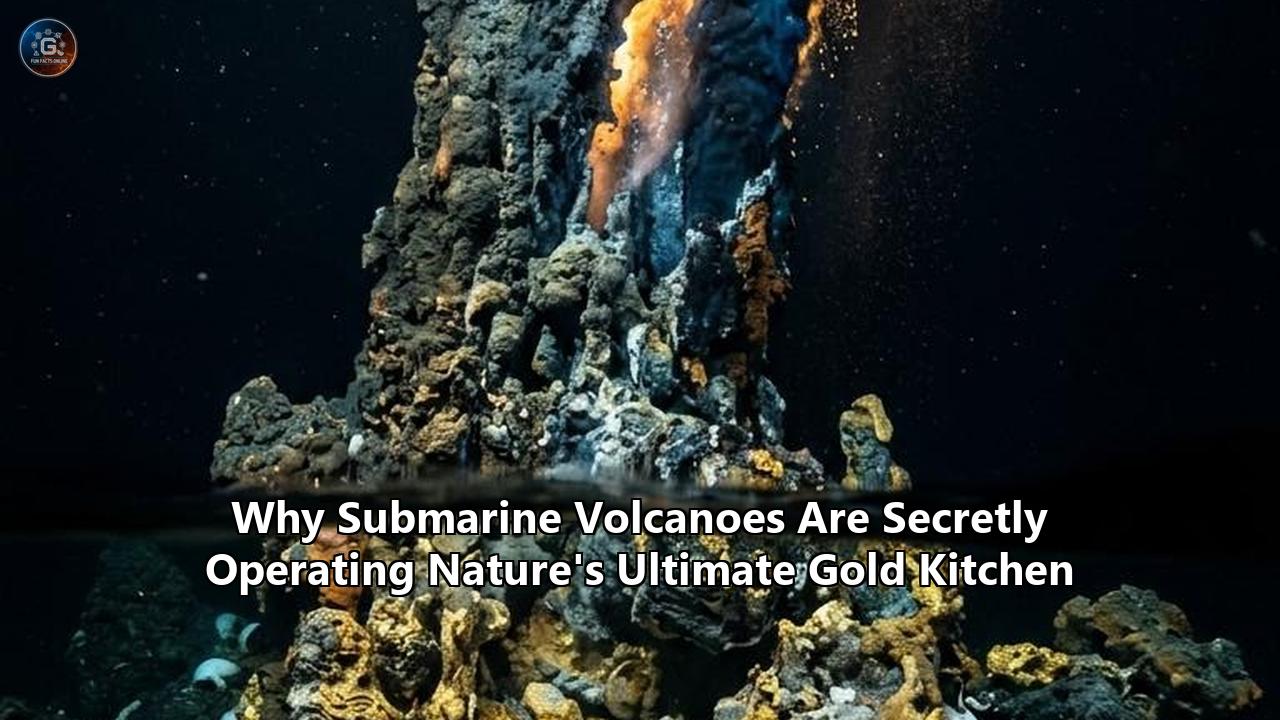
Deep beneath the ocean's surface, along subduction zones where giant tectonic plates collide, Earth is running a natural "gold kitchen." Marine geologists led by Dr. Christian Timm at the GEOMAR Helmholtz Centre for Ocean Research Kiel, alongside collaborators from the International Ocean Discovery Program (IODP), analyzed 66 volcanic glass samples recovered from the Kermadec island arc and Havre Trough in the South Pacific. Their analysis revealed that multi-stage melting of water-rich mantle rock beneath submarine volcanoes progressively enriches ascending magmas with gold long before they reach the ocean floor.
Concurrently, a research team from the University of Tokyo and Shizuoka University identified unprecedented concentrations of "invisible gold" within active hydrothermal "black smoker" chimneys at the Higashi-Aogashima knoll caldera, 350 kilometers south of Tokyo. Using secondary-ion mass spectrometry (SIMS), the scientists discovered gold locked at the atomic scale inside pyrite lattices and dispersed as micro-nanoparticles within underwater volcanic mounds—yielding some of the highest gold concentrations ever documented on the seafloor.
These twin discoveries expose a fundamental geological reality: active submarine arc volcanoes are extraordinarily efficient engines for gathering sparse precious metals from the deep mantle and cooking them into hyper-concentrated seafloor deposits. Yet, this scientific revelation introduces a critical dilemma. The extraordinary metal grades found at these submerged volcanic sites have intensified commercial interest in deep-sea mining, threatening fragile ecosystems that host life forms found nowhere else on the planet. Understanding the mechanics of these natural gold kitchens is essential not only for resolving long-standing geological mysteries, but also for addressing the environmental, technical, and regulatory challenges now looming over the deep ocean.
SUBSEA HYDROMAGMATIC GOLD REFINERY PROCESS
======================================================================
[ 1. DEEP SUBDUCTION ] ──> Subducting plate releases H2O & sulfur at 50-80 km depth.
         │
[ 2. MANTLE MELTING  ] ──> Repeated hydrous melting dissolves mantle sulfides,
                           releasing trapped gold into primary magmas.
         │
[ 3. VAPOR STRIPPING ] ──> Ascending magma degasses acidic, sulfur-rich vapors;
                           gold forms volatile complexes.
         │
[ 4. SEAFLOOR VENTING] ──> High-temp fluids (up to 300°C+) boil & hit freezing
                           seawater at black smoker chimneys.
         │
[ 5. PRECIPITATION   ] ──> Invisible gold precipitates within pyrite lattices
                           and polymetallic sulfide mounds.
======================================================================
The Arc Paradox: Why Most Volcanic Settings Are Barren While Arc Volcanoes Cook Gold
For decades, economic geologists struggled to explain why certain underwater volcanic settings are virtually devoid of gold, whereas intra-oceanic island arcs contain extraordinary concentrations. Mid-ocean ridge spreading centers—which make up more than 65,000 kilometers of underwater volcanic chains globally—produce vast volumes of basaltic crust, yet their associated hydrothermal vent chimneys typically contain less than 0.2 grams of gold per ton of mineralized rock. In contrast, volcanic arc chimneys along the Pacific Ring of Fire routinely yield gold grades exceeding 10 to 30 grams per ton, with select samples from settings like the Manus Basin in Papua New Guinea and the Izu-Bonin Arc surpassing 100 grams per ton.
This disparity stems directly from how submarine volcanoes form gold through multi-stage mantle processing. At mid-ocean ridges, primary basaltic magmas form through simple dry decompression melting of the upper mantle. In these settings, iron sulfides (such as pyrrhotite) remain insoluble in the mantle residue. Gold, which has an extreme chemical affinity for sulfur (chalco-phile behavior), stays trapped inside tiny sulfide droplets deep in the mantle as the magma ascends. Consequently, the lava that erupts at mid-ocean ridges arrives at the ocean floor already depleted of its precious metal budget.
Subduction zones operate under fundamentally different thermodynamic conditions. As an oceanic plate sinks beneath another, it carries water-saturated sediments and hydrated minerals into the hot mantle. Heat and immense pressure squeeze water and volatile gases out of the sinking slab, forcing them upward into the overlying mantle wedge.
"Our research shows that hydrous mantle melting beneath island arcs is a key driver of gold enrichment," explains Dr. Christian Timm of GEOMAR. "In these settings, the mantle behaves like a multi-stage melting system that progressively concentrates gold."
When water enters the mantle wedge, it lowers the melting point of the surrounding rock, inducing partial melting. Crucially, the addition of water and dissolved oxygen changes the chemical oxidation state of the mantle. Under these oxidized, water-rich conditions, sulfur converts from insoluble sulfide ($S^{2-}$) to soluble sulfate ($SO_4^{2-}$) or sulfur dioxide ($SO_2$). This oxidation causes the mantle’s sulfide minerals to breakdown completely. With its sulfide hosts destroyed, gold is liberated and stripped directly into the primary silicate melt.
                                      SUBDUCTION ZONE vs. MID-OCEAN RIDGE
┌──────────────────────────────────┬──────────────────────────────────┬──────────────────────────────────┐
│ Parameter                        │ Mid-Ocean Ridge (MOR)            │ Submarine Arc Volcano            │
├──────────────────────────────────┼──────────────────────────────────┼──────────────────────────────────┤
│ Primary Melting Driver           │ Dry Decompression                │ Hydrous Flux Melting             │
│ Mantle Oxidation State           │ Reduced (Low fO2)                │ Oxidized (High fO2)              │
│ Sulfide Behavior in Mantle       │ Stable (Traps Gold in Mantle)    │ Dissolved/Oxidized (Releases Au) │
│ Fluid Phase Contributions        │ Pure Seawater Circulation        │ Seawater + Acidic Magmatic Vapors│
│ Typical Vent Gold Grades         │ < 0.5 g/t Au                     │ 5.0 to 100+ g/t Au               │
│ Primary Ore Minerals             │ Chalcopyrite, Isocubanite, Pyrite│ Pyrite, Bornite, Sphalerite, Au-S│
└──────────────────────────────────┴──────────────────────────────────┴──────────────────────────────────┘
Repeated episodes of this hydrous melting act as a natural distillation sequence. Each successive melt extraction enriches the remaining magma in gold, preparing a metal-loaded fluid that eventually ascends toward the subseafloor magma chamber.
The Subseafloor Distillery: Vapor Refining and Invisible Gold
Once gold-enriched magma accumulates in shallow chambers beneath a submarine volcano—often only 1 to 4 kilometers beneath the seabed—a secondary, highly aggressive fluid refining system takes over. As the magma cools and crystallizes, it exsolves a separate, volatile-rich gas phase dominated by water vapor, sulfur dioxide ($SO_2$), hydrogen chloride ($HCl$), and hydrogen sulfide ($H_2S$).
At this depth and temperature (typically between 400°C and 800°C), gold forms extraordinarily strong chemical complexes with sulfur and chlorine in the vapor phase. Recent thermodynamic modeling demonstrates that a specialized chemical species—the gold-trisulfur complex ($Au(HS)_2^-$ or volatile sulfur-bound complexes)—allows gold to be partitioned preferentially into acidic magmatic vapors rather than remaining in the cooling rock.
These hot, buoyant, gas-rich plumes expand rapidly upward toward the seafloor through networks of faults, caldera collapse fractures, and volcanic breccias. During this ascent, the superheated magmatic gas encounters cold seawater circulating through the permeable oceanic crust. This mixing zone serves as the primary precipitation trigger within the underwater volcano's "kitchen."
When acidic, metal-bearing fluids hit the near-freezing (2°C), alkaline seawater at the seafloor interface, the chemical equilibrium collapses. The sudden drops in temperature, coupled with rapid changes in fluid pH and oxidation state, force dissolved metals out of solution. Copper, zinc, iron, and lead precipitate rapidly as polymetallic sulfide minerals, building towering "black smoker" chimneys that can grow several meters per year.
                         HYDROTHERMAL CHIMNEY INTERIOR ZONATION

                          [ Cold Seawater Ambient (2°C) ]
                                         │
                 ┌───────────────────────┴───────────────────────┐
                 │          OUTER WALL: Fe-Oxides, Silica       │
                 │ ───────────────────────────────────────────── │
                 │      MIDDLE ZONE: Pyrite + Invisible Gold     │
                 │      (Gold atom lattice substitute & Nano-Au) │
                 │ ───────────────────────────────────────────── │
                 │      INNER CORE: High-Temp Chalcopyrite       │
                 │      (Boiling Fluid Core: 300°C - 380°C)     │
                 └───────────────────────┬───────────────────────┘
                                         │
                          [ Acidic Magmatic Fluid Upflow ]
The specific chemistry of how submarine volcanoes form gold involves two distinct modes of mineral precipitation at the chimney site:
- Native Gold Micro-Nanoparticles: As the hydrothermal fluid boils or mixes with cold seawater, gold dissolved as bisulfide complexes destabilizes. Microscopic metallic gold grains, often ranging from 10 nanometers to a few micrometers in diameter, aggregate along the boundaries of growing sulfide crystals.
- Invisible Lattice-Bound Gold: At high growth rates, gold atoms substitute directly into the crystal matrix of iron sulfide minerals—principally pyrite ($FeS_2$) and arsenian pyrite. In these instances, gold ($Au^{1+}$ or $Au^{3+}$) is chemically bound inside the crystal lattice of "fool's gold," rendering it totally invisible under standard optical microscopes.
At the Higashi-Aogashima knoll caldera off Japan, SIMS analysis confirmed that invisible gold bound inside fine-grained pyrite accounts for the vast majority of the site's record gold concentrations. Rather than forming visible gold nuggets, the submarine volcano coats the subseafloor with vast tonnages of gold-bearing pyritic muds, stockwork veins, and massive sulfide mounds.
                     SUBSEA HYDROTHERMAL VENT FLUID DYNAMICS

   [ Submarine Vent Chimney ]
            ││  <-- Black smoker plume (300°C - 350°C)
            ││      High concentration of Fe, Cu, Zn, Au-nanoparticles
          ┌─┴┴─┐
   ───────┘    └─────── [ Seafloor Bedrock ]
     │               │
     │  MIXING ZONE  │  Seawater (2°C) penetrates fractures, mixing with
     │               │  rising magmatic fluids. Pressure drop induces boiling.
     │   ┌───────┐   │
     └───┤ MAGMA ├───┘  Sub-seafloor Magma Chamber (1-3 km depth)
         │ CHAMBER│     Exsolves acidic $SO_2$, $HCl$, and $H_2S$ gas phase.
         └───────┘     Gold partitioned into volatile vapor phase.
Drilling the Inferno: Insights from Brothers Volcano
To observe these hidden subterranean processes in real time, the International Ocean Discovery Program (IODP) executed Expedition 376, drilling deep into Brothers Volcano along the Kermadec Arc. Brothers Volcano is an active submarine caldera whose floor lies 1,850 meters below sea level, surrounded by steep caldera walls rising over 400 meters high.
Researchers drilled five holes beneath the caldera floor, penetrating up to 453 meters into active hydrothermal conduits. The expedition provided direct physical proof that a single submarine volcano can host two entirely different mineral-generating systems simultaneously:
- The Northwest Caldera Wall System: A seawater-dominated, mature hydrothermal site. Here, seawater circulates deep through fractured dacitic volcanic rock, heating to over 300°C and discharging through classic black smoker chimneys composed of chalcopyrite, pyrite, and sphalerite. This site represents a long-term, steady-state copper-gold concentrating engine.
- The Upper Cone Site: A nascent, magmatic-dominated system located on a resurgent volcanic cone inside the caldera. Fluids discharging here are intensely acidic (pH as low as 1.8—equivalent to battery acid), gas-rich, and laden with magmatic vapors. The extreme acidity bleaches the surrounding volcanic rock into native sulfur, pyrophyllite, and alunite, creating porous silica-rich zones that trap gold transported by ascending gas bubbles.
Dr. Cornel de Ronde, Principal Scientist at New Zealand’s GNS Science and co-chief scientist of the expedition, noted that deep drilling inside Brothers Volcano revealed the true 3D architecture of seafloor mineral deposits. The core samples established that gold enrichment is not restricted to the fragile surface chimneys seen on camera; it extends hundreds of meters down into the permeable volcanic breccias underlying the caldera floor.
                     BROTHERS VOLCANO CALDERA CROSS-SECTION

        NW Caldera Wall                        Resurgent Upper Cone
   [ Black Smokers: 302°C ]                   [ Acidic Vents: pH 1.8 ]
            │                                           │
   Seawater-Dominated Fluid                   Magmatic Volatile-Dominated
  (Chalcopyrite + Pyrite)                    (Native Sulfur + Alunite)
            │                                           │
   ┌────────────────┐                          ┌────────────────┐
   │ Deep Conduits  │                          │ Acid Leaching  │
   │ Seawater Mix   │                          │ Silicified     │
   └───────┬────────┘                          └───────┬────────┘
           │                                           │
           └───────────────────┬───────────────────────┘
                               │
                [ DACITIC MAGMA CHAMBER (1.5 km) ]
The Problem: Environmental Vulnerability, Technical Hazards, and Mining Pitfalls
The realization that submarine volcanoes construct immense deposits of gold, copper, and critical technology metals has sparked intense commercial interest. Mining consortiums and state-backed entities have sought to secure exploration licenses for Seafloor Massive Sulfide (SMS) deposits located within National Exclusive Economic Zones (EEZs) and international waters governed by the International Seabed Authority (ISA).
However, translating the science of how submarine volcanoes form gold into a viable commercial extraction model has proven to be an operational, environmental, and financial nightmare.
               THE TRIANGLE OF SUBSEA EXTRACTION CHALLENGES

                         TECHNICAL HAZARDS
                        /                 \
                       /                   \
                      /   Deep-Sea Mining   \
                     /       Dilemma         \
                    /                         \
                   /                           \
   ENVIRONMENTAL RUIN ────────────────── FINANCIAL REASONING
1. Ecosystem Destruction in Extreme Environments
Active hydrothermal vents are not barren rocks; they host some of the densest, most specialized marine ecosystems on Earth. Deprived of sunlight, these communities rely entirely on chemosynthetic bacteria that derive energy by oxidizing toxic sulfides emitted by the volcano.
- Endemic Species: Hydrothermal vents host extremophilic life forms, including giant tubeworms (Riftia pachyptila), scaly-foot snails (Chrysomallon squamiferum), and vent shrimp (Rimicaris) that survive in water laden with toxic metals and acid.
- Habitat Fragility: Vent fauna are tied directly to specific active hydrothermal fluid conduits. Removing active chimneys or destroying stockwork zones with heavy seafloor crawling machinery eliminates these biological habitats completely.
- Sediment Plumes: Grinding seafloor sulfide rock generates massive underwater plumes of fine, metal-rich toxic dust. These plumes travel tens or hundreds of kilometers in deep ocean currents, smothering filter-feeding organisms and toxicifying midwater marine food webs.
HYDROTHERMAL VENT ECOSYSTEM TROPHIC STRUCTURE
======================================================================
[ PRIMARY PRODUCERS ] Chemosynthetic Archaea & Bacteria (Oxidize H2S)
         │
[ PRIMARY CONSUMERS ] Tubeworms (Riftia), Vent Mussels, Scaly-foot Snails
         │
[ SECONDARY PREDATORS] Vent Crabs, Eelpouts, Deep-Sea Zoarcid Fish
======================================================================
2. The Legacy of Commercial Collapse: The Solwara 1 Cautionary Tale
The risks of seabed mining were highlighted by the collapse of Nautilus Minerals and its flagship "Solwara 1" project. Located at a depth of 1,600 meters in the Bismarck Sea off Papua New Guinea, Solwara 1 was set to become the world’s first commercial deep-sea gold-copper mine. The deposit was touted as containing gold grades exceeding 10 grams per ton—nearly ten times higher than typical land mines.
Despite acquiring specialized underwater crawling cutters, riser pumping systems, and surface support vessels, the project collapsed into bankruptcy. Nautilus faced mounting technical delays, soaring capital costs, intense opposition from indigenous coastal communities, and lawsuits over inadequate environmental impact statements. The venture left the Papua New Guinean government with over $120 million in lost public equity and served as a stark warning about the immense financial hazards of deep-sea mining.
NAUTILUS MINERALS / SOLWARA 1 LESSONS
----------------------------------------------------------------------
• Target: High-grade copper-gold SMS deposit (Bismarck Sea, PNG)
• Depth: ~1,600 meters below sea level
• Promised Yield: >10 g/t Gold, >7% Copper
• Failure Factors:
  1. Excessive capital expenditure for bespoke subsea machines
  2. Severe corrosive damage from hyper-acidic subsea vent fluids
  3. Devastating opposition from local communities and environmental coalitions
  4. Inability to secure insurance for operations in active volcanic zones
• Outcome: Corporate insolvency, total write-down of public investments
----------------------------------------------------------------------
3. Technical Hazards: Corrosion, Pressure, and Refractory Ore
Extracting metal from active submarine volcanoes requires operating heavy machinery under extreme pressure (over 150 to 300 atmospheres) in contact with hyper-acidic, mineral-precipitating fluids reaching 300°C.
Furthermore, because much of the gold at submarine volcano sites exists as "invisible gold" bound inside fine-grained pyrite lattices, simple physical separation on surface ships is impossible. Processing pyrite-locked gold requires complex pyrometallurgical smelting or pressure-acid leaching—processes that are chemically intensive, energy demanding, and environmentally toxic if attempted offshore.
              THE REFRACTORY "INVISIBLE GOLD" PROCESSING BARRIER

   [ Seafloor Ore Extraction ]
                │
                ▼
   [ Pyrite Crystal Matrix ] ──> Gold atoms ($Au^{1+}$) locked inside $FeS_2$ lattice
                │
                ├─► Physical Gravity Separation?   [ FAILED: Gold too small ]
                ├─► Standard Cyanidation Flotation? [ FAILED: Chemical barrier ]
                │
                ▼
   [ ADVANCED HYDROMETALLURGICAL ROASTING REQUIRED ]
   • Requires 600°C+ roasting or high-pressure oxygen autoclaving to break pyrite
   • Generates toxic $SO_2$ gas and heavy-metal tailings
   • Completely unviable for on-ship or at-sea mineral processing
The Solution: Non-Destructive Mapping, Onshore Translation, and Global Conservation
Faced with these ecological, technical, and commercial challenges, a consensus is emerging among oceanographers, geologists, and environmental policy leaders: submarine volcanoes should be utilized as natural laboratories rather than active mining pits.
By studying active gold-forming processes in the ocean, scientists and industrial leaders are unlocking solutions to terrestrial resource demands without dredging the ocean floor.
                     THREE-PRONGED STRATEGIC SOLUTION

   ┌──────────────────────────────────────────────────────────────────┐
   │  1. ONSHORE TRANSLATION: Using marine blueprints to find ancient │
   │     uplifted VMS deposits on land.                │
   ├──────────────────────────────────────────────────────────────────┤
   │  2. ADVANCED IMAGING: Deploying SIMS, AUVs, and IODP drilling    │
   │     for non-destructive seafloor research.        │
   ├──────────────────────────────────────────────────────────────────┤
   │  3. INTERNATIONAL LEGISLATION: Enforcing ISA moratoriums &       │
   │     establishing Marine Protected Areas (MPAs).          │
   └──────────────────────────────────────────────────────────────────┘
1. Translating Marine Blueprints to Onshore Prospecting
The primary value of discovering how submarine volcanoes form gold lies in applying these models to ancient volcanic terrains exposed on land. Throughout Earth's history, ancient ocean basins were uplifted onto continental margins by plate tectonics. These uplifted marine volcanic rocks form Volcanogenic Massive Sulfide (VMS) and epithermal gold deposits that are now safely accessible on dry land.
               CONTINENTAL UPLIFT: ANCIENT VMS DEPOSIT FORMATION

   PALEO-OCEANIC ARC (200 Million Years Ago)
   Submarine volcano forms gold-rich SMS deposit on ancient seafloor.
                          │
                          ▼  [ Tectonic Collision & Orogeny ]
   UPLIFTED CONTINENTAL MARGIN (Present Day)
   Seafloor strata scraped onto land; mined safely using terrestrial infrastructure.
   Examples: Abitibi Belt (Canada), Troodos Ophiolite (Cyprus), Mount Lyell (Australia).
By establishing the precise geochemical markers that signal high-grade gold formation—such as specific sulfur isotope ratios, alteration mineral patterns (e.g., pyrophyllite and alunite assemblages), and trace-element signatures—economic geologists can identify high-yield gold zones within land-based VMS systems.
- The Abitibi Greenstone Belt (Canada): One of the world’s richest gold and base metal districts, the Abitibi Belt formed as a cluster of submarine arc volcanoes over 2.6 billion years ago. Modern deep-sea data from Brothers Volcano and the Kermadec Arc allow geologists to target hidden, high-grade gold zones within these ancient rocks.
- The Mount Read Volcanics (Tasmania, Australia): The Rosebery and Mount Lyell deposits represent ancient seafloor hydrothermal systems. Applying magmatic-vapor degassing models developed at subsea calderas has allowed exploration companies to identify deeper ore bodies without exploratory trial-and-error.
"Ancient equivalents of modern seafloor hydrothermal systems like that at Brothers can be uplifted by tectonic forces where they are subsequently mined for their metal-rich minerals," notes Dr. de Ronde. "Understanding the seafloor mineralization of these critical metals has scientific and economic value with implications for security of supply."
2. High-Precision, Non-Destructive Subsea Imaging
Rather than destroying vent fields through excavation, international marine consortiums are deploying non-destructive mapping technologies to study subsea mineral systems.
                     ADVANCED SEAFLOOR DIAGNOSTIC TOOLS
┌─────────────────────────┬─────────────────────────────────────────────────────────┐
│ Technology              │ Application in Submarine Volcano Research               │
├─────────────────────────┼─────────────────────────────────────────────────────────┤
│ Secondary-Ion Mass      │ Maps invisible, lattice-bound gold nanoparticles inside │
│ Spectrometry (SIMS)     │ pyrite without destroying sample structures.     │
├─────────────────────────┼─────────────────────────────────────────────────────────┤
│ Remotely Operated       │ Collects high-definition 4K visual, thermal, and fluid  │
│ Vehicles (ROV Jason)    │ chemistry samples with millimeter precision.    │
├─────────────────────────┼─────────────────────────────────────────────────────────┤
│ Sub-seafloor Scientific │ Drills narrow core holes to map 3D ore distribution     │
│ Drilling (IODP)         │ while sealing holes to protect hydrothermal flow.│
└─────────────────────────┴─────────────────────────────────────────────────────────┘
By utilizing high-resolution AUV bathymetry, 3D seismic tomography, and remotely operated vehicle (ROV) fluid sampling, geologists can trace fluid flow paths and metal transport mechanisms in real time. These non-invasive diagnostic tools allow scientists to build complete thermodynamic models of metal transport without disturbing fragile biological vent communities.
                          ROV JASON UNDERWATER DIAGNOSTICS

         ┌─────────────────────────────────────────────────────────┐
         │                  ROV JASON / MEDEA                      │
         │  [4K Imaging] [Fluid Sampler] [Laser Raman Spectrometer]│
         └──────────────────────────┬──────────────────────────────┘
                                    │
                                    ▼
       ┌──────────────────────────────────────────────────────────────┐
       │             NON-DESTRUCTIVE SITE ANALYSIS                    │
       │ • Measures venting fluid pH and gas composition      │
       │ • Maps temperature gradients across chimney walls            │
       │ • Samples mineral crusts with targeted robotic micro-arms    │
       └──────────────────────────────────────────────────────────────┘
3. International Environmental Protection Frameworks
To prevent reckless exploitation of subsea gold kitchens, ocean scientists and policy leaders are advancing international conservation initiatives.
- International Seabed Authority (ISA) Moratoriums: A growing coalition of nations—including France, Germany, Canada, New Zealand, and numerous Pacific Island states—have called for a precautionary pause or ban on commercial deep-sea mining in international waters.
- Marine Protected Areas (MPAs): Governments are designating marine sanctuaries over hydrothermally active volcanic arcs. New Zealand’s proposed Kermadec Ocean Sanctuary aims to cover 620,000 square kilometers, protecting the volcanoes, hydrothermal vents, and endemic fauna of the Kermadec Arc from mining, dredging, and industrial fishing.
- The Common Heritage Principle: Under the United Nations Convention on the Law of the Sea (UNCLOS), deep-ocean mineral deposits in international waters are designated as the "common heritage of mankind," requiring strict collective environmental stewardship over private commercial extraction.
                    INTERNATIONAL SEABED GOVERNANCE MATRIX
----------------------------------------------------------------------------------
REGIONAL JURISDICTION      GOVERNING BODY         CURRENT LEGISLATIVE STATUS
----------------------------------------------------------------------------------
Exclusive Economic Zones   National Governments   Mixed: Moratoriums enacted by NZ,
(EEZs, <200 nautical miles)(e.g., PNG, Japan, NZ) Chile; exploration paused.

The Area                   International Seabed   Mining code stalled; strong global
(International Waters)     Authority (ISA)        push for a precautionary pause/ban.

Active Arc Sanctuaries     Marine Protected Area  Total protection enforced; mining
(e.g., Kermadec Sanctuary) Management Frameworks  and industrial extraction banned.
----------------------------------------------------------------------------------
The Horizon: What Lies Ahead for Seafloor Science
The discovery of Earth's subsea gold kitchen fundamentally reshapes our understanding of how precious metals circulate between the mantle, ocean crust, and surface environment. Far from being static piles of rock, active submarine volcanoes are dynamic chemical refineries that continuously concentrate elements essential for modern technology.
In the coming years, research expeditions led by GEOMAR, the Woods Hole Oceanographic Institution (WHOI), and Japan’s Agency for Marine-Earth Science and Technology (JAMSTEC) will explore unmapped volcanic arcs across the South Pacific and Antarctic waters. Key questions remain centered on the global budget of subsea mineralization:
- What total volume of gold and critical minerals is transferred from the Earth's mantle into the ocean crust each year?
- How will changing ocean temperatures, acidification, and circulation alter the chemical stability of subsea mineral mounds?
- Can advanced biotechnologies—such as using extremophilic vent bacteria to bio-leach metals from low-grade land deposits—eliminate the perceived demand for seafloor mining altogether?
                     FUTURE RESEARCH MILESTONES & TIMELINE

  2026 - 2027 ───> Deployment of autonomous subsea drill rigs for real-time
                   hydrothermal fluid chemistry monitoring.

  2027 - 2028 ───> Global ISA vote on deep-sea mining regulations and environmental
                   threshold standards.

  2028 - 2030 ───> Advanced machine-learning integration mapping terrestrial VMS
                   targets using marine arc geochemical databases.
By recognizing that the ultimate value of submarine volcanoes lies in scientific insight rather than raw exploitation, humanity can protect the Earth's deepest marine ecosystems while acquiring the geological intelligence required to supply its resource needs on land. Ocean science continues to prove that Earth's most complex chemical secrets are cooked up in the deep ocean dark, where fiery subduction processes forge the planet's hidden gold.
Reference:
- https://www.sciencedaily.com/releases/2026/07/260727214628.htm
- https://ecomagazine.com/news/research/seafloor-investigation-links-gold-deposits-with-subduction-zones/
- https://timesofindia.indiatimes.com/science/scientists-discover-record-breaking-invisible-gold-forming-inside-underwater-volcano-off-japan/articleshow/132468595.cms
- https://www.sciencealert.com/scientists-found-invisible-gold-hiding-in-the-seafloor-at-record-breaking-concentrations
- https://www.forbes.com/sites/davidbressan/2024/12/25/new-study-explains-how-gold-reaches-earths-surface/
- https://website.whoi.edu/gfd/wp-content/uploads/sites/14/2018/10/Hedenquist_and_Lowenstern_1994_202624.pdf
- https://www.researchgate.net/publication/236324021_Submarine_hydrothermal_activity_and_gold-rich_mineralization_at_Brothers_Volcano_Kermadec_Arc_New_Zealand
- https://www.usgs.gov/publications/magmatic-vapor-expansion-and-formation-high-sulfidation-gold-deposits-structural
- https://divediscover.whoi.edu/expedition16/mission/
- https://pubs.geoscienceworld.org/segweb/economicgeology/article/118/7/1657/615251/Hydrothermal-Alteration-Within-the-Brothers
- https://www.gns.cri.nz/news/special-issue-of-economic-geology-demonstrates-gnss-key-role/
- https://www.youtube.com/watch?v=TlzTJMVGn70