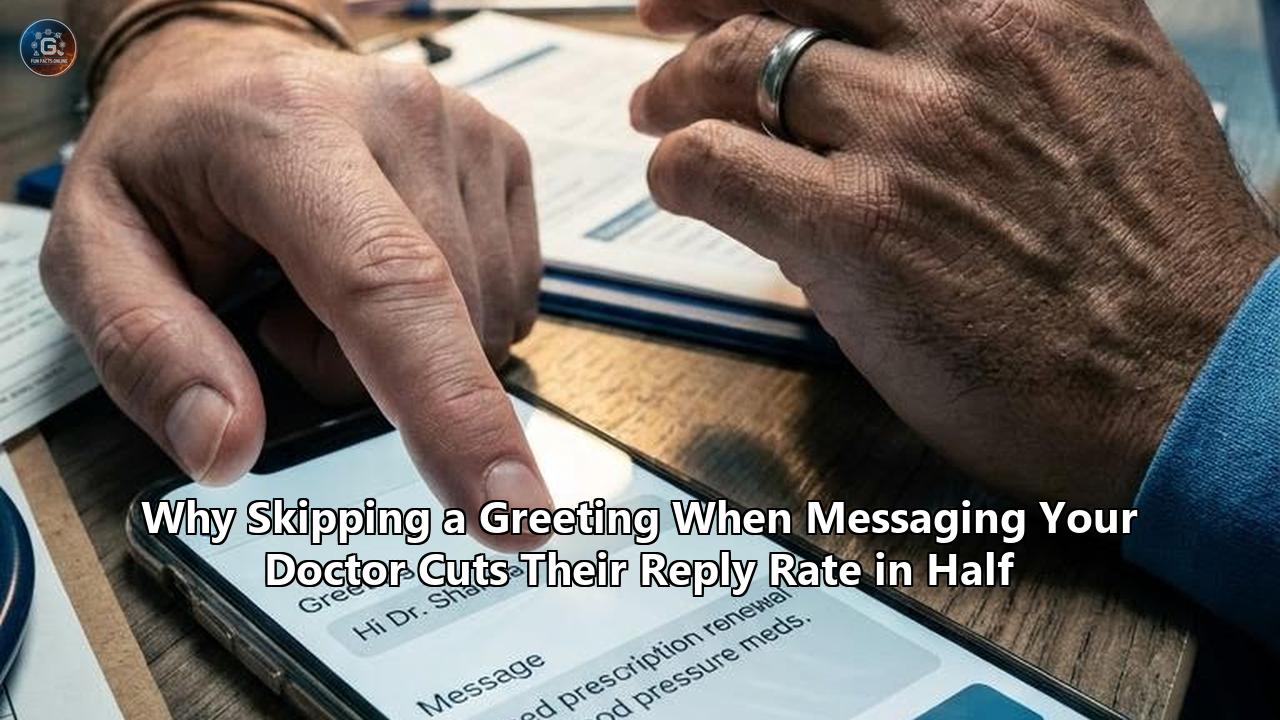
A brief opening salutation—or the complete absence of one—fundamentally alters whether a physician directly reads and answers an electronic message sent through a patient portal. In a study published in JAMA Network Open, researchers from Columbia University, Harvard University, and Mass General Brigham analyzed more than 3.6 million patient portal message threads across hundreds of outpatient practices. They discovered that messages omitting a greeting saw the probability of a direct reply from the intended physician drop precipitously compared to those opening with a formal clinician salutation.
When patients included the clinician’s last name in their opening line (such as "Dear Dr. Smith"), the target physician responded 38.7% of the time. When messages opened using the clinician's first name, direct response rates climbed higher still, nearly doubling the rate seen in unaddressed messages. In stark contrast, portal messages that skipped a greeting altogether and jumped straight into the clinical question managed an intended-physician response rate of just 25.7%.
The findings uncover a structural vulnerability in digital healthcare delivery: linguistic styling, rather than the objective severity of medical symptoms, plays a decisive role in determining which patient communications reach a doctor's eyes and which are diverted, handled by secondary staff, or left unanswered.
The research team, led by Dr. Mitchell Tang, an assistant professor of health policy and management at Columbia University’s Mailman School of Public Health, found that writing style accounted for roughly half of the documented racial, educational, and socioeconomic disparities in physician reply rates. While medical content differences explained almost none of the demographic gap in clinician responses, superficial features—primarily greetings, word count, punctuation, and tone—systematically determined workflow routing.
+-------------------------------------------------------------------------+
|                  CLINICIAN RESPONSE RATE BY MESSAGE STYLE               |
+-------------------------------------------------------------------------+
| Addressed with Last Name ("Dear Dr. [Name]")  | [████████████████] 38.7%|
| Addressed with First Name                     | [█████████████████] ~48%|
| No Greeting (Direct Symptom/Request)          | [███████████] 25.7%     |
+-------------------------------------------------------------------------+
| Word Count: 200+ Words                        | [████████████████████]  |
|                                               | 49.7% Target Response   |
| Word Count: 25 Words or Fewer                 | [█████████] 21.0%       |
+-------------------------------------------------------------------------+
Deconstructing the Triage Mechanism: Why Salutations Dictate Routing
To understand why a missing greeting produces such a steep penalty, one must examine the operational architecture of electronic health record (EHR) inboxes. In modern health systems running platforms like Epic Systems, Cerner, or Athenahealth, incoming patient messages rarely land immediately on a doctor's personal screen. Instead, they enter a centralized pool or a practice-level triage queue.
In typical ambulatory workflows, medical assistants (MAs), licensed practical nurses (LPNs), registered nurses (RNs), and clinical administrative coordinators sit between the patient portal interface and the licensed independent practitioner. These front-line staff members review hundreds of incoming electronic threads daily, performing rapid cognitive triage with limited contextual data.
                                  PATIENT PORTAL MESSAGE
                                            │
                                            ▼
                           ┌─────────────────────────────────┐
                           │      CENTRAL TRIAGE QUEUE       │
                           │  (Reviewed by MAs, LPNs, RNs)   │
                           └────────────────┬────────────────┘
                                            │
                    ┌───────────────────────┴───────────────────────┐
                    ▼                                               ▼
     ┌─────────────────────────────┐                 ┌─────────────────────────────┐
     │      FORMAL & SPECIFIC      │                 │       BLUNT & SHORT         │
     │  - Includes Doctor's Name   │                 │  - No Greeting              │
     │  - Narrative Context        │                 │  - Direct Request           │
     │  - Expressive Punctuation   │                 │  - <25 Words                │
     └──────────────┬──────────────┘                 └──────────────┬──────────────┘
                    │                                               │
                    ▼                                               ▼
     ┌─────────────────────────────┐                 ┌─────────────────────────────┐
     │ Forwarded Directly to       │                 │ Handled by Support Staff    │
     │ Intended Physician          │                 │ or Deferred/Deprioritized   │
     │ (38.7% - 49.7% Escalate)    │                 │ (21.0% - 25.7% Escalate)    │
     └─────────────────────────────┘                 └─────────────────────────────┘
Staff must make split-second routing determinations based on three core considerations:
- Is this an administrative task (such as an appointment reschedule or billing question)?
- Is this a routine clinical task governed by standing orders (such as a standard medication refill or basic laboratory notification)?
- Is this a nuanced clinical inquiry requiring the diagnostic reasoning or medical judgment of the attending physician?
The presence of a specific, personalized greeting acts as a powerful heuristic in this triage process. When a message opens with "Dear Dr. Tang" or "Hello Dr. Johnson," triage staff interpret the message as an intentional, direct doctor-patient dialogue rather than an open-ended request intended for generic office processing. The greeting personalizes the text, creating social accountability that signals the sender expects the physician herself to read and evaluate the contents.
Conversely, when a message opens bluntly with "Need refill" or "Chest feels tight since Tuesday," human triagers classify the communication as an impersonal ticket. In an environment where support staff are incentivized to protect clinicians from inbox overwhelm, messages devoid of relational pleasantries or direct clinician names are far more likely to be intercepted, addressed via protocol by an assistant, or deferred.
+-------------------------------------------------------------------------+
|                  PRIMARY DETERMINANTS OF MESSAGE ROUTING                |
+-------------------------------------------------------------------------+
| Factor                   | High Escalation Likelihood | Low Escalation  |
|                          | (Reaches Doctor)           | (Handled/Stall) |
+--------------------------+----------------------------+-----------------+
| Opening Salutation       | Addressed by Name          | No Greeting     |
| Message Length           | 100-200+ Words             | <25 Words       |
| Punctuation Style        | Expressive (??, !)         | Single/Flat (.) |
| Tone / Sentiment         | Warm, Grateful, Anxious    | Blunt, Terse    |
| Reading Level            | 6th to 9th Grade           | Very Low / High |
+-------------------------------------------------------------------------+
The Role of Linguistic Texture: Length, Punctuation, and Sentiment
Salutations are not the only stylistic elements tipping the scales. The research team applied natural language processing (NLP) to evaluate how length, syntax, emotional tone, and lexical complexity alter message pathways.
- Message Word Count: Length proved to be one of the strongest structural predictors of direct escalation. Message threads extending to 200 words or more reached the intended clinician 49.7% of the time. Messages comprising 25 words or fewer dropped to a 21.0% clinician response rate. The statistical models demonstrated an 18.7-percentage-point penalty on messages containing three words or fewer. Triage workers subconsciously correlate length with complexity and narrative importance, assuming that a long message represents a comprehensive clinical history that demands physician evaluation.
- Expressive Punctuation: Messages that incorporated expressive punctuation—such as question marks (? or ??) and exclamation points (!)—generated consistently higher physician reply rates than messages that relied strictly on periods or flat phrasing. Multiple punctuation marks appear to communicate patient distress or active uncertainty, which signals clinical urgency to triage staff.
- Sentiment and Politeness Patterns: Positive emotional valence (expressions of warmth, appreciation, or relational connection) tracked with increased physician engagement. Expressions of frustration, anger, or sadness yielded slightly reduced direct clinician responses.
- The "Please" Anomaly: In an unadjusted finding, messages containing the word "please" reached the intended clinician less often (26.8%) than messages without the word (33.8%). This statistical inversion does not indicate that courtesy is penalized; rather, "please" is disproportionately clustered in short, transactional requests (e.g., "Please refill my lisinopril" or "Please send my chart notes"), which are automatically routed to pharmacy technicians or clinical staff rather than physicians.
- Reading Level Nonlinearity: Response rates peaked among messages written between a sixth-grade and ninth-grade reading level. Rates declined for messages written at very low reading levels (which frequently lack syntactic cohesion) and dropped off for messages at postgraduate reading levels (which can obscure acute questions beneath dense terminology).
Who Is Affected: Quantifying the Health Equity Divide
The systematic bias introduced by writing style does not fall evenly across the patient population. The study's demographic decomposition reveals that stylistic sorting directly exacerbates long-standing racial, socioeconomic, and educational inequities in healthcare access.
+-------------------------------------------------------------------------+
|       WRITING STYLE AS SHARE OF TOTAL DEMOGRAPHIC RESPONSE GAP          |
+-------------------------------------------------------------------------+
| High School Education vs. College Degree  | [████████████████████] 60.5%|
| Black Patients vs. White Patients        | [████████████████] 48.0%    |
| Medicaid Beneficiaries vs. Commercial Ins | [██████████████] 42.8%      |
| Hispanic Patients vs. Non-Hispanic White  | [███████████] 34.9%         |
+-------------------------------------------------------------------------+
| Source: Analysis of JAMA Network Open Data (Tang et al.)                |
+-------------------------------------------------------------------------+
Across the 3.6-million-message dataset, baseline response disparities were pervasive:
- Black patients experienced a 3.7-percentage-point lower rate of receiving an intended-doctor response compared with White patients, representing an 11.6% relative reduction from baseline.
- Patients holding only a high school diploma or less faced substantial direct-response deficits relative to individuals with a bachelor’s or postgraduate degree.
- Patients insured through Medicaid experienced marked response penalties compared to commercially insured cohorts.
+-------------------------------------------------------------------------+
|               HOW CONTENT VS. STYLE DRIVES THE DISPARITY GAP            |
+-------------------------------------------------------------------------+
| Demographic Group   | Share Explained by Style | Share Explained by     |
| Comparison          | (Greeting, Length, Tone) | Content (Symptom Type) |
+---------------------+--------------------------+------------------------+
| Black vs. White     | 48.0%                    | 5.7%                   |
| High School vs. BA+ | 60.5%                    | 12.7%                  |
| Medicaid vs. Private| 42.8%                    | 10.1%                  |
| Hispanic vs. White  | 34.9%                    | -2.4% (Protective)     |
+-------------------------------------------------------------------------+
When the investigators isolated the underlying medical issues—evaluating whether the messages were about cardiovascular symptoms, diabetes management, acute respiratory complaints, or administrative refills—the clinical content accounted for only 5.7% of the physician response gap between Black and White patients. Content accounted for only 12.7% of the gap between educational tiers, and 10.1% of the gap between Medicaid and private insurance holders.
Writing style accounted for 48.0% of the entire clinician response gap for Black patients, 34.9% for Hispanic patients, 60.5% for patients with a high school education, and 42.8% for Medicaid recipients.
Patients from historically marginalized backgrounds are more likely to send messages characterized by brief syntax, direct phrasing, and an absence of formal epistolary salutations. Conversely, patients with higher socioeconomic status and advanced formal education frequently frame their messages using structural conventions mirroring professional business correspondence: opening with formal titles, organizing clinical events chronologically, providing polite framing context, and closing with expressions of gratitude.
The healthcare system rewards these specific sociolinguistic conventions with higher levels of clinical escalation and direct physician contact, effectively penalizing patients who write without administrative polish.
What Changes for Patients: The Asymmetrical Demands of Digital Healthcare
When electronic patient portals were initially deployed nationwide following the Health Information Technology for Economic and Clinical Health (HITECH) Act of 2009, health systems promoted them as equitable tools designed to democratize access. Patients were instructed that portal messaging provided a direct, friction-free channel to their clinical team.
The reality uncovered by recent informatics research proves that the portal is not an open channel, but an unwritten behavioral exam. For patients, navigating digital portals has introduced substantial cognitive and operational hurdles.
The Paradox of Brevity Instructions
Patients are frequently given contradictory advice regarding digital communication. Clinic brochures, portal welcome screens, and triage guidelines routinely urge patients to "keep messages brief," "stick to one topic," and "be concise."
                             THE PATIENT PARADOX

     OFFICIAL CLINIC GUIDANCE                   ACTUAL INBOX REALITY
┌─────────────────────────────────┐        ┌─────────────────────────────────┐
│ • "Keep your messages brief."   │        │ • Brief messages (<25 words)    │
│ • "Focus on a single topic."    │  VS.   │   suffer a 21% response rate.   │
│ • "Be direct and concise."      │        │ • Narrative messages (200+ wds) │
│                                 │        │   achieve a 49.7% response rate.│
└─────────────────────────────────┘        └─────────────────────────────────┘
The study proves that following this advice can impair access to care. When patients follow the recommendation to be brief and concise, they omit contextual greetings and narrative details. In doing so, they inadvertently suppress their message's algorithmic and human priority score, increasing the odds that their question is categorized as low complexity and routed away from the doctor.
Patients who inadvertently succeed in engaging their doctors are those who ignore the official guidance and write expansive, conversational, polite letters that mimic executive correspondence.
The Mobile Interface Penalty
Socioeconomic disparities in messaging style are heavily amplified by the hardware used to access healthcare portals. Lower-income individuals and Medicaid beneficiaries access patient portals primarily via smartphones using mobile browsers or native apps like Epic MyChart. Higher-income and formally educated patients disproportionately use desktop computers or laptops with full physical keyboards.
Mobile interfaces naturally encourage short, SMS-style text entry:
- Autocorrect and small on-screen keyboards discourage typing out formal greetings like "Dear Dr. Tang,".
- Mobile users tend to type fragmented, sentence-free queries ("fever 101 since 3am what should i take").
- Text boxes on mobile screens present narrow viewports that psychologically discourage long narrative descriptions.
Desktop users, by comparison, are accustomed to composing traditional emails. They naturally include formal salutations, blank line breaks, structural context, and closing signatures. As a result, the physical device a patient owns heavily shapes their message's linguistic markers, which directly alters how human triage staff route their medical concerns.
What Changes for Clinicians: Cognitive Overload and the Anatomy of the Inbox Crisis
To evaluate this dynamic fairly, the impact on physicians and primary care teams must be analyzed. Clinicians are not intentionally ignoring marginalized patients or maliciously discarding messages that lack a salutation. Instead, they are operating within an administrative crisis.
The Rise of "Pajama Time"
Since the widespread adoption of digital health records, the volume of electronic messages arriving in provider inboxes has increased exponentially. Primary care physicians spend an average of 52 minutes every working day simply managing their electronic inboxes, with nearly 20 minutes of that work occurring after hours—a phenomenon widely known in healthcare literature as "pajama time".
+-------------------------------------------------------------------------+
|                  AVERAGE CLINICIAN EHR INBOX WORKLOAD                   |
+-------------------------------------------------------------------------+
| Daily Inbox Time During Clinic Hours          | [████████████] 33 Mins  |
| Daily "Pajama Time" (After-Hours Inbox Work)  | [███████] 19 Mins       |
| Total Average Daily Inbox Allocation          | [████████████████████]  |
|                                               | 52 Minutes / Day        |
+-------------------------------------------------------------------------+
| Average Bi-Weekly Inbox Message Processing    | 400 – 450+ Messages     |
+-------------------------------------------------------------------------+
A family physician may handle between 400 and 500 discrete inbox messages every two weeks, spanning laboratory reviews, diagnostic imaging reports, specialist consult notes, prescription renewal authorizations, and patient-generated inquiries. This continuous cognitive burden is a leading driver of clinical burnout, emotional exhaustion, and career abandonment across primary care, internal medicine, and pediatrics.
Dual-Process Cognition in Message Triage
When clinicians and triage nurses process dozens of digital messages under intense time pressure, their brains default to what psychologists call System 1 thinking—fast, automated, pattern-matching cognitive processing.
                                TRIAGE COGNITION

         SYSTEM 1 (Fast / Heuristic)              SYSTEM 2 (Slow / Analytical)
┌─────────────────────────────────────────┐  ┌────────────────────────────────────┐
│ • Activated under inbox time pressure   │  │ • Deep clinical diagnostic review  │
│ • Scans for names, greetings, formatting│  │ • Chart history contextualization  │
│ • Assumes brief/terse = routine task    │  │ • Complex medication adjustments   │
│ • Sorts based on surface polish         │  │ • Reserved for high-priority queues│
└─────────────────────────────────────────┘  └────────────────────────────────────┘
In an ideal workflow, every incoming message would be evaluated using System 2 analytical processing: the clinician would open the chart, cross-reference past visit notes, examine recent vital signs, review pharmacy fill history, and evaluate the clinical text independently of formatting.
Under current operational loads, this is impossible. When evaluating high message volumes, triage nurses and doctors look for quick cues:
- A message starting with "Dear Dr. [Name]" triggers an immediate social and relational recognition cue. It reminds the provider of their personal relationship with the patient, stimulating empathy and professional accountability.
- A message that starts abruptly without a name is processed as a transaction. The reader’s cognitive filter categorizes it as administrative maintenance, increasing the likelihood that it will be forwarded to an assistant or resolved with a generic, closed-ended template.
+-------------------------------------------------------------------------+
|                     SYSTEMIC WORKFLOW COMPARISON                        |
+-------------------------------------------------------------------------+
| Attribute             | Formal Message ("Dear Dr.") | Blunt/Short No Greeting   |
+-----------------------+-----------------------------+---------------------------+
| Triage Impression     | Complex, personal inquiry   | Transactional / Refill    |
| Routing Destination   | Intended Physician's Inbox  | Shared Staff Queue        |
| Likelihood of Doctor  |                             |                           |
| Direct Response       | 38.7% – 48.0%               | 25.7%                     |
| Processing Speed      | Read carefully as clinical  | Skimmed, delegated, or    |
|                       | narrative                   | answered via smart phrase |
| Risk of Care Delay    | Low                         | Moderate to High          |
+-------------------------------------------------------------------------+
Short-Term Consequences: Clinical Delays, Care Fragmentation, and Diagnostic Risk
The systemic suppression of doctor reply rates for messages lacking a greeting produces real-world operational and clinical consequences within days of transmission.
                               SHORT-TERM CASCADE

                         Patient Sends Terse Message
                        (No greeting, brief symptom)
                                     │
                                     ▼
                        Triage Categorizes as Low-Level
                       (Delegated to MA or Staff Queue)
                                     │
                                     ▼
                       Delayed or Incomplete Response
                       (Generic advice / missing nuance)
                                     │
                                     ▼
                       Failure of Timely Escalation
                                     │
        ┌────────────────────────────┴────────────────────────────┐
        ▼                                                         ▼
Repeated Portal Messages / Phone Calls            Symptom Deterioration Leads to
(Administrative Bottleneck Escalates)             ED or Urgent Care Presentation
1. Diagnostic Drift and Delayed Interventions
When a patient sends a short message describing a subtle but important clinical change—such as "short of breath when lying down" or "dizzy after new pill"—the lack of a greeting and descriptive narrative increases the likelihood that a triage worker will mistake the message for a routine question. Instead of reaching the cardiologist or internist who understands the patient's heart failure history, the message may sit in a general nursing queue for 48 hours. In that interval, an easily manageable medication adjustment window closes, potentially leading to avoidable acute deterioration.
2. Administrative Duplication and System Churn
When patients do not receive timely, satisfactory responses from their personal doctor, they rarely remain passive. They send follow-up portal messages, submit multiple refill requests, and eventually phone the clinic. This creates administrative churn: the medical assistant must now field multiple messages and incoming telephone calls for a single clinical issue, compounding the workload and increasing clinic operational overhead.
3. Patient Disillusionment and Portal Abandonment
Digital communication works only when patients trust that their messages are reviewed by someone who knows their medical history. When patients repeatedly encounter generic, non-physician replies or delayed non-responses because their writing style does not trigger escalation, they lose trust in digital access channels. Patients may stop reporting early symptoms, skip follow-ups, or seek fragmented, high-cost care in emergency departments and urgent care centers for routine management.
Long-Term Systemic Consequences: The Generative AI Triage Trap
As healthcare systems grapple with inbox volume, health networks are turning to automated artificial intelligence to assist with message management. Generative AI systems, powered by large language models (LLMs), are being deployed within EHR environments to draft physician replies and triage incoming communications.
However, the findings from JAMA Network Open highlight a critical risk: training AI triage algorithms on historical electronic health record data will automate and institutionalize existing linguistic biases.
                             THE RECURSIVE AI BIAS LOOP

┌─────────────────────────────────────────────────────────────────────────────┐
│ 1. HISTORICAL DATA COLLECTION                                               │
│    Millions of past portal interactions reflect human triage bias:          │
│    Formal greetings escalated to doctors; blunt messages routed to staff.   │
└──────────────────────────────────────┬──────────────────────────────────────┘
                                       │
                                       ▼
┌─────────────────────────────────────────────────────────────────────────────┐
│ 2. MACHINE LEARNING MODEL TRAINING                                          │
│    AI models (LLMs) learn that length, salutations, and tone correlate      │
│    with "high physician utility" and clinician routing.                     │
└──────────────────────────────────────┬──────────────────────────────────────┘
                                       │
                                       ▼
┌─────────────────────────────────────────────────────────────────────────────┐
│ 3. ALGORITHMIC DEPLOYMENT IN HEALTH SYSTEMS                                 │
│    AI triage automatically downgrades short, ungreeted messages,            │
│    categorizing them as low-priority administrative tasks.                  │
└──────────────────────────────────────┬──────────────────────────────────────┘
                                       │
                                       ▼
┌─────────────────────────────────────────────────────────────────────────────┐
│ 4. DISPARITY CODIFICATION                                                   │
│    Marginalized patients are systematically filtered out of physician       │
│    queues at machine speed, under the guise of objective automation.        │
└─────────────────────────────────────────────────────────────────────────────┘
If an algorithm is trained to predict which messages should be forwarded to an attending physician based on what human triagers did in the past, the model will learn that messages containing "Dear Dr. [Name]" and expressive punctuation are high-priority clinical inquiries, while short messages without a greeting are low-priority clerical requests.
Rather than eliminating human bias, unadjusted algorithmic triage creates a feedback loop:
- Historical data encodes sociolinguistic disparities into machine learning models.
- Automated triage software routes incoming messages based on these learned linguistic patterns.
- Lower-income and minority patients are routed away from direct physician contact by automated algorithms.
- New EHR data is generated that reinforces the idea that only formally styled messages require physician review, deepening the inequity.
Dr. Mitchell Tang addressed this directly, warning that health system leaders must not place the responsibility on patients to change how they communicate. Expecting patients to alter their natural writing style shifts the structural burden of healthcare delivery onto the vulnerable. The solution requires re-engineering how health systems receive, interpret, and route patient communications.
Strategic Solutions: Re-engineering Clinical Workflows and Portal Design
Fixing the greeting penalty and the broader disparities tied to writing style requires changes across user interface (UI) design, triage training, and clinical system operations. Health systems cannot rely on informal etiquette or patient assimilation to solve structural workflow issues.
+-------------------------------------------------------------------------+
|                  MULTI-LEVEL REFORM FRAMEWORK                           |
+-------------------------------------------------------------------------+
| Domain                 | Problem Identified       | Structural Solution |
+------------------------+--------------------------+---------------------+
| Portal User Interface  | Open-ended, blank text   | Dynamic templates,  |
| (Patient Front-End)    | boxes favor formal prose | structured drop-    │
|                        |                          | downs, auto-greeting|
+------------------------+--------------------------+---------------------+
| Pre-Processing Layer   | Tone and syntax bias     | Algorithmic text    |
| (Triage Intermediate)  | human triage staff       | normalization &     |
|                        |                          | symptom extraction  |
+------------------------+--------------------------+---------------------+
| Staff Protocol         | Subjective, heuristic-   | Objective symptom-  |
| (Human Workflow)       | based message routing    | based routing matrix|
|                        |                          | with equity audits  |
+------------------------+--------------------------+---------------------+
| Clinician Environment  | Overwhelming volume,     | Dedicated inbox     |
| (EHR Architecture)     | unpaid after-hours work  | time, team billing, │
|                        |                          | adjusted panel size |
+-------------------------------------------------------------------------+
1. Front-End User Interface Architecture
Patient portal input windows currently resemble blank email templates or basic SMS text boxes. This unconstrained format allows wide variations in communication styles to influence message routing.
Health systems can mitigate this problem by restructuring the portal interface:
- Automated Salutation and Structural Framing: The portal software should automatically populate the header with the recipient's name ("To: Dr. Jane Doe") and insert standard greeting scaffolding, ensuring that no patient is penalized simply for omitting a salutation.
- Guided Clinical Questionnaires: Instead of providing an unformatted, blank text box, the portal can guide patients through structured, symptom-specific fields:
Primary symptom or request
Onset and duration
Severity scale (1-10)
Associated changes or medications tried
- Structured Input Parity: Standardizing the format ensures that all messages reach triage teams with comparable structural organization, preventing differences in digital literacy or formal writing experience from affecting clinical escalation.
+-------------------------------------------------------------------------+
|           SAMPLE REDESIGNED PATIENT PORTAL INTERFACE                    |
+-------------------------------------------------------------------------+
| To: Dr. Robert Vance, MD [Auto-Populated]                               |
| From: Marcus Vance | DOB: 04/12/1982 | MRN: 948201                      |
|                                                                         |
| [Select Concern Type] ▼ Medication / Symptom / Follow-up / Clerical     |
|                                                                         |
| 1. Primary Concern: [ Shortness of breath when climbing stairs         ]│
| 2. Duration:        [ 3 Days                                           ]│
| 3. Severity (1-10): [ 6 - Interfering with daily tasks                 ]│
| 4. Context/Details: [ Started after increasing dosage on Monday.       ]│
|                                                                         |
| [ Auto-Formatted Triage Summary Generated for Clinical Review ]        |
| [ Send Secure Message ]                                                 |
+-------------------------------------------------------------------------+
2. Algorithmic Normalization and NLP Pre-Triage
Instead of using artificial intelligence to mimic past human routing decisions, health systems can deploy NLP algorithms as debiasing filters.
An objective intermediate algorithm can read unstructured, highly variable patient messages—ranging from brief texts to multi-paragraph notes—and extract core clinical variables:
- Chief complaint
- Timeline of symptoms
- Current medications mentioned
- Explicit patient request
The system converts the input into a standardized clinical summary for the triage team. By removing stylistic noise—including salutations, emotional punctuation, and grammar variations—the triager's decision is guided by medical necessity rather than the sender's writing style.
┌────────────────────────────────────────────────────────────────────────┐
│                        RAW PATIENT MESSAGE                             │
│ "dizzy again today bad since morning please help"                      │
└──────────────────────────────────┬─────────────────────────────────────┘
                                   │
                                   ▼
┌────────────────────────────────────────────────────────────────────────┐
│             EQUITY-ALIGNED AI PRE-PROCESSING ENGINE                    │
│ • Strips stylistic markers & conversational noise                      │
│ • Identifies primary symptom: Acute dizziness (Onset: Morning)         │
│ • Cross-references EHR: Patient started Amlodipine 48h ago             │
│ • Calculates Clinical Acuity Score: Moderate-High (Medication Change)  │
└──────────────────────────────────┬─────────────────────────────────────┘
                                   │
                                   ▼
┌────────────────────────────────────────────────────────────────────────┐
│             STANDARDIZED CLINICAL SUMMARY FOR TRIAGE                   │
│ [CLINICAL ESCALATION PRIORITY: HIGH]                                   │
│ Patient reports acute dizziness since this morning. Chart confirms new │
│ anti-hypertensive regimen initiated 2 days prior. Recommended routing: │
│ Primary Care Physician for potential dosage adjustment.                │
└────────────────────────────────────────────────────────────────────────┘
3. Objective Routing Protocols and Continuous Triage Auditing
Healthcare organizations must replace informal, intuitive message routing with standardized clinical triage matrices. Nursing and medical assistant training must emphasize that message brevity, lack of a greeting, or non-standard syntax are not indicators of low medical complexity.
+-------------------------------------------------------------------------+
|                  OBJECTIVE MESSAGE TRIAGE PROTOCOL                      |
+-------------------------------------------------------------------------+
| Incoming Feature      | Required Routing Path     | Prohibited Action   |
+-----------------------+---------------------------+---------------------+
| New/Worsening Symptom | Licensed Nurse / Attending| Closing ticket with |
|                       | Physician Review          | administrative text |
+-----------------------+---------------------------+---------------------+
| Medication Tolerance/ | Attending Clinician or    | Unilateral staff    |
| Efficacy Concern      | Clinical Pharmacist       | protocol refusal    |
+-----------------------+---------------------------+---------------------+
| Administrative Refill | Protocol-Driven Refill    | Forwarding to doctor|
| (Unchanged Regimen)   | Queue / Support Staff     | without review      |
+-----------------------+---------------------------+---------------------+
| Terse / Short Text    | Evaluate underlying issue | Deprioritizing due  |
| (<15 words)           | or call to clarify context| to missing details  |
+-------------------------------------------------------------------------+
Clinics must also track operational metrics to identify and address communication disparities:
- Triage escalation rates categorized by patient demographic variables, insurance type, and preferred language.
- Comparative response times broken down by sender socioeconomic markers.
- Direct clinician response rates across diverse patient cohorts to identify clinic-level disparities.
4. Rebalancing Clinician Inbox Workloads
To eliminate the cognitive fatigue that drives heuristic-based sorting, health systems must formally incorporate digital inbox management into physician schedules. Treating portal communications as unpaid tasks shoehorned between face-to-face visits guarantees that clinicians will rely on cognitive shortcuts when reviewing messages.
Practical organizational adjustments include:
- Dedicated Asynchronous Care Time: Allocating protected blocks of clinical time each day solely for inbox management, lab review, and patient communications.
- Team-Based Asynchronous Care Models: Pairing every primary care physician with a designated, co-located triage nurse and clinical pharmacist working under formal collaborative care agreements to handle routine protocols safely.
- Panel Size Adjustments: Recalibrating physician patient panel sizes to reflect total clinical workload, factoring in digital messaging volumes rather than counting only in-person visits.
Practical Recommendations for Patients Navigating the Current System
Until health systems deploy standardized, equity-focused interfaces, patients must navigate existing electronic portals effectively. When messaging your doctor, following key structural conventions can increase the likelihood that your concern reaches your physician promptly:
+-------------------------------------------------------------------------+
|               EFFECTIVE PORTAL MESSAGING CHECKLIST                      |
+-------------------------------------------------------------------------+
| [✓] Open with a direct greeting naming your provider (e.g., "Dear Dr.  |
|     Smith,") to personalize the communication.                          |
|                                                                         |
| [✓] State the main medical concern clearly in the opening sentence.     |
|                                                                         |
| [✓] Provide essential narrative details: symptom duration, severity,    |
|     and any changes in daily routines or vital signs.                   |
|                                                                         |
| [✓] Use specific questions with clear punctuation (e.g., "Should I      |
|     adjust my dosage or come in for an evaluation?") to signal intent.  |
|                                                                         |
| [✓] Maintain an objective, collaborative tone and close with a clear    |
|     sign-off.                                                           |
+-------------------------------------------------------------------------+
1. Address the Provider by Name in the First Line
Begin your note with a formal salutation: "Dear Dr. [Last Name]," or "Hello Dr. [Last Name],". Explicitly including the doctor’s name indicates to triage staff that you are seeking the diagnostic assessment of your personal physician, significantly increasing the probability that the message is routed directly to their inbox.
2. Provide Contextual Detail Rather Than Extreme Brevity
While messages should remain focused on relevant medical facts, avoid sending ultra-short, three-word notes. Describe when the symptoms started, how they feel, what treatments you have tried, and any relevant home readings (such as blood pressure or blood glucose levels). Aiming for a clear, descriptive paragraph (roughly 75 to 150 words) gives triage staff sufficient context to recognize that the issue requires physician review.
+-------------------------------------------------------------------------+
|                  SAMPLE COMPARATIVE MESSAGE STRUCTURES                  |
+-------------------------------------------------------------------------+
| LOW ESCALATION PROBABILITY (21% - 25% Direct Reply)                     |
| "headache bad today need new meds please help"                          |
+-------------------------------------------------------------------------+
| HIGH ESCALATION PROBABILITY (39% - 49% Direct Reply)                    |
| "Dear Dr. Chen,                                                         |
|                                                                         |
| I hope you are having a good week. I am reaching out because I have had |
| a persistent, throbbing headache on the right side of my head for three |
| days. It has not improved after taking acetaminophen, and it is making  |
| it difficult to concentrate at work.                                    |
|                                                                         |
| Given our discussion at my last visit, should we adjust my current      |
| prescription, or would you prefer I schedule an office visit?           |
|                                                                         |
| Thank you for your guidance,                                            |
| Eleanor Davis"                                                          |
+-------------------------------------------------------------------------+
3. Articulate the Core Question Clearly
Conclude your message with a direct question indicating the guidance you need. Using a clear question mark signals to both human triage workers and digital filters that an active clinical decision is required.
4. Match the Communication Channel to Urgency
Patient portals are designed for non-urgent, elective medical communication. When messaging your doctor, expect a turnaround time of one to two business days. If you experience acute, worsening, or urgent symptoms—such as chest discomfort, sudden weakness, severe pain, or acute shortness of breath—do not rely on portal messaging. Call the clinic directly or seek emergency medical care immediately.
What to Watch Next: The Future of Clinical Communication
The findings published in JAMA Network Open have launched critical debates across medical informatics, health disparities research, and federal health policy. Over the coming months, several key developments will shape the evolution of electronic patient-provider communication:
+-------------------------------------------------------------------------+
|                  UPCOMING DIGITAL HEALTHCARE MILESTONES                 |
+-------------------------------------------------------------------------+
| Milestone              | Key Objective             | Primary Impact     |
+------------------------+---------------------------+---------------------+
| Federal Health IT      | Establish equity-centered | Standardized portal |
| Usability Guidance     | design mandates for EHRs  | UI across vendors   |
+------------------------+---------------------------+---------------------+
| LLM Triage Safety &    | Evaluate generative AI    | Prevent automated   |
| Fairness Trials        | inbox tools for bias      | demographic sorting |
+------------------------+---------------------------+---------------------+
| Asynchronous Billing   | Expand reimbursement for  | Fund protected      |
| Model Standardization  | complex digital care      | inbox review time   |
+-------------------------------------------------------------------------+- Federal Scrutiny of EHR Usability and Equity Standards: The Office of the National Coordinator for Health Information Technology (ONC) and the Centers for Medicare & Medicaid Services (CMS) are evaluating guidelines for patient portal design. Regulators are examining whether unstructured messaging portals meet accessibility standards, or if vendors must implement guided, standardized input templates to prevent demographic bias.
- Clinical Trials on AI-Assisted Triage Debiasing: Major academic health centers are initiating randomized controlled trials to evaluate AI-powered text normalization tools. These studies will measure whether converting patient messages into standardized clinical summaries before triage review can narrow the response rate gap for marginalized groups without adding to physician workload.
- Evolution of Digital Care Reimbursement Models: The American Medical Association (AMA) and commercial payers are refining billing frameworks for complex asynchronous digital care. As health systems establish sustainable reimbursement mechanisms for electronic care, organizations will face growing accountability to ensure digital communication services are delivered equitably across all patient populations.
The discovery that omitting a greeting cuts a physician's reply rate in half exposes how deeply human heuristics and administrative friction influence modern digital healthcare. Long-term progress will not come from requiring patients to learn specialized etiquette when messaging your doctor. Instead, it will depend on building healthcare systems, interfaces, and triage workflows that respond directly to clinical need, ensuring equal access to care regardless of how a message is written.
Reference:
- https://www.painnewsnetwork.org/stories/2026/8/26/how-messaging-in-patient-portals-impacts-care
- https://studyfinds.com/doctor-message-why-no-response/
- https://www.ama-assn.org/about/publications-newsletters/top-news-stories-ama-morning-rounds-week-aug-24-2026
- https://www.facebook.com/advancedmd/photos/after-analyzing-more-than-36-million-patient-portal-messages-researchers-discove/1493672896121713/
- https://www.medicaleconomics.com/view/how-patients-write-portal-messages-may-decide-whether-their-physician-ever-sees-them
- https://www.nbcpalmsprings.com/your-health-today/2026/08/24/how-you-write-a-message-to-your-doctor-could-affect-who-responds
- https://krdo.com/health/cnn-health/2026/08/24/the-way-patients-write-messages-to-doctors-might-affect-the-response/
- https://omnimd.com/blog/clinical-inbox-ehr-management/
- https://www.prevention.com/health/a73554843/doctor-message-writing-response-tips/
- https://www.facebook.com/advancedmd/posts/after-analyzing-more-than-36-million-patient-portal-messages-researchers-discove/1493673072788362/
- https://www.facebook.com/nbcpalmsprings/posts/a-new-study-of-more-than-3-million-patient-portal-message-threads-found-that-wri/1497968372352306/