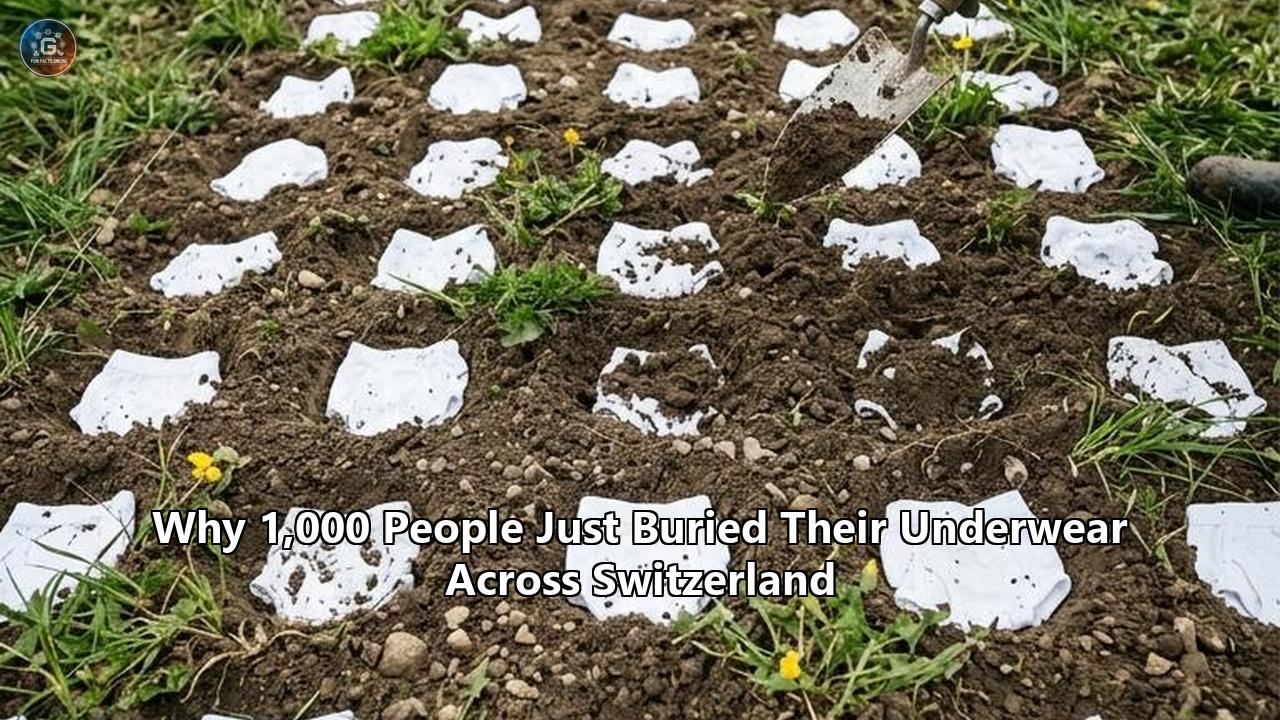
Across the gardens, arable fields, alpine meadows, and suburban yards of Switzerland, an unusual scientific harvest has concluded. A nationwide ecological investigation led by the Swiss Federal Research Institute Agroscope and the University of Zurich (UZH) has published its findings in the environmental science journal Plants, People, Planet. The study, known as Beweisstück Unterhose (Proof by Underpants), mobilized 1,000 citizen scientists to bury standardized pairs of 100% organic cotton underwear alongside thousands of scientific tea bags.
The resulting data delivers one of the most comprehensive, high-resolution national assessments of subterranean biological activity ever compiled. Over 2,000 pairs of white cotton briefs and 12,000 standardized nylon mesh tea bags were interred at depths of 15 centimeters across every major canton and elevation zone in the country. Excavated after intervals of 30 and 60 days, the degraded garments have revealed the hidden metabolic engine of Swiss soils—and exposed the direct, measurable impact of human land management on the subterranean biodiversity that sustains terrestrial life.
                  SWISS CITIZEN SCIENCE EXPERIMENTAL DESIGN

 [ Standardized Kit Distributed ]
   ├── 2 Pairs 100% Pure Organic Cotton Briefs
   └── 12 Standardized Nylon Tea Bags (Green Tea & Rooibos)
                   │
                   ▼
 [ Burial Across 1,000 National Sites (Depth: 15 cm) ]
   ├── Residential Allotment Gardens
   ├── Manicured Turfgrass Lawns
   ├── Intensive Arable Cropland
   ├── Semi-Natural Meadows & Pastures
   └── Native Forest Ecosystems
                   │
       ┌───────────┴───────────┐
       ▼                       ▼
 [ Harvest 1: 30 Days ]   [ Harvest 2: 60 Days ]
       │                       │
       └───────────┬───────────┘
                   ▼
 [ Multi-Metric Agroscope Laboratory Analysis ]
   ├── Digital Image Area Breakdown & Mass Loss
   ├── Comparison with Global Tea Bag Index (TBI)
   ├── Chemical & Elemental Profiling (C:N Ratio, pH, P, K)
   └── Soil Microbiome & Macrofaunal Correlation
The headline outcome of the investigation is stark: land-use type and human surface management outweigh baseline chemistry, soil texture, and elevation in dictating the speed at which underground organisms consume organic matter. Residential vegetable gardens emerged as the most biologically active ecosystems in the country, disintegrating cotton fabric into threadbare remnants within weeks. Conversely, manicured ornamental turf lawns proved to be biological dead zones where garments emerged largely intact.
Yet the research introduces a critical ecological caveat. While accelerated decomposition signals thriving fertility in agricultural and garden soils, the scientists found that extremely high breakdown rates in forests and natural habitats indicate severe nutrient imbalances and excess nitrogen deposition. By converting an everyday consumer item into a tactile metric of ecological vitality, the researchers have established what they term the "Underwear Index"—a validated tool for participatory soil monitoring.
                 COTTON DECOMPOSITION BY HABITAT TYPE
                           (After 60 Days)
  ┌────────────────────────────────────────┬──────────────────────┐
  │ Land-Use Category                      │ Decomposition Rate   │
  ├────────────────────────────────────────┼──────────────────────┤
  │ Private Allotment & Vegetable Gardens  │ ██████████ 85–100%   │
  │ Permanent Meadows & Low-Till Pastures  │ ███████░░░ 60–75%    │
  │ Conventional Arable Cropland           │ █████░░░░░ 45–60%    │
  │ Managed Deciduous & Conifer Forests    │ ████░░░░░░ 35–50%    │
  │ Manicured Suburban Turfgrass Lawns     │ █░░░░░░░░░ 10–25%    │
  └────────────────────────────────────────┴──────────────────────┘
The Genesis of Beweisstück Unterhose
The concept of using buried fabric to assess biological activity is rooted in agronomic field history, but the Swiss study represents the first instance where the technique was standardized, scaled across an entire nation, and coupled with molecular and chemical soil assays. Launched in the spring of 2021 by UZH agroecologist Marcel van der Heijden and Agroscope researcher Franz Bender, the initiative was conceived to address a systemic problem in environmental science: public blindness toward belowground ecology.
More than 59% of the planet's species live below the soil surface. A single handful of healthy earth contains more individual organisms—spanning billions of bacteria, millions of fungal hyphae, protozoa, nematodes, springtails, and earthworms—than there are humans on Earth. Yet because this biodiversity operates out of sight, soil health remains chronically under-monitored by the public and policymakers.
"Soils are the absolute foundation of human nutrition, water filtration, and terrestrial carbon storage," said van der Heijden, professor of agroecology at the University of Zurich and Agroscope research group leader. "However, you cannot protect what you cannot see. Our goal was to create a nationwide experiment that directly placed the biological activity of soil into the hands of citizens while gathering data across ecological gradients that no single academic laboratory could sample alone".
The logistical operation required military precision. The research consortium distributed identical starter packages to 1,000 selected participants. Each package contained two pairs of standardized, unbleached, 100% organic cotton underpants manufactured to strict structural specifications; 12 standard commercial tea bags (six green tea, six rooibos); burial markers; sampling protocols; and soil collection containers.
Participants embedded the items across 1,000 distinct coordinates. These included urban balconies, private raised beds, commercial organic wheat fields, intensive corn operations, vineyards on the slopes of Lake Geneva, high-altitude cattle pastures in the Bernese Oberland, and sub-alpine conifer stands in Graubünden. Volunteers recorded site parameters—microclimate, historic fertilizer applications, pesticide treatments, tilling routines, and vegetation cover—using a custom-built mobile application.
Thirty days into the trial, participants excavated the first pair of underpants alongside half the tea bags. At day 60, they unearthed the second set. The excavated garments were photographed against standardized scaling grids, air-dried, and shipped to Agroscope's central laboratories in Zurich-Reckenholz along with core soil samples.
           SUBTERRANEAN BIODIVERSITY AT A GLANCE (1 m² of Healthy Soil)
 ┌──────────────────────────────────────┬────────────────────────────────┐
 │ Taxonomic Group                      │ Estimated Abundance / Biomass  │
 ├──────────────────────────────────────┼────────────────────────────────┤
 │ Bacteria and Actinobacteria          │ > 10 Trillion organisms        │
 │ Fungi (Hyphal Length)                │ 10,000 to 100,000 km of hyphae │
 │ Protozoa (Amoebae, Flagellates)      │ > 1 Billion organisms          │
 │ Nematodes (Roundworms)               │ 1 to 5 Million organisms       │
 │ Microarthropods (Mites, Collembola)  │ 100,000 to 500,000 individuals │
 │ Enchytraeids (Potworms)              │ 10,000 to 50,000 individuals   │
 │ Earthworms (Lumbricidae)             │ 100 to 400 individuals         │
 └──────────────────────────────────────┴────────────────────────────────┘
The Biochemical Mechanism: How Soil Organisms Consume Cotton
The scientific validity of the underwear soil experiment rests on basic biochemistry. Organic cotton consists of roughly 95% pure cellulose—a structural polysaccharide composed of linear chains of several hundred to many thousands of $\beta(1\rightarrow4)$ linked D-glucose units.
Cellulose is the most abundant organic polymer on Earth, forming the primary structural component of green plant cell walls. In natural ecosystems, plant debris (lignocellulosic biomass) must be continuously broken down to recycle carbon and liberate sequestered nutrients back into the soil matrix.
When pure cotton fabric is buried in moist soil, it serves as an energy-dense carbon substrate for cellulolytic microorganisms:
                          CELLULOSE ENZYMATIC CASCADE

               Cotton Fibers [Polymeric β-1,4-Glucan Chain]
                                    │
                                    │ Endoglucanases (E.C. 3.2.1.4)
                                    ▼
                     Random Cleavage of Internal Bonds
                                    │
                                    │ Exoglucanases / Cellobiohydrolases (E.C. 3.2.1.91)
                                    ▼
                Progressive Release of Cellobiose Disaccharides
                                    │
                                    │ β-Glucosidases (E.C. 3.2.1.21)
                                    ▼
                           D-Glucose Monomers
                                    │
                ┌───────────────────┴───────────────────┐
                ▼                                       ▼
    Microbial Cellular Respiration            Humic Fraction Formation
(CO₂ Production) (Soil Organic Carbon Storage)- Primary Colonization by Fungi: Filamentous fungi—primarily saprophytic ascomycetes and basidiomycetes such as Chaetomium, Trichoderma, Aspergillus, and Penicillium—are the first to colonize the cotton fibers. Their hyphae penetrate the weave of the fabric, secreting specialized extracellular enzymes known as cellulases.
- Enzymatic Depolymerization: The breakdown occurs through a synergistic three-enzyme system:
Endoglucanases cleave internal bonds at random sites along the amorphous regions of the cellulose chains.
Exoglucanases (Cellobiohydrolases) attack the chain ends, progressively chopping off cellobiose units (disaccharides).
$\beta$-Glucosidases hydrolyze cellobiose into individual glucose molecules, which are absorbed directly by microbial cells as an energy source.
- Bacterial Succession: Cellulolytic bacteria, including strains of Cellulomonas, Cytophaga, and diverse Actinobacteria (Streptomyces), proliferate alongside the fungi, rapidly accelerating fiber decay.
- Macrofaunal Shredding: As the fabric softens and is coated in microbial biofilms, soil macrofauna—most notably epigeic and anecic earthworms (Lumbricus rubellus, Lumbricus terrestris), potworms (Enchytraeidae), and woodlice (Isopoda)—begin physically consuming and shredding the cotton material.
By day 60, in a healthy biological soil environment, the woven textile matrix is completely obliterated, leaving behind only the synthetic, non-biodegradable components: the elastic waistband and nylon stitching seams.
Validating the Metric: The Underwear Index Meets the Tea Bag Index
To elevate the project from a community science demonstration into a peer-reviewed methodology, the research team required a rigorous scientific control. They calibrated the cotton fabric decomposition against the established Tea Bag Index (TBI), an international, standardized ecological protocol developed by researchers at Utrecht University.
                     TEA BAG INDEX (TBI) CALIBRATION
 ┌──────────────────────────────────┬──────────────────────────────────┐
 │ Green Tea (Sencha)               │ Rooibos Tea (Aspalathus linearis)│
 ├──────────────────────────────────┼──────────────────────────────────┤
 │ Highly Labile Substrate          │ Recalcitrant, Lignin-Rich        │
 │ Rapidly Decomposed (~49% hydrolyzable)│ Slowly Decomposed (~12% hydrolyzable)│
 │ Measures Soil Microbial Capacity │ Measures Long-Term Degradation   │
 │ Determines Stabilization Factor S│ Determines Decomposition Rate k  │
 └──────────────────────────────────┴──────────────────────────────────┘
The standard Tea Bag Index uses two distinct substrates:
- Green tea, which is rich in easily accessible, hydrolyzable compounds (labile fraction), decomposes rapidly and allows scientists to calculate the decomposition rate constant ($k$) and the stabilization factor ($S$)—the proportion of labile material that is not broken down but stabilized into organic matter.
- Rooibos tea, which contains high concentrations of recalcitrant lignin and polyphenols, decomposes substantially slower, acting as a proxy for long-term woody material transformation.
The Swiss researchers demonstrated that the mass loss of cotton underwear correlates with both the labile breakdown dynamics of green tea and the mid-term humification curves of rooibos.
                    STATISTICAL CORRELATION PROFILE

   100 ┌───────────────────────────────────────────────▲ Green Tea
       │                                            ▲ /
       │                                       ▲   /
    80 │                                    ▲ /   /
       │                               ▲   /     /
%   60 │                          ▲   /   /     /  Underwear
Mass   │                     ▲   /   /   /     /   Decomposition
Loss   │                ▲   /   /   /   /     /
    40 │           ▲   /   /   /   /   /     /
       │      ▲   /   /   /   /   /   /     /
    20 │ ▲   /   /   /   /   /   /   /     /
       │/   /   /   /   /   /   /   /     /  Rooibos Tea
     0 └────┴───┴───┴───┴───┴───┴───┴────┴────┴────┴────►
       0   5   10  15  20  25  30  35  40  45  50  55  60
                             Time (Days)
The statistical modeling published in Plants, People, Planet confirmed that cotton undergarment degradation provides a proxy for soil microbial biomass carbon ($C_{mic}$), basal respiration rates, and earthworm population densities. Unlike laboratory-bound chromatography or chemical titration methods, the underwear approach provides an immediate visual readout of biological health.
If the fabric is intact, the biological community is dormant, impaired, or starved of oxygen and moisture. If only the elastic band remains, the soil food web is fully functional.
The National Spectrum: Where Soil Lives and Where It Stagnates
The final analysis incorporated 780 fully validated, contamination-free field sites across Switzerland. The resulting geographical and land-use mapping revealed significant disparities in biological activity across different landscape types.
                NATIONAL LAND-USE DECOMPOSITION PROFILE
 ┌──────────────────────┬─────────────┬──────────────┬──────────────────┐
 │ Land-Use Category    │ Median Mass │ Earthworm    │ Primary Limiting │
 │                      │ Loss (60 d) │ Density (/m²)│ Factor           │
 ├──────────────────────┼─────────────┼──────────────┼──────────────────┤
 │ Residential Gardens  │ 86.4%       │ 280–420      │ Nutrient Overload│
 │ Organic Cropland     │ 68.2%       │ 190–310      │ Tillage Disturbance│
 │ Permanent Pastures   │ 64.7%       │ 220–380      │ Soil Compaction  │
 │ Intensive Cropland   │ 51.3%       │ 60–140       │ Chemical Inputs  │
 │ Alpine Meadows       │ 44.1%       │ 40–90        │ Temperature/Season│
 │ Deciduous Forests    │ 42.8%       │ 80–180       │ Soil Acidity (pH)│
 │ Ornamental Lawns     │ 18.2%       │ 10–50        │ Compaction/Aeration│
 └──────────────────────┴─────────────┴──────────────┴──────────────────┘
1. Private Gardens and Allotments: The Biological Hotspots
Private vegetable patches and community gardens recorded the highest decomposition velocity in the nation. Over 70% of the underwear buried in these settings underwent near-total disintegration by day 60, with mass losses frequently exceeding 85% to 95%.
These soils showed consistently elevated concentrations of organic matter (humus contents between 4.5% and 8.2%), stable aggregate structures, and optimal moisture retention. Frequent additions of compost, seasoned manure, mulches, and biochar create an ideal habitat for saprophytic organisms.
Furthermore, home gardeners rarely employ heavy agricultural machinery, preventing deep soil compaction and preserving macro-pore networks created by deep-burrowing earthworms.
                 SOIL AGGREGATE ARCHITECTURE IN GARDENS

        [ Compost & Organic Residue Inputs ]
                        │
                        ▼
    ┌──────────────────────────────────────────────┐
    │          Macro-Aggregate Formation           │
    │  - Fungal Hyphae Network Entanglement        │
    │  - Glomalin & Polysaccharide Bio-Glues       │
    │  - Earthworm Castings & Mucilage Pores       │
    └──────────────────────────────────────────────┘
            │                              │
            ▼                              ▼
  [ Rapid Water Infiltration ]    [ High Oxygen Diffusion ]
            │                              │
            └──────────────┬───────────────┘
                           ▼
             [ Maximum Enzymatic Cellulolysis ]
2. Ornamental Turf Lawns: The Suburban Deserts
At the opposite end of the urban spectrum, domestic turfgrass lawns exhibited the lowest decomposition rates recorded across all lowland zones. More than half of the briefs buried under green lawns lost less than 20% of their mass over the two-month experimental window; many emerged clean and structurally sound, with only superficial staining.
The researchers attributed this biological stagnation to four interlocking management factors:
- Compaction and Anoxia: Regular foot traffic and frequent mowing compress topsoil layers, crushing macro-pores and restricting oxygen diffusion necessary for aerobic fungal metabolism.
- Biomass Starvation: Routine lawn mowing with grass clippings collected and discarded deprives the soil microbiome of organic carbon input.
- Monoculture Dynamics: Shallow, non-diverse turfgrass root architectures exudate a limited array of carbon compounds, failing to support a complex soil food web.
- Chemical Interventions: The targeted application of synthetic fertilizers, moss-control agents (iron sulfates), and selective herbicides impairs earthworm reproduction and alters fungal community structures.
3. Arable Farmland: The Tillage and Input Split
Commercial agricultural soils occupied an intermediate position, revealing sharp internal divisions driven by field management regimes:
                     AGRICULTURAL MANAGEMENT PROFILE
 ┌───────────────────────────────────┬───────────────────────────────────┐
 │ Conventional Intensive Management │ Regenerative Organic Management   │
 ├───────────────────────────────────┼───────────────────────────────────┤
 │ Synthetic NPK Fertilizer Overload │ Compost and Cover Crop Mulches    │
 │ Deep Inversion Moldboard Plowing  │ Minimal Shallow Tillage / No-Till │
 │ Bare Fallow Winter Periods        │ Year-Round Living Root Cover      │
 │ Prophylactic Fungicide / Pesticide│ Diverse Multi-Species Rotations   │
 │ Median Mass Loss: 48.2%           │ Median Mass Loss: 71.5%           │
 └───────────────────────────────────┴───────────────────────────────────┘
Farms utilizing deep moldboard plowing showed disrupted fungal mycelial networks. Tillage physically shears fungal hyphae, shifts the microbiome toward bacteria-dominated assemblages, and exposes protected organic carbon to rapid oxidation, depleting baseline microbial populations over time.
Conversely, operations practicing no-till or reduced-till methods alongside multi-species cover cropping (e.g., rye, clover, vetch) maintained decomposition rates comparable to allotment gardens.
               PLOWING VS. NO-TILL MYCELIAL ARCHITECTURE

  CONVENTIONAL (Tilled):         REGENERATIVE (No-Till):
  ┌───────────────────────┐      ┌───────────────────────┐
  │ Fragmented Hyphae     │      │ Intact Mycelial Web   │
  │ •  •  •  •  •  •  •   │      │ ─┼───┼───┼───┼───┼──  │
  │ Isolated Bacteria     │      │ Hyphal Channels       │
  │   .   .   .   .   .   │      │ ───/───\───/───\───/──│
  │ Low Aggregate Pores   │      │ Dynamic Macro-Pores   │
  └───────────────────────┘      └───────────────────────┘
The Ecological Nuance: When Fast Decomposition Signals Pollution
A central insight highlighted by the Agroscope and UZH researchers challenges a common assumption in citizen science: that faster organic breakdown is always a sign of a healthier ecosystem.
"In agricultural production systems, rapid decomposition reflects a highly active biological state that rapidly mineralizes nutrients for crops," explained co-project leader Franz Bender, head of the agroecological assessments team at Agroscope. "However, maximum decomposition velocity is definitively not desirable in every ecosystem".
                  THE DECOMPOSITION SPECTRUM CONUNDRUM

 [ LOW DECOMPOSITION ]                  [ BALANCED EQUILIBRIUM ]               [ HYPER-DECOMPOSITION ]
 ┌──────────────────────┐               ┌──────────────────────┐               ┌──────────────────────┐
 │ Turf Lawns           │               │ Native Forest / Moor │               │ Nitrogen-Loaded Sites│
 │ • Compaction         │               │ • High Carbon Storage│               │ • Nutrient Leaching  │
 │ • Low Diversity      │               │ • Complex Humus Pools│               │ • Acidification Risks│
 │ • Starved Microbiome │               │ • Endemic Symbionts  │               │ • Soil Organic Deplet│
 └──────────────────────┘               └──────────────────────┘               └──────────────────────┘
         Impaired                               Optimal                          Eutrophic Stress
       Degradation                            Conservation                         Imbalance
In semi-natural ecosystems such as old-growth beech forests (Fagus sylvatica), subalpine fir stands (Abies alba), and nutrient-poor oligotrophic grasslands, organic matter breakdown is naturally slow, regulated, and conservative. These ecosystems have evolved to store carbon in thick humus layers and rely on specialized ectomycorrhizal fungal networks that transfer nitrogen and phosphorus directly to plant root tips without rapid organic turnover.
When the underwear soil experiment was executed in certain forest locations, researchers observed high rates of cotton breakdown. Soil cores from these locations revealed substantial excess nitrogen levels. Atmospheric deposition of reactive nitrogen—originating from industrial emissions, vehicle exhausts, and volatilized ammonia from agricultural slurry—has saturated these forest biomes.
               ATMOSPHERIC NITROGEN DEPOSITION CASCADE

      [ Industrial Emissions & Agricultural NH₃ Volatilization ]
                                │
                                ▼
         [ Atmospheric Nitrogen Deposition (N-Overload) ]
                                │
          ┌─────────────────────┴─────────────────────┐
          ▼                                           ▼
 [ Mycorrhizal Fungi Dieback ]             [ Eutrophic Bacterial Bloom ]
          │                                           │
          ▼                                           ▼
 [ Loss of Forest Tree Symbioses ]         [ Hyper-Accelerated Cellulolysis ]
          │                                           │
          ▼                                           ▼
 [ Soil Acidification & Runoff ]           [ Humus & Carbon Pool Depletion ]
This nitrogen surplus alters subterranean dynamics:
- Suppression of Mycorrhizae: High inorganic nitrogen levels cause trees to allocate less carbon to their symbiotic mycorrhizal fungal partners, weakening forest root structures.
- Eutrophication of Saprophytic Decomposers: Free-living saprophytic fungi and bacteria experience a population surge, consuming carbon materials (such as the buried cotton garments) at abnormal speeds.
- Depletion of Soil Organic Carbon: Rather than building stable humus, the soil's organic reserves are rapidly mineralized and released into the atmosphere as carbon dioxide ($CO_2$), converting long-term carbon sinks into net sources.
"If an undergarment buried in a native forest or natural peat meadow vanishes in four weeks, that soil is not pristine," Bender noted. "It is undergoing eutrophication stress, driven by excessive nutrient loading that threatens the endemic plant and fungal community".
The Citizen Science Framework: 240 Co-Authors and Open Access Data
Beyond its ecological findings, Beweisstück Unterhose establishes a structural model for large-scale citizen participation in environmental monitoring. The published paper in Plants, People, Planet lists roughly 240 citizen participants as formal co-authors.
                 CITIZEN SCIENCE VALIDATION PIPELINE
 ┌──────────────────────────────────────────────────────────────────────┐
 │ Step 1: Decentralized Field Protocol                                 │
 │ 1,000 citizens execute standardized burials with precision kits.      │
 ├──────────────────────────────────────────────────────────────────────┤
 │ Step 2: Digital Mapping & Micro-Metadata Logging                    │
 │ App logs geo-coordinates, plant cover, historical inputs, moisture. │
 ├──────────────────────────────────────────────────────────────────────┤
 │ Step 3: Centralized Analytical Verification                         │
 │ Agroscope labs run mass spectrometry, digital imaging, elemental CN. │
 ├──────────────────────────────────────────────────────────────────────┤
 │ Step 4: Co-Authorship & Open-Access Archiving                       │
 │ 240 citizens co-author findings; raw data published open via Zenodo. │
 └──────────────────────────────────────────────────────────────────────┘
Conducting a soil assessment across 1,000 heterogeneous locations using traditional academic field teams would have required years of fieldwork and millions of Swiss francs in personnel logistics. By leveraging an engaged public, the study captured micro-habitats that academic scientists rarely access, such as private backyards, urban green spaces, and private farm holdings.
The integrity of the scientific process was preserved through strict verification protocols:
- Digital Image Processing: Each retrieved garment was placed under controlled lighting against a calibrated scale. Custom software calculated the remaining surface area down to the square millimeter, removing subjective bias.
- Agroscope Laboratory Validations: Soil cores accompanying the underwear were subjected to standard chemical analyses: pH extraction ($CaCl_2$), calcium acetate lactate (CAL) extraction for plant-available phosphorus and potassium, and elemental combustion analysis to measure total carbon-to-nitrogen ($C:N$) ratios.
- Open Data Repository: The complete anonymized dataset, including 780 validated sites, has been deposited in the open-access repository Zenodo, allowing ecologists worldwide to reuse the data for global change modeling.
               AGROSCOPE LAB ANALYTICAL FLOW FOR SAMPLES

                  [ Excavated Soil & Garment Package ]
                                   │
                   ┌───────────────┴───────────────┐
                   ▼                               ▼
       [ Garment Image Analysis ]        [ Core Soil Sample Prep ]
                   │                               │
         - Ultrasonic Cleaning           - Air-Drying & 2mm Sieving
         - 24h Oven Drying (60°C)        - CN Elemental Analyzer
         - High-Res Surface Scan         - CaCl₂ pH Measurements
         - Tensile Disruption Index      - CAL Spectrophotometry (P/K)
                   │                               │
                   └───────────────┬───────────────┘
                                   ▼
          [ Integrated Soil Health Metric: SOILPROOF Engine ]
The educational reach of the project extended into broader Swiss culture. Atlant Bieri, a science journalist who co-developed the initiative alongside the academic leads, published an illustrated science book, Der Dschungel im Boden (The Jungle in the Soil), which was distributed to Swiss elementary and secondary schools.
In a notable crossover with cultural institutions, fashion designer Edie Lou used partially decomposed underwear retrieved from the experiment to construct a Rococo-style ball gown. The garment was exhibited in Swiss museums to visualize the decay process and the role of soil organisms in organic waste recycling.
                PROJECT IMPACT & MULTI-SECTOR OUTREACH
 ┌────────────────────────┬────────────────────────────────────────────┐
 │ Academic Sphere        │ Peer-reviewed publication; open dataset    │
 │ Public Engagement      │ 1,000 active participants across 26 cantons│
 │ Primary Education      │ *Der Dschungel im Boden* textbook rollout │
 │ Technology Transfer    │ SOILPROOF mobile diagnostic soil app       │
 │ Cultural / Art Domain  │ Rococo ball dress exhibition by Edie Lou   │
 └────────────────────────┴────────────────────────────────────────────┘
From Cotton Testing to Global Soil Diagnostic Standards
The use of buried cotton fabric to measure biological activity has evolved from early agronomic tests into a standardized diagnostic tool. The general concept traces back to the cotton strip assay developed in the late 1980s by the UK Institute of Terrestrial Ecology, which utilized standardized Shirley Soil Burial Test Fabric to quantify cellulolytic decay in peatlands and agricultural plots.
In the mid-2010s, agricultural extension services in Canada and the United States Natural Resources Conservation Service (NRCS) popularized the informal "Soil Your Undies" challenge as an educational demonstration for farmers. The Swiss initiative has elevated this concept into a systematic, nation-scale research model.
                     EVOLUTION OF CELLULOSE SOIL ASSAYS
 ┌───────────────────────────────────┬───────────────────────────────────┐
 │ 1980s: Cotton Strip Assay         │ Rigorous industrial cotton strips;│
 │ (Shirley Institute / UK ITE)      │ limited to laboratory ecology     │
 ├───────────────────────────────────┼───────────────────────────────────┤
 │ 2010s: "Soil Your Undies" Demo   │ Informal extension demonstration; │
 │ (USDA-NRCS & Soil Assoc.)         │ unstandardized public outreach    │
 ├───────────────────────────────────┼───────────────────────────────────┤
 │ 2021–2026: Beweisstück Unterhose │ Standardized, nationwide dataset; │
 │ (Agroscope & UZH Project)         │ calibrated with Tea Bag Index     │
 ├───────────────────────────────────┼───────────────────────────────────┤
 │ Next Generation: SOILPROOF App    │ AI-driven image segmentation and  │
 │ (Global Open-Source Platform)     │ direct soil carbon mapping        │
 └───────────────────────────────────┴───────────────────────────────────┘
The Swiss study establishes clear protocols for running an underwear soil experiment to assess biological activity:
- Textile Specifications: Standardized garments must consist of 100% natural, unbleached, untreated cotton. Blended fabrics containing synthetic polymers (polyester, elastane, nylon) leave microplastic residues in the soil profile and distort mass-loss calculations.
- Depth Control: Burial at a uniform depth of 15 cm targets the rhizosphere—the active topsoil layer where microbial biomass, fungal networks, and root interactions reach maximum density.
- Standardized Timeline: Retrievals at 30 and 60 days capture both the initial microbial colonization curve and the subsequent macrofaunal consumption stage.
- Soil Moisture Accounting: Because cellulase activity drops in dry conditions, decomposition data must be correlated with local precipitation and volumetric water content to prevent false-negative readings.
               OPTIMAL PROTOCOL: UNDERWEAR SOIL EXPERIMENT

 [ Site Selection & Prep ]
   ├── Choose 2 adjacent points (1 m apart)
   └── Dig a vertical slit trench exactly 15 cm deep
               │
               ▼
 [ Burial Phase ]
   ├── Place 100% unbleached organic cotton brief vertically
   ├── Ensure flat contact between fabric and soil wall
   ├── Refill trench and firm soil to natural density
   └── Mark location with GPS coordinates & marker flags
               │
       ┌───────┴───────┐
       ▼               ▼
 [ Day 30 Harvest ]  [ Day 60 Harvest ]
   ├── Dig trench 5 cm back from burial line to protect fabric
   ├── Carefully lift remaining material using a spatula
   ├── Gently rinse loose soil using deionized water
   ├── Dry for 48 hours at room temperature
   └── Photograph against high-contrast grid & calculate mass loss
The Policy Imperative: Soil Protection in National Agendas
The publication of the Swiss study arrives as European environmental agencies confront widespread soil degradation. The European Commission estimates that between 60% and 70% of European soils are currently unhealthy due to unsustainable management practices, urban expansion, and climate change impacts.
In Switzerland, soil erosion, organic matter depletion, and compaction cost the domestic agricultural economy millions of Swiss francs annually. The Federal Office for the Environment (FOEN / BAFU) and the Federal Office for Agriculture (FOAG / BLW) have established the Swiss Soil Strategy (Bodenstrategie Schweiz), which targets zero net soil loss by 2050.
                    SWISS SOIL STRATEGY: 2050 TARGETS
 ┌───────────────────────────────────┬───────────────────────────────────┐
 │ Zero Net Soil Degradation         │ Neutralize erosion and compaction │
 │ Organic Carbon Stabilization      │ Increase humus stocks by > 0.2%/yr│
 │ Non-Chemical Biological Promotion │ Restructure direct agricultural   │
 │                                   │ payment subsidy programs          │
 │ Universal Ecological Monitoring   │ Integrate biological indices into │
 │                                   │ the Swiss Soil Monitoring Network │
 └───────────────────────────────────┴───────────────────────────────────┘
The data from the underwear experiment provides clear guidance for agricultural policymakers:
1. Re-evaluating Direct Payment Subsidies
Swiss agricultural policy distributes direct payments to farmers who meet ecological baseline performance (Ökologischer Leistungsnachweis, ÖLN). The study's authors argue that subsidy frameworks should place greater weight on direct biological soil indicators. Practices that promote decomposition in croplands—such as permanent cover crops, diverse crop rotations, and compost additions—should be prioritized over passive acreage-based compensation.
             AGRICULTURAL MANAGEMENT INTERVENTIONS & OUTCOMES
 ┌──────────────────────┬──────────────────────┬────────────────────────┐
 │ Intervention         │ Biological Impact    │ Decomposition Outcome  │
 ├──────────────────────┼──────────────────────┼────────────────────────┤
 │ Year-Round Cover     │ Continuous carbon-   │ +35% to +50% faster    │
 │ Cropping (Lolium/    │ rich root exudates;  │ textile decay; stable  │
 │ Trifolium mixes)     │ erosion reduction    │ organic carbon pools   │
 ├──────────────────────┼──────────────────────┼────────────────────────┤
 │ Compost Application  │ Direct inoculant of  │ Accelerated breakdown; │
 │ (20–30 t/ha)         │ saprophytic microbes │ increased moisture     │
 │                      │ and macro-nutrients  │ holding capacity       │
 ├──────────────────────┼──────────────────────┼────────────────────────┤
 │ Reduced/No-Till      │ Preserves continuous │ Intact fungal mycelia; │
 │ Farming              │ fungal hyphal webs   │ enhanced aggregate     │
 │                      │ and earthworm burrows│ stability index        │
 ├──────────────────────┼──────────────────────┼────────────────────────┤
 │ Intensive Rotary     │ Shears hyphal chains;│ Decreased microbial    │
 │ Cultivation / Tillage│ oxidizes carbon      │ biomass; slower        │
 │                      │                      │ long-term decay        │
 └──────────────────────┴──────────────────────┴────────────────────────┘
2. Urban Soil Management and Urban Green Infrastructure
The finding that manicured turf lawns support very low biological activity carries direct implications for urban planning and suburban land zoning. Municipalities across Switzerland are revising urban biodiversity strategies, encouraging property owners to convert monoculture grass lawns into multi-species wildflower meadows, permaculture plots, or untamed urban gardens.
                 LAWN TO WILDFLOWER CONVERSION METRICS

  CONVENTIONAL SUBURBAN LAWN:       BIODIVERSE URBAN MEADOW:
  ┌─────────────────────────┐       ┌─────────────────────────┐
  │ • Species Count: 1–3    │       │ • Species Count: 30–60  │
  │ • Earthworms: <20/m²    │       │ • Earthworms: >300/m²   │
  │ • Infiltration: Low     │       │ • Infiltration: 5x High │
  │ • Cotton Mass Loss: 15% │       │ • Cotton Mass Loss: 85% │
  └─────────────────────────┘       └─────────────────────────┘
3. Climate Resilience and Drought Resistance
A secondary analysis conducted by Agroscope in 2022 and expanded in the 2026 paper demonstrated that soils rich in active humus and earthworm populations withstand extreme weather events more effectively.
During dry spells, soils with higher biological activity (indicated by rapid cotton breakdown) retained moisture significantly longer than compacted or depleted soils. Macro-pores created by earthworms and stable soil aggregates act as underground water reservoirs, protecting agricultural yields during prolonged heatwaves.
                 SOIL STRUCTURE UNDER DROUGHT STRESS

  DEGRADED / COMPACTED SOIL:        BIOLOGICALLY ACTIVE SOIL:
  ┌─────────────────────────┐       ┌─────────────────────────┐
  │ Surface Crusting        │       │ Sponge Aggregate Matrix │
  │ ───┬─────────────────┬──│       │ ░░░ ░░░ ░░░ ░░░ ░░░ ░░░ │
  │ Rapid Runoff / Evap.    │       │ Water Stored in Pores   │
  │                         │       │                         │
  │ Deep Moisture Starvation│       │ Deep Hydraulic Transfer │
  │                         │       │   │     │     │     │   │
  └─────────────────────────┘       └─────────────────────────┘
The Next Frontier: Expanding the Underwear Metric Across Borders
With the successful publication and empirical validation of Beweisstück Unterhose*, the research consortium is expanding its operations internationally. Agroscope and the University of Zurich are collaborating with research teams across Austria, Germany, France, and the Netherlands to deploy standardized regional initiatives.
             FUTURE MILESTONES: TRANS-EUROPEAN SOIL MAPPING
 ┌──────────────────────────────────────────────────────────────────────┐
 │ Milestone 1: Rollout of the Rebranded SOILPROOF App                  │
 │ Mobile tool featuring automated computer vision decay analysis       │
 ├──────────────────────────────────────────────────────────────────────┤
 │ Milestone 2: Horizon Europe Integration                              │
 │ Alignment with EU Horizon Mission: "A Soil Deal for Europe"          │
 ├──────────────────────────────────────────────────────────────────────┤
 │ Milestone 3: DNA Metabarcoding Calibration                           │
 │ High-throughput sequencing of microbial communities directly         │
 │ colonizing the cotton fibers                                         │
 ├──────────────────────────────────────────────────────────────────────┤
 │ Milestone 4: Global Open Database on Soil Cellulose Decomposition    │
 │ Establishing unified global decay baselines across all biomes        │
 └──────────────────────────────────────────────────────────────────────┘
The underlying mobile software has been redesigned and rebranded as SOILPROOF. The updated platform incorporates computer vision algorithms that allow users to photograph an excavated garment with a smartphone and receive an instant estimate of mass loss percentage, biological activity class, and actionable soil management recommendations.
                     SOILPROOF MOBILE APPLICATION ARCHITECTURE

     [ User Captures Photo of Excavated Garment with Calibration Card ]
                                    │
                                    ▼
       [ On-Device Edge AI: Boundary & Fiber Loss Segmentation ]
                                    │
                                    ▼
       [ Cloud Database Sync: Spatial Soil Data & Local Weather APIs ]
                                    │
                                    ▼
  ┌───────────────────────────────────────────────────────────────────┐
  │ User Output:                                                      │
  │ • Decomposition Rate Score: (e.g., 78% / "Highly Active")         │
  │ • Ecological Diagnosis: (e.g., Optimal Humus / Low Compaction)   │
  │ • Soil Management Plan: (e.g., Maintain Mulch, Reduce Tillage)    │
  └───────────────────────────────────────────────────────────────────┘
Scientific teams are preparing to incorporate high-throughput DNA sequencing directly into the assay framework. By isolating environmental DNA (eDNA) from the micro-fibers of retrieved textiles, researchers will be able to identify the exact species of fungi, bacteria, and nematodes responsible for cellulose breakdown at specific geographical coordinates and elevations.
Questions remain regarding how climate warming will alter decomposition kinetics in high-altitude alpine soils, and how the accumulation of microplastics and persistent synthetic chemicals affects the enzymatic function of cellulases in intensive farming systems.
What began as an unusual experiment involving 1,000 citizens burying their underpants across Switzerland has established a new standard for ecological research. It has demonstrated that rigorous science and broad public participation can unite to reveal the complex, hidden ecosystems beneath our feet—proving that sometimes, the most effective way to assess the future of our soil is to bury a pair of briefs in the earth.
Reference:
- https://finance.biggo.com/news/983c2ed5-8ea0-49aa-9e43-4aed893ff7f3
- https://soilproof.org/beweisstuck-unterhose/
- https://zeitung.io/story.php?slug=was-2-000-unterhosen-uber-die-qualitat-von-boden-verrieten&lang=en
- https://news.ssbcrack.com/citizen-science-project-reveals-soil-biodiversity-insights-through-buried-underwear/
- https://www.news.uzh.ch/en/articles/media/2026/buried-underwear.html
- https://www.news.uzh.ch/en/articles/media/2026/buried-underwear.html
- https://www.agroscope.admin.ch/en/proof-by-underpants
- https://www.discovermagazine.com/2-000-pairs-of-buried-underwear-helped-measure-soil-health-in-this-unusual-experiment-49602
- https://www.citizenscience.uzh.ch/en/projects/underpants.html
- https://finance.biggo.com/news/983c2ed5-8ea0-49aa-9e43-4aed893ff7f3
- https://www.popsci.com/environment/bury-underwear-soil-health/
- https://www.sciencedaily.com/releases/2026/08/260827010501.htm
- https://soilproof.org/Beweisstuck-Unterhose/