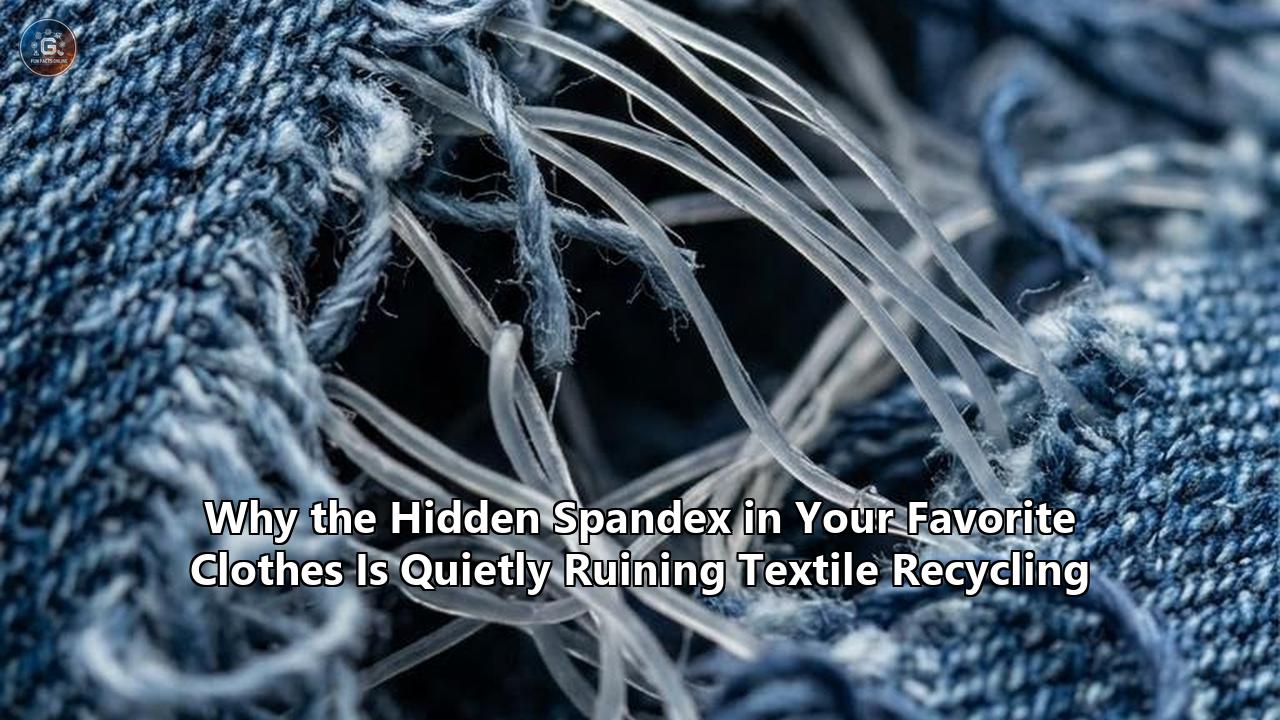
Across automated textile sorting warehouses from the Netherlands to France and into the American Sunbelt, hundreds of thousands of tons of discarded clothing are piling up in compressed, wire-bound bales. Under the European Union’s Waste Framework Directive, which mandated separate textile waste collection across all member states, municipal collection rates have surged. Concurrently, states like California and Massachusetts have accelerated their own post-consumer collection regimes. Yet at the downstream end of this massive logistical pipeline, an unexpected material bottleneck has emerged.
Textile-to-textile recycling operations are actively rejecting massive portions of this incoming stock. The culprit is neither dirt, dye, nor heavy metal fasteners. It is an almost invisible, ubiquitous filament present in everything from performance leggings and stretch denim to underwear and tailored business suits: elastane, best known by the DuPont trade name Spandex or Lycra.
Even when added in minuscule quantities—often representing just 1% to 3% of a garment’s total weight—elastane acts as a structural and chemical poison pill for recycling infrastructure. In mechanical mills, its elastic polyurethane threads stretch, snap, gum up rotating cutter blades, and create friction-induced fires. In chemical depolymerization reactors, elastane does not melt or dissolve predictably; instead, it turns into a gummy sludge that clogs industrial microfiltration systems, ruins chemical reagents, and slashes the recovery yields of valuable cotton and polyester monomers.
This friction between consumer demand for stretchy clothing and the physics of material reclamation has exposed a core contradiction in modern fashion: the features that make garments comfortable and form-fitting are directly responsible for rendering them virtually unrecyclable. Tackling the invisible barrier of elastane has become the defining technical priority for chemical engineers, mechanical sorters, and sustainability regulators worldwide.
The Invisible Saboteur in the Sorting Hub
At a commercial recycling facility, incoming garments undergo a brutal trial of physics and chemistry. To produce recycled fiber that can be spun into fresh yarn, processing mills need pure, predictable feedstocks. Cotton mills require cellulose; polyester plants require polyethylene terephthalate (PET); nylon processors require pure polyamides.
Instead, sorters receive a deluge of composite materials. A pair of modern stretch skinny jeans is rarely 100% cotton. More often, it consists of 92% cotton, 6% polyester for structural stability, and 2% elastane to provide snap-back stretch. That 2% component is sufficient to dismantle the recycling pipeline.
                     GARMENT COMPOSITION (Typical Modern Stretch Denim)
┌────────────────────────────────────────────────────────┬──────────────┬────────┐
│                        Cotton                          │  Polyester   │Spandex │
│                         92%                            │      6%      │   2%   │
└────────────────────────────────────────────────────────┴──────────────┴────────┘
                                                                            │
      ┌─────────────────────────────────────────────────────────────────────┘
      ▼
 MECHANICAL RECYCLING CONSEQUENCES:           CHEMICAL RECYCLING CONSEQUENCES:
 • Gums shredder cylinders & bearings        • Insoluble polyurethane cross-links
 • Creates high-friction heat & fire risk    • Forms gelatinous sludge in reactors
 • Prevents clean fiber carding/alignment    • Clogs costly microfiltration membranes
 • Yields weak, unusable "dust" staple       • Degrades purity of recovered monomers
"Eighty percent of textiles on the U.S. market currently contain some amount of spandex, which makes them nonrecyclable," explains Svetlana Boriskina, a research scientist in MIT’s Department of Mechanical Engineering. "There is no widely adopted technology now that recycles textiles into textiles".
The presence of elastane in post-consumer waste streams represents one of the most urgent textile recycling challenges facing the circular economy today. Because modern sorting lines rely heavily on high-speed near-infrared (NIR) spectrometry to categorize garments zooming along conveyor belts, elastane presents a severe identification problem. NIR systems measure the light reflected off a garment’s surface. But in modern core-spun yarns, elastane resides deep within the structural center of the thread, entirely enveloped by an outer sheath of spun cotton, viscose, or wool.
As a result, automated optical sorting sensors read the outer sheath, categorizing the garment as pure cotton or pure wool. The item is cleared, baled, and shipped to a high-purity recycling facility. When the bale is dropped into processing vats or tearing lines, the hidden elastane core wreaks operational havoc. Sorters find themselves caught in a bind: either invest in expensive, multi-angle analytical hardware capable of detecting hidden elastomeric cores, or face widespread rejection of their baled inventory by chemical recyclers who refuse to let polyurethane foul their million-dollar reactors.
How Spandex Infiltrated Every Corner of the Wardrobe
To understand why this issue has reached crisis levels, one must look at how elastane conquered the global garment industry. Synthesized in 1958 by DuPont chemist Joseph Shivers, elastane is a segmented block copolymer composed of polyurethane. Shivers designed the polymer to replace natural rubber, which broke down quickly under body oils, sweat, and repeated washing.
Elastane achieved performance metrics that seemed miraculous at the time:
- Elongation capabilities ranging from 400% to 800% of its relaxed length without snapping.
- Immediate mechanical recovery, snapping back to its original dimension once tension was released.
- High resistance to body oils, perspiration, and common dry-cleaning solvents.
Initially confined to corsetry, foundational undergarments, and medical support hosiery, elastane made its leap into mainstream culture through the aerobics fitness craze of the 1970s and 1980s. Once consumers experienced the athletic mobility provided by Lycra-infused bodysuits and leggings, apparel manufacturers realized that stretch was not just an athletic feature—it was a commercial asset that simplified garment sizing and manufacturing.
  1958: Synthesis         1970s-80s: Aerobics      2000s: Fast Fashion      2020s: Ubiquity
┌─────────────────┐      ┌─────────────────┐      ┌─────────────────┐      ┌─────────────────┐
│DuPont develops  │ ───► │Lycra enters     │ ───► │Spandex added    │ ───► │Over 80% of all  │
│polyurethane-    │      │activewear and   │      │to denim, shirts,│      │apparel contains │
│based elastane   │      │dancewear        │      │suits for fit    │      │elastane cores   │
└─────────────────┘      └─────────────────┘      └─────────────────┘      └─────────────────┘
Historically, tailoring rigid fabrics required precise pattern cutting, darts, and structured seams to accommodate human movement. By integrating 1% to 4% elastane into woven and knit goods, apparel brands could design garments with looser tolerances that still hugged the body. A single pair of stretch jeans or a form-fitting t-shirt could comfortably fit a wider range of body shapes, dramatically reducing return rates for retailers and lowering pattern-drafting costs.
Over the past twenty years, fast fashion turbocharged this trend. Elastane escaped the bounds of yoga pants and swimwear, embedding itself within:
- Heavy twill work pants and traditional blue denim.
- Men's dress shirts, suit jackets, and business trousers.
- Everyday underwear, sock cuffs, and t-shirt collars.
- Winter sweaters, knit thermal layers, and casual outerwear.
According to global fiber production data, worldwide elastane output has climbed reliably year after year, outpacing many other specialty synthetics. Modern consumers have grown so accustomed to the yielding comfort of stretch fabrics that non-stretch textiles are frequently judged as stiff, scratchy, and unwearable. In achieving everyday comfort, the fashion industry universally deployed a material that nature cannot break down and that existing recycling machinery cannot process.
Mechanical Meltdown: The Physics of Shredder Failure
The vast majority of commercial textile recycling that exists today is mechanical. In a mechanical recycling plant, garments are stripped of zippers and buttons, cut into uniform patches, and fed through a sequence of high-velocity tearing machines known as garnetting lines or pin cylinders. These machines feature large rotating drums covered with thousands of sharp steel pins designed to pull, pull apart, and unravel the woven or knitted threads back into individual, fluffy fibers. These reclaimed fibers can then be blended with virgin cotton or polyester and spun into fresh yarn.
                               MECHANICAL TEARING LINE

Garment Scrap ──► [ Rotary Cutters ] ──► [ Garnetting Cylinder ] ──► Output Fiber
                                                ▲
                                                │
                                    Spandex Wrapping Mechanism:
                                    • Elastane elongates under tension
                                    • Snaps backward onto high-speed rotor
                                    • Compresses around axle bearings
                                    • Friction raises heat (>200°C)
                                    • Polyurethane melts into gummy residue
When an all-cotton or all-wool garment enters a garnetting cylinder, the brittle, fibrous cellulose or protein structures shear and pull apart cleanly. But elastane behaves entirely differently:
1. Elongation Instead of Shearing
Instead of separating under the teeth of the pin cylinder, the elastane filament stretches. It absorbs the kinetic energy of the machine, elongating to multiples of its original length without breaking. When it finally does snap, it recoils violently, whipping back and wrapping tightly around the high-speed rotating drum and axle bearings.
2. High-Friction Melting and Equipment Seizure
As elastane wraps around rotating components, continuous mechanical friction rapidly drives up temperatures, often exceeding 200°C (392°F). Under this heat, the polyurethane does not vaporize; it softens, undergoes thermal degradation, and turns into an adhesive, rubbery paste. This paste gums up the pin wire teeth, coats the cutting knives, and seizes precision bearings. Mills are forced to shut down their lines for hours to manually chisel and burn the melted polyurethane off the equipment, introducing serious fire hazards and crushing factory operating margins.
3. Fiber Shortening and "Lint Dust"
Because elastane core-spun yarns are tightly twisted, attempting to pull them apart shreds the surrounding natural fibers. Instead of yielding long staple fibers capable of being carded and spun into high-tensile yarn, the mechanical action breaks the cotton or wool into microscopic fragments—little more than worthless textile dust.
The resulting material cannot be spun into new clothes. The mill’s only recourse is downcycling: baling the shredded fluff to sell for pennies on the dollar as acoustic insulation batting, automotive trunk lining, or low-grade carpet padding. Downcycling simply delays the landfill by one product lifecycle; it does not constitute circularity. Consequently, many mechanical recyclers enforce a zero-tolerance policy, rejecting any incoming feedstock with more than 1% elastane content.
The Molecular Trap: Polyurethane’s Chemical Incompatibility
Faced with mechanical recycling’s limitations, the textile sector has placed significant hope on chemical recycling—using thermal, solvent, or enzymatic reactions to break polymers down into their molecular building blocks, which can then be purified and rebuilt into virgin-quality fibers. Yet here, the presence of elastane introduces even harsher obstacles, directly compounding existing textile recycling challenges by poisoning chemical processes.
Elastane is a complex synthetic block copolymer. Its molecular chain consists of two distinct, alternating domains that give the material its unique physical behavior:
                  POLYURETHANE SEGMENTED BLOCK STRUCTURE
  ┌─────────────────────────┐               ┌─────────────────────────┐
  │      HARD SEGMENT       │               │      SOFT SEGMENT       │
  │  Diisocyanate + Diol    │ ───────────── │   Polyether / Polyester │
  │   Rigid, Crystalline    │               │    Amorphous, Flexible  │
  │ (Hydrogen-Bond Anchor)  │               │    (Elastic Coils)      │
└─────────────────────────┘ └─────────────────────────┘- The Soft Segment: Long, coiled polyether or polyester chains (such as polytetramethylene ether glycol, or PTMEG) that remain flexible and amorphous at room temperature, allowing the fiber to stretch under physical tension.
- The Hard Segment: Rigid, crystalline domains made up of diisocyanates (such as methylene diphenyl diisocyanate, or MDI) reacted with short-chain glycol or diamine chain extenders. These form intense intermolecular hydrogen bonds that physically lock the chains together, preventing the stretched coils from slipping past one another and allowing the fiber to snap back into place.
This cross-linked, dual-phase molecular structure turns elastane into an intractable chemical contaminant during the recycling of other fibers.
The Glycolysis and Solvolysis Crisis in Polyester Recycling
To recycle polyester chemically, operations typically use glycolysis or methanolysis: heating shredded PET scrap in the presence of ethylene glycol or methanol and a catalyst to cleave ester bonds, reducing the plastic back into bis(2-hydroxyethyl) terephthalate (BHET) or dimethyl terephthalate (DMT).
When elastane enters this high-temperature chemical bath, the polyurethane begins to break down unpredictably. The urethane linkages cleave alongside the polyester’s ester bonds, producing hazardous aromatic amines, free isocyanates, and secondary oligomers. In scientific trials evaluating the alcoholysis of polyester/elastane blends, researchers found that an elastane concentration of just 6% slashed the recovery rate of pure polyester monomers by 32.4%. Furthermore, the degraded polyurethane byproducts bound with residual dyes to form dark, tarry contaminants that discolored the entire chemical batch, rendering the reclaimed polyester monomers unusable for optical-grade spinning.
The Dissolution Bottleneck in Cellulosic Recycling
The situation is equally dire for cellulosic recycling platforms like the lyocell-type dissolution processes pioneered by circular ventures seeking to turn old cotton into new viscose or lyocell pulp. These processes work by dissolving cotton fibers in powerful solvents like N-methylmorpholine N-oxide (NMMO) or ionic liquids, filtering the dissolved cellulose, and extruding it through fine spinneret nozzles into a precipitation bath.
Elastane does not dissolve cleanly in standard cellulose solvents. Instead of entering true solution, the polyurethane swells into a gelatinous, micro-particulate sludge. This sludge coats and blinds the expensive ceramic and sintered-metal microfiltration membranes tasked with purifying the cellulosic dope. If even trace amounts of elastane bypass the filters, the gel fragments travel to the spinneret nozzles, clogging holes that are mere micrometers wide. A single blocked nozzle can break continuous spinning filaments, triggering plant shutdowns that cost tens of thousands of dollars per incident.
The Economics of Garment Autopsies
If elastane cannot be processed mechanically or tolerated chemically, why not simply cut it away?
This question drives the economics of post-consumer waste sorting. In an everyday garment, elastane is not always distributed evenly throughout the weave. While stretch jeans and leggings disperse elastane throughout every square centimeter of fabric via core-spun yarns, millions of other items use elastane selectively:
- The ribbed collar and cuffs of a 100% cotton crewneck sweatshirt.
- The elasticated waistband and leg openings of athletic shorts and underwear.
- The stretch binding in swim trunks and sports bras.
Removing these localized elastic components requires manual "garment autopsies". A human sorter working at a preprocessing station must take a pair of heavy shears, locate the waistband, cuff, or seam, physically cut away the elastic trim, and throw the elastomeric scrap into a waste receptacle before the remainder of the cotton or polyester can be baled for recycling.
                     THE PREPROCESSING ECONOMIC DEFICIT
┌───────────────────────────────────────┐    ┌───────────────────────────────────────┐
│              LABOR COST               │    │           RECOVERED VALUE             │
│ Manual De-trimming & Seam Shearing:   │    │ Scrap Cotton / Polyester Flake:       │
│ • ~$0.45 to $0.75 per garment         │ vs │ • ~$0.15 to $0.30 per kg market yield │
│ • 45 to 90 seconds per operator       │    │ • Net loss per garment: -$0.30 to -$0.50│
└───────────────────────────────────────┘    └───────────────────────────────────────┘
The math behind this intervention simply does not work in modern manufacturing:
- Labor Expenditure: In Western sorting facilities where labor costs range between $15 and $25 per hour, manually de-trimming a single garment takes an operator between 45 and 90 seconds, adding roughly $0.45 to $0.75 in direct labor cost to that single piece of clothing.
- Material Yield Value: The scrap value of raw, post-consumer cotton or polyester fiber destined for chemical recycling ranges between $0.15 and $0.30 per kilogram. A typical t-shirt or pair of shorts weighs between 150 and 300 grams.
- Net Loss: Sorters lose money on every garment they manually strip of elastane.
Automated robotic trimming systems are in development, using machine vision to trace seams and high-pressure water jets or laser cutters to sever waistbands. However, these machines remain expensive, technically fragile, and struggle with the infinite variety of garment geometries, fabric weights, and folded contours that arrive in post-consumer bales. For commercial sorters operating under thin margins, running manual or robotic dissection lines is economically unviable. If a garment cannot be fed directly into a shredder or reactor, its lowest-cost destination remains an incinerator or a landfill.
Chemical Solutions: Targeted Cleavage and "Splitting Agents"
Because mechanical separation cannot isolate core-spun elastane and manual de-trimming is financially ruinous, academic and industrial chemists are attacking the problem at the molecular scale. Instead of trying to recycle the primary fiber while ignoring the elastane, novel chemical approaches selectively dismantle the elastane first, leaving the host matrix intact and ready for conventional processing.
A major technical advance emerged from a collaboration between researchers at KU Leuven, the Flemish research organization VITO, and the Centexbel textile institute under the "Recyclex" initiative. The consortium tackled the core chemical dilemma: how to selectively depolymerize the polyurethane chains of elastane without destroying the chemically similar ester bonds of polyester or the delicate glucoside chains of cotton.
               SELECTIVE AMINOLYSIS OF ELASTANE (KU Leuven / VITO)

  [ Polyester / Cotton Matrix + Embedded Elastane Core ]
                          │
                          │  Reagent: Diethylamine (Dialkylamine Splitting Agent)
                          │  Conditions: Polar Co-Solvent, 130°C, 40 Minutes
                          ▼
  ┌─────────────────────────────────────────┬─────────────────────────────────────────┐
  │         TARGETED CARBAMATE CLEAVAGE     │        INTACT HOST FIBER MATRIX         │
  │ • >99.9% Chemoselective Reaction        │ • Polyester ester bonds undamaged       │
  │ • Urethane bonds cleaved into monomers  │ • Cotton cellulose chains unhydrolyzed  │
  │ • Splitting agent recovered via boiling │ • Clean, elastane-free textiles ready   │
  │ • Polyurethane converted to raw amines  │   for standard recycling streams        │
  └─────────────────────────────────────────┴─────────────────────────────────────────┘
The team deployed a class of chemical compounds known as dialkylamines—specifically secondary amines like diethylamine—as targeted "splitting agents". Published chemical analyses demonstrate that this method achieves a chemoselectivity exceeding 99.9%. The secondary amines specifically target and cleave the carbamate (urethane) bonds within the hard segments of the elastane molecule. Crucially, the reagent completely ignores the ester linkages of PET and the hydroxyl-rich structures of cellulose.
Operating at a moderate reaction temperature of 130°C (266°F) with a polar co-solvent, the process achieves complete elastane removal from polyester and cotton fabrics within 40 minutes. Once the polyurethane is broken down into low-molecular-weight oligomers and monomeric diamines, the reaction liquid is drained and the secondary amine splitting agent is recovered via simple distillation, boasting an exceptionally high recovery rate.
The host polyester or cotton fabric emerges completely free of elastomeric contamination, retaining its structural integrity, tensile strength, and molecular weight. The cleaned textile can then be routed directly into established, standard polyester glycolysis lines or cellulosic pulp processes without risking machine clogs or chemical fouling. Furthermore, the dissolved elastane fragments can be recovered and processed back into polyurethane precursor chemicals, opening the door to a closed-loop system for elastane itself.
Simultaneously, researchers at the University of Padua and institutions across Scandinavia are testing green solvent extraction systems using optimized mixtures of dimethyl sulfoxide (DMSO) and 2-methyltetrahydrofuran (2-MeTHF) paired with organic base catalysts like 1,5-diazabicyclo[4.3.0]non-5-ene (DBN). These solvent cocktails dissolve and depolymerize elastane at temperatures as low as 80°C to 100°C without requiring heavy mineral acids or hazardous chlorinated solvents.
Biological Recycling: Enzymatic Hydrolysis and Microbial Digestion
While synthetic chemists focus on targeted solvent cleavages, biotechnologists are engineering biological enzymes capable of chewing through elastomeric blends under mild conditions.
At North Carolina State University, a research team led by Dr. Sonja Salmon, an associate professor of textile engineering, chemistry, and science, has engineered an alternative enzymatic approach to separate mixed-fiber textiles. Rather than attempting to dissolve the elastane or polyester synthetics directly, Dr. Salmon’s laboratory uses tailored cocktails of cellulase enzymes in a mildly acidic, warm-water bath to selectively digest the cotton portion of blended fabrics.
                ENZYMATIC SEPARATION DYNAMICS (NC State Model)

  Polycotton / Elastane Scrap Garment
                  │
                  │  Enzymatic Bath: Cellulase Cocktail (pH ~4.8, 50°C, 48 hrs)
                  ▼
  ┌───────────────────────────────────────────┬─────────────────────────────────────────┐
  │             LIQUID PHASE                  │               SOLID PHASE               │
  │ • Cellulose converted into glucose syrup  │ • Pristine polyester filaments intact   │
  │ • Filtered and isolated as feedstock      │ • Clean elastane threads recovered      │
  │ • Usable for industrial bio-fermentation  │ • Synthetic fraction ready for clean    │
  │   or biogas generation                    │   thermoplastic melt processing         │
  └───────────────────────────────────────────┴─────────────────────────────────────────┘
"In a landfill, the polyester is not going to degrade, and the cotton might take several months or more to break down," Salmon notes. "Using our method, we can separate the cotton from polyester in less than 48 hours".
The cellulase enzymes selectively chop the long-chain cellulose polymers into soluble glucose syrup and microscopic cellulosic fragments. The liquid glucose is drained off—providing a sugar feedstock that can be fermented into industrial biochemicals or used for biogas generation—leaving the synthetic fibers behind.
Once the cotton is removed, the remaining synthetic skeleton of polyester and elastane is no longer locked in an intimate weave. Without the cellulose bulk, the synthetics can be sorted through density-based flotation baths, or the elastane can be treated with specialized polyurethane-degrading enzymes known as polyurethanases.
Researchers are isolating these enzymes from soil-dwelling bacteria and fungi, such as strains of Pseudomonas putida and Curvularia senegalensis, which produce cutinases, esterases, and ureases capable of breaking down synthetic ester-based polyurethane bonds at room temperature.
BIOLOGICAL ENZYME MATRIX FOR TEXTILE DECONSTRUCTION:
┌─────────────────────┬──────────────────────────────┬──────────────────────────────┐
│ Enzyme Class        │ Target Bond / Material       │ Resulting Degradation Stream │
├─────────────────────┼──────────────────────────────┼──────────────────────────────┤
│ Endocellulases      │ Internal beta-1,4 bonds      │ Fragmented cellulose pulp    │
│ Exocellulases       │ Terminal cellulose ends      │ Glucose syrup solution       │
│ Polyurethanases     │ Ester-urethane linkages      │ Dicarboxylic acids & diols   │
│ Bacterial Cutinases │ Polyurethane amorphous zones │ Water-soluble oligomers      │
└─────────────────────┴──────────────────────────────┴──────────────────────────────┘
Enzymatic processes operate under mild conditions—using non-toxic, water-based solutions at temperatures between 40°C and 50°C, requiring only a fraction of the energy consumed by high-heat chemical solvolysis. The major challenge, however, remains processing speed. While chemical reactors dissolve elastane within 40 minutes, enzymatic digestion can take anywhere from 24 to 72 hours, creating a throughput challenge for sorting facilities that handle hundreds of tons of waste every day.
Researchers are currently utilizing directed evolution and machine-learning protein design to engineer hyper-stable, ultra-fast enzymes capable of cleaving elastane bonds in hours rather than days, aiming to bridge the gap between laboratory success and industrial throughput.
Engineering Out the Problem: Recyclable Stretch Alternatives
While circularity platforms try to resolve the back-end consequences of elastane, an opposing faction of material scientists argues that solving this issue requires eliminating elastane from garment design entirely.
At MIT, researchers have bypassed polyurethane chemistry altogether to engineer a clean, recyclable stretch yarn. Dr. Svetlana Boriskina and her engineering colleagues published details of a stretch yarn fabricated entirely from polyolefins—the same family of simple plastics used to manufacture common milk jugs and grocery bags.
                 MIT POLYOLEFIN MONO-MATERIAL RECYCLING LOOP

  Discarded Activewear Yarn (Engineered Polyolefin Blend)
                        │
                        │  Zero Chemical Reagents / No Polyurethane Cores
                        │  Standard Mechanical Shredding & Melt Extrusion
                        ▼
  ┌─────────────────────────────────────────────────────────────────────────────┐
  │                      100% REVERSIBLE THERMOPLASTIC CYCLE                    │
  │ • Melted at lower temperatures (~130°C vs 260°C for PET)                    │
  │ • Respun into fresh, high-elasticity continuous filament yarn               │
  │ • Retains tensile strength and elasticity after 10+ recycling loops         │
  │ • True garment-to-garment circularity without fiber degradation             │
  └─────────────────────────────────────────────────────────────────────────────┘
The MIT team designed a specialized polymer formulation that pairs flexible polyolefin chains with crystalline domains, mimicking the spring-and-damper mechanics of spandex without relying on polyurethane. The resulting yarn matches the hand feel, weight, and elasticity of traditional nylon-spandex or polyester-spandex threads.
The primary difference lies in the end-of-life profile: because the yarn avoids polyurethane cores, garments woven from it do not require complex chemical bath separations. At the end of its life, a polyolefin shirt can simply be shredded, melted at modest temperatures (around 130°C), and re-extruded into brand-new yarn. The MIT team demonstrated that even after 10 continuous melt-and-respun cycles, the yarn suffered negligible loss in strength, recovery, and flexibility.
Beyond entirely new polymers, fabric mills are looking to advanced mechanical knitting geometries to deliver stretch without adding secondary fibers:
- Bicomponent Polyesters (PET/PTT): Yarns engineered by spinning two different polyesters—standard polyethylene terephthalate (PET) and polytrimethylene terephthalate (PTT)—together side-by-side in a single filament. When heated during finishing, the two polymers shrink at different rates, forcing the filament to curl into a microscopic helical spring. This yields a fabric with built-in "mechanical stretch" of 15% to 30%, which is plenty for casual shirts and trousers, while remaining 100% polyester chemically. Sorters can feed these items directly into standard polyester recycling streams without separating any elastomeric cores.
- Engineered High-Twist Weaves: Utilizing high-twist worsted yarns woven in open, flexible plain or twill weaves that yield naturally to body movement through structural mechanics rather than chemical elasticity.
- Bio-Based and Biodegradable Elastanes: Manufacturers like Hyosung TNC have launched bio-based spandex variants (such as regen BIO Spandex) derived from industrial sugarcane feedstocks. While bio-feedstocks decouple elastane from fossil fuels, researchers emphasize that simply swapping the carbon source does not make the elastane any easier to recycle in mechanical mills or chemical reactors. To achieve circularity, companies like Candiani Denim have commercialized patented stretch fibers derived from vulcanized natural rubber (such as Coreva), which can safely biodegrade in municipal composts at the end of the garment’s life, avoiding persistent synthetic microfibers.
STRETCH TEXTILE COMPARISON: TRADITIONAL VS. NEXT-GENERATION
┌────────────────────────────┬──────────────────┬─────────────────┬─────────────────┐
│ Metric / Property          │ Standard Spandex │ PET/PTT Spring  │ MIT Polyolefin  │
├────────────────────────────┼──────────────────┼─────────────────┼─────────────────┤
│ Polymer Base               │ Polyurethane     │ Pure Polyester  │ Pure Polyolefin │
│ Maximum Elasticity         │ 400% - 800%      │ 15% - 35%       │ 200% - 400%     │
│ Mechanical Recyclability   │ Destructive (0%) │ Full (100%)     │ Full (100%)     │
│ Chemical Compatibility     │ Causes sludge    │ Zero disruption │ Zero disruption │
│ Mono-Material Compliant    │ No (Blend)       │ Yes (Polyester) │ Yes (Polyolefin)│
└────────────────────────────┴──────────────────┴─────────────────┴─────────────────┘
Policy Levers: The Regulatory Push Against Blended Fibers
Consumer habits and corporate voluntary sustainability goals have proven too weak to halt the proliferation of unrecyclable elastane blends. Now, governments are turning to economic and regulatory penalties.
The European Union’s revised Waste Framework Directive and the overarching Ecodesign for Sustainable Products Regulation (ESPR) are changing the financial balance for clothing brands selling into the European market. Under the incoming mandatory Extended Producer Responsibility (EPR) frameworks taking effect across Europe, fashion brands must pay fees on every single garment placed on the market, covering the full logistical cost of collecting, sorting, and recycling that garment when discarded.
                     EU "ECO-MODULATED" EPR FEE SCALE
  Garment Design Profile                       Producer Fee Impact
┌───────────────────────────────────────────┐ ┌───────────────────────────────────┐
│ MONO-MATERIAL APPAREL                     │ │ BASELINE / DISCOUNTED FEE         │
│ • 100% Pure Cotton or Polyester           │ │ Rewarded for circular             │
│ • Zero elastane contamination             │ │ recyclability                     │
└───────────────────────────────────────────┘ └───────────────────────────────────┘
                      │
                      ▼
┌───────────────────────────────────────────┐ ┌───────────────────────────────────┐
│ COMPLEX BLENDED FABRIC                    │ │ SEVERE FINANCIAL SURCHARGE        │
│ • Intimate core-spun elastane blends      │ │ Penalized for locking materials   │
│ • Inseparable mixed synthetic fractions   │ │ into incinerator/landfill streams │
└───────────────────────────────────────────┘ └───────────────────────────────────┘
Crucially, the EU’s EPR framework includes "eco-modulation" mechanisms. Rather than applying a flat tax per kilogram of clothing, eco-modulation calculates fees based on the circularity of the product:
- The Mono-Material Bonus: A t-shirt made of 100% pure, unblended cotton or 100% circular polyester qualifies for discounted EPR fees because sorting facilities can readily process and monetize the recovered material.
- The Blended Material Penalty: A garment containing intimate multi-material blends—specifically cotton-elastane or polyester-elastane—faces substantial financial surcharges. The manufacturer is directly charged for the added sorting complexity, mechanical processing downtime, and residual incineration costs caused by the unrecyclable elastomeric fibers.
In the United States, policy is moving in a similar direction. California’s Senate Bill 707 (The Responsible Textile Recovery Act) establishes a state-mandated Extended Producer Responsibility program for apparel, requiring producers to fund recycling collection and create infrastructure capable of processing complex post-consumer apparel.
At the same time, the EU’s roll-out of Digital Product Passports (DPP) will soon mandate that all garments carry a machine-readable data carrier (such as an RFID tag or high-density QR code) linking to a comprehensive bill of materials down to exact polymer weight percentages. This eliminates the problem of core-spun elastane fooling NIR optical scanners. When a garment hits the sorting line, automated RFID scanners read the digital passport instantly, identifying the precise presence of 2% elastane without needing surface optical analysis, routing the item away from standard mechanical shredders and into specialized chemical recovery lines.
The Path Forward for Circular Fashion
The tension surrounding elastane highlights the broader, structural challenges facing industrial circularity. For fifty years, the apparel industry engineered clothing exclusively for production cost, shelf-appeal, and wearing comfort, completely ignoring what would happen to the physical molecules once a garment wore out. Now that global regulations are holding fashion brands financially liable for their waste, this overlooked 2% fiber has become a major roadblock.
                     THE ROADMAP TO CIRCULAR STRETCH: 2026-2030
┌─────────────────────────┬─────────────────────────┬─────────────────────────┐
│       2026 - 2027       │       2027 - 2028       │       2028 - 2030       │
│   DETECTION & TRIAGE    │   CHEMICAL SEPARATION   │     DESIGN OVERHAUL     │
├─────────────────────────┼─────────────────────────┼─────────────────────────┤
│ • Expansion of Digital  │ • First commercial-     │ • Wide commercial use   │
│   Product Passports     │   scale selective       │   of polyolefin and     │
│ • Deployment of deep-   │   aminolysis reactors   │   mechanical-stretch    │
│   scan optical sorting  │ • Enzymatic cellulose   │   mono-materials        │
│ • Strict mechanical     │   recovery plants come  │ • Eco-modulated fees    │
│   feedstock screening   │   online in Europe      │   penalize polyurethane │
└─────────────────────────┴─────────────────────────┴─────────────────────────┘
Resolving this crisis requires action on two parallel tracks:
First, the industry must scale emerging chemical extraction and selective aminolysis systems. If processing hubs can selectively cleave polyurethane bonds using secondary amine splitting agents or targeted enzymatic washes, millions of tons of existing stretch clothing can be diverted from landfills and safely fed into established cotton and polyester recycling lines. Chemical engineers have proven the underlying science in the laboratory; the challenge now is building the reactors, recovery loops, and supply chains needed to run these processes at industrial scale.
Second, clothing brands must redesign their baseline textile architectures. Where extreme elasticity is non-negotiable—such as high-performance swimwear, medical support garments, and professional athletic compression gear—the industry will need closed-loop chemical extraction systems capable of recovering and repolymerizing the elastane.
Everyday clothing, however, must move toward circularity by design. By replacing core-spun elastane with engineered mechanical-stretch polyesters, recyclable polyolefin alternatives, and bio-based compostable filaments, designers can preserve the comfort consumers expect without engineering products destined for the dump.
Until these material alternatives and chemical sorting processes are deployed at scale, post-consumer textile collection lines will remain clogged. A tiny thread of clear polyurethane, buried deep inside our favorite clothes, has made one thing unmistakably clear: genuine circularity cannot happen through collection alone—it has to be engineered into the very first stitch.
Reference:
- https://recyclinginside.com/markets/textile-recycling/
- https://www.reusenews.eu/post/separate-textile-collection-europe-risks
- https://sensing.konicaminolta.us/us/blog/why-u-s-brands-should-not-wait-for-federal-textile-recycling-laws/
- https://fanterco.com/scaling-textile-to-textile-recycling-for-epr-compliance/
- https://repositum.tuwien.at/bitstream/20.500.12708/198712/1/Boschmeier%20Emanuel%20-%202024%20-%20Elastane%20the%20contaminant%20in%20textile%20recycling%20New...pdf
- https://thecarboncloset.com/blog/p7dbyy3281-could-bio-based-spandex-make-stretch-fas
- https://www.rewildist.com/field-notes/stretch-responsibly-your-guide-to-sustainable-elastane
- https://dokumen.pub/design-anthropology-object-cultures-in-transition-2ndnbsped-1474259049-9781474259040.html
- https://plastics.uri.edu/wp/wp-content/uploads/Gutierrez-Ciesielska-Wrobel-ABSTRACT-2023-Global-Plastics-Forum.pdf
- https://sportek.com/blogs/news/how-sustainable-is-spandexhow-sustainable-is-spandex
- https://spandexbyyard.com/blogs/spandex-vs-other-stretch-fabrics-type-explained/recycling-spandex-activewear
- https://www.mdpi.com/2071-1050/17/8/3319
- https://news.mit.edu/2026/mit-engineers-design-recyclable-elastic-yarn-0727
- https://www.textile-platform.eu/events/strategies-for-dealing-with-elastane-containing-textile-waste
- https://www.patsnap.com/resources/blog/rd-blog/chemical-recycling-of-polyurethane-elastane-fiber-from-textile-waste-patent-landscape-patent-landscape/
- https://news.ncsu.edu/2023/03/researchers-separate-cotton-from-polyester-in-blended-fabric/
- https://pro.refashion.fr/en/news/recyclage/chemical-recycling-of-textiles
- https://www.specim.com/case-study-picvisa-harnesses-hyperspectral-imaging-to-revolutionize-textile-sorting/
- https://spot.vito.be/en/integrative-approach-towards-valorization-and-chemical-recycling-polymers-textiles
- https://pmc.ncbi.nlm.nih.gov/articles/PMC9031234/
- https://spandexbyyard.com/blogs/spandex-vs-other-stretch-fabrics-type-explained/recyclable-vs-biodegradable-spandex-a-definitive-guide-to-the-sustainable-future-of-stretch
- https://www.textileworld.com/textile-world/fiber-world/2025/06/textile-recycling-roundup-2025/
- https://pubs.rsc.org/gc/article/25/24/10622/810568/Selective-chemical-disassembly-of-elastane-fibres
- https://pubs.rsc.org/gc/article/28/34/13845/1278719/Selective-depolymerization-and-recovery-of
- https://www.eea.europa.eu/en/topics/in-depth/textiles
- https://vito.be/en/news/recyclex-advances-chemical-textile-recycling-novel-methods-elastane-detection-and-removal
- https://thesis.unipd.it/handle/20.500.12608/102690
- https://pmc.ncbi.nlm.nih.gov/articles/PMC12737259/
- https://worldbiomarketinsights.com/cotton-and-polyester-fabric-separated-in-groundbreaking-study/
- https://www.fashionindex.com/blog/separating-natural-and-synthetic-fibers
- https://www.labmanager.com/researchers-separate-cotton-from-polyester-in-blended-fabric-30006
- https://specialtyfabricsreview.com/2023/10/01/enzymes-power-cotton-polyester-blend-separation/
- https://greenstitch.io/blogs/eu-wfd/