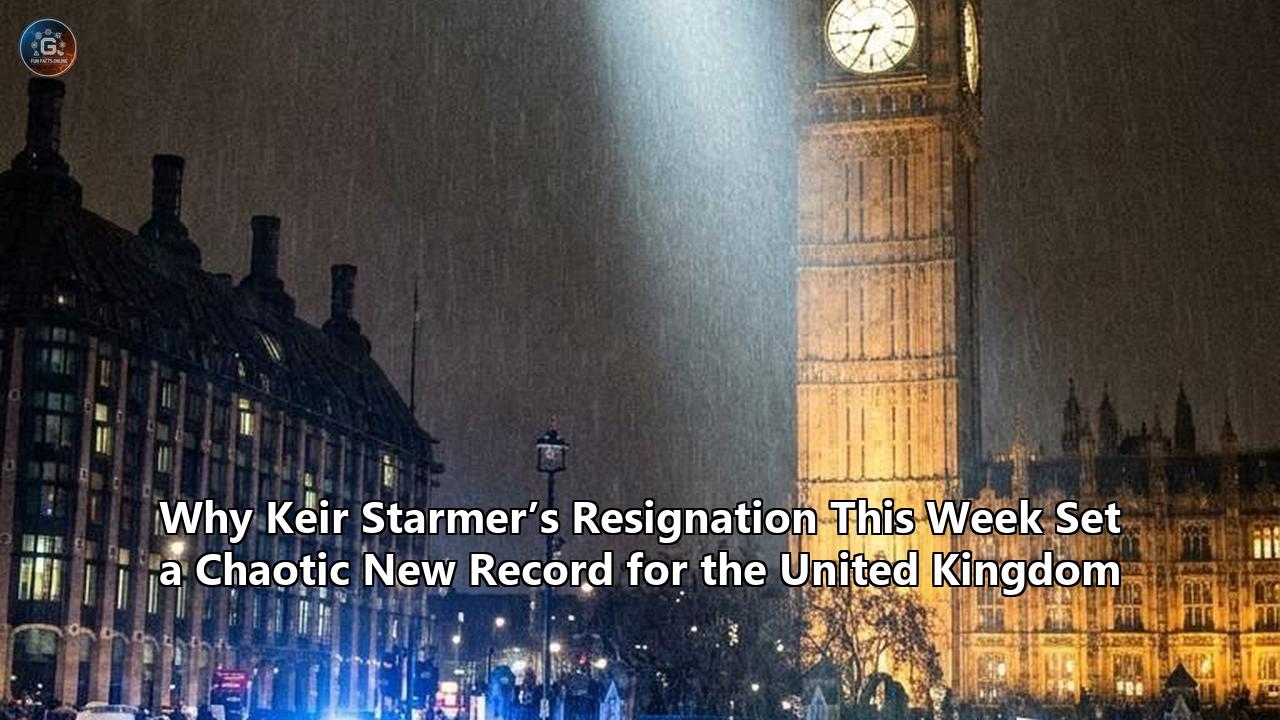
On Monday morning, June 22, 2026, Keir Starmer stood behind a lone podium outside the famous black door of 10 Downing Street and brought a swift, emotional end to his premiership. Less than two years after leading the Labour Party to a historic landslide victory in July 2024, Starmer conceded that he no longer possessed the authority to lead his party or the country. Choking up as he spoke of his children, he announced he would step down, initiating a transition that will soon install the United Kingdom's seventh prime minister in just ten years.
The immediate fallout of the Keir Starmer resignation has sent shockwaves through Westminster, but the crisis has been mounting for months. While Starmer campaigned on a promise to end the "soap opera politics" of the Conservative era, his short-lived administration ultimately succumbed to the same forces of internal mutiny, personal scandals, and economic discontent that sank his predecessors. The speed of his decline has shattered records: never before has a British prime minister with such a commanding parliamentary majority—411 seats won in 2024—been forced out of office so quickly by their own MPs.
What lies behind this sudden collapse is a complex mix of constitutional maneuvering, a major diplomatic scandal involving the late sex offender Jeffrey Epstein, and a fundamental economic paradox. To understand why Starmer’s departure marks a chaotic new low for British political stability, one must look beyond the tears on Downing Street and analyze the structural, economic, and tactical machinery that engineered his downfall.
The Makerfield Maneuver: How the "King of the North" Engineered the Exit
The proximate cause of the Keir Starmer resignation was a brilliantly executed, highly unusual constitutional maneuver from within his own party. For nearly a year, Andy Burnham, the highly popular former Mayor of Greater Manchester, had been openly positioned by party rebels as the natural successor to Starmer. However, Burnham faced a fundamental constitutional barrier: under British political convention, a prime minister must be a sitting member of either the House of Commons or the House of Lords. Having left Parliament in 2017 to run for mayor, Burnham was on the outside looking in.
That changed on May 14, 2026, when Josh Simons, the loyal Labour MP for the safe seat of Makerfield in Greater Manchester, abruptly resigned his seat. Simons' resignation was not due to personal scandal, but rather a coordinated sacrifice designed to create a Westminster vacancy specifically for Burnham. This maneuver was incredibly rare; the last time a sitting MP resigned solely to pave a path back to Parliament for an aspiring leader was during the 1965 Leyton by-election.
The resulting by-election, held on June 18, 2026, became a high-stakes proxy war. The anti-immigration Reform UK party, led by Nigel Farage, sensed blood in the water. Reform’s candidate, Robert Kenyon, campaigned on the premise that a vote for Burnham was a vote to prolong Labour’s Westminster chaos. Despite a furious campaign, Burnham’s local popularity in the North West proved insurmountable. He won the seat decisively with 24,927 votes (54.8%), relegating Reform to a distant second.
Makerfield By-Election Results (June 18, 2026)
==================================================
Candidate (Party)             Votes      Percentage
--------------------------------------------------
Andy Burnham (Labour Co-op)   24,927     54.8%
Robert Kenyon (Reform UK)     15,696     34.5%
Rebecca Shepherd (Restore)     3,111      6.8%
Michael Winstanley (Con)         997      2.2%
Others (Combined)                717      1.7%
--------------------------------------------------
Total Turnout: 58.8% (45,476 ballots cast)
==================================================
Burnham’s return to Parliament on Monday, June 22, was the final blow to Starmer’s authority. As Burnham was sworn in to a chorus of cheers in Westminster Hall, Starmer was forced to accept that a shadow prime minister was now sitting on his backbenches with the explicit backing of dozens of restive Labour MPs.
The speed of the transition was locked in within hours of Starmer’s speech. Wes Streeting, the former Health Secretary who had resigned from Starmer’s cabinet in May after devastating local election losses, was widely expected to run against Burnham in a leadership contest. But in a swift tactical move on Monday afternoon, Streeting declared he would not stand and instead threw his full backing behind Burnham. With Streeting folding his campaign, Burnham has become the overwhelming favorite to assume the premiership unchallenged, potentially entering Downing Street by mid-July.
The Math of Instability: Seven Prime Ministers in Ten Years
To understand why this development is being viewed globally as a sign of deep-seated systemic chaos, one must look at the historical trajectory of British governance. The transition from Starmer to his successor will mark the seventh individual to hold the office of prime minister since the Brexit referendum in June 2016.
The Revolving Door of 10 Downing Street (2016–2026)
======================================================
Prime Minister       Party          Tenure
------------------------------------------------------
David Cameron        Conservative   2010 – July 2016
Theresa May          Conservative   July 2016 – July 2019
Boris Johnson        Conservative   July 2019 – Sept 2022
Liz Truss            Conservative   Sept 2022 – Oct 2022
Rishi Sunak          Conservative   Oct 2022 – July 2024
Keir Starmer         Labour         July 2024 – June 2026
TBD (Likely Burnham) Labour         July 2026 – Present
======================================================
This rapid turnover represents an unprecedented breakdown in the stability of the Westminster system. For the majority of the 20th century, British prime ministers enjoyed long, stable tenures. Margaret Thatcher served for over 11 years; Tony Blair served for ten. The civil service operated with a high degree of continuity, and foreign allies could rely on consistent policy directions spanning decades.
The post-2016 era, however, has transformed Downing Street into a high-turnover corporate suite. This hyper-velocity of leadership changes has profound consequences for the mechanics of British governance:
- The Hollowed-Out Civil Service: Every new prime minister brings a completely different policy agenda, a fresh set of special advisers, and a reshuffled cabinet. This constant churning leaves the permanent civil service in a state of perpetual paralysis. Long-term infrastructure projects, healthcare reforms, and defense strategies are repeatedly paused, rewritten, or scrapped entirely.
- The Loss of Sovereign Trust: Global financial markets require predictability. The gilt market sell-off during Liz Truss’s brief 44-day tenure in 2022 demonstrated how quickly investors can lose faith in British fiscal management. While Starmer’s Chancellor, Rachel Reeves, sought to project absolute competence, the Keir Starmer resignation has reignited fears of a "country risk premium" being applied to UK assets.
- Diplomatic Atrophy: Britain's standing on the world stage has been severely diminished by its inability to keep a leader in office. G7 summits and NATO negotiations require personal relationships built over years. When a British prime minister sits down with foreign leaders, there is a tacit understanding that they may not survive the year.
The underlying mechanics of this instability are rooted in the shift toward "presidential-style" campaigns within a parliamentary framework. Prime ministers are increasingly judged on their personal brand and national poll numbers. However, unlike a president with a fixed term, a prime minister remains entirely dependent on the confidence of their parliamentary party. When a leader's personal popularity plummets, MPs, fearing the loss of their own seats in the next general election, have become increasingly ruthless in triggering internal coups.
The Vetting Catastrophe: The Mandelson Scandal That Sunk No. 10
While political impatience and electoral panic provided the fuel, the spark that ignited the bonfire of Starmer’s premiership was a colossal error of judgment regarding one of the most controversial figures in modern British political history: Lord Peter Mandelson.
In December 2024, freshly installed in Downing Street and eager to build bridges with the incoming administration of US President Donald Trump, Starmer and his Foreign Secretary, David Lammy, made a calculated gamble. They appointed Peter Mandelson, a veteran Labour architect of the "New Labour" era, as Britain’s Ambassador to the United States—widely considered the crown jewel of diplomatic postings.
Mandelson’s prior association with Jeffrey Epstein, the convicted American sex offender, had long been a matter of public record. However, Starmer’s team believed the controversy had been safely managed and that Mandelson's vast network of global contacts outweighed the reputational risks.
This calculation collapsed spectacularly in September 2025. The US Department of Justice released a massive cache of private emails and files belonging to Epstein, revealing that Mandelson's relationship with the disgraced financier was far deeper, darker, and more continuous than he had ever admitted. The documents revealed that Mandelson had:
- Referred to Epstein as his "best pal" in a 2003 birthday book message.
- Actively advised Epstein to "fight for early release" from his 18-month sentence in Florida for soliciting prostitution from a minor.
- Exchanged scores of friendly, informal messages with Epstein long after the financier's 2008 conviction.
- Allegedly leaked highly sensitive, confidential British government information to Epstein during the 2008-2009 global financial crisis while Mandelson was serving as Business Secretary under Gordon Brown.
Starmer acted swiftly in September 2025, dismissing Mandelson from his post and overseeing his resignation from both the Labour Party and the House of Lords. In February 2026, Starmer stood in the House of Commons and offered a humiliating, direct apology to Epstein’s victims, declaring that Mandelson had "betrayed our country, our Parliament, and my party".
But the crisis was far from over. On February 23, 2026, Mandelson was arrested by the Metropolitan Police on suspicion of misconduct in public office. The arrest triggered a catastrophic series of resignations within Downing Street, starting with Starmer's Chief of Staff, Morgan McSweeney, and his Director of Communications, Tim Allan.
The Downfall Timeline: How the Mandelson Scandal Dismantled Starmer's Premiership
===================================================================================
Date               Event
-----------------------------------------------------------------------------------
Dec 2024           Starmer appoints Peter Mandelson as UK Ambassador to the US.
Jan 28, 2025       UK Security Vetting (UKSV) formally denies Mandelson security
                   clearance. Foreign Office officials overrule the advice.
Sept 11, 2025      Epstein files leaked. Starmer summarily fires Mandelson.
Jan 2026           US DOJ releases further emails showing leak of government info.
Feb 8-9, 2026      Chief of Staff and Director of Comms resign. Scottish Labour
                   Leader Anas Sarwar publicly calls on Starmer to resign.
Feb 23, 2026       Mandelson arrested on suspicion of misconduct in public office.
April 16, 2026     The Guardian reveals Mandelson failed security vetting in Jan 2025.
                   Starmer fires FCDO Permanent Secretary Olly Robbins to deflect blame.
April 21, 2026     Olly Robbins testifies to parliament that No. 10 pressured officials
                   to push Mandelson's appointment through as a "done deal".
May 7, 2026        Labour suffers historic losses in local elections. Cabinet mutiny begins.
June 22, 2026      Keir Starmer announces his resignation outside 10 Downing Street.
===================================================================================
The fatal blow to Starmer’s credibility came in April 2026, when The Guardian revealed that Mandelson had actually failed his developed security vetting (DV) on January 28, 2025. Despite the explicit warning from UK Security Vetting, senior officials in the Foreign Office had overruled the recommendation and granted the clearance anyway.
Attempting to contain the political firestorm, Starmer sacked Olly Robbins, the highly respected Permanent Under-Secretary of the Foreign Office, blaming civil servants for failing to inform him of the failed vetting. This attempt to shift blame backfired spectacularly. Appearing before a parliamentary committee on April 21, Robbins testified that Starmer’s personal office had placed "constant pressure" on officials to speed up the process and bypass standard safeguards, treating Mandelson’s appointment as an absolute "done deal".
The revelation that Starmer—a former Director of Public Prosecutions who had built his entire political identity on the rule of law and professional competence—had overseen the bypassing of national security vetting to install an Epstein associate in Washington utterly destroyed his moral authority.
The Economic Paradox: Strong Growth, empty Pockets
The political damage of the Mandelson scandal was magnified by a profound economic disconnect. On paper, the United Kingdom’s macroeconomic indicators under Starmer looked remarkably strong. By the spring of 2026, Britain had recorded the strongest economic growth in the G7 for the first quarter of the year. Inflation, which had peaked at historic highs during the post-pandemic crisis, had finally settled back to the Bank of England's target level of 2.0%. Even the chronic backlog in the state-run National Health Service (NHS) had begun to show modest improvements.
UK Key Economic Indicators: Reality vs. Perception (Q1 2026)
===================================================================
Indicator                     Value       Economic Significance
-------------------------------------------------------------------
Q1 GDP Growth (Relative G7)   +0.6%       Highest growth rate among G7 peers.
CPI Inflation                 2.0%        Returned to Bank of England target.
Unemployment Rate             4.2%        Stable, near historic lows.
NHS Treatment Waiting Lists   -450,000    First sustained drop in five years.
-------------------------------------------------------------------
Starmer Net Approval Rating   -46%        Lowest recorded for sitting PM.
===================================================================
Yet, despite these positive top-line numbers, the British public felt poorer, more taxed, and increasingly resentful. The reasons for this disconnect are rooted in the specific fiscal choices made by Starmer and his Chancellor, Rachel Reeves, as they attempted to plug a massive £22 billion public spending deficit inherited from the Conservatives.
The Trap of Fiscal Drag
To avoid breaking their campaign promise not to raise headline rates of income tax, national insurance, or VAT, Starmer and Reeves relied heavily on a mechanism known as "fiscal drag". By freezing income tax thresholds while nominal wages rose with inflation, millions of middle-income and working-class Britons were quietly pushed into higher tax brackets.
Sharon Graham, the general secretary of the influential Unite union and a prominent critic of Starmer’s centrist path, pointed to this policy as a direct betrayal of working-class voters. "Action must be taken immediately to end the freeze on tax thresholds," Graham declared following the resignation. "Reversing the fiscal drag that has pulled workers into unfair tax bands must be an absolute priority for whoever takes over".
The Employer National Insurance Hike
In her first budget, Reeves announced a massive £40 billion tax-raising package. The centerpiece of this strategy was a £25 billion hike in employers' National Insurance contributions—effectively a payroll tax on businesses. While intended to fund social care and public services, the hike provoked furious anger from the business community. Corporate leaders warned that the tax would choke off private investment, suppress wage growth, and lead to widespread hiring freezes. This policy directly undermined Starmer’s central narrative that Labour was the natural "party of business."
The Winter Fuel Allowance Disaster
In a bid to demonstrate fiscal discipline to the bond markets, Starmer’s government made the highly unpopular decision to strip the winter fuel allowance from approximately 10 million elderly citizens, turning it into a means-tested benefit.
The backlash was immense. Not only did it alienate older voters, but it also triggered a furious rebellion from Labour’s left wing, who argued that saving a relatively small sum of money at the expense of vulnerable pensioners was morally indefensible. Although the government eventually backtracked and offered partial concessions under heavy pressure, the damage to Starmer’s public image was permanent. He was cast not as a compassionate leader restoring public services, but as an austere technocrat imposing quiet hardship.
The Geopolitical Crucible: Resignations and the Iran War
The final pillars of Starmer’s authority crumbled not in Westminster, but in the deserts of the Middle East and the corridors of Washington.
The outbreak of the Iran war in late 2025 threw British foreign policy into chaotic disarray. US President Donald Trump, returning to the White House with a highly confrontational regional agenda, placed immense pressure on Downing Street to join a "Coalition of the Willing" and commit British military assets, including Royal Air Force squadrons and Royal Navy warships, to direct combat operations against Iranian forces.
Starmer, wary of dragging Britain into another open-ended Middle Eastern conflict and facing a highly volatile domestic population, resisted Trump's demands. While this caution was privately welcomed by senior diplomats, it provoked public fury from the Trump administration. The discord culminated in a highly unusual, preemptive social media post by Trump on Sunday, June 21—just hours before Starmer’s official announcement—declaring that Starmer was about to resign and criticizing him for failing on "IMMIGRATION AND ENERGY". This public intervention from Washington effectively nudged Starmer out the door, showcasing the weakness of the UK’s global position.
UK Defense Spending Targets vs. Actual Commitments (2025-2026)
===================================================================
Year       Defense Spending Target (% GDP)   Status
-------------------------------------------------------------------
2024       2.3% (Actual)                     Sunak-era baseline.
June 2025  5.0% (Pledged by Starmer)         Announced under heavy G7
                                             and US pressure.
May 2026   5.0% (Delayed)                    Defense Investment Plan
                                             postponed indefinitely.
June 2026  Healey & Carns Resign             Protesting funding cuts.
===================================================================
At the same time, Starmer was facing a severe mutiny within his own defense establishment. Under intense pressure from both the US and Eastern European allies to bolster deterrence against Russia, Starmer had pledged in June 2025 to increase Britain’s defense spending to an ambitious 5.0% of GDP.
However, given the tight fiscal constraints imposed by Chancellor Reeves, the government repeatedly delayed the publication of its actual defense investment plans. Earlier in June 2026, John Healey, the highly respected Defense Secretary, and Al Carns, the Armed Forces Minister, resigned in rapid succession, protesting that the military was being starved of the resources required to meet its global commitments. The departure of his entire defense team left Starmer’s national security credentials in ruins.
How the Westminster System Accelerates Political Ruin
To an international audience, the speed with which a prime minister who held a historic 170-seat majority in Parliament can be utterly dismantled is deeply confusing. In presidential systems, such as that of the United States, a leader with a major electoral mandate is virtually guaranteed a fixed four-year term, short of impeachment for high crimes.
The British Westminster system, however, is a cabinet government, not a presidential one. Its constitutional design actively accelerates political collapse through several specific institutional mechanisms:
- The Absence of a Direct Mandate: British voters do not elect a prime minister; they elect local Members of Parliament. The prime minister is simply the leader of the party that can command a majority in the House of Commons. Consequently, if a prime minister becomes an electoral liability, the parliamentary party can replace them overnight without needing to consult the wider electorate.
- The Power of the 1922 Committee and the Labour NEC: While the Conservative Party uses the famous "1922 Committee" to manage leadership challenges, the Labour Party relies on its National Executive Committee (NEC) and the parliamentary party. If a substantial portion of Labour MPs indicate they will no longer serve under a leader, the Prime Minister’s position becomes instantly untenable.
- The Lack of Coalition Safeguards: Because the UK's first-past-the-post voting system routinely produces single-party majority governments, there are no coalition partners to act as a stabilizing buffer. All policy failures, internal disputes, and economic downturns are laid squarely at the door of the governing party and its single leader.
In Starmer's case, the collapse of his authority was accelerated by a profound factional divide. To secure the Labour leadership in 2020, Starmer had run on a platform that united the party's left and center wings. Once in power, however, he systematically marginalized the left, suspending former leader Jeremy Corbyn and purging left-wing candidates.
This centrist pivot successfully reassured middle-class voters in 2024, but it left Starmer without a loyal base of support when things went wrong. When the local election losses of May 2026 occurred, neither the left of his party (who viewed him as a betrayer) nor the center-right (who viewed him as an electoral liability) had any interest in saving him.
What Lies Ahead: The Burnham Coronation and the EU Reset
As Keir Starmer prepares to retreat to the backbenches, the United Kingdom faces an incredibly tense, condensed timeline. Starmer announced that he will remain in office as a caretaker prime minister until his party selects a new leader, a process that is expected to conclude before Parliament returns from its summer recess on September 1.
The Path to a New Prime Minister: The Summer 2026 Timeline
===================================================================
Date             Constitutional / Party Step
-------------------------------------------------------------------
June 22, 2026    Starmer announces resignation; King Charles III informed.
June 22, 2026    Andy Burnham sworn in as MP for Makerfield.
July 9, 2026     Nominations for the Labour leadership contest open.
July 16, 2026    Deadline for nominations. If unchallenged, Burnham becomes Leader.
July 22, 2026    Scheduled UK-EU Summit. Burnham expected to attend as PM.
Sept 1, 2026     Parliament returns. New PM formally presents legislative agenda.
===================================================================
Under the rules set out by Labour's NEC, nominations for the leadership contest will formally open on July 9. A process of hustings, where candidates make their case to fellow Labour MPs, is scheduled to be completed by July 16, the last day before Parliament breaks for summer recess.
Because Wes Streeting has backed Andy Burnham, there is an extremely high probability that Burnham will run entirely unchallenged. If no other candidate secures the required nominations from MPs, Burnham could be crowned Labour leader and invited by King Charles III to form a government as early as July 17.
Prospective Burnham Cabinet: The Westminster Whispers
===================================================================
Cabinet Post             Likely Candidate      Political Alignment
-------------------------------------------------------------------
Prime Minister           Andy Burnham          Soft-Left / Regionalist
Chancellor               Wes Streeting         Centrist / Reformer
Foreign Secretary        Yvette Cooper         Continuity Centrist
Energy Secretary         Ed Miliband           Green / Progressive
Defense Secretary        John Healey (Return)  Atlanticist
===================================================================
A Burnham-led administration would represent a massive shift in both style and substance. Nicknamed the "King of the North," Burnham’s political identity is built on regional devolution, public ownership of transport, and an explicitly compassionate, soft-left economic agenda. He is expected to quickly move to reverse the freeze on income tax thresholds and reconsider the cuts to the winter fuel allowance, aiming to win back the working-class voters who fled to Reform UK.
However, the incoming prime minister will inherit an exceptionally difficult inbox. Burnham will have to immediately prepare for a high-stakes UK-EU bilateral summit scheduled for July 22, where he must attempt to salvage Starmer’s stalled plans for a "regulatory reset" with Brussels.
Furthermore, Burnham will have to find a way to manage relations with an aggressively hostile Trump administration while simultaneously addressing the massive funding black hole in Britain's public services and defense infrastructure.
A Nation in Search of Equilibrium
The dramatic exit of Keir Starmer has exposed a fundamental truth about modern British politics: the country’s institutional framework is struggling to cope with the compounding stresses of the post-Brexit era.
The UK is locked in a volatile cycle where deep economic stagnation, rapid public service decay, and highly personalized political media combine to destroy the authority of any leader who enters Downing Street. Landslide majorities, once a guarantee of stable, multi-year governance, have shown they can dissolve in months under the pressure of party infighting and personal scandal.
As Andy Burnham prepares to take the reins, the central question is no longer just whether he can revive Labour’s flagging political fortunes, but whether any British prime minister can restore long-term stability to a system that seems increasingly designed for chaos. Until Britain addresses the structural issues of its tax burden, its declining public services, and its hyper-reactive constitutional design, the revolving door of 10 Downing Street is likely to keep spinning.
Reference:
- https://www.theguardian.com/politics/2026/jun/22/keir-starmer-quits-prime-minister-what-will-happen-next-uk-politics-explained
- https://www.forbes.com/sites/siladityaray/2026/06/22/uk-prime-minister-keir-starmer-announces-resignation/
- https://www.cbsnews.com/news/keir-starmer-resigns-uk-prime-minister-labour-party-andy-burnham/
- https://www.thehindu.com/news/international/analysis-why-keir-starmer-resigned/article71132963.ece
- https://www.tpr.org/news/2026-06-22/keir-starmer-has-resigned-paving-way-for-a-7th-u-k-prime-minister-in-10-years
- https://www.pbs.org/newshour/world/how-uks-keir-starmer-went-from-election-landslide-to-downfall
- https://en.wikipedia.org/wiki/Anas_Sarwar
- https://makerfieldbyelection.co.uk/
- https://en.wikipedia.org/wiki/2026_Makerfield_by-election
- https://www.theguardian.com/politics/2026/jun/22/keir-starmer-resigns-as-prime-minister
- https://novaramedia.com/2026/06/22/wes-streeting-backs-andy-burnham-for-prime-minister/
- https://www.ksat.com/news/2026/06/22/the-latest-uk-prime-minister-keir-starmer-quits/
- https://www.theguardian.com/politics/2026/jun/22/andy-burnham-to-stand-to-become-labour-leader-and-uk-prime-minister
- https://labourlist.org/2026/06/live-reaction-from-mps-and-party-figures-as-starmer-announces-resignation/
- https://en.wikipedia.org/wiki/Keir_Starmer
- https://www.ctvnews.ca/world/article/keir-starmer-what-went-wrong/
- https://www.ft.com/content/f5cc1126-9de5-4597-b043-c74bed7573cb?syn-25a6b1a6=1
- https://en.wikipedia.org/wiki/Relationship_of_Peter_Mandelson_and_Jeffrey_Epstein
- https://www.pbs.org/newshour/world/uks-starmer-apologizes-to-epstein-survivors-for-making-peter-mandelson-an-ambassador
- https://time.com/article/2026/06/01/peter-mandelson-files-ambassador-to-us-epstein-fallout-trump-revelations/
- https://novaramedia.com/2026/02/09/scottish-labour-leader-calls-for-keir-starmer-to-resign/
- https://www.unitetheunion.org/news-events/news/2026/june/keir-starmer-s-resignation-unite-reaction
- https://www.thenational.scot/news/26217036.anas-sarwar-responds-keir-starmer-resignation/