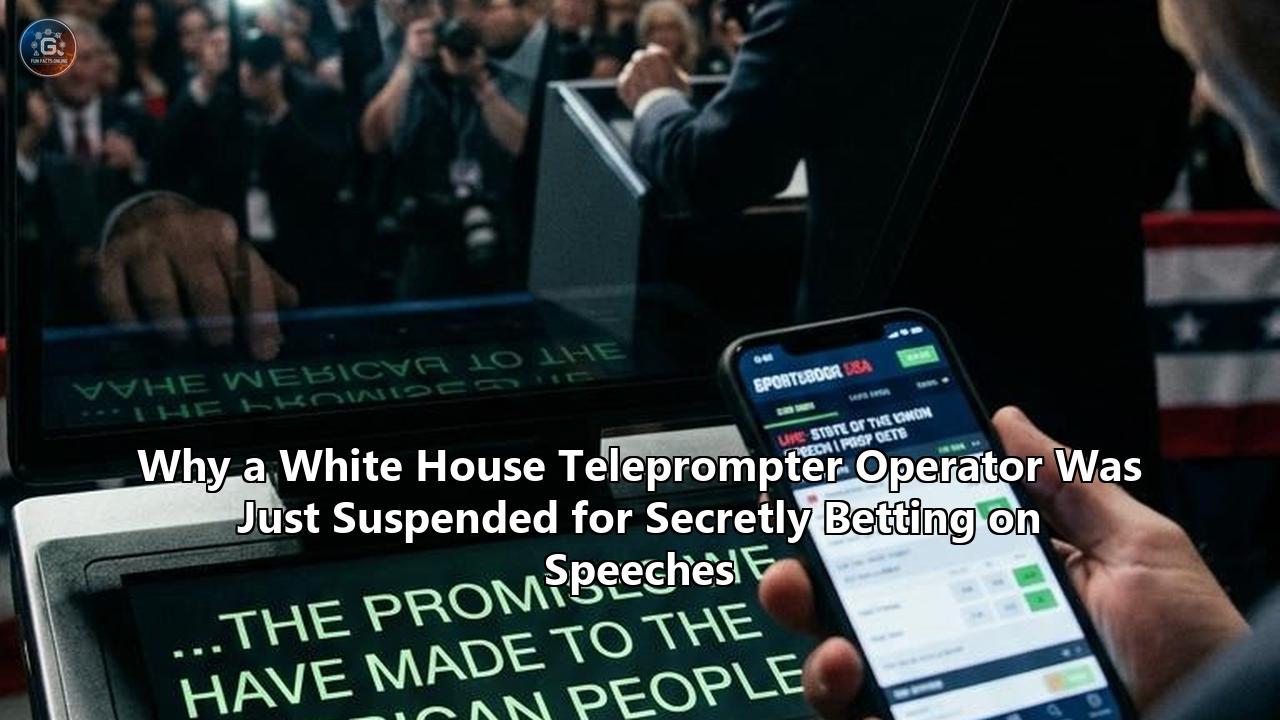
At a press briefing on July 16, 2026, White House Press Secretary Karoline Leavitt faced a room of reporters eager to discuss a security breach that was as bizarre as it was sophisticated. A senior aide on the President’s production team, a man who had stood feet away from Donald Trump for a decade, had been suspended without pay. His offense was not leaking classified documents or selling state secrets, but rather exploiting his front-row seat to the presidency to wage a highly profitable, covert campaign on prediction markets.
Gabriel Perez, a deputy assistant to the president who commanded a $175,000 annual salary, had been placed on unpaid administrative leave. He is currently cooperating with the Commodity Futures Trading Commission (CFTC) after being caught using advance knowledge of presidential speeches to make more than $100,000 in bets on the platform Kalshi.
Trump, who had personally praised Perez’s technical skills on the campaign trail as "gold," was reportedly furious. "He believes it’s deeply unfortunate and frankly a disgrace," Leavitt told reporters.
This sudden termination has ignited the White House teleprompter scandal, exposing a critical vulnerability at the intersection of modern political staging, high-speed algorithmic trading, and the wild-west expansion of real-money prediction markets. The fallout goes far beyond the career of a single technician; it reveals how a trusted staffer bypassed traditional security protocols, manipulated a novel financial ecosystem, and triggered a high-stakes algorithmic trap set by a trading platform’s internal surveillance team.
The Mechanical Edge: Why the Prompter Operator Holds the Script
To understand how Perez pulled off his scheme, one must look past the podium to the physical mechanics of presidential speechmaking. The modern presidential teleprompter—often referred to in the industry as a "podium prompter" or "glass prompter"—is an elegant piece of theatrical illusion.
The setup consists of two stands placed on either side of the lectern. At the top of each stand is a pane of specialized beam-splitter glass, angled at precisely 45 degrees. On the floor or stage level below each stand sits an ultra-bright LCD monitor displaying the text of the speech in reverse. The optical properties of the beam-splitter glass reflect the text upward so that it appears normally to the speaker, while remaining completely transparent to the audience and television cameras. This dual-panel arrangement allows a president to sweep their gaze left and right across a crowd, maintaining the illusion of direct eye contact while reading a scrolling script word-for-word.
But the glass is only half the system. The heart of the operation is the manual scrolling software and the human being operating the hand-control scroll wheel offstage.
While automated speech-recognition software exists to scroll text based on vocal pacing, the White House Communications Agency (WHCA) and the executive production team strictly avoid automation for high-stakes addresses. Instead, they rely on a live, highly trained human operator who listens to the speaker's cadence in real-time, micro-adjusting the scroll speed to match pauses, emphasis, and the natural rhythm of delivery. If a speaker slows down for rhetorical effect, pauses for applause, or veers off-script to ad-lib an aside, a mechanical scroll would fall out of sync within seconds. The human operator must be perfectly in sync with the speaker’s mind.
Perez was that human operator. Having worked with Trump since the 2016 campaign, he was one of the few technical staffers who knew exactly how the president delivered a line.
+-------------------------------------------------------------+
|               PRESIDENTIAL TELEPROMPTER SYSTEM              |
+-------------------------------------------------------------+
|                                                             |
|       [ Glass Panel ]                         [ Glass Panel ]|
|         (Angled 45°)                            (Angled 45°) |
|              \                                        /     |
|               \                                      /      |
|                \               [Podium]             /       |
|                 \                 ||               /        |
|                  \                ||              /         |
|                   \               ||             /          |
|                                                             |
|       [Floor Monitor]                         [Floor Monitor]|
|        (Reversed Text)                         (Reversed Text)|
|                                                             |
+-------------------------------------------------------------+
|                        OFFSTAGE CONTROL                     |
+-------------------------------------------------------------+
|   [Operator Console (Perez)]  ===>  Real-Time Scroll Speed  |
|   - Final Script Formatting                                  |
|   - Instant Edit Authority                                  |
|   - Direct Phone/Tablet Access                              |
+-------------------------------------------------------------+
Because of this unique role, Perez had "final eyes" on nearly all prepared remarks. When a speech is drafted by a team of speechwriters, it undergoes dozens of revisions. The final draft is eventually passed to the teleprompter operator, who imports it into specialized software (such as Telescript or CPC) and formats it for optimal readability. This formatting involves:
- Breaking sentences into short, punchy lines of 3 to 5 words to match the speaker's eye span.
- Adjusting font sizes (typically 64-point to 84-point) to accommodate the speaker's visual range.
- Inserting physical stage directions, phonetic spellings of foreign names, and specific cues.
- Receiving last-second, handwritten additions from the president or chief of staff directly at the podium and typing them into the live system on the fly.
In short, Perez possessed an informational monopoly. He did not just have access to the final draft hours before a speech; he was the physical gatekeeper of the words that would appear on the glass. For someone looking to profit from prediction markets, this was the ultimate inside track.
Inside the "Mention Markets": The High-Octane Frontier of Prediction Betting
To understand why Perez’s access was so valuable, one must examine the specific financial instrument he exploited: "mention markets".
While prediction markets are widely known for macro-level wagers—such as predicting election outcomes, Federal Reserve interest rate hikes, or quarterly GDP growth—platforms like Kalshi and Polymarket have increasingly offered micro-level "event contracts". Among the most popular of these are mention markets, which allow traders to buy and sell "Yes" or "No" contracts on whether a specific public figure will say a particular word or phrase during a defined live event.
+-------------------------------------------------------------------------+
|                  ANATOMY OF A KALSHI "MENTION CONTRACT"                  |
+-------------------------------------------------------------------------+
|  Contract: Will President Trump say "Hormuz" during the address?       |
|                                                                         |
|  [ YES ] Contract Price: $0.15  <==   Reflects 15% Implied Probability  |
|  [ NO  ] Contract Price: $0.85  <==   Reflects 85% Implied Probability  |
|                                                                         |
|  Resolution Rules:                                                      |
|  - Must be spoken during the designated time window.                     |
|  - Verified via the official White House written transcript.            |
|  - Pays out $1.00 for correct prediction, $0.00 for incorrect.          |
+-------------------------------------------------------------------------+
|  Gabriel Perez's Strategy:                                               |
|  1. Sees "Hormuz" is in the final formatted prompter script.             |
|  2. Buys "YES" contracts at $0.15.                                      |
|  3. Payout: $1.00 per contract (666% return on capital).                |
+-------------------------------------------------------------------------+
These contracts trade in a format identical to binary options, priced between $0.01 and $0.99. The price of a contract directly reflects the market’s perceived probability of the event occurring. For instance, if a contract for Trump saying the word "Hormuz" during a foreign policy address is trading at $0.15, the market believes there is a 15% chance he will utter the word.
If the word is spoken during the address, the "Yes" contract settles at $1.00, yielding an 85-cent profit per share. If the word is not spoken, the "Yes" contract settles at $0.00, and the "No" contract pays out $1.00.
To maintain order and prevent constant disputes, Kalshi’s rules for these markets are exceptionally rigid:
- Official Source Resolution: Markets do not resolve based on live television audio, which can be muffled, interrupted, or misheard. Instead, they are tied strictly to an official, published transcript. For White House events, this is the official transcript published by the White House Office of the Press Secretary.
- Strict Root-Word Parameters: The rulebooks pre-define whether plurals, tenses, or related terms qualify. For example, a contract on the word "tariff" might explicitly state that "tariffs" or "tariffed" do not count unless specified.
- Defined Windows: The target words must be spoken within a highly specific timeframe—usually from the moment the speaker takes the podium to the moment they step away.
These rules created a paradise for an insider like Perez. While regular retail traders spent hours analyzing past speeches, drafting frequency charts, and attempting to guess the administration's policy direction, Perez merely had to look at his teleprompter monitor.
If the official transcript was going to be compiled from the prepared text loaded into his machine, and if he had formatted the word "Hormuz" or "rigged election" into the software, the probability of that word appearing was not 15%—it was closer to 95%. By purchasing "Yes" contracts at heavily discounted prices, Perez was essentially buying dollar bills for fifteen cents apiece.
The Master Class in Deception: Perez's Three-Month Trading Campaign
According to federal investigators, Perez’s trading activity spanned at least a dozen high-profile addresses over a three-month period starting in late 2025. This was not a one-time lapse in judgment; it was a systematic, calculated exploitation of some of the most historic events of the year.
The 2026 State of the Union Address (February 24, 2026)
The State of the Union (SOTU) is the Super Bowl of political prediction markets. Millions of dollars flow into contracts predicting everything from the length of the speech to the specific words the president will use to describe the state of the economy.
Because SOTU addresses are drafted over several weeks by an army of policy advisers, cabinet secretaries, and senior speechwriters, the script is incredibly dense, detailed, and guarded under tight information security protocols.
Perez, however, had the final prompter copy loaded onto his terminal hours before Trump walked down the aisle of the House chamber. Investigators believe Perez placed large, high-conviction wagers on several highly specific, low-probability words that had been inserted into the text to appease specific congressional factions.
By betting on these obscure words, which the market had priced at single-digit probabilities (between $0.02 and $0.08), Perez secured massive payouts when Trump read them verbatim off the glass.
The World Economic Forum in Davos (January 2026)
International summits like Davos are highly sensitive events where even minor word choices can move global currency and equity markets.
Perez allegedly exploited his access to Trump’s bilateral remarks and main address to global leaders, betting heavily on specific economic terms that the market assumed Trump would avoid.
Because the international press corps was focused on predicting whether Trump would strike a conciliatory or confrontational tone, the mention markets for specific trade-related phrases were highly volatile. Perez was able to buy contracts at optimal prices long before the speech began.
The Medal of Honor Ceremony (March 2026)
While major addresses like the SOTU drew heavy volume, Perez also targeted smaller, highly scripted events where the lack of public scrutiny meant that contract prices remained stagnant.
At a Medal of Honor ceremony in March, the prepared remarks contained highly specific historical references, names of military units, and locations from decades-old battles. These were words that no casual political observer could have predicted.
Perez placed highly concentrated bets on these exact names, clearing tens of thousands of dollars on a minor, mid-day broadcast that barely registered in the national news cycle.
+--------------------------------------------------------------------------+
|                  SUMMARY OF GABRIEL PEREZ'S EXPLOITED EVENTS             |
+--------------------------------------------------------------------------+
|  Date           | Event                        | Target Wagers           |
+-----------------+------------------------------+-------------------------+
|  December 2025  | Primetime Address            | Key policy buzzwords    |
|  January 2026   | WEF Address (Davos)          | Trade & tariff terms    |
|  Feb 24, 2026   | State of the Union Address   | Highly obscure phrases  |
|  March 2026     | Medal of Honor Ceremony      | Military unit names     |
+--------------------------------------------------------------------------+
|  Total Estimated Profits: >$100,000 | Frozen by Kalshi: ~$90,000         |
+--------------------------------------------------------------------------+
The Fatal Flaw: The Ad-Lib Escape Hatch
Perez’s scheme was mathematically flawless on paper, but it suffered from a major operational variable: Donald Trump’s legendary propensity to go off-script.
While most politicians stick closely to the text scrolling on the glass, Trump is famous for treating a teleprompter as a set of loose suggestions rather than an ironclad script. He frequently pauses to deliver minutes-long, stream-of-consciousness riffs, skips entire pages of prepared remarks when he feels a line is too dry, or completely rewrites policy announcements live on television.
This unpredictability presented a lethal hazard for Perez's wagers. If Perez had bet $10,000 on Trump saying a specific word in paragraph 14, and Trump suddenly decided to skip from paragraph 10 straight to the conclusion, Perez's "Yes" contracts would instantly crash to $0.00.
To mitigate this risk, Perez engaged in a practice that ultimately proved to be his undoing: mid-speech panic-selling.
Sitting at the operator console, tracking Trump’s spoken words line-by-line while simultaneously watching the live market on a secondary device, Perez was performing a frantic, high-wire act. When Trump would begin to veer off-script, pacing away from the podium or ad-libbing a story, Perez could see that the president was about to bypass the section of the speech containing his target betting words.
Using his phone, Perez would immediately dump his "Yes" shares back into the market at whatever price he could get, or rapidly buy "No" contracts to hedge his exposure. Because he was the one scrolling the text, he knew Trump had skipped the paragraph several seconds before the rest of the trading public—and the market-making algorithms—realized the words were never going to be said.
This real-time, zero-latency trading, executed while the president was actively speaking on live television, left a glaring digital footprint.
The Surveillance Dragnet: How Kalshi's Algorithms Trapped the Insider
For all the growth and excitement surrounding prediction platforms, the reality of trading on a federally regulated exchange like Kalshi is that every keystroke, login, IP address, and transaction is monitored by sophisticated market-surveillance software.
The White House teleprompter scandal did not unravel because of a tipster or an FBI wiretap. It unraveled because of Robert DeNault, Kalshi’s head of enforcement, and a series of automated algorithmic alerts designed to detect asymmetric information flow.
In March 2026, Kalshi’s internal surveillance systems flagged a pattern of anomalous trading activity in several of its "mention markets" tied to presidential speeches. Modern financial surveillance on prediction exchanges does not just look for people who win; it looks for "toxic flow"—trading behavior that suggests the participant is not taking a statistical risk, but rather executing trades with perfect, non-probabilistic certainty.
Several key red flags triggered the exchange’s automated alarms:
- The Timing of Position Entry: An account registered under a residential IP address in the Washington, D.C., metro area was consistently establishing massive, highly illiquid positions in obscure speech contracts just hours—and sometimes minutes—before major addresses.
- The "No-Loss" Distribution: The account's win rate on highly specific, low-probability words was statistically impossible. In the world of quantitative finance, a trader hitting 95% accuracy on event contracts priced at $0.05 is a clear indicator of material nonpublic information (MNPI).
- The Mid-Speech Execution Correlation: The absolute smoking gun was the millisecond correlation between the president's physical delivery and the account's trading activity. Kalshi's engineers matched the time stamp of the account’s sell orders with the exact moment Trump skipped paragraphs in his live broadcast. The account was selling off its "Yes" positions precisely when the prompter operator would have realized the president had skipped a section.
             TIMELINE OF A SUSPICIOUS TRANSACTION (SOTU ADDRESS)

   Time (EST)      Event / Trading Activity
   ----------      ---------------------------------------------------------
   06:15 PM        Perez loads SOTU script into teleprompter software.
                   Identifies highly specific term: "biochem".

   06:30 PM        Perez logs into Kalshi via mobile device.
                   Buys 10,000 "YES" contracts on "biochem" at $0.08.
                   (Total outlay: $800. Potential payout: $10,000).

   09:15 PM        SOTU begins. Trump is reading off the glass.

   09:42 PM        Trump approaches the foreign policy section.
                   Suddenly, Trump ad-libs a joke about a senator and
                   skips the paragraph containing "biochem".

   09:43 PM        Within 3 seconds of the skip, Perez dumps all
                   10,000 "YES" contracts at $0.04, cutting losses.

   [ALGO ALERT]    Kalshi's surveillance system flags a $400 exit order
                   placed mid-speech, precisely correlating with Trump's
                   unscripted verbal skip.
Once the algorithms flagged the account, Kalshi's compliance team initiated an internal investigation.
Because Kalshi is a Designated Contract Market (DCM) regulated by the CFTC, it is legally mandated to enforce strict Know Your Customer (KYC) and Anti-Money Laundering (AML) protocols. Users cannot trade anonymously; they must submit validated social security numbers, physical addresses, and employment disclosures.
When Kalshi’s analysts pulled the account registration details, the puzzle pieces fell into place with alarming speed:
- The account belonged to Gabriel Perez.
- The employer field—which Kalshi had recently begun requiring users to update in June 2026—indicated he was a federal employee.
- A cross-reference of public White House staff directories and payroll records confirmed his exact job title: Deputy Assistant to the President and Teleprompter Operator.
Recognizing the massive legal and political implications of their discovery, Kalshi’s leadership took immediate, decisive action. They froze Perez's account, locking up over $90,000 in paper profits before he could execute a withdrawal.
They then compiled their trading logs, IP routing data, and behavioral analysis into a formal referral and handed it directly to the CFTC’s Division of Enforcement.
The Legal and Regulatory Battleground: Decoding CFTC Rule 180.1
The White House teleprompter scandal has pushed federal regulators into uncharted legal territory, forcing them to answer a fundamental question: Is betting on a speech using inside information actually "insider trading" in the eyes of the law?
To the average person, the answer is an obvious yes. But in the highly technical world of financial regulation, traditional insider trading laws are built almost entirely around securities—stocks, bonds, and options regulated by the Securities and Exchange Commission (SEC) under the Securities Exchange Act of 1934 and Rule 10b-5.
Those laws are predicated on a specific legal concept: a corporate insider (like a CEO) owes a fiduciary duty to their shareholders. If that CEO trades their company’s stock based on confidential earnings data, they are breaching that duty.
But a presidential speech is not a stock, the United States government is not a corporation, and a teleprompter operator does not owe a fiduciary duty to public "shareholders" in a prediction market.
To bridge this regulatory gap, the CFTC is relying on a highly potent, relatively modern legal weapon: the Misappropriation Theory of Insider Trading, codified under Section 6(c)(1) of the Commodity Exchange Act (CEA) and CFTC Rule 180.1.
+--------------------------------------------------------------------------+
|             SEC VS. CFTC INSIDER TRADING: THE LEGAL SPLIT                |
+--------------------------------------------------------------------------+
|  SEC (Classical Theory)               |  CFTC (Misappropriation Theory)  |
+---------------------------------------+----------------------------------+
|  - Regulates: Securities (Stocks)     |  - Regulates: Commodities/Swaps  |
|  - Breach of duty to: Shareholders    |  - Breach of duty to: Source     |
|  - Focus: Corporate profits           |  - Focus: Integrity of system    |
|                                       |                                  |
|  * SEC Rule 10b-5                     |  * CFTC Rule 180.1               |
|    Prohibits deceptive devices        |    Prohibits fraud by            |
|    in connection with purchase        |    misappropriating any          |
|    or sale of securities.             |    nonpublic information.        |
+--------------------------------------------------------------------------+
|  The Perez Case: Under CFTC Rule 180.1, Perez violated his duty of       |
|  confidentiality to the White House (the source) by using its prepared  |
|  remarks for personal financial gain on a regulated platform.   |
+--------------------------------------------------------------------------+
Rule 180.1 was modeled directly after SEC Rule 10b-5, but with a crucial difference: it applies to swaps, futures, and commodity contracts. Under the misappropriation theory, a person commits fraud when they:
- Gain access to material, nonpublic information (MNPI) through a relationship of trust and confidence.
- Misappropriate that information for personal trading purposes.
- Breach a duty of confidentiality owed to the source of the information (not the market participants themselves).
In this case, the "source" is the Executive Office of the President. By accepting employment at the White House, signing non-disclosure agreements, and agreeing to federal ethical guidelines, Perez owed a strict duty of confidentiality to the White House. When he took the prepared speech text and used it to place bets on Kalshi, he misappropriated that proprietary property for personal gain, directly violating CFTC Rule 180.1.
The "Eddie Murphy Rule"
The CFTC's enforcement case is further bolstered by Section 746 of the Dodd-Frank Wall Street Reform and Consumer Protection Act, colloquially known as the "Eddie Murphy Rule."
Inspired by the plot of the 1983 movie Trading Places—where the villainous Duke brothers attempt to corner the orange juice futures market using a stolen, confidential USDA crop report—this provision explicitly prohibits government employees and other officials from using nonpublic, confidential government information to trade futures, options, or swaps.
Historically, the Eddie Murphy Rule was viewed as a theoretical safeguard designed to prevent agricultural or energy department staffers from front-running oil and corn futures. But on February 25, 2026, the CFTC’s Division of Enforcement issued a landmark Prediction Markets Advisory (Release 9185-26).
The advisory made it explicitly clear that the agency views event contracts on prediction platforms as "swaps" and that the misuse of material nonpublic government information on these platforms constitutes illegal insider trading under CFTC Rule 180.1.
                CFTC PREDICTION MARKETS ADVISORY (RELEASE 9185-26)

   "The Division will closely scrutinize and prosecute trading activity on
   Designated Contract Markets (DCMs) where market participants utilize
   material nonpublic information (MNPI) in breach of a pre-existing duty...
   Event contracts and prediction markets are not exempt from the Commodity
   Exchange Act's core anti-fraud and anti-manipulation provisions."
This advisory was followed on March 31, 2026, by a public warning from the CFTC Director of Enforcement, who took direct aim at a growing narrative in Silicon Valley and Wall Street that prediction markets are naturally immune to insider trading laws:
"Unfortunately, a myth has spread that insider trading is permissible—even encouraged—in the prediction markets... Some have suggested that insider trading is inevitable or beneficial because it gives people with confidential information a financial incentive to trade on it... Not so. Insider trading in the commodity futures and swap markets is prohibited by the CEA and relevant CFTC regulations. And this is not some abstract theory; the prohibition on insider trading in commodity markets involves a straightforward application of the law."
Perez is currently in active settlement negotiations with the CFTC. Legal experts believe that to avoid a devastating federal lawsuit, he will likely be forced to agree to a permanent trading ban on all prediction platforms, disgorge the entirety of his paper winnings, and pay substantial civil monetary penalties.
The Precedents: A Broadening Crackdown on Inside Information
The White House teleprompter scandal is not an isolated incident. It is the crown jewel in a series of aggressive, coordinated enforcement actions by the CFTC and the Department of Justice (DOJ) to police prediction markets.
For years, platforms like Kalshi and Polymarket operated in a regulatory gray area, with many retail users believing that because they were betting on real-world events rather than corporate stocks, traditional trading rules did not apply. That illusion has been systematically dismantled by federal prosecutors in the Southern District of New York (SDNY).
The Google "AlphaRaccoon" Case (May 2026)
Just two months before Perez's suspension, federal authorities charged a senior software engineer at Google with civil and criminal wire fraud, commodities fraud, and money laundering in connection with trades placed on Polymarket.
Trading under the pseudonym "AlphaRaccoon," the engineer accessed restricted, internal Google databases containing confidential, nonpublic search query logs to see the finalized rankings for Google's highly anticipated "Year in Search" list weeks before it was publicly released.
+--------------------------------------------------------------------------+
|                  THE GOOGLE "ALPHARACCOON" CASE (MAY 2026)               |
+--------------------------------------------------------------------------+
|  Defendant: Google Software Engineer                                     |
|  Platform: Polymarket                                                    |
|  Asymmetric Edge: Internal database access to "Year in Search" rankings   |
|  Total Profits: $1.2 Million                                             |
|  Charges: Civil Commodities Fraud, Criminal Wire Fraud, Money Laundering |
+--------------------------------------------------------------------------+
|  This case established that corporate nonpublic data used to trade       |
|  event contracts constitutes "misappropriated property" under federal   |
|  fraud statutes.                                                  |
+--------------------------------------------------------------------------+
The engineer used this data to trade more than 20 separate event contracts tied to those rankings with near-perfect accuracy, generating $1.2 million in profits. The DOJ criminally prosecuted him, establishing a precedent that corporate nonpublic data is misappropriated property under federal wire fraud statutes.
The U.S. Army "Maduro Raid" Case (Early 2026)
In another national security incident, a U.S. Army soldier was arrested and charged with insider-trading-type offenses.
The soldier, who was privy to classified operational planning regarding a high-stakes military raid targeting Venezuelan dictator Nicolás Maduro, placed speculative bets on a prediction market regarding the timing and execution of the operation.
The incident sent shockwaves through the Pentagon, prompting an immediate review of how classified information is compartmentalized.
These cases highlight a shifting paradigm. Whether it is search rankings, military operations, or presidential speeches, the federal government is making it clear that if you have an informational advantage gained through a professional duty, using that advantage on a prediction market is a federal crime.
The Anatomy of an Executive Memo: How the White House Tried—and Failed—to Prevent the Leak
The most politically damaging revelation of the White House teleprompter scandal is that the administration knew this vulnerability existed months before Perez was caught.
On March 24, 2026—coincidentally, the exact month Kalshi’s surveillance systems first detected Perez’s suspicious trading activity—the White House Management Office sent an urgent, highly restrictive internal memorandum to all West Wing aides and technical staff.
The memo, titled "Compliance with Federal Ethical Guidelines Regarding Online Prediction Markets," was a direct warning shot. It explicitly ordered all federal employees, contractors, and technical assistants that they were strictly prohibited from placing wagers on any prediction market platform using nonpublic, privileged government information.
                     OFFICE OF WHITE HOUSE MANAGEMENT
                              MEMORANDUM

   DATE: March 24, 2026
   TO: All Executive Office of the President Staff, Contractors, and Aides
   SUBJ: Use of Nonpublic Information on Prediction Market Platforms

   "...Staff are reminded that federal ethical guidelines explicitly prohibit
   the use of nonpublic, official, or privileged information for personal
   financial gain. This prohibition extends to all digital assets, event
   contracts, and prediction market platforms (including but not limited to
   Kalshi and Polymarket)... Any such transaction constitutes a severe
   breach of trust and will result in immediate termination and referral to
   federal law enforcement."
The memo was triggered by a growing realization among senior staff that the administration's tight circle of information was leaking, but not to traditional journalists. Instead, the leak was manifesting as sudden, inexplicable price movements on prediction boards.
For instance, hours before a major policy rollout, the probability of a specific word or policy option on Kalshi would spike from 10% to 90%, signaling to sophisticated outside observers that an insider was loading up on contracts.
Despite the clear, unambiguous warnings in the March 24 memo, Perez continued his trading. His actions point to a profound psychological disconnect that is increasingly common among younger, tech-savvy professionals: the gamification of insider information.
In the minds of many modern traders, prediction markets do not feel like traditional, stuffy financial markets. They feel like video games or fantasy sports.
A staffer who would never dream of buying shares of Lockheed Martin based on a classified briefing might see nothing wrong with placing a $500 wager on whether their boss says "monkeying" or "biochem" on television. The informal interface, the rapid-fire dopamine hits of "yes/no" trading, and the cultural normalization of political betting have combined to blind individuals to the severe, life-altering legal consequences of their actions.
The Structural Gap: Why the STOCK Act Failed to Stop the Scandal
The White House teleprompter scandal has exposed a massive, systemic loophole in the federal government’s ethical and legislative framework.
For more than a decade, the gold standard for policing insider trading within the halls of government was the Stop Trading on Congressional Knowledge (STOCK) Act of 2012.
Passed with overwhelming bipartisan support following a series of scandals involving lawmakers trading stocks ahead of public health briefings and financial regulations, the STOCK Act made it clear that members of Congress, executive branch officials, and their staffs are subject to traditional insider trading laws.
+--------------------------------------------------------------------------+
|                  THE EVOLUTION OF FEDERAL ETHICAL LAWS                   |
+--------------------------------------------------------------------------+
|  STOCK Act of 2012                     |  The Proposed 2026 Reforms      |
+----------------------------------------+---------------------------------+
|  - Targets: Publicly traded stocks     |  - Targets: Event contracts,    |
|    and municipal bonds.                |    swaps, and prediction markets|
|  - Assumes: Trading occurs during      |  - Assumes: Real-time, 24/7     |
|    standard market hours.              |    mobile trading during events.|
|  - Filing: Requires public disclosure  |  - Filing: Immediate, automatic |
|    of stock trades within 45 days.     |    disclosing or flat ban.      |
+--------------------------------------------------------------------------+
|  The Gap: The STOCK Act did not anticipate high-speed prediction        |
|  markets where a user can bet on a single word spoken on live TV.      |
+--------------------------------------------------------------------------+
But the STOCK Act was written in an era of analog finance. Its authors envisioned a world where a staffer learned of a new corporate tax cut, called their broker, and bought shares of a manufacturing conglomerate.
Consequently, the text of the STOCK Act focuses almost exclusively on "securities" and "commodities" in the traditional sense. It did not—and could not—anticipate a world of high-speed, liquid prediction markets where a user can bet on the specific syllables leaving the President's mouth.
Because of this legislative obsolescence, the existing disclosure rules are completely ineffective:
- The 45-Day Reporting Window: Under the STOCK Act, covered employees must file public disclosures of their financial transactions within 45 days. In the hyper-fast world of event contracts—which resolve, pay out, and settle in a matter of hours—a 45-day reporting delay is an eternity. An insider could execute thousands of high-yield trades and exit the market completely before a single disclosure form was ever filed.
- The Salary Cap Loophole: Many strict federal conflict-of-interest laws apply only to senior-level, "senior executive service" (SES) employees who make decisions of national significance. Technical staffers, logistics coordinates, advance team members, and teleprompter operators—despite having access to highly valuable, market-moving information—often fall below the legislative thresholds that trigger mandatory financial monitoring.
This structural gap has left federal agencies playing catch-up, relying on creative interpretations of existing fraud statutes rather than clear, targeted laws.
The Political Fallout and the Future of Prediction Markets
As the dust settles on the suspension of Gabriel Perez, the political and structural consequences of the White House teleprompter scandal are beginning to reverberate across Washington and the global financial sector.
The Threat to White House Production Security
Behind the scenes, the White House Communications Agency (WHCA) and the Executive Management Office are scrambling to completely overhaul how presidential speeches are handled.
For decades, the staging of a presidential speech was viewed primarily as a physical security challenge: ensuring the podium was bulletproof, the audio lines were secure from interception, and the physical perimeter was locked down.
Now, staging is being recognized as an information security challenge.
Moving forward, the White House is implementing strict "clean room" protocols for teleprompter operators and speech staging personnel:
- Device Interdiction: Operators will be required to surrender all personal mobile phones, smartwatches, and internet-connected devices before entering the offstage control booth.
- Segmented Script Loading: Rather than loading an entire 45-minute address into the prompter software hours in advance, scripts will be fed to the operator terminal in real-time, block-by-block, limiting the window of opportunity for advance knowledge.
- Dedicated Terminal Monitoring: Software logs will be continuously monitored by White House IT security to detect if any text is copied, exported, or transmitted from the prompter machine.
The Legislative Push: The Senate Prediction Market Ban
On Capitol Hill, the scandal has breathed new life into a bipartisan coalition of lawmakers who have long viewed prediction markets as a dangerous, corrupting influence on American democracy.
+-------------------------------------------------------------------------+
|                  THE BATTLE FOR PREDICTION MARKET REGULATION             |
+-------------------------------------------------------------------------+
|  Proponents of Bans (e.g., Sen. Chris Murphy):                          |
|  - Believe prediction markets are "rigged" and open to manipulation.     |
|  - Argue that wagers invite insider corruption and damage integrity.|
|                                                                         |
|  Proponents of Regulation (e.g., Kalshi, CFTC):                         |
|  - Believe markets provide highly accurate, crowd-sourced data.|
|  - Argue that robust algorithmic surveillance can stop bad actors. |
+-------------------------------------------------------------------------+
Critics, led by Senator Chris Murphy (D-CT), have pointed to the Perez incident as definitive proof that these markets are structurally flawed. "These platforms are not trading venues; they are rigged casinos that invite government employees to monetize their public service," Murphy stated in the wake of the scandal.
A pending bipartisan Senate bill aims to ban all federal employees and their immediate families from participating in any prediction markets or event contracts, replicating the strict prohibitions that govern sports betting among professional athletes and league staff.
The Corporate Compliance Panic
The shockwaves are also hitting the private sector. Major law firms and corporate compliance departments are issuing urgent advisories to their clients, warning them that the CFTC’s aggressive stance on prediction markets applies to corporate insiders just as much as government employees.
If a software engineer can be prosecuted for betting on Google search rankings, or a teleprompter operator for betting on presidential speeches, then a corporate communications director who bets on whether their CEO says "headwinds" or "AI integration" during an upcoming earnings call is in equal jeopardy.
Firms like Skadden, Arps and Sidley Austin are advising companies to immediately update their internal compliance codes of conduct.
Specifically, they are recommending that organizations:
- Broaden the Definition of Prohibited Trading: Update corporate policy handbooks to explicitly forbid employees from trading "event contracts, swaps, prediction markets, or binary options" tied to company metrics, product launches, or executive speeches.
- Expand Insider Training: Incorporate prediction market scenarios into annual compliance training, debunking the myth that these platforms are exempt from federal insider trading laws.
- Monitor Communication Channels: Scan internal Slack channels, emails, and shared documents to ensure that details of upcoming earnings calls or product names are not leaking to platforms like Polymarket or Kalshi.
What to Watch: The Next Milestones in the Sagas of Prediction Markets
As the investigation into Gabriel Perez continues, several crucial milestones will dictate the future of political betting and information security in the United States.
The first is the resolution of the White House teleprompter scandal. Whether Perez reaches a quiet civil settlement with the CFTC or faces a criminal indictment from the Southern District of New York will set a permanent legal benchmark for the industry. A criminal prosecution would signal that the federal government is willing to use the full weight of the prison system to keep insiders off these platforms.
The second is the survival of the "mention markets" themselves. Under pressure from regulators, platforms like Kalshi and Polymarket may be forced to evaluate whether the high engagement and media buzz generated by these hyper-specific wagers are worth the constant threat of insider manipulation and regulatory scrutiny. If the platforms decide the compliance costs are too high, they may quietly phase out speech-based wagers entirely, focusing instead on macro-level economic indicators that are harder for a single individual to control.
Finally, the world will watch the presidential podium. As the President steps up to deliver his next major address, the offstage technician running the scroll wheel will be working under unprecedented security, surrounded by armed guards and strict data locks.
Every word projected onto the glass will remain a high-stakes message to the nation—but behind the scenes, the fight to keep those words from becoming a lucrative gambling chip is only just beginning.
Reference:
- https://www.washingtonexaminer.com/news/white-house/4651787/white-house-staffer-administrative-leave-insider-trading-scandal/
- https://www.businessinsider.com/white-house-teleprompter-operator-unpaid-leave-kalshi-betting-scandal-investigation-2026-7
- https://www.youtube.com/watch?v=4L5rUuE-W74
- https://www.youtube.com/shorts/gg4F_8mIets
- https://www.hcamag.com/us/specialization/employment-law/white-house-teleprompter-operator-placed-on-leave-over-trump-speech-bets/582718
- https://www.youtube.com/watch?v=EV3qjzavCGk
- https://www.straitstimes.com/world/united-states/trump-teleprompter-operator-suspended-over-betting-allegations-white-house
- https://www.tpr.org/2026-07-16/officials-probe-whether-white-house-teleprompter-operator-profited-off-trumps-words
- https://tannerteleprompting.com/presidential-teleprompter/
- https://teleprompterpad.com/products/teleprompter-pad-ipresent-pro-portable-presidential-teleprompter-for-ipad-tablet-or-monitor-includes-remote-control-case-app-stage-prompter-for-presentations-live-speech-prompter-autocue
- https://whcacannonball.blogspot.com/p/how-presidents-have-used-teleprompters.html
- https://teleprompterpad.com/blogs/article/what-is-a-presidential-teleprompter
- https://www.teleprompter.com/blog/what-is-a-presidential-teleprompter
- https://www.engadget.com/2217170/a-white-house-teleprompter-operator-reportedly-won-big-betting-on-presidential-speeches/
- https://www.forbes.com/sites/saradorn/2026/07/16/trumps-teleprompter-operator-suspended-for-allegedly-betting-on-his-speeches/
- https://www.cbsnews.com/news/white-house-teleprompter-operator-kalshi-bets/
- https://www.rotowire.com/prediction-markets/mentions
- https://www.swlaw.com/publication/insider-trading-law-comes-to-prediction-markets-corporate-policies-need-to-catch-up/
- https://www.bettingusa.com/prediction-markets/mentions/
- https://defirate.com/prediction-markets/mention-markets/
- https://gamblingharm.org/mention-markets-betting/
- https://www.timesofisrael.com/trump-teleprompter-operator-suspended-over-betting-allegations-white-house-says/
- https://www.wyso.org/2026-07-17/white-house-teleprompter-operator-suspected-of-profiting-off-trumps-words
- https://www.dwt.com/blogs/financial-services-law-advisor/2026/05/doj-cftc-case-employee-prediction-market-trading
- https://www.dawn.com/news/2016036/trump-suspends-teleprompter-operator-over-betting-allegations
- https://www.foley.com/insights/publications/2026/05/insider-predicting-cftcs-first-action-and-how-we-got-here/
- https://www.skadden.com/insights/publications/2026/06/insights-june-2026/how-to-stay-ahead-of-the-risk
- https://www.sidley.com/en/insights/newsupdates/2026/06/prediction-markets-and-corporate-compliance-why-companies-should-act-now
- https://www.pbs.org/newshour/politics/trumps-teleprompter-operator-on-unpaid-leave-over-alleged-kalshi-bets-on-trump-speeches
- https://www.youtube.com/watch?v=07qJvdSSSD8