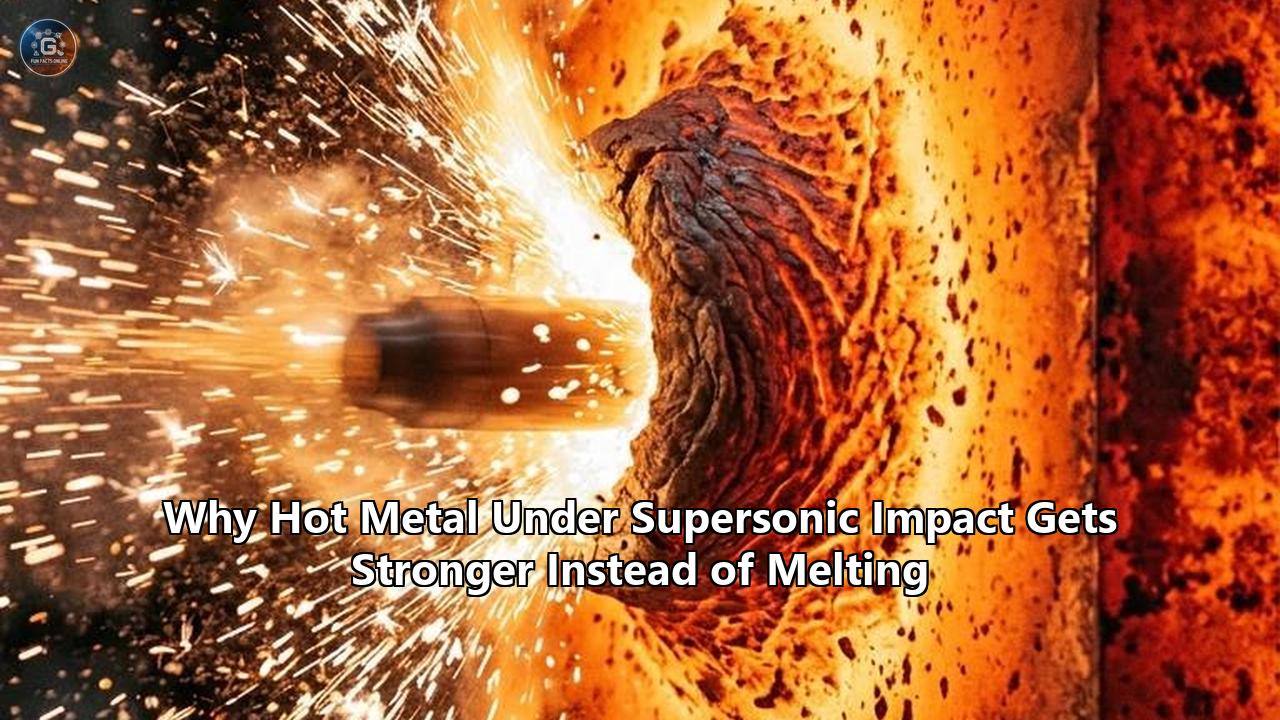
Inside the laboratory at Northwestern University, a pulsed neodymium-doped yttrium aluminum garnet laser fires a ten-nanosecond flash of infrared light into an acceleration substrate. The target is imperceptible to the naked eye: a single spherical particle of sapphire, twenty micrometers in diameter—roughly one-fifth the width of a human hair.
Accelerated across a microscopic gap at speeds exceeding Mach 3, the ceramic micro-projectile slams into a polished foil of pure copper.
Under any textbook rule of materials science, the outcome of this collision should be predictable. If the copper target is room temperature, it indents. If the copper target is heated to 177 degrees Celsius, common sense and three millennia of blacksmithing dictate that the metal should be softer, deeper craters should form, and the impacting particle should lose energy to the pliable substrate.
Instead, high-speed cameras capturing the impact at 100 million frames per second revealed an anomaly that contradicted fundamental metallurgical assumptions: the hotter the copper became, the harder it resisted.
As the foil’s temperature climbed from ambient conditions to near 200 degrees Celsius, the sapphire micro-sphere did not bury itself deeper into a heat-softened target. It ricocheted violently, rebounding with a substantial fraction of its initial velocity. The crater left behind was shallower, the metal underneath visibly more resistant to penetration. At 177 degrees Celsius, pure copper—a material so ductile it is easily drawn into bendable home electrical wire—demonstrated a localized hardness exceeding 300 megapascals, matching the structural yield strength of commercial cold-rolled steel.
The empirical confirmation of this thermal hardening anomaly, detailed in landmark papers led by materials scientist Christopher Schuh, dean of Northwestern University’s McCormick School of Engineering, and MIT researcher Ian Dowding, alongside dynamic-strain research by Mostafa Hassani’s group at Cornell University, has sent shockwaves through the physics of extreme mechanics.
The findings upend the baseline equations that defense agencies, spacecraft builders, and turbine manufacturers have used for decades to model hypervelocity impacts, micrometeorite strikes, and high-energy machining. Under extreme deformation rates, the classical rule that heat softens solid matter collapses entirely.
The Blacksmith’s Fallacy
For thousands of years, the mechanical manipulation of metal has depended on a single physical principle: thermal softening. A blacksmith plunges iron into a bed of glowing coals because heat provides thermal activation energy to the crystalline lattice.
At the microscopic level, solid metals are arranged in periodic crystal lattices. When a metal deforms permanently—what metallurgists term plastic deformation—planes of atoms slide over one another. This slippage does not occur all at once. Instead, it is mediated by line defects known as dislocations.
Dislocations travel through the crystal grain like ripples moving through a heavy carpet. When these dislocations hit obstacles—such as impurity atoms, phase boundaries, or intersecting dislocation lines—they snag. To keep the metal bending, an external mechanical force must push the dislocation past the snag. At elevated temperatures, ambient thermal energy shakes the crystal lattice violently. The oscillating atoms give trapped dislocations an extra kinetic kick, allowing them to overcome barriers with far less applied force.
This is the bedrock of thermal activation: add heat, reduce the stress needed to drive plastic flow.
Conventional Low-Strain Deformation:
[Applied Mechanical Stress] + [Thermal Energy (Heat)]
     ↓
Dislocations readily overcome lattice obstacles
     ↓
Material Yields Easily (Thermal Softening)
In military armor testing, hypervelocity ballistics, and aerospace reentry, engineers routinely extrapolated this relationship to high-speed environments. Conventional dynamic impact models, such as the Johnson-Cook plasticity model widely used in finite-element crash simulations, explicitly include a thermal softening parameter. The mathematics assume that as a projectile strikes a vehicle skin and kinetic energy converts into plastic work—heating the localized strike zone—the resistance of the struck metal must plummet.
"One of the most basic tenets in metallurgy is that if you heat a metal, it becomes softer," Schuh observed when reflecting on the findings. "Engineers have built entire analytical frameworks around that single assumption. But when you compress time—when you drive the deformation event down into millionths or billionths of a second—those rules stop working."
The team discovered that under extreme rates of strain, the classical physics of thermal activation does not just diminish; it is completely overtaken by a competing quantum-mechanical phenomenon that runs in the opposite direction.
The Micro-Ballistic Breakthrough
The primary reason this thermal hardening effect remained hidden for so long lies in the brutal limitations of macroscopic ballistic testing.
Historically, investigating how materials respond to supersonic strikes required firing centimeter-scale projectiles from two-stage light-gas guns into thick metal blocks. While these experiments achieved projectile speeds of several kilometers per second, they created severe secondary effects.
A large bullet slamming into a plate generates massive, trailing compressive shock waves. These pressure fronts induce enormous hydrostatic stresses, often reaching millions of pounds per square inch. Under those extreme, multi-megabar pressures, the bulk material melts dynamically or behaves as an incompressible liquid—a state known as hydrodynamic flow. The sheer energy volume masked the underlying microstructural kinetics. Researchers could examine only the post-mortem rubble of the crater, unable to decouple the distinct contributions of temperature, shock pressure, and sheer strain rate.
Macroscopic Ballistics (Gas Guns):
Centimeter-scale projectile → Hydrostatic shockwave → Hydrodynamic fluid-like flow
*Microscopic lattice physics completely obscured by bulk shock pressure*

Micro-Ballistics (LIPIT Laser Launch):
Micron-scale particle → Localized shear zone (<100 µm) → Pure strain-rate physics
*Isolates dislocation dynamics without distorting shockwaves*
To slice through that noise, Dowding and Schuh deployed a laser-induced particle impact testbed (LIPIT).
Instead of firing macroscopic slugs, the system uses micro-ballistics:
- High-precision lasers vaporize a thin sacrificial film underneath microscopic target spheres.
- Monodisperse sapphire and alumina particles—ranging from 10 to 20 microns across—are launched as single, precision bullets.
- Speeds are tuned from 100 meters per second to well over 1,000 meters per second, crossing the sonic threshold into true supersonic velocities.
- Target foils are clamped to an integrated heating stage, carefully elevating base temperatures while high-speed optics illuminate the impact zone with nanosecond laser pulses.
"In our work, the impacted region is smaller than around 100 micrometers," Schuh explained. "This small scale lets us perform high-rate deformations without having a large shock wave or high-pressure conditions to contend with."
By reducing the impact zone to the scale of individual crystalline grains, the team eliminated shockwave interference. When a 10-micron sphere strikes a foil at 400 meters per second, the collision finishes in tens of nanoseconds. The target material is forced to stretch and shear at strain rates exceeding $10^6$ to $10^8$ per second. In that compressed fraction of time, the metal is subjected to deformations equivalent to stretching its length by 100 million percent in a single second.
When the team launched microparticles into heated pure copper, titanium, and gold foils, the data overturned expectations. High-speed cameras tracked the incoming velocity ($v_i$) and outgoing rebound velocity ($v_r$). At room temperature (20 °C), the particles transferred substantial energy into the copper, leaving pronounced craters and rebounding slowly.
When the stage was heated to 100 °C, and then to 177 °C, the coefficient of restitution ($v_r / v_i$) climbed consistently. The particles bounced faster and higher. The metal was refusing to give way.
Researchers systematically measuring metal supersonic impact strength under varying thermal loads witnessed a direct increase in hardness with rising temperature—the exact opposite of traditional plasticity predictions.
Quantifying Metal Supersonic Impact Strength on the Microscale
The experimental results across different metals and temperature profiles established a clear mechanical correlation:
| Material Target | Test Temperature (°C) | Particle Velocity (m/s) | Approximate Dynamic Hardness (MPa) | Observed Mechanical Response |
|---|---|---|---|---|
| Pure Copper (Cu) | 20 °C (Ambient) | ~400 m/s | ~230 MPa | Baseline plastic cratering; low rebound velocity |
| Pure Copper (Cu) | 100 °C | ~400 m/s | ~270 MPa | Reduced penetration; intermediate restitution coefficient |
| Pure Copper (Cu) | 177 °C | ~400 m/s | >300 MPa (~30% increase) | High rebound velocity; shallow indentation matching steel |
| Pure Titanium (Ti) | 20 °C to 155 °C | ~450 m/s | Progressive rise | Consistent thermal hardening trend |
| Pure Gold (Au) | 20 °C to 155 °C | ~350 m/s | Progressive rise | Retains crystal-shear resistance at elevated heat |
| Copper Alloys (Brass/Bronze) | 20 °C to 155 °C | ~400 m/s | Progressive decline | Classical thermal softening; deeper craters |
The physical mechanisms dictating metal supersonic impact strength hinge on a crossover between two regimes of motion. The critical parameter is not simply the total energy delivered by the projectile, but the extreme rate at which that energy forces the crystal lattice to accommodate strain.
Inside the Lattice: The Phonon Drag Regime
To understand why a hot metal hardens during hypervelocity deformation, one must trace what happens to dislocations when they are accelerated close to the speed of sound.
Under ordinary, low-speed deformation, dislocations move slowly through the lattice. They creep along at velocities measured in millimeters or meters per second, pausing whenever they encounter an impurity, an intersecting crystal boundary, or an internal obstacle. In this slow-motion regime, thermal vibrations help push the dislocation past obstacles. Thermal energy serves as an assistant.
Regime 1: Thermal Activation (Strain Rate < 10⁴ s⁻¹)
Dislocation Velocity: Low (m/s)
[Dislocation] ──> [Obstacle] ──(Thermal Vibration Kick)──> Clears Obstacle
Result: Heating lowers yield stress. Metal softens.

─────────────────────────────────────────────────────────

Regime 2: Phonon Drag (Strain Rate > 10⁶ s⁻¹)
Dislocation Velocity: Transonic (~1,000–3,000 m/s)
[Dislocation] ──> ░░░░ Dense Sea of Vibrating Phonons ░░░░ ──> Viscous Drag
Result: Heating increases phonon density. Metal hardens.
When a microparticle hits a metal foil at supersonic velocity, this mechanism breaks down entirely. The metal must accommodate millions of percent of strain per second. The dislocations are no longer gently hopping from one pinning site to another; they are driven forward by immense shear stresses, accelerating to velocities that approach the speed of transverse acoustic waves in the crystal—several thousand meters per second.
At these speeds, thermal activation becomes irrelevant. The dislocations are moving too quickly to wait for a random thermal boost to pop them over an obstacle. Instead, they enter a completely different physical regime known as dislocation-phonon drag.
A phonon is a quantized packet of thermal vibration moving through a crystal lattice. As a metal heats up, its atoms do not sit still; they vibrate vigorously around their equilibrium positions. The higher the temperature, the denser and more agitated this sea of phonons becomes.
When a dislocation moves at supersonic speeds through this environment, it collides directly with those vibrating lattice waves. The phonons scatter off the moving dislocation's stress field, draining its kinetic energy. The effect is directly analogous to an aircraft encountering aerodynamic drag: the faster the plane attempts to fly, the more air molecules strike its nose, creating a resistive drag force that scales with speed.
"Beyond this crossover point, the higher temperature increases the activity of phonons—waves of sound or heat—within the material," Dowding explained. "These phonons interact with dislocations in the crystalline lattice in a way that limits their ability to slip and deform. The effect increases with increased impact speed and temperature, so that the faster you go, the less the dislocations are able to respond."
The hotter the metal, the higher the phonon density. The denser the phonons, the thicker the resistance confronting the dislocations. Instead of aiding deformation, heat turns the crystalline lattice into a viscous swamp.
Because the dislocations cannot move fast enough to accommodate the projectile's incoming energy, the crystal structure locks up. The material's dynamic yield stress spikes, the projectile cannot drive itself into the bulk, and the remaining kinetic energy is forced back into the micro-projectile, launching it upward in an aggressive rebound.
"If we smack a pure metal really fast, we're asking the atoms to move faster than they really want to," Schuh noted. "So, they resist and push back."
The Purity Puzzle and the Inversion of Classical Metallurgy
The investigation did not stop with pure elements. As Schuh and Dowding pushed their inquiries further, they made an equally startling discovery regarding chemical composition. The anomalous thermal hardening did not appear across all metals. In fact, it was fiercely selective.
For decades, structural metallurgy has relied on alloying. Pure copper, pure iron, and pure aluminum are notoriously weak engineering materials. To make them usable, metallurgists introduce deliberate impurities: carbon into iron to create steel, zinc into copper to create brass, or magnesium into aluminum. These foreign atoms warp the local crystal lattice, generating internal friction that pins dislocations and prevents them from moving.
When the researchers ran identical micro-ballistic impact tests on alloyed metals, the thermal hardening effect vanished.
As slightly alloyed copper samples were heated, their resistance dropped. The sapphire spheres sank deeper, the rebound velocity collapsed, and the materials displayed standard thermal softening.
Material Response Under Supersonic Micro-Impact When Heated:

Pure Metals (High Purity Cu, Ti, Au):
No internal solute pinning → Dislocations accelerate instantly to sonic limits
→ Phonon drag dominates → Material strengthens with heat

Alloyed Metals (Brass, Bronze, Structural Steels):
Lattice crowded with solute atoms → Dislocations constantly snag on impurities
→ Thermal energy helps overcome solute pinning → Material softens with heat
This contrast revealed the underlying mechanics. In an alloy, the lattice is already so full of solute atoms that dislocations are constantly trapped behind pinning barriers. Even at strain rates of millions per second, dislocations spend a critical fraction of their transit time attempting to break past those chemical snags. In that environment, thermal energy still acts as an accelerant, helping dislocations unpin and allowing the alloy to soften as temperature rises.
In high-purity metals, however, there are virtually no solute barriers to trip over. The runway is clear. The moment the supersonic impact strikes, dislocations accelerate unimpeded until they slam into the drag limit imposed by the phonon sea.
Purity, historically seen as a detriment to structural strength, acts as an enabling trigger for phonon drag hardening under hypervelocity conditions.
The Hall-Petch Reversal at Extreme Strain
This structural inversion deepened when dynamic mechanical researchers examined the internal boundary architecture of metals.
At Cornell University, assistant professor Mostafa Hassani and doctoral researcher Laura Wu investigated another metallurgical rule: the Hall-Petch effect. Since the early 1950s, materials scientists have known that reducing the grain size of a metal—packing more microscopic crystalline boundaries into a given volume—makes it stronger. Grain boundaries act as structural walls that stop dislocations in their tracks. Fine-grained metals are universally specified for high-strength engineering components.
Wu prepared copper samples with grain sizes ranging from 1 micrometer to 100 micrometers, spanning the classic Hall-Petch spectrum, and blasted them with laser-launched microprojectiles at supersonic velocities.
The data contradicted seventy years of materials doctrine. Under supersonic impact, the fine-grained copper deformed substantially more, yielding deeper indentations and dissipating kinetic energy into damaged microstructure. The coarse-grained copper—ordinarily the weaker material—proved significantly harder, bouncing the micro-projectiles away with shallower craters.
"We double-checked all our data collection," Wu recounted. "We added new data points and repeated experiments, but the results held every time."
The explanation traced directly back to the dislocation-phonon interaction. In a fine-grained metal, a dislocation can travel only a short distance before crashing into a grain boundary. It never has enough open space to accelerate to transonic velocities where phonon drag takes over.
In coarse-grained metals, dislocations have a long, uninterrupted track. They accelerate rapidly, slam into the viscous resistance of phonon drag, and freeze the lattice into a rigid, highly resistant state.
At extreme strain rates, the structural hierarchy of metals inverts. Heat makes pure metals behave like steel, while large-grained crystalline structures outperform ultrafine grain boundaries.
Redefining Aerodynamic and Space Defense Calculations
These findings alter how engineers evaluate material survivability in demanding kinetic environments.
For decades, designers working on spacecraft shielding, hypersonic flight vehicles, and industrial machinery operated under the assumption that high temperatures were universally degrading. When an aerospace vehicle travels through the upper atmosphere at Mach 5 or Mach 8, aerodynamic friction heats its leading edges to hundreds of degrees Celsius. Traditional engineering models assumed that if the vehicle flew through a cloud of airborne particulates—such as high-altitude ice crystals, volcanic ash, or sand—the blistering surface temperatures would make the thermal protection tiles or metal skins softer and more susceptible to erosion.
The realization that pure metals gain dynamic hardness when heated changes that baseline calculation.
Hypersonic Reentry Conditions:
 Mach 5+ Speeds  ──>  Aerodynamic Friction  ──>  Skin Temperature > 150 °C
                                                         │
 Airborne Particulate Strike (Rain/Sand/Dust)            │
             │                                           │
             ▼                                           ▼
 Extreme Strain Rate Collision (>10⁶ s⁻¹)  +  Elevated Phonon Density
             │                                           │
             └───────────────────┬───────────────────────┘
                                 ▼
                     Dislocation-Phonon Drag
                                 ▼
           Dynamic Surface Hardening (Reduced Erosion)
"If you are flying a helicopter in a sandstorm, a lot of these sand particles will reach high velocities as they hit the blades," Dowding pointed out, highlighting the compounding role of environmental desert heat. When rotor leading edges or turbine components absorb supersonic impacts from microscopic particulates, the localized friction heat may actually act as an armor mechanism rather than a point of failure.
Similarly, in low Earth orbit, satellites and space habitats face continuous bombardment by micrometeoroids and space debris, traveling at speeds between 7 and 10 kilometers per second. Spacecraft surfaces facing the Sun can experience ambient heating well beyond 100 degrees Celsius.
Under older models, an orbital shield baking in direct solar radiation was assumed to have compromised mechanical strength. The new experimental evidence indicates that against microscopic high-speed debris, solar heating could drive the metal into an elevated phonon drag state, increasing its resistance to cratering and particle penetration.
"In space, micro-meteorites fly around and crash into things," Schuh explained. "If we want to keep them from destroying a satellite, for example, we might consider choosing a different purity metal than we would have otherwise."
By rethinking material selection to optimize metal supersonic impact strength, designers may move away from complex, high-cost alloys in specific target zones. Pure metals—previously dismissed as too soft for structural use—could serve as dynamic armor layers, exploiting their unobstructed crystal lattices to trigger instantaneous phonon drag stiffening under ballistic fire.
Industrial Ripples: Cold Spray Additive Manufacturing
Beyond aerospace defense, the discovery carries immediate operational consequences for cold spray additive manufacturing—an industrial process that relies explicitly on supersonic microparticle collisions.
Cold spray deposition has become an essential technique for repairing military aircraft, restoring worn engine housings, and fabricating dense, corrosion-resistant coatings without melting the feedstock powder. The technique works by injecting metal microparticles (typically 10 to 50 microns in diameter) into a supersonic gas stream, propelling them at velocities between 300 and 1,200 meters per second through a de Laval nozzle. When the particles strike a substrate, their kinetic energy causes intense localized plastic shear. Instead of melting, the particles undergo solid-state bonding, mechanically interlocking and welding to the substrate at the atomic level.
Cold Spray Processing Velocity Windows:

 [Low Velocity]  ──> Elastic/Plastic Rebound (Particles bounce off)
       │
 [Critical Window] ──> Severe Interfacial Shear → Solid-State Bonding
       │
 [Excessive Speed] ──> Drag Hardening / Hydrodynamic Erosion (Substrate erodes)
A longstanding puzzle in cold spray manufacturing has been the unexpected erosion threshold. For years, operators assumed that higher particle velocities and hotter gas streams would continually improve bonding efficiency.
Yet, empirical production runs consistently hit a performance wall: push the gas temperature and velocity beyond a certain limit, and the incoming particles suddenly stop sticking. Instead of building up a thick coating, the high-speed powder begins carving craters into the substrate, scouring the part away in an erosive sandblast.
The discovery of phonon drag hardening provides the missing physics behind this wall.
When the metal particles and the substrate interface are heated while undergoing supersonic impact, the rapid strain rates trigger dislocation-phonon drag. The metal hardens abruptly instead of plasticizing. Because the crystal lattice cannot undergo the rapid plastic shear required to disrupt surface oxide layers and create solid-state bonds, the particle experiences a high-velocity rebound or micro-fractures the surface, destroying the coating layer.
Understanding the exact temperature-velocity boundary where phonon drag overrides plastic flow allows manufacturers to tune their supersonic nozzles precisely, operating just below the drag-hardening transition to maximize deposition efficiency while avoiding costly surface erosion.
The Thermal Cliff-Edge
While the realization that heat can strengthen metals marks a major conceptual pivot, materials scientists emphasize that the phenomenon operates within strict thermodynamic boundaries.
The strengthening effect cannot continue indefinitely. In all crystalline metals, an absolute thermodynamic cliff-edge exists: the melting point.
As temperatures continue to rise toward the melting threshold, the amplitude of thermal atomic oscillations becomes so violent that the periodic crystal lattice itself breaks down. Once the crystal structure dissolves into a disorganized liquid, the concept of dislocations ceases to exist. At that moment, phonon drag vanishes, and the liquid metal provides almost zero shear resistance, giving way to bulk hydrodynamic splash and thermal ablation.
Increasing Temperature Under Supersonic Impact:
[Ambient] ──(Dislocation Glide)──> [Elevated Temp] ──(Peak Phonon Drag)──> [Melting Point]
Soft/Ductile                      Hardness Spikes (~30%+)                Lattice Collapses
Base Yield                        Matches Alloy Steel                    Total Fluid Softening
"There will be a limit to this strengthening effect," Dowding confirmed. "Of course, at some point the increased temperature will begin to melt the metal, and at that point the effect will reverse again and lead to softening. But where that crossover occurs is still unknown."
The critical challenge for dynamic physicists is mapping that transition zone.
Between the onset of dislocation-phonon drag and the ultimate collapse into molten fluid lies an unexplored thermodynamic territory. Researchers are currently deploying in situ dynamic X-ray diffraction at high-energy synchrotrons, such as the Advanced Photon Source at Argonne National Laboratory, to photograph the crystal lattice in real time during laser impacts. By flashing femtosecond X-ray beams through targets during the nanoseconds of microparticle collision, they hope to observe phonon scattering directly as it immobilizes dislocations—and pinpoint the exact temperature where the lattice abruptly transitions from dynamic ultra-hardness to liquid collapse.
Rewriting the Fundamentals of Extreme Physics
The discovery that hot metals strengthen under supersonic impact challenges long-held foundational assumptions in classical mechanics. It exposes the perils of extrapolating low-rate material behavior to extreme environments, demonstrating that conditions of ultra-high velocity fundamentally rewire the physical laws governing solids.
For decades, aerospace engineers, ballistics experts, and materials designers assumed that extreme kinetic environments were defined by a destructive feedback loop: friction and impact generated heat, heat softened the protective metals, and softened metals failed.
The experimental evidence establishes a more intricate reality. Within a wide operating window, metals struck by supersonic projectiles turn their own thermal energy into a defensive shield. The vibrating lattice, long assumed to be the enemy of structural stiffness, becomes an insurmountable barrier to deformation.
As aerospace systems venture deeper into hypersonic corridors and satellite networks confront an increasingly crowded orbital environment, the ability to exploit this physics will dictate the next generation of resilient engineering. The centuries-old image of the blacksmith's forge has found its counterweight in the physics of hypersonic flight: strike a metal fast enough, and the heat that was supposed to bend it will make it as unyielding as armor plate.
Reference:
- https://cf003.cdn.4science.cloud/4s-assetstore-prod--mit--dspace/35462954442795643287138241845742708791?response-content-type=application%2Fpdf&response-content-disposition=attachment%3B+filename%3D%22s41467-018-07509-y.pdf%22&Expires=1792020308&Signature=fcjA9V~eyE43aXLuziPIWTWBBT~40FFoJ5pTckDsRp~rdqvWHjGXtSa4GSRmKFv6oF1Q4Oovke9qMW4yiWxq99QcUM5KAjHZ8mPiTzxyZCY2f6nmwBr62zYDWy2sl6woNolkk3dSRdGdCaIWxKQTzEAuzqieQb6Mrsf8ipGhe7bOvMIf8kTHtchoJqaDMxB7AE0OmaZXpsi8LefuHSiuR595Dfb-j9aNeKbmPWnHgo-bZdl16l3HmKVVki7yUcH56ftnHCKUJAeDHwdg1dpbRLjn7rVrVRlouqd8BIw7PkABRjNcKUh2ANHYOo8CExZVygvqW0oaSIQ9YdYzAvGv0Q__&Key-Pair-Id=K1M0LPFHJMTXJX
- https://news.mit.edu/2024/study-under-extreme-impacts-metals-get-stronger-when-heated-0522
- https://www.technologynetworks.com/applied-sciences/news/groundbreaking-study-finds-metals-actually-get-stronger-when-hot-387167
- https://physicsworld.com/a/extreme-impacts-make-metals-stronger-when-heated/
- https://dmse.mit.edu/news/under-extreme-impacts-metals-get-stronger-when-heated/
- https://news.northwestern.edu/stories/2026/02/extreme-heat-increases-strength-of-pure-metals
- https://news.mit.edu/2018/microscopic-materials-take-tiny-hits-1129
- https://3dprinting.com/news/under-extreme-impacts-metals-get-stronger-when-heated-new-mit-study-finds/
- https://news.cornell.edu/stories/2026/01/supersonic-tests-defy-70-year-old-rule-metal-strength
- https://www.reddit.com/r/todayilearned/comments/1nmmz2y/til_when_two_metals_impact_each_other_at/
- https://www.pnas.org/doi/10.1073/pnas.2424355122
- https://pubmed.ncbi.nlm.nih.gov/42095747/