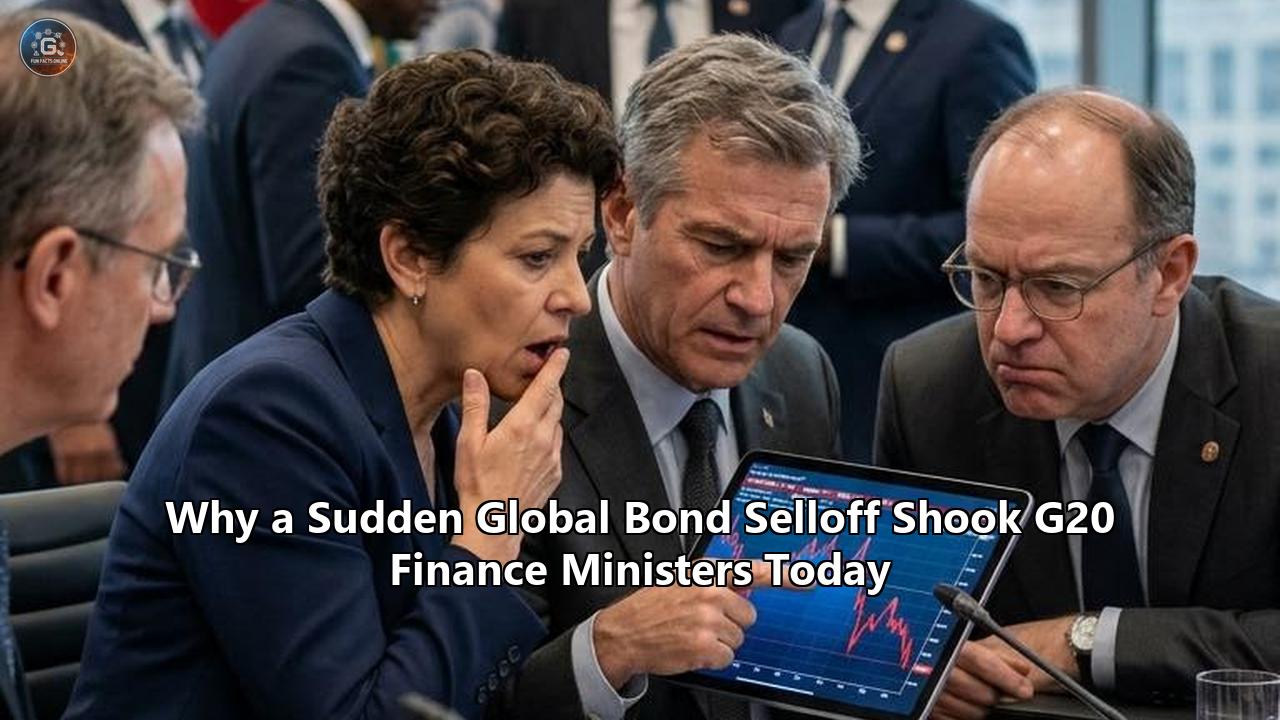
ASHEVILLE, North Carolina — Inside the ballroom of the Omni Grove Park Inn, where finance ministers and central bank governors from the Group of 20 gathered beneath the shadow of the Blue Ridge Mountains, the official schedule called for a choreographed review of global growth initiatives, supply chains, and debt transparency.
The market had other plans.
Midway through the opening plenary, delegates seated along the mahogany perimeter began leaning toward their aides. Handheld devices lit up with emergency red flashes from institutional trading desks in Tokyo, London, and New York. What started at dawn as a routine uptick in sovereign yields had metastasized within hours into a synchronized, multi-continent route.
Benchmark 10-year U.S. Treasury yields surged toward 4.80%, touching a 20-month peak, while the 30-year long bond yield pierced 5.27%, hovering near heights untouched since the summer of 2007. In Tokyo, a three-decade threshold fell when the 10-year Japanese Government Bond (JGB) yield punched through 3.00% for the first time since 1996. Across the Atlantic, British 10-year gilts spiked seven basis points to 5.22%—their highest level since the 2008 financial crisis—and 30-year gilt yields pushed to 5.77%, a 28-year high. German 10-year Bunds and French OATs experienced similar rapid intraday liquidations.
This sudden global bond market selloff effectively hijacked the summit agenda. The carefully drafted communiqués regarding sovereign debt relief for developing nations suddenly looked detached from reality. The core sovereign debt of the world’s wealthiest economies was undergoing an aggressive, structural repricing.
"The room went completely quiet when the JGB prints crossed the tape," said one European delegate who spoke on the condition of anonymity because the closed-door proceedings were confidential. "Everyone realized this was not a localized wobble. The anchor that holds global asset pricing in place was dragging."
The Immediate Shockwave: Yields Across Major Economies
To grasp the magnitude of the tremor that struck the G20 meeting, one must examine the simultaneous deterioration across sovereign debt curves within a single six-hour window:
| Sovereign Benchmark | Yield Reached | Historical Comparison | Key Domestic Catalyst |
|---|---|---|---|
| U.S. 10-Year Treasury | 4.80% | Highest since January 2025 | Persistent CPI, fiscal supply glut, energy price surge |
| U.S. 30-Year Treasury | 5.27%–5.34% | Highest since July 2007 | Buyer fatigue at auction, term premium blowout |
| Japan 10-Year JGB | 3.00% | Highest since 1996 (30-year high) | BOJ rate normalization, quantitative tightening |
| Japan 2-Year JGB | 1.80% | Highest since 1995 (31-year high) | Looming policy rate hikes, inflation above target |
| U.K. 10-Year Gilt | 5.22% | Highest since June 2008 | Sticky services inflation, fiscal deficit stress |
| U.K. 30-Year Gilt | 5.77% | Highest since 1998 (28-year high) | Long-end supply pressure, pension asset reshuffling |
| German 10-Year Bund | 2.92% | Highest in 15 years | European energy inflation, ECB policy repricing |
A forensic examination of the session reveals that this selloff was not triggered by a single headline. Instead, it was the culmination of four distinct pressure points that collided on market screens, exposing structural fragilities in global finance that policymakers had spent months trying to downplay.
Layer One: The Middle East Energy Spark and the Hawkish Pivot
The opening link in the chain began not in the debt markets, but in the physical energy corridors of the Middle East.
Over the preceding 48 hours, direct military friction around key shipping arteries sent Brent crude futures vaulting nearly 2% past $92 per barrel, while European natural gas benchmarks surged to multi-month highs. For global fixed-income desks that had spent the spring assuming inflation was locked into a steady glide path back to 2%, the sudden oil spike shattered interest rate forecasts.
                     [ ENERGY SHOCK ]
         Brent Crude > $92/bbl; NatGas Spikes
                          │
                          ▼
             [ INFLATION EXPECTATIONS ]
       Wholesale PPI at 6%; CPI Resurges to 3.8%
                          │
                          ▼
            [ HAWKISH CENTRAL BANK SHIFT ]
       Fed, ECB, BOJ Signal "Higher for Longer"
                          │
                          ▼
          [ GLOBAL BOND DURATION DUMP ]
       Investors Demand Higher Term Compensation
In Washington and Frankfurt, central bankers were already showing signs of anxiety. U.S. consumer price inflation had stabilized at an uncomfortable 3.8%, while wholesale producer prices were tracking at an annualized rate of 6%.
Federal Reserve Governor Michael Barr delivered a stark warning on the eve of the summit, stating he would vote for an interest rate increase at the upcoming Federal Open Market Committee (FOMC) meeting if inflation failed to moderate, driving market pricing for a rate hike to roughly 66%.
"Fixed income markets spent the early part of the year priced for an immaculate scenario: rapid disinflation, low commodity prices, and central banks racing to cut borrowing costs," said Alicia Garcia-Herrero, chief economist for the Asia-Pacific region at Natixis. "Instead, the world ran headfirst into persistent energy spikes, elevated logistics costs, and central banks warning that their job is far from finished. When you adjust rate expectations upward in an environment with high baseline debt, the long end of the curve is where the explosion happens."
As oil crossed $92, long-dated sovereign debt—which is exceptionally sensitive to long-term inflation expectations—began to slide. Yet commodity prices alone could not explain the sheer velocity of the worldwide rout. The real acceleration lay deeper in the structural supply-demand mismatch of sovereign issuance.
Layer Two: The $40 Trillion Debt Avalanche and Missing Buyers
For decades, sovereign debt issuers operated under an unspoken luxury: whenever yields drifted uncomfortably higher, price-insensitive buyers stepped in. Central banks absorbed trillions in paper through quantitative easing (QE), foreign central banks recycled trade surpluses into foreign exchange reserves, and domestic commercial banks accumulated government paper to satisfy regulatory liquidity ratios.
By late 2026, every pillar of that price-insensitive buyer base had eroded.
The United States national debt crossed the $40 trillion threshold this quarter, running an annual fiscal deficit approaching $2 trillion during a period of full employment. The U.S. Treasury has been forced to dramatically scale up auction sizes across bills, notes, and bonds. Concurrently, the Federal Reserve, the European Central Bank, and the Bank of England have been steadily conducting Quantitative Tightening (QT), actively allowing hundreds of billions of dollars in sovereign debt to roll off their balance sheets without reinvestment.
PAST DECADE (QE REGIME):
Central Banks + FX Reserve Managers  ──►  Absorbed ~60-80% of Net Issuance (Price-Insensitive)
                                         └──► Kept Term Premia Negative

CURRENT REALITY (QT & FISCAL EXPANSION):
Sovereign Supply Surges ($40T US Debt) ──►  Private Funds & Dealers Must Absorb (Price-Sensitive)
                                         └──► Demands Steep Term Premium Discount
"The core drivers are structural: deficit spending, the cost of servicing a rising debt load, and shifting Treasury auction dynamics," said David Krakauer, vice president of portfolio management at Mercer Advisors. "Price-sensitive buyers such as hedge funds and private asset managers have supplanting price-insensitive official buyers like central banks. A hedge fund does not buy a 30-year bond out of public duty. It buys duration only if it is paid a substantial term premium to take on that risk."
The vulnerability of this dynamic was laid bare during recent U.S. Treasury debt sales, where auctions frequently "tailed"—forcing primary dealers to absorb larger-than-expected allocations at higher yields. The U.S. Treasury attempted to mitigate the strain by doubling the size of its long-term debt buyback programs from $2 billion to $4 billion.
Yet when private investors realized that public debt supply was outstripping organic demand, the stopgap buybacks proved insufficient.
"We have entered a dangerous sovereign feedback loop," explained Padhraic Garvey, regional head of research for the Americas at ING. "Higher yields create higher interest expense, which widens fiscal deficits, which then requires even more debt issuance. The United States alone is spending more than $1 trillion annually just to service its existing debt load. The market is looking at that arithmetic and demanding higher compensation across the entire curve."
Layer Three: The Tokyo Transmission Line and the Great Repatriation
While Washington’s fiscal numbers laid the foundation, the catalyst that converted an orderly selloff into an international rout was traced by analysts directly to Tokyo.
For over a quarter of a century, Japan stood as the undisputed anchor of global zero-rate financing. Under decades of Yield Curve Control (YCC) and negative interest rates, the Bank of Japan (BOJ) pinned domestic yields to the floor. In response, Japanese life insurers, pension funds (such as the $1.5 trillion GPIF), and agricultural lenders exported capital abroad, becoming the single largest foreign holders of U.S. Treasuries, French OATs, Australian bonds, and European sovereign paper.
That multi-decade financial dynamic has now reversed.
                     [ THE TOKYO PIVOT ]
                 BOJ Lifts Rates & Exits YCC
                              │
                              ▼
        [ 10-Year JGB Reaches 3.00% (30-Year High) ]
                              │
                              ▼
     [ FX Hedging Costs Turn Foreign Bonds Negative Yielding ]
                              │
                              ▼
               [ THE REPATRIATION ENGINE ]
       Japanese Institutional Funds Liquidate Foreign Assets:
       • U.S. Treasuries sold
       • French OATs dumped
       • Australian & U.K. paper offloaded
                              │
                              ▼
     [ Capital Returns Home to Domestic JGB Market ]
When JGB 10-year yields hit 3.00% and 2-year notes climbed to 1.795%, the mathematical calculus for Japanese institutional capital inverted. With foreign exchange hedging costs remaining steep due to the U.S.-Japan interest rate differential, a 10-year Treasury yielding 4.80% hedged back into yen delivers an effective return that is negative. A domestic 10-year JGB yielding 3.00% with zero currency risk suddenly became the most attractive investment Japanese institutions had seen in an entire generation.
"Investors are demanding greater compensation to own duration, but what we are witnessing in Japan is a structural reallocation of global wealth," said Masahiko Loo, senior fixed income strategist at State Street Investment Management in Tokyo. "For years, Japanese money acted as the marginal buyer for Western debt. Now, domestic Japanese institutions are under immense pressure to bring capital home. When Japanese funds stop buying—or begin actively liquidating—foreign sovereign bonds to purchase 3% domestic paper, the rest of the world loses its primary shock absorber."
Inside the G20 meeting rooms in Asheville, the tension over this dynamic was visible. On the sidelines of the summit, U.S. Treasury Secretary Scott Bessent held direct bilateral talks with Bank of Japan Governor Kazuo Ueda. Bessent urged Tokyo to ensure "sound monetary policy" to anchor inflation expectations and avoid erratic foreign exchange swings that could destabilize foreign bond holdings.
Yet with the yen sliding past 160 per dollar and Japanese inflation remaining stubborn, Ueda faced domestic imperatives that left little room to accommodate foreign borrowing requirements.
The resulting cross-border capital repatriation triggered automated liquidations across Western sovereign desks, turning what could have been a localized Japanese rate adjustment into a synchronized global bond market selloff.
Layer Four: The Plumbing Crisis — Unwinding the Basis Trade
Behind the macroeconomic fundamentals of inflation and sovereign deficits lay an acute mechanical accelerant: the shadow leverage buried in the sovereign debt market’s plumbing.
Over the past three years, hedge funds and multi-strategy trading desks had accumulated record leveraged positions in the U.S. Treasury and European sovereign cash-futures "basis trade." The trade exploits tiny price discrepancies between physical government bonds and their corresponding futures contracts:
- The Setup: A hedge fund buys a cash government bond (e.g., a 10-year Treasury) and sells short an equivalent Treasury futures contract.
- The Leverage: Because the price spread between the cash bond and the futures contract is narrow—often mere fractions of a basis point—funds borrow heavily in the short-term overnight repurchase (repo) market, leveraging their equity by 20 to 50 times to generate double-digit returns.
- The Vulnerability: The trade depends on ultra-low repo borrowing costs, stable market liquidity, and tight bid-ask spreads.
When benchmark yields broke key technical levels, the volatility index for fixed income (the ICE BofA MOVE Index) jumped. Primary dealers—constrained by post-2008 capital regulations, specifically the Supplementary Leverage Ratio (SLR)—faced higher balance sheet costs and widened their bid-ask spreads.
                      [ VOLATILITY SURGE ]
                Yields Spike Past Key Resistance
                               │
                               ▼
                   [ REPO MARGIN SPIKES ]
           Lenders Demand Immediate Margin Collateral
                               │
                               ▼
                 [ FORCED BASIS LIQUIDATION ]
      Hedge Funds Must Sell Physical Cash Bonds to Cover Short Futures
                               │
                               ▼
               [ DEALER CAPACITY EXHAUSTION ]
        Primary Dealers Constrained by Balance Sheet Rules (SLR)
                               │
                               ▼
                  [ LIQUIDITY AIR POCKET ]
             Order Books Thin; Yields Spike Higher
As repo desks demanded higher intraday margin to cover open positions, leveraged funds faced margin calls. To cover their exposures, several prominent relative-value desks were forced to sell physical cash Treasuries and buy back their short futures positions.
This programmatic unwind created a liquidity "air pocket." Cash bonds flooded the market at the exact moment primary dealers lacked the balance-sheet capacity to absorb them. The mechanics turned an orderly repricing of duration into a self-reinforcing liquidation spiral.
"People assume sovereign debt trades like cash, but under modern regulatory constraints, market depth can vanish in minutes," said a senior fixed-income execution trader at a Tier-1 Wall Street bank. "When relative-value desks are forced to liquidate their cash legs during an auction week, nobody stands in front of that freight train. The bids disappear, spreads widen out to crisis levels, and the yield spikes in vertical fashion."
The Closed-Door Asheville Clash: Fiscal Dominance and Fractures
As the market turmoil escalated outside, the atmosphere inside the G20 sessions turned contentious. What was intended to be a collaborative dialogue on supply chain resilience and multilateral growth descended into sharp ideological finger-pointing.
U.S. Treasury Secretary Scott Bessent attempted to steer the forum toward addressing what Washington described as structural economic imbalances—specifically targeting non-market export policies and calling for deregulation to stimulate private investment. Bessent maintained that robust economic growth, driven by private-sector dynamism rather than government subsidies, offered the only credible path out of debt distress.
"We believe that non-market-based economies pushing out a never-ending stream of cheap exports is not sustainable," Bessent stated at a press briefing following the sessions, arguing that market distortions abroad were worsening domestic fiscal imbalances.
                     [ ASHEVILLE G20 DISPUTE ]
                                 │
         ┌───────────────────────┴───────────────────────┐
         ▼                                               ▼
[ THE U.S. POSITION ]                         [ THE EUROPEAN/IMF COUNTER ]
• Focus on private capital & growth           • U.S. fiscal deficits drive global rates
• Rebalance foreign trade surpluses           • Energy shock compounds public debt
• Resist rigid fiscal austerity rules         • Sovereign debt hitting hard ceiling
European finance ministers and central bankers pushed back, arguing that the true destabilizing force in global financial markets was the runaway fiscal trajectory of the United States itself. With the U.S. deficit approaching 7% of GDP during an economic expansion, European delegates contended that American fiscal dominance was pulling global yields higher, raising the cost of capital across the world and forcing foreign central banks to maintain tighter monetary conditions than domestic conditions warranted.
International Monetary Fund Managing Director Kristalina Georgieva intervened during the afternoon ministerial session with a pointed assessment. In private briefings to the ministers, the IMF highlighted that the economic shocks from energy volatility were depressing five-year growth projections to their weakest levels since 2009.
Georgieva emphasized that long-term sovereign debt stability required structural fiscal consolidation from major deficit economies, not simply hopes for future economic expansion.
"Dealing with global debt is essential for boosting economic growth for everyone," noted Eric LeCompte, Executive Director of Jubilee USA Network, who monitored the G20 discussions. "The immediate worries about the sovereign bond market have overtaken every other conversation. You cannot talk about assisting emerging markets when the sovereign debt of the G7 nations is flashing amber."
By the time the final chair's statement was released, the fractures were evident. While 19 member nations agreed on language urging countries to eliminate "distortions that constrain domestic consumption" and reduce excessive trade surpluses, China refused to endorse the chair's critique of non-market policies.
Meanwhile, references to sovereign debt coordination remained confined to generalized support for technical frameworks, offering no concrete collective commitment to rein in public spending among the world’s leading economies.
The Economic Transmission: Entering the "Concern Zone"
The sudden spike in sovereign bond yields is far more than a specialized issue for trading desks. Sovereign yields serve as the benchmark discount rate upon which virtually all borrowing throughout the global real economy is priced.
When the price of sovereign duration collapses, the real economy absorbs the impact through three primary transmission channels:
[ SOVEREIGN YIELD BLOWOUT (10Y > 4.80% / 30Y > 5.30%) ]
                          │
         ┌────────────────┼────────────────┐
         ▼                ▼                ▼
[ CONSUMER CREDIT ]  [ CORPORATE DEBT ]  [ RISK ASSETS & FX ]
• Mortgages near 7%  • Refinancing cliff • Equity multiple squeeze
• Auto loans surge   • Capex budgets cut • Emerging market capital flight
• Demand contracts   • Default risk rises • Strong dollar strains debt
1. Consumer Borrowing and the Housing Freeze
In the United States, 30-year fixed mortgage rates, which track long-term Treasury yields, moved back toward 6.8% to 7.0%, chilling home sales and locking existing homeowners into current properties. In the United Kingdom and Europe, where variable and short-term fixed mortgages are common, the rise in 5-year and 10-year swap rates will pass through directly to household balance sheets over the coming quarters.
2. The Corporate Refinancing Cliff
Between late 2026 and 2028, global corporations face a maturity wall of over $1.8 trillion in corporate bonds issued during the low-interest-rate environment of 2020–2021. Companies that had locked in borrowing costs at 3% or 4% now face refinancing at 7.5% to 9%. This shift threatens to divert cash flow away from capital expenditures and hiring into debt servicing.
3. Real Yields and Equity Discounting
The main driver of the selloff has been a surge in real yields (nominal yields minus inflation expectations), rather than inflation breakevens alone.
"This is the critical element that equity markets are only beginning to digest," said ING’s Padhraic Garvey. "Higher real yields mean companies cannot simply raise prices to offset their cost of capital. We are entering the concern zone—the other side of 5.0% for the 10-year Treasury and above 3.5% for European benchmarks—where alarm bells begin to ring for corporate valuations. Future corporate cash flows must be discounted at a structurally higher hurdle rate."
4. Emerging Market FX Pressure and Capital Outflows
As U.S. and Japanese yields climbed, capital rushed out of frontier and emerging markets back toward core advanced-economy debt. The U.S. dollar index surged, pushing emerging market currencies lower and inflating the local-currency cost of servicing foreign-currency denominated debt.
Countries that were on the cusp of accessing international bond markets to refinance their own obligations found the window abruptly shut.
Critical Checkpoints: What to Watch Next
As finance ministers departed Asheville to return to their home capitals, market focus shifted from political rhetoric to upcoming structural inflection points. The durability of the current market repricing will hinge on several key events over the coming weeks:
- The September 15–16 FOMC Meeting: Investors are closely monitoring Fed Chair Jerome Powell and the Federal Open Market Committee's updated "Dot Plot" projections. A hawkish rate hike or a formal reduction in projected rate cuts for 2027 could solidify the 10-year yield above the critical 5.0% threshold.
- The Bank of Japan’s Autumn Policy Review: Desk traders will watch whether Governor Ueda accelerates rate increases or expands quantitative tightening. Any further climb in JGB yields toward 3.5% could drive another round of foreign sovereign debt liquidations by Japanese life insurers.
- The U.S. Treasury Quarterly Refunding Announcement: Debt managers in Washington face an escalating challenge over how to distribute future debt issuance across short-term Treasury bills versus long-term bonds. Over-issuing at the long end risks triggering another buyer strike, while over-relying on short-term bills threatens to strain Treasury money market liquidity.
- Energy Market Escalation in the Middle East: With Brent crude trading above $92, any wider disruption to tanker transit through the Strait of Hormuz could push oil past $100 per barrel, solidifying second-round inflation pressures and locking central banks into higher-for-longer policy stances.
- U.S. and European Regulatory Action on SLR: Wall Street trade groups are stepping up lobbying efforts for the Federal Reserve and international regulators to permanently exempt sovereign debt and central bank reserves from the Supplementary Leverage Ratio. Such an adjustment would permit primary dealers to absorb larger auction volumes without exhausting their balance sheets.
The New Macro Baseline
The dramatic repricing witnessed during the G20 ministerial marks a distinct transition in the global financial architecture. For fifteen years following the 2008 financial crisis, the world economy functioned under the assumption of abundant liquidity, suppressed real yields, and sovereign bond markets that acted as passive risk absorbers.
That framework has fractured.
The collision of fiscal deficits, geopolitical commodity shocks, central bank balance sheet contraction, and the domestic revival of Japanese fixed-income yields has reintroduced market discipline to sovereign issuers. Rather than serving as a stabilizing foundation, sovereign debt has itself become a prominent source of macro volatility.
As one departing delegate reflected while leaving the Grove Park Inn: "For years, governments operated as if there was no ceiling to market absorption. Today, the bond market reminded every finance minister in that room that the ceiling exists—and we are running straight into it."
Reference:
- https://www.sknvibes.com/news/newsdetails.cfm/127825
- https://home.treasury.gov/news/press-releases/sb0620/
- https://www.investing.com/news/economy-news/global-bond-rout-deepens-as-japan-yield-hits-key-threshold-4883562
- https://www.facebook.com/BrianAllenNews/videos/a-global-bond-sell-off-is-pushing-us-treasury-yields-to-levels-not-seen-in-nearl/1000748126335606/
- https://www.scmp.com/economy/global-economy/article/3366046/bessent-addresses-g20-peers-analysts-warn-benchmark-bond-yields-near-concern-zone
- https://www.globalbankingandfinance.com/trading-day-over-rout/
- https://ground.news/article/global-bond-yields-soar-to-multi-decade-highs-as-middle-east-turmoil-reignites-inflation-fears_9294d8
- https://www.jubileeusa.org/us_hosts_g20_finance_ministers_to_discuss_debt_bond_markets_and_growth
- https://live.euronext.com/en/financial-news/g20-finance-chiefs-except-china-back-action-distorted-trade
- https://www.weforum.org/stories/financial-and-monetary-systems/why-global-bond-market-treasury-yields/