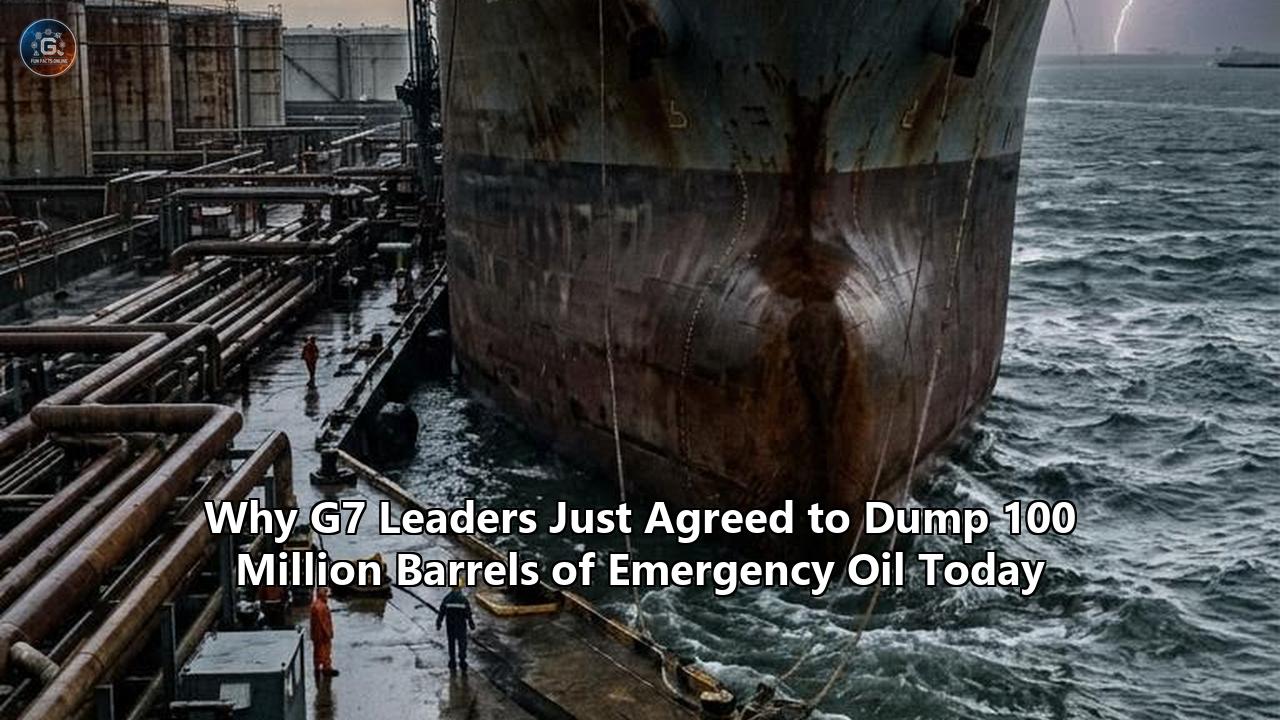
The Group of Seven industrial powers struck an emergency accord to inject 100 million barrels of crude oil and refined petroleum products into global markets over four months, deploying a front-loaded package specifically weighted toward middle distillates to halt an escalating fuel crisis. Convened under the rotating presidency of French President Emmanuel Macron, the emergency video summit of G7 leaders concluded with an agreement to coordinate directly with the International Energy Agency (IEA) to open strategic stockpiles. The decision arrived alongside an explicit diplomatic compromise: European capitals agreed to draw down their tightly held diesel stockpiles after United States President Donald Trump threatened a unilateral ban on American diesel exports, an embargo that threatened to sever European supply chains ahead of the northern hemisphere winter.
The joint intervention unfolds against twin supply disruptions that have pushed international energy markets into disarray. Armed conflict in the Middle East has severely throttled tanker transit through the Strait of Hormuz, stranding millions of barrels per day of Gulf crude and condensate. Simultaneously, precision Ukrainian drone strikes against inland Russian refineries have knocked out critical hydrocracking and distillation infrastructure, taking an estimated 1.2 million barrels per day of Russian diesel and naphtha off the seaborne market. With Brent crude settling above $102 a barrel and American on-highway retail diesel climbing to record territory between $6.37 and $6.52 per gallon, the economic shock has triggered fears of a transport-driven inflationary wave.
Under the terms established by the G7 communiqué, the coordinated release begins immediately, mandating that participating economies execute a substantial, front-loaded injection of diesel within the first 20 days. In return, the United States formally backed away from protectionist trade barriers. The leaders affirmed a binding commitment to refrain from export restrictions on energy and energy products among G7 members, blunting a trade dispute that had threatened transatlantic relations.
The emergency mobilization exposes divergent crisis-management strategies across western capitals. Competing philosophies—ranging from physical stockpile depletion and protective export embargoes to refinery yield mandates and fiscal tax relief—have clashed over how to navigate an acute structural deficit in refined products.
                          GLOBAL DIESEL DEFICIT (OCTOBER 2026)
                                 Estimated Market Impact
  ┌─────────────────────────────────────────────────────────────────────────────┐
  │  Primary Drivers of Deficit:                                                │
  │   • Strait of Hormuz tanker transit throttling (~20M bpd corridor disrupted)│
  │   • Ukrainian drone strikes on Russian refineries (~1.2M bpd diesel offline)│
  │   • US retail diesel: $6.37 - $6.52/gal | Brent crude: $102+/bbl            │
  └──────────────────────────────────────┬──────────────────────────────────────┘
                                         │
                         G7 COMPETING CRISIS RESPONSES
  ┌──────────────────────────────────────┴──────────────────────────────────────┐
  ▼                                                                             ▼
Multilateral Coordinated Depletion                         Unilateral Protectionism
(Adopted Policy: G7 Oil Reserves Release)                  (Averted Policy: US Export Ban)
 • 100M bbls total over 120 days                            • Ring-fence domestic refining
 • 50M bbls diesel + 50M bbls crude                         • Retain 1.2M-1.5M bpd of US diesel
 • Front-loaded: 20-day prompt release                      • High risk of European supply collapse
 • Preserves allied trade channels                          • Strands US Gulf refining logistics
Anatomy of the Drawdown: Product Intervention vs. Crude Liquidation
The structural design of the G7 oil reserves release marks a departure from historic stockpile interventions. In previous emergency operations orchestrated through the IEA—such as the 1991 Gulf War drawdown, the post-Hurricane Katrina release in 2005, the 2011 Libyan supply disruption, and the 2022 response to the invasion of Ukraine—the volume released consisted almost entirely of unrefined crude oil. Government-owned reserves, particularly the United States Strategic Petroleum Reserve (SPR), were engineered around the premise that an oil shock is fundamentally an upstream extraction crisis.
This current crisis, however, centers on a deficit of refined fuels, specifically ultra-low-sulfur diesel (ULSD) and gasoil. Releasing crude oil into a market where refinery throughput is constrained by damaged facilities, scheduled autumn maintenance, and crude-slate misalignments fails to deliver prompt relief at the retail pump.
Under the framework negotiated by Macron and presented to the G7 leaders, the 100-million-barrel commitment is split evenly: approximately 50 million barrels of finished diesel and 50 million barrels of crude oil. The agreement establishes a rapid deployment timeline:
- Prompt Phase (Days 1–20): A front-loaded release prioritizing refined diesel directly into regional distribution channels, targeted at suppressing prompt-month wholesale futures and narrowing the historic crack spreads that have detached refined fuel prices from underlying crude costs.
- Sustained Phase (Days 21–120): A phased distribution of the remaining refined product and crude tranches, calibrated alongside synchronized refinery run schedules and coordinated maintenance deferrals among allied nations.
- Review Mechanism: An IEA monitoring mandate requiring an empirical market impact assessment within 20 days to determine whether supplemental tranches must be authorized.
This structure directly addresses the divergence between crude pricing and distillate pricing. While crude oil represents the baseline feed, diesel serves as the primary logistical fuel for global commerce, fueling heavy freight trucking, maritime transport, rail networks, agricultural harvesting, and industrial construction. When diesel prices surge, the impact filters directly through core consumer price baskets, creating an immediate, non-discretionary inflation shock.
By compelling the drawdown of finished fuels, the G7 bypassed the processing lag of conventional crude releases. A barrel of crude discharged from a subterranean salt cavern in Texas or Louisiana requires maritime transport, commercial pipeline scheduling, blending, refinery cracking, and regional terminal transport—a logistical sequence that often takes between 30 and 45 days before the product reaches a fuel pump. A finished diesel release from European inland tanks or coastal storage terminals, by contrast, can clear into wholesale pipeline manifolds and river barges in Antwerp, Rotterdam, and Amsterdam within 48 to 72 hours.
Multilateral Liquidity vs. Mercantilist Protectionism
The emergency summit was forced by an ideological clash between the White House and European capitals over market defense mechanisms. The confrontation pitted multilateral liquidity mobilization against domestic export protectionism.
               POLICY COMPARISON: INTERVENTION PLAYBOOKS
┌─────────────────────────┬───────────────────────────┬───────────────────────────┐
│ Feature                 │ Coordinated Multilateral  │ Unilateral Export         │
│                         │ Reserve Release (Adopted) │ Restriction (Averted)     │
├─────────────────────────┼───────────────────────────┼───────────────────────────┤
│ Target Mechanism        │ Physical supply injection │ National supply isolation │
│ Direct Objective        │ Lower global benchmarks   │ Ring-fence domestic pump  │
│ Alliance Cohesion       │ High: Burden sharing      │ Low: Diplomatic breach    │
│ Downstream Distortion   │ Minimal operational shift │ Extreme: Stranded barrels │
│ Strategic Risk          │ Inventory exhaustion      │ Retaliatory trade barriers│
│ Refining Impact         │ Maintains complex runs    │ Compels run cuts in USGC  │
│ Implementation Lag      │ Days (Prompt tenders)     │ Weeks (Legal challenges)  │
└─────────────────────────┴───────────────────────────┴───────────────────────────┘
Facing domestic political backlash over diesel crossing $6.50 a gallon weeks before the November midterm elections, the Trump administration had prepared an executive order instructing the Department of Commerce and the Department of Energy to restrict US petroleum product exports. The proposal aimed to trap domestic refining output within the continental United States, theoretically saturating the domestic market to suppress retail fuel prices.
The United States exports between 1.2 million and 1.5 million barrels of diesel per day, serving as a primary supplier to Latin America, Canada, and Western Europe. A sudden curtailment of American distillate exports would have isolated the European continent, which had already replaced lost Russian seaborne barrels with Gulf Coast imports. European officials warned that an American export ban would break cross-border energy markets, create acute fuel shortages in northern Europe, and force European governments to institute industrial rationing.
European leaders, led by Macron and German Chancellor Olaf Scholz, argued that unilateral export bans would trigger supply shocks that would ultimately backfire on the United States. US Gulf Coast refineries are configured to process heavy, sour crude oils, requiring continuous, high-volume product off-take to avoid operational throttling. If export docks along the Houston Ship Channel and Corpus Christi were closed to international tankers, coastal storage facilities would reach capacity within weeks. Unable to move finished product into global commerce, refiners would be forced to lower crude processing rates, reducing total domestic gasoline production and perversely tightening American energy supplies.
The multilateral path adopted through the G7 oil reserves release serves as an exchange: the United States secured an immediate injection of physical diesel supplies to suppress global and domestic benchmarks, while Europe secured a binding US commitment to keep energy export corridors open.
Following the summit, Macron defended the multilateral approach:
"We have all committed together to releasing these strategic reserves in the proportions agreed, with an absolute focus on diesel. We are equally committed to ensuring there are no export bans, and President Trump was very clear on this point during our discussions".
Trump, communicating via his Truth Social platform, claimed victory for American consumers while dropping the immediate threat of trade sanctions:
"Europe has just agreed to release a massive amount of their heavily stocked Diesel Oil. The process will begin immediately. We reached an agreement that delivers lower prices for every single American".
The Physical Divergence: Why Releasing Crude Fails a Diesel Shortage
The technical reality of modern petroleum refining explains why traditional crude liquidations proved insufficient to stabilize prices, requiring an intervention focused on refined fuels. Crude oil is not a fungible, end-use commodity; it is an unrefined chemical feedstock that must pass through complex refining units to yield commercial transportation fuels.
                 REFINING PATHWAY: FROM CRUDE TO DISTILLATE
                               Disruption Vectors

    CRUDE FEEDSTOCK                         REFINERY UNITS                       FINISHED FUELS
  ┌─────────────────┐                     ┌─────────────────┐                  ┌────────────────┐
  │ Middle East     │ ──X (Hormuz Choke)─►│ Atmospheric &   │                  │ Gasoline       │
  │ Crude           │                     │ Vacuum Units    │                  │ (~35-45% yield)│
  └─────────────────┘                     └────────┬────────┘                  └────────────────┘
                                                   │
  ┌─────────────────┐                              ▼                           ┌────────────────┐
  │ Light Sweet /   │                     ┌─────────────────┐                  │ Diesel / Gasoil│
  │ US Tight Crude  │ ───────────────────►│ Hydrocracker &  │ ──X (UA Strikes)─► (~25-30% yield)│
  └─────────────────┘                     │ Hydrotreater    │                  │ CRITICAL PINCH │
                                          └─────────────────┘                  └────────────────┘
                                                   │
                                                   ▼                           ┌────────────────┐
                                          ┌─────────────────┐                  │ Jet Fuel,      │
                                          │ Fluid Catalytic │                  │ Fuel Oil, etc. │
                                          │ Cracker (FCC)   │                  └────────────────┘
                                          └─────────────────┘
The 3:2:1 crack spread—a standard market metric representing the margin earned by refining three barrels of crude oil into two barrels of gasoline and one barrel of distillate—surged past historic norms in late 2026. The single-barrel diesel crack spread blew out to more than $45 a barrel over Brent. This margin confirmed that the price spike was driven by refining and logistical friction rather than a sheer scarcity of upstream crude oil.
Several technical constraints explain why releasing crude alone could not resolve the bottleneck:
1. Desulfurization and Hydrocracking Limits
Diesel requires hydrotreating to remove sulfur compounds to meet environmental standards (under 10 parts per million for ULSD). Middle East crudes, which typically contain higher sulfur levels, require extensive treatment using high-pressure hydrogen units. While light sweet crude from the US Strategic Petroleum Reserve can be processed quickly, it yields a higher proportion of naphtha and light ends (gasoline) rather than the heavier middle distillates needed for diesel.
2. Refinery Infrastructure Bottlenecks
Refineries across Europe and the US Mediterranean basin were already operating near maximum utilization rates, leaving little spare distillation capacity to absorb additional crude. Releasing more crude into a market with full refineries creates domestic crude gluts near pipeline hubs without yielding additional diesel molecules at the rack.
3. Destruction of Secondary Processing Capacity
Ukrainian drone strikes on Russian refining infrastructure specifically targeted catalytic cracking, vacuum distillation, and hydrocracking units at critical complexes like Ryazan, Tuapse, and Nizhny Novgorod. This strategy disabled secondary refining capacity while leaving basic atmospheric distillation units operating, stripping Russia's ability to produce finished, export-grade ULSD.
Releasing crude oil into this environment does nothing to replace the sophisticated secondary processing capacity knocked offline. The G7's decision to inject finished diesel supplies bypasses the damaged refining chain entirely, providing immediate relief to physical distribution networks.
Stockpile Architecture: US SPR vs. European Stockholding Agencies
The execution of the G7 oil reserves release exposes major structural differences between American and European strategic reserve models. These legal, operational, and logistical divergences govern how quickly and effectively each region can mobilize fuel reserves.
                   STRATEGIC RESERVE STRUCTURAL MODELS
┌─────────────────────────┬───────────────────────────┬───────────────────────────┐
│ Metric                  │ United States (SPR)       │ European Union (CSO Model)│
├─────────────────────────┼───────────────────────────┼───────────────────────────┤
│ Institutional Design    │ Fully State-Owned (DOE)   │ Public-Private Agencies   │
│ Primary Storage Medium  │ Deep underground salt     │ Above-ground steel tanks, │
│                         │ caverns (TX & LA)         │ commercial pipeline hubs  │
│ Primary Inventory Type  │ 98%+ Unrefined Crude      │ High proportion of refined│
│                         │ (Sweet & Sour)            │ products (ULSD, Gasoil)   │
│ Allocation Method       │ Competitive tender &      │ Direct delivery to market,│
│                         │ exchange-for-physical     │ CSO ticket buybacks       │
│ Geographic Footprint    │ Concentrated Gulf Coast   │ Decentralized across all  │
│                         │ terminal pipelines        │ member states and racks   │
│ Replenishment Authority │ Congressional / Executive │ Mandated 90-day net import│
│                         │ direct market buybacks    │ commercial requirement    │
└─────────────────────────┴───────────────────────────┴───────────────────────────┘
The United States: Centralized Crude in Subterranean Caverns
The United States Strategic Petroleum Reserve, established under the Energy Policy and Conservation Act (EPCA) of 1975, is owned directly by the federal government and managed by the Department of Energy (DOE). The physical inventory is concentrated across four deep salt-dome cavern sites along the Gulf of Mexico:
- Bryan Mound (Freeport, Texas)
- Big Hill (Winnie, Texas)
- West Hackberry (Hackberry, Louisiana)
- Bayou Choctaw (Baton Rouge, Louisiana)
The SPR's architecture was engineered specifically to protect against maritime import blockades of unrefined crude. Consequently, the US reserve holds virtually no refined transportation fuels.
The Northeast Home Heating Oil Reserve and the Northeast Gasoline Supply Reserve are small regional inventories totaling only around one million barrels each, offering negligible utility during a nationwide or transatlantic diesel crisis.
When the US contributes to an emergency release, it must distribute crude through pipeline interconnects to commercial terminals along the Gulf Coast. If the problem is an international shortage of diesel, the American mechanism relies entirely on commercial refiners to purchase the crude, run it through crackers, and distribute the refined products.
Europe: Decentralized Distillates and Compulsory Stockholding Agencies
The European Union maintains strategic stocks through a hybrid system governed by EU Council Directive 2009/119/EC. The directive requires member states to maintain emergency oil stocks equivalent to at least 90 days of average daily net imports or 61 days of average daily domestic consumption, whichever is greater.
Unlike the centralized US system, the European framework relies on Compulsory Stockholding Organizations (CSOs) that operate as non-profit public entities or statutory bodies funded by levies on commercial fuel sales:
- EBV (Erdölbevorratungsverband) in Germany: Germany’s stockholding agency holds significant reserves of middle distillates stored in above-ground steel tank farms and caverns strategically placed across the Rhine-Ruhr, southern distribution hubs, and northern coastal pipelines.
- SAGESS (Société Anonyme de Gestion des Stocks de Sécurité) in France: Coordinates with the professional oil committee CPSSP to maintain substantial finished product reserves in consumer regions, with diesel accounting for a major share of total French inventory.
- CORES (Corporación de Reservas Estratégicas) in Spain: Manages strategic stockpiles distributed across national refining centers and CLH (Exolum) logistics pipelines.
European strategic reserves are intentionally held as finished fuels. Across the European Union, approximately 39 million metric tons of emergency gasoil and diesel were positioned in commercial tankage, with France and Germany holding roughly 35% of the bloc's total distillate reserve.
Because European CSOs store finished fuels adjacent to major consumption centers and pipeline arteries, they can inject diesel directly into wholesale racks and regional terminals via administrative decree. This architectural difference allowed European capitals to provide the immediate diesel volumes demanded by the United States, breaking the diplomatic impasse.
Crisis Management Options: Comparing the Competing Playbooks
The decision to drain strategic reserves through the G7 oil reserves release was chosen over four competing policy alternatives, each presenting distinct economic tradeoffs and operational limits.
                     POLICY RESPONSE TRADEOFF MATRIX
┌──────────────────────┬──────────────────────┬──────────────────────┬──────────────────────┐
│ Strategic Option     │ Immediate Benefits   │ Secondary Costs      │ Feasibility Limits   │
├──────────────────────┼──────────────────────┼──────────────────────┼──────────────────────┤
│ 1. Strategic Reserve │ Fast wholesale price │ Depletes emergency   │ Finite volume;       │
│    Release (Chosen)  │ compression; avoids  │ runway; creates      │ requires expensive   │
│                      │ trade barriers       │ replenishment trap   │ refills later        │
├──────────────────────┼──────────────────────┼──────────────────────┼──────────────────────┤
│ 2. National Export   │ Insulates domestic   │ Severe diplomatic    │ Strands domestic     │
│    Bans / Embargoes  │ wholesale pump       │ rupture; retaliatory │ refineries; lowers   │
│                      │ prices quickly       │ trade measures       │ allied output        │
├──────────────────────┼──────────────────────┼──────────────────────┼──────────────────────┤
│ 3. Bypass Pipelines  │ Restores physical    │ Constrained capacity;│ Fixed throughput;    │
│    & Upstream Pushes │ crude transit outside│ maritime chokepoints │ geopolitical         │
│                      │ of war zones         │ remain at terminals  │ vulnerability        │
├──────────────────────┼──────────────────────┼──────────────────────┼──────────────────────┤
│ 4. Fiscal Subsidies  │ Cushions consumer    │ High fiscal cost;    │ Strains budgets;     │
│    & Tax Holidays    │ price shock at the   │ subsidizes demand    │ fails to produce     │
│                      │ pump immediately     │ during a shortage    │ new physical barrels │
└──────────────────────┴──────────────────────┴──────────────────────┴──────────────────────┘
Option 1: Strategic Petroleum Stockpile Liquidation (The Selected Course)
The Tradeoff: Immediate price relief traded against depleted strategic runway.Liquidating reserves provides an immediate injection of physical barrels without requiring new commercial capital or upstream drilling. It sends a clear signal to short sellers, forcing prompt-month prices to drop.
However, this policy relies on finite inventories. Prior to the summit, IEA member countries had already drawn down roughly 325 million barrels of the historic 400-million-barrel allocation authorized in March. By committing another 100 million barrels, the G7 pushed Western strategic reserves to their lowest aggregate levels since the mid-1980s.
If the closure of the Strait of Hormuz extends into the winter, or if more refinery infrastructure is damaged, governments will have fewer remaining emergency stocks to deploy.
Jim Krane, energy research fellow at Rice University’s Baker Institute, underscored the risk of running down stockpiles:
"Draining stocks will reduce retail fuel prices for a while, at the cost of leaving Europe and its partners with less emergency cover. At some point in the future, the G7 will have to refill their strategic reserves. The longer the underlying conflict persists, the more dangerous this policy becomes".
Option 2: Downstream Trade Nationalism (The Avoided US Path)
The Tradeoff: Domestic market insulation traded against broken allied alliances and refinery imbalances.Advocates for US export bans pointed out that keeping American-produced diesel within the country would saturate domestic distribution lines and lower fuel prices before the election.
However, this policy ignores the interconnected nature of global oil logistics. Complex refiners require flexible access to global markets to balance their product slates. Halting exports would cause tanks along the Gulf Coast to top out, forcing refiners to slow down operations and unintentionally reducing the production of other critical fuels like jet fuel and motor gasoline.
Diplomatically, cutting off refined fuel exports to Europe during a regional crisis would have undermined transatlantic alliances, inviting retaliatory trade barriers on other goods and products.
Option 3: Infrastructure Bypasses and Upstream Rerouting
The Tradeoff: Circumvents conflict zones but runs into hard throughput limits.To bypass the Strait of Hormuz, energy planners looked to overland transit pipelines, notably:
- Saudi Arabia’s East-West Crude Pipeline (Petroline), running from the Eastern Province to Yanbu on the Red Sea, which has a nominal capacity of roughly 5 million to 7 million barrels per day.
- The Abu Dhabi Crude Oil Pipeline (ADCOP), linking Habshan fields directly to the port of Fujairah outside the Persian Gulf, carrying up to 1.5 million barrels per day.
While operational, these overland lines can only handle a portion of the 20 million barrels per day of crude and products that typically pass through the Strait of Hormuz. Furthermore, ships picking up fuel at Red Sea ports still face maritime threats in the Bab el-Mandeb strait, limiting the effectiveness of bypass routes as a complete replacement for blocked waters.
                     PERSIAN GULF TRANSIT BOTTLENECK

  Total Persian Gulf Waterborne Outflow: ~20.0 Million bpd
  ┌─────────────────────────────────────────────────────────────────────────────┐
  │                                                                             │
  │  [ X ] Strait of Hormuz Chokepoint (Compromised Tanker Navigation)          │
  │        Remaining Operational Throughput: Heavily Curtailed                  │
  │                                                                             │
  └──────────────────────────────────────┬──────────────────────────────────────┘
                                         │
                   AVAILABLE BYPASS INFRASTRUCTURE (MAX UTILIZATION)
  ┌──────────────────────────────────────┴──────────────────────────────────────┐
  │                                                                             │
  │  ► Saudi Petroline to Yanbu (Red Sea):           ~5.5M - 7.0M bpd           │
  │  ► UAE ADCOP Pipeline to Fujairah:               ~1.5M bpd                  │
  │  ► Sumed Pipeline / Other Minor Links:           ~1.0M bpd                  │
  │                                                                             │
  │  MAXIMUM COMBINED BYPASS CAPACITY:               ~8.0M - 9.5M bpd           │
  │                                                                             │
  │  UNRESOLVED CAPACITY SHORTFALL:                  ~10.5M+ bpd                │
  └─────────────────────────────────────────────────────────────────────────────┘
Option 4: Fiscal Price Offsets and Demand Restraint
The Tradeoff: Eases consumer costs in the near term but strains budgets and preserves high demand.Governments also considered fiscal tools, such as fuel tax cuts and pump subsidies, similar to measures deployed in 2022. Several European leaders and US state governors pushed for temporary suspensions of fuel duties to ease the pain for consumers.
The drawback to fuel subsidies during a physical supply crunch is economic: lowering pump prices subsidizes consumption, keeping demand high when supply is constrained. This dynamic prevents prices from clearing efficiently and worsens physical shortages.
From a public finance perspective, Western governments already carry higher sovereign debt burdens and persistent fiscal deficits than they did in 2022. Diverting billions into fuel subsidies risks fueling broader inflation, complicating monetary policy for central banks.
Similarly, aggressive demand-reduction measures—such as driving restrictions, lower highway speed limits, or industrial conservation mandates—carry high political costs that leaders facing elections are reluctant to impose.
Market Dynamics: Refinery Coordination and Distillate Economics
Recognizing that releasing reserves alone cannot solve a structural product shortfall, the G7 agreement includes operational measures designed to maximize refinery output.
A key provision directs member states to synchronize refinery maintenance turnarounds and defer scheduled maintenance shutdowns. Refineries routinely pause operations in the spring and autumn for multi-week maintenance cycles to clean units, replace catalysts, and reconfigure process units between summer gasoline and winter heating oil slates. With European and North American facilities entering planned autumn turnarounds, the G7 moved to coordinate run schedules, postponing non-critical maintenance into the winter to keep refining throughput as high as possible.
The agreement also encourages refiners to adjust product yields toward diesel and middle distillates. Modern refining facilities enjoy minor flexibility to swing their production slates:
                  REFINERY SLATE YIELD ADJUSTMENT LIMITS
┌─────────────────────────┬─────────────────────────┬─────────────────────────┐
│ Product Cut             │ Baseline Yield Ratio    │ Maximum Distillate Mode │
├─────────────────────────┼─────────────────────────┼─────────────────────────┤
│ Light Naphtha / Gas     │ 45%                     │ 39%                     │
│ Middle Distillates      │ 28%                     │ 35%                     │
│ Heavy Residue / Other   │ 27%                     │ 26%                     │
└─────────────────────────┴─────────────────────────┴─────────────────────────┘
By adjusting cut temperatures in atmospheric distillation towers and running hydrocrackers in severe diesel mode, refiners can lift middle distillate yields by four to six percentage points. While this operational shift slightly reduces gasoline production, it matches the G7’s strategic goal: flooding the market with middle distillates to suppress diesel crack spreads.
Market reaction to the coordinated G7 action was swift, though commodities analysts question how long the relief will last. In early trading following the summit, prompt ULSD futures on the New York Mercantile Exchange (NYMEX) dropped roughly 8%, while benchmark ICE Gasoil futures in Europe recorded double-digit declines. Brent crude prices briefly fell below $100 per barrel before settling near $102.60.
                     ENERGY FUTURES REACTION (OCTOBER 2026)
  ┌─────────────────────────────────────────────────────────────────────────────┐
  │                                                                             │
  │  $110 ──                                                                    │
  │         \                                                                   │
  │  $105 ── \                       Pre-Summit Peak: $105.80                   │
  │           \                     /\                                          │
  │  $100 ──   \                   /  \     Post-Release Settlement: $102.60    │
  │             \                 /    \───────────────┐                        │
  │   $95 ──     \               /                     │                        │
  │               \             /                      ▼                        │
  │   $90 ──       \___________/             Brent Crude Stabilizes             │
  │                                                                             │
  └─────────────────────────────────────────────────────────────────────────────┘
  ┌─────────────────────────────────────────────────────────────────────────────┐
  │                                                                             │
  │  $4.50 ──                                                                   │
  │          \                       NYMEX ULSD Peak: $4.42/gal                 │
  │  $4.00 ── \                     /\                                          │
  │            \                   /  \                                         │
  │  $3.50 ──   \                 /    \    -8% Immediate Futures Decline       │
  │              \               /      \──────────────┐                        │
  │  $3.00 ──     \             /                      │                        │
  │                \___________/                       ▼                        │
  │  $2.50 ──                                Wholesale Diesel Drops             │
  │                                                                             │
  └─────────────────────────────────────────────────────────────────────────────┘
Energy analysts emphasize that while inventory releases can relieve prompt shortages, they cannot bridge a sustained geopolitical supply deficit. Hamad Hussain, commodities economist at Capital Economics, noted:
"The emergency release by G7 members will put downward pressure on prices, particularly global diesel cracks. However, the impact will be short-lived given that an inventory injection is a temporary bridge over a permanent supply gap. The fundamental driver remains the military friction in Hormuz and the loss of Russian refining units".
Jason Bordoff, founding director of the Center on Global Energy Policy at Columbia University, pointed out the psychological effect of lifting trade threats:
"A significant part of the immediate price recovery reflects the removal of Trump’s threatened diesel export ban. That threat added an acute panic premium to European and Atlantic markets. With the export ban set aside in exchange for this coordinated release, markets were able to price out that worst-case fragmentation scenario".
Geopolitical Risks: Alliance Cohesion and the Depletion Window
The G7 oil reserves release provides temporary economic relief, but it carries clear geopolitical tradeoffs. The most immediate consequence is the continued drawdown of Western strategic stocks.
Following the release of 325 million barrels from the March IEA program, the additional 100-million-barrel commitment brings total emergency stock liquidations above 425 million barrels in a single calendar year. This volume represents more than double the strategic reserves drawn down following Russia’s invasion of Ukraine in 2022, cutting into the emergency runway held by Western governments.
                 STRATEGIC STOCK DEPLETION: 2022 vs. 2026

  2022 Ukraine War Drawdown:
  ██████████████ 182.7M Barrels Released

  2026 Dual Crisis Mobilization:
  █████████████████████████████████████████████ 425M+ Barrels Total
  (325M March Pledge Delivered + 100M October G7 Agreement)
The underlying logistics of replenishment present a serious policy trap. When the 120-day release period concludes, G7 members will face historically depleted storage sites.
Replacing those reserves requires buying crude and refined distillates on the open market, creating a structural source of demand that could establish an elevated floor under prices for years. If physical flows through the Strait of Hormuz remain restricted when the release ends, G7 economies will find themselves with smaller strategic cushions just as winter demand peaks.
The crisis has also laid bare the vulnerabilities of transatlantic energy security. While the Macron-chaired video conference averted an immediate trade rupture, Washington's willingness to use energy export bans as leverage rattled allied capitals. The dispute confirmed to European planners that relying on American liquefied natural gas and diesel imports exposes Europe to shifting domestic political pressures in the United States.
Inside the European Union, the friction will likely accelerate calls for strategic autonomy in energy processing, pushing member states to reinforce their own refining and storage systems rather than relying on open-market transatlantic shipping lanes.
For adversaries in Moscow and Tehran, the coordinated release demonstrates both the resolve and the operational vulnerabilities of the Western alliance. The need to draw down emergency reserves to cap fuel prices proves that targeted disruptions at key energy chokepoints—such as the Strait of Hormuz—can generate severe economic and political pressure inside Western democracies.
At the same time, the joint action shows that the G7 and the IEA can still overcome internal divisions to mobilize physical resources, preventing localized energy crises from turning into uncontrolled inflationary spirals.
Market Signals to Track
As the G7 oil reserves release begins with its front-loaded diesel tranche, market participants, policymakers, and logistics operators are tracking several key indicators to evaluate whether the intervention successfully stabilizes the market or merely delays a larger supply deficit:
- The 20-Day Diesel Deliverability Pace: The primary operational test centers on how smoothly CSOs and commercial operators execute physical diesel deliveries during the first 20 days. Observers are tracking whether European agencies (such as Germany's EBV and France's SAGESS) distribute physical barrels directly to end-users or merely auction tickets that remain stored in commercial tanks.
- The ICE Gasoil/Brent Crack Spread: A sustained contraction of the diesel crack spread toward historical averages ($15 to $22 per barrel) will confirm that targeted distillate liquidations are relieving downstream pressure. If cracks stay above $35 a barrel, it will indicate that physical bottlenecks and refinery damage continue to outpace emergency reserve injections.
- Tanker Security in the Strait of Hormuz: The duration of the crisis hinges on tanker movements through the Strait of Hormuz. Tanker-tracking data showing whether escorted convoys or alternative routes can restore export volumes through the Persian Gulf corridor will determine whether the 100-million-barrel program provides an adequate bridge or falls short of the supply gap.
- Russian Refining Outages and Ukrainian Strike Frequency: Ongoing drone operations against Russian domestic refining capacity will determine how much export supply remains offline. If Ukrainian strikes continue to hit secondary hydrocracking towers across the Volga and Central regions, the loss of seaborne diesel will persist well into the coming year, limiting the relief provided by G7 stocks.
- Refinery Autumn Turnaround Adherence: Market watchers are scrutinizing whether European and American refiners follow the G7's call to postpone planned maintenance. Any unscheduled operational shutdowns or equipment failures at major cracking complexes will offset the volumes provided by the emergency release.
- The Post-Release Refill Schedule: Market watchers are already looking past the 120-day drawdown window toward the timeline for rebuilding strategic stockpiles. Clear forward guidance from the IEA and the US Department of Energy on when and how depleted reserves will be repurchased will determine whether markets face a new floor under long-term crude and distillate pricing.
The coming weeks will determine whether deploying emergency stockpiles can stabilize a strained energy system, or whether resolving this crisis ultimately requires repairing damaged energy supply chains and cooling the geopolitical conflicts that triggered the intervention.
Reference:
- https://time.com/article/2026/10/03/the-g7-is-releasing-emergency-fuel-reserves-how-much-will-it-help-americans-/
- https://www.dawn.com/news/2034568
- https://www.pbs.org/newshour/world/g7-nations-agree-to-release-100-million-barrels-of-oil-including-diesel
- https://www.theguardian.com/business/2026/oct/02/g7-release-barrels-oil-diesel-reserves-emergency
- https://www.icis.com/explore/resources/news/2026/10/02/11235973/g7-nations-agree-100-million-barrel-crude-and-diesel-release
- https://www.newsquawk.com/headlines/the-european-union-is-seeking-to-form-a-unified-position-on-releasing-diesel-reserves-after-the-us-called-for-diesel-stock-releases-reports-suggest
- https://www.roic.ai/news/europe-holds-emergency-talks-on-diesel-reserves-10-01-2026
- https://time.com/article/2026/10/03/the-g7-is-releasing-emergency-fuel-reserves-how-much-will-it-help-americans-/
- https://www.arabnews.com/world/g7-countries-agree-to-release-diesel-and-oil-stocks-after-us-pressure-3004297
- https://www.facebook.com/ABCNews/videos/g7-nations-to-release-100m-barrels-of-oil-and-diesel-fuel/1101108412784070/
- https://www.reddit.com/r/oil/comments/1wvvu5a/g7_agrees_100_millionbarrel_emergency_oil_release/
- https://www.aljazeera.com/news/2026/10/3/g7-to-release-100-million-barrels-of-oil-and-diesel-will-it-curb-prices
- https://timesofindia.indiatimes.com/world/us/trump-says-europe-to-release-massive-amount-of-diesel-immediately/articleshow/134642020.cms
- https://www.forbes.com/sites/saradorn/2026/10/02/g7-nations-releasing-diesel-stock-amid-record-high-us-prices/
- https://www.wfaa.com/article/news/nation-world/group-seven-g7-oil-barrel-release-reserve-diesel-gas-prices/507-82aec489-07bf-462f-821e-97b17f6f9acd
- https://www.theguardian.com/business/2026/oct/02/g7-release-barrels-oil-diesel-reserves-emergency
- https://www.youtube.com/watch?v=9pDRQkUQJYM
- https://www.marketscreener.com/news/eu-s-emergency-diesel-stocks-are-mainly-in-germany-and-france-ce785ad3d88bfe24
- https://www.businesstimes.com.sg/international/global/g7-release-100-million-barrels-diesel-and-other-reserves-prices-soar
- https://www.facebook.com/time/posts/the-international-energy-agency-will-coordinate-the-release-of-100-million-barre/1465373245448670/
- https://www.telesurenglish.net/g7-diesel-reserves/
- https://www.middleeasteye.net/live-blog/live-blog-update/g7-plans-oil-and-diesel-supply-offers-100-million-barrels-macron-says
- https://www.facebook.com/nbcpalmsprings/posts/the-g7-has-agreed-to-release-100-million-barrels-of-crude-oil-and-fuel-products-/1536300561852420/