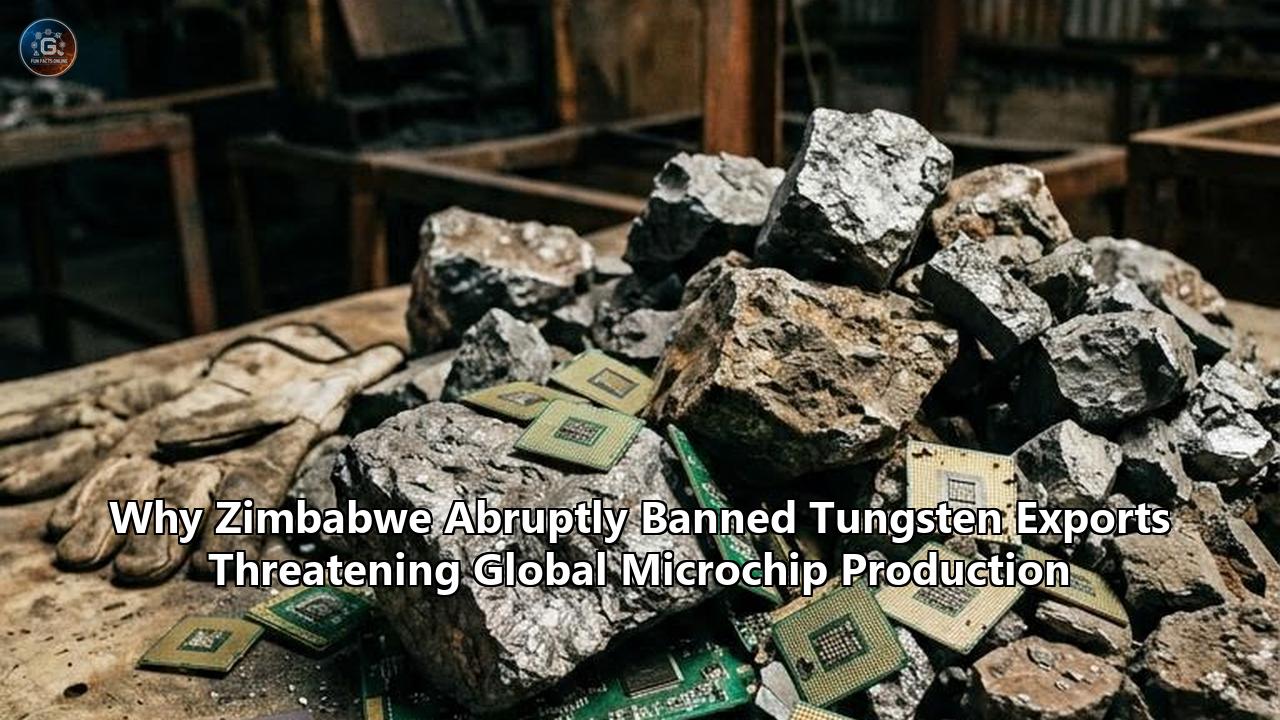
HARARE, Zimbabwe — Freight trains and flatbed trucks carrying heavy, black mineral concentrate ground to a sudden halt across Zimbabwe’s transport corridors following an emergency directive issued by the Ministry of Mines and Mining Development. In a private circular dispatched to the state-owned Minerals Marketing Corporation of Zimbabwe (MMCZ), the government ordered an immediate and indefinite freeze on the foreign shipment of all antimony and tungsten, encompassing raw ores and concentrates.
The circular, authored by Permanent Secretary for Mines Dr. Thomas Utete Wushe and confirmed by senior ministry officials, instructed border customs agents, railway operators, and private logistics handlers to suspend export processing without exception. The state marketing body was instructed to stop certifying outward shipments, immediately paralyzing supply pipelines destined for trading hubs in South Africa, processing centers in China, and chemical plants in Japan and Europe.
The abrupt order caught multinational mining companies, commodities trading houses, and commercial logistics firms completely off guard. At railhead sidings outside Bulawayo, processing yards in the Mutare greenstone belt, and the Forbes border post leading toward Mozambique’s Port of Beira, cargo containers holding thousands of tons of high-density wolframite and scheelite ores were detained under armed police and customs guard.
Harare justified the move under the Base Minerals Export Control Act, framing the intervention as a sovereign imperative to eradicate illicit cross-border mineral smuggling, eliminate transfer pricing loopholes, and compel foreign mining conglomerates to construct chemical processing plants inside the country. However, the collateral consequences of the zimbabwe tungsten export ban have cascaded far beyond Southern Africa, triggering acute supply alarms inside the boardrooms of the global semiconductor industry.
Tungsten is a dense, high-melting-point refractory metal vital to advanced microelectronics. It forms the atomic-scale conductive plugs, barrier layers, and vertical interconnects embedded inside leading-edge central processing units, graphics processors, high-bandwidth memory chips, and high-density 3D NAND flash drives.
With China—which produces nearly 80% of global primary tungsten—already throttling its own exports via quotas and dual-use licensing regimes, international chipmakers had turned to alternate mineral corridors to diversify their supply chains. Zimbabwe’s surprise export clampdown has severed one of the most promising alternate supply routes, intensifying a severe raw materials crisis for foundries operating at the technological frontier.
The Ministerial Edict: Anatomy of Harare's Immediate Export Freeze
The regulatory hammer fell through an urgent ministerial instruction addressed to MMCZ General Manager Dr. N.J. Moyo. The text directed the marketing authority to refuse export clearance for any outward consignment containing tungsten or antimony, regardless of whether commercial sales contracts had been finalized or material was already in transit.
Under Zimbabwean law, the MMCZ holds an exclusive statutory monopoly over the marketing and export of all minerals extracted within national borders, excluding gold and silver, which are governed through the Reserve Bank of Zimbabwe’s Fidelity Printers and Refiners. By directing the MMCZ to withhold export authorizations, the government severed the legal conduit through which foreign capital transacts with domestic extraction operations.
"The Ministry of Mines and Mining Development hereby directs the Minerals Marketing Corporation of Zimbabwe to suspend, with immediate effect and until further notice, the export of antimony and tungsten in all forms, including ores and concentrates," Dr. Wushe wrote in the official directive. The ministry asserted that the extreme measure had been taken "in the national interest," emphasizing that the state would no longer tolerate the hemorrhage of unrefined mineral wealth without capturing domestic value-added equity.
The intervention was executed under the Base Minerals Export Control Act, an expansive legal framework empowering the executive branch to prohibit the export of any base mineral without an explicit, ministerial-level exemption permit. It expands on the statutory infrastructure established by Statutory Instrument 5 of 2023, which initially prohibited the export of unbeneficiated base mineral ores, and accelerates the timeline of the Critical Minerals Declaration enacted earlier this year. That policy classified 14 minerals—including lithium, antimony, tungsten, cobalt, nickel, and platinum group metals—as sovereign strategic assets subject to state intervention and mandatory domestic processing quotas.
               CRITICAL PATH: FROM HARARE TO SILICON FABRICATION

 [ Zimbabwe Mines ]  -->  Wolframite / Scheelite Concentrates (BANNED)
         |
         x  <-- Export Freeze Enforced by MMCZ & Customs Agents
         |
 [ Merchant Smelters ] -> Conversion to Ammonium Paratungstate (APT)
         |
 [ Chemical Synthesizers ] -> Synthesis of High-Purity Tungsten Hexafluoride (WF6)
         |
 [ Advanced Fabs ]   -->  Atomic Layer Deposition (ALD/CVD) of Contact Plugs
                          in 3nm/2nm GAAFET Logic & 300+ Layer 3D NAND Memory
Senior officials within the Ministry of Mines confirmed that the immediate suspension followed an exhaustive inter-agency audit of export declarations conducted jointly by the Zimbabwe Revenue Authority (ZIMRA), the Minerals Flora and Fauna Unit of the Zimbabwe Republic Police, and the central intelligence services. The findings pointed to discrepancies between the declared assay grades of exported concentrates and the market values realized abroad.
According to ministry sources, bulk mineral consignments categorized as low-grade raw ore often contained unbilled fractions of high-value co-minerals, including bismuth, tantalum, and gold. Mining enterprises took advantage of the lack of domestic assay laboratory infrastructure to export high-purity concentrates under the guise of unrefined aggregate, depriving the Treasury of corporate royalties and withholding taxes.
"We have witnessed a systematic leakage of strategic national wealth," a senior official in the Ministry of Mines stated on condition of anonymity. "Multinational companies extract raw rock, load it into shipping containers, and transport it to foreign smelting operations while declaring marginal base valuations at our borders. Zimbabwe receives crumbs, while the real industrial value, skilled jobs, and manufacturing margins are captured overseas. That economic paradigm has ended. If you wish to profit from Zimbabwean tungsten, you must build the processing plants within our borders."
The Chamber of Mines of Zimbabwe, the primary body representing large-scale and mid-tier mining operators, reacted with alarm. Mining executives warned that an abrupt halt without transitional off-ramps or grace periods threatened the solvency of operating projects.
"Mining is a long-cycle, capital-intensive industry dependent on predictable cash flows," said Isaac Kwesu, Chief Executive Officer of the Chamber of Mines of Zimbabwe. "Our member companies have binding contractual delivery commitments with international off-takers. An indefinite cessation of concentrate shipments creates immediate working capital crises, freezes operational revenues, and jeopardizes mining jobs, particularly in regions where tungsten extraction supports entire community ecosystems."
Despite industry pushback, the government held firm. Checkpoints on primary transport arteries leading to border posts with South Africa and Mozambique were reinforced, with military and customs units turning back heavy haulers loaded with mineral concentrates. Overseas buyers who had prepaid shipments suddenly faced an administrative blockade with no defined timeline for resolution.
The Strategic Metallurgy of Silicon: Why Microchips Cannot Function Without Tungsten
To understand why a regulatory order signed in Harare has sent shockwaves through high-technology industrial centers in Hsinchu, Seoul, Tokyo, and Silicon Valley, one must examine the physical architecture of advanced microprocessors. Modern microchips, fabricated at dimensional nodes spanning 7 nanometers down to 2 nanometers, are the most structurally intricate physical devices ever constructed. Within these sub-microscopic landscapes, tungsten performs a mechanical and electrical role for which science has yet to find a commercially viable substitute.
                       TRANSISTOR CONTACT ARCHITECTURE

       [ Metal Layer 1 (M1) - Copper Interconnect Network ]
                                |
             +------------------+------------------+
             |                                     |
    [ Barrier: TiN ]                      [ Barrier: TiN ]
    [ Tungsten Plug ] (Middle-of-Line)    [ Tungsten Plug ] (Middle-of-Line)
             |                                     |
    [ Source Contact ]                    [ Drain Contact ]
    +----------------------------------------------+
    |               Silicon Substrate              |
    |         (3nm / 2nm GAAFET Transistor)        |
    +----------------------------------------------+
During the fabrication of an integrated circuit, the manufacturing sequence is split between the Front-End-of-Line (FEOL), where billions of microscopic transistors are shaped into the silicon wafer, and the Back-End-of-Line (BEOL), where multi-layered copper wiring networks are laid down to distribute power and signals. Between these two zones lies a critical metallurgical boundary known as the Middle-of-Line (MOL).
The Middle-of-Line is where the microscopic terminals of the transistor—the source, drain, and gate—must physically connect to the first copper routing layer. Semiconductor foundries cannot connect copper directly to the transistor's silicon terminals. Copper atoms are exceptionally mobile under thermal stress and electric fields; if copper comes into direct contact with silicon, it rapidly diffuses into the semiconductor lattice, poisoning the active region, destroying the p-n junctions, and rendering the entire microchip dead on arrival.
Tungsten serves as the protective, highly conductive bridge. Possessing the highest melting point of any metallic element (3,422 degrees Celsius), a low coefficient of thermal expansion, and resistance to electromigration—the physical displacement of metal atoms caused by the momentum of flowing electrons—tungsten forms the vertical contact plugs and vias that link active transistors to the external world.
+------------------------------------+---------------------------------------------+
| Physical Property                  | Industrial Significance in Semiconductor Fabs|
+------------------------------------+---------------------------------------------+
| Melting Point (3,422°C)            | Resists extreme thermal annealing cycles   |
| Low Diffusivity in Silicon         | Eliminates junction poisoning from copper   |
| High Electromigration Resistance   | Prevents open-circuit voids under currents  |
| Conformal Chemical Vapor Deposition| Fills high-aspect-ratio vertical trenches   |
+------------------------------------+---------------------------------------------+
Inside cleanrooms, foundries deposit these tungsten contact plugs using chemical vapor deposition (CVD) and atomic layer deposition (ALD). In these processes, gaseous tungsten hexafluoride ($WF_6$) is introduced into vacuum reaction chambers alongside hydrogen or silane gas. Under elevated temperatures, a chemical reduction takes place directly on the wafer's surface:
$$WF_6 + 3H_2 \longrightarrow W_{(s)} + 6HF_{(g)}$$
The gaseous hydrogen fluoride is evacuated, leaving behind a pinhole-free, ultra-pure film of metallic tungsten that conforms to the vertical contact vias etched into the silicon. As transistor dimensions shrink to atomic scales, the aspect ratios—the ratio of a hole's depth to its width—of these contact vias become extreme, exceeding 10:1 in leading-edge logic and 40:1 in memory architectures.
Tungsten deposited from $WF_6$ gas is one of the few materials capable of filling these deep, narrow channels without creating structural voids that would cause catastrophic chip failure.
The reliance on tungsten expands dramatically within the memory manufacturing sector, specifically in 3D NAND flash memory, which powers enterprise cloud storage servers, artificial intelligence data banks, and consumer solid-state drives. Unlike planar logic chips, 3D NAND increases data storage density by stacking memory cells vertically in continuous microscopic towers.
Leading memory fabricators, including Samsung Electronics, SK Hynix, and Micron Technology, are mass-producing 3D NAND memory chips containing between 232 and 300 vertical layers, with roadmaps targeting architectures that exceed 400 layers.
In these vertical towers, tungsten serves as the gate electrode and word-line metallization across every single memory layer. The foundries etch microscopic holes through hundreds of stacked dielectric films, subsequently filling every layer with tungsten via chemical vapor deposition using $WF_6$.
Consequently, as 3D NAND layer counts multiply, the volume of high-purity tungsten consumed per individual wafer expands along a vertical curve. An operational wafer fab running 100,000 wafer starts per month consumes thousands of kilograms of semiconductor-grade tungsten precursor annually.
+-----------------------+--------------------+------------------------------------+
| Semiconductor Node    | Architecture Type  | Tungsten Deposition Application   |
+-----------------------+--------------------+------------------------------------+
| 3nm / 2nm Logic       | GAAFET Nanosheet   | MOL Contact Plugs, Local Interconnect|
| 5nm / 7nm Logic       | FinFET             | Vertical Contact Plugs, Gate Metals|
| 232+ Layer 3D NAND    | Vertical Charge-Trap| Word-Line Metal, Channel Fillings  |
| 1b / 1c DRAM          | High-Aspect Ratio  | Storage Node Contacts, Bitline Vias|
+-----------------------+--------------------+------------------------------------+
The specialty gas manufacturing ecosystem that synthesizes $WF_6$ is tightly concentrated. A handful of chemical conglomerates—including SK Specialty in South Korea, Kanto Denka Kogyo, Resonac, and Central Glass in Japan, alongside Air Products and Merck’s Versum Materials in the United States and Europe—produce semiconductor-grade $WF_6$. These chemical manufacturers require constant, predictable deliveries of high-grade raw tungsten intermediates, typically in the form of Ammonium Paratungstate (APT) or pure tungsten metal powder.
Because the gas synthesis process demands exceptional chemical purities—often rated at 99.999% (5N) to 99.9999% (6N) purity, with metallic contamination limits measured in parts per trillion—the specialty gas manufacturers maintain strict, auditable qualifications for the upstream concentrates and refining facilities feeding their supply chains. Any sudden severance of upstream mineral feedstocks ripples directly through the chemical conversion furnaces, threatening the flow of specialty gases into cleanrooms.
Geopolitical Crossroads: China's Grip, Western Embargoes, and the Global Squeeze
The timing of the Zimbabwean export prohibition intersects with a broader geopolitical crisis surrounding critical minerals. Over the past three decades, China systematically centralized control over the global tungsten value chain. According to data from the British Geological Survey and the U.S. Geological Survey, Chinese mines produced approximately 67,000 metric tons of the estimated 85,000 metric tons of tungsten mined worldwide last year, representing nearly 79% to 83% of global primary output.
More crucially, China constructed an even tighter bottleneck across downstream processing, controlling approximately 85% of global refining capacity for Ammonium Paratungstate (APT), the chemical precursor from which all advanced tungsten products, carbides, and gases are derived.
            GLOBAL TUNGSTEN EXTRACTION & PROCESSING PROFILE

  Primary Mine Extraction (World Total: ~85,000 Tonnes)
  [#############################################       ] China (~79-83%)
  [###                                                 ] Vietnam (~7%)
  [##                                                  ] Russia (~3%)
  [######                                              ] Rest of World (~10%)

  Ammonium Paratungstate (APT) Refining Capacity
  [###############################################     ] China (~85%)
  [########                                            ] Rest of World (~15%)
Beginning in February 2025, Beijing began turning its mineral dominance into geopolitical leverage. Citing national security imperatives and domestic environmental conservation, the Chinese Ministry of Commerce introduced strict export controls covering tungsten oxides, APT, and high-performance tungsten carbide compounds.
Shipments abroad were placed under rigorous dual-use licensing protocols requiring foreign end-users to prove that their applications would not interface with Western military hardware. In December 2025, Chinese authorities tightened the noose further, issuing an order that restricted authorized tungsten export licenses to just 15 designated, state-vetted enterprises for the 2026-2027 calendar period.
The impact was swift and severe. Chinese exports of refined tungsten intermediates dropped by approximately 40%. European and North American industrial buyers scrambled to secure alternative volumes, triggering an explosive commodity rally.
Benchmark European Ammonium Paratungstate prices (CIF Rotterdam) surged from approximately $83 per kilogram of tungsten trioxide ($WO_3$) in January 2026 to more than $340 per kilogram by mid-summer, translating to an unprecedented $3,400 per metric ton unit (mtu). Spot prices for tungsten concentrates roughly tripled, while specialized powders spiked toward $55,000 per ton, and delivered tungsten prices in the United States surpassed $158,000 per metric ton.
                COMMODITY BENCHMARK ACCELERATION (2026)

  European APT Benchmark (USD / Metric Ton Unit WO3)

  $3,500 |                                              * (July 2026: $3,400)
  $3,000 |                                         *
  $2,500 |                                   *
  $2,000 |                             *
  $1,500 |                       *
  $1,000 |                 *
    $500 |  * (Jan 2026: $830)
      $0 +------------------------------------------------------------
            Jan 2026                                    Sep 2026
This structural market deficit was compounded by an impending legislative deadline originating from Washington. Under Defense Federal Acquisition Regulation Supplement (DFARS) clause 252.225-7052, passed by the United States Congress, defense contractors and advanced hardware manufacturers face an absolute, statutory prohibition against procuring tungsten that has been sourced from, or processed within, four designated adversary nations: China, Russia, Iran, and North Korea.
For years, procurement departments circumvented these defense restrictions because the legal definition turned solely on where the final tungsten metal was melted or chemically synthesized. A Western company could import Chinese raw concentrate, process it in Europe or North America, and label it compliant.
However, beginning on January 1, 2027, the DFARS statutory language expands to the origin of the mine and ore. The rule explicitly names recycled and scrap streams, dictating that material originating from Chinese soil cannot reset its origin through re-melting or processing in a third country.
With the United States having mined zero domestic tungsten since 2015, Western aerospace, defense, and semiconductor procurement syndicates were caught in an escalating squeeze. They were legally forced to eliminate Chinese material by 2027, yet lacked commercial mining projects outside China capable of fulfilling demand.
+------------------------------------+---------------------------------------------+
| Market Stress Factor               | Real-World Commercial Fallout               |
+------------------------------------+---------------------------------------------+
| China Export Licensing Squeeze     | Refined intermediate exports dropped by 40% |
| US DFARS 252.225-7052 Mandate      | Bars Chinese/Russian ore on Jan 1, 2027     |
| APT Price Surge (Jan-July 2026)    | Surged 310% from $830/mtu to $3,400/mtu     |
| US Domestic Tungsten Extraction    | Exactly zero metric tons mined since 2015   |
+------------------------------------+---------------------------------------------+
International trading conglomerates—including Traxys, Glencore, and Japanese trading firms (sogo shosha) like Mitsubishi Corporation and Hanwa—spent months scouring the globe for uncommitted, non-Chinese deposits. They focused on tungsten-rich belts in Africa, with Zimbabwe serving as a key target.
Although Zimbabwe’s historical reported output accounted for a modest share of the global total, the nation possesses geological resources capable of rapid scale. International mining exploration capital had begun pouring into Zimbabwean wolframite projects, targeting them as independent feeder channels to supply non-Chinese supply chains.
The sudden enforcement of the zimbabwe tungsten export ban shattered these diversification strategies. By halting concentrate shipments, Harare closed off one of the few escape valves available to Western supply chains, leaving microchip and defense procurement managers scrambling for alternative feedstocks.
Geology of the Craton: Zimbabwe's Strategic Mineral Reserves
Zimbabwe’s geological wealth is an anomaly born of billions of years of crustal evolution. Situated on the ancient Archaean Zimbabwe Craton, the country’s territory is traversed by mineralized greenstone belts and the Great Dyke—a massive, 550-kilometer-long layered igneous intrusion that bisects the nation and hosts the world's second-largest known deposits of platinum group metals and high-grade chromium.
Surrounding this central intrusion lie complex granitic plutons and pegmatite fields that harbor significant deposits of lithium, cesium, tantalum, tin, antimony, and tungsten.
                 GEOLOGICAL PROFILE: ZIMBABWE CRATON

               (North: Zambezi Metamorphic Belt)
                               |
       +-----------------------+-----------------------+
       |                                               |
 [ Great Dyke ]                                [ Greenstone Belts ]
 - 550km Mafic/Ultramafic Intrusion             - Mutare, Tshontanda, Mweza
 - World #2 PGM Reserves                        - Massive Wolframite Quartz Veins
 - Major Chromite Formations                    - Scheelite Skarn Formations
       |                                               |
       +-----------------------+-----------------------+
                               |
               (South: Limpopo Mobile Belt)
Tungsten mineralization across Zimbabwe occurs primarily in two distinct mineralogical forms: wolframite (an iron-manganese tungstate mineral, $(Fe,Mn)WO_4$) and scheelite (a calcium tungstate mineral, $CaWO_4$). These deposits are concentrated within hydrothermal quartz veins, pegmatite contacts, and metamorphic skarns along the edges of ancient granitic intrusions.
Historically, Zimbabwe supported a vibrant tungsten mining industry during the twentieth century, anchored by operations such as the R.H.A. Tungsten Mine near Kamativi, the Beardmore Mine, the Scheelite King Mine, and deposits across the Mutare, Masvingo, and Tshontanda belts.
The primary commercial tungsten assets within Zimbabwe include:
- The R.H.A. Tungsten Project: Located in the Dete area of Matabeleland North, approximately 270 kilometers north of Bulawayo, this deposit is held by London-listed Premier African Minerals alongside local state investment vehicles. R.H.A. encompasses both an open-pit target and extensive underground historic workings, containing high-grade wolframite hosted in a series of quartz veins traversing a quartz-tourmaline schist sequence. Historic grades within the ore envelope run up to 1.5% to 2% $WO_3$, far above typical open-pit global averages, which often operate on grades below 0.2%.
- The Kamativi Multi-Mineral Complex: Located along the northern edge of the craton, Kamativi was traditionally mined for tin by the Kamativi Tin Mines syndicate. However, the pegmatites of the complex contain significant associated mineralization, including wolframite, spodumene (lithium), tantalite, and beryl. Re-evaluation of tailings dumps and surrounding hard-rock intrusions has identified millions of tons of multi-metallic mineral resources containing high tungsten fractions.
- The Mutare Greenstone Belt and Tshontanda Formations: Stretching along the eastern and northwestern margins, these formations host hydrothermal quartz veins with coarse wolframite and scheelite crystals. While partially mined during the mid-20th century, extensive shallow deposits remain, attracting domestic operations and small-scale mining syndicates.
- Bikita and Sandawana Pegmatite Systems: While globally known for hosting some of the planet’s largest lithium and cesium deposits, these complex pegmatite fields host substantial, often unassayed, associated zones of tungsten and antimony mineralization, typically present as fine-grained wolframite and stibnite.
+--------------------------+-----------------------+----------------------------------+
| Mining Asset / District  | Dominant Mineral      | Geological Setting               |
+--------------------------+-----------------------+----------------------------------+
| R.H.A. Project           | Wolframite            | Quartz-tourmaline schist veins   |
| Kamativi Complex         | Wolframite / Cassiterite| Multi-mineral pegmatite swarms  |
| Mutare Belt              | Scheelite / Wolframite| Hydrothermal greenstone skarns   |
| Bikita / Sandawana       | Wolframite / Stibnite | Lithium-cesium zoned pegmatites  |
+--------------------------+-----------------------+----------------------------------+
Despite its resource quality, Zimbabwe’s modern tungsten extraction sector has remained largely fragmented. Outside of formal, mid-tier development projects, a substantial portion of extraction has been driven by Artisanal and Small-Scale Mining (ASM) syndicates.
These informal diggers extract high-grade wolframite from shallow pits and surface quartz veins, using manual crushing, washing, and gravity sluicing to produce high-density concentrates grading between 50% and 65% $WO_3$.
This informal sector formed the core of the government’s smuggling concerns. Because tungsten possesses extreme density (roughly 19.3 grams per cubic centimeter, comparable to gold), raw concentrates occupy minimal physical volume.
A standard 4x4 pickup truck can carry two metric tons of high-grade concentrate, valued at tens of thousands of dollars on the black market. For years, unregistered intermediate buyers, often bankrolled by foreign trading houses, bought concentrates directly from artisanal miners in rural areas, paying cash in US dollars.
The material was then smuggled across the border into Mozambique, disguised as base building stone or blended into South African transit freight, evading the MMCZ marketing network entirely.
Once arriving at ports in Durban or Beira, this untracked material entered the international merchant pool, where it was mixed into feedstocks bound for Asian and European chemical refiners. By enforcing a blanket ban, Harare aimed to choke this informal pipeline, halt tax evasion, and assert sovereign control over every ounce of strategic metal leaving the country.
The Industrialization Paradox: The Hurdle of Domestic Beneficiation
While the political logic behind Harare’s export ban mirrors the resource nationalism gaining traction across the Global South, the directive runs into severe engineering and thermodynamic hurdles on the ground.
The Zimbabwean government's policy premise is direct: by prohibiting the export of raw concentrates, mining companies will be forced to construct domestic chemical refining plants, turning wolframite into refined Ammonium Paratungstate (APT), tungsten metal powder, or finished industrial products within the country.
"The era of shipping out dirt and rocks is over," declared Mines Minister Winston Chitando in an address backing the export control framework. "Our Vision 2030 economic transformation requires that Zimbabwe industrialize its resource base. We are demanding that those who exploit our mineral assets build the chemical infrastructure to add value here. If you can extract it, you must process it."
               THE INDUSTRIAL REFINING DIVIDE

  MINING & PHYSICAL CONCENTRATION (Feasible in Zimbabwe)
  [ Hard Rock Mining ] -> [ Crushing / Milling ] -> [ Gravity / Magnetic ]
  Yield: Wolframite / Scheelite Concentrates (50-65% WO3)

       ||  [ GOVERNMENT EMBARGO / EXPORT STOP ]
       \/

  CHEMICAL CONVERSION & REFINING (Virtually Absent in Zimbabwe)
  [ Pressure Digestion ] -> [ Liquid-Liquid Ion Exchange ] -> [ Evaporation ]
  Reagents: NaOH / HCl / High-Purity Ammonia
  Energy: Uninterrupted Industrial Baseload Power
  Output: Ammonium Paratungstate (APT) Crystals / Tungsten Powder
However, the leap from producing a 60% $WO_3$ mineral concentrate to operating a commercial APT chemical refining facility represents an immense technological divide.
Operating an APT refinery is not a simple smelting process; it is a complex, high-risk hydrometallurgical chemical operation that demands deep engineering capacity, specialized chemical reagents, and vast supplies of industrial power and water:
- Chemical Digestion: The mineral concentrate must be ground to a fine powder and digested inside high-pressure autoclaves at temperatures exceeding 220 degrees Celsius, using concentrated sodium hydroxide ($NaOH$) for wolframite or sodium carbonate ($Na_2CO_3$) for scheelite, converting the solid ore into a liquid sodium tungstate solution.
- Impurity Separation: The resulting liquid must undergo extensive chemical purifications. Deleterious elements—such as arsenic, phosphorus, silicon, molybdenum, and antimony—must be removed via chemical precipitation, acidification, and sulfide additions.
- Solvent Extraction and Ion Exchange: The purified sodium tungstate is converted to an ammonium tungstate solution using complex organic liquid-liquid solvent extraction circuits or specialized ion-exchange columns. This step requires thousands of tons of hazardous petrochemical solvents, organic amines, and hydrochloric acid.
- Crystallization: The ammonium tungstate solution is placed in thermal crystallizers to precipitate high-purity crystals of Ammonium Paratungstate:
$$(NH_4)_{10}[H_2W_{12}O_{42}] \cdot 4H_2O$$
The crystals are then filtered, washed, and dried. If the product is to be converted into pure tungsten metal powder for electronics, the APT must be calcined into tungsten blue oxide ($WO_{3-x}$) and subsequently reduced under high-temperature, explosive hydrogen atmospheres ($H_2$) inside industrial tube furnaces heated to between 800 and 1,000 degrees Celsius.
+--------------------------+-----------------------+----------------------------------+
| Processing Stage         | Primary Chemical Input| Environmental / Engineering Risk |
+--------------------------+-----------------------+----------------------------------+
| Autoclave Digestion      | Sodium Hydroxide/Soda | High-pressure, corrosive leaks   |
| Solvent Extraction       | Amines, Kerosene dil. | Toxic fire risk, hazardous waste |
| Evaporative Boil-down    | Thermal Energy        | Immense, uninterrupted electricity|
| Hydrogen Gas Reduction   | Ultra-pure H2 gas     | High-temperature explosion danger|
+--------------------------+-----------------------+----------------------------------+
Zimbabwe currently possesses zero operational APT chemical refineries. It lacks domestic manufacturing plants for the required chemical reagents, meaning every ton of caustic soda, hydrochloric acid, and specialized organic solvents would have to be imported via ports in South Africa or Mozambique at significant capital expense.
The most insurmountable barrier, however, is electric power. Zimbabwean industry has suffered from persistent power deficits, caused by historic droughts lowering water levels at the Kariba Dam hydroelectric station and frequent outages at the aging coal-fired Hwange Thermal Power Station.
Industrial operators routinely face load-shedding lasting between 8 and 14 hours a day, unless they procure power through expensive imports from Mozambique’s Cahora Bassa or construct captive solar installations.
An APT refinery and its companion hydrogen reduction furnaces cannot operate on an intermittent power grid. An unexpected drop in electrical current during a high-pressure autoclave run or an evaporative crystallization cycle ruins entire chemical batches, damages reactor vessels, and creates severe industrial safety hazards.
                 ZIMBABWE CRITICAL INFRASTRUCTURE DEFICIT

  Hydrometallurgical APT Processing Needs:
  [ Baseload Power: Constant 24/7/365 Electricity Supply ]
  Current Reality: Kariba Drought Curtailments + Hwange Grid Outages

  [ Chemical Logistics: Domestic Caustic Soda / Hydrochloric Acid / Ammonia ]
  Current Reality: Near Total Reliance on Cross-Border Road Tanker Imports

  [ Environmental Control: Specialized Toxic Tailings Containment ]
  Current Reality: Nascent Regulatory Regimes for Complex Hydrometallurgical Effluent
Mining executives point to the government's previous lithium raw export ban as an imperfect model. In late 2022 and early 2023, Zimbabwe banned the export of raw lithium ore. That measure successfully compelled Chinese battery giants—such as Zhejiang Huayou Cobalt, Sinomine Resource Group, and Chengxin Lithium—to inject over $1 billion into building domestic processing plants.
However, those facilities produce spodumene concentrate and semi-refined lithium sulfate—mechanical crushing, flotation, and basic roasting operations rather than full-scale chemical plants producing battery-grade lithium hydroxide or cathode precursors.
Applying that same policy to tungsten by banning not just raw ore, but all forms of concentrate, has set an impossible processing requirement. By blocking concentrate shipments before any domestic hydrometallurgical refining capacity exists, the government has created an industrial vacuum.
Without immediate cash flow from concentrate exports, mid-tier mining operators cannot fund the construction of complex chemical refineries, leaving mining assets facing indefinite care and maintenance.
Supply Chain Contagion: Foundries, Specialty Gases, and the 2nm Node
As hundreds of tons of concentrate sit idle in Zimbabwean warehouses, the disruption is rippling across the fragile networks that feed global semiconductor manufacturing. Global supply chains do not operate with large safety buffers for specialized materials; they run on fine-tuned just-in-time delivery schedules.
The abrupt implementation of the zimbabwe tungsten export ban hit an international ecosystem already destabilized by China’s export licensing restrictions, creating an acute supply crunch.
                 THE SPECIALTY GAS CHOKEPOINT

  [ Tungsten Mining / Concentrates (Global Deficit) ]
                         |
                         v
     [ APT Refiners (85% Controlled by China) ]
                         |
                         v
    [ Specialized Gas Synthesizers (Japan, Korea, US) ]
    - SK Specialty, Kanto Denka, Resonac, Central Glass
    - Produce 99.999% Ultra-Pure WF6 Precursor Gas
                         |
                         v
  [ Tier-1 Semiconductor Fabs (TSMC, Samsung, Intel) ]
  - Consumed in High-Aspect Ratio Interconnects
  - Fab Qualification Timeline: 9 to 18 Months per Supplier
Specialty chemical gas manufacturers in Japan and South Korea were among the first to sound alarms. Plants producing high-purity tungsten hexafluoride ($WF_6$) operate on strict quality regimes.
Unlike general industrial manufacturing, where an engineer can swap steel or copper suppliers with standard paperwork, semiconductor fabs qualify specialty chemical suppliers through an exhaustive process that takes anywhere from 9 to 18 months.
Every single shipment of $WF_6$ delivered to a leading-edge fabrication facility in Hsinchu or Pyeongtaek is assayed for traces of contamination. Contamination of a single part per billion of an unwanted transition metal or alkali element can cause gate dielectric breakdown across thousands of wafers, turning multimillion-dollar production runs into scrap.
Consequently, when chemical gas producers face raw material shortfalls from primary sources, they cannot simply purchase unvetted tungsten powder on the spot market. If alternative feedstocks cannot be obtained and verified, the chemical plants must slow synthesis lines to preserve inventory.
Industry reports confirm that Japanese $WF_6$ gas synthesis facilities began reviewing production schedules over the summer, citing restricted raw material allocations and skyrocketing input costs.
+------------------------------------+---------------------------------------------+
| Semiconductor Fab Vector           | Downstream Vulnerability Mechanism          |
+------------------------------------+---------------------------------------------+
| 3D NAND Flash Memory               | Scaling past 300 layers multiplies WF6 use  |
| 3nm / 2nm Logic Foundries          | Complex nanosheet geometries require ALD    |
| Specialized Gas Chemical Refiners  | 9-18 month lead-time to qualify new inputs  |
| Defense Microelectronics           | DFARS bans all Chinese ore starting Jan 2027|
+------------------------------------+---------------------------------------------+
The supply pressure comes at a vulnerable moment for chipmakers. The global rollout of artificial intelligence hardware has driven high demand for leading-edge logic processors and high-bandwidth memory (HBM) stacks. Foundries are operating at near-maximum capacity, with advanced packaging lines working around the clock.
Concurrently, logic fabs are executing an architectural shift: transitioning away from three-dimensional FinFET transistors to Gate-All-Around (GAA) nanosheet architectures at the 3nm and 2nm nodes.
In Gate-All-Around architectures, the transistor channels consist of horizontally stacked silicon ribbons surrounded entirely by the metal gate. The dimensional clearances within these nanosheet stacks are measured in single nanometers.
Depositing the atomic layer contact structures and Middle-of-Line vertical plugs requires higher chemical conformity and precision, driving an increase in the number of atomic layer deposition (ALD) process steps per wafer. Any supply volatility or rationing of $WF_6$ threatens to limit wafer starts precisely as these advanced architectures enter high-volume commercial production.
               THE SEMICONDUCTOR "PAPERCLIP PARADOX"

  +-------------------------------------------------------------+
  | Advanced Wafer Value: $20,000 - $30,000 (3nm / 2nm Process) |
  +-------------------------------------------------------------+
  | Tungsten Content Cost per Wafer: ~ $25 - $50 (Tiny fraction)|
  +-------------------------------------------------------------+
  | System Impact of Zero Tungsten:                             |
  | Complete Line Stoppage -> Zero Wafer Output                 |
  +-------------------------------------------------------------+
This dynamic illustrates the "paperclip paradox" of advanced semiconductor manufacturing. Tungsten accounts for a fraction of one percent of the total bill of materials for an advanced microchip. A wafer valued at $25,000 may contain only a few dozen dollars worth of tungsten metal.
Yet, without that minuscule fraction of metal, the entire multi-billion-dollar fabrication line stops dead. There are no substitute materials that can be deployed at scale:
- Cobalt ($Co$): Explored by Intel at the 10nm node for local interconnects, cobalt suffered from higher resistance in narrow contact plugs and proved difficult to deposit conformally without voids in deep, high-aspect-ratio holes.
- Ruthenium ($Ru$): While viewed as a viable candidate for future sub-1nm interconnects, ruthenium is a scarce, expensive precious metal with annual global production under 35 metric tons—barely enough to support specialized niche lines, let alone the global memory industry.
- Molybdenum ($Mo$): Emerging as a candidate to replace tungsten in ultra-high-density 3D NAND word lines due to lower resistivity at thin dimensions, molybdenum faces its own supply chokepoints and would require years of equipment redesign and process retooling before widespread cleanroom adoption.
Tungsten remains the undisputed workhorse for semiconductor contacts and vertical interconnects. By cutting off alternative supply, Harare's export freeze has tightened an already critical bottleneck, leaving global foundries vulnerable to compounding disruptions.
The Broader African Playbook: The Surge of Critical Resource Nationalism
Zimbabwe’s confrontation with international mining houses does not exist in isolation. It is part of a sweeping, continent-wide wave of critical resource nationalism that is reshaping the geopolitical dynamics of global trade. Across Africa, resource-rich governments are moving aggressively to scrap the historic "pit-to-port" colonial mining model, in which foreign enterprises extract raw geological materials, export them for minimal royalties, and leave host nations with ecological damage and exhausted deposits.
From Conakry to Kinshasa, governments are leveraging their mineral wealth to force foreign capital into domestic industrialization:
        THE AFRICAN BENEFICIATION WAVE (2020-2026)

  [ Guinea ]  ================> Mandated domestic alumina refinery construction
                                for bauxite export concessions.

  [ DRC ]     ================> Enacted export restrictions and quota regimes
                                on raw cobalt and copper concentrates.

  [ Namibia ] ================> Prohibited export of unprocessed critical minerals,
                                including lithium, cobalt, and rare earth ores.

  [ Zimbabwe ] ================> Enacted sequential export bans:
                                - Raw Lithium (2022/2023)
                                - Critical Base Minerals (May 2026)
- Antimony & Tungsten (July/Sept 2026)- Guinea: The ruling military administration threatened to revoke bauxite mining concessions unless multinational syndicates constructed domestic alumina refineries to process raw ore within the country.
- The Democratic Republic of Congo: The government deployed strict export quotas, royalty revisions, and joint-venture renegotiations across its copper and cobalt belts, attempting to capture sovereign control over processing margins.
- Namibia: The government passed legislation barring the export of unprocessed critical minerals, including lithium, cobalt, and rare earths, demanding local pre-processing before export clearance.
Zimbabwe, however, has pursued the most aggressive timeline. President Emmerson Mnangagwa’s administration has tied mineral retention directly to "Vision 2030," a policy blueprint aimed at transforming Zimbabwe into an upper-middle-income industrial economy over the next decade.
The government calculates that the global energy transition, artificial intelligence expansion, and Western-Chinese trade friction have created a unique window of geopolitical leverage. Harare is gambling that international powers need its minerals urgently enough that they will fund domestic refineries rather than walk away.
This aggressive posture carries profound geopolitical undertones. For decades, Harare has lived under United States and European economic sanctions targeting political and military elites.
Frustrated by Western isolation, Zimbabwe executed a strategic "Look East" policy, welcoming Chinese capital to acquire and develop major infrastructure and mining assets across its lithium, gold, coal, and chrome belts.
Yet, this latest export ban targets Chinese operations just as directly as Western trading houses. Much of the smuggled and artisanal tungsten leaving Zimbabwe was destined for Chinese processing plants.
By abruptly halting shipments, Harare sent an unmistakable signal to Beijing: even allied nations must process resources domestically rather than treating Zimbabwe as a raw material quarry.
             GEOPOLITICAL LEVERAGE ARCHITECTURE

         [ Zimbabwe Sovereign Critical Mineral Reserves ]
                               |
         +---------------------+---------------------+
         |                                           |
   [ Western Nations ]                         [ China ]
   - Blocked by DFARS 2027 from                - Domestic mines depleting;
     buying Chinese tungsten.                  - Seeks foreign concentrates
   - Desperate for non-China ore.                to maintain APT dominance.
         |                                           |
         +---------------------+---------------------+
                               |
                               v
            [ Harare's Policy Ultimatum ]
            "Build local chemical processing plants,
             or leave the mineral in our ground."
Western governments find themselves caught in a policy dilemma of their own making. Legislative measures like the United States Inflation Reduction Act and the European Union Critical Raw Materials Act were designed to reduce reliance on Chinese supply chains.
Similarly, the Pentagon’s DFARS 2027 rule legally forces defense contractors to eliminate Chinese tungsten. However, while the West erected legal barriers against Chinese minerals, it made little progress toward developing alternative mining and refining infrastructure outside China.
Now, with the zimbabwe tungsten export ban cutting off access to one of the most viable alternative sources of raw ore, Western manufacturers face a shrinking pool of compliant resources.
Supply Forecast: The Widening Deficit and Upstream Bottlenecks
The structural crisis across the global tungsten sector cannot be resolved simply by opening up new mines in the short term. Developing a hard-rock mining and mineral extraction facility requires lengthy timelines spanning environmental permitting, reserve drilling, metallurgical testing, capital financing, and mill construction.
According to an exhaustive global supply analysis by S&P Global, international first-use tungsten demand is projected to climb from approximately 162,000 metric tons of $WO_3$ equivalent to over 180,000 tons by 2030, driven by the dual expansion of defense manufacturing and advanced microelectronics.
               PROJECTED PRIMARY MINE-SUPPLY DEFICIT
                      (Ex-China Accessible Ore)

   50,000 Tonnes |---------------------------------------------------
                 |                               Demand: ~50,000 T
   40,000 Tonnes |                 +---------------------------------
                 |                 |  16,000 TONNE STRUCTURAL DEFICIT
   30,000 Tonnes |-----------------+---------------------------------
                 | Accessible Supply Pipeline: ~34,000 T (Max Capacity)
   20,000 Tonnes | (Assumes ALL 11 announced global projects arrive online)
                 +---------------------------------------------------
                                 Target Year: 2030
Across the entire globe, there are only 11 announced, commercial-scale tungsten mining projects in development outside China. Even if every single one of those 11 projects is delivered on schedule without operational or financial delays, they are projected to add roughly 20,000 metric tons of annual $WO_3$ capacity by 2030.
This would bring total accessible primary production outside China to roughly 34,000 tons, against an ex-China primary demand footprint projected to exceed 50,000 tons.
The result is a projected structural deficit of at least 16,000 metric tons of tungsten trioxide annually outside China. The shutdown of Zimbabwean production removes critical tonnage that was needed to bridge this multi-year supply gap.
+------------------------------------+---------------------------------------------+
| Global Upstream Development Project| Operational Status / Commercial Headwind    |
+------------------------------------+---------------------------------------------+
| Sangdong Project (South Korea)     | Underground re-commissioning underway      |
| Gentung Project (Montana, USA)     | Capital expenditure; target late 2027 online|
| Mt Mulgine Project (Australia)     | Pre-feasibility study; target 2029 online   |
| Hemerdon / Drakelands (UK)         | Restructuring funding; technical delays     |
| Zimbabwean Assets (RHA, Kamativi)  | Paralyzed by indefinite export ban          |
+------------------------------------+---------------------------------------------+
A few independent mining ventures outside China are attempting to address the shortage:
- The Sangdong Mine (South Korea): Owned by Almonty Industries, the historic Sangdong underground deposit represents one of the largest and highest-grade tungsten resources outside China. While Almonty is working to bring Sangdong back into commercial production to supply Western and Allied foundries, commercial ramp-ups take time. Furthermore, its planned output is already heavily oversubscribed by aerospace, tooling, and defense contractors.
- The Gentung Project (Montana, USA): Almonty is also advancing the Gentung project in the United States, targeting late 2027 completion. However, the initial capital expenditure remains modest at roughly $32 million, meaning its production capacity will fulfill only a fraction of North American demand.
- Mt Mulgine (Western Australia): Tungsten Mining NL recently published a Pre-Feasibility Study (PFS) for its massive Mt Mulgine deposit. While holding substantial resource scale, the project is scheduled for initial commercial production no earlier than 2029.
- Hemerdon Mine (United Kingdom): Formerly known as Drakelands, this massive open-cast tungsten-tin deposit in Devon closed in 2018 due to metallurgical and processing difficulties. While the UK’s National Wealth Fund recently committed financial support to restart operations, technical re-engineering and environmental hurdles mean substantial commercial output remains several years away.
Compounding the crisis is the fact that high prices alone no longer solve the bottleneck. While the benchmark European APT price surged above $340 per kilogram—far above the theoretical incentive price of $90 per kilogram required to make every modeled deposit profitable—capital cannot buy time. Permitting, environmental impact reviews, mine dewatering, processing plant construction, and cleanroom supply qualification require multi-year development cycles.
               THE CRITICAL MINERAL ESCALATION TIMELINE

   Feb 2025: China restricts tungsten oxides & APT under export controls.
   Dec 2025: China caps authorized export licenses to just 15 firms.
   Feb 2026: Zimbabwe temporarily halts raw minerals to audit leakages.
   May 2026: Zimbabwe issues Critical Minerals Declaration covering 14 metals.
   July 2026: Dr. Wushe drafts internal directive halting antimony & tungsten.
   Sep 2026: Full enforcement confirmed; all tungsten shipments frozen indefinitely.
   Jan 2027: US DFARS 252.225-7052 ban on Chinese/Russian mined ore takes effect.
The abrupt closure of Zimbabwe’s borders eliminates accessible merchant feedstocks that were keeping international processors afloat. Western industrial tooling leaders like Kennametal have already reported negative operational cash flows, squeezed between skyrocketing raw tungsten procurement costs and fixed contractual customer pricing.
As specialty gas synthesizers and chemical refiners consume their remaining stockpiles over the coming quarters, the absence of alternative mineral supplies will land squarely on semiconductor cleanrooms.
The Road Ahead: Industry Standoff and What to Watch
The global semiconductor ecosystem is facing an unprecedented raw material squeeze. Foundries that operate at tolerances measured in fractions of a nanometer are confronting a raw supply disruption rooted in the resource politics of Southern Africa.
As the standoff between the Zimbabwean Ministry of Mines and international mining companies settles into an indefinite stalemate, industry executives, trade envoys, and procurement analysts are monitoring several critical inflection points:
+-----------------------------------------------------------------------------------+
|                           CRITICAL MILESTONES TO WATCH                            |
+-----------------------------------------------------------------------------------+
| 1. The MMCZ Quota Off-Ramp: Watch for temporary exemptions granted to operators   |
|    submitting binding chemical refinery construction blueprints to Harare.        |
|                                                                                   |
| 2. DFARS 2027 Defense Crunch: The January 1, 2027 US procurement deadline banning  |
|    Chinese mined ore will force Western defense and chip sectors to confront the  |
|    gap between legal requirements and physical supply availability.               |
|                                                                                   |
| 3. Upstream Cleanroom Disruption: Inventory drawdowns among specialty gas         |
|    manufacturers (WF6) in Japan and South Korea over the next 3 to 6 months will   |
|    reveal whether wafer starts at 3nm/2nm logic and 3D NAND fabs must be curtailed.|
+-----------------------------------------------------------------------------------+
1. The Likelihood of a Pragmatic Exemption Framework
Market observers are watching closely to see whether Harare will blink, repeating the policy trajectory seen during its previous mineral export bans. When Zimbabwe suspended lithium concentrate exports in February 2026, the sweeping halt threatened to bankrupt local operations and cut off vital foreign exchange revenues. By April, the government eased the restrictions, implementing an exemption framework that allowed miners to export concentrates if they presented approved plans and capital commitments to build domestic processing plants.
If cash shortages worsen, the Ministry of Mines may implement a similar quota system for tungsten, allowing partial shipments for operators that invest in domestic refining infrastructure. However, if the government maintains an uncompromising ban, domestic operations will shutter, cutting off all production.
2. Bilateral Negotiations with China
Because Chinese state-backed enterprises dominate Zimbabwe’s broader mining investments, intense closed-door negotiations are underway between Harare and Beijing. Chinese entities may propose financing a centralized, state-backed hydrometallurgical processing hub inside Zimbabwe.
Such a deal would allow Chinese firms to build and operate the chemical plants in exchange for guaranteed off-take rights to the refined intermediate chemicals. While this would satisfy Harare’s demand for domestic value-addition, it would deal a blow to Western chipmakers, locking Zimbabwe’s strategic reserves into Chinese-controlled supply channels.
3. The DFARS January 1, 2027 Regulatory Collision
The Western electronics and defense supply base is running straight into a regulatory wall. On January 1, 2027, the United States Department of Defense's absolute prohibition on Chinese-origin tungsten takes full effect at the mine and ore level.
If Zimbabwe’s deposits remain blocked and new non-Chinese mining capacity fails to come online fast enough, Western defense contractors and microchip suppliers will find it mathematically impossible to comply with the law while meeting production schedules.
The Pentagon will be forced to either issue emergency waivers delaying enforcement of the DFARS clause, or accept direct supply chain delays across critical high-technology manufacturing programs.
4. Yield Pressures and Wafer Allocation Rationing
Over the coming quarters, specialty gas synthesizers will exhaust pre-ban inventories of tungsten concentrates and intermediate chemicals. If synthesis rates of semiconductor-grade $WF_6$ drop, specialty gas providers will be forced to place customers on allocation rationing.
Integrated device manufacturers and foundries may have to make difficult choices, prioritizing high-margin AI processors at the expense of automotive microcontrollers, power management chips, and consumer memory modules.
The developing crisis in Harare demonstrates that the microchip industry cannot remain insulated from the physical realities of global extraction. In a world racing toward artificial intelligence and advanced electronics, the most sophisticated cleanrooms on Earth remain tethered to the basic, unyielding politics of the earth itself. The unexpected shutdown of Zimbabwe's tungsten corridors has exposed this structural vulnerability, showing that when the flow of critical minerals is broken at the source, the machinery of modern computing grinds to a halt.
Reference:
- https://investornews.com/critical-minerals-rare-earths/zimbabwe-freezes-critical-minerals-exports-indefinitely/
- https://afnisinsights.com/2026/09/08/zimbabwe-tightens-antimony-tungsten-export-controls-pushes-for-more-value/
- https://www.moomoo.com/403
- https://www.facebook.com/groups/AfricaNews/posts/4329508570623076/
- https://news.chemnet.com/news-9667.html
- https://miningzimbabwe.com/zimbabwe-suspends-antimony-and-tungsten-exports/
- https://www.digitimes.com/news/a20260625PD209/recycling-capacity-production-localization-worldwide.html
- https://www.facebook.com/zbcnews/videos/zmf-welcomes-export-ban-on-raw-mineralsthe-president-of-the-zimbabwe-miners-fede/1963783541015422/
- https://www.miningmx.com/news/battery-minerals/64356-zimbabwe-halts-all-raw-mineral-and-lithium-concentrate-exports/
- https://blog.chiptracer.com/2026/09/01/tungsten-semiconductor-supply-chain-risk/
- https://www.inhancetechnologies.com/blogs/tungsten-supply-chain-risks-and-wf6-sourcing-strategies-for-semiconductor-manufacturers
- https://eureka.patsnap.com/report-tungsten-s-role-in-cutting-edge-semiconductors
- https://semiflows.com/blog/what-is-tungsten-in-semiconductor-manufacturing
- https://www.investing.com/analysis/tungsten-price-shock-signals-deeper-supply-crisis-200688073
- https://www.industrialinfo.com/news/article/china-restrictions-lead-to-tungsten-supply-crunch--358432
- https://www.facebook.com/zimpaperssundaynews/posts/zimbabwes-mining-sector-faces-a-looming-resource-gap-unless-investment-in-minera/1707211277749345/
- https://semiflows.com/blog/tungsten-contact-fill-and-cmp-in-28nm
- https://www.indexbox.io/store/northern-america-tungsten-hexafluoride-gas-market-analysis-forecast-size-trends-and-insights/
- https://www.openpr.com/news/4611503/tungsten-prices-2026-global-supply-constraints-drive-fresh
- https://www.fundacionbankinter.org/en/news/tungsten-future-of-semiconductors-alternative-to-silicon/
- https://nora.nerc.ac.uk/id/eprint/529923/1/WMP_2015-2019_COMPLETE.pdf
- https://startupfortune.com/kennametals-cash-flow-turned-negative-as-tungsten-prices-went-vertical/
- https://investingnews.com/china-named-15-tungsten-exporters-for-2026-the-west-is-drilling/
- https://www.facebook.com/zimpaperssundaynews/posts/zimbabwes-mining-sector-is-highly-diversified-with-close-to-40-different-mineral/904743121329502/
- https://www.newzimbabwe.com/zimbabwe-suspends-antimony-tungsten-exports-in-processing-push/
- https://www.ctia.com.cn/en/news/tungsten-news/page/2