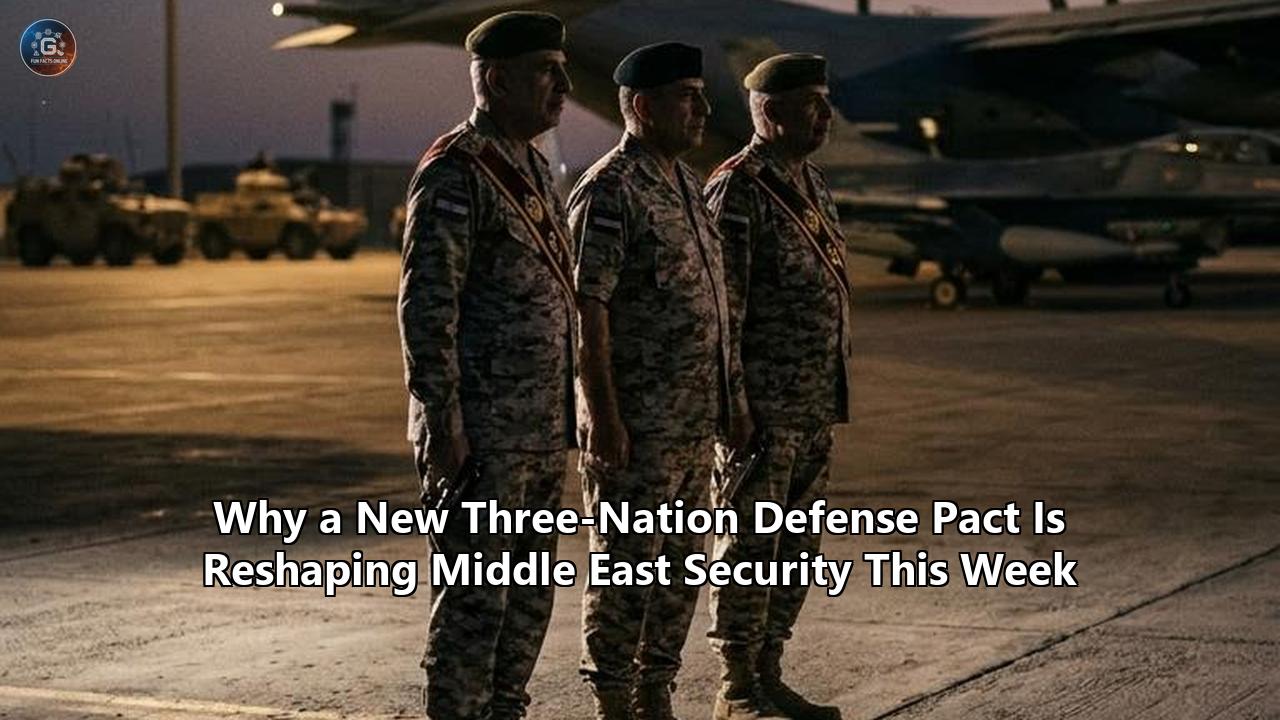
The signing of the Mecca Joint Defence Agreement on August 7, 2026, by Saudi Crown Prince Mohammed bin Salman, Turkish President Recep Tayyip Erdoğan, and Pakistani Prime Minister Shehbaz Sharif marks a decisive restructuring of regional alignment. Executed at the Al-Safa Palace in Islam’s holiest city, the accord commits all three signatory states to treat an armed attack against any single member as an attack against them all. This explicit collective defense clause—invoking the inherent right of individual and collective self-defense under Article 51 of the United Nations Charter—establishes a trilateral alliance that combines Saudi Arabia’s financial and energy dominance, Turkey’s NATO-grade defense industry, and Pakistan’s battle-tested armed forces and nuclear capability.
The agreement builds directly upon the bilateral Strategic Mutual Defence Agreement signed between Riyadh and Islamabad in September 2025. That earlier pact followed a series of destabilizing events across West Asia, including Israeli strikes on targets in Qatar, direct missile exchanges between Western forces and Iran, and renewed Houthi interdiction of Red Sea shipping lanes. By integrating Ankara into this framework, the Mecca Agreement elevates a pair of bilateral military relationships into a structured collective defense system.
This newly established Middle East security pact arrives as regional states reassess the reliability of external security guarantees. Decades of reliance on American military posture in the Persian Gulf have yielded to strategic hedging. Rather than outsourcing national defense to Washington or constructing fragile regional coalitions, the signatories of the Mecca Accord have opted to assemble an indigenous, multi-theater coalition.
                          [ Mecca Joint Defence Agreement ]
                                 (Signed Aug 7, 2026)
                                          |
         +--------------------------------+--------------------------------+
         |                                |                                |
  [ Saudi Arabia ]                 [ Türkiye ]                    [ Pakistan ]
  • Capital & Energy Reserves     • NATO-Grade Industrial Base   • Nuclear Deterrent Umbrella
  • Strategic Geographic Depth    • Advanced EW & Drone Tech     • Battle-Tested Force Mass
  • Religious Legitimacy          • Air & Naval Power            • Deep Military Manpower
The fallout from this tripartite arrangement has created clear divisions across regional capitals. In Tel Aviv and Abu Dhabi, the agreement is viewed with extreme concern, prompting calls for counter-alignments. In Washington and Tehran, officials have sought to publicly minimize its immediate operational impact while privately adjusting their long-term strategic plans.
Exclusionary dynamics are equally revealing: Riyadh’s veto of Egyptian participation highlights deep divisions over how to counter regional instability. The Mecca Agreement demonstrates how regional middle powers are leveraging competing defense technologies, diplomatic doctrines, and industrial models to reshape the Middle Eastern security landscape.
Competing Security Paradigms: Mass and Depth vs. Integrated High-Tech Shields
The Mecca Accord highlights a sharp divergence in how Middle Eastern powers approach national survival. On one side sits the model pursued by Israel, the United Arab Emirates, and the United States: an integrated, network-centric air defense shield relying on high-technology interception, real-time sensor fusion, and targeted bilateral normalization. On the other side is the doctrine embodied by the new Saudi-Turkish-Pakistani alliance: a deterrence model based on territorial mass, deep industrial supply chains, strategic geographic depth, and raw military capacity.
+-----------------------------------+----------------------------------------------------+-----------------------------------------------------+
| Strategic Dimension               | High-Tech Shield Model (UAE / Israel / US)         | Mass & Depth Model (Saudi Arabia / Türkiye / Pak)   |
+-----------------------------------+----------------------------------------------------+-----------------------------------------------------+
| Primary Operational Doctrine      | Sensor-to-shooter fusion, precision interception   | Collective deterrence, deep industrial reserves     |
| Core Systems & Hardware           | Iron Dome, David's Sling, Arrow 3, THAAD, Aegis    | Bayraktar drones, MILGEM frigates, Shaheen-III      |
| Financial & Economic Cost Curve   | High cost per intercept; asymmetric inventory loss | Scalable domestic production; mass-produced munitions|
| Geographic Scope & Footprint      | Compact, high-density infrastructure defense       | Trans-regional depth (South Asia to Anatolia)       |
| Primary Strategic Limitation      | Interceptor depletion during saturation attacks    | C4ISR interoperability across multi-origin force    |
+-----------------------------------+----------------------------------------------------+-----------------------------------------------------+
The Abraham Accords framework and its accompanying Middle East Air Defense (MEAD) initiative were designed around the assumption that modern aerial threats—primarily low-altitude drone swarms, land-attack cruise missiles, and maneuvering ballistic platforms—could be neutralized by linking early-warning radar arrays across Gulf Cooperation Council (GCC) states with Israeli radar sites and U.S. Fifth Fleet assets.
This high-tech umbrella achieved notable tactical successes during air defense engagements over the Red Sea and Persian Gulf throughout late 2025 and early 2026. However, the approach suffers from a fundamental economic and industrial imbalance: the cost-per-interception ratio heavily favors the attacker. Utilizing a $2 million to $3.5 million missile interceptor—such as the SM-2, THAAD, or Arrow 3—to down a $20,000 delta-wing attack drone or a low-cost artillery rocket rapidly exhausts interceptor stockpiles and strains national treasuries during prolonged wars of attrition.
In contrast, the Mecca Agreement’s "Mass and Depth" paradigm reasserts the importance of state scale, standing armies, and sovereign manufacturing capacity. By uniting Turkey, Pakistan, and Saudi Arabia, the alliance links three complementary elements:
- Turkey’s Industrial Backbone: A domestic defense sector capable of mass-producing un-crewed aerial vehicles (UAVs), armored platforms, guided munitions, and electronic warfare suites independent of Western export restrictions.
- Pakistan’s Military Mass: A active-duty military exceeding 650,000 personnel, backed by extensive experience in high-intensity conventional warfare, asymmetric counter-insurgency, and an established nuclear delivery infrastructure.
- Saudi Arabia’s Capital and Depth: Vast financial reserves capable of funding large-scale defense R&D, coupled with physical geographic depth across the Arabian Peninsula and primary control over global energy supplies.
The tradeoffs between these two paradigms are significant. High-tech defense networks offer rapid reaction times and protection for sensitive, highly concentrated economic nodes—such as Dubai's financial centers or Haifa’s ports. Yet they leave host nations vulnerable if an adversary successfully saturates radar guidance systems or forces a prolonged conflict that drains Western supply chains.
The mass-and-depth model offers strong long-term deterrence by signaling to potential aggressors that attacking one member will trigger a response across multiple geographic fronts, supported by a sovereign industrial machine. However, this model faces major operational hurdles. Synchronizing command-and-control protocols among a NATO member (Turkey), a non-NATO major ally reliant on Chinese and Western platforms (Pakistan), and a Gulf nation deploying primarily American and European military hardware presents immense technical challenges.
Competing Regional Responses: Tripartite Alignment vs. The "Hexagon Alliance"
The creation of the Mecca Agreement has triggered immediate counter-moves across West Asia, exposing deep divisions regarding the future of Middle Eastern security architecture. Rather than creating a unified regional consensus, the pact has accelerated the formation of competing diplomatic and military blocs.
             [ REGIONAL SECURITY REALIGNMENT ]
                            |
         +------------------+------------------+
         |                                     |
[ Mecca Agreement Axis ]              [ Hexagon Alignment ]
• Türkiye                             • Israel
• Saudi Arabia                        • Greece / Cyprus
• Pakistan                            • India
                                      • UAE / Abraham Accords
The Signatories: Defense of State Sovereignty
For Riyadh, Ankara, and Islamabad, the trilateral accord represents an explicit effort to defend state sovereignty against both state-sponsored aggression and non-state subversion. Unlike Western-led coalitions that often prioritize regional intervention or regime-change operations, the Mecca partners have aligned their foreign policies around preserving central state authority.
This strategy is evident across multiple conflict theaters:
- Yemen: All three powers support the internationally recognized government against Houthi forces.
- Sudan: They back the Sudanese Armed Forces (SAF) as the legitimate representative of state authority against the Rapid Support Forces (RSF).
- Somalia: They uphold the territorial integrity of Mogadishu against separatist movements in Somaliland.
Turkish President Recep Tayyip Erdoğan outlined this vision during the signing ceremony in Mecca, stating:
"This agreement, based on the principle of collective deterrence, will contribute to cooperation in the fields of security and defense, joint projects in the defense industries, and the fight against terrorism. The agreement is not directed against any country. It is also open to the participation of brotherly countries that share the goal of advancing peace, prosperity, and stability in our region".
The Israeli and Emirati Reaction: The "Hexagon Alliance" Counter-Strategy
In Tel Aviv, the reaction to the Mecca Accord was swift and critical. Senior Israeli security officials expressed grave concern over an alliance that places Turkish defense technology and Pakistani military capacity directly behind Saudi foreign policy.
A senior Israeli official, speaking anonymously to the Ynet news outlet shortly after the Mecca summit, warned:
"The agreement worries us. It is a pact aimed at Israel. We wouldn't be surprised if Egypt joins the Mecca Agreement. It brings hostile forces right to our doorstep".
This anxiety stems from the broader breakdown of Israeli-Turkish diplomatic relations following the Gaza conflict and Ankara's expanding military footprint in the Eastern Mediterranean and Red Sea. In response, Israeli Prime Minister Benjamin Netanyahu accelerated efforts to operationalize what Israeli defense planners term the "Hexagon Alliance". This prospective grouping aims to formally link Israel, Greece, Cyprus, India, and key Abraham Accords signatories—specifically the UAE and Bahrain—into an opposing strategic framework.
+-----------------------------------+----------------------------------------------------+-----------------------------------------------------+
| Strategic Dimension               | Mecca Joint Defence Agreement                      | Proposed Hexagon Alliance                           |
+-----------------------------------+----------------------------------------------------+-----------------------------------------------------+
| Primary Core Axis                 | Riyadh – Ankara – Islamabad                        | Tel Aviv – Abu Dhabi – Athens – New Delhi           |
| Strategic Objective               | Sovereign state defense; Islamic power projection  | Maritime choke-point control; Anti-Iranian defense  |
| Stated Stance on Iran             | Managed containment, direct diplomatic channels    | Max Pressure; Active military counter-structure     |
| Stated Stance on Non-State Actors | Opposes sub-state armed militias (e.g., RSF, STC)  | Flexible pragmatic partnerships with local actors   |
| Primary Strategic Depth           | Anatolia, Arabian Peninsula, South Asia            | Eastern Mediterranean, Red Sea, Indian Ocean        |
+-----------------------------------+----------------------------------------------------+-----------------------------------------------------+
The UAE finds itself in an increasingly complex position. While Abu Dhabi shares Saudi Arabia's concern over Iranian drone and missile threats, it views Riyadh’s new alliance with Turkey and Pakistan as a direct challenge to its own regional ambitions. The Emirati leadership has favored targeted, high-tech defense partnerships alongside strategic investments in sub-state actors to secure maritime choke points—such as the Bab-el-Mandeb Strait and the Horn of Africa.
Saudi Arabia’s insistence on building a broad, sovereign-state defense bloc with Ankara directly opposes Abu Dhabi's strategy. This dynamic has deepened the political rift between Crown Prince Mohammed bin Salman and Emirati President Sheikh Mohamed bin Zayed Al Nahyan.
Iran and the United States: Tactical Downplaying vs. Strategic Realignment
Publicly, both Washington and Tehran have downplayed the Mecca Agreement. Iranian Foreign Ministry Spokesman Esmail Baghaei noted during a press briefing in Tehran that "countries in the region cannot rely on the claim of security provided by the US as in the past". Tehran has framed the deal as a natural consequence of declining American power rather than an immediate anti-Iranian military coalition.
Behind the scenes, however, Iranian military planners are reassessing their regional posture. A collective defense pact uniting Pakistan—Iran’s eastern neighbor—with Turkey and Saudi Arabia creates a formidable Sunni-led military footprint along Iran’s borders. This encirclement restricts Tehran’s ability to project power through regional proxies without risking a broader multi-front confrontation.
                    [ IRAN'S STRATEGIC ENCIRCLEMENT RISK ]
                                       |
    +----------------------------------+----------------------------------+
    |                                  |                                  |
[ Western Flank ]                  [ Southern Flank ]                 [ Eastern Flank ]
• Türkiye                          • Saudi Arabia                     • Pakistan
• NATO-Standard Tech               • Capital & Energy Dominance       • Nuclear & Conventional Force
For the United States, the Mecca Agreement represents a fundamental shift in its role within West Asia. While Washington was not the architect of the deal, U.S. officials recognize that the era of exclusive reliance on American security guarantees has ended. The American role in the Middle East is shifting from an absolute strategic guarantor to a primary hardware provider operating alongside self-directed regional alliances.
Technical and Industrial Hardware Architectures
The operational success of any Middle East security pact ultimately depends on the integration of hardware, software, and real-time intelligence platforms. The Mecca Accord brings together three vastly different military-industrial complexes, each contributing unique capabilities while introducing complex integration challenges.
               [ TRILATERAL HARDWARE & CAPACITY MATRIX ]
                                   |
         +-------------------------+-------------------------+
         |                         |                         |
  [ TÜRKIYE ]                [ PAKISTAN ]             [ SAUDI ARABIA ]
  • Bayraktar Akinci / TB3   • Shaheen-III MRBM       • F-15SA Strike Eagle
  • TF Kaan 5th-Gen Fighter  • JF-17 Block III        • Eurofighter Typhoon
  • Koral EW Suites          • HQ-9/P Air Defense     • Patriot PAC-3 / THAAD
  • MILGEM Frigates          • Battle-Tested Infantry  • Massive Financial Reserves
Turkey: Advanced Unmanned Platforms and Electronic Warfare
Turkey brings a self-sufficient defense-industrial sector designed to operate free from foreign arms embargoes. The Turkish defense industry, led by firms such as Baykar, Turkish Aerospace Industries (TAI), Aselsan, and Roketsan, provides the alliance with cutting-edge un-crewed and electronic warfare capabilities:
- Unmanned Aerial Vehicles (UAVs): The Bayraktar Akinci high-altitude long-endurance (HALE) drone and the carrier-capable TB3 offer precise strike options against mobile targets, equipped with indigenous MAM-L and MAM-C smart micro-munitions.
- Next-Generation Aviation: Ankara's ongoing development of the TAI Kaan 5th-generation stealth fighter offers alliance members an alternative to U.S. F-35 platforms, which remain subject to strict export approvals.
- Electronic Warfare (EW) and Radar: Aselsan’s Koral land-based EW system and airborne jammer suites provide capabilities for suppressing enemy air defenses (SEAD) and degrading adversary radar networks.
- Naval Power Projection: The MILGEM project’s Ada-class and Istanbul-class frigates provide scalable littoral combat capabilities equipped with Atmaca anti-ship missiles.
+-----------------------------------+----------------------------------------------------+-----------------------------------------------------+
| Hardware Category                 | System / Platform Models                           | Strategic Contribution to Alliance                  |
+-----------------------------------+----------------------------------------------------+-----------------------------------------------------+
| Unmanned Strike & ISR             | Bayraktar Akinci, TB3, TAI Anka-3                  | Low-cost precision strikes; real-time surveillance  |
| Ballistic & Cruise Missiles       | Shaheen-III, Babur Cruise Missile, Fateh-II        | Long-range strategic strike; counter-value defense  |
| Tactical Fighter Aviation         | F-15SA, Eurofighter, JF-17 Block III, TAI Kaan     | Multi-role air superiority and deep strike capability|
| Integrated Air & Missile Defense  | Patriot PAC-3, THAAD, HQ-9/P, Hisar-O              | Layered defense against cruise/ballistic missiles   |
| Electronic Warfare & C4ISR        | Aselsan Koral, Airborne Jamming Suites             | Radar suppression, communications disruption        |
+-----------------------------------+----------------------------------------------------+-----------------------------------------------------+
Pakistan: Strategic Ballistic Delivery and Mass Force Structure
Pakistan offers long-range delivery systems, deep conventional warfighting experience, and nuclear ambiguity:
- Strategic Ballistic Systems: The Shaheen-III medium-range ballistic missile (MRBM), with an estimated range of 2,750 kilometers, alongside the Babur land-attack cruise missile, gives the alliance long-range precision-strike capabilities spanning South Asia, Central Asia, and the Middle East.
- Combat Aviation: The JF-17 Block III multi-role fighter, jointly developed with China, features an Active Electronically Scanned Array (AESA) radar, helmet-mounted displays, and integration with PL-15 beyond-visual-range (BVR) air-to-air missiles.
- Air Defense Infrastructure: The Chinese-origin HQ-9/P long-range air defense system provides high-to-medium altitude interception capabilities complementary to Western platforms.
- The Nuclear Umbrella Question: While Pakistani officials maintain that their strategic nuclear arsenal remains strictly dedicated to national defense against India, the country's formal inclusion in a mutual defense pact introduces a powerful element of strategic ambiguity. Potential aggressors must calculate whether an attack on Riyadh or Ankara could trigger a escalation involving a nuclear-armed power.
Saudi Arabia: Advanced Western Hardware and Capital Allocation
Saudi Arabia contributes high-end Western aerospace hardware backed by deep financial reserves:
- Air Superiority Fleets: The Royal Saudi Air Force operates advanced tactical aircraft, including 84 F-15SA Strike Eagles and 72 Eurofighter Typhoons, equipped with modern targeting pods and precision-guided weapons.
- Integrated Air Defense: Riyadh fields a robust air defense network consisting of U.S. MIM-104 Patriot PAC-3 MSE batteries and Terminal High Altitude Area Defense (THAAD) systems, offering proven protection against short- and medium-range ballistic missiles.
- Industrial Capital Injection: Through Saudi Military Industries (SAMI), the Kingdom provides the financial resources required to co-produce, scale, and accelerate joint technology programs with Turkish and Pakistani defense firms.
The Technical Interoperability Challenge
The main operational obstacle facing the Mecca Accord signatories lies in C4ISR (Command, Control, Communications, Computers, Intelligence, Surveillance, and Reconnaissance) fusion.
                       [ C4ISR INTEGRATION BARRIERS ]
                                     |
    +--------------------------------+--------------------------------+
    |                                |                                |
[ Türkiye (NATO) ]          [ Saudi Arabia (US) ]         [ Pakistan (Non-NATO) ]
• Tactical Link 16          • Link 16 & US Protocols      • Non-NATO Data Links
• Strict ITAR / NATO Rules  • Foreign Military Sales Rules• Chinese/Indigenous Tech
Integrating Turkish NATO-standard Link 16 tactical data networks with Saudi Arabia’s American-supplied platforms and Pakistan’s non-NATO data links requires custom software interfaces and dedicated bridging hardware. Without seamless data sharing, the alliance risks operational delays during fast-moving aerial engagements or missile saturation attacks.
Diplomatic Friction and Exclusions: The Egyptian Dilemma and the UAE Rift
The diplomatic maneuvering surrounding the Mecca summit was as defined by who was absent as by who was present. In the days preceding the August 7 signing, Turkish Foreign Minister Hakan Fidan pushed to expand the trilateral agreement to include Egypt, aiming to establish a four-nation Sunni heavyweight alliance.
                     [ THE EGYPTIAN INCLUSION DEBATE ]
                                     |
         +---------------------------+---------------------------+
         |                                                       |
[ Türkiye's Proposal ]                                  [ Saudi Arabia's Veto ]
• Include Cairo to form 4-nation bloc                   • Opposed Egyptian inclusion "for now"
• Add Egypt's large standing army                       • Frustrated by Cairo's economic management
• Balance North African security interests               • Disapproved of Egypt-UAE alignment
However, Saudi Arabia firmly rejected Cairo's inclusion. According to Saudi diplomatic sources, Riyadh opposed Egyptian participation due to growing frustration with President Abdel Fattah el-Sisi’s economic policy and Cairo’s close relationship with the United Arab Emirates—a nation increasingly viewed by Saudi Arabia as a primary regional competitor.
Riyadh judged that Cairo’s inclusion would add little immediate operational value while risking diplomatic friction and political gridlock within the strategic command structure.
+-----------------------------------+----------------------------------------------------+-----------------------------------------------------+
| Geopolitical Actor                | Strategic Stance on the Mecca Accord               | Key Driver of Foreign Policy                        |
+-----------------------------------+----------------------------------------------------+-----------------------------------------------------+
| Saudi Arabia                      | Lead Architect & Sponsor                           | Autonomous security; counter-proxy containment       |
| Türkiye                           | Co-Lead & Technology Provider                      | Industrial arms exports; regional power projection  |
| Pakistan                          | Co-Lead & Strategic Shield Provider                 | Middle East integration; economic & defense backing |
| Egypt                             | Non-aligned; Excluded by Saudi Veto                | Financial balance; preserving US & UAE ties         |
| United Arab Emirates              | Highly Skeptical / Rival Alignment                 | Maritime control; supporting sub-state actors       |
| Israel                            | Opposed / Alarmed                                  | Countering Turkish & Pakistani power projection     |
+-----------------------------------+----------------------------------------------------+-----------------------------------------------------+
For Egypt, this exclusion highlights a diplomatic balancing act. Cairo ultimately avoided being forced to choose between the Ankara-Riyadh-Islamabad bloc and its primary financial benefactors in Abu Dhabi and Washington. Joining the Mecca Pact would have strained Egypt’s relationships with the UAE and Israel while risking U.S. Congressional holds on foreign military financing. By remaining outside the accord, Egypt retains its role as an independent diplomatic mediator in North Africa and Gaza, though it risks marginalization as regional security decisions shift toward the Mecca signatories.
The broader schism between Saudi Arabia and the UAE highlights how the Middle East security pact is reshaping Gulf politics. The fundamental disagreement over state-centric versus sub-state security strategies has fractured the once-unified GCC foreign policy stance.
While Saudi Arabia uses its financial resources and religious weight to anchor coalitions with major regional states, the UAE continues to build focused, high-tech networks linking Abu Dhabi with Western arms manufacturers, Indian markets, and Israeli technology firms. This structural rivalry will likely define Red Sea and Persian Gulf diplomacy for years to come.
Great Power Realignments: Washington, Beijing, and Moscow
The formation of the Mecca Agreement reflects the global transition toward multipolarity. Major external powers—the United States, China, and Russia—are recalibrating their strategic policies in response to this middle-power defense bloc.
                     [ GREAT POWER DYNAMICS & RESPONSES ]
                                       |
    +----------------------------------+----------------------------------+
    |                                  |                                  |
[ United States ]                  [ China ]                          [ Russia ]
• Shift from Guarantor to Merchant • Secures BRI & Gulf Oil Flow      • Capitalizes on NATO Friction
• Hub-and-Spoke Model Broken       • Welcomes Regional Self-Reliance  • Expands Arms Sales Opportunities
• Maintains High-End Hardware Sales• Avoids Direct Security Guarantees• Exploits Western Supply Delays
The United States: From Exclusive Guarantor to Primary Hardware Merchant
For decades, U.S. strategy in the Middle East operated on a bilateral "hub-and-spoke" system. Washington maintained separate, individual security commitments with Gulf monarchies, Israel, and Egypt, positioning itself as the indispensable security mediator. The Mecca Accord challenges this structure by establishing an independent, self-directed defense alliance operating outside Washington's control.
The U.S. position has adjusted accordingly:
- Strategic Realism: Recognizing its limited leverage to block the agreement, Washington has adopted a pragmatic approach, treating the Mecca alliance as a complementary framework for regional stability.
- Defense Trade Focus: The U.S. role is shifting toward acting as an advanced equipment provider, focusing on sales of high-end aerospace and air defense systems like F-35s, F-15SAs, and THAAD batteries.
- Loss of Veto Power: American policymakers can no longer dictate regional security terms or easily block third-party defense agreements by threatening to withdraw U.S. forces.
China: Economic Security Without Military Commitments
Beijing views the Mecca Accord through the lens of energy security and infrastructure protection:
- Protecting Energy Imports: As the world's largest importer of Persian Gulf crude, China benefits from a stable security framework capable of safeguarding energy infrastructure and maritime trade routes.
- Integrating BRI Infrastructure: The alliance links core nodes of the Belt and Road Initiative (BRI), bridging the China-Pakistan Economic Corridor (CPEC) with Gulf ports and Turkish logistics corridors into Europe.
- Avoiding Military Entanglements: China retains its non-aligned diplomatic posture, expanding defense exports—such as the HQ-9/P systems and wing-loong drones—without taking on binding regional security obligations.
Russia: Exploiting NATO Friction and Strategic Flexibility
Moscow sees both opportunity and risk in the new trilateral alliance:
- Exploiting NATO Disunity: Turkey’s co-leadership of an independent defense pact alongside non-NATO powers highlights growing strategic divergence within NATO, offering Russia diplomatic leverage.
- Balanced Multipolarity: While Moscow maintains a strategic partnership with Tehran, it values balanced relations with Riyadh and Ankara to manage global oil markets through OPEC+.
- Alternative Defense Markets: As Western defense suppliers prioritize domestic inventory, Russia seeks opportunities to supply specialized sub-systems, raw materials, and joint energy projects to the Mecca partners.
Operational Trade-Offs and Risks of Escalation
While the Mecca Joint Defence Agreement provides collective deterrence, it introduces operational trade-offs and political risks that could drag its signatories into unwanted regional conflicts.
                      [ ALLIANCE RISKS & TRADEOFFS ]
                                     |
    +--------------------------------+--------------------------------+
    |                                |                                |
[ Entanglement Risk ]        [ Operational Gaps ]            [ Economic Burden ]
• Dragged into Border Disputes• C4ISR Interoperability Flaws  • Mass Manufacturing Costs
• Escalation via Proxies      • Command Structure Gridlock    • Resource Diversion from R&D
Deterrence versus Entanglement
The primary benefit of a collective defense clause—deterring potential aggressors through the threat of a multi-front response—is also its greatest vulnerability. Under Article 5-style provisions, a localized military crisis involving one member state risks escalating into a wider conflict:
- The South Asian Vulnerability: If hostilities break out along the Line of Control between Pakistan and India, Islamabad could press its allies for diplomatic, economic, or logistical backing under the Mecca Agreement. Such a scenario would place Saudi Arabia and Turkey in direct opposition to New Delhi, jeopardizing major trade relations.
- Red Sea Escalation: Renewed missile or drone strikes by Houthi forces against Saudi energy facilities could obligate Turkish naval combatants and Pakistani air defense units to deploy directly to the Southern Red Sea, risking open friction with regional proxy networks.
- Eastern Mediterranean Clashes: Turkish naval disputes in the Aegean or Eastern Mediterranean could test Saudi Arabia's willingness to extend diplomatic or logistical cover to Ankara in disputes involving European states.
Industrial Burden and Supply Chain Risks
Building indigenous defense self-reliance requires long-term capital commitment. While Saudi Arabia possesses deep financial resources, converting capital into real military production requires years of technology transfer, workforce training, and infrastructure buildout.
Dependencies on critical sub-components—such as advanced microprocessors, radar transceivers, and specialized alloys sourced from Western or East Asian suppliers—leave the alliance's production lines vulnerable to external sanctions or global trade disruptions.
+-----------------------------------+----------------------------------------------------+-----------------------------------------------------+
| Risk Category                     | Threat Vector                                      | Potential Impact on Alliance                        |
+-----------------------------------+----------------------------------------------------+-----------------------------------------------------+
| Strategic Entanglement            | Localized conflict trigger (e.g., Kashmir, Red Sea)| Unintended escalation; economic disruption          |
| Technological Supply Vulnerability| Component export holds (microchips, specialized alloys)| Bottlenecks in drone/missile manufacturing lines   |
| Command Friction                  | Divergent political priorities during crisis       | Decision-making delay; strategic paralysis          |
| Operational Interoperability      | Incompatible C4ISR architectures and data links    | Friendly-fire risks; delayed air defense response   |
+-----------------------------------+----------------------------------------------------+-----------------------------------------------------+
Future Trajectory: Unresolved Questions and Strategic Milestones
As the signatories move from signing the agreement to practical implementation, the coming months will test whether this trilateral Middle East security pact can evolve into a functional defense system or remain a symbolic arrangement.
                  [ FUTURE TIMELINE & STRATEGIC MILESTONES ]
                                       |
    +----------------------------------+----------------------------------+
    |                                  |                                  |
[ Late 2026 ]                      [ Early 2027 ]                     [ Late 2027+ ]
• Joint Trilateral Exercises       • Operational Integration          • Industrial Expansion
• Establishing Joint Command HQ    • Shared Early-Warning Networks    • Co-Development Programs
Key Milestones to Watch
- Establishment of a Joint Command Center: Observers will closely monitor whether the three nations establish a permanent, integrated military headquarters—likely in Riyadh or Jeddah—with dedicated staff officers from all three armed forces.
- Trilateral Military Exercises: Scheduled joint drills in late 2026 across the Arabian Sea and Saudi Arabian airspace will serve as an initial test for air-defense interoperability, joint naval interdiction, and shared command protocols.
- C4ISR and Radar Integration: The technical integration of Turkish electronic warfare assets, Saudi Patriot interceptors, and Pakistani early-warning radars will reveal the extent of operational readiness.
- Defense Co-Development Contracts: Formal agreements transferring Turkish aviation technology and Pakistani ballistic expertise to Saudi manufacturing hubs will measure the alliance's progress toward industrial self-sufficiency.
+-----------------------------------+----------------------------------------------------+-----------------------------------------------------+
| Strategic Milestone               | Expected Horizon                                   | Operational Indicator                               |
+-----------------------------------+----------------------------------------------------+-----------------------------------------------------+
| Joint Military Command HQ         | Q4 2026                                            | Permanent staffing in Riyadh; shared intelligence   |
| Combined Defense Drills           | Q1 2027                                            | Live-fire maritime and air defense exercises        |
| Integrated Radar Data-Sharing     | Q2 2027                                            | Real-time early warning feeds across Arabian Sea    |
| Industrial Co-Production Expansion| Q3 2027+                                           | Saudi-based assembly lines for Turkish drones       |
+-----------------------------------+----------------------------------------------------+-----------------------------------------------------+
Unresolved Questions
- Can the Accord Survive Major Political Transitions?
The Mecca Agreement was driven by the close personal alignment of Crown Prince Mohammed bin Salman, President Recep Tayyip Erdoğan, and Prime Minister Shehbaz Sharif. Whether the pact can endure political leadership changes in Ankara or Islamabad remains an open question.
- Will Secondary Powers Join the Alliance?
While Egypt’s entry was blocked, other regional states—including Oman, Qatar, Jordan, or Sudan’s central government—may seek formal observer status or specialized security agreements under the Mecca framework to hedge against regional uncertainty.
- How Will Israel and the UAE Counter the Pact?
As the Mecca alliance consolidates, Israel and the UAE may accelerate efforts to convert the "Hexagon Alliance" from a political concept into an operational security architecture, formalizing a two-bloc system across West Asia.
The signing of the Mecca Joint Defence Agreement marks a clear departure from the historical security arrangements of the Middle East. By uniting capital, military force, and defense-industrial capability into a sovereign collective defense system, Saudi Arabia, Turkey, and Pakistan have established a powerful new center of gravity in regional security. How this tripartite alliance navigates operational challenges, regional rivalries, and major-power relationships will determine the stability of West Asia and South Asia for years to come.
Reference:
- https://mecouncil.org/blog_posts/what-is-the-mecca-joint-defense-pact-and-what-it-is-not/
- https://breakingdefense.com/2026/08/saudi-arabia-turkey-pakistan-ink-joint-defense-agreement/
- https://en.wikipedia.org/wiki/Mecca_Joint_Defence_Agreement
- https://www.youtube.com/watch?v=YFghUw4_3ls
- https://mondoweiss.net/2026/08/the-mecca-pact-is-the-latest-sign-of-the-u-s-s-declining-influence-in-the-middle-east/
- https://globalaffairs.org/commentary/analysis/gulfs-new-nato
- https://www.timesofisrael.com/mecca-defense-pact-isnt-meant-to-challenge-israel-at-least-not-on-the-battlefield/
- https://www.middleeasteye.net/news/how-mecca-agreement-aims-manage-us-separation-middle-east-region
- https://www.orfonline.org/expert-speak/a-new-axis-in-west-asia-reading-the-new-saudi-turkish-pakistani-defence-pact
- https://www.middleeasteye.net/news/saudi-arabia-opposed-egypts-inclusion-mecca-agreement-sources-say
- https://southasiajournal.net/post/west-asia/61579/the-defense-pact-formation-of-new-strategic-triangle
- https://www.atlanticcouncil.org/dispatches/why-saudi-arabia-pakistan-and-turkey-just-signed-a-defense-pact/
- https://www.cbsnews.com/news/saudi-arabia-turkey-pakistan-defense-agreement/
- https://www.jpost.com/international/article-904851
- https://www.kurdistan24.net/en/story/930977/saudi-arabia-turkey-pakistan-sign-trilateral-defense-pact-in-mecca
- https://www.semafor.com/article/08/10/2026/egypt-could-be-the-latest-addition-to-the-mecca-defense-pact