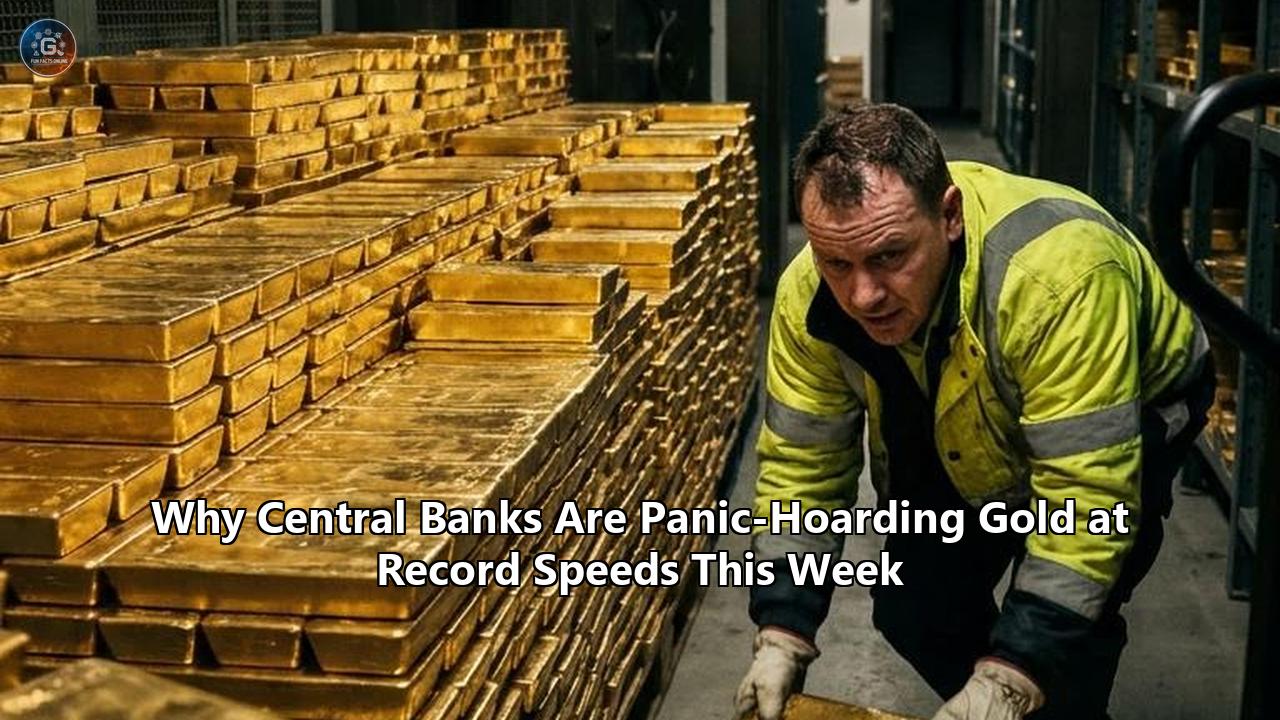
The World Gold Council’s latest operational figures show official net purchases surging past 289 tonnes in the second quarter alone—a fivefold acceleration over early-year accumulation rates—with August and September tracking a relentless, multi-jurisdiction scramble for physical metal. The aggressive pace continued this week as bilateral trade settlement data and IMF reserve filings confirmed that sovereign buyers have systematically absorbed more than 1,000 metric tonnes of physical gold annually for four consecutive years.
This institutional panic-buying is not an ordinary hedge against consumer price inflation. Instead, it marks an orchestrated exit from Western reserve assets.
Speaking on a panel in Sorrento on Monday, Bank of Italy Deputy Governor Sergio Nicoletti Altimari stated plainly what reserve managers have privately acknowledged for quarters: "Gold is a safe haven asset, probably the safe haven asset, as proven by its performance over time and across a broad range of crises". Altimari emphasized that the role of physical bullion has become existential in an environment marked by aggressive geopolitical risk, weaponized payment networks, and severe economic fragmentation.
Alongside him, Deutsche Bundesbank President Joachim Nagel acknowledged that while 10-year US Treasury yields remain elevated above 5%, the traditional market model has completely broken down. Central banks are no longer treating sovereign debt as risk-free. Nagel pointed directly to the acute credit and counterparty risks stemming from unprecedented government debt loads in the developed world, explicitly validating gold as an essential asset alongside sovereign paper.
The result is a dislocation that classical financial economics insists should not exist: spot gold has remained anchored well above $4,000 an ounce even as global sovereign bond yields sit near multi-decade peaks. The old mechanics governing the opportunity cost of holding non-yielding metal have ceased to apply. What the market is witnessing this week is not a cyclical rebalancing, but a run on paper reserves by the very institutions tasked with safeguarding national wealth.
The Scale of the Hoard: Deconstructing the 2026 Official Buying Surge
The velocity of official sector purchases over recent months has caught bullion clearinghouses off guard. According to compiled transaction logs, customs filings, and balance-sheet updates from the International Monetary Fund (IMF), central banks accounted for an unprecedented share of total global physical gold demand.
The second quarter’s net purchase figure of 289 tonnes marked a 62% increase over the same period last year, driven by an aggressive mix of emerging market accumulation and a return of European buyers. While reported net purchases reached 39 tonnes in August, analysts tracking trade discrepancies note that actual official absorption is significantly higher.
Official Central Bank Net Gold Purchases (Historical vs. Current Run-Rate)
-------------------------------------------------------------------------
2010–2021 Average:       ~450–500 tonnes / year
2022:                    1,082 tonnes / year
2023:                    1,037 tonnes / year
2024:                    1,045 tonnes / year
2025:                    1,020 tonnes / year
2026 (YTD Annualized):   >1,000 tonnes / year pace (Q2 Print: 289 tonnes)
The data confirms a structural divergence between reported official figures and actual vaulted metal movements. Sovereign buyers are increasingly deploying non-disclosed transactional pathways—relying on state investment funds, sovereign wealth conduits, commercial banks, and direct off-market purchases from domestic mining entities—to accumulate metal without triggering price spikes on the New York Mercantile Exchange (COMEX) or the London Over-the-Counter (OTC) markets.
The World Gold Council’s definitive survey of reserve managers underscores the depth of this shift: 89% of participating central banks expect global official holdings to increase over the next 12 months, while an unprecedented 45% stated that their own institutions intend to aggressively expand their physical allocation.
The underlying motive is clear: central banks gold reserves are being rebuilt to levels of systemic dominance last witnessed prior to the 1971 closing of the gold window. Across the globe, official institutions have expanded gold’s share of total foreign exchange reserves from an average of 14% two years ago to more than 25% today, driven both by relentless volume accumulation and dramatic price appreciation.
Country-by-Country: Who Is Leading the Bullion Run?
The panic-buying dynamic is not monolithic; it divides into distinct geopolitical blocs, each executing a targeted strategy to decouple from foreign exchange vulnerabilities.
Key Central Bank Buyers and Reserve Allocation (2026 Official Filings)
=============================================================================
Country / Central Bank         2026 Purchases (YTD)   Total Gold Reserves   Gold % of Reserves
-----------------------------------------------------------------------------
Poland (National Bank of Poland)      ~90 tonnes            640 tonnes            ~28%
People's Bank of China (PBoC)*        ~80 tonnes          2,387+ tonnes           ~9%
Uzbekistan (Central Bank)             ~50 tonnes            439 tonnes            ~90%
Kazakhstan (National Bank)            ~36 tonnes            377 tonnes            ~79%
Czech Republic (Czech National Bank)  ~18 tonnes             52 tonnes            ~18%
India (Reserve Bank of India)         ~45 tonnes            850+ tonnes           ~10%
=============================================================================
*Note: Unofficial institutional estimates suggest China's actual sovereign gold
reserves exceed 5,000 tonnes when accounting for domestic mining absorption and SAFE accounts.
Poland: The Eastern Flank Fortress
The National Bank of Poland (NBP) has emerged as the single most aggressive official buyer in the Western alliance. Under Governor Adam Glapiński, the NBP added another eight tonnes in July and an estimated 12 tonnes across August and September, bringing its cumulative 2026 purchases near 90 tonnes and total holdings to 640 tonnes.
Glapiński’s stated objective is unequivocal: lift gold to 30% of Poland’s total reserve portfolio and push national vaults toward a 700-tonne strategic inventory. Positioned on NATO’s eastern border adjacent to the Ukraine theater, Warsaw views bullion not as an investment asset, but as national sovereignty collateral. In an official strategy update, Glapiński noted that a nation armed with massive physical gold reserves commands respect, guarantees sovereign credit ratings, and secures trade viability even under conditions of catastrophic regional conflict.
China: The Strategic De-Dollarization Leviathan
The People's Bank of China (PBoC) extended its official buying streak to 22 consecutive months in August, adding 20 tonnes in that month alone and bringing year-to-date reported accumulation to 80 tonnes. Officially, Beijing reports 2,387 tonnes of gold, representing roughly 9% of its total foreign exchange reserves.
However, market participants and intelligence analysts treat China’s official filings as a fraction of reality. Non-monetary gold imports into China crossed 1,000 metric tonnes during the first seven months of the year—a 78% year-on-year surge despite local prices trading at historic premiums.
Analysis from BMO Capital Markets and sovereign trade monitors indicates that when factoring in domestic mine production—which is mandated by law to remain within China—and the off-balance-sheet purchases conducted by the State Administration of Foreign Exchange (SAFE), China’s true sovereign gold stockpile likely surpasses 5,200 tonnes.
Speaking at the LBMA conference, Zeng Hui, Vice President of the Shanghai Gold Exchange, detailed a fundamental transformation inside the world’s largest bullion market: Chinese domestic demand is no longer led by seasonal retail jewelry buyers. It has shifted irreversibly toward institutional allocations, sovereign reserve building, and investment-grade bars and coins. Beijing is systematically insulating its balance sheet from potential Western sanctions, liquidating US Treasury bills in favor of unencumbered physical metal settled directly on the Shanghai Gold Exchange.
The Central Asian Accumulators: Uzbekistan and Kazakhstan
Central Asia has developed into an economic fortress of physical bullion. The Central Bank of Uzbekistan bought eight tonnes in August alone, bringing its 2026 accumulation to 50 tonnes and lifting gold to roughly 90% of its total sovereign reserves. Kazakhstan followed a parallel trajectory, adding seven tonnes in August to reach 36 tonnes on the year, with gold now comprising 79% of its foreign reserves.
For these mineral-rich nations, swapping extracted commodities for Western paper sovereign debt makes no sense when the issuing nations of those fiat currencies face mounting structural deficits and geopolitical tensions.
The Czech Republic: 41 Consecutive Months of Accumulation
Within the European Union, the Czech National Bank (CNB) has provided a clinic in deliberate reserve transformation. The CNB has expanded its gold reserves for 41 consecutive months.
Led by Governor Aleš Michl, the Czech central bank has pursued an aggressive long-term trajectory to raise its holdings to 100 tonnes, explicitly stating that a modern European central bank cannot navigate the current era of structural inflation and monetary fragmentation without a robust, physically owned anchor asset that carries zero default risk.
India’s Strategic Vault Repatriation
The Reserve Bank of India (RBI) has accelerated a two-pronged strategy: steady domestic buying and aggressive international repatriation. The RBI has added dozens of tonnes to its reserves this year, pushing total official holdings above 850 tonnes.
Crucially, India has engaged in the largest logistical bullion transfer in its modern history, pulling more than 100 metric tonnes of physical gold bars out of the Bank of England’s underground vaults in London and flying them via specialized transport aircraft directly into high-security vaults in Mumbai and Nagpur. The message from New Delhi is unmistakable: counterparty trust in Western storage facilities is waning; in a systemic crisis, sovereign gold must reside within sovereign borders.
The Unprecedented Re-Entrants: South Korea
Even long-dormant monetary authorities are breaking decade-long silences. The Bank of Korea entered the market with an allocation of roughly $250 million to gold-backed exposure, marking its first active increase in gold reserve positioning in 13 years. While modest in absolute tonnage, the move by an East Asian central bank deeply integrated with the US dollar system signals that anxiety surrounding reserve preservation has permeated traditional Western allies.
The Yield Anomaly: Why Central Banks Are Defying 5.3% Treasury Yields
The central mystery dominating fixed income desks this week is why reserve managers are willing to bypass risk-free yields on sovereign debt to hoard non-yielding metal.
For seven decades, the foundational axiom of reserve management was clear: Gold pays no yield; sovereign bonds do. Under this framework, gold’s price moved in lockstep with the inverse of real interest rates, calculated via 10-year US Treasury Inflation-Protected Securities (TIPS) yields. When real yields were negative or deeply depressed, holding non-yielding physical gold was an acceptable trade-off. When real yields spiked toward 2% or nominal yields held firm above 5%, capital moved decisively back into interest-bearing paper claims, driving gold lower.
Historical Model vs. 2026 Reality
-----------------------------------------------------------------------------
Traditional Dynamic:   US Treasury Yields Rise  ==> Opportunity Cost Rises ==> Gold Drops
2026 Reality:          10Y Treasuries at ~5.3%  ==> Central Bank Buying Accelerates ==> Gold Surges >$4,000/oz
The historical model has detached entirely from reality. The US 10-year Treasury note yields approximately 5.3%. Under traditional models, gold prices should be tumbling toward historic support levels. Instead, gold trades at record highs above $4,000 an ounce, supported by an unyielding institutional bid.
At the LBMA summit in Sorrento, Joachim Nagel of the Bundesbank addressed this dynamic directly. While acknowledging that rising nominal yields increase the mathematical appeal of bonds on paper, Nagel emphasized that reserve managers must balance yield against the catastrophic credit risks of out-of-control public debt.
The distinction boils down to a fundamental tenet of financial survival: the difference between return on capital and return of capital.
George Cheveley, portfolio manager at global asset manager Ninety One, noted this week that central banks have fundamentally revised their risk algorithms. "Gold has several characteristics that remain attractive to central banks: it is highly liquid, acts as a long-term inflation hedge and, critically, does not carry another country's credit risk," Cheveley observed.
Reserve managers are no longer optimizing their portfolios for incremental quarter-over-quarter carry yield. They are optimizing for structural solvency. When an asset manager holds a US Treasury, a German Bund, or a Japanese Government Bond, they are holding a digital legal claim issued by a foreign sovereign with an ever-expanding debt profile. When a central bank holds an allocated 400-ounce Good Delivery gold bar within its own vault, it holds a terminal monetary asset that is no one else’s liability, cannot be debased by central bank balance sheet expansion, and cannot be frozen by an executive order from a foreign capital.
The Weaponization of the US Dollar and Sovereign Contagion
To identify the precise catalyst of this institutional panic, one must look to February 2022, when the United States, the European Union, and their G7 allies enacted the most radical monetary measure since World War II: the freezing of more than $300 billion in sovereign foreign exchange reserves belonging to the Central Bank of the Russian Federation (CBR).
Prior to that moment, foreign exchange reserves were viewed as untouchable sovereign assets protected by customary international law and central bank immunity. By freezing Russia’s euro and dollar accounts overnight, Western governments crossed a monetary Rubicon.
The escalation reached its climax when the G7 formalized agreements to use the interest and direct profits generated by those frozen Russian assets to service large-scale military and reconstruction loans for Ukraine. In the eyes of central bankers outside the G7 orbit, this was not merely an administrative freeze; it was sovereign expropriation.
The geopolitical reverberations across emerging markets and non-aligned states were immediate:
- The Weaponization Precedent: If the sovereign reserves of a nuclear power and permanent UN Security Council member could be frozen overnight, no nation holding dollars or euros in foreign custody is entirely secure.
- The Secondary Sanctions Threat: The rapid deployment of the Office of Foreign Assets Control (OFAC) sanctions, asset freezes, and SWIFT messaging exclusions demonstrated that access to the dollar payments architecture is contingent on geopolitical alignment with Washington.
- The Flight to Neutral Assets: Foreign reserve managers recognized that holding reserves in Western currencies turned their sovereign balance sheets into geopolitical vulnerabilities.
The data proves how radically reserve behaviors adapted. In the decade preceding 2022, global central banks purchased an average of 450 to 500 tonnes of gold per year. Since 2022, that run-rate has doubled to well over 1,000 tonnes annually.
Non-aligned nations across the Middle East, Asia, and Latin America realized that there is only one reserve asset that completely bypasses the Western banking jurisdiction: physical gold bullion held on domestic soil or within politically uncompromised jurisdictions. By holding physical metal, a nation ensures that no foreign government can unilaterally freeze its liquidity or seize its wealth with a keystroke in New York (Fedwire) or Brussels (Euroclear).
Fiscal Dominance: The G7 Debt Trap and the $36 Trillion Reality
Beyond geopolitical sanctions, a second, equally potent driver is pushing central banks into gold: the structural deterioration of G7 public balance sheets, led by the United States.
The numbers defining the US fiscal position have broken beyond sustainable peacetime baselines:
- Total Gross National Debt: Exceeds $36 trillion.
- Annual Deficit Spending: Running at an structural rate of $1.8 to $2.2 trillion annually, regardless of economic cycle.
- Net Interest Costs: Has crossed $1.1 trillion annually, consuming more capital than the entire annual US national defense budget and approaching 20% of all federal tax revenues.
- Debt-to-GDP Ratio: Elevated above 120%, with Congressional Budget Office projections tracking a relentless ascent toward 140% over the coming decade.
Reserve managers are students of monetary history. They understand the doctrine of fiscal dominance—the economic tipping point where the size of government debt makes it mathematically impossible for the central bank to maintain higher interest rates without causing sovereign default or catastrophic banking failures.
The Fiscal Dominance Feedback Loop
=============================================================================
1. Sovereign Debt Climbs ($36T+) ==> Interest Expense Surges ($1.1T/yr)
2. Higher Rates Crush the Treasury ==> Central Bank Forced to Re-Expand Liquidity
3. Long-Term Currency Debasement Becomes Inevitable
4. Central Banks Exit Paper Claims ==> Hoard Physical Gold Bullion
=============================================================================
Under fiscal dominance, the issuing central bank has only three historical solutions: outright default, severe real-economy austerity, or monetary inflation via financial repression and deficit monetization.
Outright default is politically off the table. Real-economy austerity is politically unviable across Western democracies facing deep domestic divisions. That leaves only one mathematical outcome: the long-term debasement of the currency. The Federal Reserve, whether over a two-year or ten-year horizon, will ultimately be forced to cap yields, lower real interest rates below the rate of inflation, and monetize fiscal deficits to keep the sovereign solvent.
Foreign reserve managers holding trillions in US paper are executing a simple mathematical calculation. If the terminal destination of the US dollar is debasement to service unpayable sovereign obligations, continuing to store a nation’s sovereign savings exclusively in dollar-denominated debt is a dereliction of fiduciary duty.
This dynamic is accelerating the structural reallocation of central banks gold reserves. Central bankers are replacing fixed-income claims that face guaranteed purchasing-power erosion with an unprintable monetary asset that has survived every sovereign default cycle for five millennia.
The Vault Shift: The Scramble for Physical Repatriation
The surge in gold accumulation is accompanied by a massive physical movement of metal: sovereign gold repatriation.
For half a century, the infrastructure of the global gold market was built on convenience. Central banks kept their gold vaulted in London at the Bank of England or in New York at the Federal Reserve Bank of New York. This centralization allowed reserve managers to execute rapid liquidity operations, lease their gold out to bullion banks for yield, settle transactions quickly via book-entry ledger updates, and maintain immediate access to the deepest foreign exchange markets.
That model of trust is collapsing. Central banks have increasingly demanded the physical return of their bars.
Major Repatriation Initiatives of the Modern Era
-----------------------------------------------------------------------------
Germany (Bundesbank):        Repatriated 674 tonnes from New York and Paris
Netherlands (DNB):           Repatriated over 100 tonnes to Amsterdam
Poland (NBP):                Repatriated 100+ tonnes from London; continuing
India (RBI):                 Repatriated 100+ tonnes from Bank of England (2024-2026)
African Sovereign Mandates:  Ghana, Nigeria, Zimbabwe mandating domestic storage
                             and local currency bullion backstops
The distinction between allocated physical gold held domestically versus unallocated custody claims held abroad has become a primary policy divide. When a central bank holds unallocated gold in an overseas institution, it essentially holds a general credit claim against that custodian. In peacetime, that claim is reliable. In an era of secondary sanctions, capital controls, and geopolitical embargoes, foreign custody represents an unacceptable point of failure.
This shift has created massive logistical friction. Transferring hundreds of tonnes of physical bullion is a complex, high-risk military-grade operation. Transporting 100 tonnes of gold requires specialized high-security air convoys, custom-built vaulting aircraft, specialized logistics underwriters at Lloyd's of London, and heavy armed escorts.
The fact that central banks like the Reserve Bank of India are paying tens of millions of dollars in freight, insurance, and security costs to physically move metal back home proves that this is not an academic exercise. Sovereign authorities are actively preparing their balance sheets for a world where global clearing systems could be severed.
The Shadow Architecture: Alternative Settlement, mBridge, and Bilateral Trade
Central bank hoarding of physical bullion does not exist in an economic vacuum. It is deeply integrated into an emergent, parallel architecture designed to bypass the Western petrodollar and SWIFT banking rails.
For decades, the US dollar served as the unchallenged global transaction intermediary because oil, metals, and agricultural goods were priced exclusively in greenbacks. That monopoly is rapidly eroding. Over the past 36 months, an expanding volume of international commodity trade has been settled outside the dollar:
- China and Saudi Arabia executing bilateral non-dollar hydrocarbon trades.
- Russia, India, and China settling energy transactions in rubles, yuan, and rupees.
- Cross-border pilot platforms like Project mBridge—a multi-central bank digital currency platform developed by the Bank for International Settlements (BIS) alongside the central banks of China, Thailand, the UAE, and Saudi Arabia—demonstrating instantaneous peer-to-peer foreign exchange settlement without passing through New York clearing banks.
The Bilateral Settlement Liquidity Bottleneck
-----------------------------------------------------------------------------
Problem: Country A exports oil to Country B. Country A receives Country B's soft
         currency, but does not want to accumulate it due to inflation/capital controls.
Old Solution: Settle in US Dollars via SWIFT and hold US Treasury bills.
New Solution: Clear net trade imbalances using physical gold or tokenized bullion assets.
The fatal flaw of bilateral local-currency trade has always been trade imbalances. If India buys massive volumes of crude from Russia in rupees, Russia inevitably amasses billions in soft currency that it cannot easily spend or convert.
Gold provides the ultimate neutral clearing mechanism. When trading partners refuse to hold each other’s fiat currencies and wish to avoid the dollar, net trade surpluses can be—and increasingly are—cleared in physical gold. By expanding central banks gold reserves, emerging market monetary authorities are creating the deep, liquid balance sheet buffers required to guarantee and settle non-dollar commodity trade without exposing their economies to foreign exchange shocks.
At the same time, talk of a BRICS-sponsored reserve asset increasingly centers on a basket of currencies anchored by physical commodities, with gold serving as the foundational weight. Whether an explicit common currency ever launches is almost secondary; the mere act of member states accumulating thousands of tonnes of physical bullion allows them to clear trade imbalances bilaterally using gold-equivalent valuations.
The Private Market Squeeze: How Central Banks Are Starving the System
The aggressive accumulation of physical gold by official sector institutions is triggering an unprecedented supply crunch in the commercial market.
Unlike fiat currency, the supply of physical gold is constrained by geology and operational physics. Global mine production has plateaued at approximately 3,600 metric tonnes per year. When recycling is factored in, total annual global supply rarely exceeds 4,800 to 5,000 tonnes.
Annual Global Gold Supply vs. Sovereign Absorption Dynamics
=============================================================================
Total Mine Supply:                       ~3,600 tonnes / year
Total Recycled Gold:                     ~1,200–1,400 tonnes / year
TOTAL ANNUAL SUPPLY:                     ~4,800–5,000 tonnes / year
-----------------------------------------------------------------------------
Official Central Bank Absorption:        ~1,000–1,200+ tonnes (~25% of all supply)
Industrial & Technology Demand:          ~300 tonnes
Private Physical Investment (Bars/Coins): ~1,200–1,400 tonnes
Western ETF Investment Inflows:          Surging (>250 tonnes annualized)
REMAINING FREE FLOAT FOR JEWELRY:        Severely constrained; prices forced higher
=============================================================================
When central banks consistently remove more than 1,000 tonnes of physical metal from the market each year, they are permanently locking away between 20% and 25% of total annual supply. Unlike hedge funds or private retail investors, central banks do not trade or flip their metal. When sovereign vaults absorb gold, it is removed from the commercial float for decades, if not generations.
This sovereign vacuum effect has caught Western institutional investors in a squeeze. For nearly two years following the initial 2022 rate-hike cycle, Western investors were net sellers of gold, dumping holdings in gold-backed exchange-traded funds (ETFs) to chase money market funds paying 5%. That Western liquidation was completely absorbed by eastern central banks and private Asian buyers.
Now, the dynamic has reversed. As the Federal Reserve and other Western central banks initiate policy-easing cycles, Western institutional capital is flooding back into precious metals. Global gold-backed ETFs recorded a massive $17.1 billion in net inflows in August alone, bringing year-to-date inflows past $27.7 billion.
Western institutional capital, retail physical investors, and sovereign reserve managers are now directly competing for a finite pool of physical metal.
Vault inventories held by the LBMA and COMEX have experienced sustained drainage. While unallocated paper trading volumes can create the illusion of limitless liquidity, the availability of actual physical bars meeting London Good Delivery specifications (400-ounce bars with minimum 99.5% purity) has tightened drastically. Spot physical premiums across Asian and Middle Eastern hubs have decoupled upward, signaling that the paper price set on Western futures exchanges must continually climb to incentivize the release of physical inventory.
The Lessons of "Brown's Bottom": The Cost of Underestimating Gold
The current rush by central banks to hoard physical bullion stands as the ultimate historical rebuke to the monetary theories that dominated Western central banking at the turn of the millennium.
Between 1999 and 2002, the UK Treasury, under then-Chancellor of the Exchequer Gordon Brown, made the fateful decision to liquidate 395 tonnes of the United Kingdom's gold reserves—roughly half of its national stockpile. The stated rationale was the textbook doctrine of the era: gold was an outdated, non-yielding relic. The proceeds were deployed into interest-bearing foreign government debt, primarily US Treasuries and European bonds.
The gold was dumped across 17 public auctions at an average price of approximately $275 an ounce, generating roughly $3.5 billion in total revenue.
The catastrophic nature of that decision—colloquially remembered in trading lore as "Brown’s Bottom"—has become a foundational case study for today’s reserve managers:
- The Sale Value: 395 tonnes sold for $3.5 billion.
- The Current Value: At current spot prices above $4,000 an ounce, that identical physical stockpile would be worth more than $50.8 billion.
- The Opportunity Cost: A catastrophic nominal loss exceeding $47 billion, paired with the structural loss of unencumbered sovereign collateral.
The yield captured by the UK Treasury from holding government bonds over the intervening two decades was completely eradicated by the structural depreciation of those sovereign currencies against hard commodities.
The architects of today's reserve policies—from Warsaw to Beijing, and from New Delhi to Prague—have learned the lesson of the UK's blunder. The yield argument of the 1990s was not wrong about the mathematics of interest; it was fatally wrong about what fundamentally matters when a monetary order enters a period of structural instability. Yield is an asset-class strategy for normal times. Gold is the foundational balance sheet backstop for systemic transitions.
Structural Bifurcation: The Splitting of the International Monetary Standard
The institutional hoarding of physical gold is not merely an isolated trade; it is the financial foundation for an emerging multi-reserve global standard.
Since the 1944 Bretton Woods agreement, the global economy has functioned within a unipolar currency regime. The US dollar, backed by the depth of American capital markets, the rule of law, and the physical enforceability of the petrodollar recycling system, served as the world’s undisputed primary reserve asset. Foreign nations exported goods to the United States, earned dollars, and reinvested those surplus dollars back into US Treasury securities. This dynamic granted Washington what French Finance Minister Valéry Giscard d’Estaing famously termed the "exorbitant privilege"—the ability to run structural deficits and issue debt at minimal cost, knowing the rest of the world was legally and structurally obligated to absorb it.
That mechanism is officially breaking down. The trajectory of global foreign exchange reserves over the past quarter-century illustrates an unmistakable path toward currency fragmentation:
US Dollar Share of Global Allocated Foreign Exchange Reserves
-----------------------------------------------------------------------------
Year 2000:   ~71% of global reserves
Year 2010:   ~62% of global reserves
Year 2022:   ~58% of global reserves
Year 2026:   ~54% and accelerating downward
As the dollar's absolute share of global reserves contracts, it is not being replaced by another single fiat currency. The euro faces its own structural sovereign debt issues and growth headwinds. The Japanese yen remains weighed down by decades of yield curve control and extreme debt-to-GDP ratios. The Chinese renminbi, while expanding its trade-settlement footprint, lacks the open capital accounts and foreign legal protections required to become the world’s primary reserve vehicle.
In the absence of a trusted fiat successor, the global monetary system is reverting to the only historically proven neutral reserve asset: physical gold.
We are witnessing a bifurcation of the international reserve system:
- The Western Sphere: Dominated by the United States, the European Union, the United Kingdom, and select allies, relying heavily on interest-bearing, digitally cleared sovereign debt securities that face long-term fiscal expansion risks.
- The Non-Aligned & Eastern Sphere: Centered across the BRICS+ alliance, Central Asia, and the Global South, shifting reserve asset allocations aggressively away from foreign counterparty debt and directly into physical gold, hard energy infrastructure, and bilateral commodity swaps.
In this bifurcated architecture, physical gold acts as the sovereign bridge asset. It is the universal clearing medium that both sides of the geopolitical divide still accept without question. When trust between sovereign superpowers deteriorates, counterparty paper is discarded in favor of physical weight.
Market Implications: What Happens When the World's Biggest Buyers Never Sell?
The irreversible accumulation of physical bullion by sovereign buyers carries systemic implications for global capital markets, macroeconomic stability, and sovereign debt issuance.
1. The Disappearance of Marginal Treasury Buyers
Historically, foreign central banks were the reliable marginal buyers of new US Treasury debt. As the US federal government accelerates its debt issuance toward multi-trillion-dollar annual run-rates, this critical base of foreign institutional demand is retreating.
If foreign central banks continue to divert their structural surpluses away from Treasuries and into physical gold, the United States will be forced to fund its operations domestically: relying on commercial banks, private money market funds, or the Federal Reserve itself via balance sheet expansion. This threatens to create chronic structural upward pressure on sovereign borrowing costs or necessitate overt monetary monetization.
2. A Permanent Structural Floor Under the Gold Price
Historically, gold was famous for punishing multi-year bear markets, routinely crashing 30% to 50% when central banks tightened financial conditions and raised borrowing costs. Those bear markets were driven by Western speculative investment flows.
The scale of central bank demand has effectively established an unyielding structural floor beneath the market. Whenever the gold price experiences a cyclical pullback driven by algorithm trading or US dollar strength, official sector buyers step into the market to absorb supply.
Reserve managers do not trade on 14-day relative strength indexes (RSI) or technical moving averages; they operate on generational strategic mandates. Any pricing weakness represents an opening to accelerate long-term tonnage targets. This has removed severe downside volatility, turning gold into a steady, trending sovereign asset.
3. The Remonetization of Gold Under Basel III
The panic-buying dynamic is quietly reinforced by international banking regulations. Under the global Basel III banking framework, physical, allocated gold held within qualifying vaults is classified as a Tier 1 zero-risk-weighted asset, equivalent to cash and sovereign government bonds.
Prior to this regulatory evolution, gold was often treated as a Tier 3 asset, requiring banks to hold 50% haircuts against its paper value. By elevating physical bullion to Tier 1 status, the global regulatory framework has codified what central banks are practicing: unencumbered physical gold is an apex liquidity asset, mathematically superior to unsecured corporate or sovereign credit claims.
The Forward Horizon: Milestones, Redlines, and the Road Ahead
As the final quarter of the year unfolds, several critical indicators and strategic milestones will determine whether this sovereign buying run intensifies into an even larger monetary crisis.
Key Metrics and Triggers to Monitor
- The 30% Strategic Allocation Threshold: Poland’s rapid approach toward its 700-tonne target will place gold at approximately 30% of its total reserves. If other middle-tier European nations—such as the Czech Republic, Hungary, or Romania—formally adopt a 25% to 30% gold reserve mandate, it will establish a new baseline for European reserve management, forcing traditional Western institutions to justify holding massive portfolios of depreciating sovereign debt.
- China's Full-Year Customs Discrepancies: Watch the divergence between the PBoC’s officially declared monthly reserve additions and the total non-monetary physical imports landing in Shanghai and Beijing. A wider divergence confirms that the shadow de-dollarization of the world’s second-largest economy is accelerating faster than diplomatic channels admit.
- Western ETF Inflow Acceleration: Central banks carried the gold market while Western institutions sat on the sidelines. If interest-rate cuts trigger sustained Western retail and hedge fund inflows into physical ETFs while central bank buying continues at a 1,000-tonne annual run rate, a severe supply deficit will open up, triggering vertical price discovery.
- Bilateral Energy Clearing Announcements: Any formal move by Gulf Cooperation Council (GCC) hydrocarbon producers to accept physical gold, tokenized gold settlement, or local-currency baskets anchored by gold as primary payment for oil exports will mark the formal termination of the 1974 petrodollar agreement.
The systemic lesson from the conference halls of Sorrento to the secure trading desks of Shanghai is unequivocal. Central banks are panic-hoarding gold because they understand the structural limitations of the system they oversee. They are the creators of fiat currency; they know its mechanics, its political vulnerabilities, and its terminal trajectory.
When those tasked with printing paper claims systematically liquidate those claims to stockpile unencumbered, physically vaulted metal, they are issuing the ultimate monetary warning. The global financial order is not approaching a structural crossroad; it is already operating through one. The sovereign dash for gold is not a speculative bet on the market—it is an aggressive, coordinated preparation for the monetary era that comes next.
Reference:
- https://live.euronext.com/en/financial-news/gold-retains-key-reserve-status-despite-surging-bond-yields-central-bankers-say
- https://www.australianresourcesandinvestment.com.au/2026/10/06/central-bank-buying-builds-case-for-gold-equity-re-rating/
- https://www.gold.org/goldhub/research/gold-demand-trends/gold-demand-trends-q2-2026/central-banks
- https://www.gold.org/goldhub/gold-focus/2026/10/central-bank-gold-statistics-central-banks-continue-summer-spree-august
- https://www.gold.org/goldhub/research/central-banks
- https://research-center.amundi.com/article/gold-beyond-records
- https://www.usgoldbureau.com/news/post/if-bonds-pay-53-why-are-central-banks-buying-gold
- https://www.business-standard.com/finance/personal-finance/gold-is-26-below-its-2026-peak-buy-now-or-wait-what-investors-should-do-126100600129_1.html
- https://bullionexchanges.com/blog/central-bank-gold-buying-in-2026-who-is-buying-and-why