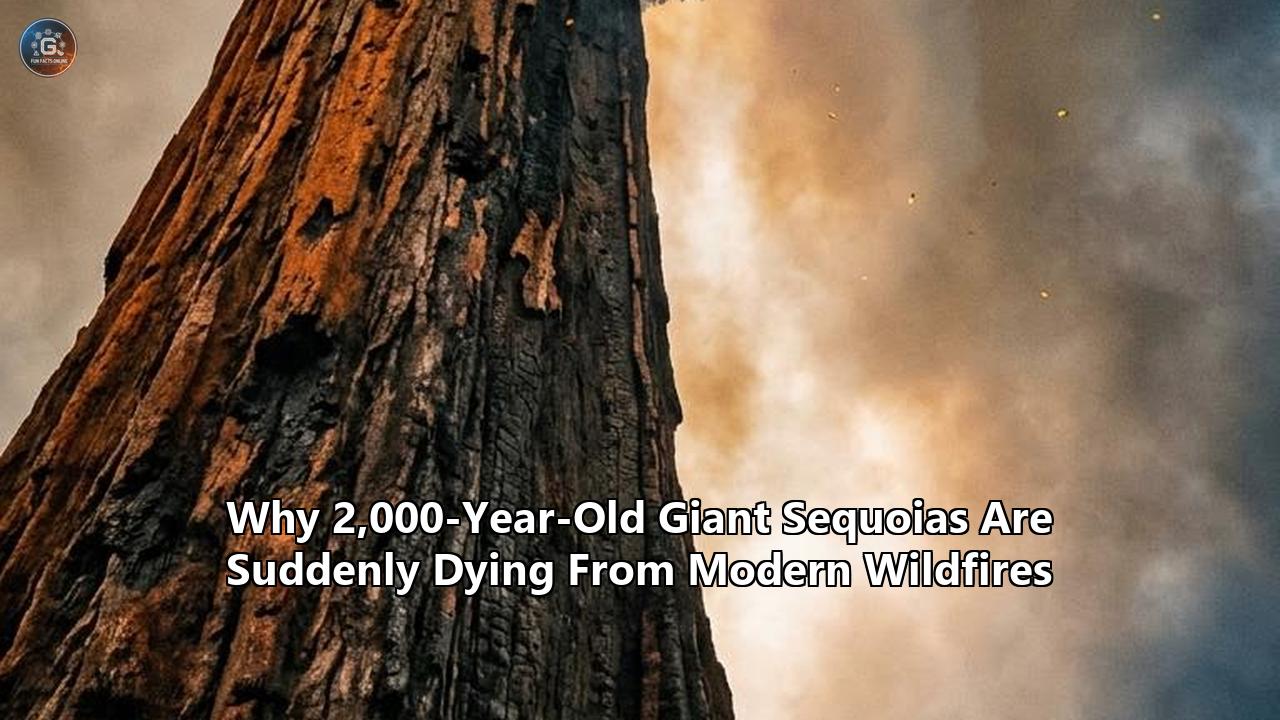
Deep inside California’s Board Camp Grove, perched on a steep, south-facing ridge of the southern Sierra Nevada, stand the blackened skeletons of titans. For more than two millennia, these individual giant sequoias (Sequoiadendron giganteum) absorbed the shocks of human history. They were saplings during the Roman Republic, matured through the Middle Ages, and weathered hundreds of lightning-sparked forest fires without losing their upper crowns.
Then came the late summer of 2020.
Driven by record-shattering heat, severe atmospheric drought, and dense understory fuels accumulated over a century of aggressive fire suppression, the Castle Fire tore through the grove. Flames did not simply crawl across the forest floor as they had for thousands of years; they climbed into the cloud-high canopies, generating firestorm conditions that vaporized crowns 200 feet above the ground. In a matter of hours, trees that had survived twenty centuries were transformed into giant columns of charcoal.
The losses registered by forest ecologists in the aftermath were staggering. Between 2015 and 2021, a sequence of catastrophic megafires—anchored by the 2020 Castle Fire and the 2021 KNP Complex and Windy Fires—killed an estimated 13% to 19% of all mature giant sequoias on Earth. Over 85% of all sequoia grove acreage burned in just six years, compared to barely a quarter of the acreage over the entire preceding century.
A comprehensive range-wide assessment published in Fire Ecology by the Giant Sequoia Lands Coalition confirmed that mature mortality from severe wildfires has reached an unprecedented 18%. Researchers found that while less than 1% of the world’s mature sequoias perished from fire in the three decades prior to 2015, the modern surge in high-severity fire has pushed nearly three-quarters of all remaining groves into a state of structural vulnerability.
The sudden collapse of these ancient trees triggered an urgent scientific investigation. Field biologists, forest entomologists, and remote-sensing specialists set out to trace the hidden mechanics behind the die-off. What they uncovered was not a single catastrophic blow, but a complex, multi-tiered ecological trap—where hotter droughts, unnatural forest density, altered fire physics, and an unexpected native insect parasite combined to breach an evolutionary defense system that had held for millions of years.
                 THE MULTI-TIERED ECOLOGICAL TRAP

   [ Historical Fire Suppression ]     +     [ Hotter Droughts (Climate) ]
   - Fuel ladders (dense firs/pines)         - Extreme atmospheric demand
   - Massive wood debris buildup             - Reduced snowpack & soil water
                 │                                      │
                 └──────────────────┬───────────────────┘
                                    │
                                    ▼
                      [ High-Severity Wildfires ]
                      - Flame heat reaches 200+ ft canopy
                      - Destroys upper foliage (crown scorch)
                      - Cooks cambium layer through bark
                                    │
                                    ▼
                      [ Hydraulic & Vascular Stress ]
                      - Loss of stomatal water regulation
                      - Disrupted water transport upward
                                    │
                                    ▼
                  [ Native Bark Beetle Attack ]
                  - Phloeosinus punctatus invades canopy
                  - Kills upper foliage & cambium
                                    │
                                    ▼
                      [ Catastrophic Tree Death ]
                      - Standing die-off within 6 months
                      - Seedbank incineration in soil
The Armor That Held for Two Millennia
To understand why giant sequoias dying in modern fires represents such a profound ecological shift, researchers first had to evaluate how the species was engineered to survive fire in the first place.
Giant sequoias are not merely tolerant of fire; they are ecologically dependent on it. For millions of years, low-to-moderate severity fires swept through the Sierra Nevada every 6 to 35 years. These natural blazes cleared out competing shade-tolerant conifers, exposed bare mineral soil, and opened up canopy gaps that allowed light to reach the forest floor. The heat of these surface fires pulsed upward into the canopy, causing serotinous sequoia cones to dry out, flex open, and release millions of tiny seeds onto a freshly ash-fertilized seedbed.
Evolution outfitted the trees with a suite of defense mechanisms against fire:
- Asbestos-Like Bark: Mature sequoias sport fibrous, spongy bark that can grow up to 18 inches thick. Lacking volatile resins found in pines and firs, the bark acts as a thermal shield, insulating the tree's delicate vascular tissue—the cambium layer—from ground-level heat.
- Self-Pruning Lower Canopies: As sequoias mature, they shed their lower branches, lifting their leafy foliage 100 to 150 feet above the forest floor. This gap prevents ground flames from climbing into the crown.
- Chemical Defense: The wood and bark are packed with high concentrations of fire-retardant tannins, which discourage both fungal decay and wood-boring insects.
- Elevated Growing Points: A mature monarch can reach heights over 250 feet, keeping its main photosynthetic machinery well above the reach of conventional forest fires.
When surface blazes burned through historical groves, they rarely injured more than the base of the trunk. Over centuries, repeated fires might burn through the thick bark at the base, carving out hollows known to foresters as "catfaces" or basal scars. Yet, even with massive fire scars penetrating their trunks, the trees continued to transport water and nutrients through their intact outer cambium, living on for additional centuries.
"For decades, the working paradigm in forest science was that giant sequoias were virtually indestructible by fire," explains Dr. Nathan Stephenson, Research Ecologist Emeritus with the U.S. Geological Survey (USGS) who spent more than forty years studying Sierra Nevada forests. "An old-growth monarch would occasionally fall over because its roots gave way, or it might succumb to cumulative damage over thousands of years. But the idea that a single wildfire could kill thousands of mature trees across multiple groves in a single season was simply outside our historical framework".
The tipping point arrived when the nature of the fires changed.
Layer 1: The Fuel Trap and Fire Ladders
The initial clue in explaining the widespread loss was found on the forest floor. When federal agencies and university researchers conducted post-fire field surveys across the footprints of the 2020 Castle Fire and 2021 KNP Complex Fire, they recorded fuel conditions fundamentally different from anything the trees had encountered during their two-thousand-year lives.
Beginning in the late 19th century, federal and state land management policies prioritized total fire suppression. Indigenous cultural burning practices—which had kept Sierra forests open and park-like for centuries—were outlawed. For over a hundred years, every low-intensity surface fire ignited by lightning was systematically extinguished.
Without frequent surface fires to burn away dead limbs, leaf litter, and fallen trees, fuel accumulated at unnatural rates. Shade-tolerant tree species like white fir (Abies concolor) and incense-cedar (Calocedrus decurrens) sprouted by the millions beneath the sequoia canopy. These younger trees grew unchecked, filling the vertical space between the forest floor and the high sequoia branches—creating what foresters call "fuel ladders".
HISTORICAL FIRE REGIME (Pre-1850)        MODERN FIRE TRAP (2000s)

     ┌───┐   Mature Sequoia                   ┌───┐   Mature Sequoia
     │   │   (High Canopy)                    │   │   (High Canopy)
     │   │                                    │   │
     │   │                                    │   │
     │   │                                    ├───┤ ◄── Canopy Heat Bridge
     │   │                                    │   │
     │   │                                    │   │   Dense Ladder Fuels
     │   │                                    ├───┤   (White Firs & Incense-Cedars)
     │   │                                    │   │
  ───┴───┴─────────────────────────        ───┴───┴─────────────────────────
  Frequent Low-Intensity Surface Fire       Massive Accumulated Fuel Bed
  (Clears saplings, burns bark exterior)    (Flames travel up ladders into canopy)
When severe droughts hit California between 2012 and 2021, these overgrown understories dried out. When wildfires finally ignited during wind events, the results were catastrophic. The surface blazes consumed the massive accumulation of logs and debris on the ground, creating extreme thermal energy. Flames then climbed the white fir ladder trees directly into the crowns of the ancient sequoias.
"When fire reaches the canopy of a giant sequoia grove, the physical dynamics change completely," says Dr. Christy Brigham, Chief of Resource Management and Science at Sequoia and Kings Canyon National Parks. "You are no longer looking at a surface fire that cleans the understory. You are looking at a plume-dominated canopy fire generating radiant heat in excess of 1,500 degrees Fahrenheit. At that temperature, even thick bark cannot insulate the cambium, and the living needles in the crown are instantly cooked".
Field evaluations revealed two primary mechanisms of direct fire death:
- Total Crown Scorch and Consumption: In high-severity burn patches, flames ignited the upper foliage directly. A giant sequoia can survive losing up to 75% or 80% of its canopy, but when 85% to 100% of the green foliage is scorched or consumed, the tree can no longer photosynthesize and dies of immediate carbon starvation and thermal shock.
- Basal Cambium Girdling: In areas where deep duff and heavy fallen logs had accumulated around the base of trees over a century, fires burned hot and slow for days. This sustained, localized heat cooked the living cambium layer around the entire circumference of the trunk, girdling the tree beneath its thick bark.
Yet, as researchers mapped the damage, they stumbled upon an anomaly that direct fire damage could not fully explain.
Layer 2: The Stealth Predator — The Bark Beetle Mystery
In 2014, mid-way through California’s historic multi-year drought, USGS field crews monitoring sequoia groves in Sequoia National Park noticed something that had never been documented in scientific literature: mature giant sequoias were dying standing upright, without high-severity canopy scorch.
Historically, sequoias were considered immune to bark beetle infestations that periodically decimated nearby pine and fir forests. While lower conifers lacked chemical defenses and succumbed to mass beetle attacks during dry spells, sequoia wood contained high concentrations of defensive compounds that repelled insects.
However, when scientists climbed into the crowns of dead and dying standing sequoias, they found tiny exit holes and intricate larval galleries carved into the bark and cambium of the upper branches. The culprit was identified as Phloeosinus punctatus—the western cedar bark beetle.
         MECHANICS OF A WESTERN CEDAR BARK BEETLE ATTACK

  1. Drought + Fire Damage ──► Tree loses hydraulic pressure / cannot produce resin
  2. Beetles Target Upper Canopy ──► Attack branches 150–200 feet above ground
  3. Larval Galleries Cut Cambium ──► Disrupts sugar and water pathways
  4. Canopy Dieback Threshold ──► Loss of 20% foliage snaps water column
5. Rapid Tree Collapse ──► Complete standing mortality within 6 monthsDr. Seth Davis, Associate Professor of Forest Entomology at Colorado State University, began leading a multi-institution research effort to decipher why this native insect had suddenly turned deadly.
"The western cedar bark beetle was historically viewed as a secondary pest—essentially a scavenger," Dr. Davis explains. "What we realized through our post-fire and drought studies is that severe environmental stress alters the chemical and physical relationship between the beetle and the tree".
Dr. Davis and his colleagues discovered that the combination of hotter droughts and moderate fire damage compromised the giant sequoia’s internal hydraulic system. Giant sequoias pull hundreds of gallons of water per day from the soil up to their tops, stretching thin columns of water under massive tension inside their xylem vessels. When soil moisture drops during extreme droughts and air temperatures soar, that tension increases.
If a fire burns through the understory, scorching even 30% or 40% of the lower canopy or damaging part of the root system, the tree's ability to maintain that water column deteriorates. The tree becomes hydraulically stressed and loses its ability to produce the sap pressure needed to pitch out invading beetles.
"These beetles do not attack the trunk near the ground where the bark is thick," Dr. Davis notes. "They fly straight into the upper canopy—150 to 200 feet in the air—where the bark is thinner and the water stress is highest. They bore into the stems and lay eggs. As the larvae hatch and mine through the vascular tissue, they sever the flow of nutrients".
Dr. Davis’s research revealed a critical vulnerability: because giant sequoias rely on their foliage to regulate water transport throughout their massive bodies, losing a relatively small percentage of canopy foliage to beetle galleries can trigger a system-wide hydraulic collapse.
"It does not take total defoliation," Dr. Davis says. "If bark beetles destroy just 20% of the upper foliage in a tree that is already stressed by drought and moderate fire scorch, it can snap the hydrologic tension. The water column breaks, cavitation occurs throughout the xylem, and a 2,000-year-old tree can die standing up within six months".
This finding reshaped scientists' understanding of post-fire mortality. Thousands of trees that survived the immediate heat of wildfires in 2020 and 2021 with moderate crown injury were subsequently finished off by beetle invasions in the two to three years that followed.
Layer 3: The Threat of Local Extinction
As field teams evaluated the broader impacts of the fire crisis, they encountered a second disturbing trend: in high-severity burn areas, the natural regeneration system of giant sequoias was breaking down.
Historically, high-severity burn patches in sequoia forests were small—usually less than an acre or two—where a lightning strike had taken out a small group of trees. These small gaps provided the ideal mix of bare mineral soil, direct sunlight, and seed rain from surviving sequoias surrounding the edge of the burn.
However, the 2020 Castle Fire and 2021 KNP Complex created continuous patches of high-severity burn spanning thousands of acres. In groves like Board Camp, Homer's Nose, and Alder Creek, high-intensity canopy fires burned so hot that they incinerated the green seed cones high in the crowns rather than merely heating them to release seeds.
A landscape-scale study conducted by USGS researchers in partnership with the National Park Service and U.S. Forest Service evaluated post-fire seedling regeneration across four heavily burned groves. The findings revealed that large-patch, high-severity burns create an ecological barrier to forest recovery.
               PATTERNS OF REGENERATION POST-WILDFIRE

HISTORICAL / MIXED-SEVERITY BURN      LARGE-PATCH HIGH-SEVERITY BURN (Modern)
┌─────────────────────────────────┐   ┌─────────────────────────────────┐
│     [Green Canopy Edges]        │   │     [Incinerated Canopies]      │
│   ┌───────────────────────┐     │   │   ┌───────────────────────┐     │
│   │ Small Cleared Patch   │     │   │   │  Massive Burn Area    │     │
│   │ - Cones release seeds │     │   │   │  (Hundreds of Acres)  │     │
│   │ - Bare soil + sunlight│     │   │   │ - Cone bank destroyed │     │
│   │ - Abundant seedlings  │     │   │   │ - Soil baked & sterile│     │
│   └───────────────────────┘     │   │   │ - Zero seed rain      │     │
│                                 │   │   └───────────────────────┘     │
│  RESULT: Robust Natural Forest  │   │  RESULT: Shrub Dominated /      │
│          Regeneration            │   │          Local Extinction Risk  │
└─────────────────────────────────┘   └─────────────────────────────────┘
In areas where all mature sequoias were killed over large contiguous areas, there were no live seed-bearing trees left within wind-dispersal distance. Furthermore, the extreme ground heat had baked the upper soil layer, destroying organic matter and changing soil structure.
Instead of thousands of sequoia seedlings carpeting the forest floor as expected after a fire, researchers found vast expanses of ash and rock rapidly colonized by aggressive brush species like deer brush (Ceanothus integerrimus) and mountain whitethorn (Ceanothus cordulatus).
"When you lose every seed-bearing tree over hundreds of acres, natural regeneration cannot occur," says Dr. Brigham. "The seeds cannot travel hundreds of yards across open burn scars. Without human intervention, these groves will not return as sequoia forests. They will transition into permanent shrublands, effectively extirpating giant sequoias from portions of their native range where they have grown for millennia".
Layer 4: The 77 Percent Solution — Quantifying What Works
Amid the destruction of the 2020–2021 fire seasons, researchers noticed critical variations in tree survival. Even within groves swept by high-severity fire, specific stands of giant sequoias survived remarkably well.
To understand why some stands survived while neighboring trees burned, a research team led by scientists at the University of California, Davis, the USGS, and the National Park Service embarked on a multi-year analysis combining advanced remote sensing and field validation. The findings were published in Nature Communications.
Using airborne lidar (light detection and ranging) to measure 3D forest structure alongside high-resolution PlanetScope satellite imagery, the researchers tracked pre-fire fuel conditions and individual tree outcomes for approximately 26,400 giant sequoias across 19 groves impacted by the Castle and KNP Complex fires.
           UC DAVIS / NATURE COMMUNICATIONS STUDY FINDINGS

     [ Untreated Sequoia Stands ]       [ Prescribed Burn Treated Stands ]
     ───────────────────────────       ──────────────────────────────────
     • High understory fuel accumulation• Forest floor fuel cleared
     • Dense white fir ladder trees     • Lower limbs pruned by low fire
     • 4x HIGHER MORTALITY RISK         • 77% REDUCTION IN MORTALITY RISK
     • High vulnerability to crown fire • High canopy fire resistance
The study provided rigorous quantitative proof of the value of proactive forest management:
- 77% Reduction in Mortality Risk: Giant sequoias growing in areas that had received prescribed burns within the ten years prior to the megafires were nearly four times more likely to survive than untreated trees in the same groves.
- Preventable Loss: Computer simulations run by the team indicated that prior prescribed fire treatments saved an estimated 1,900 large giant sequoias during the 2020 and 2021 blazes alone.
- Wider Applications: Had low-intensity prescribed fire treatments been applied across all grove acreage prior to 2020, thousands of additional mature trees—representing centuries of irreplaceable genetic diversity—would have survived.
"The data clearly demonstrates that prescribed fire acts as a functional vaccine against high-severity wildfire," explains Dr. Derek Young, a forest ecologist at UC Davis and co-author of the study. "When we use low-intensity, controlled fire under mild weather conditions to consume accumulated surface fuels and remove ladder trees, we alter the physics of subsequent wildfires. When a high-severity fire hits a treated area, it drops out of the canopy and returns to the ground, where mature sequoias are built to withstand it".
The stark survival differential provided a clear path forward for land managers, sparking a shift in conservation strategy across federal, state, and tribal lands.
The Landscape Scale: Measuring Range-Wide Vulnerability
The insights gained from post-fire studies prompted land managers to conduct a comprehensive assessment of all remaining giant sequoia groves across California.
In a report titled "The State of the Giant Sequoias: Losses, Risks and Opportunities," produced by the Giant Sequoia Lands Coalition—a collaboration uniting the National Park Service, U.S. Forest Service, Tule River Tribe, California State Parks, and Save the Redwoods League—researchers mapped the current health and hazard profiles of the species across its entire native footprint.
       RANGE-WIDE RESILIENCE STATUS OF GIANT SEQUOIA GROVES
       (Source: Giant Sequoia Lands Coalition Assessment)

       [ High Resistance Zone ] ─── 26%
       (Treated with prescribed fire / thin understories)

       [ Moderate Resilience Zone ] ─── 61%
       (Needs fuel reduction treatments to withstand extreme fire)

       [ Extinction / Failure Risk ] ─── 13%
       (Severe fuel loading, steep topography, high beetle pressure)
The range-wide assessment revealed critical structural realities:
- Limited High-Resistance Acreage: Only 26% of the giant sequoia range currently exhibits high resistance to extreme wildfires—meaning three-quarters of all existing grove acreage remains vulnerable to canopy fire under severe weather conditions.
- Extinction Risk in Unmanaged Areas: Approximately 13% of the native range is categorized at high risk of local extinction due to dense fuel accumulations, steep topography, and heavy surrounding beetle populations.
- Concentrated Geographic Footprint: Giant sequoias grow natively in fewer than 100 discrete groves scattered along a narrow 250-mile belt on the western slope of the Sierra Nevada, total acreage amounting to roughly 48,000 acres. Because their distribution is so spatially concentrated, single megafires can wipe out significant fractions of the species' global population in a matter of days.
"We are no longer managing for future generations in a abstract sense," says Dr. Brigham. "We are actively intervening to prevent the immediate loss of a species in real time. If we experience two more fire seasons like 2020 and 2021 without reducing fuel loads, we could lose half of the remaining mature giant sequoias on the planet".
The Frontline Counterattack: Technology, Fire, and Reforestation
Facing the reality of giant sequoias dying across historically protected national parks and national forests, land managers launched an unprecedented intervention effort. The emergency response centers on three main strategies: forest fuel reduction, artificial reforestation, and high-tech tree monitoring.
                     TRIAD OF EMERGENCY INTERVENTION

         ┌───────────────────────────┼───────────────────────────┐
         │                           │                           │
         ▼                           ▼                           ▼
[ Active Fuel Reduction ]   [ Hands-On Reforestation ]   [ AI & Remote Monitoring ]
- Mechanical thinning of firs- Planting climate-adapted  - USGS AI detecting standing
- Accelerated prescribed burns  seedlings in high-burn gaps dead trees via satellite
- Hand-clearing around bases - Hand-watering during dry  - Early beetle infestation
  of monarch trees             summers                     detection in upper crowns
1. Accelerating Mechanical Thinning and Prescribed Burns
Federal agencies have used emergency authorities to bypass traditional administrative delays, expediting fuel-reduction projects across dozens of unburned and partially burned groves. Forestry crews equipped with chainsaws and heavy machinery are mechanically thinning white firs and incense-cedars, hauling out biomass, and creating defensive buffer zones around ancient trees.
Following thinning, specialized fire crews execute broadcast prescribed burns under optimal weather conditions. By reintroducing low-severity fire during late fall or early spring when soil moisture is high and temperatures are mild, managers clear ground fuels without threatening the high canopy.
2. Hand-Planting the Next Generation
In large high-severity burn gaps where natural regeneration failed, crews from the National Park Service, U.S. Forest Service, and Save the Redwoods League are carrying nursery-grown sequoia seedlings into the backcountry on foot and pack mule.
To build long-term climate resilience, seeds are collected from diverse elevation zones and microclimates across the Sierra Nevada. Planting crews place young saplings in sheltered micro-habitats, surrounding them with protective mesh to prevent deer browsing and hand-watering them through their first critical dry summers.
3. Early Warning Systems: AI and Canopy Infrared
To track beetle infestations and water stress before visible canopy collapse occurs, scientists from the USGS and National Park Service are deploying artificial intelligence tools paired with high-resolution satellite and aerial imagery.
The AI system analyzes multispectral reflectance data to detect subtle changes in needle moisture and chlorophyll content in individual crowns 200 feet above the ground. By identifying drought-stressed trees and early beetle attacks across entire landscapes, resource managers can target localized interventions—such as deploying pheromone disruptors to confuse bark beetles or applying targeted watering—before a tree succumbs to hydraulic failure.
A New Relationship With Old Growth
The crisis facing California’s ancient giants has forced a fundamental shift in conservation philosophy. For over a century, forest management in national parks was defined by passive preservation—the belief that the best way to protect wild ecosystems was to draw a boundary around them and let nature take its course.
The rapid collapse of 18% of the world’s mature giant sequoias in less than a decade exposed the limits of passive preservation in an era of rapid climate change and fuel accumulation.
               THE EVOLUTION OF FOREST MANAGEMENT

PASSIVE PRESERVATION (1890s–2010s) ──► ACTIVE ECOLOGICAL STEWARDSHIP (2020s+)
• Total fire suppression            • Frequent controlled fire integration
• Zero timber management in parks   • Strategic mechanical understory thinning
• Hands-off ecosystem monitoring    • Hands-on reforestation & seed planting
• Assumption of natural immunity     • Tech-driven pest & drought intervention
Today, scientists, forestry professionals, and Indigenous land stewards agree that saving the remaining 82% of the world’s giant sequoias requires active, continuous intervention.
"We cannot simply put a fence around a grove and assume these trees will survive the next fifty years on their own momentum," reflects Dr. Stephenson. "The atmosphere is warmer, droughts are drier, and the fuels are heavier than at any point in the last two thousand years. Human actions altered these forests over the past century, and human actions are now required to stabilize them".
Standing on the ash-covered slopes of the southern Sierra Nevada, amidst young green seedlings growing in the shadow of charred 200-foot trunks, the lesson is clear. Giant sequoias possess the evolutionary resilience to live for millennia, but their survival through the coming century depends on how quickly humans can restore low-intensity fire to their native groves.
Key Data & Research Sources
- Giant Sequoia Lands Coalition Range-Wide Assessment (2026): Published in Fire Ecology, documenting an 18% loss of mature sequoia population since 2015 and establishing that 26% of grove acreage exhibits high fire resistance.
- UC Davis / USGS / NPS Prescribed Burn Study: Published in Nature Communications, analyzing 26,400 individual sequoias and proving that prior prescribed fire cuts tree mortality risk by 77%.
- USGS & National Park Service Mortality Reports: Documenting the mechanics of the 2020 Castle Fire (7,500–10,600 large sequoias killed) and 2021 KNP Complex / Windy Fires (2,261–3,637 large sequoias killed).
- Colorado State University Forest Entomology Research: Led by Dr. Seth Davis, discovering the novel mortality mechanism of the Western Cedar Bark Beetle (Phloeosinus punctatus) in water-stressed giant sequoias.
Reference:
- https://www.nps.gov/articles/000/preliminary-estimates-of-sequoia-mortality-in-the-2020-castle-fire.htm
- https://www.nps.gov/articles/000/wildfires-kill-unprecedented-numbers-of-large-sequoia-trees.htm
- https://research.fs.usda.gov/treesearch/63950
- https://earth.org/sequoia-trees-of-california/
- https://www.doi.gov/wildlandfire/helping-restore-giant-sequoias-after-significant-wildfires
- https://warnercnr.source.colostate.edu/new-research-provides-insight-into-bark-beetle-involved-in-giant-sequoia-tree-death/
- https://www.nps.gov/articles/000/giant-sequoias-face-new-threats.htm
- https://www.savetheredwoods.org/newsroom/press-releases/new-scientific-study-assesses-giant-sequoias-mortality-due-to-severe-wildfires/
- https://www.usgs.gov/programs/ecosystems-land-change-science-program/news/assessing-giant-sequoia-mortality-and
- https://www.usgs.gov/programs/ecosystems-land-change-science-program/news/collaborative-innovation-giant-sequoia
- https://www.sequoiaeco.com/hello-world/
- https://www.sciencedaily.com/releases/2026/07/260726015243.htm
- https://ucanr.edu/sites/default/files/2021-04/347896.pdf