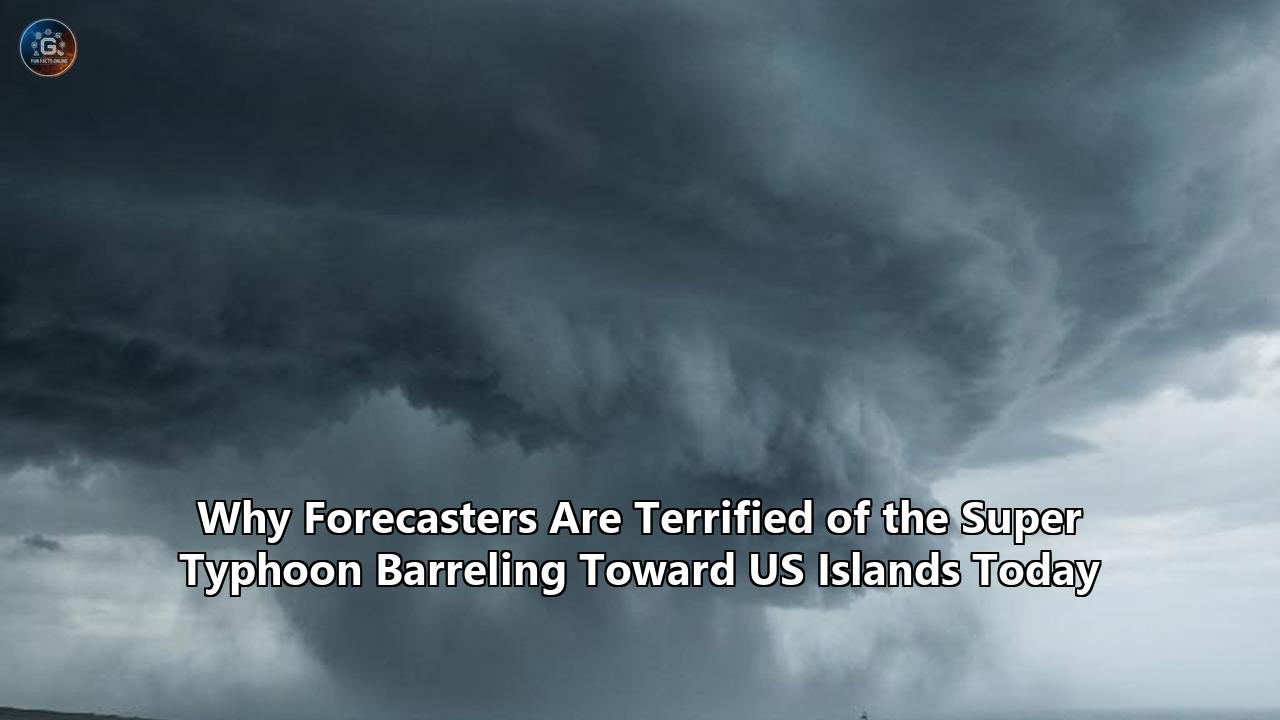
Tropical Cyclone 05W is undergoing rapid intensification. By tonight, it will be classified as a super typhoon. But it isn't the wind speed that has seasoned forecasters terrified. It is the coordinates.
Less than ten days ago, Super Typhoon Sinlaku—a Category 5 monster with maximum sustained winds of 185 mph and a crushing central pressure of 896 millibars—barreled through this exact same patch of ocean. Sinlaku made landfall over the Northern Mariana Islands late on April 14, shredding the islands of Saipan and Tinian as a high-end Category 4, while simultaneously lashing Guam with torrential flash floods and tropical-storm-force winds.
The wreckage from Sinlaku is still fresh. The recovery hasn't even fully started. And now, the atmosphere is chambering another round. Tracking a super typhoon US islands are fundamentally unequipped to handle back-to-back requires an entirely different playbook—one that emergency managers currently do not possess.
This is the nightmare scenario meteorologists call the "double-tap." Behind the public advisories and the standard weather warnings lies a deep, systemic dread among atmospheric scientists, military strategists, and federal logisticians. Here is the technical reality of why the storm barreling toward the Marianas today represents an unprecedented logistical and meteorological crisis.
The Ground Reality: A Pre-Stripped Defense
To understand the panic in the forecast offices, you must look at what is happening on the ground today, April 23. Up until the latest satellite data came in, the American citizens living in Guam and the Commonwealth of the Northern Mariana Islands (CNMI) were taking their first hesitant steps toward recovery.
Just yesterday, the Guam Department of Agriculture officially activated its Crop Loss Compensation Program, sending assessors out to commercial farms to catalog the devastating loss of livestock and the total leveling of banana and papaya crops. After a week of gridlock, the Guam Department of Education finally cleared several facilities, including J.Q. San Miguel and M.U. Lujan Elementary Schools, to reopen their doors to students this morning. Down at the Micronesia Mall in Dededo, the Department of Public Health and Social Services had just finalized staging for a massive walk-up distribution center scheduled for Friday, intended to provide free medical care, immunizations, and urgent food commodities to thousands of households whose refrigerators have been rotting for over a week.
Now, those reopening plans are being violently scrapped. The plywood is going right back over the shattered windows.
When a community absorbs the kinetic energy of a super typhoon US islands experience a fundamental alteration of their physical geography and infrastructure. Wind engineering principles dictate that structures are designed to survive high-velocity impacts as sealed envelopes. Once a single window is blown out or a roof is compromised, the internal pressurization changes, making the structure exponentially more vulnerable to subsequent winds.
Sinlaku already stripped the islands of their defenses. Tens of thousands of people across Saipan and Tinian lost power as utility poles were snapped like matchsticks. Glen Hunter, a resident of Saipan, reported watching tin roofs flying past his yard during the peak of Sinlaku's assault. Today, those dislodged tin roofs, broken concrete blocks, and snapped ironwood trees are no longer just debris—they are ammunition.
A 150-mph wind is survivable in a reinforced concrete bunker. A 150-mph wind carrying a barrage of corrugated steel and splintered lumber acts as a massive, high-speed blender. Forecasters are terrified because the baseline resistance of the Marianas is currently zero. The trees that didn't fall last week have severely compromised root systems due to soil saturation. The temporary tarps provided by the Red Cross will instantly shred. The power grid, heavily reliant on above-ground lines, cannot be patched before the next eyewall hits.
The Physics of the "Cold Wake" Failure
From a purely thermodynamic perspective, today’s approaching storm should not exist.
Tropical cyclones operate as massive atmospheric heat engines. They draw their latent heat from ocean surface waters, which must be at least 26 degrees Celsius (79 degrees Fahrenheit) to sustain storm development. When a massive, 400-mile-wide storm like Sinlaku churns across the ocean, the intense cyclonic winds drag the sea surface, generating extreme turbulent mixing. This mechanical mixing typically causes upwelling, pulling cold water from the ocean depths to the surface.
This process leaves behind a thermal scar known as a "cold wake." Under normal climatological conditions, a Category 5 storm essentially starves the ocean behind it, making it nearly impossible for a secondary storm to follow the exact same track for weeks, if not months. The cold wake acts as a natural thermodynamic shield.
But 2026 is defying oceanic norms. The Western Pacific Warm Pool is currently running an unprecedented fever. The heat anomalous to this April doesn't just sit on the skin of the ocean; it extends hundreds of meters deep. This metric, known as Tropical Cyclone Heat Potential (TCHP), measures the integrated vertical temperature of the water column. Because the 26-degree isotherm is currently situated so incredibly deep in the Philippine Sea, Sinlaku’s upwelling didn’t pull up cold water—it simply pulled up more hot water.
The thermal shield never materialized. Instead, the ocean reloaded.
Climatologically, the emergence of a Category 5 storm in April is exceptionally rare. Peak typhoon season in the Western Pacific typically runs from June through November. Prior to this year, one of the only comparable early-season monsters was Super Typhoon Hester back in 1953. Yet, Sinlaku was already the second Category 5 of 2026, following Tropical Cyclone Horacio, which exploded over the South Indian Ocean in late February.
Now, with Tropical Cyclone 05W feeding off the exact same un-depleted heat reservoir, forecasters are watching the laws of thermodynamics push the boundaries of known meteorological parameters. The water is acting like high-octane rocket fuel, bypassing the standard limits of seasonal climatology.
Flying Blind: The Radar and Sensor Deficit
Inside the JTWC, the anxiety is compounded by a severe deficit in ground truth. When tracking a super typhoon US islands are uniquely vulnerable to, meteorologists rely on an intricate web of satellites, buoys, and ground-based radar to calculate exact wind speeds and central pressure.
In the Atlantic basin, the National Hurricane Center relies heavily on the US Air Force Reserve’s 53rd Weather Reconnaissance Squadron—the "Hurricane Hunters." These heavily modified WC-130J aircraft fly directly into the eye of the storm, dropping GPS dropsondes that measure pressure, temperature, and wind speed all the way down to the ocean surface.
The Western Pacific has no dedicated Hurricane Hunter fleet. The JTWC relies almost entirely on satellite telemetry and the Advanced Dvorak Technique (ADT), a method of estimating storm intensity based on cloud patterns and infrared temperatures.
During Sinlaku’s approach on April 13, the Suomi NPP satellite, utilizing its Visible Infrared Imaging Radiometer Suite (VIIRS), captured the storm's massive structure, documenting gravity waves in the upper troposphere that indicated extreme updraft velocities. Forecasters also heavily utilize Himawari-9, a geostationary satellite that provides high-resolution imagery every ten minutes.
But satellites have limitations. They cannot directly measure the wind speed at the surface. For that, forecasters rely on the NEXRAD WSR-88D Doppler radar stationed on Guam, along with coastal anemometers.
During Sinlaku’s destructive pass last week, surface observation equipment took a severe beating. Anemometers are notorious for failing or snapping just before a storm reaches its absolute peak. If Guam's radar array or the CNMI’s coastal sensors were degraded by Sinlaku, forecasters tracking today’s incoming storm are effectively flying blind right as the system approaches the coastline. They are forced to rely on microwave satellite passes—which only happen a few times a day—to see through the upper-level cirrus clouds and examine the structural integrity of the storm's inner core.
Without constant, real-time ground radar, predicting the exact wobble of the eyewall becomes a terrifying guessing game. A deviation of just ten miles in the storm's track dictates whether an island experiences the catastrophic 150-mph winds of the right-front quadrant, or the relatively manageable 90-mph winds of the outer bands.
The Mechanics of Rapid Intensification
The most dangerous phrase in modern meteorology is "Rapid Intensification" (RI). Defined formally as an increase in maximum sustained winds of at least 30 knots (35 mph) in a 24-hour period, RI is the phenomenon that keeps forecasters awake at night.
Today’s approaching storm is currently undergoing explosive RI. The mechanics behind this are deeply complex, relying on a combination of low vertical wind shear, high atmospheric moisture, and the aforementioned deep ocean heat.
As the storm organizes, conservation of angular momentum takes over. Much like a figure skater pulling their arms in to spin faster, as the thunderstorms near the center of the cyclone consolidate, the radius of maximum winds shrinks. This leads to the formation of a "pinhole eye"—a tiny, sharply defined clearing in the center of the storm, often less than 10 miles across. Pinhole eyes are the meteorological signature of a buzzsaw. When Sinlaku rapidly intensified between April 11 and April 12, its central pressure plummeted to 896 millibars, placing it in the upper echelon of the most powerful storms ever recorded on Earth.
The danger of an RI event occurring right before landfall is that it completely paralyzes the emergency response timeline. Evacuation protocols and sheltering logistics take days to execute. If a storm is forecasted to hit as a Category 1, residents may choose to shelter in place in standard wooden structures. If that storm rapidly intensifies overnight into a Category 4 or 5, the sun rises on a death trap.
Because the residents of the Marianas are currently living in partially destroyed homes, temporary shelters, and debris-filled neighborhoods, their baseline survivability threshold is drastically lower than it was nine days ago. There is no time to reinforce what is already broken.
The Logistical Trap for FEMA
The Federal Emergency Management Agency (FEMA) operates on a highly structured logistical framework dictated by the Stafford Act. When Sinlaku hit, President Donald Trump swiftly approved emergency disaster declarations for both Guam and the Northern Mariana Islands, unlocking federal funds and resources.
In response, FEMA dispatched nearly 100 personnel to the region, coordinating with the American Red Cross to open shelters for more than 1,000 displaced residents across the islands.
Today, those first responders are caught in a logistical trap.
Responding to a disaster on the US mainland is a matter of driving convoys of utility trucks and supply trailers down the interstate. Responding to a disaster in the Marianas requires an aerial and maritime supply chain stretching 6,000 miles from the West Coast. Heavy equipment, transformers, concrete utility poles, and massive generators must be flown into Guam International Airport or shipped into Apra Harbor. From Guam, they must be transloaded onto smaller barges or cargo planes to reach Saipan, Tinian, and Rota.
With a second super typhoon bearing down today, that fragile, thousands-of-miles-long supply chain has been abruptly severed.
Cargo planes cannot land in 100-mph crosswinds. Barges cannot navigate 30-foot swells. The ports are locking down, and the airfields are being secured. The FEMA personnel, Army Corps of Engineers structural specialists, and Red Cross volunteers who arrived last week to help are now in the direct path of the new storm. They have instantly transitioned from responders to potential survivors.
The stockpiles of MREs (Meals Ready-to-Eat), bottled water, and medical supplies that were currently being unloaded at distribution points—like the planned event at the Micronesia Mall—must now be hurriedly repacked and secured into concrete bunkers. The entire recovery apparatus is frozen in place.
The Strategic Chokepoint: Military Operations on Guam
Beyond the immediate humanitarian crisis, the double-tap storm creates a severe strategic vulnerability for the United States military.
Guam is widely referred to by locals as "Typhoon Alley," but inside the Pentagon, it is known as the tip of the spear. The island is the westernmost sovereign territory of the United States and serves as a vital power projection hub in the Indo-Pacific theater. Naval Base Guam is home to fast-attack nuclear submarines, while Andersen Air Force Base hosts strategic bombers, tanker fleets, and advanced reconnaissance drones.
When a super typhoon approaches, the military executes a massive, highly choreographed retreat known as the Conditions of Readiness (COR) protocol.
Vessels cannot remain tied to the pier during a typhoon. The extreme storm surge and wave action would repeatedly smash billion-dollar destroyers and submarines against the concrete moorings, causing catastrophic hull damage. Therefore, the Navy executes a "sortie," rushing ships out into the open Pacific Ocean where they can dive deep or ride out the massive swells far away from land.
Simultaneously, the Air Force must evacuate its flight lines. Any aircraft that cannot fit inside the reinforced concrete hangars at Andersen AFB must be flown thousands of miles away, typically to bases in Hawaii, Alaska, or Japan.
During Sinlaku, this protocol was executed flawlessly. But the immediate arrival of a second super typhoon means those assets cannot return.
In the high-stakes geopolitical chessboard of the Pacific, adversaries monitor the weather just as closely as the JTWC. When Guam’s military installations are locked down, the US defense posture in the South China Sea, the Taiwan Strait, and the broader Indo-Pacific is temporarily blinded and geographically displaced. A single storm creates a strategic gap of three to four days. Back-to-back super typhoons keep critical assets out of the theater for weeks.
Furthermore, Guam houses the Terminal High Altitude Area Defense (THAAD) missile battery, a vital radar and interception system designed to protect the island from regional ballistic missile threats. While the radar arrays are designed to withstand extreme conditions, continuous exposure to 150-mph winds filled with airborne debris pushes the engineering limits of the island's most sensitive defense networks.
The Topography of Wind and Water
As today's storm approaches the Marianas, forecasters are intensely focused on the topographical interaction between the cyclone and the volcanic islands.
Saipan, the largest island in the CNMI, features highly complex terrain. Mount Tapochau rises to an elevation of 1,545 feet in the center of the island. When extreme typhoon winds interact with steep volcanic topography, a phenomenon known as the "venturi effect" occurs. Much like putting your thumb over the end of a garden hose, as the wind is forced up and over the mountain ridges, it compresses and accelerates.
This means that while the JTWC might forecast maximum sustained winds of 150 mph, localized wind gusts funneling through the valleys and cresting the ridges of Saipan could easily exceed 190 mph. This micro-scale acceleration is exactly what shreds localized microgrids and rips the roofs off structures that survived the initial eyewall impact.
Then there is the water. The National Weather Service expects the incoming system to dump another 10 to 20 inches of rain over the archipelago, mirroring the deluge brought by Sinlaku. The ground on Guam, Rota, Tinian, and Saipan is completely saturated. The water table cannot absorb another drop.
Flash flooding and rapid runoff are absolute certainties. But the deeper threat lies in the structural integrity of the terrain itself. Volcanic soil, when hyper-saturated and battered by continuous wind, is highly prone to massive landslides. Entire hillsides, stripped of their stabilizing vegetation by Sinlaku, are now at extreme risk of collapsing, threatening to bury roadways and severing the only land routes connecting the northern and southern halves of the islands.
The oceanic impact is equally severe. A super typhoon pushes a massive wall of water ahead of it, known as storm surge. The Marianas are surrounded by deep ocean trenches—the Mariana Trench lies just to the east—which limits the gradual buildup of storm surge compared to the shallow continental shelf of the US Gulf Coast. However, the sheer kinetic force of the wind generates localized hazardous surf exceeding 20 to 30 feet, which violently batters the exposed coral reefs and coastal highways.
A Permanently Shifted Baseline
As the clock ticks down on April 23, the meteorologists at the JTWC continue to run their models, updating the forecast tracks every six hours. The atmosphere is indifferent to the exhaustion of the people on the ground.
For the meteorologists, emergency managers, and military commanders involved, this is the second super typhoon US islands will endure before the traditional typhoon season even begins. It forces a fundamental reassessment of Pacific infrastructure and survival.
The economic reality of the Marianas makes this vulnerability particularly acute. Saipan’s tourism-dependent economy was already reeling. The island never fully financially recovered from the catastrophic impact of Super Typhoon Yutu in 2018, which was closely followed by the global economic shutdown of the coronavirus pandemic. Now, local businesses that had just barely managed to replace their inventory and repair their storefronts over the last five years are facing total erasure.
Moving forward, the conversation inside federal agencies is shifting from temporary relief to structural permanence. The traditional cycle of erecting wooden power poles, waiting for a typhoon to snap them, and shipping new wooden poles from the mainland is logistically and financially unsustainable. The push to underground the entire power grid on Guam and the CNMI—a multi-billion-dollar endeavor—is gaining urgent political traction. Furthermore, residential building codes, which are already strict, will likely face demands for absolute concrete monolithic construction, abandoning the use of tin roofs entirely.
But those are conversations for next year. Tonight, survival is the only metric that matters.
As the sun sets over the Philippine Sea, the satellite imagery shifts from visible light to infrared. The eye of the new super typhoon glows menacingly on the screens in Pearl Harbor, a perfect, frictionless engine of destruction feeding on an abnormally boiling ocean. The sirens in Saipan, Tinian, and Guam are wailing again, cutting through the humid evening air, signaling the residents to abandon their cleanup efforts, retreat into their concrete shelters, and brace for the terrifying roar of the wind, hoping the walls that held last week can hold just one more time.
Reference:
- https://www.britannica.com/event/Super-Typhoon-Sinlaku
- https://www.pbs.org/newshour/nation/super-typhoon-sinlaku-pounds-remote-u-s-islands-in-the-pacific-ocean-with-ferocious-winds
- https://ghs.guam.gov/jic-recovery-release-no-16-doag-crop-loss-compensation-program-activated-dphss-update-gdoe-schools
- https://www.sfchronicle.com/weather/article/sinlaku-typhoon-western-pacific-us-islands-22202607.php
- https://www.theguardian.com/environment/2026/apr/13/weather-tracker-super-typhoon-sinlaku-threatens-mariana-islands
- https://science.nasa.gov/earth/earth-observatory/super-typhoon-sinlaku/
- https://satlib.cira.colostate.edu/event/tropical-storm-sinlaku/
- https://www.theguardian.com/us-news/2026/apr/13/super-typhoon-sinlaku-mariana-islands-guam
- https://www.wutc.org/2026-04-15/super-typhoon-sinlaku-pounds-remote-u-s-islands-in-the-pacific-ocean