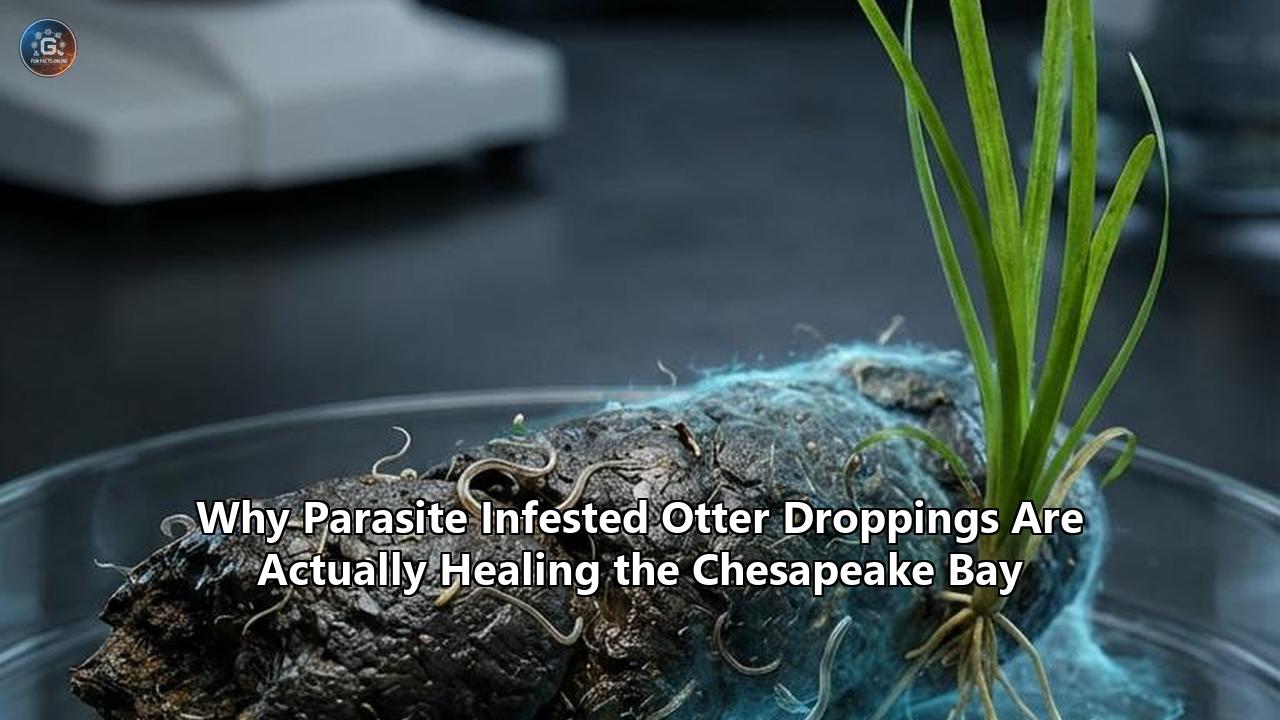
The mystery began with an unseemly discovery on a wooden dock in Edgewater, Maryland. Researchers arriving at the Smithsonian Environmental Research Center (SERC) found a watery, foul-smelling deposit left behind in the night. Within that scat was a bright, fire-engine-red worm. Wildlife cameras quickly identified the source: a North American river otter using the man-made floating dock as its personal latrine.
While finding animal droppings on a rural dock is hardly an unprecedented event, that single crimson parasite sparked an 11-month ecological investigation that has fundamentally altered our understanding of estuarine health. Published recently in Frontiers in Mammal Science, the resulting study revealed that river otter droppings across the largest estuary in the United States are absolutely teeming with parasites.
Far from being a sign of a sick population, this heavy parasite load indicates something far more complex and highly beneficial. By actively hunting down and consuming infected prey, these apex predators act as specialized sanitation workers. They cull diseased fish and crustaceans, remove parasites from the food web, and actively engineer a healthier, more resilient coastal environment.
Through a combination of traditional field tracking and advanced DNA analysis, scientists are now deciphering exactly how these semi-aquatic mammals are healing local waters. To understand how feces and flatworms translate to ecosystem health, we have to examine the predatory economics, genetic sequencing, and disease dynamics happening beneath the surface.
A 12-Kilometer Scat Hunt on the Rhode River
To investigate the implications of that initial red worm, a team led by SERC graduate researcher Calli Wise and parasite ecologist Dr. Katrina Lohan systematically monitored 18 active otter latrines. These sites were scattered across a 12-kilometer stretch of the Rhode River, a sub-estuary of the larger bay.
North American river otters (Lontra canadensis) possess highly specific, and rather unsanitary, social habits. They eat, play, socialize, and defecate in the same localized areas. While this behavior might seem counterintuitive from a hygiene perspective, these concentrated latrines act as communication hubs. By leaving scent-marked scat on prominent features like mossy banks, fallen logs, and increasingly, human-built structures like boardwalks and docks, otters broadcast their presence to passing rivals and mates.
For the researchers, these latrines provided a logistical goldmine. Over nearly a year of fieldwork, the team recovered an average of 28 scat samples per site. Visually, the droppings emitted a potent odor of fish and were visibly packed with undigested scales and crustacean shells. But visual inspection alone could not identify the microscopic ecological interactions hidden within the waste. To map the true diet of the estuary’s apex predator, the team had to take the samples back to the Coastal Disease Ecology Laboratory.
Metabarcoding: Reading the Genetic Ledger of the Estuary
Identifying exactly what an elusive, nocturnal predator eats in murky estuarine waters has historically frustrated marine biologists. Visual observation is nearly impossible, and physical stomach content analysis requires invasive or lethal sampling. Scat analysis offers a non-invasive alternative, but soft-bodied prey and microscopic parasites digest too quickly to leave physical traces.
To bypass this limitation, the SERC researchers utilized a highly sensitive technique called DNA metabarcoding. Unlike traditional DNA sequencing, which targets a single organism, metabarcoding amplifies specific, short genetic sequences across an entire mixed sample. By extracting the genetic soup from the otter droppings and running it through high-throughput sequencing machines, the scientists generated a comprehensive list of every organism that passed through the otter's digestive tract.
The genetic ledger was expansive. Finfish and crabs accounted for 93 percent of all identified prey items. The data confirmed the otters were heavily consuming the American blue crab, alongside an array of teleost fish, ducks, and frogs. They were also serving as active pest control by hunting invasive species like the common carp and the southern white river crayfish.
Crucially, the metabarcoding illuminated the invisible layer of the ecosystem: the parasites. The genetic sequences revealed a massive concentration of parasitic DNA, primarily originating from trematodes, commonly known as flukes. They also found traces of microscopic dinoflagellates and parasitic flatworms known to infect the gills and fins of fish.
Because databases of parasite DNA are still incomplete, the team could not identify every single pathogen down to the species level. However, the data clearly showed that the vast majority of these parasites were adapted to infect ray-finned fishes and crustaceans, not mammals. The otters were not severely infected themselves; rather, they were consuming prey that was riddled with disease.
The Parasite Paradox: Why Infection Equals Ecosystem Health
In human terms, we view parasites entirely as negative pathogens to be eradicated. In a wild ecosystem, however, parasites are fundamental drivers of energy transfer and population control. A healthy, robust environment contains a vast diversity of parasites.
Parasites rarely kill their hosts immediately. Instead, they rely on complex life cycles that often require multiple host species to reproduce. For example, a trematode might begin its life inside an aquatic snail, swim out to infect a fish, and finally mature inside the gut of a bird or mammal that eats the fish.
Because parasites draw energy from their hosts, infected fish and crabs suffer a heavy biological tax. They grow slower, swim less efficiently, and suffer from compromised immune systems. Some estuarine parasites even engage in "host manipulation," altering the neurological behavior of the fish to make it swim erratically or closer to the surface. Why? Because the parasite needs the fish to be eaten by a predator so it can reach its final reproductive stage.
This dynamic creates a vulnerability that Chesapeake Bay otters aggressively exploit. As opportunistic hunters operating in low-visibility environments, otters target the easiest possible meal. A sluggish, parasite-drained fish or a neurologically compromised crab requires significantly less caloric expenditure to catch than a perfectly healthy specimen.
"It is possible that river otters, like other top predators, wouldn't be able to find enough food to eat without parasites," Dr. Lohan explained during the release of the study findings. The parasites effectively subsidize the otter’s energy budget by slowing down the prey.
Culling the Weak: The Mechanics of Predatory Healing
This predator-parasite relationship is where the estuarine healing mechanism activates. By disproportionately hunting and eating the sickest individuals in the water, river otters inadvertently act as ecosystem engineers.
When an otter consumes an infected fish, the fish is removed from the local population. More importantly, the highly acidic, mammalian digestive tract of the otter acts as an incinerator for many fish-specific pathogens. While a few parasites are adapted to survive in mammals, the vast majority of aquatic flatworms and flukes die during the otter's digestive process.
This culling creates immense selective pressure on the prey populations. Because the sick, heavily parasitized individuals are eaten before they can breed, they no longer contribute to the gene pool. Only the fish and crabs with the strongest immune systems and the most robust genetics survive to reproduce. Over successive generations, the constant predatory pressure from the otters actively guides the evolutionary trajectory of the estuary's fish, forcing them to become more resistant to disease.
Furthermore, by breaking the parasite's transmission cycle, otters reduce the overall viral and parasitic load circulating in the water column. If left unchecked by predators, a parasite population can explode, leading to mass die-offs of fish or crabs. By constantly skimming the sickest animals out of the water, the otters act as an ecological regulatory valve, preventing localized disease outbreaks from reaching epidemic proportions.
Economic Subsidies: Protecting the Blue Crab Fishery
The biological balancing act performed by these otters extends far beyond academic ecology; it has direct, tangible impacts on regional economics. The estuary is a vital commercial engine, and the Maryland blue crab (Callinectes sapidus) is its signature commodity.
Crustacean fisheries are notoriously vulnerable to sudden population collapses driven by disease. Parasitic dinoflagellates and various fungal infections can decimate crab harvests, causing millions of dollars in economic damages to watermen, seafood processors, and the coastal restaurant industry. When disease runs rampant in crab populations, the yield drops, prices skyrocket, and the regional economy suffers.
The genetic evidence proving that Chesapeake Bay otters consume large numbers of blue crabs might initially sound like a negative for commercial fishers competing for the same resource. However, the reality of the predator-prey dynamic suggests the exact opposite.
By aggressively targeting the weakest, slowest, and most heavily infected crabs, the otters apply a continuous sanitizing effect on the fishery. They are removing the active biological vectors that could otherwise spread highly contagious pathogens through the dense underwater grasses where crabs molt and mate. In economic terms, the otters provide a free, localized disease-management service.
As state and federal agencies spend billions of dollars on restoration efforts, nutrient management, and artificial oyster reefs, natural biological controls are often overlooked. Apex predators require zero state funding to operate, yet they maintain the genetic vitality of the very seafood resources upon which the regional economy relies.
Disease Sentinels: Mammalian Canaries in the Coal Mine
Beyond their role in culling sick fish, river otters offer another distinct advantage to modern science: they act as real-time biological sensors for human health risks.
Ecologists refer to this concept as being a "disease sentinel". Because river otters are mammals, their physiology shares more commonalities with humans than the fish or invertebrates that share their habitat. Pathogens, heavy metals, and urban pollutants that bioaccumulate in an otter's body are highly relevant indicators of what might soon threaten local human populations.
While most of the parasites identified in the SERC study targeted teleost fish, the metabarcoding did pick up genetic traces of nematodes (roundworms) and single-celled apicomplexans. Some apicomplexan parasites are known to cause human gastrointestinal illnesses, such as cystoisosporiasis, a severe diarrheal disease.
"As river otters move into more urban waterways, they will be increasingly exposed to pollutants and parasites of concern to humans," noted Calli Wise. The study demonstrated a clear trend of otters adapting to human infrastructure, explicitly choosing floating docks and wooden boardwalks to establish their latrines. As coastal development pushes deeper into estuarine environments, the overlap between human recreation and otter habitats tightens.
If scientists detect a sudden spike in mammal-transmissible pathogens or chemical pollutants within the latrines, it serves as an early warning system. Monitoring otter scat provides municipalities with actionable intelligence regarding sewage overflows, agricultural runoff, and the introduction of novel urban pathogens before those threats trigger a human public health crisis.
The Resurrection of an Estuarine Apex Predator
The fact that scientists can monitor Chesapeake Bay otters today is a testament to one of the region's most successful, yet least publicized, conservation victories.
Historically, the North American river otter was abundant across every major watershed on the eastern seaboard. However, their dense, highly insulated, and waterproof pelts made them a prime target for the global fur trade. Decades of unregulated trapping in the 18th and 19th centuries devastated their numbers. This aggressive overharvesting was subsequently followed by the rapid industrialization of the 20th century. Rampant habitat destruction, the draining of wetlands, and extreme water pollution decimated the clean aquatic environments the otters required to survive.
By the late 1900s, river otters had become effectively extirpated from large swaths of their historical range. Their absence left a massive void at the top of the estuarine food web, allowing disease dynamics within prey populations to shift dramatically.
Recognizing the ecological deficit, state wildlife agencies initiated a targeted reintroduction program in the mid-1990s. Biologists trapped healthy otters from stable populations in other states and carefully relocated them into recovering watersheds across Maryland and the surrounding states.
Coupled with the enforcement of the Clean Water Act and localized wetland restoration projects, the reintroduction proved successful. The otters found an environment ripe with prey and began to slowly reclaim their ancestral territories. Yet, despite their successful rebound, these nocturnal and highly elusive mammals have remained a scientific blind spot.
Until the recent SERC latrine study, wildlife managers lacked precise population estimates or definitive dietary data for the coastal populations. Because they hunt at night and avoid human interaction, calculating their exact density remains an ongoing challenge. To address this data gap, SERC founded the Chesapeake Bay Otter Alliance, a collaborative initiative designed to map their exact distribution utilizing the very same scat-tracking techniques pioneered in the 2025 study.
The Unseen Architecture of the Food Web
To truly grasp the healing mechanism of the otter, we have to adjust how we view the architecture of a natural environment. We readily acknowledge the physical components of an ecosystem—the water quality, the temperature, the volume of submerged aquatic vegetation, and the raw tonnage of fish. We map the visible food chain from phytoplankton to smaller baitfish, up to the striped bass, and finally to the coastal predators.
But the SERC findings force us to map the invisible connections. A single river otter latrine is not just a deposit of waste; it is a concentrated data point revealing how biological energy flows through an environment.
When an otter consumes a crab infected with a parasite, it is interacting with three distinct trophic levels simultaneously. The parasite alters the prey's behavior, the prey feeds the predator, and the predator controls the parasite's geographical spread. The health of the bay relies entirely on the tension generated by these interactions.
If we remove the parasites, the otters might starve, unable to catch enough swift, healthy fish to maintain their high-metabolism lifestyles. If we remove the otters, the parasite populations could cascade out of control, overwhelming the immune systems of the fish and crabs, leading to localized extinctions. The presence of parasite-infested droppings on a human-made dock is the ultimate proof that the system is functioning exactly as it evolved to. The disease is present, but it is being aggressively managed by the ecosystem's own internal logic.
Unanswered Questions and the Path Forward
The discovery published by the SERC team has fundamentally shifted how marine biologists view the relationship between apex predators and estuarine disease ecology. However, the initial findings from the Rhode River sub-estuary represent only a fraction of the data needed to understand the bay's full biological network.
As environmental monitoring continues into 2026 and beyond, several critical scientific hurdles remain. The most pressing challenge is the incompleteness of the global genetic database for parasitic organisms. While metabarcoding successfully extracted thousands of genetic sequences from the scat, many of those sequences lacked a match in the existing scientific registry. Researchers know the parasites are there, but they cannot yet assign a specific taxonomic identity to all of them. Expanding this genetic library will require years of dedicated laboratory work, capturing and sequencing live parasites from specific fish species to create reference barcodes.
Furthermore, ecologists are eager to map how river otter predation scales across different salinities and urbanization levels. The initial 12-kilometer study zone provided a baseline, but the estuary is a massive, highly varied system. Scientists must now track how the otters' diets—and the corresponding parasite loads—shift as they move from the deep marine waters near the Atlantic up into the purely freshwater tributaries in the north.
There is also the pressing need to monitor the specific pathogens that could cross the mammalian barrier. As the Chesapeake Bay Otter Alliance continues to recruit citizen scientists to report latrine locations, researchers will be specifically testing for the accumulation of heavy metals, microplastics, and zoonotic diseases. If an otter population near an urban center suddenly experiences a spike in mammalian parasites or chemical toxicity, it will serve as the immediate trigger for human public health interventions.
The next time a dock owner or kayaker spots a pile of fish-scented scat resting on a boardwalk, the reaction shouldn't be disgust. That unassuming evidence is the physical byproduct of a massive, unseen ecological war. Every consumed parasite and every digested crab shell represents a localized victory for the estuarine immune system. Through their endless, unseen nocturnal hunting, these apex predators are slowly, methodically sanitizing the waters, proving that sometimes the clearest sign of a healing environment looks an awful lot like a fire-engine-red worm.
Reference:
- https://www.discoverwildlife.com/animal-facts/mammals/north-america-river-otter-scat-chesapeake-bay
- https://www.frontiersin.org/news/2025/08/14/otter-poo-reveals-animals-shape-ecosystems
- https://www.eurekalert.org/news-releases/1094030
- https://www.chesapeakebaymagazine.com/first-of-its-kind-river-otter-study-reveals-bay-habitat-health/
- https://scitechdaily.com/weird-looking-otter-poo-leads-to-a-surprising-ecological-discovery/
- https://a-z-animals.com/articles/think-otter-poop-is-gross-its-actually-the-key-to-saving-chesapeake-bays-apex-predator/
- https://www.frontiersin.org/journals/mammal-science/articles/10.3389/fmamm.2025.1620318/full
- https://impactful.ninja/otter-poo-study-reveals-hidden-role-in-ecosystem-health/
- https://www.earth.com/news/what-river-otter-poop-reveals-about-life-in-chesapeake-bay/
- https://www.cbsnews.com/baltimore/news/maryland-smithsonian-researcher-otter-poop-scat-health-ecosystem/
- https://www.smithsonianmag.com/smithsonian-institution/from-playful-otters-to-pint-size-owls-these-eight-awesome-animals-call-the-chesapeake-bay-home-180987083/