On June 29, 2026, the screens inside the CERN Control Centre in Meyrin, Switzerland, did something they had not done in years: they went flat.
For nearly two decades, the 27-kilometer ring of the Large Hadron Collider (LHC) had been humming with energy, driving counter-rotating beams of protons to nearly the speed of light before smashing them together in a mimicry of the Big Bang. But on that quiet summer afternoon, operators initiated a final, controlled dump of the beam. The superconducting magnets, chilled to temperatures colder than deep space, began a slow, deliberate warmup. The world’s most powerful particle accelerator was officially switched off.
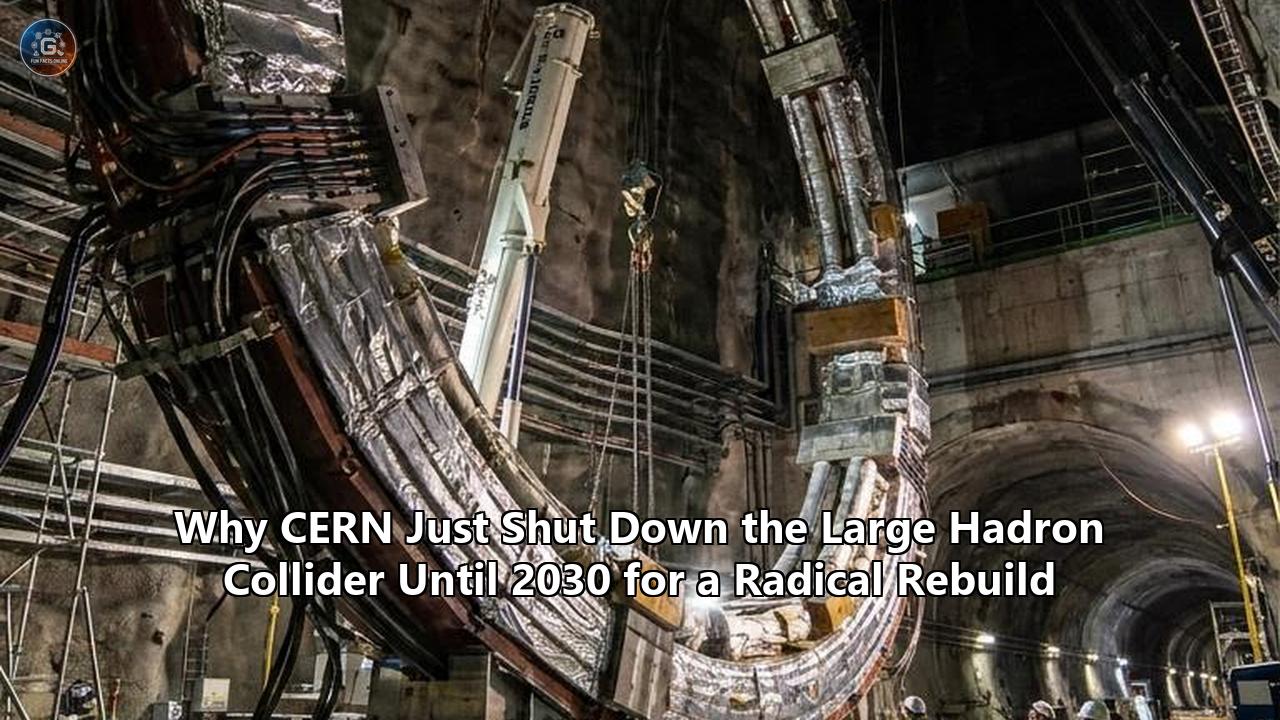
This is not a temporary pause for routine maintenance. It is the beginning of Long Shutdown 3 (LS3)—a grueling, four-year, multi-billion-dollar surgical intervention destined to last until June 2030. Over the next four years, teams of civil engineers, physicists, and technicians will dismantle more than a kilometer of the machine’s core. They will excavate new subterranean galleries, lower some of the most complex superconducting technology ever conceived into the earth, and rebuild the accelerator’s primary collision points from scratch.
"Today we say goodbye to the LHC as we have known it," remarked Oliver Brüning, CERN’s Director for Accelerators and Technology. "While preparing to welcome its successor: the HiLumi LHC, which will extend this scientific adventure far into the future."
To the outside world, the shutdown might look like a retreat—a long silence at a time when the physics community is desperate for clues to resolve the mysteries of dark matter, dark energy, and the fundamental imbalances of the universe. But an investigation into the technical, geopolitical, and structural realities of this shutdown reveals a different story. The Large Hadron Collider upgrade is a high-stakes, race-against-the-clock overhaul that pushed CERN to its absolute limits, forced organizers to rewrite their timelines amid global conflict, and required engineering solutions that seem more like science fiction than modern manufacturing.
This is the untold story of why CERN had to pull the plug, and how they plan to pull off the most radical rebuild in particle physics history.
The Paper Trail: Why the Shutdown Was Delayed and Extended
The road to LS3 was paved with paper, redrawn timelines, and high-level bureaucratic anxiety. Initially, the shutdown was scheduled to begin much earlier and last for a significantly shorter period. Yet, an examination of CERN Council documents and technical review committee reports reveals a compounding series of crises that forced a massive reshuffle.
In late 2024, the CERN Council quietly approved a revised schedule that pushed the start of LS3 back to mid-2026 and extended its duration. The official explanation was polite, citing "significant challenges" in the production of detector components. But the truth, buried in the minutes of the LHC Experiments Committee (LHCC), was far more dramatic: the project had run completely out of "schedule contingency."
The two crown jewels of the LHC’s detection suite—the ATLAS and CMS experiments—were in trouble. To handle the deluge of particles that the Large Hadron Collider upgrade will produce, both experiments require entirely new "inner trackers"—massive, multi-layered silicon eyes designed to reconstruct the trajectories of thousands of particles simultaneously.
"For ATLAS, the new Inner Tracker (ITk) was on the critical path, and for CMS, the High-Granularity Calorimeter (HGCAL) was operating with virtually zero schedule contingency," says Mike Lamont, CERN’s former director for accelerators and technology. "Any further delay in production would have meant the collider sitting idle after the upgrade because the experiments weren't ready to receive the beams."
LHC REVISED TIMELINE (AS OF 2026 SHUTDOWN)
┌─────────────────────────────────────────────────────────────┐
│  RUN 3 (Extended)        ►  Ends June 2026                  │
├─────────────────────────────────────────────────────────────┤
│  LONG SHUTDOWN 3 (LS3)   ►  July 2026 – June 2030           │
├─────────────────────────────────────────────────────────────┤
│  HIGH-LUMINOSITY (Run 4) ►  Launches June 2030              │
└─────────────────────────────────────────────────────────────┘
The bottlenecks were not just intellectual; they were geopolitical. The highly specialized supply chains for the silicon sensors, application-specific integrated circuits (ASICs), and carbon-fiber support structures required for the ITk and HGCAL projects were shattered. First came the logistical paralysis of the COVID-19 pandemic. Then, the Russian invasion of Ukraine dealt a devastating blow to several European manufacturing hubs and academic partnerships that provided raw materials and high-precision machining.
Faced with a choice between forcing an unrealistic schedule that risked a catastrophic failure during installation, or delaying the entire project to give collaborating universities and industries breathing room, CERN chose the latter. The start of the High-Luminosity LHC (HL-LHC) was pushed to 2030, and the shutdown was lengthened to four years. It was a calculated gamble: give the builders the time they need, but accept a four-year gap in new data collection.
The Subterranean Civil Engineering Nightmare
To understand why this rebuild is so radical, one must look below the surface—literally. The LHC is housed in a circular tunnel buried up to 175 meters beneath the French-Swiss border.
The primary objective of the High-Luminosity upgrade is to increase "luminosity"—a measure of how many particles can squeeze into a given space to collide. To achieve this, the machine needs a completely new powering and magnet infrastructure. However, the existing LHC tunnel is cramped, packed to the ceiling with cryogenic pipes, electrical cables, and the accelerator ring itself. There is physically no room for the massive new power converters, helium refrigeration units, and safety systems required for the upgrade.
The solution was a daring civil engineering project: digging entirely new underground networks.
Before the shutdown, contractors excavated two massive new service tunnels, each roughly 300 meters long, running parallel to the main accelerator ring near Point 1 (ATLAS in Switzerland) and Point 5 (CMS in France). These new technical galleries are designed to house the sensitive power equipment and cryogenic systems, isolating them from the radiation of the beam line.
But the hardest part of the job is happening right now, during LS3.
"On the machine side, the absolute critical path is drilling 28 vertical cores to link the new HL-LHC technical galleries directly to the active LHC tunnel," explains Jean-Philippe Tock, the project’s lead coordinator for LS3. "These are essentially vertical conduits through which we will drop the high-voltage lines, cryogenic tubes, and control cables."
       [ SURFACE SUBSTATIONS ]
                 │
                 │ (100m+ Shafts)
                 ▼
     [ NEW HL-LHC GALERIES ]   ◄─── (Power, Cryo, Safety)
                 │
                 │◄─── 28 Vertical Cores (The 6-Month Drilling Challenge)
                 ▼
      [ MAIN LHC TUNNEL ]      ◄─── (Accelerator & Magnets)
The engineering teams originally calculated that they could drill these 28 cores in just two months. But when they began tendering the contracts and consulting with geological specialists, they hit a wall. The rock surrounding the LHC tunnel—composed of complex sedimentary layers of Jura limestone and molasse—is unpredictable. Drilling vertical shafts just meters away from an incredibly delicate, aligned-to-the-millimeter particle accelerator is a logistical nightmare.
"If the drill bit vibrates too violently, or if water leaks into the main tunnel, we could ruin billions of dollars of existing infrastructure," says Tock. "The specialists told us flat out: you cannot do this in two months. It has to be six."
This six-month drilling process is the foundational roadblock of the entire shutdown. Until those vertical cores are bored, sealed, and verified, not a single piece of the new superconducting hardware can be connected.
The Secret of the Brittle Magnets: Switching to Niobium-Tin
Once the civil engineering challenges are resolved, the physical heart of the Large Hadron Collider upgrade can begin. Teams must dismantle and remove approximately 1.2 kilometers of the existing accelerator around the ATLAS and CMS interaction points.
In their place, they will install a series of radical new focusing magnets known as "inner triplets."
In the original LHC, the beams of protons are steered and focused using electromagnets made of niobium-titanium ($NbTi$) superconducting wire. Cooled to 1.9 Kelvin using superfluid helium, these magnets produce a magnetic field of about 8.3 Tesla. They have performed flawlessly, but they have reached their theoretical limit. They simply cannot squeeze the proton beams any tighter.
"At the collision points, the proton bunches are currently about 10 centimeters long and 15 to 20 micrometers wide," says Ezio Todesco, who heads the interaction region magnet design for the HL-LHC. "With the upgrade, we want to compress that width down to just 5 micrometers—essentially focusing the beam into a spot size that is five times smaller than a human hair."
To achieve this extreme compression, physicists had to abandon niobium-titanium and turn to a far more powerful, yet incredibly temperamental material: niobium-tin ($Nb_3Sn$).
MAGNET MATERIAL COMPARISON: NbTi vs. Nb3Sn
┌──────────────────────────────────────┬──────────────────────────────────────┐
│ Niobium-Titanium (NbTi) - Existing   │ Niobium-Tin (Nb3Sn) - Upgrade        │
├──────────────────────────────────────┼──────────────────────────────────────┤
│ • Peak Magnetic Field: ~8.3 Tesla    │ • Peak Magnetic Field: ~12 Tesla     │
│ • Material State: Ductile & Flexible │ • Material State: Brittle as Glass   │
│ • Squeezes beam to: ~15-20 μm        │ • Squeezes beam to: ~5 μm            │
│ • Manufacturing: Wind then install   │ • Manufacturing: Wind, bake, treat   │
└──────────────────────────────────────┴──────────────────────────────────────┘
Niobium-tin is a superconducting superhero. Under the right conditions, it can generate magnetic fields of 12 Tesla or more—an increase of nearly 50 percent over the current LHC magnets. This increased field strength is what makes the tighter beam focus possible.
But niobium-tin has a fatal flaw: it is as brittle as glass.
"If you bend a niobium-titanium wire, it behaves like copper—it just bends," says Giorgio Apollinari, project director for the US High-Luminosity LHC Accelerator Upgrade Project (AUP), which is building half of the new magnets. "But if you bend a niobium-tin wire after it has been heat-treated, it fractures. The superconductivity is instantly lost, and the magnet is ruined."
The manufacturing process is an exercise in extreme patience and precision. Technicians must first wind the unreacted, flexible niobium and tin wires into the shape of the magnet coils. Only after the winding is complete can the entire assembly be placed into a massive furnace and baked at temperatures reaching 650 degrees Celsius for several days. During this baking process, the niobium and tin chemically react to form the superconducting compound $Nb_3Sn$.
From that moment on, the magnet cannot be touched, flexed, or subjected to any mechanical stress. To protect the fragile coils, they must be encased in rigid, high-strength aluminum shells using a technique developed by Lawrence Berkeley National Laboratory.
"We are essentially pre-loading the magnets under immense mechanical pressure using keys and bladders," Apollinari explains. "When the magnet is cooled down and energized, the magnetic forces want to push the coils outward. The aluminum shell acts like an external corset, keeping everything perfectly immobile. If the coils move by even a fraction of a millimeter, the friction will generate enough heat to cause a 'quench,' knocking the magnet out of its superconducting state."
The shipment of these delicate, 4.2-meter-long magnets from the United States to Geneva was itself a multi-million-dollar logistical cliffhanger. Each magnet had to be suspended in custom-built, shock-absorbing transport frames fitted with real-time telemetry to track every bump, vibration, and thermal shift during its journey across the Atlantic.
Colliding Beams Sideways: The Magic of Crab Cavities
Even if the new niobium-tin magnets succeed in compressing the proton beams into ultra-thin needles, physicists face another fundamental limitation of the original LHC design: the crossing angle.
In the LHC, two separate beam pipes carry protons in opposite directions around the ring. At the interaction points inside ATLAS and CMS, these two beam pipes merge into one. However, the beams do not travel completely head-on; they must cross at a very small angle to prevent the incoming and outgoing proton bunches from colliding prematurely before they reach the center of the detector.
"This crossing angle is a major bottleneck," says Rama Calaga, a leading RF physicist at CERN. "The proton bunches are not points; they are long, thin packets, like needles. When they cross at an angle, only the very centers of the needles overlap. The front of one bunch misses the back of the other. As we focus the beams tighter, this geometric effect actually causes us to lose up to 70 percent of our potential collisions."
To bypass this geometric limit, the Large Hadron Collider upgrade is introducing a technology never before used in a proton accelerator: Superconducting Radiofrequency (SRF) "Crab Cavities."
PROTON BUNCH INTERACTIONS AT INTERACTION POINT

Without Crab Cavities (Crossing Angle Loss):
Bunch A:   =======>   (travels diagonally)
Bunch B:   <=======   (travels diagonally)
                  \ /
                   X  <-- Only the centers overlap; most protons miss.
                  / \

With Crab Cavities (Tilted / Crab Walk):
Bunch A:   /////// >  (tilted horizontally/vertically)
Bunch B:   < ///////  (tilted horizontally/vertically)
                  │ │
                  │X│ <-- Bunches collide head-on, maximizing overlap.
                  │ │
The name is highly descriptive. Just as a crab walks sideways, these cavities force the proton bunches to rotate and travel slightly sideways as they enter the collision zone.
The crab cavities are hollow niobium structures cooled to 2 Kelvin. As the proton bunches pass through them at the speed of light, the cavities generate a transverse electromagnetic field that oscillates at a frequency of 400 Megahertz—reversing its polarity every 2.5 nanoseconds.
"The timing is microscopic," Calaga explains. "The front of the proton bunch enters the cavity and gets kicked to the left. The center of the bunch passes through exactly when the field is zero, so it goes straight. The back of the bunch enters 250 picoseconds later, after the field has flipped, and gets kicked to the right. The entire bunch is rotated on its axis."
By tilting the bunches of protons just before they meet, they collide completely head-on inside the detectors, maximizing the cross-sectional overlap. Once the bunches exit the collision point, a second set of crab cavities on the opposite side "un-tilts" them, returning them to their normal orientation.
"It’s an incredibly precise dance," says Calaga. "If the phase of the radiofrequency wave shifts by even a fraction of a degree, we will kick the beams out of alignment entirely, which could easily damage the collimators or the vacuum chambers. It requires synchronization at the level of femtoseconds."
The 100,000-Ampere "Python" Superconducting Link
Bringing thousands of amperes of electrical current to these new magnets introduces yet another engineering crisis: heat.
The massive power converters that feed electricity into the LHC's magnets are typically housed in the same tunnels as the magnets themselves. However, the radiation environment of the High-Luminosity era will be so intense that any normal silicon-based power electronics would be destroyed in a matter of weeks.
To protect this equipment, all the power converters must be moved up and away, housed in the brand-new subterranean galleries dug out by civil engineers. But this creates a new dilemma: how do you transport up to 100,000 amperes of direct current (DC) over a distance of nearly 100 meters, from the warm technical galleries down through the new vertical cores to the cryogenic magnets, without losing massive amounts of energy and boiling the liquid helium?
"If you use normal copper cables, the resistance over that distance is so high that they would generate massive amounts of heat," says Amalia Ballarino, the lead physicist responsible for CERN’s new cold powering systems. "Worse, the physical connection between the warm copper and the cold magnet would act as a massive thermal bridge, dumping heat directly into our cryogenic system. It would completely overwhelm our liquid helium refrigerators."
The solution is a marvel of materials science: a 75-meter-long, flexible superconducting cable bundle colloquially known as "the python."
THE "PYTHON" POWER LINK CROSS-SECTION
┌──────────────────────────────────────────────────────────┐
│ [ FLEXIBLE OUTER CRYOSTAT ]                             │
│   │                                                      │
│   ├─► [ HELIUM GAS FLOW (15 K to 35 K) ]                 │
│   │     │                                                │
│   │     └─► [ MAGNESIUM DIBORIDE (MgB2) CABLES ]         │
│   │           • Carries up to 120,000 Amperes            │
│   │           • Operates at "high" temperatures          │
│   │                                                      │
│   └─► [ REBCO HIGH-TEMP SUPERCONDUCTING CURRENT LEADS ]  │
│         • Bridges the final gap to room temperature      │
└──────────────────────────────────────────────────────────┘
Rather than using traditional low-temperature superconductors like niobium-titanium, which require liquid helium at 1.9 Kelvin, Ballarino’s team developed a system using magnesium diboride ($MgB_2$). Discovered to be a superconductor in 2001, $MgB_2$ has a critical temperature of 39 Kelvin—nearly some 30 Kelvin higher than niobium-titanium.
"Because $MgB_2$ can operate at higher temperatures, we don't need to fill the entire 100-meter-long link with liquid helium," Ballarino explains. "Instead, we cool the cables using a forced flow of cold helium gas at temperatures between 15 Kelvin and 35 Kelvin. The helium gas boils off from the magnet cryostats in the main tunnel, flows up through the 'python' to cool the $MgB_2$ cables, and is then collected at the top, compressed, and re-liquefied. It is a completely self-contained, highly sustainable closed-loop system."
The "python" contains up to 19 individual superconducting cables twisted together inside a highly insulated, flexible vacuum cryostat. This is the first large-scale, high-current industrial application of magnesium diboride in the world, and its success is paving the way for revolutionary new power transmission lines on the surface, potentially allowing lossless power grids in major metropolitan areas.
ATLAS and CMS Get "New Eyes"
While engineers are working on the accelerator, thousands of experimental physicists worldwide are spending LS3 completely rebuilding the detectors that surround the collision points.
When the Large Hadron Collider upgrade is complete, the rate of collisions will increase by a factor of five to ten beyond the original design. In detector physics terms, this creates a major problem called "pile-up."
"Currently, when two proton bunches cross, we see about 30 to 40 individual proton-proton collisions happening simultaneously," says Joachim Mnich, CERN’s Director for Research and Computing. "In the High-Luminosity era, that number will jump to between 140 and 200 simultaneous collisions per bunch crossing. The detector will be hit by an absolute wall of radiation and particles every 25 nanoseconds. The existing detectors would see nothing but a blinding, white-out smear."
To survive this onslaught, both ATLAS and CMS are replacing their core tracking systems.
HIGH-LUMINOSITY PILE-UP IMPACT
┌──────────────────────────────────────┬──────────────────────────────────────┐
│ Standard LHC Run 3 (Before 2026)     │ High-Luminosity LHC (After 2030)     │
├──────────────────────────────────────┼──────────────────────────────────────┤
│ • ~30-40 collisions per crossing     │ • ~140-200 collisions per crossing   │
│ • Tracker: Silicon strips & drift    │ • Tracker: 100% High-Granularity     │
│   tubes                              │   Silicon Sensors                    │
│ • Tracking Dimension: 3D (Space)     │ • Tracking Dimension: 4D (Space +    │
│                                      │   Time Resolution of ~30 picoseconds)│
└──────────────────────────────────────┴──────────────────────────────────────┘
The ATLAS Inner Tracker (ITk) is being completely replaced with an all-silicon detector. Silicon is highly radiation-hard, but more importantly, it can be segmented into incredibly tiny pixels and strips. The new ITk will feature billions of individual readout channels—essentially a multi-gigapixel camera capable of taking 40 million three-dimensional pictures every second.
Meanwhile, CMS is introducing the High-Granularity Calorimeter (HGCAL). This is a towering, sandwich-like structure of silicon sensors and heavy metals designed to measure the energy of particles. But what makes the HGCAL truly radical is its timing resolution.
"We are moving from three-dimensional tracking to four-dimensional tracking," Mnich says. "By measuring the arrival time of every single particle with a precision of about 30 picoseconds, we can separate particles that are separated by just millimeters in space but fractions of a nanosecond in time. This timing information is the magic key that allows us to disentangle the 200 simultaneous collisions and reconstruct the precise physics of rare events."
The Physics of the 2030s: What Is at Stake?
When the Large Hadron Collider gradually restarts in 2028 for beam commissioning, and officially launches its High-Luminosity run (Run 4) in June 2030, it will mark the beginning of a brand-new scientific era.
The primary target of the Large Hadron Collider upgrade is the Higgs boson—the particle discovered at CERN in 2012 that grants mass to all other fundamental particles.
While the discovery of the Higgs was a historic achievement, physicists have only scratched the surface of its properties. The Standard Model of particle physics makes highly precise predictions about how the Higgs should interact with other particles, and, crucially, how it should interact with itself—a phenomenon known as "Higgs self-coupling."
THE SCIENTIFIC OBJECTIVES: POST-2030 RUN
┌─────────────────────────────────────────────────────────────────────────────┐
│ 1. HIGGS SELF-COUPLING                                                      │
│    • Does the Higgs boson interact with itself as predicted by theory?      │
│    • Resolving this will explain the stability of the vacuum in our universe.│
├─────────────────────────────────────────────────────────────────────────────┤
│ 2. THE SEARCH FOR DARK MATTER                                               │
│    • Sifting through trillions of collisions for extremely rare, invisible  │
│      particles that escape the detector.                                    │
├─────────────────────────────────────────────────────────────────────────────┤
│ 3. SOLVING THE ANTIMATTER MYSTERY                                           │
│    • Exploring why the universe is made entirely of matter when the         │
│      Big Bang should have produced equal amounts of matter and antimatter.  │
└─────────────────────────────────────────────────────────────────────────────┘
"If the Higgs boson self-interaction deviates from the Standard Model prediction by even a few percent, it would point to entirely new physics," says Mnich. "It could explain how the early universe underwent its phase transitions, and whether the vacuum of space we occupy today is truly stable or destined to decay."
The upgrade is also designed to search for the elusive components of Dark Matter. Many theoretical models, such as Supersymmetry, predict the existence of heavy, stable, weakly interacting neutral particles that could make up the bulk of the universe's mass. Because these particles would pass through the LHC's detectors without leaving a trace, physicists must look for "missing energy"—instances where a collision produces a jet of visible particles flying in one direction, with absolutely nothing balancing them on the other side.
"With ten times more data, we are not just looking for new particles; we are performing precision diagnostics on the universe," says Brüning. "If there is a crack in the Standard Model, the High-Luminosity LHC will find it."
The High-Stakes Four-Year Count Down
Between now and June 2030, the subterranean complex beneath Meyrin and Cessy will remain a hive of activity. Thousands of scientists, engineers, and technicians are living through one of the most stressful phases of their careers. There is no backup plan. If a single superconducting link fails, if a niobium-tin magnet quenches during commissioning, or if the vertical core drilling damages the main accelerator ring, the entire future of high-energy physics could be derailed.
Yet, walking through the quiet control rooms and the busy assembly halls of SM18 (CERN’s magnet testing facility), one does not sense panic. Instead, there is a quiet, methodical focus.
The Large Hadron Collider has always been more than just a machine. It is a monument to human curiosity, built by thousands of individuals from nations that are often at war on the surface, cooperating in silence deep underground.
The ring has gone silent, but the work has only just begun.
Key Technical Milestones to Watch During LS3 (2026–2030)
- Late 2026: Completion of the 28 vertical core excavations linking the new technical galleries to the LHC tunnel.
- Mid-2027: Arrival of the final niobium-tin quadrupole magnets from the US Accelerator Upgrade Project (AUP).
- 2028: Gradual restart and beam commissioning of the injector complex (Linac 4, PS, SPS).
- Late 2029: Progressive cooldown of the first sectors of the main LHC ring to 1.9 Kelvin.
- January 2030: Final hardware commissioning begins at Point 1 (ATLAS) and Point 5 (CMS).
- June 2030: First physics beams return to the newly upgraded High-Luminosity LHC, launching Run 4.
Reference:
- https://home.cern/cern-bids-farewell-to-the-lhc-and-enters-long-shutdown-3/
- https://www.youtube.com/watch?v=EOzrPxnBXWc
- https://sciencebusiness.net/network-updates/cern-develops-new-superconducting-link-high-luminosity-lhc
- https://indico.cern.ch/event/1639916/contributions/6899253/attachments/3215122/5727585/ACC-PM-MS-0004_5_0.pdf
- https://www.photonics.com/Articles/Large-Hadron-Collider-Offline-for-Ambitious/p5/a72382
- https://home.cern/new-schedule-cerns-accelerators/
- https://www.technology.stfc.ac.uk/projects/crab-cavity-cryomodules-for-cerns-hl-lhc/
- https://cerncourier.com/a/revised-schedule-for-the-high-luminosity-lhc/
- https://cerncourier.com/hl-lhc-counts-down-to-ls3/
- https://hilumilhc.web.cern.ch/article/ls3-schedule-change
- https://home.cern/updated-schedule-cerns-accelerators/
- https://home.cern/updated-schedule-cerns-accelerators/
- https://indico.fnal.gov/event/64275/contributions/290476/attachments/179540/245127/CMS_Status_PAC_2024.pdf
- https://www.google.com/sorry/index?continue=https://www.google.com/search%3Fq%3Dtime%2Bin%2BAin,%2BFR&q=EgS0vKyzGOfOp9IGIjDHs32izKmAwJhHILqNWBgQDbhH5k4jag4PDR23DRYEEricqMBLaf3EiNoHulsJs5YyAnJSWgFD
- https://home.cern/crab-cavities-colliding-protons-head/
- https://news.fnal.gov/2026/02/hilumi-lhc-full-scale-tests-start/
- https://cerncourier.com/a/crab-cavities-enter-next-phase/
- https://home.cern/hi-lumi-news-first-magnet-us-accelerator-upgrade-project-shipped-cern/
- https://atap.lbl.gov/research/scientific-programs-and-centers/superconducting-magnet-program/high-luminosity-large-hadron-collider-accelerator-upgrade-project/
- https://elements.lbl.gov/news/new-magnets-for-large-hadron-collider-upgrade-successfully-pass-halfway-mark/
- https://www.bnl.gov/newsroom/news.php?a=220753
- https://proceedings.jacow.org/srf2021/papers/weocav03.pdf
- https://acceleratingnews.eu/news/issue-50/high-luminosity-lhc-hl-lhc/what-hi-lumis-95m-long-it-string-and-why-it-vital-cerns
- https://cerncourier.com/a/new-superconducting-technologies-for-the-hl-lhc-and-beyond/
- https://cds.cern.ch/pow