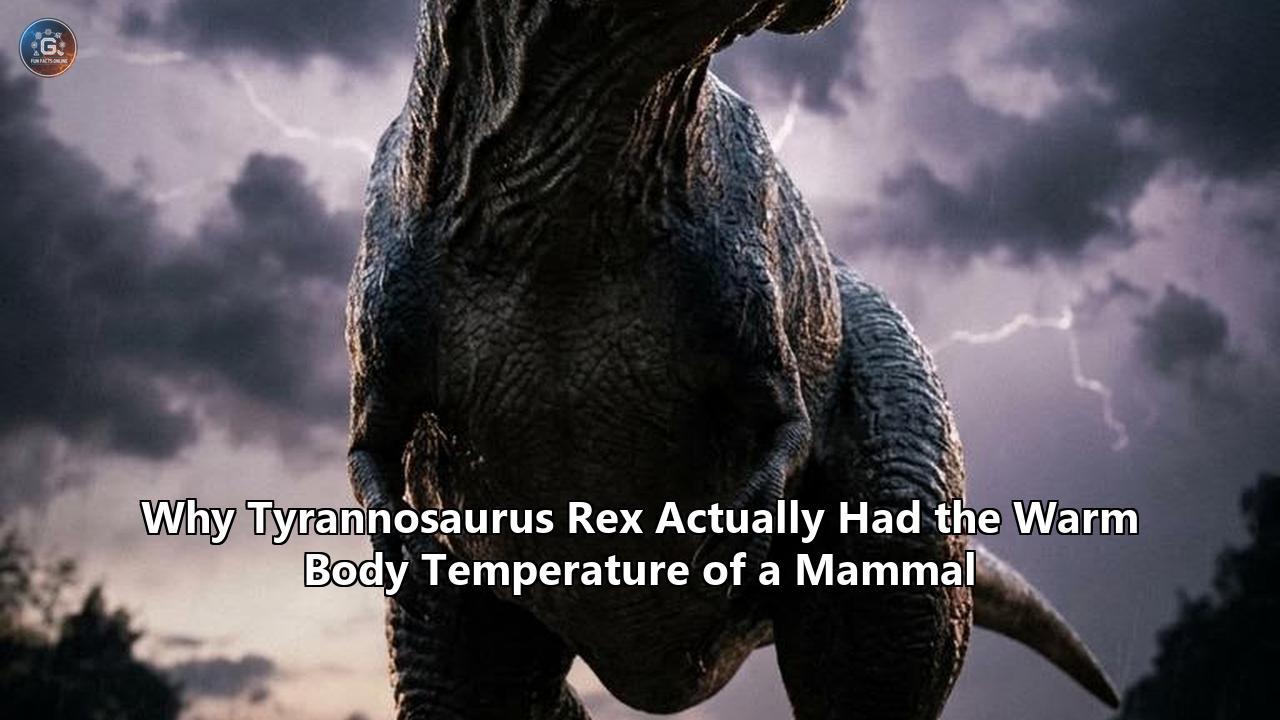
A research team led by the University of California, Los Angeles, has directly measured the internal thermal state of Tyrannosaurus rex using pristine fossil tooth enamel, establishing that the apex predator operated at an internal core temperature of 36.3°C (97.3°F), with an analytical uncertainty of ±2.5°C. The study, published in Science Advances, provides direct chemical evidence that this multi-ton carnivorous dinosaur maintained a constant body heat practically identical to that of modern placental mammals, including humans and adult African elephants.
The discovery settles a debate that has divided vertebrate paleontology for more than half a century. Paleontologists have long argued over whether giant theropods were lethargic, cold-blooded reptiles dependent on sunlight, active warm-blooded endotherms generating heat through cellular metabolism, or "gigantotherms"—animals whose sheer bulk trapped thermal energy passively.
The research team, which included geobiologists Robert Eagle and Aradhna Tripati alongside lead author Randon J. Flores, circumvented decades of inferential arguments by reading the atomic signatures sealed inside the enamel of three Tyrannosaurus rex teeth recovered from Montana’s Late Cretaceous Hell Creek Formation. Two of the teeth belonged to a subadult individual nicknamed "Thomas" (cataloged as LACM 150167), an animal that stood roughly 34 feet long and weighed an estimated 3,000 kilograms at death.
By deploying an advanced iteration of clumped isotope paleothermometry—a geochemical technique that tracks the thermodynamic preference of heavy carbon and oxygen isotopes to bond to one another inside mineralizing tissues—the researchers determined the precise physical temperature at which the apatite crystals formed inside the animal's jaw.
To verify whether this heat was genuinely generated from within or merely mirrored a stifling Late Cretaceous greenhouse climate, the researchers analyzed fossil teeth from five contemporary crocodilians and shells from freshwater bivalves buried within the identical geological strata. The crocodilian teeth registered an average formation temperature of 30.9°C (87.6°F). The bivalves, which recorded ambient water temperatures of the ancient river system, averaged 25.9°C (78.6°F).
The fact that the tyrannosaur ran more than 5°C hotter than its cold-blooded reptilian neighbors in the exact same environment, and more than 10°C above the seasonal water average, eliminates the possibility that the geochemical signal was a post-burial artifact or an echo of outside heat.
The quantification of tyrannosaurus rex body temperature at 36.3°C establishes that the animal was an active, high-metabolism endotherm. Yet this definitive number is not an isolated bolt from the blue; it is the culmination of an escalating, decades-long scientific dispute that systematically dismantled the nineteenth-century view of dinosaurs as sluggish, tail-dragging lizards.
  CHRONOLOGY OF A PHYSIOLOGICAL DEBATE

  1842 ──── Richard Owen coins "Dinosauria": Viewed as giant, slow, cold-blooded reptiles
  1905 ──── Henry Fairfield Osborn describes T. rex: Presumed an ectothermic lizard-king
  1969 ──── John Ostrom describes Deinonychus: Sparks the bird-dinosaur link
  1975 ──── Robert Bakker's "Dinosaur Renaissance": Asserts energetic endothermy
  1980s ─── Armand de Ricqlès: Bone histology reveals fast-growing fibrolamellar tissue
  1990 ──── Spotila & Paladino: "Gigantothermy" hypothesis claims mass, not metabolism, preserved heat
  1994 ──── Barrick & Showers: Oxygen isotopes show low thermal gradients (<4°C) across T. rex
  2004 ──── Erickson et al.: S-shaped growth curves prove teenage growth spurts of 2 kg/day
  2011 ──── Eagle et al.: Clumped isotopes successfully calibrate sauropod body temperatures
  2020 ──── Dawson et al.: Eggshell paleothermometry detects endothermy across major clades
  2022 ──── Wiemann et al.: Raman spectroscopy of metabolic waste proves true high-metabolism theropods
  2026 ──── Flores, Eagle, Tripati et al.: Direct tooth enamel clumped isotopes clock T. rex at 36.3°C
1842–1968: The Stagnant Reign of the Cold-Blooded Orthodoxy
For more than a century following the official scientific christening of dinosaurs, the idea that a giant theropod could share the internal thermal characteristics of a mammal was considered biologically impossible.
When British anatomist Sir Richard Owen coined the term Dinosauria in 1842, he recognized that these animals possessed anatomical complexities superior to modern lizards, such as a fused sacrum and an erect limb posture. Yet Owen and his contemporaries remained bound by taxonomic categorization: dinosaurs were reptiles, and reptiles were, by physiological definition, ectothermic poikilotherms. They were animals whose metabolic furnaces were nonexistent, whose internal temperatures matched the surrounding air, and whose lives were dictated by ambient heat flux.
This perspective deepened when the American Museum of Natural History’s Henry Fairfield Osborn described and named Tyrannosaurus rex in 1905. The sheer physical dimensions of the predator—approaching 40 feet in length and standing on massive hindlimbs—were interpreted through the lens of classical reptilian anatomy. Early museum mounts depicted T. rex as an upright, tail-dragging beast whose vertical posture resembled that of a kangaroo.
Within this framework, the animal's energetics were assumed to match its heavy, awkward posture. Biologists deduced that an animal of such monstrous scale could only function under severe metabolic limitations:
- Low resting metabolic rates that limited sustained pursuit or continuous physical exertion.
- Protracted digestion cycles requiring days or weeks of torpid rest following a feeding event.
- Multidecadal, plodding maturation periods spanning half a century or more, analogous to the growth rates of giant tortoises.
- Inability to tolerate thermal volatility, restricting such creatures to equatorial, swampy lowlands with stable microclimates.
This orthodoxy persisted through the mid-twentieth century. Prominent paleontologists such as Charles W. Gilmore and Edwin H. Colbert viewed large theropods as passive sun-baskers. They reasoned that if a multi-ton carnivore attempted to generate heat like a mammal, it would inevitably cook its internal organs due to the physical principles of surface-area-to-volume scaling. For 126 years, the cold-blooded status of Tyrannosaurus rex remained an untouchable assumption of vertebrate evolution.
1969–1984: The Ostrom-Bakker Rebellion
The first serious fracture in the cold-blooded consensus appeared in 1969 with John Ostrom’s monograph on Deinonychus antirrhopus, a small Early Cretaceous theropod discovered in Montana’s Cloverly Formation.
Ostrom documented an anatomical suite that shattered traditional reptilian assumptions: a rigid, ossified rod-stiffened tail built for dynamic counterbalancing, delicate forelimbs designed for grasping prey, and a hypertrophied, hyper-extendable sickle claw on the second toe of the foot. These were not the anatomical signatures of a sluggish crawler. They were the mechanical blueprints of an agile, obligate biped built for sustained, high-speed predatory maneuvers. Ostrom boldly drew explicit morphologic parallels between Deinonychus and modern ground birds, reviving Thomas Henry Huxley’s forgotten nineteenth-century hypothesis that birds were the living descendants of theropod dinosaurs.
Ostrom’s radical insights were seized upon and weaponized by his former student, Robert T. Bakker. Beginning in the early 1970s and culminating in his 1975 Scientific American treatise "Dinosaur Renaissance," Bakker launched an aggressive academic campaign arguing that dinosaurs were fully endothermic, highly active animals running on the internal fires of modern mammals and birds.
Bakker built his case on multiple converging ecological and anatomical lines:
Predator-Prey Biomass Ratios
In modern mammalian ecosystems, warm-blooded predators require vast amounts of fuel to maintain their high basal metabolic rates, burning roughly 80 to 90 percent of their ingested calories solely on internal thermogenesis. As a consequence, mammalian apex predators constitute a tiny fraction—typically 1 to 3 percent—of the total animal biomass in their habitats.
In contrast, cold-blooded ectothermic predators like crocodiles require far less food to survive and can represent up to 20 to 40 percent of the faunal biomass in an ecosystem. Bakker calculated the census numbers of fossil deposits from the Late Cretaceous, demonstrating that large theropods, including Tyrannosaurus, made up only 2 to 5 percent of the preserved animal biomass, a ratio directly matching modern mammalian guilds rather than reptilian assemblages.
Biomechanical Posture and Locomotor Stamina
Bakker pointed out that every living animal with a fully erect, parasagittal limb posture—where the legs are positioned directly beneath the body rather than sprawling laterally—is an obligate endotherm. Sprawling reptiles suffer from Carrier’s constraint: they cannot breathe and run at the same time because the lateral bending of the torso compresses one lung while expanding the other.
Dinosaurs had fully erect stances, column-like legs, and rigid vertebral columns, indicating they had bypassed Carrier's constraint entirely to facilitate sustained aerobic endurance.
Bakker’s arguments split the paleontological community into warring factions. Traditionalists struck back, claiming that predator-prey biomass ratios in the fossil record were skewed by taphonomic sorting, bone preservation biases, and collection anomalies. They insisted that comparing a multi-ton theropod to a warm-blooded bird or mammal was a biophysical impossibility. To resolve the dispute, paleontologists had to move beyond external anatomy and look directly into the fossilized tissues themselves.
1980–1998: The Microstructural Evidence of Histology
If Tyrannosaurus rex possessed the warm, active metabolism of a mammal, evidence of that rapid metabolic rate would be recorded in the growth architecture of its skeleton. Beginning in the late 1970s and early 1980s, French paleohistologist Armand de Ricqlès pioneered the study of thin-sectioned fossil dinosaur bones under polarized light microscopy, initiating an era of microstructural analysis.
De Ricqlès discovered that the internal cortex of large theropod bones was dominated not by the slow, lamellar-zonal bone typical of modern lizards, turtles, and alligators, but by dense, woven-fibrolamellar bone. This bone type is characterized by:
- Disorganized, fast-forming collagen matrix scaffolds.
- Intense vascularization packed with circular primary osteons.
- Pervasive secondary remodeling via Haversian systems, where osteoclasts continuously tunnel out old bone and osteoblasts replace it with fresh, mineral-rich bone tissue.
In modern animals, woven-fibrolamellar bone is found almost exclusively in warm-blooded mammals and rapidly growing birds. Cold-blooded reptiles are physically incapable of precipitating bone matrix at the sustained speeds required to form fibrolamellar tissue.
+----------------------------------------------------------------------------------------------------+
|                                 BONE HISTOLOGY MATRIX COMPARISON                                   |
+--------------------------+-----------------------+------------------------+------------------------+
| Histological Feature     | Modern Ectotherm      | Modern Placental       | *Tyrannosaurus rex*    |
|                          | (e.g., Alligator)     | (e.g., Mammal/Elephant)| (Hell Creek specimens) |
+--------------------------+-----------------------+------------------------+------------------------+
| Primary Matrix Type      | Slow Lamellar-Zonal   | Rapid Fibrolamellar    | Dense Fibrolamellar    |
| Vascular Density         | Low; sparse canals    | Very high; plexiform   | Extremely high canals  |
| Secondary Remodeling     | Rare or localized     | Extensive (Haversian)  | Dense Haversian systems|
| Sustained Growth Spurt   | Absent (linear/slow)  | Present (sigmoidal)    | Present (up to 2kg/day)|
| Tissue Deposition Rate   | <1 to 5 µm/day        | 10 to 50+ µm/day       | 15 to 40 µm/day        |
+--------------------------+-----------------------+------------------------+------------------------+
By the late 1990s, Gregory Erickson, Jack Horner, and Kevin Padian took paleohistology a step further by counting lines of arrested growth (LAGs)—cyclical growth rings deposited annually during seasonal slowdowns—in cross-sections of long bones from individuals across varying stages of development.
Their findings revealed a growth curve that reshaped evolutionary biology. A Tyrannosaurus rex did not spend a century creeping toward adulthood. It hatched as a slender creature no larger than a turkey, grew steadily through its juvenile phase, and then entered an explosive adolescent growth spurt between the ages of 12 and 18. During this peak developmental window, a teenage T. rex packed on approximately 2.1 kilograms (4.6 pounds) of bone and soft tissue per day, rapidly expanding from a one-ton subadult into an eight-ton predator before plateauing near age twenty.
Such mass-specific growth rates were completely incompatible with an ectothermic metabolism. No known cold-blooded reptile, regardless of climate, could process food, absorb nutrients, and lay down skeletal bioapatite at such high velocities. The histological data proved that the physiological engine driving Tyrannosaurus rex operated at an energetic level comparable to modern mammals. Yet, skeptics remained unconvinced, retreating to a new thermodynamic defense: gigantothermy.
1990–1999: The Gigantothermy Defense and the First Geochemical Scans
In 1990, physiologists James R. Spotila and Michael P. Paladino published a paper proposing that large dinosaurs did not need to be metabolically endothermic to be warm. Instead, they championed the concept of gigantothermy, also known as inertial homeothermy.
Spotila and Paladino based their hypothesis on biophysical principles of thermal inertia:
- As an animal increases in physical size, its volume (the mass that generates and stores heat) increases by the cube of its linear dimensions ($r^3$).
- Conversely, its surface area (the exterior skin through which heat is lost to the atmosphere) increases only by the square of its linear dimensions ($r^2$).
- In a multi-ton creature such as Tyrannosaurus rex, the ratio of surface area to internal volume becomes extremely small.
Because of this physical reality, an animal weighing several tons absorbs and radiates heat at an exceptionally slow pace. Spotila demonstrated that modern leatherback sea turtles (Dermochelys coriacea), which can weigh up to 900 kilograms, achieve internal body temperatures well above the surrounding seawater while swimming through sub-polar currents, despite having the low basal metabolic rate of a standard reptile.
Applied to dinosaurs, gigantothermy posited that Tyrannosaurus rex had the slow cellular metabolism of an alligator, but because of its bulk, it acted as a massive heat reservoir. It absorbed warmth during the balmy Cretaceous day and retained it throughout the night, achieving a stable body temperature without the need for expensive mammalian metabolism.
THE GIGANTOTHERMY (INERTIAL HOMEOTHERMY) DILEMMA

             HEAT GAIN/LOSS (via Surface Area: r²)
                          │    ▲
                          │    │
                     ┌────┴────┴────┐
                     │              │
                     │  MASS: r³    │  <- Massive thermal inertia retains heat,
                     │              │     preventing nighttime cooling.
                     └──────────────┘
                          │    ▲
                          ▼    │
             IS IT HIGH METABOLIC FURNACE (Endothermy)
                                OR
             JUST PASSIVE HEAT TRAPPING (Gigantothermy)?
The first quantitative attempt to test this hypothesis geochemically came in 1994, when Reese E. Barrick and William J. Showers published a study in Science. They turned to stable isotope paleobiology, measuring the ratio of oxygen-18 to oxygen-16 ($\delta^{18}\text{O}$) preserved in the phosphate groups ($\text{PO}_4^{3-}$) of vertebrate bones.
The physics behind Barrick and Showers' technique relies on temperature-dependent isotopic fractionation: when biogenic apatite forms in an animal, the partitioning of oxygen isotopes between body water and the mineralizing phosphate depends on local temperature. If an animal is cold-blooded, extremities such as the lower legs, tail, and snout fluctuate with ambient temperatures, cooling down substantially compared to the animal's deep visceral core.
Barrick and Showers extracted phosphate from 12 skeletal elements from a single, well-preserved Tyrannosaurus rex skeleton collected from the Hell Creek Formation (specimen NMC 9950). They sampled vertebrae deep inside the torso, ribs, the massive femur, and distal extremity elements including the lower metatarsals and the tail tip.
Their findings revealed that the intraskeletal temperature difference between the core body vertebrae and the distal tail and limb bones did not exceed 4°C. In comparison, modern ectothermic alligators exhibit thermal differences between their deep body core and distal limbs of up to 10°C to 12°C under fluctuating environmental conditions.
The team concluded that the tyrannosaur was a homeotherm, possessing a stable internal thermal state throughout its body. Crucially, they estimated that the basal tyrannosaurus rex body temperature hovered well above 30°C.
However, the 1994 study had an inherent geochemical limitation: traditional oxygen isotope thermometry relies on knowing the precise isotopic composition of the animal's internal body water ($\delta^{18}\text{O}_{\text{water}}$) at the moment the bone formed. But an extinct animal's body water varies depending on:
- The water it drank (which changed based on rain patterns, local humidity, and river chemistry).
- Evaporative moisture loss from its lungs and skin.
- Physiological changes over the course of the year.
Because Barrick and Showers were forced to make assumptions about Cretaceous water compositions, critics of endothermy dismissed their findings. Skeptics argued that the low isotopic variation did not prove a high, mammal-like metabolic rate; it simply proved that an 8-ton animal had high thermal inertia, remaining warm due to sheer physical volume. The debate stalled for more than a decade.
2006–2019: The Clumped Isotope Leap
The geochemical impasse was broken in the mid-2000s in the laboratories of the California Institute of Technology. A team led by geochemist John M. Eiler engineered a technique that eliminated the need to guess the isotopic signature of ancient environmental water: carbonate clumped isotope paleothermometry.
Traditional stable isotope geochemistry measures the bulk ratio of heavy to light isotopes, such as $^{13}\text{C}/^{12}\text{C}$ or $^{18}\text{O}/^{16}\text{O}$, in isolation. Clumped isotope paleothermometry, by contrast, tracks the physical bonding of two rare, heavy isotopes directly to each other within the crystal lattice—specifically, the bonding of carbon-13 ($^{13}\text{C}$) to oxygen-18 ($^{18}\text{O}$) inside the carbonate ion ($\text{CO}_3^{2-}$), forming the rare isotopologue $^{13}\text{C}^{18}\text{O}^{16}\text{O}_2^{2-}$.
The fundamental physics governing this phenomenon is rooted in quantum thermodynamics:
$$^{13}\text{C}^{16}\text{O}_3^{2-} + ^{12}\text{C}^{18}\text{O}^{16}\text{O}_2^{2-} \rightleftharpoons ^{13}\text{C}^{18}\text{O}^{16}\text{O}_2^{2-} + ^{12}\text{C}^{16}\text{O}_3^{2-}$$
At low temperatures, chemical systems naturally settle into states with the lowest zero-point vibrational energy. Heavy-isotope bonds are structurally stronger and possess lower zero-point energy than bonds involving lighter isotopes. Consequently, at cooler temperatures, $^{13}\text{C}$ and $^{18}\text{O}$ are more likely to pair—or "clump"—together within the carbonate molecule.
As the temperature increases, thermal kinetic energy increasingly disrupts this order, driving the distribution of isotopes toward thermodynamic equilibrium. At high temperatures, the heavy isotopes pair up purely based on statistical chance.
ISOTOPE CLUMPING MECHANISM IN BIOAPATITE

At Lower Temperatures (< 25°C - Cold Blood / Ambient Water)
   O¹⁶ ─── C¹³ ═══ O¹⁸  <-- Heavy isotopes seek each other out.
                            Higher degree of "clumping" (High Δ47).

At Higher Temperatures (> 36°C - Mammalian / Avian Core Heat)
   O¹⁸ ─── C¹² ─── O¹⁶  <-- Thermal vibrations disrupt preferential pairing.
   O¹⁶ ─── C¹³ ─── O¹⁶      Distribution approaches random chance (Lower Δ47).
The thermodynamic metric that quantifies this phenomenon is designated as $\Delta_{47}$ (Delta-47), which measures the excess abundance of mass-47 carbon dioxide ($\text{CO}_2$) molecules—predominantly containing both $^{13}\text{C}$ and $^{18}\text{O}$—released when carbonate is dissolved in high-purity phosphoric acid, compared to a purely random distribution:
$$\Delta_{47} = \left( \frac{R^{47}_{\text{sample}}}{R^{47}_{\text{stochastic}}} - 1 \right) \times 1000$$
Where $R^{47}$ represents the ratio of mass-47 isotopologues ($^{13}\text{C}^{18}\text{O}^{16}\text{O}$) to mass-44 isotopologues ($^{12}\text{C}^{16}\text{O}_2$).
Because this isotopic clumping depends strictly on the internal temperature at the exact moment the mineral formed, $\Delta_{47}$ acts as an absolute paleothermometer. It operates completely independently of the isotopic composition of the water the animal drank, its diet, or the local air humidity.
In 2011, Robert Eagle, Aradhna Tripati, John Eiler, and their colleagues applied this method to vertebrate paleontology in a landmark study published in Science. They sampled the bioapatite within the teeth of gigantic sauropod dinosaurs, revealing body temperatures of 35.7°C to 38.2°C for Camarasaurus and Brachiosaurus.
Yet sauropods were the ultimate candidates for passive gigantothermy; their gargantuan weights, often exceeding 30 to 50 metric tons, meant their warm bodies could still be explained away by surface-area-to-volume thermodynamics rather than true metabolic endothermy.
A subsequent turning point occurred in 2020, when a team led by Robin Dawson and Pincelli Hull applied clumped isotope analysis to fossil dinosaur eggshells representing theropods, sauropods, and ornithischians. Published in Science Advances, their study showed elevated calcification temperatures across multiple dinosaur clades.
Theropod eggshells, closely related to the tyrannosaur lineage, consistently precipitated their mineral shells at temperatures between 36°C and 40°C, matching the body heat of modern birds. Nevertheless, eggshells only recorded maternal oviduct temperatures during reproductive cycles, leaving critics to wonder whether full-grown predatory theropods sustained these temperatures year-round through internal metabolic activity.
2020–2023: Spectroscopic Metabolomics Directly Targets the Cellular Engine
To dismantle the gigantothermy hypothesis once and for all, researchers had to look beyond temperature alone; they needed a direct way to quantify an extinct animal's metabolic rate. Temperature measures how hot an animal is, whereas metabolic rate measures the volume of oxygen its cells consume and the calories its mitochondria burn to produce that heat.
In 2022, molecular paleobiologist Jasmina Wiemann, working alongside an international team at Yale and Caltech, published a paper in Nature establishing a chemical bridge between fossil bone and metabolic performance.
When an animal breathes, its metabolic rate determines the volume of oxygen drawn into its tissues. A high-performance metabolism produces high levels of reactive oxygen species (ROS) as natural byproducts of oxidative phosphorylation inside mitochondria. These reactive oxygen molecules attack surrounding cellular building blocks—specifically lipids and proteins—triggering a chain of chemical reactions known as lipoxidation and non-enzymatic glycation.
This process produces enduring organic macromolecules:
- Advanced Lipoxidation End-products (ALEs)
- Advanced Glycation End-products (AGEs)
These chemical end-products are hydrophobic, insoluble, and resistant to millions of years of diagenesis. They embed directly within the mineral matrix of bones, acting as permanent molecular recorders of an individual's baseline metabolic burn rate.
THE MOLECULAR METABOLIC TRACE
  High Oxygen Consumption (Aerobic Respiration)
               │
               ▼
  Surge in Reactive Oxygen Species (ROS)
               │
               ▼
  Oxidative Attack on Lipids and Structural Proteins
               │
               ▼
  Formation of Insoluble ALEs and AGEs
               │
               ▼
  Permanent Entombment within Cortical Bone Mineral Matrix
               │
               ▼
  Quantified via in situ Raman and FTIR Spectroscopy
Wiemann’s team developed a non-destructive protocol using high-resolution Raman and Fourier-transform infrared (FTIR) spectroscopy to map the concentration of these metabolic end-products in the fossil bones of dozens of extinct amniotes, calibrating them against living species with known metabolic baselines.
The results dismantled decades of assumptions:
- Ancestral archosaurs—the common ancestors of dinosaurs, pterosaurs, and crocodilians—already possessed elevated metabolic rates.
- Giant sauropods and theropods—including predatory lineages closely related to Tyrannosaurus rex—did not have reptilian metabolisms; they were active endotherms. Their metabolic rates were not merely high; they were directly comparable to, and in some cases exceeded, those of modern placental mammals, approaching the metabolic machinery of living birds.
- Ornithischian dinosaurs, such as Stegosaurus and Triceratops, showed an evolutionary reversal toward lower, ectothermic metabolic rates, likely relying on environmental and behavioral basking to stay active.
Wiemann’s work demonstrated that large theropods possessed the cellular machinery required to generate their own internal heat. The only missing piece of the puzzle was an exact, highly precise measurement of Tyrannosaurus rex's core temperature using an unaltered physical tissue sample.
The Breakthrough: Sub-Milligram Tooth Enamel Mass Spectrometry
The long scientific quest reached its decisive culmination with the study published in Science Advances. The breakthrough was driven by an optimization of clumped isotope mass spectrometry that allowed researchers to analyze sample sizes far smaller than previously possible.
For years, clumped isotope analyses of fossil bioapatite required substantial amounts of material—often hundreds of milligrams of bone or enamel powder—to generate enough carbon dioxide gas to measure the rare mass-47 isotopologues reliably. Because museum curators protect rare fossils, extracting large chunks of a pristine Tyrannosaurus rex skeleton was completely out of the question.
Furthermore, fossilized bone is notoriously porous; over 66 million years, circulating groundwater deposits secondary calcite into the microscopic osteon canals, contaminating the original biological isotope signal with geological noise.
The research team, led by Randon Flores, Robert Eagle, and Aradhna Tripati, surmounted this obstacle by targeting fossil tooth enamel using a micro-sampling technique.
Why Enamel?
Tooth enamel is the hardest, densest tissue in the vertebrate body. Unlike bone or dentine, which contain organic collagen networks and microscopic pores that invite diagenetic alteration, enamel is comprised of more than 96 percent pure crystalline bioapatite (carbonated hydroxyapatite) with large, densely packed crystals.
Once enamel mineralizes inside an animal's gum line, it forms a sealed geochemical time capsule that resists isotope exchange with external fluids, preserving the animal's pristine body chemistry for tens of millions of years.
STRUCTURAL COMPARISON: SUSCEPTIBILITY TO DIAGENESIS

       FOSSIL CORTICAL BONE                    FOSSIL DENTAL ENAMEL
 ┌───────────────────────────────┐       ┌───────────────────────────────┐
 │ ~70% Inorganic Bioapatite     │       │ >96% Pure Inorganic Bioapatite│
 │ ~30% Collagen & Void Space    │       │ Interlocking crystalline grid │
 │ High porosity; open canals    │       │ Impermeable to fluid invasion │
 │ Highly susceptible to ground- │       │ Resists isotopic alteration   │
 │ water diagenetic exchange     │       │ over tens of millions of years│
 └───────────────────────────────┘       └───────────────────────────────┘
            [COMPROMISED]                           [PRISTINE]
The Micro-Sampling Protocol
Using a low-speed rotary drill equipped with a tungsten carbide bit, the team removed tiny samples—a mere 5 milligrams of enamel powder, an amount smaller than a single grain of table salt—from two teeth of the specimen "Thomas" (LACM 150167) and a third isolated T. rex tooth collected from the Hell Creek Formation.
The enamel powder was digested in 105% phosphoric acid at 90°C to release purified $\text{CO}_2$ gas. The liberated gas was cryogenically purified through a series of vacuum traps, passed through a gas chromatography column to eliminate trace hydrocarbon contamination, and transferred into the dual-inlet system of a high-resolution isotope ratio mass spectrometer.
By measuring the precise abundance of the mass-47 ion beams, the researchers calculated the $\Delta_{47}$ values against established international standards. Across all three samples, the calculations converged on an identical result: tyrannosaurus rex body temperature averaged 36.3°C (97.3°F), with an uncertainty margin of ±2.5°C.
+----------------------------------------------------------------------------------------------------+
|                         HELL CREEK ISOTOPIC PALEOTHERMOMETRY PROFILE                               |
+--------------------------+-----------------------+------------------------+------------------------+
| Sample Taxon             | Material Analyzed     | Calculated Clumped     | Thermal Status         |
|                          |                       | Temperature            |                        |
+--------------------------+-----------------------+------------------------+------------------------+
| *Tyrannosaurus rex*      | Tooth Enamel          | 36.3°C ± 2.5°C         | Mammalian-grade        |
| (Specimen Thomas + Indet)| (LACM 150167)         | (97.3°F)               | Endotherm              |
|                          |                       |                        |                        |
| Crocodilians             | Tooth Enamel          | 30.9°C ± 2.1°C         | Ectotherm / Behaviorally|
| (5 sympatric specimens)  | (Hell Creek Fm)       | (87.6°F)               | Thermoregulated        |
|                          |                       |                        |                        |
| Unionid Bivalves         | Shell Carbonate       | 25.9°C ± 1.8°C         | Ambient River Water /  |
| (Freshwater clams)       | (Hell Creek Fm)       | (78.6°F)               | Environmental Baseline |
+--------------------------+-----------------------+------------------------+------------------------+
The environmental control data confirmed the validity of the measurement:
- The Freshwater Bivalves (25.9°C): Provided the baseline mean temperature of the Hell Creek aquatic environment during warm seasons.
- The Crocodilians (30.9°C): Represented contemporary semi-aquatic ectotherms that basked on riverbanks to warm their bodies above water temperatures, but lacked internal thermogenesis.
- *The Tyrannosaurus rex (36.3°C): Maintained a core temperature 5.4°C hotter than contemporary crocodilians and 10.4°C higher than ambient river temperatures.
Crucially, the teeth from "Thomas" were formed when the individual was an actively growing subadult weighing an estimated 3 metric tons—less than half the mass of a fully grown adult T. rex. If the animal's elevated temperature were purely an artifact of passive gigantothermy, a 3-ton subadult would have registered a significantly lower internal temperature than an 8-ton adult due to its higher surface-area-to-volume ratio.
Instead, the subadult teeth displayed the same thermodynamic plateau as adult theropods, conclusively proving that Tyrannosaurus rex generated its internal heat metabolically.
The Internal Mechanics of a 36°C Tyrannosaur
Discovering that Tyrannosaurus rex operated at a stable 36.3°C reshapes our understanding of the animal's anatomy, organ systems, and daily ecology. An internal body temperature comparable to that of modern placental mammals carries immense biological payoffs, but it also imposes steep metabolic costs.
Maintaining an internal temperature above 36°C in a multi-ton carnivore requires continuous cellular combustion. This metabolic engine relies on an interconnected suite of anatomical systems working in lockstep.
THE CARDIO-RESPIRATORY ENGINE OF T. REX
 ┌───────────────────────────────────────────────────────────────────┐
 │ 4-CHAMBERED HEART                                                 │
 │ Complete ventricular separation; high-pressure systemic circuit   │
 │ drives oxygenated blood through a 40-foot body.                   │
 └─────────────────────────────────┬─────────────────────────────────┘
                                   │
                                   ▼
 ┌───────────────────────────────────────────────────────────────────┐
 │ DUAL-CIRCUIT VASCULAR PUMP                                        │
 │ Prevents high-pressure systemic flow from rupturing delicate      │
 │ pulmonary tissues, matching modern mammalian/avian hemodynamics. │
 └─────────────────────────────────┬─────────────────────────────────┘
                                   │
                                   ▼
 ┌───────────────────────────────────────────────────────────────────┐
 │ UNIDIRECTIONAL AIR-SAC RESPIRATION                                │
 │ Cervical and abdominal air sacs drive continuous oxygen flow      │
 │ across non-collapsing parabronchial lungs during both breaths.    │
 └─────────────────────────────────┬─────────────────────────────────┘
                                   │
                                   ▼
 ┌───────────────────────────────────────────────────────────────────┐
 │ CRANIAL COOLING RADIATORS                                         │
 │ Vascular pads in the dorsotemporal fenestrae dump excess heat to  │
 │ keep the brain from overheating.                                  │
 └───────────────────────────────────────────────────────────────────┘
The Cardio-Pulmonary Architecture
To sustain mammalian-grade endothermy, an animal must move massive quantities of oxygen to its cells without flooding its lungs:
- A Four-Chambered Heart: Tyrannosaurus rex could not have functioned with the three-chambered or partially divided heart of modern reptiles, which permits the mixing of oxygenated and deoxygenated blood. It required an entirely divided four-chambered heart featuring complete ventricular separation. This anatomical layout maintained a high-pressure systemic circulation to pump blood up to a brain elevated 15 to 20 feet off the ground, paired with a low-pressure pulmonary circuit to keep delicate lung capillaries from rupturing.
- Avian-Style Air Sacs and Unidirectional Flow: The vertebrae and ribs of Tyrannosaurus rex are extensively hollowed out by postcranial pneumaticity—deep cavities where balloon-like respiratory air sacs invaded the skeleton. These structures demonstrate that T. rex used a bird-like, unidirectional lung ventilation system. Air flowed through non-expanding, parabronchial lungs in a continuous, single direction during both inhalation and exhalation. This system provided the continuous gas exchange needed to sustain a metabolic burn rate running at 36.3°C.
The Thermoregulation Dilemma: Cranial Heat Exchangers
While small endotherms struggle to retain heat, a multi-ton warm-blooded predator faces the opposite problem: shedding excess metabolic heat to avoid heatstroke during physical exertion. A 36°C T. rex could easily overheat without specialized physiological cooling structures.
Anatomical research led by Casey Holliday on the skull architecture of Tyrannosaurus revealed the presence of specialized heat exchangers on the skull roof. The dorsotemporal fenestrae—large openings located on the top of the cranium—were traditionally assumed to house bulging jaw-closing muscles (the pseudotemporalis superficialis).
However, comparative anatomical mapping of alligators and birds showed that these openings housed dense, vascular capillary beds. Acting as biological heat sinks, these vascular pads could dilate to dissipate heat into the air, or adjust internal blood flow via counter-current circulation to keep cool, oxygenated blood flowing to the brain.
TOP VIEW: CRANIAL THERMAL REGULATION
                      [ Snout / Nasal Passages ]
                                  │
                                  ▼
                   [ Orbit / Visual Center (Eye) ]
                                  │
                                  ▼
 ┌─────────────────────────────────────────────────────────────────┐
 │                DORSOTEMPORAL FENESTRAE BEDS                     │
 │ Highly vascularized capillary networks located on cranial roof. │
 │ Act as biological cooling radiators:                            │
 │ • Dilate to shed excess core body heat via convection.           │
 │ • Cool arterial blood feeding the cerebral cortex.              │
 └─────────────────────────────────────────────────────────────────┘
                                  │
                                  ▼
                     [ Braincase / Core Torso ]
Caloric Demands and Predatory Ecology
Operating at human body temperatures carried a high energetic cost. While a cold-blooded, 8-ton reptilian Tyrannosaurus might have survived on one or two Edmontosaurus carcasses a month, an active endotherm maintaining a 36.3°C body temperature burned through an enormous caloric budget.
Calculations derived from Kleiber’s Law (which scales basal metabolic rate to body mass as $BMR \propto M^{0.75}$) indicate that an adult Tyrannosaurus rex required tens of thousands of calories per day. This high energetic baseline explains several core aspects of its ecology:
- Active Hunting and Opportunistic Scavenging: The animal could not afford to spend weeks passively waiting in ambush like a crocodile; it had to patrol huge territories to locate and take down rich food sources, including large ceratopsians (Triceratops) and hadrosaurs (Edmontosaurus).
- Bone Crushing for Marrow Extraction: Fossilized tyrannosaur coprolites (fossil feces) and bite marks on prey bones show extensive bone fragmentation. T. rex did not just strip flesh; its massive jaws and robust teeth pulverized heavy limb bones to access the calorie-dense lipids and fats contained inside deep bone marrow.
- Low Population Density: Because each individual consumer required vast amounts of food energy to survive, Tyrannosaurus rex maintained low population densities across North America, mirroring the wide ecological footprints of modern apex predators like African lions and Siberian tigers.
Paleophysiology's Next Frontier
The empirical demonstration that tyrannosaurus rex body temperature matched that of modern mammals fundamentally shifts the evolutionary landscape, transforming long-standing debates into testable, quantitative hypotheses. By turning fossil enamel into a reliable thermometer, paleochemists and evolutionary biologists are pushing into previously inaccessible areas of prehistoric life.
FUTURE RESEARCH FRONTIERS IN DINOSAUR PHYSIOLOGY

  ONTOGENETIC THERMAL PROFILES
  • Map enamel chemistry across all developmental stages:
    Hatchlings ───> Juveniles ───> Subadults ───> Fully Matured Adults
  • Determine whether neonates hatched endothermic or utilized nests.

  ARCTIC THEROPOD METABOLICS
  • Apply clumped isotopes to high-latitude lineages (e.g., Nanuqsaurus).
  • Assess overwintering survival strategies in polar Cretaceous nights.

  THE K-Pg EXTINCTION METABOLIC PARADOX
  • Resolve why high-metabolism theropods succumbed to the asteroid impact
    while small avian theropods and mammals persisted.
Ontogenetic Thermal Mapping
The first frontier involves tracing the thermoregulation of tyrannosaurids throughout their lifespans. By drilling microscopic enamel samples across embryonic teeth preserved inside dinosaur eggs, small juveniles (including disputed specimens attributed to Nanotyrannus), and fully mature adults, researchers can track whether these predators hatched as endotherms or passed through a transitional metabolic stage as their mass increased.
Extreme High-Latitude Thermoregulation
Another line of research targets polar dinosaur populations. Teeth recovered from Nanuqsaurus hoglundi—a tyrannosaur that lived along the ancient Arctic coastal plains of Alaska’s Prince Creek Formation—provide an ideal test case.
During the Late Cretaceous, this region experienced months of freezing winter darkness. Clumped isotope paleothermometry on these polar specimens will reveal whether high-latitude theropods maintained their warm internal temperatures during dark winters, or if they relied on torpor, hibernation, or seasonal migrations.
The Extinction Paradox
Finally, establishing that large theropods ran on high-metabolism endothermy introduces a fresh evolutionary question surrounding the Cretaceous-Paleogene (K-Pg) mass extinction 66 million years ago.
For decades, the survival of mammals, crocodilians, and birds alongside the total extinction of non-avian dinosaurs was explained by contrasting warm-blooded and cold-blooded physiology. The realization that non-avian theropods had warm mammalian body temperatures dismantles simple metabolic explanations for their demise.
Instead, survival during the post-impact winter appears to have hinged on total caloric requirements and absolute body size. While small endothermic mammals and birds survived on seeds, insects, and detritus beneath the soil, a multi-ton, warm-blooded predator running an internal furnace of 36.3°C faced an insurmountable ecological trap: once the global food web collapsed, its high metabolic demand became an immediate death sentence.
The physical teeth of Tyrannosaurus rex* have preserved this ancient balance between physiological power and vulnerability. By demonstrating that the tyrant dinosaur matched our own mammalian warmth, geochemistry has closed a century-long debate. The apex predator of the Cretaceous was not an overgrown lizard waiting for the sun to warm its blood, but an active, endothermic powerhouse operating at the very biophysical limits of vertebrate life.
Reference:
- https://www.zmescience.com/science/paleontology/we-knew-t-rex-was-warm-blooded-now-scientists-know-how-hot/
- https://www.sci.news/paleontology/tyrannosaurus-rex-body-temperature-15077.html
- https://www.geologypage.com/2022/06/hot-blooded-t-rex-and-cold-blooded-stegosaurus-chemical-clues-reveal-dinosaur-metabolisms.html
- https://www.techexplorist.com/t-rex-teeth-reveal-dinosaurs-body-temperature/104298/
- https://www.youtube.com/watch?v=y-YQLrOmzY4
- https://greekreporter.com/2026/09/18/t-rex-body-temperature-first-time/
- https://tippinsights.com/t-rex-had-a-human-like-body-temperature-study-finds/
- https://dailygalaxy.com/2026/09/t-rex-temperature-revealed-by-fossil-teeth/
- https://news.yale.edu/2022/05/25/taking-dinosaurs-temperature-new-biomarker
- https://pubmed.ncbi.nlm.nih.gov/35614213/
- https://www.semanticscholar.org/paper/Fossil-biomolecules-reveal-an-avian-metabolism-in-Wiemann-Men%C3%A9ndez/a27b1f2c1f9c7e22e8d022361d063d1163d4a99b
- https://newscord.org/article/ucla-researchers-estimate-t-rex-body-temperature-at-36-celsius-using-enamel-chem--Story_20260917_Trexwaswarmbloodedan87d69d12
- https://www.ksl.com/article/51624868/tooth-study-shows-t-rex-was-warmblooded-with-human-like-temperature