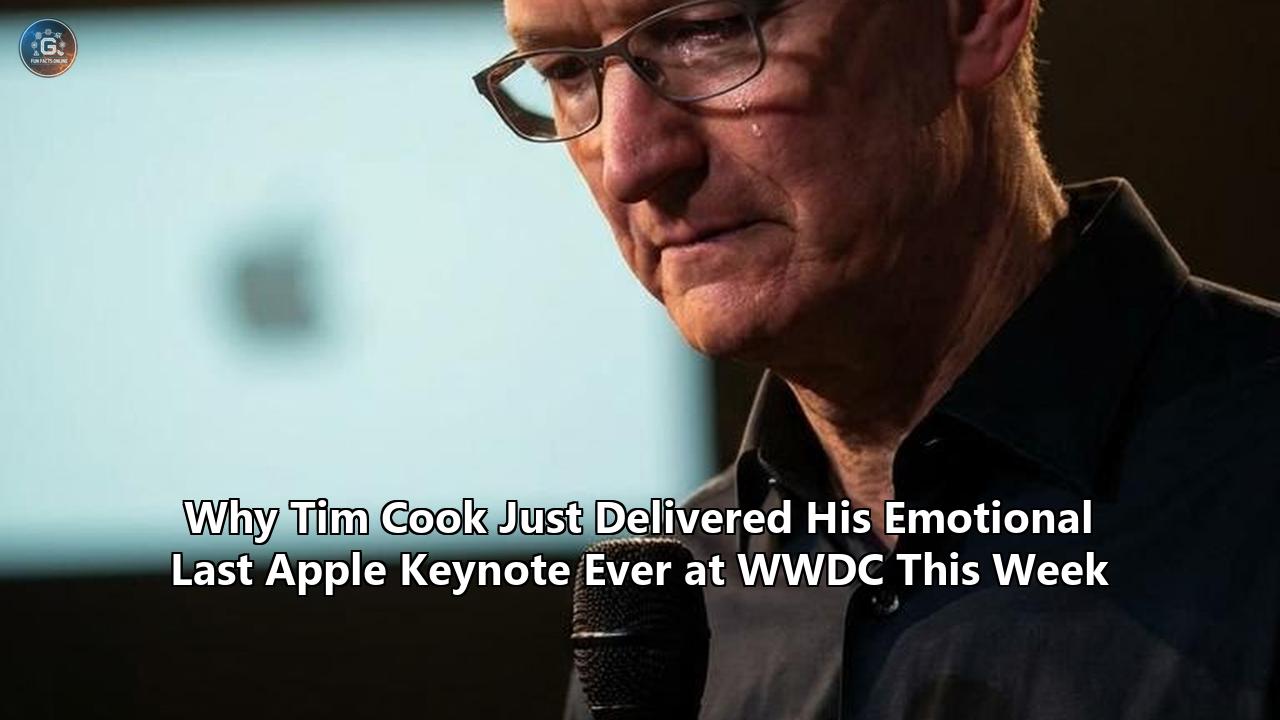
The atmosphere inside Apple Park’s Steve Jobs Theater on June 8, 2026, was unlike any other Worldwide Developers Conference (WWDC) in the company’s fifty-year history. The usual hum of excitement among the thousands of developers, engineers, and journalists was laced with a palpable sense of solemnity. As the lights dimmed to kick off the event, Craig Federighi, Apple’s Senior Vice President of Software Engineering, did not dive straight into the latest features of iOS 27 or macOS Golden Gate. Instead, he took a moment to introduce a man who has spent the last fifteen years transforming Apple from a highly successful consumer electronics company into a multi-trillion-dollar global empire.
Federighi called him "the man, the myth, the living legend".
When Tim Cook stepped onto the stage, the crowd erupted into a thunderous, minutes-long standing ovation. The emotional weight of the moment was clear. Having announced in April 2026 that he would officially step down as Chief Executive Officer on September 1, 2026, to transition to the role of Executive Chairman, this final Tim Cook Apple Keynote at WWDC represented a historic farewell. It was his final opportunity to address the global developer community that he has championed, protected, and monetized with unprecedented operational precision.
"I want to take a moment to express how important WWDC is to me personally and how deeply meaningful it has been to meet so many of our wonderful developers," Cook said, his voice carrying an uncharacteristic tremor. "Your imagination and ingenuity have inspired me for the past fifteen years, and I am deeply grateful to have been on this journey with you."
While Cook’s emotional send-off made headlines worldwide, the event itself was not merely a retrospective. It was a showcase of the technological and operational frameworks that Cook spent his tenure building. Underneath the sentimental goodbyes lay the real story: a massive, highly complex transition of Apple’s software architecture, design principles, supply chain logistics, and executive leadership.
To fully understand the gravity of why Cook chose this moment to take his final bow—and why the transition to his designated successor, John Ternus, is happening now—one must peel back the layers of technology, economics, and geopolitics that define the modern Apple.
Rebuilding the Brain: The Complex Science of Siri AI
The technical center of gravity for WWDC 2026 was the official rollout of Siri AI. For years, Apple faced criticism for lagging behind competitors in the generative artificial intelligence space. While rivals launched web-reliant chat interfaces, Apple quietly spent billions of dollars on research and development to build a fundamentally different kind of AI: one designed from the ground up to respect user privacy and operate directly on-device.
Siri AI, showcased during a historic Tim Cook Apple Keynote that was as much about the future of computing as it was about his legacy, is a total rewrite of Apple’s digital assistant. Rather than acting as a voice-to-text parser that routes basic commands to web search engines, Siri AI is now a standalone conversational application with system-wide agentic capabilities.
The Dual-Engine Architecture: On-Device vs. Cloud
The engineering behind Siri AI relies on a sophisticated hybrid execution model. Apple’s system divides tasks between an on-device local model and a remote, highly secure cloud infrastructure known as Private Cloud Compute (PCC).
- The On-Device Orchestrator: When a user inputs a query—either via voice or the new chatbot interface—a localized, highly quantized version of the Apple Foundation Model (AFM) processes the request. This on-device engine is optimized specifically for the Apple Silicon Neural Engine. Running a large language model (LLM) locally on a mobile device requires extreme computational efficiency to prevent thermal throttling and battery drain. Apple accomplishes this using 2-bit and 4-bit model quantization, compressing the parameter size without sacrificing the model's accuracy on daily tasks like reading emails, drafting text, or searching local photo libraries.
- Private Cloud Compute (PCC): For queries that exceed the computational limits of on-device hardware, the local orchestrator routes the request to Apple's PCC servers. These servers are powered by custom Apple Silicon chips (specifically M-series Ultra processors) designed to run server-side foundation models. What makes PCC unique in the industry is its cryptographic verification. No data is stored on disk, and Apple’s engineers cannot access the user data routed to these servers. Independent security researchers can cryptographically verify the code running on PCC, ensuring that user privacy remains absolute—a core tenet of the brand Cook cultivated during his tenure.
Agentic AI and the Semantic Index
The true paradigm shift in Siri AI is its agentic nature. Traditional voice assistants execute single, discrete commands, such as "Set an alarm for 7:00 AM." Siri AI is designed to understand personal context and execute multi-step workflows across different applications.
[User Request: "Summarize the project brief my manager emailed me yesterday and add the action items to my calendar."]
                         │
                         ▼
             [On-Device Semantic Index]
                         │
         ┌───────────────┴───────────────┐
         ▼                               ▼
 [App 1: Mail (Local)]        [App 2: Calendar (Local)]
  Reads & parses email         Schedules actions & checks conflicts
  via local AFM parser         using system-level API
         │                               │
         └───────────────┬───────────────┘
                         ▼
       [Siri AI Generates Response & Confirms]
This is made possible by the Semantic Index, a system-level database that constantly parses, categorizes, and maps relationships between the data stored on a user's device. The Semantic Index scans emails, text messages, calendar appointments, photos, and files, creating a localized vector database. When a user asks, "When does my mom's flight land, and who is picking her up?" Siri AI does not search the public web. It queries the Semantic Index, locates the flight confirmation email, scans the user's text thread with their sibling, matches the names, and delivers a highly accurate, personalized response.
Multi-Model Integration and Partner APIs
Recognizing that on-device models cannot compete with the sheer world-knowledge of massive, trillion-parameter web-scale models, Apple built a federated system. If Siri AI determines that a query requires deep, creative writing or vast encyclopedic knowledge, it offers the user the choice to route the query to external models.
At WWDC 2026, Apple demonstrated seamless, API-level integrations with both Google Gemini and Anthropic’s Claude. The developer interface does not require the user to log into separate apps or manage multiple subscriptions. Instead, Siri AI acts as the intelligent broker, passing queries to these external brains securely, stripping personal identifiers from the metadata before it leaves the Apple ecosystem.
Refining "Liquid Glass": The Physics of Modern UI
Beyond the internal logic of artificial intelligence, WWDC 2026 introduced substantial refinements to how users physically interact with Apple hardware. A key focus of the software keynotes was the maturation of Liquid Glass, the design language Apple introduced in 2025 to succeed the long-standing "flat" design paradigm that had dominated since iOS 7.
Liquid Glass is a user interface language built around the physics of light, refraction, and depth. Rather than presenting flat rectangles of color, Liquid Glass utilizes highly dynamic, translucent panels that respond to physical inputs and light sources. However, the initial rollout in 2025 received mixed reviews; many users complained of visual fatigue and readability issues in bright lighting conditions.
The Opacity Engine and Render Pipeline
To address these complaints, Apple’s software design teams spent the last year rebuilding the rendering engine that drives Liquid Glass. Introduced in iOS 27 and macOS Golden Gate, the updated design language now features an adaptive opacity engine.
[UI Layer (Text & Controls)]
───────────────────────────────────────────── (Dynamic Contrast Mapping)
[Adaptive Translucent Panel]  ◄─── [Opacity Control Layer]
───────────────────────────────────────────── (Real-time Refraction Shader)
[App Content / Wallpaper]
This engine relies on several key technical features:
- Real-Time Refraction Shaders: Every translucent panel in the operating system now calculates how background light passes through it. The system treats the panel as a physical sheet of custom-molded glass, mimicking real-world optical properties such as chromatic aberration and light scattering.
- The Opacity Slider: A new system-wide accessibility and aesthetic control allows users to adjust the physical transparency of the glass elements. This is not a simple alpha-channel adjustment; sliding the opacity control alters the computational complexity of the real-time blur shaders, allowing older hardware to conserve battery by rendering simpler, more opaque panels.
- Dynamic Contrast Mapping: To ensure legibility, the operating system continuously analyzes the background imagery beneath any text element. If a bright, white light source moves behind a semi-transparent panel, the rendering engine automatically shifts the text color and background contrast ratio to guarantee that the content remains readable, adhering strictly to modern accessibility standards.
By moving away from static assets and relying entirely on real-time physics-based rendering, Apple’s design language is preparing for a future where interfaces are not bound to flat glass screens but are projected onto the physical world via spatial computing hardware like the Vision Pro.
The Financial Masterclass: The Economics of the Cook Era
While the technical developments at WWDC 2026 are impressive, the backdrop of this transition is fundamentally economic. To understand why Tim Cook’s departure as CEO is such a monumental moment, one must analyze the staggering financial metrics that defined his fifteen-year reign.
When Cook took over from Steve Jobs in August 2011, Apple’s market capitalization was approximately $350 billion. By the time he walked onto the stage for his final Tim Cook Apple Keynote in June 2026, the company’s market cap had soared past $4 trillion—an astonishing increase of over 1,000%. Over the same period, Apple's annual revenue quadrupled, climbing from $108 billion in fiscal year 2011 to $416 billion by 2025.
Apple's Market Capitalization (2011 vs. 2026)
┌─────────────────────────────────────────────────────────────────┐
│ 2011 (Jobs to Cook Transition): $350 Billion                    │
├─────────────────────────────────────────────────────────────────┤
│ 2026 (Cook to Ternus Transition): $4.0+ Trillion                │
└─────────────────────────────────────────────────────────────────┘
How did an operations executive, widely dismissed by critics in 2011 as a "bean counter" incapable of matching Steve Jobs’ creative genius, engineer the most lucrative corporate expansion in human history? The answer lies in two highly deliberate, multi-year economic strategies: the scale of the Apple ecosystem and the creation of the Services division.
The Ecosystem Flywheel and Hardware Monetization
Tim Cook understood that Apple’s primary financial asset was not merely the physical iPhone, but the ecosystem lock-in that surrounded it. Rather than trying to invent a completely new product category every three years, Cook focused on optimizing the supply chain, reducing bill-of-materials (BOM) costs, and maximizing the lifetime value of every customer.
Under Cook’s leadership, Apple’s active installed base of devices grew from roughly 150 million in 2011 to over 2.2 billion active devices by 2026. This massive user base became a highly predictable, recurring source of revenue. The hardware became the entry point into a tightly controlled sandbox, and once a consumer purchased an iPhone, they were systematically guided into buying peripheral hardware like the Apple Watch, AirPods, and iPads, all designed to work best within the proprietary walled garden.
The Services Revolution
Cook’s most significant financial masterstroke was the creation and aggressive expansion of Apple’s Services division. In 2011, Apple’s software and internet services were largely seen as cost centers designed to sell hardware—MobileMe was a failure, and iTunes was a simple digital storefront. Cook saw a massive opportunity to monetize the installed base through recurring subscription fees.
By launching and scaling iCloud, Apple Music, Apple Pay, Apple TV+, Apple Arcade, and the App Store, Cook turned the Services division into a financial engine. To put this in perspective:
- In 2011, services revenue was negligible.
- By 2025, Apple’s Services division alone generated more than $100 billion in annual revenue.
- If the Services division were spun off into an independent company, its annual revenue would place it in the top 40 of the Fortune 500, larger than industrial giants like Boeing, Comcast, or Nike.
From an investment perspective, services revenue is far more valuable than hardware revenue. While physical product sales are subject to cyclical upgrade behaviors and supply chain disruptions, subscriptions provide predictable, monthly recurring revenue. Furthermore, the gross margins on Services are exceptionally high—hovering around 70% to 74%—compared to the 35% to 38% gross margins typical of Apple’s hardware products. This margin expansion is what ultimately drove Apple's valuation multiples from a modest 12x price-to-earnings (P/E) ratio in the early 2010s to over 30x by 2026.
The Capital Return Program
The final pillar of Cook’s financial legacy is his aggressive capital return program. Unlike Jobs, who famously preferred to hoard cash to protect Apple from potential economic downturns, Cook believed that excess capital belonged to the shareholders.
Under Cook, Apple initiated one of the largest share buyback programs in corporate history, spending more than $800 billion over fifteen years to purchase and retire its own stock. By reducing the total number of outstanding shares, Apple consistently boosted its earnings per share (EPS), driving stock prices up even during quarters where net income growth was flat. Combined with a steadily growing dividend, this capital allocation strategy made Apple stock the ultimate safe haven for institutional and retail investors alike, shielding the company from the volatility that plagued other Silicon Valley tech giants.
Supply Chain Sovereignty and Geopolitical Tightropes
While Tim Cook’s financial achievements are legendary, his true operational masterpiece was the construction of the world’s most efficient, resilient, and highly coordinated global electronics supply chain. For millions watching the Tim Cook Apple Keynote, the emotional core was his departure from the public stage; but for the global manufacturing and logistics sectors, the story was the culmination of his life's work in operations.
Before becoming CEO, Cook served as Apple’s Chief Operating Officer. His first major task under Steve Jobs was to dismantle Apple’s inefficient, in-house manufacturing plants and move production to contract manufacturers in Asia, primarily Foxconn and Pegatron in China. This move created the "just-in-time" supply chain that allowed Apple to operate with incredibly low inventory levels, turning over its warehouse stock every few days and maximizing cash flow efficiency.
The Geopolitical Pivot and the "China+1" Strategy
By the early 2020s, however, Cook’s highly concentrated supply chain became a massive liability. The combination of global pandemic shutdowns, escalating trade tensions between Washington and Beijing, and the constant threat of a conflict over the Taiwan Strait forced Apple to undertake one of the most complex industrial migrations ever attempted.
Under Cook’s direct supervision, Apple quietly executed its "China+1" strategy, diversifying its manufacturing footprint across South and Southeast Asia.
Apple's Global Manufacturing Shift (Historical Trend)
┌────────────────────────────────────────────────────────┐
│ 2011: ~95% Concentrated in Mainland China              │
├────────────────────────────────────────────────────────┤
│ 2026: Distributed among China, India, and Vietnam      │
└────────────────────────────────────────────────────────┘
The execution of this strategy has been highly complex:
- The India Expansion: Through partnerships with Foxconn, Pegatron, and Tata Electronics, Apple scaled up its assembly operations in India. By 2026, a significant percentage of all flagship iPhones are manufactured in state-of-the-art facilities in southern India, matching Chinese factories in both build quality and manufacturing yields.
- The Vietnam Ecosystem: Apple migrated the production of secondary devices—such as iPads, MacBooks, and AirPods—to industrial zones in northern Vietnam. This allowed Apple to leverage Vietnam’s proximity to China’s existing raw materials supply chain while establishing a separate sovereign manufacturing base.
- The Domestic Semiconductor Play: To comply with political pressure in the United States, Cook committed to sourcing advanced silicon from TSMC's multi-billion-dollar fabrication plants in Arizona, ensuring that the brains of future Macs and iPhones would have a domestic supply chain option.
The White House Diplomacy
Navigating this geopolitical tightrope required extraordinary diplomatic skill. While other tech CEOs publicly clashed with political leaders, Cook adopted a strategy of direct, pragmatic engagement.
A prime example of this occurred in August 2025. Facing the threat of sweeping tariffs on foreign-manufactured semiconductors, Cook visited the White House. Rather than issuing press releases, Cook met personally with political leadership and presented a custom glass plaque set in a 24-karat gold base made entirely from American-sourced materials.
During that visit, Cook announced a massive $100 billion expansion in Apple’s U.S. investment commitment, bringing the company’s total projected contribution to the domestic economy to $600 billion. This move secured crucial tariff exemptions for Apple's high-margin products, allowing the company to protect its hardware margins while competitors were forced to raise retail prices or absorb tariff costs. Cook’s ability to align Apple’s corporate interests with nationalistic economic policies on both sides of the Pacific is widely regarded by business historians as one of the greatest corporate diplomatic achievements of the modern era.
The Succession Plan: Enter John Ternus
As Tim Cook prepares to step back into the role of Executive Chairman on September 1, 2026, the tech industry is turning its attention to the man chosen to lead Apple into its next era: John Ternus.
Apple Executive Leadership Transition (September 1, 2026)
┌───────────────────────────────────────┐
│ Current CEO: Tim Cook                 │ ───► Transitions to Executive Chairman
├───────────────────────────────────────┤
│ Incoming CEO: John Ternus             │ ───► Currently SVP of Hardware Engineering
└───────────────────────────────────────┘
The choice of Ternus as successor is the result of a carefully orchestrated, multi-year succession plan designed by Apple's board of directors. Late last year, deliberate leaks to the Financial Times and Bloomberg served as trial balloons, letting Wall Street digest the idea of a change in leadership before the official announcement was made in April 2026. This deliberate, non-disruptive process stands in stark contrast to the chaotic leadership transitions seen at other major technology firms.
Who is John Ternus?
John Ternus is a 25-year Apple veteran, having joined the company’s product design team in 2001. In 2021, he was elevated to the role of Senior Vice President of Hardware Engineering, succeeding Dan Riccio.
Throughout his career at Apple, Ternus has been central to some of the company's most important product engineering achievements:
- The Apple Silicon Transition: Ternus oversaw the engineering work that successfully migrated Apple's entire personal computer lineup from Intel processors to custom, ARM-based Apple Silicon (the M-series chips). This transition remains one of the most successful execution triumphs in computer history, delivering dramatic improvements in performance-per-watt and unifying Apple’s software architecture across mobile, desktop, and tablet devices.
- The iPad Pro Redesign: Ternus championed the aesthetic and functional modernization of the iPad line, introducing the thin-bezel, flat-edge aluminum designs and pioneering the integration of high-refresh-rate ProMotion displays and Ultra Retina XDR tandem-OLED screens.
- The Mac Studio and Mac Pro: Under his guidance, Apple rebuilt its reputation with creative professionals by launching powerful, modular desktop computers that corrected the thermal and expandable-storage errors of the "trash can" Mac Pro era.
The Leadership Spectrum: Jobs vs. Cook vs. Ternus
Ternus represents a fascinating synthesis of the two iconic leaders who came before him. To understand what an Apple under Ternus will look like, it is helpful to analyze how his style compares across key executive dimensions:
| Dimension | Steve Jobs Era (1997–2011) | Tim Cook Era (2011–2026) | John Ternus Era (2026+) |
|---|---|---|---|
| Core Focus | Product, design, and user experience above all else. | Operational efficiency, supply chain, and global scaling. | Technical precision, hardware design, and platform integration. |
| Organizational Style | Highly centralized micromanagement, creative tension. | Collaborative, process-driven, structured, and long-term planned. | Team-oriented, design-focused, and engineering-led. |
| Presentation Style | Highly theatrical, charismatic, and emotionally charged. | Methodical, executive, structured, and deliberate. | Professional, relaxed, articulate, and product-focused. |
| Key Legacy | Creating the modern smartphone and personal computer. | Scaling the ecosystem to a $4T valuation and services dominance. | Integrating agentic AI and spatial computing into the physical world. |
Ternus is not a theatrical visionary in the mold of Steve Jobs, nor is he a pure logistics operator like Tim Cook. He is a deeply respected engineer who understands the physical properties of hardware at an atomic level. His design philosophy is defined by clean-cut, quiet precision—a trait that makes him highly popular among Apple’s rank-and-file engineers, who view his elevation as a return to Apple’s roots as a product-first engineering house.
Socio-Technical Implications: Privacy, Safety, and the Future of Mobile Interfaces
The announcements at WWDC 2026 went beyond core technology and corporate governance. They also highlighted a broader societal push regarding the ethics of personal computing. As AI agents become more deeply integrated into our daily lives, questions of privacy, data monetization, and child safety have moved to the center of global legislative and regulatory debates.
System-Level Child Safeguards
One of the most notable segments of the WWDC 2026 keynote was dedicated to a sweeping overhaul of Apple’s parental controls and child safety features. This was widely interpreted by analysts as a preemptive defense against tightening regulations on youth safety online.
                ┌────────────────────────────────┐
                │ Apple Account Creation (Under) │
                └───────────────┬────────────────┘
                                │
                        [Under 13 Years]
                                │ Mandatory Setup
                                ▼
         ┌──────────────────────────────────────────────┐
         │            System-Level Safe Mode            │
         ├──────────────────────────────────────────────┤
         │ • Hard Communication Limits (Whitelist Only) │
         │ • Kernel-Level Image/Video Content Filters   │
         │ • Automatic Screen Time Interventions        │
         └──────────────────────────────────────────────┘
The system includes:
- Mandatory Child Accounts: Anyone under the age of 13 must now operate under a system-level Child Account. These accounts can remain in place with parental overrides up to the age of 18.
- System-Level Communications Filtering: Parents and guardians can now define exactly who a child can contact via Phone, FaceTime, and Messages. Rather than setting up limits inside individual third-party apps, these communication restrictions are baked directly into the operating system’s kernel, applying automatically to any third-party communication software downloaded from the App Store.
- On-Device Content Scanning: Utilizing local machine learning models, the child's device automatically detects and blurs sensitive, age-inappropriate media within incoming messages, search queries, and web browsers, without transmitting any data back to Apple or law enforcement.
By integrating these controls at the system level rather than relying on application-layer restrictions, Apple is positioning its devices as the only viable "safe harbor" for parents concerned about their children’s digital wellbeing. This strategy reinforces the ecosystem's lock-in effect, particularly for entire families who must remain within the iOS and macOS environments to coordinate these safety nets.
Looking Ahead: The Looming Questions for Post-Cook Apple
The transition of leadership on September 1, 2026, marks the end of a golden era for Apple. When John Ternus steps onto the stage this fall to introduce the iPhone 18 Pro and the rumored foldable iPhone Ultra, he will do so under the intense scrutiny of a global financial market that has grown accustomed to the safety and predictability of Tim Cook's management.
As the tech world looks back at this final Tim Cook Apple Keynote, several crucial, forward-looking questions remain unanswered:
- Can Ternus Maintain the Valuation Multiple? Wall Street valued Apple under Cook not because of its creative leaps, but because of its incredibly stable, high-margin cash flows. If Ternus struggles to maintain the same level of operational discipline or if geopolitical shifts disrupt the new Asian manufacturing footprints, Apple's high P/E ratio could contract, erasing hundreds of billions of dollars in market value.
- The App Store Economics vs. Agentic AI: The traditional App Store business model relies on a 30% cut of individual app sales and in-app purchases. However, if Siri AI becomes the primary way users interact with their devices—performing complex multi-app tasks in the background without the user ever opening individual apps—what happens to the App Store's economics? If third-party developers become back-end API providers for Siri, Apple’s traditional monetization pipeline will have to be completely reinvented.
- The AI Monopolization and Antitrust Risk: By integrating Siri AI at the core of the operating system and using its own Semantic Index to choose which external models to query, Apple is walking into a regulatory minefield. Antitrust authorities in the United States, Europe, and Asia are already investigating whether Apple is using its platform dominance to freeze out independent AI applications and browser engines.
Tim Cook’s emotional farewell at WWDC 2026 was the grand finale of a corporate masterclass. He leaves behind a company that is more profitable, more globally dominant, and more deeply integrated into the fabric of daily human life than ever before. But as he takes his seat as Executive Chairman, he leaves John Ternus with a formidable task: guiding a legacy built on physical screens and global supply chains into a future defined by agentic intelligence and invisible computing.
The transition is now official. The stage is set, the software has been deployed, and the system is in motion. As Cook noted in his closing remarks to the crowd at Apple Park, "the best is still ahead at Apple." Now, it is up to the next generation of leadership to prove him right.
Reference:
- https://www.macworld.com/article/3154372/apple-event-wwdc-2026-live-blog.html
- https://mashable.com/tech/apple-wwdc-2026-keynote-live-updates
- https://www.pbs.org/newshour/economy/apple-unveils-new-ai-features-with-privacy-focus-at-last-developers-conference-with-ceo-tim-cook
- https://www.cnet.com/tech/services-and-software/tim-cook-live-speech-kicks-off-outgoing-ceos-last-wwdc-event/
- https://www.youtube.com/watch?v=UhGals1u8kU
- https://www.techradar.com/phones/we-asked-1-500-apple-fans-what-they-wanted-from-wwdc-2026-and-tim-cook-delivered-but-excitement-levels-waned-elsewhere
- https://9to5mac.com/2026/04/21/tim-cook-retirement-leak-worked-perfectly-in-predicting-reactions/
- https://www.phonearena.com/news/apple-wwdc-missed-perfect-opportunity-to-send-off-ceo-tim-cook_id181074
- https://en.wikipedia.org/wiki/Tim_Cook
- https://tickernews.co/tim-cook-to-step-down-as-apple-ceo-in-2026/
- https://www.engadget.com/2189698/everything-announced-at-apples-wwdc-2026-keynote/
- https://aldailynews.com/apple-expected-to-unveil-new-ai-features-at-last-developers-conference-with-ceo-tim-cook/
- https://9to5mac.com/2026/06/08/how-to-watch-apples-wwdc-keynote-ios-27-new-siri-and-more/
- https://uk.pcmag.com/mobile-phones/165234/how-to-watch-apples-wwdc-2026-keynote-siris-biggest-test-yet
- https://www.youtube.com/shorts/kmGZ8tlQM_8