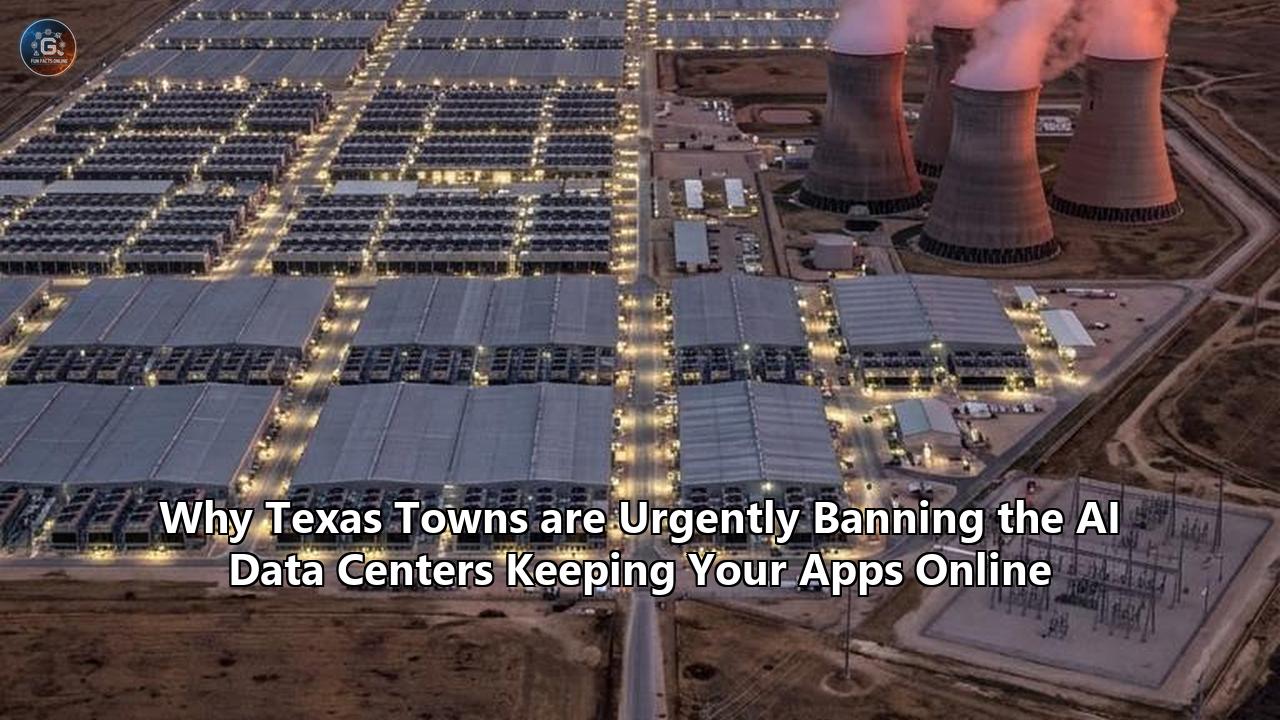
On June 16, 2026, the city council of San Marcos, Texas, gathered for a vote that would reverberate through the boardrooms of Silicon Valley. In a tight 4-3 decision, the municipality amended its Land Development Code and Design Manual to create a first-of-its-kind ordinance: an outright ban on data center developments within city limits.
The decision was not made because San Marcos is anti-technology. Rather, local officials realized that the massive computer warehouses keeping America's smartphones, streaming apps, and artificial intelligence models online were threatening to consume the very resources keeping their town alive.
This local revolt is not an isolated incident. Across the Lone Star State, communities that once rolled out the red carpet for Big Tech are slamming the door. On July 9, 2026, five Fort Worth City Council members signed a joint letter calling for an emergency 90-day moratorium on all new data center developments.
A few weeks prior, rural Hill County attempted to pass its own one-year pause on construction, only to be hit with a staggering $100 million federal lawsuit by developer RCM Hill LLC. Even the state's highest office has undergone a dramatic about-face. Governor Greg Abbott, who in late 2025 praised Texas as the "epicenter of AI development," spent the summer of 2026 demanding bans on rural AI data centers and stripping them of state tax exemptions.
How did Texas—a state globally famous for its cheap land, deregulation, and business-friendly climate—become the frontline of a fierce war against the physical infrastructure of the internet?
The answer lies at the intersection of a massive technological transition, the fragile physics of an isolated power grid, the geology of depleted aquifers, and a quiet sonic invasion that is making rural residents physically ill.
The Silicon Gold Rush: From Simple Clouds to Thirsty AI
To understand why Texas towns are panicking, it is necessary to demystify what a data center actually is. For the average smartphone user, "the cloud" is an abstract, clean concept. It is the invisible place where photos are backed up, emails are archived, and social media feeds are generated.
In physical reality, the cloud is exceptionally heavy, loud, and hot. It consists of sprawling, windowless concrete warehouses, often covering hundreds of acres, packed with row after row of server racks. These servers run continuously, processing trillions of data packets every second.
For over a decade, traditional cloud data centers were highly coveted by local governments. They were clean, quiet neighbors that generated substantial property tax revenue while demanding very little from municipal services like schools, police, or road maintenance. But the rise of generative artificial intelligence has completely rewritten the physical footprint of these facilities.
Traditional data centers host CPU-based servers designed to handle sequential tasks: loading a webpage, processing a credit card transaction, or hosting a video. These servers are relatively energy-efficient. A typical server rack in a traditional cloud data center consumes between 5 and 15 kilowatts (kW) of power.
AI data centers are entirely different beasts. Training and running large language models requires parallel processing at an unprecedented scale. This work is done by specialized Graphics Processing Units (GPUs), such as Nvidia's H100, H200, and Blackwell architectures.
These chips run at blistering speeds and require astronomical amounts of electricity. A single rack of AI servers can easily draw 40 to 100+ kW of power. When thousands of these racks are packed into a single facility, the power demand shifts from the megawatt (MW) scale to the gigawatt (GW) scale.
This energy consumption creates a secondary, highly physical challenge: heat. Under normal operating conditions, a high-density AI chip converts almost 100% of its electrical input into thermal energy. If that heat is not dissipated immediately, the microprocessors will melt and fail within seconds.
To prevent this, data centers must employ massive, industrial-scale cooling systems. The primary, cheapest, and historically most common method is evaporative cooling.
[Electricity Input (Megawatts)] ──> [AI Server Racks (Silicon GPUs)]
                                               │
                                               ▼  (Generates Extreme Heat)
[Water-Intensive Evaporative Cooling] <────────┘
        │
        ├─> [Water Loss via Evaporative Vapor (Millions of Gallons/Day)]
        └─> [Chemical Runoff / Biocides Discharged into Local Watersheds]
In an evaporative cooling system, warm air from the server rooms is pulled through water-saturated media. As the water evaporates into the air, it absorbs the heat, and the cooled air is pushed back into the server rooms.
The hot, moist air is then exhausted into the atmosphere through giant cooling towers. While highly effective at keeping servers cool, this process is incredibly thirsty.
The Hydrological Crisis: Drinking Water vs. Chatbots
The sheer volume of water consumed by these facilities has become a primary driver of the local bans. According to state infrastructure data compiled by the Houston Advanced Research Center (HARC), Texas data centers consumed approximately 25 billion gallons of water in 2025. Driven by the AI infrastructure boom, that number is projected to skyrocket to as much as 161 billion to 399 billion gallons annually by 2030.
To put 399 billion gallons into perspective, it is nearly eight times the total annual residential water consumption of the entire city of San Antonio.
A single large-scale, hyperscale AI data center can consume between 1 million and 5 million gallons of water every single day. That is equivalent to the daily water needs of a town of 10,000 to 50,000 residents.
In a state like Texas, which is grappling with a multi-year, climate-fueled drought, this consumption is a direct threat to municipal survival.
Data Center Water Consumption vs. Municipal Equivalents (Daily)
┌──────────────────────────────────────────────┐
│ Hyperscale AI Data Center: 5,000,000 Gallons │
├──────────────────────────────────────────────┤
│ Town of 50,000 Residents:  5,000,000 Gallons  │
└──────────────────────────────────────────────┘
The situation in San Marcos highlights this ecological tension. The city sits directly atop the Edwards Aquifer, a highly sensitive karst limestone aquifer that serves as the primary drinking water source for over two million Central Texans. The aquifer also feeds the local springs that sustain endangered species and power a vibrant tourism economy.
"We are looking at a future where we are going to be rationing water for human beings while a windowless warehouse down the road gets millions of gallons of freshwater to keep a chatbot running," says Carlos Rubinstein, a water consultant and former commissioner of the Texas Commission on Environmental Quality.
The problem is exacerbated by a severe lack of regulatory transparency. Texas law does not currently require data center developers to disclose their projected water usage before they begin operations. Tech companies routinely demand that local economic development corporations sign strict Non-Disclosure Agreements (NDAs), preventing local citizens and even some city council members from knowing how much water a proposed project will consume until the contracts are already signed.
Furthermore, the water used in evaporative cooling is not returned to the local watershed. It is evaporated into the sky and carried away by wind currents, resulting in a total net loss to the local water table.
The wastewater that is discharged from these facilities is often treated with heavy doses of biocides—chemicals like chlorine and bromine used to prevent algae and bacterial growth in the cooling towers—creating additional concerns about local water pollution.
Some developers are attempting to build in more arid regions of West Texas, where land is cheap and flat. However, the aquifer systems there, such as the Edwards-Trinity Aquifer, are even more depleted.
When Fermi America (an AI firm cofounded by former Texas Governor Rick Perry) announced plans to build an 18-million-square-foot AI data center campus in Amarillo on 5,800 acres, local water managers were stunned by the scale. Even closed-loop systems, which recycle water internally, require millions of gallons of water just to fill the systems at startup.
The ERCOT Grid Crisis: From Megawatts to Gigawatts
The second major catalyst for the urgent local bans is the fragile state of the Texas electric grid. Unlike every other state in the contiguous United States, Texas operates its own isolated power grid, managed by the Electric Reliability Council of Texas (ERCOT). Because the grid does not cross state lines, it largely avoids federal regulation by the Federal Energy Regulatory Commission (FERC).
However, this isolation means Texas cannot easily import electricity from neighboring states during times of emergency—a vulnerability that became tragically apparent during Winter Storm Uri in 2021, when grid failures left millions without power and resulted in hundreds of deaths.
In the years since that disaster, ERCOT has struggled to keep up with the state's booming population and industrial growth. The arrival of AI data centers has pushed the system to its absolute limit.
In early 2026, ERCOT officials released a set of demand forecasts that shocked energy analysts. Historically, grid planners prepared for a steady, incremental growth in peak demand.
As of mid-2026, developers had submitted formal requests to connect projects representing a mind-boggling 439 gigawatts (GW) of future electricity demand to the ERCOT grid.
ERCOT Grid Demand Comparison (Gigawatts)
┌────────────────────────────────────────────────────────┐
│ Current ERCOT Record Peak Demand (Aug 2023):  85.5 GW  │
├────────────────────────────────────────────────────────┤
│ Total Pending Interconnection Requests:      439.0 GW  │ (5x Current Record!)
└────────────────────────────────────────────────────────┘
For context, the highest peak demand ever recorded on the Texas grid was 85.5 GW, set during a historic heatwave in August 2023. The pending requests represent more than five times the total record capacity of the entire Texas grid. According to ERCOT, roughly 89% of these massive "large load" requests come directly from data centers.
"Our existing process really was not designed for the volume of large load interconnection requests that we have been experiencing," admitted Jeff Billo, ERCOT's vice president of interconnection and grid analysis, during a board meeting.
Under the historical "first-come, first-served" system, transmission service providers would study each data center's grid connection request individually. But when hundreds of gigawatts of requests arrived simultaneously, the system collapsed.
Each individual study assumed a static grid background, but because so many projects were applying at once, the underlying assumptions of the studies were constantly shifting and invalidating one another.
The Regulatory Redesign: "Batch Zero"
To prevent a total systemic failure of the grid interconnection queue, ERCOT and the Public Utility Commission of Texas (PUCT) took emergency action in June 2026. They approved a new, highly restrictive regulatory framework known as Batch Zero.
Instead of evaluating projects individually, ERCOT is grouping all qualified large-load interconnection requests (facilities requiring 75 MW or more) into a single, system-wide transitional study. Under Nodal Protocol Revision Request 1325 (NPRR 1325) and Planning Guide Revision Request 145 (PGRR 145), any data center participating in Batch Zero must agree to strict new operational constraints:
- Mandatory Registration: Every large load must be fully registered and visible to ERCOT grid operators, ending the practice of hiding behind local retail electric providers.
- Real-Time Dispatchability: Data centers must be able to curtail their power usage instantly when directed by ERCOT during grid emergencies.
- Ramp Rate Compliance: Facilities cannot instantly turn on or off gigawatts of demand; they must ramp their power consumption up or down slowly to avoid destabilizing grid frequency.
The Batch Zero process is designed to weed out speculative projects and prioritize developers with serious capital and completed engineering plans. However, it also means that many planned data centers are now facing multi-year delays, pushing their operational dates past 2030.
The Sonic Invasion: The Physical Sickness of the Hum
While water scarcity and grid reliability dominate the macro-economic debates, local communities are often driven to pass urgent bans by a much more visceral, inescapable threat: noise pollution.
A data center is not a silent warehouse. To keep thousands of high-density AI servers cool, these facilities require massive banks of industrial exhaust fans, air chillers, and cooling towers, as well as rows of megawatt-scale diesel backup generators and gas turbines to protect against grid outages. This machinery runs 24 hours a day, 365 days a year.
The result is a relentless, low-frequency mechanical hum that can travel for miles, bypassing traditional walls and windows.
Data Center Acoustic Profile
┌──────────────────────────────┬──────────────────────────────────────────┐
│ Audible Noise (Up to 96 dB)  │ Fans, cooling towers, backup generators.  │
├──────────────────────────────┼──────────────────────────────────────────┤
│ Infrasound (< 20 Hz)         │ Unaudible but physically felt as kinetic │
│                              │ pressure; causes inner-ear imbalance.    │
└──────────────────────────────┴──────────────────────────────────────────┘
Unlike normal urban noise, which rises and falls with traffic patterns, data center noise is perfectly flat and continuous. In Brazoria County, Texas, residents living near a six-acre computing site operated by Giga Energy describe a living nightmare.
"The noise rattles you to the core 24/7," wrote local resident Melissa Burnett. Another neighbor, Kimberly Fortenberry, lamented that her family spent years building their dream home, only for an AI computing facility to destroy their peace. "We can’t even sit on the back porch without the constant noise," she wrote, describing the developer's installed sound walls as completely useless.
The Danger of Infrasound
The acoustic profile of a data center contains a hidden hazard: infrasound. This is low-frequency sound below 20 Hertz, which sits below the threshold of human hearing.
Even though residents cannot "hear" infrasound, their bodies physically register it as atmospheric pressure waves and physical vibrations.
Medical researchers have documented that prolonged exposure to high-volume infrasound can disrupt the vestibular system of the inner ear, leading to a suite of physiological symptoms collectively referred to as "vibroacoustic disease."
In Granbury, Texas, a Bitcoin mining and computing facility hosting over 60,000 high-speed computers was built less than 100 yards from a residential mobile home park. Within months of its activation, local clinics were overwhelmed by residents presenting with a bizarre cluster of identical symptoms:
- Constant, unexplained vertigo and loss of balance.
- Severe, debilitating migraines and chronic headaches.
- Insomnia, night terrors, and panic attacks caused by the constant vibration of bedroom walls.
- Fluid discharging spontaneously from the ears of both adults and children.
- Elevated blood pressure and chronic cardiovascular stress.
A 2026 investigation by Time Magazine validated these residents' complaints, linking their ailments directly to the stress of continuous noise and infrasound pollution.
The regulatory landscape offers virtually no protection for these citizens. The United States has not had a federal agency dedicated to noise control since the EPA’s Office of Noise Abatement and Control was completely defunded in 1981.
This leaves noise enforcement entirely to municipal and county governments. Most rural Texas counties do not own the specialized acoustic equipment required to measure low-frequency infrasound, nor do they have the legal frameworks to enforce limits on multi-billion-dollar technology firms.
"I don't want to be by a data center," says Kaesha Avishai, a retired nurse living in Lufkin, Texas, who discovered that a developer had quietly purchased land near her home for a massive computing complex. "I don't want to hear the buzz, the hum."
Avishai was so desperate to protect her homestead that she used ChatGPT to write a speech protesting the development, delivering it to her county commissioners. "The irony of using their own AI weapons against them wasn't lost on me," she said.
The Legal Chessboard: Why Cities Can Ban but Counties Get Sued
As public anger has boiled over, local governments have scrambled to find ways to halt these developments. However, they have run headfirst into a complex, highly lopsided legal framework governed by the Texas Local Government Code.
In Texas, the ability to regulate land use depends entirely on whether a local government is a "Home-Rule City" or a county.
Texas Jurisdictional Power Gap
┌──────────────────────────────────────────────┐
│ Home-Rule Cities (Population > 5,000)        │
│ ─> Broad zoning powers                       │
│ ─> Can write land-use codes to ban projects │
├──────────────────────────────────────────────┤
│ Texas Counties (Administrative Arms)          │
│ ─> No general zoning authority               │
│ ─> Vulnerable to $100M+ civil lawsuits       │
└──────────────────────────────────────────────┘
Home-Rule Cities: The Zoning Shield
Under the Texas Constitution, cities with a population of more than 5,000 residents can adopt a "Home-Rule" charter. This status grants them immense self-governing authority. Essentially, a home-rule city can pass any ordinance or regulation as long as it is not explicitly prohibited by state or federal law.
Most importantly, home-rule cities possess zoning authority. They can divide their territory into residential, commercial, and industrial zones, and they can legally dictate what types of businesses are allowed to operate in those zones.
This is the legal mechanism San Marcos used to execute its ban. By formally defining "data centers" in its Land Development Code and rendering them an ineligible land use in every single zoning category across the entire city, San Marcos legally shut the door.
Because the city has the constitutional right to manage its own zoning, legal experts believe its ban is highly likely to survive the inevitable court challenges from developers.
Counties: The Unarmed Regulators
Texas counties exist in a completely different legal reality. Unlike cities, counties are considered administrative arms of the state. They have no home-rule authority and can only exercise powers that are explicitly and narrowly granted to them by the Texas Legislature.
Most crucially, Texas counties have zero general zoning authority. They cannot dictate what a private landowner does with their property in unincorporated areas—which is precisely where nearly half of all planned Texas data centers are now being proposed.
This power disparity was illustrated in the summer of 2026 in Hill County. Spurred by furious residents who were terrified of a proposed 300-acre AI data center project in north Hillsboro, county commissioners voted 3-2 to enact a one-year moratorium on all data center construction in unincorporated areas.
The victory was incredibly short-lived. Just two weeks later, the developer, RCM Hill LLC, filed a federal lawsuit against Hill County in Austin, demanding $100 million in damages. The lawsuit argued that the county had "exceeded its lawful powers" under the Texas Local Government Code because counties have no statutory right to issue development moratoriums or regulate land use in this manner.
Recognizing that a $100 million judgment would completely bankrupt the county, the commissioners held an emergency meeting and voted unanimously to rescind the moratorium.
They replaced the ban with a weak, legally fragile "checklist" of voluntary developer guidelines. State Senator Paul Bettencourt further squeezed counties by requesting a formal opinion from the Texas Attorney General, Ken Paxton, on whether county-level restrictions are illegal, effectively freezing other county commissioners from taking similar action.
Who Pays? The Hidden Ratepayer Tax
The battle over data centers is not just about local noise or water; it is a high-stakes economic fight over who pays to upgrade the electrical grid.
When a massive industrial user—like an AI data center requiring 500 megawatts of power—wants to connect to the grid, it cannot simply plug into a standard neighborhood power line.
Connecting these facilities requires the construction of massive, high-voltage transmission lines, brand-new electrical substations, and upgraded grid-stabilizing equipment.
Historically, under ERCOT rules, the cost of building these massive transmission upgrades was socialized. The developer paid a small portion, but the vast majority of the capital expenditure was folded into the "Transmission and Distribution" charges of every single electricity bill in the state.
This meant that a retired grandmother in Houston or a school teacher in Lubbock was actively subsidizing the grid infrastructure required to power a tech giant's AI models.
As these numbers reached the billions, the economic unfairness sparked a fierce political backlash. In April 2025, Texas regulators approved a massive $13.8 billion 765-kilovolt transmission strategy. This represents the first extra-high-voltage transmission backbone in ERCOT history, designed specifically to move power from remote generation areas to the massive industrial loads of the Permian Basin and the new data center clusters.
To prevent these costs from being offloaded onto everyday citizens, the state has entered a new phase of AI data center regulations.
Utility Cost Distribution: Old vs. Proposed AI Data Center Regulations
┌────────────────────────────────────────────────────────┐
│ Historical Model (Socialized Cost):                   │
│ ─> Developer pays minimal connection fees              │
│ ─> 90% of grid upgrades paid by all Texas ratepayers   │
├────────────────────────────────────────────────────────┤
│ Proposed Regulations (User-Pays Model):                │
│ ─> Developer must fully fund local transmission lines  │
│ ─> Developer must secure/fund dedicated new generation │
└────────────────────────────────────────────────────────┘
Under direct orders from Governor Abbott, the Public Utility Commission of Texas is drafting a suite of strict AI data center regulations. The core principle of these new rules is a "user-pays" model:
- Data centers must fully fund 100% of the transmission infrastructure required to serve their operations.
- Developers cannot pass connection costs onto residential ratepayers.
- Tech companies must pay for the physical substations and high-voltage lines needed to reach their remote facilities.
Stripping the Tax Breaks
Simultaneously, state leaders are moving to eliminate the highly lucrative tax incentives that lured these companies to Texas in the first place.
For years, the state offered massive sales-and-use tax exemptions on the purchase of expensive computers, software, cooling systems, and electricity under the state's tax code.
These exemptions allowed tech companies to save hundreds of millions of dollars on every single campus they built.
In his summer 2026 policy recommendations, Governor Abbott called for the complete elimination of these tax exemptions for data centers. "These companies are no longer providing a net benefit to our state that justifies these handouts," Abbott argued during a campaign stop in Bullard, Texas. "They must be responsible for funding their own projects here in Texas. If you want to build an AI data center, you must bring your own money, bring your own power, and reuse your own water."
The "Bring Your Own Power" Paradox and the Fossil-Fuel Boom
Faced with tightening AI data center regulations and massive delays in connecting to the ERCOT grid, tech companies have turned to a new strategy: co-location and self-generation.
Often referred to as the "Bring Your Own Power" (BYOP) model, developers are attempting to bypass the public grid entirely by building their own dedicated power plants directly next to their data centers.
While this sounds like a logical solution, it has created a massive environmental and regulatory paradox.
Almost every major technology hyperscaler—including Microsoft, Google, Meta, and Amazon—has highly publicized, legally binding corporate pledges to become "carbon neutral" or "carbon negative" by 2030. They run marketing campaigns showcasing their investments in wind farms and solar arrays.
But wind and solar are intermittent; they do not blow or shine 24 hours a day, whereas AI training models must run continuously. To secure the reliable, round-the-clock "baseload" power required for AI, these companies are driving a massive boom in fossil-fuel generation.
According to a July 2026 report by the Environmental Integrity Project, there are currently at least 74 massive, natural gas-fired power plants planned across the United States designed to supply electricity directly to data centers.
Texas is the absolute epicenter of this fossil-fuel resurgence, hosting 32 of these 74 planned gas plants.Planned Data Center-Dedicated Gas Plants (By State)
┌──────────────────────────────────────────────┐
│ Texas: 32 Gas Plants │
├──────────────────────────────────────────────┤
│ Rest of U.S.: 42 Gas Plants │
└──────────────────────────────────────────────┘These 32 proposed Texas facilities—planned for counties like Comal, Bexar, Pecos, and Caldwell—are projected to emit more than 287 million tons of greenhouse gases annually. That is equivalent to the tailpipe emissions of 61 million gasoline-powered cars driving for an entire year, completely erasing decades of state and corporate carbon-reduction progress.
"This is the great hypocrisy of the AI boom," says Neha Gour, an infrastructure researcher. "These companies claim they are building a green digital future, but behind the curtain, they are constructing dozens of heavy-polluting, natural gas combustion turbines to power their algorithms. And because these plants are built on-site, the air pollution and toxic emissions are dumped directly onto the local communities living next door."
The Co-Location Threat to Public Reliability
For developers who do not want to build their own gas plants, the alternative is "co-location". In a co-location arrangement, a data center is built directly adjacent to an existing power plant (such as a nuclear or large gas facility) and buys electricity directly from the generator before it ever reaches the public grid.
This practice has deeply alarmed ERCOT and state lawmakers. Because the power is consumed directly on-site by the data center, that electricity is effectively removed from the pool of resources available to serve everyday Texans.
During a scorching summer heatwave or a freezing winter storm, a 1,000-megawatt nuclear plant that once kept 200,000 homes warm might now be fully dedicated to training an AI model, leaving the public grid highly vulnerable to rolling blackouts.
The Road to the 2027 Legislative Session
The battle lines are now clearly drawn. As the state moves toward the upcoming biennial Texas Legislative Session, which begins in January 2027, the future of the internet’s physical infrastructure is hanging in the balance.
Key Legislative Battles to Watch (Jan 2027 Session)
┌────────────────────────────────────────────────────────┐
│ 1. County Zoning Rights: Will commissioners get land-  │
│    use authority?                                      │
├────────────────────────────────────────────────────────┤
│ 2. Tax Incentive Repeals: Will state sales tax         │
│    exemptions be stripped?                             │
├────────────────────────────────────────────────────────┤
│ 3. Water Disclosure Mandates: Will developers be       │
│    forced to reveal consumption?                       │
└────────────────────────────────────────────────────────┘
Several legislative committees are already holding interim hearings to draft comprehensive, statewide AI data center regulations. Key legislative priorities for the 2027 session include:
- County Land-Use Authority: Empowering rural counties with limited zoning or land-use authority specifically to regulate the location of heavy industrial data centers and protect residential neighborhoods.
- Mandatory Water Disclosures: Forcing developers to publicly disclose their projected water consumption, cooling methodologies, and source aquifers before receiving construction permits.
- The Elimination of Tax Exemptions: Formally repealing the sales-and-use tax exemptions that save tech giants billions of dollars at the expense of state revenues.
- Strict Noise and Infrasound Limits: Establishing statewide decibel and low-frequency vibration limits for data centers, backed by stiff financial penalties and shut-down orders for non-compliant facilities.
Until the legislature meets, the battle will continue to play out in tense city hall meetings and county commissioners' courts across the state. Home-rule cities will continue to use San Marcos as a blueprint, rewriting their land-use codes to shut out developers.
Counties will try to find clever legal workarounds—such as inserting strict water and energy restrictions into local road-use or economic incentive agreements—to protect their communities without triggering devastating developer lawsuits.
This conflict exposes a fundamental paradox of modern life. We have built a society that demands instant app connectivity, unlimited high-definition video streaming, and flawless, real-time artificial intelligence. We want the digital world to be infinite and instantaneous.
But as the towns of Texas are discovering, the digital world is not virtual. It is deeply physical. It is made of steel, concrete, roaring fans, and thirsty cooling towers. And as long as we demand an infinite cloud, our communities will have to fight to protect the very finite soil, water, and quiet under our feet.
References
- --- Texas Tribune: San Marcos becomes the first Texas city to ban data centers within city limits, utilizing home-rule zoning powers (June 30, 2026).
- --- The Real Deal: Fort Worth City Council members join statewide pushback, calling for a moratorium on data center developments (July 10, 2026).
- --- The University Star: San Marcos updates Land Development Code to prohibit data centers; counties face legal restrictions (July 7, 2026).
- --- Bond Buyer: Governor Greg Abbott demands data centers bring their own power and water, directs PUCT to protect residential ratepayers (July 7, 2026).
- --- Route Fifty: Hill County rescinds data center moratorium after being hit with a $100 million lawsuit by developer (June 8, 2026).
- --- WFAA-TV: Fort Worth City Council considers 90-day moratorium after zoning commission rejects proposed regulations (July 8, 2026).
- --- Texas Farm Bureau: Rural landowners and agricultural groups raise alarms over data centers' massive resource consumption (July 6, 2026).
- --- The Daily Signal: Governor Abbott calls for blocking AI data centers in rural neighborhoods and stripping their tax breaks (July 8, 2026).
- --- Texas Tribune: ERCOT large-load queue reaches unprecedented levels, forcing shift to "Batch Zero" vetting process (June 17, 2026).
- --- Data Center Knowledge: Texas regulators approve $13.8 billion 765-kilovolt transmission strategy to accommodate AI-era demand (July 6, 2026).
- --- Texas Tribune / Environmental Integrity Project: 32 planned gas-fired power plants in Texas to supply electricity directly to data centers (July 1, 2026).
- --- Houston Chronicle: Over 480 large data centers request grid connections, seeking five times ERCOT's current record peak demand (June 8, 2026).
- --- TechRadar / AI Weekly: Low-frequency hum and infrasound from AI data centers causing physical illness and distress in Granbury, Texas (June 28, 2026).
- --- EESI / Reddit: Relentless noise pollution from cooling fans and generators sparks outrage in Brazoria County (May 17, 2026).
- --- Texas Tribune / Time Magazine: East Texans in Lufkin stand against proposed data centers over noise and land degradation (July 9, 2026).
- --- Nature Forward: Data centers' water consumption patterns, lack of transparency, and use of chemical biocides (February 4, 2026).
- --- Aquaria.world: Edwards Aquifer under severe threat as Texas data center water demand is projected to hit 399 billion gallons by 2030 (March 28, 2026).
- --- MyEldorado.net: Arid West Texas aquifers challenged by new data center projects; Fermi America Amarillo project details (October 1, 2025).
- --- Texas Observer:* Gaps in state water planning as Texas does not require tech firms to disclose projected water consumption (February 4, 2026).
Reference:
- https://www.texastribune.org/2026/06/30/texas-san-marcos-data-center-ban-zoning-laws/
- https://universitystar.com/35871/news/san-marcos-becomes-first-city-in-texas-to-prohibit-data-centers/
- https://www.wfaa.com/article/news/politics/fort-worth-city-council-data-center-moratorium/287-cab25e36-e0d9-4a15-bd66-89e6b7fb2a2d
- https://www.route-fifty.com/artificial-intelligence/2026/06/texas-county-rescinds-its-data-center-moratorium-after-100-million-lawsuit-developer/414022/
- https://www.texastribune.org/2026/06/05/texas-hill-county-moratorium-rescinded-data-centers/
- https://www.dailysignal.com/2026/07/08/abbott-calls-for-data-center-ban/
- https://myeldorado.net/stories/data-centers-and-their-growing-thirst-for-water-raise-concerns-for-states-aquifers,123017
- https://www.texastribune.org/2025/09/25/texas-data-center-water-use/
- https://www.eesi.org/articles/view/data-centers-and-water-consumption
- https://www.fwpcoa.org/content.aspx?page_id=5&club_id=859275&item_id=130961
- https://www.houstonchronicle.com/business/energy/article/ercot-grid-data-centers-22286592.php
- https://www.aquaria.world/blog-posts/the-edwards-aquifer-is-running-low-data-centers-keep-moving-in
- https://www.texasobserver.org/texas-ai-data-centers-water-usage-regulation/
- https://natureforward.org/data-centers-and-water-use/
- https://www.brookings.edu/articles/ai-data-centers-and-water/
- https://www.tpr.org/news/2026-04-29/greater-edwards-aquifer-authority-report-sounds-the-alarm-over-proposed-data-centers-in-texas
- https://www.texastribune.org/2026/06/17/texas-ercot-data-center-energy-grid/
- https://www.texastribune.org/2026/07/01/texas-data-center-power-plans-emissions/
- https://www.ercot.com/news/release/06182026-puct-approves-ercots
- https://www.willkie.com/-/media/files/publications/2026/06/ercot-approves-implementing-new-batch-zero-process-for-large-load-interconnections.pdf
- https://keentelengineering.com/batch-zero-ercot-large-load
- https://www.seyfarth.com/news-insights/ercots-batch-zero-proposal-and-what-it-means-for-large-load-projects-in-texas.html
- https://therealdeal.com/texas/2026/07/10/fort-worth-council-members-call-for-data-center-moratorium/
- https://www.reddit.com/r/texas/comments/1tfu2f8/texans_say_ai_boom_sounds_like_a_washing_machine/
- https://aiweekly.co/alerts/ai-data-centers-inaudible-hum-is-sickening-nearby-residents
- https://www.thecooldown.com/green-tech/data-centers-noise-pollution-texas-communities-impact/
- https://www.kiiitv.com/article/news/local/contractor-says-525-acre-data-center-wont-create-noise-issues-but-researcher-urges-public-scrutiny/503-88f8f723-8c1a-4158-84be-9d3d428b4270
- https://www.newsfromthestates.com/article/data-center-proposed-quiet-corner-east-texas-leaves-community-bracing-boom
- https://www.texastribune.org/2026/06/30/texas-abbott-data-center-development-ban-rural-communities/
- https://www.texastribune.org/2026/05/12/texas-hill-county-approves-data-center-construction-pause-ai/
- https://www.tomshardware.com/tech-industry/big-tech/texas-county-passes-data-center-moratorium-for-a-year-follows-other-local-governments-pausing-similar-projects-but-state-senator-says-counties-cannot-impose-these-bans
- https://www.datacenterknowledge.com/energy-power-supply/how-ercot-s-post-crez-bet-is-reshaping-ai-infrastructure
- https://www.bondbuyer.com/news/data-center-boom-faces-scrutiny-litigation-in-southwest
- https://www.newsweek.com/maps-data-centers-areas-where-power-grids-struggling-12152061