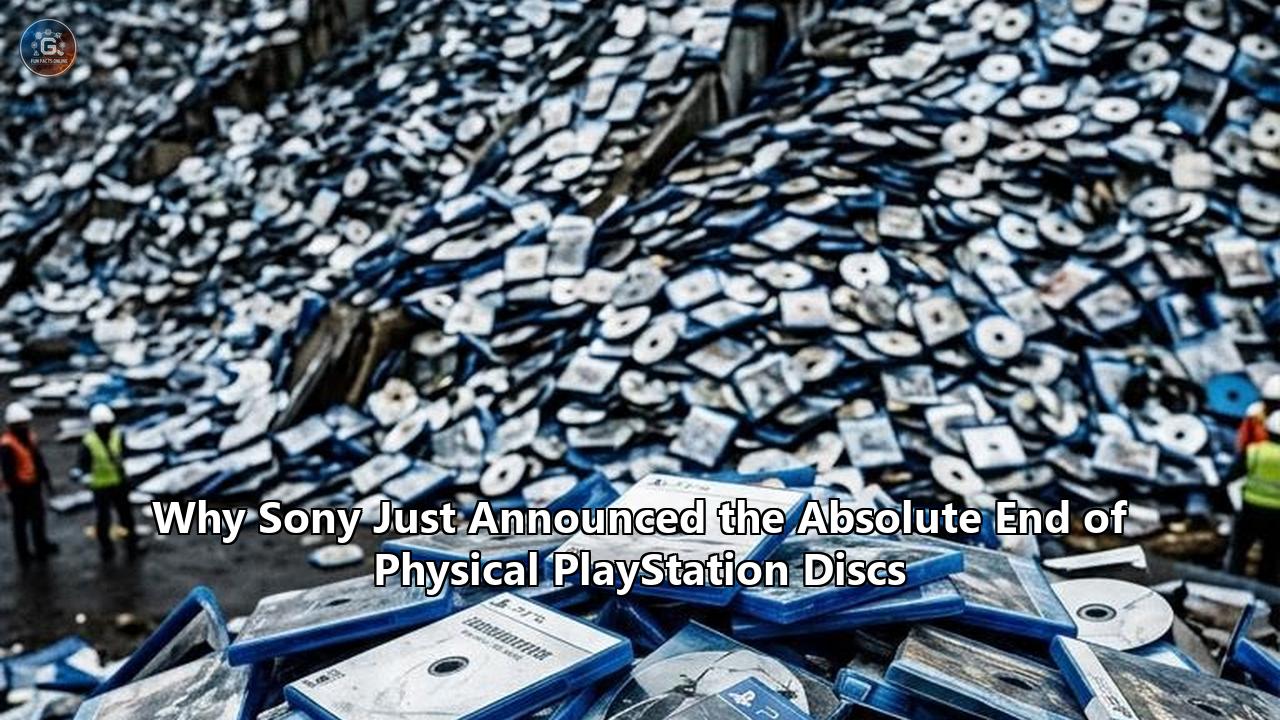
The morning of July 1, 2026, began like any other midsummer Wednesday for the video game industry. There were the usual patch notes, the routine announcements of upcoming summer events, and the slow trickle of trailers. Then, at precisely 9:00 AM Pacific Time, a brief post appeared on the official PlayStation Blog.
Signed by Sid Shuman, Senior Director of SIE Content Communications, the announcement was written in the dry, understated prose typical of corporate restructures. Tucked beneath a headline detailing upcoming system updates was a paragraph that would instantly ignite a firestorm across the global gaming community.
Starting January 2028, Sony Interactive Entertainment will cease the production and distribution of physical game discs for all PlayStation consoles. From that moment on, every new game released on the platform—whether developed by Sony’s first-party studios or third-party publishers—will be distributed entirely in digital formats.
The bombshell did not arrive in isolation. In a secondary blog post published at the exact same hour, Sony announced a phased, global shutdown of the digital storefronts for the PlayStation 3 and PlayStation Vita. The stores would begin closing in select Latin American markets as early as August 2026, concluding with a total global shutdown by July 2027.
The convergence of these two announcements laid bare a stark, inescapable paradox. At the very moment Sony was locking down its future to an all-digital ecosystem, it was turning off the lights on the digital past. For millions of players, the realization was immediate and chilling: the era of tangible game ownership was over, and the digital safety net was far more fragile than they had ever been led to believe.
What followed was a cascade of public outrage, industry speculation, and deep-seated anxiety about the preservation of cultural history. But behind the public relations disaster lies a trail of financial breadcrumbs, deliberate hardware iterations, and strategic maneuvers that Sony has been quietly executing for nearly a decade. The end of playstation physical discs was not a sudden pivot. It was a long-planned destination.
The Spreadsheet Sovereignty: Inside the Margin Math
To understand why Sony made a move of this magnitude, one must look past the emotional attachment of plastic cases and disc art, and dive straight into the company’s financial statements.
For years, the physical games market has been on a slow, irreversible decline. According to data compiled by retail research firm Circana, US consumer spending on physical video games fell to $1.5 billion in 2025. While that number might sound substantial, it represents the lowest figure recorded since Circana began tracking the metric in 1995—a staggering drop from the physical market's peak of $11.6 billion in 2008.
Within Sony's own financial ecosystem, the disparity is even more pronounced. In its fiscal year 2025 corporate report, physical game distribution accounted for a mere 3% of PlayStation’s total software revenue. The vast majority of the company's money is generated through digital downloads, add-on content (microtransactions and DLC), and subscriptions like PlayStation Plus.
"It was inevitably going to happen someday," says Mat Piscatella, Executive Director and Video Game Industry Advisor at Circana. "Sales of new physical video games have fallen every year since the late 2000s. Through a combination of consumer preference and manufacturer strategic decisions, the market shift has already happened. What we are seeing now is the psychological shift catching up to the economic reality."
U.S. New Physical Video Game Spending (Peak vs. 2025)
======================================================
2008 (Peak):   ██████████████████████████████ $11.6B
2025 (Low):    ███ $1.5B
But why would Sony completely eliminate a market that, according to Niko Partners analyst Daniel Ahmad, still accounted for roughly 70 million physical disc sales globally in 2025? The answer lies in the highly lucrative nature of a closed digital storefront.
Consider the economic anatomy of a standard $70 retail video game. When a player walks into a store like GameStop or Best Buy and purchases a physical copy of a third-party game, that $70 is divided among several players:
- Retailer Margin: Retailers typically take a 20% to 25% cut of the shelf price to cover their overhead, space, and staff.
- Manufacturing & Distribution: Pressing the Blu-ray disc, printing the sleeve, manufacturing the plastic case, and shipping those physical boxes to retail distribution centers worldwide costs roughly $4 to $5 per unit.
- Platform Licensing Fee: If the game is made by a third-party publisher (like Electronic Arts or Ubisoft), Sony collects a physical licensing fee, which hovers around 15% ($10.50).
Under this physical retail model, the publisher of a $70 game might only see about $45.50 of that initial purchase price make it back to their bank account.
Now, look at the digital model. When that same $70 game is purchased digitally through the PlayStation Store, the logistics of retail margins, physical manufacturing, and shipping are completely eliminated.
- If it is a first-party game (developed by PlayStation Studios, such as Naughty Dog or Santa Monica Studio), Sony keeps the entire $70.
- If it is a third-party game, Sony collects its standard 30% platform fee ($21) as the host of the digital storefront, leaving the publisher with $49.
By enforcing the end of playstation physical discs, Sony is effectively dismantling the middleman. The company is driving 100% of its platform revenue through its own digital gateway, where it sets the rules, controls the promotions, and takes a massive piece of every single transaction.
"The decision to stop physical disc production at this point is entirely a platform-led decision," Daniel Ahmad explained. "It is designed to cut costs for Sony, eliminate the resale and used games market, and drive all revenue through the PlayStation Store."
Following the Breadcrumbs: The Stealth Transition
While the announcement on July 1, 2026, shocked the public, a closer look at Sony’s hardware releases and system updates over the past six years reveals a clear, calculated path toward this digital-only destination. Sony didn’t drop physical media overnight; they slowly conditioned their audience to live without it.
Phase 1: The Dual-SKU Strategy (2020)
When the PlayStation 5 launched in November 2020, Sony introduced two distinct models: a standard console with an Ultra HD Blu-ray drive for $499, and a "Digital Edition" for $399. By subsidizing the digital console by $100, Sony did something brilliant: they paid consumers to lock themselves into the PlayStation Store ecosystem. A buyer who saved $100 upfront on the console would spend the next several years buying games exclusively from Sony's storefront, quickly making up the $100 subsidy in pure profit margins for the platform holder.
Phase 2: The Modular Compromise (2023)
In late 2023, Sony retired the original PS5 models in favor of the "PS5 Slim." Rather than offering two completely different internal builds, Sony manufactured a single, unified console design with a detachable disc drive. If you bought the digital model, you could purchase the disc drive separately as an accessory for $80. This modular design was the first clear signal to supply chain analysts that Sony was looking to phase out the integration of disc drives on the assembly line, treating physical media reading as a legacy add-on rather than a core feature.
Phase 3: The Default Digital Flagship (2024)
The clearest warning shot came with the launch of the PlayStation 5 Pro in late 2024. Despite its premium $700 price tag, the most powerful console on the market shipped with no disc drive in the box. Players who wanted to use their existing physical libraries on the high-end hardware were forced to hunt down the external disc drive accessory, which suffered from severe stock shortages for months. Sony had successfully decoupled its premium audience from physical media.
Phase 4: The Developer Directives (2025)
Behind the scenes, third-party publishers were already preparing for the transition. Rumors began circulating in late 2025 when Rockstar Games quietly updated its pre-order pages for the highly anticipated Grand Theft Auto VI. When physical pre-orders opened, the fine print revealed that physical editions sold at retail would not contain a Blu-ray disc; instead, the box would house a cardboard insert containing a digital download code.
"We had been hearing whispers from publishers for at least eighteen months before the official announcement," says a senior software engineer at a major European publishing house, who agreed to speak on the condition of anonymity. "Sony’s developer relations teams were strongly suggesting that we optimize our build pipelines for digital delivery. They told us that physical disc certification processes would become increasingly expensive and subject to longer lead times. They were making physical releases as friction-filled as possible for us behind the scenes."
The Death of the Bargain Bin: The Retail and Consumer Fallout
For decades, the physical retail market acted as a natural check on video game pricing. When physical discs sit on store shelves at Amazon, Walmart, Target, or GameStop, they represent inventory. Inventory takes up physical space, and physical space costs money.
If a game fails to sell, retailers are forced to discount it to clear shelf space. This dynamic created the beloved "bargain bin"—a consumer haven where games that launched at $70 could be purchased for $20 or $30 just a few months later.
Furthermore, the physical market fostered a thriving secondhand economy. Players could trade their completed games to GameStop for store credit, or buy used copies from eBay and local mom-and-pop shops at a fraction of the cost.
With the end of playstation physical discs, this entire ecosystem is set to vanish.
The Physical vs. Digital Life Cycle
===========================================================
PHYSICAL SYSTEM (Consumer-Friendly Lifecycle):
Publisher -> Factory -> Retailer Shelf -> Consumer Purchase -> Trade-in -> Used Market Sale

DIGITAL SYSTEM (Closed Loop Monopoly):
Sony Store -> Consumer Download -> Tied to Account Permanently (No Resale, No Gifting)
"Without physical discs, Sony has near-monopolistic power over PlayStation game pricing," notes consumer rights advocate Amanda Henderson. "If you want to play a game on your PlayStation 5 or the eventual PlayStation 6, you will have exactly one store to buy it from: the digital PlayStation Store. There is no competition. If Sony decides that a three-year-old game should remain priced at $70, there is absolutely nothing the consumer can do about it."
The alternative option that Sony has promised—selling "digital formats at retail"—is what the industry refers to as "code-in-a-box". Instead of buying a disc, you buy a plastic case containing a scratch-off card with a PlayStation Network (PSN) code.
While this allows traditional retailers to keep some presence on store shelves, it offers zero benefits to the consumer. You cannot resell a digital code once it is redeemed. You cannot lend it to a friend. And, as many point out, these digital codes often come with hard expiration dates printed in tiny font on the back of the packaging.
"It's the illusion of physical retail," says Henderson. "You are paying for the plastic, the cardboard, and the gasoline to drive to the store, just to receive a slip of paper that links to a digital license that Sony can revoke at any time."
The Preservation Crisis: "You Only Have the Right to Turn on the Tap"
The backlash to Sony's announcement was swift, passionate, and deeply concerned with the preservation of video games as an art form. Within days of the July 1 announcement, a Change.org petition calling on Sony to reverse its decision amassed over 285,000 signatures.
The panic was further intensified by the simultaneous news of the PS3 and Vita storefront closures. It highlighted the most uncomfortable truth of the digital age: when you "buy" a digital game, you do not own the game; you own a temporary, non-transferable license to play it.
This reality was forcefully demonstrated to PlayStation users earlier in the year when a licensing dispute between Sony and Warner Bros. Discovery resulted in the sudden deletion of 550 digital movies from users' accounts. These were movies that players had legally purchased, yet they vanished overnight with no compensation.
Celebrated game director Hideo Kojima, creator of Metal Gear Solid and Death Stranding, was among the loudest voices of concern. In a post that went viral across social media, Kojima expressed deep sorrow over the death of physical media, warning that an all-digital future is culturally dangerous.
"Eventually, even digital data will no longer belong to individuals on their own terms," Kojima wrote. "There's a server somewhere, and you only have the right to turn on the tap. When that server goes dark, or when a license expires, the water stops running. We are losing our ability to preserve our own culture."
The closure of the PS3 and Vita stores means that hundreds of digital-only games that were never released physically will be lost to history. Unless a player has already downloaded those games onto an active console hard drive, they will be legally inaccessible.
Historical Media Lifespans
===========================================================
Cartridges (NES/Sega):      40+ Years (Still playable today)
CD-ROMs/DVDs (PS1/PS2):     25+ Years (Still playable today)
Digital-Only (PS3/Vita):    14-20 Years (Storefronts closing; new purchases impossible)
"This is a watershed moment for the preservation community," says Dr. Elena Vance, a digital archivist and professor of media studies. "When a physical disc exists, it can be preserved in libraries, sold at garage sales, and played on retro hardware decades later. When a digital storefront closes, the software is effectively deleted from human history unless we resort to piracy. By forcing an all-digital future, console makers are creating a disposable culture where games exist only as long as they are profitable to host on a server."
When asked about the legality of Sony’s transition to an all-digital ecosystem, Michael McGrath, the European Union Commissioner for Democracy, Justice, the Rule of Law, and Consumer Protection, confirmed to reporters in Strasbourg that the EU has no legal framework to force a private company to continue manufacturing physical goods.
"Under current European consumer protection laws, companies are free to transition their business models to digital-only formats, provided they honor existing purchases and do not engage in deceptive trade practices," McGrath stated. "While we understand the concerns of physical media collectors, a platform holder has the legal right to dictate the media formats supported by its proprietary hardware."
The View from the Top: An Ex-Boss Speaks
To get a clearer picture of how this decision was viewed from inside the boardrooms of Tokyo and San Mateo, I spoke with Shawn Layden, the former Chairman of PlayStation Worldwide Studios. Layden, who spent 32 years at Sony and was one of the key architects of the highly successful PlayStation 4 era, offered a nuanced, bittersweet perspective on the end of playstation physical discs.
"I can tell you that this was not a snap decision," Layden said during our conversation. "Ditching the disc drive was something we actually debated for a solid year during my final years at the company. At the time, we ultimately decided against it because the digital infrastructure just wasn't ready globally. But the pandemic changed everything. It accelerated digital adoption by five to seven years."
Layden characterized Sony’s decision as "fairly dramatic" but ultimately logical from a cold business standpoint.
"I remember a time when digital sales were exactly zero percent because we simply didn't have a digital market," Layden recalled. "To go from that to 85% of software sales being digital is a monumental shift. I think there is probably an immense amount of financial and supply chain analysis that went behind this decision. Sony has some of the smartest finance minds in the world, and they looked at the cost of maintaining physical pressing plants, the logistics of global shipping, the rising cost of retail distribution, and they made the call."
Yet, strictly as a fan of the medium, Layden couldn't hide his personal sadness.
"I won't take issue with the business decision, because I'm not a finance guy anymore," Layden admitted. "But as a fan—just strictly as a fan—it makes me kind of sad. I have a huge collection of physical games. When I buy a game like Call of Duty, sure, digital is incredibly convenient because it’s a living game that changes constantly. But when I buy something like God of War, I want to hold that box. I want to see the artwork on my shelf. I want to have that physical anchor to that experience. Losing that option feels like we are losing a piece of the magic that made console gaming special."
Layden also pointed out that Sony's decision is bound to have a profound ripple effect across the entire industry.
"PlayStation has historically been the market leader," Layden noted. "When PlayStation makes a dramatic move like this, it heavily influences how third-party publishers, retail partners, and even rival console manufacturers look at their own long-term strategies. It sets a new baseline for the entire industry."
The Cold Equation of the Vocal Minority
Despite the massive online outcry, the boycotts, and the petitions, market analysts are near-unanimous in their belief that Sony will not—and has no financial reason to—reverse its decision.
"I sympathize deeply with physical media fans, but Sony will not reverse this," says Dr. Serkan Toto, CEO of Tokyo-based industry advisory group Kantan Games. "They of course knew exactly what the online reaction would look like, and they are simply waiting for this storm to pass. From a business perspective, the math is just too clean."
Dr. Toto suggests applying a simple reality check to the 285,000-signature petition that has dominated gaming news cycles.
"Sony has over 120 million active PlayStation users globally. Around 50 million of those subscribe to PlayStation Plus. When you look at 285,000 signatures, you are looking at roughly 0.2% of the active user base. The vast majority of consumers—the millions of casual players who buy FIFA, Madden, and Call of Duty every year—do not care about physical discs. They have already transitioned to digital-only play. They want the convenience of pressing a button on their controller and playing immediately. Sony is not going to jeopardize a massive boost to their profit margins to appease a vocal minority of 1%."
Indeed, the online "boycott" of PlayStation’s digital transition has already begun to show signs of fracturing. Within forty-eight hours of the announcement, social media threads calling on players to cancel their PS Plus subscriptions in protest were flooded with comments from players admitting they would break their boycott the moment major upcoming titles like Call of Duty or Grand Theft Auto VI were released.
"You can love your preferred video game ecosystem, franchise, or whatever all you want," Mat Piscatella wrote in a brutal, widely shared post. "You can think your years of customer loyalty should and will be reciprocated. But these businesses do not love you back. You are a number on a spreadsheet, and the spreadsheet says physical media is dead."
The Next-Gen Horizon: What Happens in 2028?
With the January 2028 deadline firmly locked in, the focus of the games industry has rapidly shifted toward the future of hardware.
The timing of Sony’s cutoff date is not coincidental. Analysts and supply chain researchers agree that 2028 will likely mark the launch of the next generation of video game consoles—specifically, the PlayStation 6 and Microsoft’s next-gen Xbox project, currently codenamed "Project Helix".
Predicted 2028 Console Landscape
===========================================================
Sony PlayStation 6:         100% Digital (No built-in disc drive; optional legacy USB drive)
Xbox "Project Helix":       100% Digital (Cloud and digital download focus)
Nintendo Switch 2:          Hybrid Cartridge & Digital (The last physical stronghold)
"Sony's digital-only plan almost certainly guarantees that the PlayStation 6 will launch without a disc drive built-in," says Piers Harding-Rolls, Research Director at Ampere Analysis. "If they are stopping all physical disc production in January 2028, there is absolutely no reason to waste space, weight, and manufacturing costs on placing a Blu-ray laser inside their next-generation machine. If a disc drive is offered at all, it will be a legacy external USB accessory sold separately at a high markup for players who want to play their older PS4 and PS5 libraries."
This hardware shift could also help Sony address another mounting crisis: the soaring cost of console development. With predictions that next-generation consoles could cost $800 to $1,000 to manufacture due to rising silicon and component costs, cutting out physical drives is an easy way for console makers to reclaim some margin.
"If you can't convince people to buy a $1,000 console, you have to find other ways to make up that margin," notes Piscatella. "Eliminating physical distribution is the lowest-hanging fruit. It clawbacks millions of dollars from retail middlemen and immediately puts it back into the pockets of the platform holders and major publishers."
Meanwhile, all eyes are on Nintendo. The Kyoto-based company has historically marched to the beat of its own drum, and the Nintendo Switch 2 continues to rely on proprietary flash-memory cartridges. Because flash cartridges do not require the massive industrial footprint of laser-disc pressing plants, and because Nintendo enjoys an incredibly strong physical retail presence, experts believe they will remain the lone champion of physical media for the foreseeable future.
"This will most likely leave Nintendo as the last major console manufacturer to produce physical media," says Piscatella. "And that could actually become a major competitive advantage for them among collectors, parents, and those who value physical ownership."
The Post-Physical Wilderness
The end of playstation physical discs marks the closing chapter of a story that began in 1994, when a sleek, grey box with a spinning CD-ROM drive first arrived to challenge cartridge-based gaming. For more than three decades, the physical disc was the physical embodiment of our gaming memories. It was the plastic cases lined up on bedroom shelves, the midnight launch events at local strip malls, and the simple joy of loaning a favorite game to a friend over a weekend.
Now, those tactile rituals are being permanently phased out in favor of server pings, licensing agreements, and closed-loop digital storefronts.
As January 2028 approaches, PlayStation owners are left with a stark choice. They can embrace the frictionless convenience of the digital download, knowing that their entire library exists at the whim of corporate licensing deals and server maintenance schedules. Or they can watch from the sidelines as the physical history of the medium is slowly locked behind a digital paywall, hoping that the servers never go dark.
The corporate spreadsheets have won. The discs are stopping. But as we step into this silent, all-digital future, the words of Shawn Layden echo with a haunting clarity:
"As a business, it makes perfect sense. But as a fan... it just makes you realize that we are entering a very different, much colder world."
Reference:
- https://blog.playstation.com/2026/07/01/physical-disc-production-ending-in-january-2028-for-new-games-releasing-on-playstation-consoles/
- https://www.cbsnews.com/news/sony-playstation-physical-discs-digital-2028/
- https://www.theguardian.com/games/2026/jul/07/playstation-sony-ending-physical-game-production
- https://www.techradar.com/gaming/if-not-ps6-then-ps7-analyst-says-playstation-ending-physical-discs-was-bound-to-happen-as-the-console-ecosystem-is-nearly-entirely-digital-at-this-point
- https://games.gg/news/eu-cant-stop-sony-killing-disc/
- https://www.engadget.com/2205792/sony-will-stop-making-disc-based-playstation-games-starting-2028/
- https://www.vice.com/en/article/playstation-stores-for-ps3-and-ps-vita-will-close-in-2027/
- https://www.ign.com/articles/sony-shutting-down-playstation-store-for-new-purchases-on-ps3-and-vita
- https://www.gamesindustry.biz/sony-to-close-down-ps3-and-ps-vita-online-store-globally-by-july-2027
- https://www.cnet.com/tech/gaming/sony-phasing-out-physical-discs-for-ps5-closes-stores/
- https://www.windowscentral.com/gaming/playstation-kills-physical-games-as-xbox-and-sony-continue-making-poor-decisions
- https://kotaku.com/former-playstation-boss-sony-game-discs-sad-2000714799
- https://www.techradar.com/gaming/ex-playstation-boss-calls-sonys-plan-to-kill-physical-disc-production-fairly-dramatic-and-remembers-a-time-when-digital-sales-were-zero-percent-because-we-didnt-have-a-digital-market
- https://www.reddit.com/r/PS5/comments/1ull9oi/sony_is_unlikely_to_reverse_its_decision_on/
- https://www.videogameschronicle.com/news/playstation-ditching-physical-games-unlikely-to-influence-nintendos-plans-says-analyst/
- https://www.gamespot.com/articles/playstations-disc-based-game-sales-have-dropped-dramatically-in-recent-years/
- https://www.forbes.com/sites/zacharyfolk/2026/07/01/sony-ditches-games-on-physical-discs-by-january-2028/
- https://www.techradar.com/gaming/if-not-ps6-then-ps7-analyst-says-playstation-ending-physical-discs-was-bound-to-happen-as-the-console-ecosystem-is-nearly-entirely-digital-at-this-point
- https://www.gamespot.com/articles/your-loyalty-to-sony-or-xbox-means-nothing-analyst-says/
- https://www.notebookcheck.net/Analyst-Nintendo-could-be-the-last-console-maker-to-stand-behind-physical-games-after-Sony-s-disc-exit.1334990.0.html
- https://www.levelup.com/en/news/as-digital-purchases-hit-80-playstation-will-cease-physical-game-sales-by-2028-but-are-players-really-to-blame/
- https://www.youtube.com/watch?v=-MwN9x5MB0Y
- https://www.youtube.com/shorts/ryqF6ECSoBA
- https://www.thestar.com.my/tech/tech-news/2026/07/10/sony-plans-major-change-to-playstation-games-that-has-thousands-concerned
- https://www.inkl.com/news/playstations-disc-less-future-could-heavily-influence-xbox-and-nintendos-approach-to-physical-games-former-sony-boss-says-calling-the-decision-dramatic
- https://nerdist.com/article/playstation-will-cease-physical-disc-production-2028-sony/