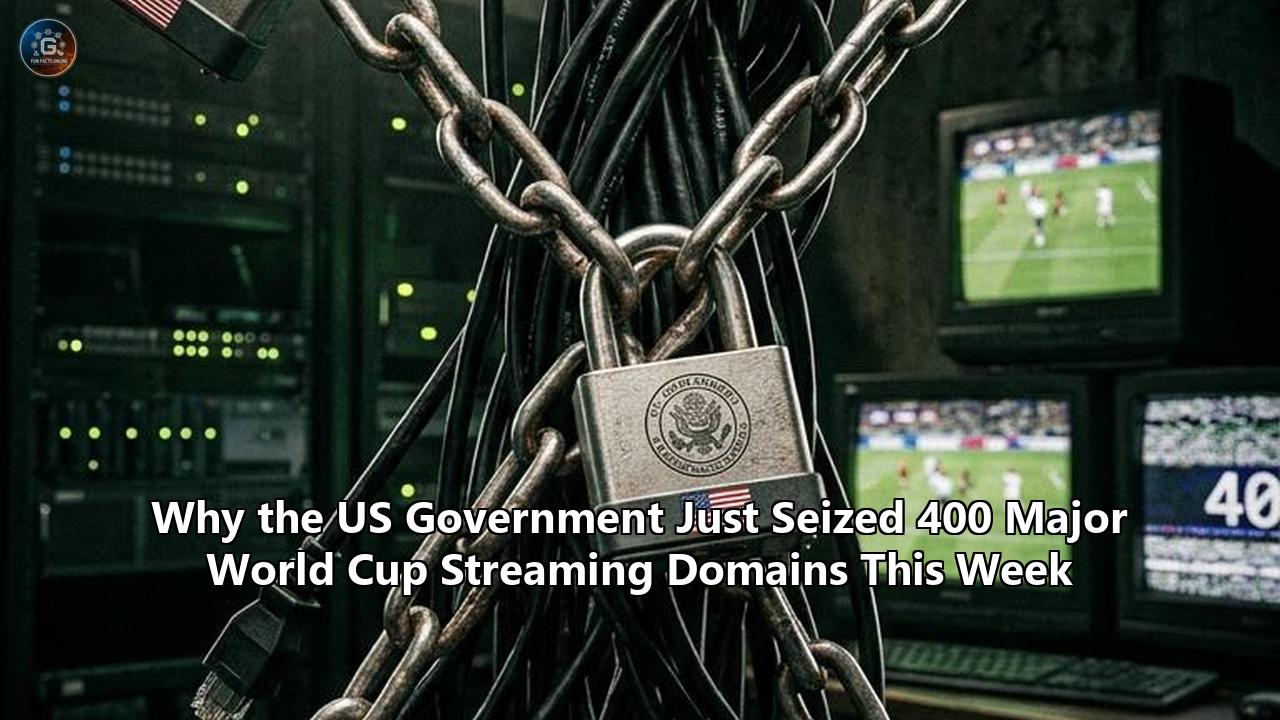
The screen went black in the middle of a high-stakes group stage match. For millions of football fans worldwide watching the 2026 FIFA World Cup, the sudden loss of their video feed was not a technical glitch, nor was it a temporary buffering issue. Instead, it was replaced by a stark, official seal of the United States Department of Justice, flanked by the insignias of Homeland Security Investigations (HSI) and the National Intellectual Property Rights Coordination Center.
"This website has been seized by law enforcement authorities as part of Operation Offsides," the digital banner read. "This action was taken to protect consumers and enforce intellectual property rights worldwide."
In an unprecedented, coordinated global sweep, federal authorities unsealed a series of court orders authorizing the seizure of nearly 400 internet domains. These platforms were engaged in the unauthorized, real-time streaming of matches from the ongoing tournament, co-hosted by the United States, Canada, and Mexico.
The crackdown, formally named Operation Offsides, represents one of the largest and most complex digital piracy disruptions in sports broadcasting history. It was orchestrated through a matrix of international law enforcement agencies, cyber prosecutors, and private-sector media giants—including FIFA, NBCUniversal, beIN Media Group, Warner Bros. Discovery, the Ultimate Fighting Championship (UFC), and the Motion Picture Association’s Alliance for Creativity and Entertainment (ACE).
But as investigators dig deeper into the digital carcass of this sprawling piracy network, they are discovering that the battle is about far more than protecting the commercial rights of multi-billion-dollar media conglomerates. The real story lies in what was happening behind those screens: a highly sophisticated, transnational cybercrime apparatus that weaponized the enthusiasm of sports fans, turning millions of unsuspecting viewers into accomplices and targets of global hacking syndicates.
The Paper Trail in the Eastern District of Virginia
To understand how a global operation of this scale unfolded, one must trace the legal and technical paper trail back to the U.S. District Court for the Eastern District of Virginia. On June 26, federal prosecutors quietly filed a primary affidavit supporting the seizure warrants.
The Eastern District of Virginia is a historically significant venue for internet infrastructure cases. Because many major domain registries (such as Verisign, which manages the .com and .net registries) are physically located or legally registered within the court's jurisdiction, federal judges there possess the unique legal leverage to order the immediate redirection of top-level domains.
According to court documents, HSI special agents initiated the probe by setting up covert monitoring stations to intercept and analyze live network traffic. Agents visited the targeted domains as matches were actively being played. They confirmed that each site was capturing live, high-definition broadcast signals from legitimate rightsholders and retransmitting them to the public without authorization.
The legal strategy was built on demonstrating immediate, irreparable economic harm to rightsholders, combined with proof of criminal copyright infringement under U.S. law.
"We have seized hundreds of domains, used to illegally stream World Cup matches for profit, to disrupt the international networks that profit from the global popularity of the World Cup," said Assistant Attorney General A. Tysen Duva of the Justice Department's Criminal Division. "This operation illustrates the Department's respect for intellectual property rights and the responsibility of the United States as a host nation to protect the FIFA World Cup from criminals."
  [Covert HSI Monitoring] ---> [Signal Capture Verified] ---> [EDVA Court Filing]
                                                                     │
  [Domain Registrars Ordered] <--- [Seizure Warrants Issued] <───────┘
              │
              ▼
  [DNS Records Redirected to DOJ Seal]
The administrative weight behind this operation is immense. Management of the case fell to senior legal minds within the DOJ’s Computer Crime and Intellectual Property Section (CCIPS). CCIPS Senior Counsel Brian Mund, Assistant Deputy Chief Adrienne Rose, and Acting Deputy Chief Christopher Merriam coordinated the technical execution of the warrants alongside Assistant U.S. Attorney Jacob Mercer.
By targeting the root DNS (Domain Name System) settings of the offending sites, U.S. authorities did not just block the sites for American users; they effectively erased them from the global internet directory. Any attempt to resolve the web addresses from Tokyo, London, or Buenos Aires redirected users directly to the DOJ's digital warning sign.
Unmasking the SOCKS5 Trap: The Hidden Cybersecurity Risk
While the public-facing narrative of Operation Offsides focuses heavily on intellectual property protection, cybersecurity researchers and federal investigators warn of a far more insidious threat buried in the code of these illegal platforms.
"When you open your network to illegal streaming sites, you're taking a significant risk," warned Special Agent in Charge Eric Weindorf of the ICE Homeland Security Investigations Washington Field Office. "These streamers not only violate copyright laws but also expose viewers to potential threats—including malware attacks and unsecure connections that can compromise personal and financial data."
The danger is not limited to typical pop-up ads or deceptive redirects. A deep-seated cybercrime trend involves the silent monetization of user bandwidth through malicious residential proxy networks.
How the Proxy Abuse Works
Many of the seized World Cup illegal streaming sites operated as Trojan horses. To bypass traditional ad-blockers and provide high-quality, buffer-free video feeds, some platforms prompted users to download custom web players, mobile applications, or proprietary "media browser extensions".
Hidden deep within the terms of service of these applications—or embedded entirely without consent via exploit kits—was a software development kit (SDK) that turned the viewer's device into an active SOCKS5 residential proxy node.
  [User Device] ──(Streams World Cup)──> [Illegal Streaming Site]
        │
        ├─► [Bundled Malicious SDK Installed Silently]
        │
        ▼
  [Home Wi-Fi Network] <──(Traffic Routed Covertly)──> [Cybercrime Syndicate]
        │                                                     │
        ▼                                                     ▼
  [Viewed as Legitimate IP]                             [DDoS / Fraud / Data Theft]
When a user watched a match, their device silently opened a reverse tunnel back to the streaming network’s command-and-control servers. This allowed external cybercriminals to route their own malicious internet traffic directly through the fan’s home internet connection.
To the rest of the internet, any action taken by the hacker appeared to originate from the innocent fan’s IP address. This traffic was routinely sold on underground forums to third-party bad actors who used these legitimate residential connections to execute:
- Credential Stuffing Attacks: Flooding banking portals with stolen usernames and passwords.
- Distributed Denial of Service (DDoS) Attacks: Overwhelming corporate and government networks using thousands of hijacked "viewer" connections.
- Ad Fraud: Artificially inflating web traffic metrics to steal revenue from legitimate ad networks.
- Illegal Content Distribution: Routing highly illegal materials, including stolen database credentials, through residential IP addresses to evade law enforcement tracking.
According to security analysts, many of these illicit streaming networks deliberately operated their video portals at a financial loss. They spent thousands of dollars acquiring premium broadcast feeds and server bandwidth, offering them to the public for free. This loss-leader model was designed purely to attract millions of concurrent users, thereby growing their pool of active proxy exit nodes.
This technical finding aligns with a parallel major crackdown executed in late June 2026. The FBI, working alongside Google's Threat Intelligence Group, disrupted NetNut, a massive residential proxy network consisting of over two million compromised consumer devices—many of which were infected via sketchy, uncertified Android TV boxes and sports streaming applications.
The intersection of these two investigations reveals that World Cup illegal streaming is no longer just a copyright headache; it is an active engine for global cybercrime infrastructure.
Following the Infrastructure: The Bulgaria and Peru Connection
The digital footprint of the seized domains led investigators far beyond the shores of North America. Because the modern piracy ecosystem is highly decentralized, taking down a front-end domain is often akin to pruning a single leaf off a massive, deeply rooted weed.
To achieve a meaningful disruption, Operation Offsides utilized the International Computer Hacking and Intellectual Property (ICHIP) network. This specialized division of U.S. prosecutors, stationed in regional hubs like São Paulo, Brazil, and Bucharest, Romania, worked directly with foreign law enforcement task forces to execute synchronized physical and digital raids.
┌────────────────────────────────────────────────────────┐
│              OPERATION OFFSIDES ACTIONS                │
├──────────────────────────┬─────────────────────────────┤
│ Primary Server Seizures  │ Bulgaria, Peru              │
├──────────────────────────┼─────────────────────────────┤
│ Infrastructure Blockades │ Croatia, Romania,           │
│                          │ Poland, Colombia            │
├──────────────────────────┼─────────────────────────────┤
│ Domain Seizures (EDVA)   │ ~400 domains                │
└──────────────────────────┴─────────────────────────────┘
Federal investigators identified Peru and Bulgaria as the primary physical hosting hubs for the unauthorized distribution syndicates.
In Bulgaria, local cybercrime units targeted bulletproof hosting providers. These data centers deliberately ignore standard Digital Millennium Copyright Act (DMCA) takedown notices, providing safe harbor to piracy groups in exchange for premium hosting fees.
By executing physical search warrants and seizing the actual bare-metal servers, Bulgarian authorities managed to sever the source feeds for dozens of prominent streaming websites simultaneously.
In Peru, investigators targeted the administrative operators of several high-profile regional syndicates. These networks had compromised local telecommunication networks, intercepting direct satellite and fiber-optic broadcast feeds of the World Cup before they could be encrypted or restricted.
The investigation also led to secondary infrastructure disruptions and domain revocations across Croatia, Romania, Poland, and Colombia. U.S. authorities provided real-time, actionable intelligence leads to foreign police forces, allowing them to dismantle local mirror servers and cash-out channels used by the administrators of the streaming sites.
"Through Operation Offsides and strong partnerships with law enforcement and the private sector, we identified and seized hundreds of domains, disrupting those who steal and distribute copyrighted content," stated Ivan J. Arvelo, Director of the National Intellectual Property Rights Coordination Center. He emphasized that the financial proceeds generated by these networks do not merely enrich tech-savvy teenagers; they actively fuel organized transnational criminal organizations.
Inside the Pirate Playbook: How Feeds Are Stolen
The sheer scale of the seizures highlights a broader, ongoing technological arms race between legitimate broadcasters and digital pirates. To distribute high-definition live video feeds to millions of concurrent viewers without incurring massive server bills, piracy syndicates rely on two primary technical methods: Restreaming and CDN Leeching.
1. Restreaming (Traditional Piracy)
Restreaming relies on capturing a legitimate, authorized video feed and re-encoding it for illegal distribution.
  [Broadcaster Satellite/Fiber] ──► [Authorized Cable/IPTV Box]
                                               │
                                               ▼
  [Pirate Decoder (HDMI Splitter / HDCP Stripper)] ──► [High-Speed Hardware Encoder]
                                                               │
                                                               ▼
[Illegal Streaming Website / P2P Network] ◄──────────────────┘- The pirate purchases a legal subscription to an authorized World Cup broadcaster (such as Fox Sports, Telemundo, or live streaming apps).
- The output from the authorized decoder box or smart TV is routed through an HDMI splitter designed to bypass High-bandwidth Digital Content Protection (HDCP) encryption.
- The unencrypted, raw video and audio signals are captured by a high-speed hardware encoder.
- The encoder converts the video into standard HTTP Live Streaming (HLS) or Dynamic Adaptive Streaming over HTTP (DASH) formats, breaking the video into short, chunked segments.
- These segments are pushed to bulletproof distribution servers, which serve them to end-users via web browsers or illicit IPTV playlists.
While effective, traditional restreaming is highly resource-intensive. The pirates must pay for their own delivery bandwidth, which can quickly become cost-prohibitive when dealing with millions of concurrent viewers during high-demand World Cup matches.
2. CDN Leeching (Modern Infrastructure Hijacking)
To bypass the costs associated with restreaming, modern piracy networks have turned to a far more sophisticated and damaging method: CDN Leeching.
  [Broadcaster CDN (Edge Servers)] <───(Legitimate URL & DRM Keys Hijacked)─── [Pirate Platform]
                 │                                                                   │
                 ├───────────────────────────────────────────────────────────────────┤
                 ▼                                                                   ▼
  [Authorized Subscriber]                                                   [Unauthorized Pirate Viewer]
  (Broadcaster pays delivery cost)                                         (Broadcaster STILL pays delivery cost)
In a CDN leeching setup, the pirates do not actually host or encode the video content themselves. Instead, they exploit security weaknesses in the broadcaster’s own Content Delivery Network (CDN) infrastructure.
- URL Hijacking: Legitimate broadcasters use CDNs (such as Akamai, Cloudflare, or Fastly) to distribute their live video segments to edge servers located close to their users. Pirates analyze the broadcaster’s web players, extracting the direct, raw .m3u8 or .mpd manifest URLs used to pull the video chunks.
- DRM Key Proxying: Most premium broadcasts are protected by Digital Rights Management (DRM) systems like Widevine, FairPlay, or PlayReady. When an authorized player requests a stream, it must fetch a temporary decryption key from a license server. Pirates bypass this by setting up reverse proxy servers. When an unauthorized user requests the stream on a pirate site, the pirate platform interceptively requests the DRM keys from the official keyserver, wraps the request in valid headers, and passes the decryption keys back to the illegal viewer.
- Token Spoofing: To prevent unauthorized hotlinking, broadcasters protect their CDN URLs with temporary cryptographic tokens. However, if the broadcaster’s token validation logic is weak, or if the tokens are generated client-side, piracy scripts can automatically generate or harvest valid tokens in real-time, allowing unauthorized users to pull video segments directly from the broadcaster’s own CDN edge servers.
The financial implications of CDN leeching are devastating. Not only do broadcasters lose out on potential subscription and advertising revenue, but they are also forced to pay the actual delivery bandwidth costs for the millions of viewers watching the illegal streams.
In essence, the legitimate rights holders are unwittingly funding the distribution infrastructure of their own competitors.
Case Study: The Fall of the PirloTV Network
The scale of Operation Offsides is best illustrated by examining its highest-profile target: the PirloTV piracy network.
In the weeks leading up to and during the 2026 World Cup, a coalition comprising the Alliance for Creativity and Entertainment (ACE), UEFA, Mexico's Institute of Industrial Property (IMPI), and Mexican law enforcement successfully dismantled 44 domains directly linked to PirloTV.
                        ┌───────────────────────────────┐
                        │     THE PIRLOTV NETWORK       │
                        ├───────────────────────────────┤
                        │ Annual Traffic: 950M+ visits  │
                        ├───────────────────────────────┤
                        │ Mexico Traffic: 230M+ visits  │
                        ├───────────────────────────────┤
                        │ Primary Target: Latin America │
                        └───────────────────────────────┘
PirloTV was not a traditional streaming service. Rather than hosting content, it acted as a massive, highly structured directory that aggregated and embedded links to unauthorized live sports broadcasts, primarily soccer. It drew feeds from dozens of licensed global broadcasters, including ESPN, Fox Sports, TNT Sports, and DSports.
According to data compiled by ACE, the PirloTV network was a titan of the digital black market:
- Collectively, its domains generated over 950 million visits annually.
- Over 230 million of those visits originated from Mexico alone, making it the dominant sports piracy brand in the country.
- The platform primarily targeted viewers across Latin America (specifically Colombia and Mexico), while pulling substantial traffic from Spain and the United States.
What made PirloTV particularly dangerous—and notoriously difficult to defeat—was its aggressive domain migration strategy.
"The network has remained resilient, moving from one domain to another to both avoid blockades and domain seizures," noted copyright analyst Ernesto Van der Sar of TorrentFreak. "While many domain registrars have cooperated with rightsholders, some have not, and the network has consistently been able to move to new homes as old ones are shuttered."
Whenever a court order was issued against a domain like pirlotv.site, the administrators would immediately redirect their traffic to backup domains like pirlotv.online or pirlotv.tv, keeping their index of active streams alive with minimal disruption.
The PirloTV shutdown was a major victory, but as Operation Offsides proved, it was only one head of a multi-headed hydra.
The Legitimate Access Problem: Why Fans Turn to Piracy
While federal agencies frame the fight against World Cup illegal streaming as a black-and-white battle between law enforcement and criminal organizations, digital media analysts point out that the rampant demand for illegal streams is often a direct symptom of market fragmentation.
Modern sports broadcasting has evolved into a highly complex, expensive maze. In the past, major sporting events like the World Cup were broadcast on free-to-air television or a single premium cable package.
Today, the rights are fractured across a dizzying array of networks, streaming services, and mobile-only platforms, each guarded by separate paywalls.
  [Legitimate Ecosystem]                       [Piracy Ecosystem]
  ┌─────────────────────────┐                  ┌─────────────────────────┐
  │ • Multiple Apps Required│                  │                         │
  │ • Regional Blackouts    │                  │ • One Central Directory │
  │ • $75+/month Cost       │                  │ • No Blackouts          │
  │ • Mobile Restrictions   │                  │ • 100% Free             │
  │ • Complex Logins        │                  │ • One-Click Streaming   │
  └─────────────────────────┘                  └─────────────────────────┘
               │                                            │
               ▼                                            ▼
      [High Friction]                              [Low Friction]
To watch the entirety of the 2026 World Cup legally across the host nations, a fan may need to navigate:
- Broadcaster Fragmentation: Different matches are split between English-language rights holders (like Fox Sports) and Spanish-language rights holders (like Telemundo/Peacock).
- Device Limitations: Certain apps only allow streaming on television sets, restricting mobile access unless users pay for premium tiers.
- Regional Blackouts: Geo-blocking rules restrict access to specific matches based on local carriage agreements, leaving traveling fans unable to watch their home country play despite having paid subscriptions.
- The Mobile Crisis: Spanish media report that a significant portion of the audience for platforms like PirloTV consists of younger, mobile-first users who want to watch games on their phones while commuting or working. Legitimate broadcasters have often struggled to deliver seamless, affordable mobile-first options, leaving a vacuum that piracy networks are more than happy to fill.
"In many cases, fans are not making a binary choice between legal and illegal," notes sports media analyst Simon Brydon. "They are navigating a maze of rights packages, blackout rules, subscription tiers, and regional restrictions that make access feel like a puzzle rather than a service. What starts as a simple question of 'where do I watch tonight' often becomes a journey across apps, logins, and payment prompts."
Under this pressure, piracy ceases to be merely an act of copyright theft and becomes an act of simplification. A pirate site offers a single, consolidated page with links to every match, requiring no accounts, no credit cards, and no geographical restrictions.
Until the legitimate broadcasting ecosystem can compete on convenience and simplicity, the pressure on illegal streaming channels will continue to grow, regardless of how many domains the government seizes.
The Next Frontier of Sports Anti-Piracy
As the 2026 World Cup transitions into its high-stakes knockout rounds, federal authorities and private rightsholders are preparing for the next phase of the conflict.
Operation Offsides demonstrated that traditional domain seizures, while highly visible, are no longer sufficient to stop modern sports piracy.
The battlefield is shifting from the surface of the web deep into the internet's core routing and delivery layers.
Real-Time Infrastructure Blocking
Rights holders are increasingly looking to bypass domain-level enforcement entirely, focusing instead on dynamic, real-time IP and DNS blocking at the Internet Service Provider (ISP) level.
Under this model, rightsholders work with ISPs to identify the active IP addresses of pirate streaming servers as a match begins.
Instead of waiting weeks for a federal court to issue a domain seizure warrant, ISPs can dynamically block routing to those specific server IPs for the exact duration of the live event, rendering the pirate stream inaccessible.
This strategy has already seen legal momentum. For instance, major leagues like La Liga have initiated aggressive legal battles against infrastructure providers like Cloudflare, arguing that reverse-proxy and DNS services must take a more active, systemic role in blockading pirated feeds at the network level.
  [Live Match Starts] ──► [Pirate Stream Detected] ──► [IP/DNS Telemetry Shared]
                                                               │
                                                               ▼
  [Pirate Feed Dead]  ◄─── [ISPs Dynamically Block IP] ◄───────┘
  (Blocks last only for duration of the match)
Automated "Mirror" Seizures
The DOJ’s Computer Crime and Intellectual Property Section (CCIPS) has confirmed that real-time monitoring of global network traffic will continue for the duration of the tournament.
Working with automated threat intelligence feeds, federal prosecutors have set up rapid-response legal pipelines.
If a seized network attempts to deploy backup "mirror" domains, the new addresses can be added to existing court orders and seized within minutes, preventing piracy syndicates from regaining their audience during critical matches.
Ultimately, the dramatic events of Operation Offsides have made one thing clear: the era of sports piracy being viewed as a victimless, low-level copyright issue is officially over.
When fans turn to illicit sources to watch their teams chase glory on the pitch, they are no longer just bypassing a paywall. They are stepping directly into a high-tech global conflict where their data, their devices, and their home networks are the ultimate prize.
Summary of Key Government Actions and Legal Filings
| Agency / Entity | Key Role in Operation Offsides |
|---|---|
| U.S. Department of Justice (DOJ) | Issued and unsealed the federal court orders for the domain seizures. |
| Homeland Security Investigations (HSI) | Verified unauthorized broadcasts in real-time and executed the digital seizures. |
| National IPR Coordination Center | Led the overall anti-piracy campaign and coordinated public-private partnerships. |
| ICHIP Network | Coordinated synchronized international raids and server takedowns in Eastern Europe and South America. |
| U.S. District Court (E.D. Va.) | Served as the primary legal venue for filing the seizure warrants. |
| Private-Sector Coalitions (FIFA, ACE, etc.) | Provided the signal telemetry, domain lists, and network mapping required to identify targets. |
Reference:
- https://www.bleepingcomputer.com/news/security/us-seizes-hundreds-of-fifa-world-cup-illegal-streaming-domains/
- https://www.techradar.com/pro/security/nearly-400-illegal-world-cup-2026-streaming-sites-taken-offline-by-us-doj
- https://satnews.com/2026/06/29/us-department-of-justice-seizes-400-domains-streaming-world-cup-matches-under-operation-offsides/
- https://www.washingtontimes.com/news/2026/jun/29/justice-department-seizes-400-sites-streaming-world-cup-illegally/
- https://cyberpress.org/doj-seizes-400-domains/
- https://satnews.com/2026/06/29/us-department-of-justice-seizes-400-domains-streaming-world-cup-matches-under-operation-offsides/
- https://www.scworld.com/brief/us-doj-seizes-nearly-400-domains-used-for-illegal-world-cup-streaming
- https://www.justice.gov/opa/pr/united-states-seizes-hundreds-internet-domains-used-illegally-stream-world-cup-matches
- https://www.justice.gov/opa/pr/united-states-seizes-hundreds-internet-domains-used-illegally-stream-world-cup-matches
- https://www.news4hackers.com/us-authorities-crackdown-on-illegal-fifa-world-cup-streaming-domains/
- https://krebsonsecurity.com/2026/07/fbi-seizes-netnut-proxy-platform-popa-botnet/
- https://securityaffairs.com/194690/cyber-crime/law-enforcememt-operation-disrupted-malicious-residential-proxy-networks-netnut.html
- https://www.cleafy.com/cleafy-labs/mirax-a-new-android-rat-turning-infected-devices-into-potential-residential-proxy-nodes
- https://www.synamedia.com/blog/stop-illegal-sport-streaming-site-usage/
- https://www.pcmag.com/opinions/should-i-use-a-vpn-to-stream-sports
- https://www.techradar.com/pro/security/nearly-400-illegal-world-cup-2026-streaming-sites-taken-offline-by-us-doj
- https://www.streamingmedia.com/Articles/News/Online-Video-News/Sports-Streaming-Piracy-Has-Moved-Into-the-Pipes-173070.aspx
- https://www.plagiarismtoday.com/2026/06/25/3-count-global-fight/
- https://satnews.com/2026/06/29/us-department-of-justice-seizes-400-domains-streaming-world-cup-matches-under-operation-offsides/
- https://www.motionpictures.org/2025/09/mpa-creative-protector-award-recipient-ivan-j-arvelo-the-federal-agent-protecting-your-favorite-movies-from-piracy/
- https://www.streamingmediaglobal.com/Articles/Post/Blog/Securing-live-streams-how-end-to-end-video-platforms-are-combatting-piracy-170398.aspx
- https://www.bleepingcomputer.com/news/security/pirlotv-sports-piracy-network-disrupted-as-44-domains-seized/
- https://jonlu.ca/posts/illegal-streams
- https://therecord.media/us-takes-down-hundreds-world-cup-streaming-sites
- https://www.bleepingcomputer.com/news/security/us-seizes-hundreds-of-fifa-world-cup-illegal-streaming-domains/
- https://www.scworld.com/brief/sports-piracy-ring-linked-to-pirlotv-disrupted-in-44-domain-takedown
- https://gazettengr.com/u-s-govt-seizes-nearly-400-websites-illegally-streaming-2026-fifa-world-cup/