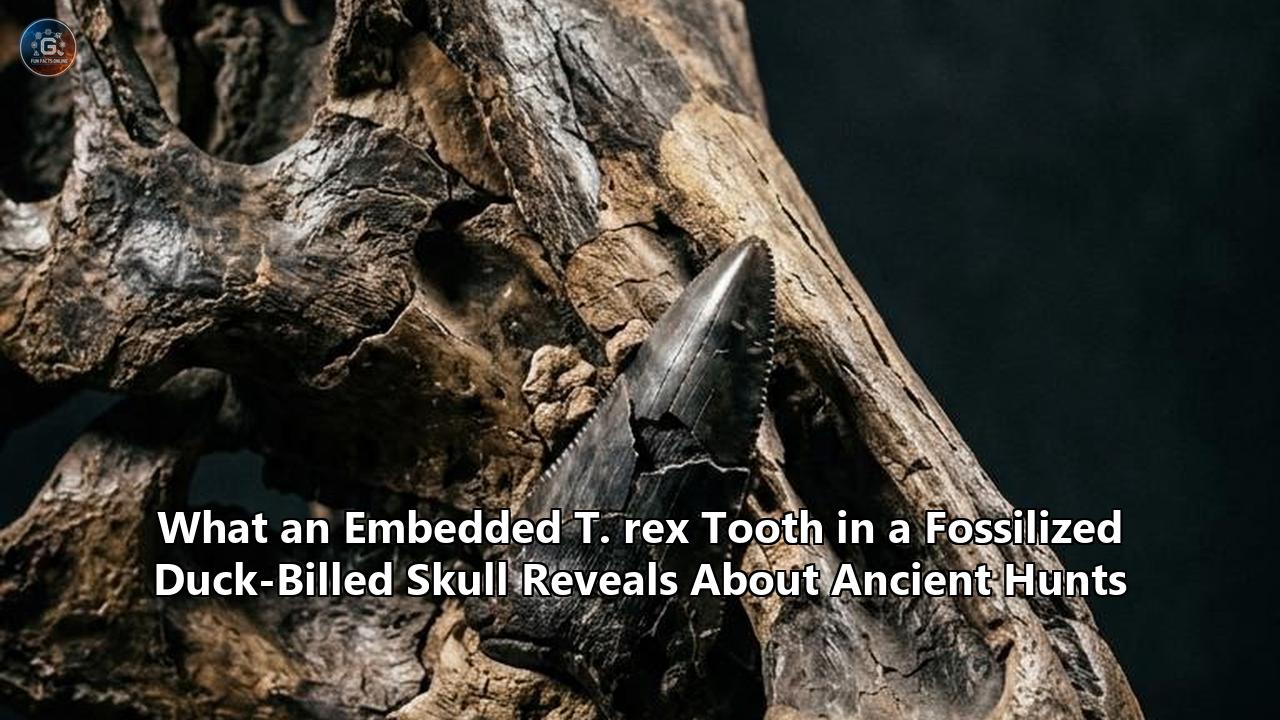
A 66-million-year-old fossilized skull of a duck-billed dinosaur on display in a Montana museum is rewriting what scientists know about the final, violent moments of Late Cretaceous prey. The skull, cataloged as MOR 1627 and housed in the Museum of the Rockies in Bozeman, Montana, preserves an extraordinary moment of prehistoric violence: a broken tooth from a large, adult Tyrannosaurus rex remains lodged deep inside the animal's nasal bone. The fossilized skull also features up to 23 additional tyrannosaurid bite marks scattered across its surface.
The findings, published in the peer-reviewed scientific journal PeerJ by doctoral researcher Taia C. A. Wyenberg-Henzler from the University of Alberta and Dr. John B. Scannella, Curator of Palaeontology at the Museum of the Rockies, provide a rare, direct physical record of a tyrannosaur attack caught mid-action. Because the bone surrounding the embedded tooth shows absolutely no signs of healing or remodeling, scientists have concluded that the bite occurred at, near, or immediately after the time of the duck-bill's death. The angle and placement of the tooth suggest a face-to-face encounter where the predator exerted massive force to control or dispatch its prey, offering unprecedented direct insights into T. rex hunting behavior.
By using advanced computed tomography (CT) scans and comparative forensic methodologies, researchers have been able to reconstruct the sequence of events that transpired 66 million years ago on the coastal plains of what is now eastern Montana. This discovery does more than just depict a dramatic battle; it sheds light on the complex mechanics of tyrannosaur jaw forces, the ecological dynamics of Late Cretaceous food webs, and the long-running scientific debate over how these iconic apex predators acquired their meals.
The Specimen: MOR 1627’s Secret Hidden in Plain Sight
The story of this scientific breakthrough began in 2005 in Dawson County, Montana, within the fossil-rich sediments of the Hell Creek Formation. A fossil prospector named Marge Baisch discovered a beautifully preserved, nearly complete skull of an adult Edmontosaurus annectens—a massive, shovel-billed herbivore commonly referred to as a duck-billed dinosaur. The fossil was excavated by Ken Olson on public lands managed by the Bureau of Land Management and subsequently transported to the Museum of the Rockies, where it was prepared by fossil preparator Carrie Ancell.
For nearly two decades, the skull sat on public display in the museum’s Hall of Horns and Teeth. Visitors and researchers alike admired its complete, articulated structure, but its most profound feature remained largely unanalyzed until Wyenberg-Henzler and Scannella initiated a collaborative investigation to examine the tooth traces on the skull.
                                  [ MOR 1627 SKULL ]
                                          |
                      +-------------------+-------------------+
                      |                                       |
             [ Left Nasal Bone ]                    [ Post-Orbital / Jaw Areas ]
                      |                                       |
          Embedded Tyrannosaur Tooth                  23 Distinct Bite Marks
          (No signs of bone healing)              (Concentrated on chewing muscles)
                      |                                       |
Frontal, Face-to-Face Strike Systematic Post-Mortem FeedingBecause of their size and abundance, hadrosaurids like Edmontosaurus were a primary food source for the apex predators of their environment. However, capturing and subduing an 8-ton animal was a perilous task. While paleontologists have long found isolated dinosaur bones with tyrannosaur bite marks, finding a complete, articulated skull that preserves both a broken tooth in the face and multiple associated bite wounds is exceptionally rare. The skull of MOR 1627 represents a virtual crime scene, allowing paleontologists to apply modern forensic techniques to reconstruct a millions-of-years-old encounter.
Cretaceous CSI: How Scientists Fingerprinted the Culprit
When paleontologists find a tooth embedded in a fossilized bone, they cannot simply assume it belongs to a T. rex. The Hell Creek Formation was a highly diverse ecosystem home to several species of carnivorous theropod dinosaurs, as well as massive crocodilians. To identify the attacker, Wyenberg-Henzler and Scannella had to act as forensic investigators, systematically ruling out other potential candidates.
First, the researchers eliminated non-dinosaurian predators. Giant crocodylians like Brachychampsa and Borealosuchus coexisted with Edmontosaurus, but their teeth are typically smooth, conical, and lack the specialized cutting edges found in theropods. The embedded tooth in MOR 1627 featured highly developed, serrated ridges along its front and back edges, known as carinae. This immediately pointed to a non-avian theropod dinosaur.
                     [ THEROPOD TOOTH IDENTIFICATION ]
                                     |
              +----------------------+----------------------+
              |                                             |
     [ Small-Bodied Theropods ]                    [ Large-Bodied Theropods ]
      (e.g., Acheroraptor, Troodon)                 (e.g., Tyrannosaurus rex)
              |                                             |
      - High denticle density                       - Low denticle density
        (many serrations per mm)                      (broadly spaced serrations)
      - Blade-like, thin crowns                     - Thick, ovoid, banana-like crowns
              |                                             |
        [ EXCLUDED ]                                  [ MATCH CONFIRMED ]
To narrow down the specific theropod, the researchers turned to a microscopic detail: the tooth’s denticles, which are the individual serration "teeth" that line the carinae. Denticle size, shape, and density (the number of serrations packed into a single millimeter of space) vary significantly between dinosaur species.
- Dromaeosaurids and Troodontids: Smaller predators from the Hell Creek Formation, such as Acheroraptor temertyorum, Saurornitholestes, and Troodon, were ruled out because their teeth feature much higher denticle densities. Their teeth are also highly blade-like and lacks the structural thickness required to survive an impact with dense nasal bones without shattering completely.
- Dakotaraptor: A larger raptor, Dakotaraptor steini, did inhabit the ecosystem, but its teeth also exhibit distinct, hook-like denticle shapes and a much flatter cross-section than the tooth embedded in MOR 1627.
- Tyrannosaurus rex: By measuring the apicobasal (base-to-tip) height, labiolingual (lip-to-tongue) width, and mesiodistal (front-to-back) length of the embedded tooth tip, the researchers found a perfect match with a large-bodied tyrannosaurid. The low denticle density—meaning broader, chunkier serrations—was characteristic of Tyrannosaurus.
Furthermore, the curvature and robust, ovoid cross-sectional shape of the tooth crown indicated that it was a maxillary tooth, originating from the middle or posterior portion of the predator’s upper jaw. The sheer size and robustness of the tooth fragment matched an adult Tyrannosaurus rex with a skull estimated to be at least one meter in length, ruling out juvenile tyrannosaurs or the controversial, smaller taxon Nanotyrannus.
Inside the Bone: What CT Scans Revealed About the Strike
To understand exactly how the tooth became trapped in the face of the Edmontosaurus, the researchers transported the delicate skull to Advanced Medical Imaging at Bozeman Health Deaconess Hospital. There, they subjected the fossil to high-resolution computed tomography (CT) scanning.
CT scanning is an essential tool in modern paleontology. Because fossilized bone and the mineralized enamel and dentin of dinosaur teeth have different densities, they absorb X-rays at different rates. The CT scanner captures thousands of individual virtual slices of the specimen, which computer software then compiles into a highly detailed, three-dimensional digital model. This allowed the scientists to look directly inside the nasal bone of MOR 1627 without physically damaging the priceless display fossil.
                     [ CT SCAN INTERPRETATION OF STRIKE ]

       Oblique angle of entry (downward & backward)
             \
              \      [ Edmontosaurus Nasal Bone ]
               \     ========================
                v    |      *Tooth Tip*     |  <- Penetrates directly into
                     |     (No Osteoblasts/ |     the nasal cavity
                     |     No Woven Bone)   |
                     ========================
                                |
                     [ NO BONE RECONSTRUCTION ]
                                |
                     Injury occurred at, near,
                      or after time of death
The CT scans revealed that the tooth tip had driven entirely through the left nasal bone, protruding directly into the nasal cavity of the Edmontosaurus. The tooth was embedded at an oblique, downward, and backward angle. This trajectory is highly informative: it demonstrates that the bite was delivered from the front, with the T. rex positioned directly in front of the duck-bill, slamming its upper jaws down onto the herbivore's snout.
The most critical revelation from the CT scans, however, was the complete absence of bone remodeling or reactive bone growth. In living vertebrates, the skeletal system reacts immediately to trauma. When a bone is fractured or punctured, specialized cells called osteoblasts rush to the site of the injury to deposit a disorganized matrix of collagen and calcium, forming a soft callus of woven bone to stabilize the wound. Over several weeks and months, this woven bone is gradually remodeled into dense, structured lamellar bone.
The CT scans of MOR 1627 showed sharp, clean margins where the tyrannosaur tooth had punctured the nasal bone. There was no sign of a bone callus, no spongy woven bone, and no evidence that the bone had attempted to close around the foreign object.
This complete lack of healing narrows the timing of the strike to a critical biological window:
- Lethal Predation: The T. rex attacked the living Edmontosaurus, delivering a face-bite so powerful that the tooth snapped off in the nasal bone. The attack was immediately fatal, or the Edmontosaurus died shortly thereafter, leaving no time for its skeletal system to initiate a healing response.
- Post-Mortem Scavenging: The Edmontosaurus was already dead when the T. rex encountered it. The bite to the face was delivered during the process of feeding on the fresh carcass.
While differentiating between these two scenarios is one of the most difficult challenges in taphonomy, the orientation of the bite and the comparative ecology of modern predators provide compelling clues that point toward an active, violent hunt.
Frontal Assaults: The Mechanics of the Killing Blow
To decipher whether MOR 1627 represents a predatory attack or post-mortem scavenging, Wyenberg-Henzler and Scannella looked to the behavior of modern carnivorous animals. When lions, spotted hyenas, crocodiles, or komodo dragons feed on a carcass, they do so in a highly systematic, energy-conserving manner.
Scavengers almost always target the softest, most nutrient-dense, and easily accessible portions of a carcass first. They focus on the abdominal cavity to access internal organs, followed by the heavy muscle masses of the hindlimbs and pelvic region.
Biting the dry, bony, muscle-poor snout of a cold carcass is an incredibly inefficient behavior for a scavenger. It carries an extremely high risk of breaking valuable teeth on dense facial bones while yielding virtually no caloric reward.
                          [ CARCASS EXPLOITATION ]
                                     |
              +----------------------+----------------------+
              |                                             |
       [ Scavenging Tactic ]                         [ Predatory Tactic ]
              |                                             |
      - Target soft tissues first                   - Target head/neck first
      - Focus on hindlimbs, viscera                 - Objective: Prey subdual
      - Avoid dense, dry facial bones               - Clamping jaws restrict airway
              |                                             |
        [ LOW RISK ]                                  [ HIGH RISK / HIGH FORCE ]
In contrast, active hunters targeting large, struggling prey frequently bite the head and neck. Head bites are employed by modern apex predators for two primary reasons:
1. Prey Subdual and Control
A multi-ton, living herbivore like Edmontosaurus was immensely powerful. If a predator attempted to attack it from behind or grasp its torso, the hadrosaur could lash out, kick, or run, potentially dragging or injuring the predator. By clamping its massive jaws onto the snout or face of the prey, a predator can use its own body weight to anchor, disorient, and steer the struggling animal, neutralizing its ability to flee or counterattack.
2. Delivering the Dispatch Blow
A powerful bite to the snout or head of a large animal can collapse the nasal passages and trachea, crushing the airway and causing rapid suffocation. It can also sever major cranial nerves, crush the jaw apparatus, or fracture the braincase, causing instantaneous death.
The orientation of the embedded tooth in MOR 1627—driven straight down into the top of the nose from the front—suggests a direct, face-to-face confrontation. This frontal strike is highly characteristic of an active predator attempting to bring down a massive, fighting target. The incredible force required to drive a thick, robust tyrannosaur tooth deep enough into the nasal bone to snap it off further indicates the use of active, deadly force. This evidence paints a vivid picture of the Edmontosaurus's final, terrifying moments as it met its attacker face-to-face.
The 23 Bite Marks: From Predation to Feeding
The embedded tooth in the nasal bone of MOR 1627 is only one part of the story. The skull also preserves up to 23 other distinct tyrannosaurid bite marks, which provide vital clues about what happened after the initial struggle.
                     [ MOR 1627 BITE MARK DISTRIBUTION ]

            [ Right Side of Skull ]             [ Left Side of Skull ]
                      |                                   |
             Behind the eye region               Back third of bottom jaw
                      |                                   |
           ===================================================
           |   These locations map perfectly to the adductor  |
           |    muscle chambers (major chewing muscles).      |
           ===================================================
                      |
           [ BEHAVIORAL INTERPRETATION ]
                      |
           Once the prey was subdued, the predator
           systematically fed on the meat-rich
           portions of the head.
The distribution of these bite marks is highly organized, concentrated in specific regions on both sides of the skull. On the right side of the Edmontosaurus skull, the bite marks are located primarily in the region behind the eye. On the left side, they are located along the back third of the bottom jaw.
To a general audience, these locations might seem random, but to paleontologists studying dinosaur anatomy, they map perfectly onto the muscular layout of a duck-billed dinosaur's head. Hadrosaurs like Edmontosaurus were specialized, highly efficient plant-grinders. To process tough, fibrous Cretaceous vegetation, they possessed massive dental batteries containing hundreds of teeth. Operating these complex dental systems required immense, powerful jaw-closing muscles.
The back third of the skull and the rear portions of the lower jaw housed the major adductor muscle chambers. On a living Edmontosaurus, these areas would have been the most muscular, flesh-rich portions of the entire head.
The presence of these concentrated bite marks indicates a clear transition from predation to feeding. Once the Edmontosaurus was subdued and killed (or found dead), the T. rex did not simply leave the carcass. It systematically fed on the head. The predator used its powerful jaws to bite deeply into the rear of the skull, peeling back the thick skin and connective tissue to harvest the energy-rich adductor muscles.
Some of these bites were executed with immense force, leaving deep puncture marks in the bone, while others were more delicate, scraping along the surface of the jaw as the predator stripped away the flesh. This reveals a level of feeding sophistication, showing that T. rex was not a mindless, chaotic biter, but an efficient consumer capable of utilizing localized meat reserves on even the bony parts of its prey.
Biomechanics: The Physics of a Bone-Crushing Bite
To understand how a Tyrannosaurus rex could drive a thick tooth deep into solid bone and snap it off, we must examine the extraordinary biomechanical engineering of the dinosaur’s skull and jaws.
Adult tyrannosaurs possessed the most powerful bite force of any known terrestrial animal in Earth's history. Biomechanical modeling studies have estimated that an adult T. rex could bite down with a force of up to 12,000 pounds (approximately 53,000 to 60,000 Newtons). For comparison, a modern lion bites with a force of roughly 1,000 pounds, a large alligator at about 3,000 pounds, and a great white shark at approximately 4,000 pounds. The bite of a T. rex was in a league of its own, designed not merely to cut flesh, but to shatter bone.
This immense crushing power was enabled by several unique anatomical adaptations:
| Anatomical Feature | Biomechanical Function |
|---|---|
| Fused Nasal Bones | Most theropods had flexible, sutured nasal bones. In T. rex, these bones were fused into a thick, arched structure that absorbed massive compressive forces during a bite. |
| Banana-Shaped Teeth | Unlike the thin, blade-like teeth of other meat-eating dinosaurs, adult T. rex teeth were thick, ovoid in cross-section, and deeply rooted, preventing them from snapping under lateral stress. |
| Wide Posterior Skull | The back of the T. rex skull was exceptionally wide, providing massive attachment areas for jaw-closing adductor muscles. |
| Maxillary Rigidity | High levels of skeletal fusion in the upper jaw prevented bending, ensuring that the full force of the bite was transferred directly to the prey. |
Despite these incredible adaptations, the physics of biting a struggling, multi-ton animal like Edmontosaurus meant that teeth were subjected to extreme, unpredictable lateral forces. When the T. rex clamped its jaws onto the nose of the hadrosaur, the herbivore likely thrashed violently. This sudden, lateral movement, combined with the immense downward pressure of the tyrannosaur's bite, placed massive shear stress on the tooth crown. Under this extreme pressure, the tooth reached its structural breaking point and snapped off inside the nasal bone.
             [ TYRANNOSAUR TOOTH REPLACEMENT CYCLE ]

       [ Active Tooth ]  <- Snaps off during hunt (MOR 1627)
       ================
              ||
              ||  <- Root dissolves naturally
              ||
     [ Replacement Tooth ]  <- Constantly growing in jawbone
     =====================
              ||
              v
     Slides into empty socket within a few months.
     No permanent damage or toothlessness for the predator.
Losing a tooth was not a catastrophic event for a Tyrannosaurus rex. Like modern crocodilians and sharks, tyrannosaurs were polyphyodonts, meaning they continuously shed and replaced their teeth throughout their entire lives.
Within the jawbone, beneath each active tooth, a series of replacement teeth were constantly developing. When a tooth broke or wore down, the root of the old tooth would dissolve, allowing the new, fully formed tooth to slide up and take its place within a matter of months. This continuous replacement cycle allowed T. rex to engage in high-risk, bone-crushing T. rex hunting behavior without the fear of permanent toothlessness or starvation. The broken tooth left in MOR 1627 was a minor biological cost for a successful meal.
Predator vs. Scavenger: Settling a Historic Debate
The discovery of specimen MOR 1627 adds an important data point to one of the most famous and persistent debates in the history of paleontology: was Tyrannosaurus rex an active, deadly apex predator, or was it merely a giant, slow-moving scavenger?
For much of the 20th century, popular culture and scientific consensus agreed that T. rex was the ultimate hunter. However, in the late 1980s and 1990s, some paleontologists, most notably Dr. Jack Horner (then Curator of Paleontology at the Museum of the Rockies), challenged this view. Horner argued that T. rex was anatomically unsuited for active hunting and was instead an obligate scavenger—the Cretaceous equivalent of a vulture.
Horner and other proponents of the scavenger hypothesis pointed to several key anatomical lines of evidence:
- The Forelimbs: The famously short, two-clawed arms of T. rex were far too small to grasp or hold struggling prey, unlike the powerful arms and claws of dromaeosaurids.
- The Brain: Brain casts revealed massive olfactory bulbs, indicating an exceptionally keen sense of smell that would have been ideal for detecting the scent of decaying carcasses from miles away.
- The Eyes: Some researchers argued that T. rex had poor vision, although later studies proved it actually possessed excellent binocular vision and depth perception, comparable to modern raptors.
- Speed and Locomotion: Biomechanical modeling of T. rex leg bones suggested that its massive weight (7 to 9 tons) would have shattered its feet if it ran at high speeds. Its top speed was likely limited to a brisk walk or slow jog of around 12 to 15 miles per hour, making it too slow to chase down agile prey.
                     [ THE T. REX BEHAVIORAL CONSENSUS ]

       [ Obligate Scavenger ] <--------------------> [ Active Predator ]
          (Horner Theory)                               (Classic View)
                 \                                          /
                  \                                        /
                   v                                      v
                        [ OPPORTUNISTIC CARNIVORE ]
                                    |
                    - Hunts live prey when possible
                      (Confirmed by healed tail fossil & MOR 1627)
                    - Scavenges free meat when available
                      (Confirmed by unhealed bite marks)
While the scavenger hypothesis was highly controversial, it forced the scientific community to look for direct, physical evidence of T. rex hunting behavior. A bite mark on a fossilized bone alone does not prove hunting; a T. rex could easily have chewed on a carcass that had died of disease, old age, or drowning.
To prove active predation, scientists needed to find a "smoking gun": an injury inflicted by a T. rex that showed clear signs of healing, proving the prey animal was alive at the time of the attack and survived.
That first smoking gun was discovered in 2013 by a team of paleontologists led by David Burnham and Robert DePalma. They described a fossilized hadrosaur tail vertebrae excavated from the Hell Creek Formation in South Dakota. Wedged tightly between two tail bones was a 1.5-inch-long T. rex tooth crown.
Critically, the surrounding bone had grown completely over the wound, fusing the two vertebrae together. This was unambiguous proof of active predation: a T. rex had chased down a living Edmontosaurus, bitten its tail as it fled, lost a tooth in the process, and the hadrosaur had escaped to live another day, allowing its bones to heal.
If the 2013 tail fossil proved that T. rex chased escaping prey, the 2026 study of MOR 1627 provides the opposite bookend: the face-to-face clash and subsequent feed. MOR 1627 shows that T. rex did not just bite the tails of fleeing herbivores; it engaged in direct, head-on assaults.
The scientific consensus has now solidly settled on Tyrannosaurus rex being an opportunistic carnivore, much like modern lions, spotted hyenas, and grizzly bears. It was a highly capable, active predator that hunted live prey whenever the opportunity arose, but it would never turn down a free meal and would gladly scavenge carcasses when it encountered them.
The Hell Creek Arms Race: Ecology of a Lost World
To fully understand the behavioral implications of MOR 1627, we must step back and look at the ecosystem in which these dinosaurs lived. The Hell Creek Formation preserves a highly detailed record of the final days of the Mesozoic Era, dating to between 68 and 66 million years ago, just before the Cretaceous-Paleogene (K-Pg) mass extinction event.
During this time, Western North America was split down the middle by the Western Interior Seaway, forming a long, narrow island continent known as Laramidia. The climate was warm, humid, and sub-tropical, characterized by lush coastal plains, dense forests, and winding river deltas.
This highly productive environment supported a high biomass of massive herbivorous dinosaurs. However, living in Hell Creek was an ongoing evolutionary arms race.
                       [ HELL CREEK ECOSYSTEM ARMS RACE ]

       [ MEGA-HERBIVORES ]                          [ APEX PREDATOR ]

     - Triceratops (3-foot horns)                 - Tyrannosaurus rex
     - Ankylosaurus (Armored club)     <======>     (12,000 lbs bite force,
     - Edmontosaurus (8-ton size,                   fused nasals, bone-crushing
       herd behavior)                               banana teeth)
The primary herbivores had evolved extreme physical defenses:
- Triceratops possessed three-foot-long, solid-bone brow horns and a massive, protective neck frill.
- Ankylosaurus was covered in thick bony armor plates (osteoderms) and wielded a heavy tail club capable of shattering a predator's legs.
- Edmontosaurus lacked horns or armor but relied on its massive size, speed, and herd dynamics to deter predators.
To exploit this highly defended, heavy-bodied prey base, the local carnivores had to evolve specialized, high-force killing tactics. A lightweight, agile predator that relied on slicing flesh would have struggled to quickly neutralize a multi-ton Triceratops or Edmontosaurus before being crushed or outrun.
This ecological pressure drove the evolution of the tyrannosaurids. Over millions of years, they transitioned from medium-sized, slender hunters into the deep-skulled, bone-crushing giant that was Tyrannosaurus rex.
The frontal, face-biting strategy preserved in MOR 1627 is a direct consequence of this evolutionary arms race. Clamping onto the face of a massive hadrosaur was a high-risk, high-reward tactic designed to quickly control and dispatch a giant animal.
The fact that the T. rex's tooth snapped off during the struggle is a testament to the physical limits of biological materials when subjected to the extreme forces of Late Cretaceous combat.
Paleo-Forensics: The New Era of Dinosaur Research
The study of specimen MOR 1627 by Wyenberg-Henzler and Scannella is a prime example of "paleo-forensics"—a rapidly growing sub-discipline of paleontology that applies modern forensic science, biomechanics, and digital imaging to ancient fossils.
For over a century, paleontology was largely a descriptive science. Paleontologists discovered bones, described their shapes, and cataloged them into species. Today, however, the field resembles a high-tech crime scene investigation.
                     [ PALEO-FORENSIC METHODOLOGY ]

     [ High-Res CT Scanning ] -----------------> Reveals internal structures &
                                                 tooth entry angles without damage.

     [ Denticle Morphometrics ] ---------------> Identifies predator species by
                                                 measuring microscopic serrations.

     [ Bone Histology / CT ] ------------------> Determines if bone was alive or
                                                 dead by checking for healing.

     [ Comparative Tapho-Ecology ] ------------> Reconstructs behavior by comparing
                                                 marks with modern predator habits.
By combining these advanced tools, paleontologists no longer have to guess at how extinct animals behaved. They can reconstruct their lives, deaths, and ecological interactions with a level of detail that was once thought impossible.
Perhaps the most exciting implication of this research is that it demonstrates how many secrets are still waiting to be discovered inside museum collections. Specimen MOR 1627 was discovered in 2005 and displayed for nearly 20 years before anyone realized that the broken tooth in its nose and the surrounding bite marks held the key to reconstructing a Cretaceous predator-prey struggle.
As technology continues to advance, researchers will increasingly turn their attention away from the field and toward the vast archives of existing museums. By applying next-generation imaging, molecular analysis, and biomechanical modeling to fossils that have been sitting in drawers for decades, the next generation of paleontologists will continue to breathe life into the dry bones of the ancient past, transforming silent skeletons into dynamic stories of survival, adaptation, and prehistoric violence.
What to Watch For Next
As the scientific community digests the findings from MOR 1627, several key avenues of research are poised to expand our understanding of T. rex hunting behavior and Cretaceous ecosystems:
- Finite Element Analysis (FEA) Modeling: Researchers are expected to import the high-resolution CT scans of MOR 1627 into FEA software. This will allow engineers to simulate the exact physical stresses experienced by the Edmontosaurus skull during the bite, calculating precisely how many thousands of pounds of force were required to drive the tooth through the nasal bone and cause it to snap.
- Re-evaluating Other Museum Specimens: Paleontologists worldwide are beginning to re-examine other displayed and archived hadrosaur skulls for subtle, unhealed tooth punctures and micro-fragments of embedded teeth that may have been overlooked during initial preparation.
- Dental Microwear and Trophic Studies: Advanced analysis of the microscopic wear patterns on the T. rex tooth tip itself could reveal what the predator ate in the days leading up to its encounter with MOR 1627, helping to map out the broader diet of individual tyrannosaurs.
- The Nanotyrannus Debate: While Wyenberg-Henzler and Scannella identified the embedded tooth as belonging to an adult T. rex, proponents of the controversial, separate dwarf tyrannosaur taxon Nanotyrannus may analyze the denticle spacing to argue for their own behavioral models.
The broken tooth of MOR 1627 remains a stark, silent witness to a day when the earth shook with the footsteps of giants. It stands as an enduring testament to the raw physical power of the "Tyrant Lizard King" and the brutal, face-to-face realities of life and death in the ancient Cretaceous world.
Reference:
- https://timesofindia.indiatimes.com/science/t-rex-tooth-found-in-a-duck-billed-dinosaur-fossil-reveals-how-the-apex-predator-hunted-66-million-years-ago/articleshow/132389008.cms
- https://pmc.ncbi.nlm.nih.gov/articles/PMC12922588/
- https://www.fossilguy.com/news/tyrannosaurus-embedded-tooth/index.htm
- https://www.sciencedaily.com/releases/2026/07/260713000811.htm
- https://www.miragenews.com/dinosaur-fossil-reveals-t-rexs-last-moments-1709588/
- https://blog.everythingdinosaur.com/blog/_archives/2026/02/19/remarkable-fossil-demonstrates-tyrannosaur-prey-interaction.html
- http://rileyblack.net/blog-tooth-and-bone/tyrannosaurus-edmontosaurus-bite
- https://timesofindia.indiatimes.com/science/t-rex-tooth-found-in-a-duck-billed-dinosaur-fossil-reveals-how-the-apex-predator-hunted-66-million-years-ago/articleshow/132389008.cms
- https://www.miragenews.com/dinosaur-fossil-reveals-t-rexs-last-moments-1709588/
- https://fossilsplus.com/2-t-rex-tooth-02/
- https://www.theguardian.com/science/2013/jul/15/t-rex-tooth-embedded-prey-dinosaur
- https://www.earthdate.org/episodes/hadrosaur-hightails-it
- https://www.discovermagazine.com/t-rex-tooth-marks-emerged-from-a-wyoming-bonebed-of-3-000-fossils-along-with-one-deceptive-bite-49383
- https://museumstore.hmns.org/products/worn-tooth
- https://blog.everythingdinosaur.com/blog/_archives/2026/02/19/remarkable-fossil-demonstrates-tyrannosaur-prey-interaction.html
- https://pubmed.ncbi.nlm.nih.gov/41727239/
- https://www.sciencealert.com/scientists-found-a-t-rex-tooth-embedded-in-another-dinosaurs-skull
- https://www.smithsonianmag.com/science-nature/caught-in-the-act-scientists-find-a-t-rex-tooth-stuck-in-a-hadrosaur-tail-11569193/
- https://theintelligent.co.uk/science/2026/edmontosaurus-skull-embedded-tyrannosaurus-tooth-reveals-ancient-predator-prey
- https://blog.everythingdinosaur.com/blog/_archives/2013/07/16/t-rex-tooth-crown-found-embedded-in-an-edmontosaurus-tail-predatory-behaviour.html
- https://www.researchgate.net/profile/Taia-Wyenberg-Henzler