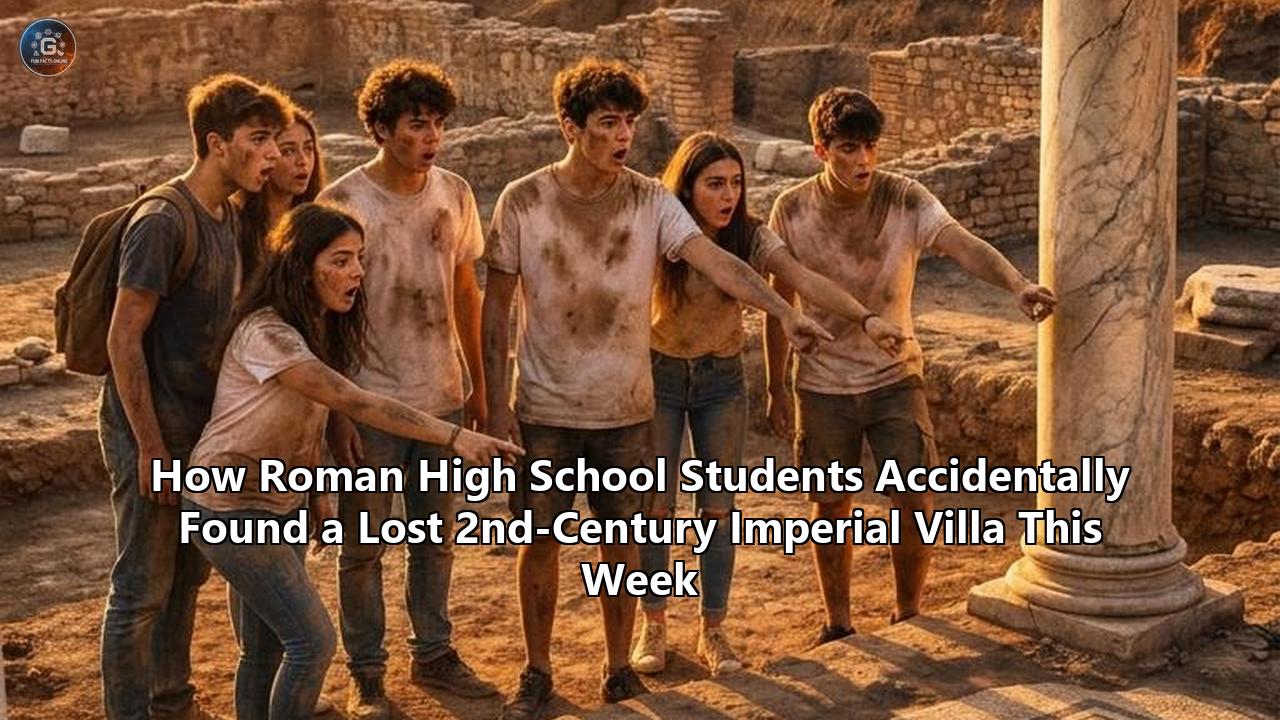
The heavy iron door beneath the gymnasium of the Liceo Scientifico Statale C. Cavour had been locked for as long as anyone could remember. For decades, the students of this prestigious Roman high school, located in the historic Rione Monti neighborhood, traded whispers about what lay on the other side of that threshold. Some spoke of forgotten fascist-era air-raid shelters; others dreamed of medieval catacombs or secret passageways leading directly to the Colosseum, which stands less than a thousand feet away.
This week, those decades of schoolyard myth-making culminated in an extraordinary archaeological reality. In the school’s crowded Aula Magna, officials from the Special Superintendency of Rome (Soprintendenza Speciale Archeologia Belle Arti e Paesaggio di Roma), alongside university researchers and school administrators, officially presented the "Domus Liceo Cavour" to the public.
The reveal confirmed that a group of teenage student-protesters had accidentally triggered a major Roman villa discovery. Beneath the active floorboards of the boys’ gymnasium lies a sprawling, remarkably intact second-century C.E. imperial-era mansion, complete with vibrant floral frescoes, complex geometric mosaics, and high-relief vaulted stuccoes that have not seen the light of day for centuries.
The announcement marks the end of a multi-year, €350,000 excavation and restoration project funded by the European Union’s NextGenerationEU "Caput Mundi" recovery fund. It also marks the beginning of an entirely new chapter in urban archaeology, demonstrating how a student-led occupation during the height of the COVID-19 pandemic escalated into one of the most unexpected archaeological breakthroughs in modern Rome.
This is the chronological story of how that forgotten subterranean world was lost, whispered about, breached by curious teenagers, and ultimately restored to the heritage of the Eternal City.
The Forgotten Prequel: Bureaucracy and Forgotten Lead Pipes (1895–1950)
To understand how a luxurious Roman home could be lost directly beneath a modern school, one must look back to the late 19th century, a period of frantic expansion and modernization in the newly unified Kingdom of Italy.
Between 1865 and 1885, a Catholic missionary congregation constructed a massive headquarters on the sloped terrain of the Esquiline Hill, overlooking the ancient valley of the Colosseum. The builders utilized heavy masonry, driving deep foundations into the soil without conducting the systematic archaeological surveys that are mandatory today. In their haste to erect the missionary complex—which would eventually be converted into the state-run Liceo Cavour—the construction crews bypassed, bricked over, or simply ignored several subterranean chambers.
The first true physical encounter with the ancient estate occurred in 1895. Municipal engineers were digging trench systems to pave the nearby Via degli Annibaldi. During these excavations, workers sliced directly through the easternmost edge of a large, high-status Roman domus.
The municipal archaeologists of the late Victorian era took brief note of the structure. They uncovered a portion of the villa’s outer walls and, crucially, recovered a series of lead water pipes, known as fistulae. These ancient pipes were stamped with the names of the property’s historical owners: Lucius Fabius Gallus, a prominent Roman senator, and Umbria Albina, a wealthy noblewoman of the gens Umbrius.
+-------------------------------------------------------------+
|               HISTORICAL OWNERS OF THE DOMUS                |
+------------------------------+------------------------------+
|    Lucius Fabius Gallus      |        Umbria Albina         |
|   (Roman Senator & Water     |   (Noblewoman of the gens    |
|     System Controller)       |  Umbrius, origin: Samnium)   |
+------------------------------+------------------------------+
Though the 1895 find was documented in municipal archives, the discoveries were quickly backfilled and forgotten. Rome was growing at a breakneck pace, and the bureaucratic machinery of the city’s urban expansion routinely swallowed such discoveries in administrative dust. Nobody realized that while the eastern fringe of the villa had been clipped by the street, the vast majority of the luxurious residential complex lay perfectly sealed, undisturbed, and structurally intact directly beneath the adjacent missionary building.
During the middle of the 20th century, the subterranean space experienced a quiet, unrecorded period of human contact. Between 1920 and 1950, when the building was still under religious administration before transitioning into a public high school, various occupants utilized portions of the upper cellar levels.
Recent stratigraphic work by the Special Superintendency has revealed layers of mid-century graffiti scrawled upon some of the ancient walls. These markings, written in charcoal and pencil, include simple names, religious symbols, and dates from the Second World War. They indicate that while the deep, vaulted rooms remained buried under tons of sediment and modern backfill, the higher chambers of the Roman house were occasionally accessed as makeshift storage vaults or shelters during bombings.
Yet, when the Catholic mission was fully secularized and transformed into the Liceo Scientifico Cavour, the keys to these deep cellars were misplaced, the access points were sealed with modern brickwork to support the weight of the gymnasium above, and the villa slipped back into total obscurity.
Rumors Under the Gym: The Lore of Liceo Cavour (2010–2020)
As the decades rolled on, the physical reality of the ruins transitioned into the realm of schoolyard folklore. Generation after generation of students at Liceo Cavour traded stories of what lay beneath their desks. The school’s physical location made these stories highly plausible.
From its front steps on Via degli Annibaldi, students look directly down at the Colosseum. The school is situated in the ancient district of the Carinae, a prestigious residential ridge that was once the Beverly Hills of the Roman Republic and early Empire. This was the neighborhood where historical figures like Marcus Tullius Cicero, Pompey the Great, and Octavian—before he became Emperor Augustus—maintained their private residences.
               [ Esquiline Hill / Carinae District ]
                                |
             +------------------+------------------+
             |                                     |
    [ Ancient Period ]                      [ Modern Period ]
  Home to elite Romans:                  Liceo Scientifico Cavour
 - Pompey the Great                       Built directly over
 - Marcus Tullius Cicero                  the 2nd-century C.E.
 - Octavian (Augustus)                    imperial domus ruins
Despite the neighborhood's illustrious history, extensive modern archaeological excavations had always been scarce because of the dense, highly protective layers of 19th-century municipal development. The school itself was built directly over these ancient strata, effectively acting as a concrete cap that preserved the ruins below while preventing archaeologists from accessing them.
Prior to this official announcement, the prospect of a Roman villa discovery under the school was nothing more than a ghost story to the faculty. Claudia Marino, a veteran history and Latin teacher at Liceo Cavour who also holds formal training in classical archaeology, recalls hearing these rumors early in her career.
"Ten years ago, a student told me the story of an ancient painted room under the gym, but I didn't give it much thought," Marino, 52, recalled. "In a city like Rome, every school has rumors of a buried gladiator or a hidden tunnel. We are surrounded by so much history that it is easy to become desensitized to the whispers."
Marino routinely took her students out of the classroom to conduct open-air history lessons on the nearby Palatine Hill, teaching them how to read the landscape of ancient ruins. She taught her pupils that classical structures did not merely disappear; they were recycled, built over, and compressed into the geological layers of the modern metropolis.
What she did not realize was that her own students were already using those lessons to construct a covert map of the school's forbidden basement. Driven by curiosity, a loose lineage of student-spelunkers had been quietly investigating the school’s lower levels for years, finding drafty vents and tiny foundation cracks that hissed with the cool, damp air of subterranean voids.
The Siege of January 2021: How a Protest Unlocked the Past
The definitive turning point in this story arrived in January 2021, set against the backdrop of the global pandemic. Italian high school students, frustrated by months of isolation and the government's plans to extend remote learning protocols, launched a wave of coordinated protests across the country.
At Liceo Cavour, the students organized an occupazione—a traditional Italian student protest where teenagers take physical control of their school building, barricade the entrances, sleep in the classrooms, and refuse to allow administrators or faculty inside.
For several consecutive nights, a group of teenage activists had the run of the massive, empty 19th-century missionary complex. Free from the supervision of teachers and security guards, and battling the profound boredom of the lockdown era, they began to explore the furthest reaches of the campus.
Equipped with nothing but their smartphones, flashlights, and a shared sense of adventure, they descended into the dark, labyrinthine basement levels situated far beneath the active gymnasium floor.
Deep in the damp crawlspaces of the building's foundations, the students discovered a heavy, rusted iron door that had been locked for generations. Rather than turning back, they began searching nearby administrative offices and storage closets for old keys.
Against all odds, they located an antique brass key that fit the rusted lock. With a heavy metallic groan, the door swung open, revealing a disused, debris-filled boiler room from the early 20th century, cluttered with defunct pipes, broken coal shovels, and forgotten maintenance equipment.
[Student Occupation: Jan 2021]
       |
       +---> Descend into basement crawlspaces
       |
       +---> Locate locked iron door & find antique key
       |
       +---> Enter disused boiler room
       |
       +---> Discover structural anomaly: ancient Roman brickwork
       |
       +---> Squeeze through narrow masonry breach
       |
       +---> Uncover vaulted chambers with 2nd-century frescoes
As the teenagers picked their way through the dust of the boiler room, they noticed a stark structural anomaly in the back wall. The rough, modern bricks of the 19th-century foundation suddenly gave way to a far older, highly precise masonry technique: opus latericium, the characteristic flat-brick construction of imperial Rome.
Peering through a narrow breach where the modern foundation had settled and cracked, the students could see a vast, pitch-black void on the other side. One by one, they squeezed through the narrow masonry gap.
When they raised their phone screens to illuminate the darkness, they did not find a musty utility tunnel. Instead, their beams of light cut through the gloom to strike brilliant, saturated pigments of red, yellow, and blue plaster. Above them, vaulted ceilings curved gracefully through the dark, decorated with delicate, raised white stucco reliefs of mythological figures and geometric borders. Beneath their feet, under a thick layer of fine silt, lay the distinct pattern of a stone mosaic floor.
The students realized they were standing in an undiscovered ancient Roman villa. They had managed to break into a subterranean time capsule that had remained sealed and protected from the modern world for hundreds of years.
Squeezing Through the Boiler Room: The Secret Verified
When the student occupation finally ended and classes resumed, the student leaders did not keep their discovery a secret. They approached Claudia Marino with an air of nervous excitement.
"When the protest was over, a group of students came to me and said, 'Professoressa, there really is something under the school, and you need to see it,'" Marino said. "Because of my background in archaeology, they knew I wouldn't just dismiss them. But even then, I was prepared to find a Roman wall fragment or a pile of discarded ancient bricks."
Intrigued, Marino agreed to let the students guide her down into the school's foundations. She followed them through the boiler room, holding her breath as she squeezed her way through the same narrow breach in the brickwork.
The moment she stepped into the ancient chamber and swept her flashlight across the walls, her professional skepticism vanished. The quality of the plaster work, the pristine state of the vaulted ceilings, and the sheer scale of the rooms told her instantly that they were standing in a massive, high-status imperial residence.
"I was completely stunned," Marino recalled. "The preservation of the paintings was extraordinary. The Pompeian red was as bright as if it had been painted yesterday, and the stuccoes on the vaults were incredibly refined. I knew immediately that this was not a simple basement or a minor storage room. This was the domestic heart of an elite Roman family from the golden age of the Empire."
Recognizing the immense historical significance of the site, Marino immediately contacted the Special Superintendency of Rome. The state agency, led by Soprintendente Daniela Porro, dispatched a team of emergency surveyors to inspect the basement.
The initial site inspection confirmed the students’ findings: the rooms under the gym were part of an exceptionally well-preserved mid-second-century C.E. domus. The transition from a student secret to an officially sanctioned excavation highlights how a serendipitous Roman villa discovery can mobilize state machinery, turning a schoolyard rumor into a major public heritage initiative.
Peeling Back the Strata: The Battle of the Excavation (2025–2026)
Despite the immediate excitement of the discovery, launching a full-scale archaeological excavation beneath an active public high school in the center of Rome is an incredibly complex logistical and engineering challenge.
It would take several years of administrative negotiation, structural planning, and fundraising before the first shovels could safely hit the dirt. The breakthrough came via the European Union's Post-Pandemic Recovery Instrument (NextGenerationEU), which allocated €350,000 to the project under the "Caput Mundi" initiative, designed to restore and open neglected cultural heritage sites across Rome.
+-----------------------------------------------------------+
|              PROJECT FINANCIALS & TIMELINE                |
+------------------------------+----------------------------+
| Total EU Funding Allocated   | €350,000 (Caput Mundi)     |
| Direct Construction Budget   | €210,000                   |
| Excavation Launch Date       | September 2025             |
| Phase 1 Public Unveiling     | May 28, 2026               |
+------------------------------+----------------------------+
With €210,000 dedicated directly to physical works, the Special Superintendency appointed architect Alessandra Centroni as the project's manager, with architect-engineer Giulia Carluccio serving as the director of works. The excavation contract was awarded to the specialized heritage firm Edil Costruzioni Group S.r.l., working alongside the expert excavators of SAMA Scavi Archeologici.
To guide the scientific direction of the dig, the team brought in Professor Filippo Coarelli, a world-renowned archaeologist and topographer of ancient Rome from the University of Perugia.
The physical excavation began in earnest in September 2025. The conditions inside the subterranean space were hostile to both the archaeological team and the delicate preservation of the ruins. The spaces were cramped, pitch-black, and completely unventilated, with zero natural air circulation.
Furthermore, because the ruins lay directly beneath the active school gymnasium, the engineers had to exercise extreme caution to ensure that the structural integrity of the 19th-century foundations was not compromised. Heavy machinery was out of the question; every bucket of dirt, modern debris, and ancient backfill had to be removed by hand through narrow access shafts.
                [ Active School Gym Floor ]
===========================================================  <-- Structural Support
      |                                               |
      v [ Cramped, Unventilated Subterranean Zone ]   v
      |                                               |
      +---> Excavation performed entirely by hand
      |
      +---> Intricate structural reinforcement of foundations
      |
      +---> Slow, stratigraphic removal of 20th-century backfill
The first phase of the work involved clearing out the modern debris and backfill that had accumulated over the centuries. The team slowly worked their way down the sloped terrain along Via Frangipane, which allowed for a direct, secure access point into the excavation zone without disrupting the daily schedule of the students attending classes directly above them.
As the archaeologists peeled back the stratigraphic layers, they meticulously documented the modern and historical graffiti on the walls, ensuring that the 20th-century history of the site was preserved before restoring the ancient surfaces.
The excavation was a masterclass in modern stratigraphic archaeology. The team did not just dig for treasures; they carefully analyzed the soil composition, structural shifts, and artifact placement to piece together the life cycle of the villa.
By the time the primary phase of the excavation concluded in the spring of 2026, the team had successfully cleared and consolidated five large, vaulted chambers of the ancient domus. They recovered enough material culture to fill 48 crates, including complete amphorae, delicate bone hairpins, bronze coins, and domestic drinking vessels that span several centuries of Roman history.
Inside the Domus: Frescoes, Stuccos, and the Elite Umbrius Family
The physical features of the newly excavated Domus Liceo Cavour are nothing short of spectacular, offering an unprecedented look into the domestic luxury of the Roman high class during the Nerva-Antonine and Severan dynasties.
The home represents a classic urban domus, designed as a sprawling, inward-facing oasis of wealth and political influence in the middle of one of the ancient city’s busiest neighborhoods.
The Frescoes and Color Palette
The most striking element of the villa is the preservation of its painted plaster walls. The subterranean nature of the chambers, which protected them from the weathering effects of rain, wind, and fluctuating temperatures, kept the ancient pigments remarkably vivid.
Large expanses of the walls are covered in the classic, deep iron-oxide pigment known as Pompeian red. This red is contrasted by elegant, hand-painted black and yellow borders that divide the walls into decorative panels.
Within these panels, ancient artists executed delicate, whimsical floral motifs, light botanical garlands, and stylized human figures that appear to float across the plaster. The style is highly characteristic of the mid-second century C.E., reflecting a period where Roman elite tastes shifted toward airy, elegant, and highly sophisticated naturalistic imagery.
+-------------------------------------------------------------+
|               WALL DECORATION SCHEME (DOMUS)                |
+-------------------------------------------------------------+
|  Dominant Base: Saturated Pompeian Red (Iron-Oxide)         |
|  Panel Dividers: Deep Charcoal Black & Ochre Yellow         |
|  Central Motifs: Floating human figures, botanical garlands  |
|  Ceiling Juncture: Intricate monochrome high-relief stucco  |
+-------------------------------------------------------------+
The Vaulted Ceilings and Stuccoes
Unlike many archaeological sites where the upper floors and roofs have collapsed, the vaulted ceilings of the Domus Liceo Cavour survived the pressure of the modern buildings above. These concrete barrel vaults are adorned with exquisite, high-relief stucco decorations.
The stuccoes feature elaborate geometric frameworks, including classic meander patterns, repeating squares, and delicate floral medallions. Some of the rooms feature monochromatic white stuccoes, which relied on the play of light and shadow from ancient oil lamps to create a sense of deep, architectural texture.
The sophistication of this plasterwork indicates that the villa’s owners hired top-tier artisans, likely the same workshops that decorated the imperial villas of Hadrian in Tivoli or the grand residences on the nearby Palatine Hill.
The Geometric Mosaics
The floors of the excavated chambers have yielded equally impressive artistic treasures. In one of the primary reception rooms (oecus), the team uncovered a large, intact stone mosaic floor.
Rather than the uniform, tiny square tiles (tesserae) found in standard Roman homes, this floor features a highly stylized, fashionable pattern composed of large, irregularly shaped pieces of rare, colored marbles.
This specific flooring technique, known to have been highly popular among the Roman aristocracy during the mid-second century, served as a bold, expensive display of wealth. The use of imported marbles from Greece, North Africa, and Asia Minor in an irregular, painterly mosaic design was a clear signal to guests of the family's far-reaching economic and political networks.
+---------------------------------------------------------------+
|                      MOSAIC STYLE PROFILE                     |
+----------------------------------+----------------------------+
| Tile Composition                 | Large, irregular fragments |
| Material Types                   | Rare, imported marbles     |
| Chronological Fashion            | Mid-second century C.E.    |
| Social Implication               | Extreme luxury / Patrician |
+----------------------------------+----------------------------+
The Owners: Lucius Fabius Gallus and the Gens Umbrius
This Roman villa discovery is made even more compelling by the fact that historical researchers can confidently put names to the people who once walked these mosaic floors.
By cross-referencing the 1895 lead pipe inscriptions with classical historical texts, Professor Filippo Coarelli and the research team reconstructed the social profile of the villa’s inhabitants.
               [ L. Fabius Gallus ]
             (2nd-Century Roman Senator)
                        |
                        | (Acquired or Shared Property)
                        v
               [ Umbria Albina ]
         (Noblewoman of the gens Umbrius)
                        |
       +----------------+----------------+
       |                                 |
 [ Elite Class ]                [ Samnium Roots ]
Water supply controller          Family rose from Pompeii/
in imperial capital              Samnium to Rome's Senate
Lucius Fabius Gallus was an influential Roman senator who, according to historical records, held a controlling interest in a portion of Rome’s highly complex municipal water distribution network. His co-occupant or subsequent owner, Umbria Albina, belonged to the prominent gens Umbrius, a family whose ancestral roots lay in the rugged Samnium region of south-central Italy, not far from Pompeii.
The Umbrii were a classic example of provincial elites who successfully climbed the social, economic, and political ladders of the Roman Empire, eventually moving to the capital, entering the Senate, and purchasing prime real estate in the ultra-prestigious Carinae neighborhood.
The discovery of their beautifully preserved home provides invaluable physical context to the social dynamics of 2nd-century Rome, showing how these aristocratic families lived, decorated their homes, and displayed their imperial status just steps away from the political heart of the empire.
The Living Monument: A New Era for Public Archaeology
The presentation of the Domus Liceo Cavour this week represents a major triumph for the city of Rome, but it also opens a new, forward-looking debate on how modern cities should manage their buried history.
Rather than sealing the ruins back up or transferring the frescoes to a traditional museum, the Special Superintendency of Rome and the administration of Liceo Cavour are embarking on a pioneering, collaborative educational experiment.
Under the framework of the "Cantieri Narranti" (Narrating Construction Sites) philosophy, the archaeological site will not be isolated from the school that sits above it. Instead, the ruins are being structurally integrated into the school’s daily curriculum and identity.
Plans are currently underway to construct a secure, independent public entrance along the descent of Via Frangipane. This pathway will allow tourists and historical enthusiasts to visit the subterranean Roman villa without disrupting the high school’s operations or compromising student safety.
              [ Future Public Access Architecture ]
=================================================================
  [ Via Frangipane Entrance ]   ---> Direct, subterranean access
                                       |
  [ Domus Liceo Cavour ]        <------+ (Tours managed by students)
                                       |
  [ School Gym / Classrooms ]   ---> Kept secure and separate
In a brilliant educational twist, the students of Liceo Cavour are slated to become the primary caretakers and interpreters of the ruins. Through Italy’s Percorsi per le Competenze Trasversali e per l'Orientamento (PCTO)—a national program that integrates real-world work experience into high school education—students will receive specialized training from professional archaeologists and art historians.
The very teenagers who attend chemistry and calculus classes upstairs will soon guide international tourists through the vaulted chambers below, explaining the 2nd-century frescoes, the family history of Lucius Fabius Gallus, and the thrilling story of how their own classmates discovered the villa during a school occupation.
"It is a beautiful circle of history," Claudia Marino observed with pride. "The same students whose curiosity and rebellion brought this forgotten Roman house back into the light of the 21st century will now be the ones who explain its beauty to the rest of the world. It turns archaeology from a dry academic subject into a living, breathing part of their daily lives."
Chronology of the Discovery
To see how this extraordinary story developed, the complete timeline of the "Domus Liceo Cavour" spans more than a century of urban development, student activism, and scientific excavation:
- 1865–1885: A Catholic missionary congregation constructs its headquarters on the Esquiline Hill, driving modern foundations directly over unrecognized ancient Roman structures.
- 1895: Municipal workers excavate Via degli Annibaldi, slicing through the easternmost edge of the Roman villa. Lead water pipes are discovered with the names of Lucius Fabius Gallus and Umbria Albina, but the findings are quickly archived and forgotten.
- 1920–1950: The subterranean chambers are briefly accessed by religious occupants, leaving behind charcoal and pencil graffiti that documents their presence during the chaotic decades of the early-to-mid 20th century.
- 2010–2020: The building operates as the public Liceo Scientifico Statale C. Cavour. Schoolyard legends circulate among the student body regarding hidden chambers and ancient paintings beneath the boys' gymnasium floor, though faculty members remain highly skeptical.
- January 2021: Frustrated by pandemic-related remote learning protocols, students occupy the school for several nights. During their exploration of the deep basement, they discover an old brass key, unlock a rusted iron door, enter a disused boiler room, and squeeze through a narrow structural crack to reveal the beautifully preserved Roman villa.
- Spring 2021: The student occupation ends. Teenagers guide history and Latin teacher Claudia Marino down to the site. Recognizing its monumental value, Marino reports the find to the Special Superintendency of Rome, initiating years of bureaucratic planning and fundraising.
- September 2025: Backed by €350,000 in EU recovery funds, a professional excavation team led by architect Alessandra Centroni, engineer Giulia Carluccio, and Professor Filippo Coarelli officially launches physical work to clear, stabilize, and excavate the five subterranean chambers.
- May 28, 2026: Archaeologists, administrators, and students host a joint press conference in the school's Aula Magna to present the spectacular results of the excavation to the public, officially naming the site the "Domus Liceo Cavour".
- June 2026 (This Week): The international community celebrates the formal public reveal of the villa, sparking global interest in the project and finalizing plans to transform the high school into a unique, student-run living museum.
Looking Ahead: The Open Questions of Rione Monti
While the current phase of the excavation has successfully stabilized and revealed five key rooms of the Domus Liceo Cavour, archaeologists emphasize that this is only the beginning of what could be a much larger, multi-decade investigation.
The boundaries of the villa remain unknown. Radar scans conducted by the University of Perugia suggest that the preserved residential complex extends far beyond the footprint of the high school gymnasium, stretching deep beneath the school’s outdoor courtyards and potentially under neighboring residential buildings along Rione Monti.
                             [ Unexplored Zone ]
                       (Courtyards, Adjacent Blocks)
                                     ^
                                     |
[ Domus Liceo Cavour ] <-------------+-------------> [ Via degli Annibaldi ]
 (5 Excavated Rooms)                                  (1895 Trench Area)
Unlocking these adjacent zones will require a delicate balance of urban engineering, community cooperation, and additional public funding. For now, the successful excavation of the school's basement stands as a powerful testament to the layers of history that sleep beneath the feet of modern Romans.
By taking the initiative to unlock a rusted door, a group of curious high school students did not just break the rules of a school protest—they permanently expanded the map of the ancient Roman world, proving that sometimes the most profound historical discoveries require nothing more than an open mind, a lost key, and the courage to squeeze through the dark.
References
- "La Domus Liceo Cavour, scoperta nei sotterranei del Liceo Cavour vicino al Colosseo..."
- "Gli studenti che esplorano il seminterrato della loro scuola a Roma hanno trovato una villa romana antica..."
- "Knowing this, local students recently undertook multiple clandestine explorations through passageways underneath the gymnasium..."
- "In January 2021, students at a high school across the street from the Colosseum came up with a bold plan..."
- "A Group of Students Peered Into a Locked Room—and Discovered an Ancient Roman Home..."
- "Student Protesters Accidentally Discovered an Ancient Roman Villa Beneath Their School..."
- "For years, students at a high school just steps from the Colosseum in Rome have spun tales of mysterious rooms..."
- "Students exploring the basement of their school in Rome have found an ancient Roman villa..."
- "Students in Italy have stumbled upon an ancient Roman structure — right beneath their high school's gym..."
- "The Soprintendenza Speciale (the special superintendency for archaeology in Rome) continues to conduct stratigraphic analysis..."
- "Italian teenagers discover a 1,800-year-old Roman luxury villa hiding beneath their high school gym..."
- "Nascosta per secoli sotto la palestra maschile del Liceo Cavour, una domus romana di età medio-imperiale è tornata alla luce..."
- "Domus Liceo Cavour – Liceo Scientifico Cavour..."
- "La Domus Liceo Cavour, scoperta nei sotterranei del Liceo Cavour vicino al Colosseo, collega racconti scolastici..."
- "Domus Liceo Cavour. Localizzazione: Municipio I, Rione Monti; Via Cavour..."
- "Scoperta una domus romana sotto il liceo Cavour: affreschi e mosaici nella scuola a due passi dal Colosseo..."
- "In 1895, when digging beneath a street outside, the Via degli Annibaldi, authorities discovered the easternmost section..."
- "DOMUS LICEO CAVOUR – Cantieri Narranti. Rilievo dei resti archeologici, restauro e consolidamento delle murature..."
- "According to Live Science, archaeologists found a mosaic in one room composed of a motley array of large tiles..."
- "Los investigadores creen que la casa pertenecía a un miembro de la familia Umbrius..."
- "Roma non finisce mai di stupire. L'ultima scoperta riguarda una magnifica domus di periodo medio-imperiale, che si nasconde al di sotto del piano delle palestre..."
- "The discovery was presented to the public on May 28 by Marino and Filippo Coarelli, an archaeologist at the University of Perugia..."
- "Filippo Coarelli, a Perugiai Egyetem régészprofesszora és a helyi örökségvédelmi hatóságok tájékoztatása szerint..."
- "The investigation of the Roman house began at the start of the year, but the discovery was widely publicized on May 28..."
Reference:
- https://www.popsci.com/science/roman-villa-discovery-under-high-school/
- https://www.popularmechanics.com/science/archaeology/a71497639/roman-villa-high-school/
- https://www.smithsonianmag.com/smart-news/these-italian-teenagers-stayed-overnight-at-their-school-they-found-ancient-roman-ruins-hidden-in-the-basement-180988917/
- https://www.reddit.com/r/Archaeology/comments/1tvr11j/roman_villa_in_a_schools_basement_discovered_by/?tl=it
- https://www.liceocavour.edu.it/web/?page_id=1636
- https://www.fanpage.it/roma/scoperta-una-domus-romana-sotto-il-liceo-cavour-affreschi-e-mosaici-nella-scuola-a-due-passi-dal-colosseo/
- https://gizmodo.com/student-protesters-accidentally-discovered-an-ancient-roman-villa-beneath-their-school-2000768209
- https://cantierinarranti.it/intervent/domus-liceo-cavour/
- https://economictimes.indiatimes.com/news/international/us/italian-teenagers-discover-a-1800-year-old-roman-luxury-villa-hiding-beneath-their-high-school-gym/articleshow/131548450.cms?from=mdr
- https://www.scintilena.com/domus-liceo-cavour-una-villa-romana-riemerge-sotto-la-palestra-di-una-scuola-a-roma/06/12/
- https://allthatsinteresting.com/italy-cavour-scientific-high-school-roman-house
- https://allthatsinteresting.com/italy-cavour-scientific-high-school-roman-house
- https://initalia.virgilio.it/roma-magnifica-domus-liceo-67651
- https://gizmodo.com/student-protesters-accidentally-discovered-an-ancient-roman-villa-beneath-their-school-2000768209
- https://www.reddit.com/r/Archaeology/comments/1tvr11j/roman_villa_in_a_schools_basement_discovered_by/
- https://www.radiocolonna.it/cultura-e-spettacolo/la-domus-nascosta-sotto-il-liceo-cavour-affreschi-e-stucchi-intatti-riemersi-nel-cuore-di-roma-fotogallery/
- https://soprintendenzaspecialeroma.it/wp-content/uploads/2026/03/id-132-Domus-Liceo-Cavour.pdf
- https://mult-kor.hu/okori-luxusvilla-maradvanyait-tartak-fel-egy-romai-kozepiskola-alatt-20260606
- https://www.scintilena.com/domus-liceo-cavour-una-villa-romana-riemerge-sotto-la-palestra-di-una-scuola-a-roma/06/12/
- https://www.livescience.com/archaeology/romans/italian-teenagers-discover-1-800-year-old-roman-luxury-house-underneath-their-high-school-gym
- https://www.lavanguardia.com/historiayvida/20260605/11556926/alumnos-roma-descubren-lujosa-domus-romana-1800-anos-debajo-gimnasio-instituto-roma-coliseo.html
- https://www.livescience.com/archaeology/romans/italian-teenagers-discover-1-800-year-old-roman-luxury-house-underneath-their-high-school-gym
- https://en.clickpetroleoegas.com.br/curious-teenagers-enter-the-underground-of-a-school-near-the-colosseum-and-discover-a-1800-year-old-roman-house-hidden-beneath-the-school-rpc95/