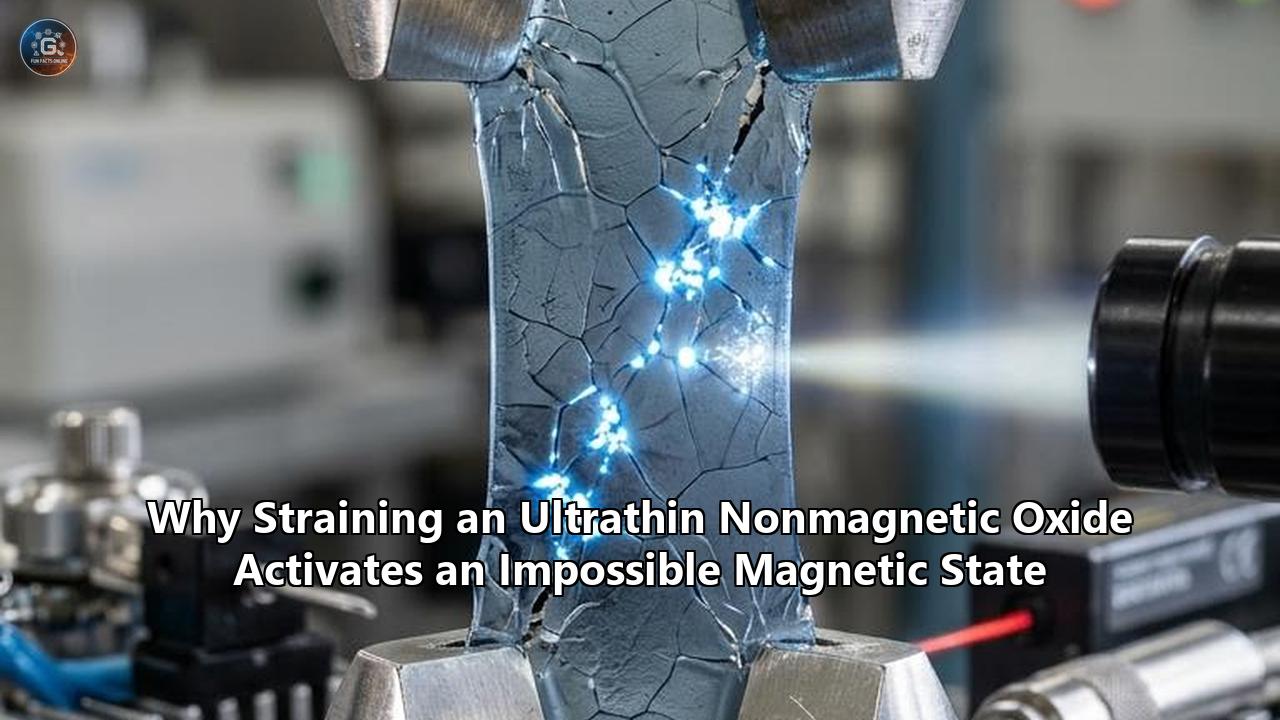
A research collaboration led by Rice University, the University of Minnesota, and the Paul Scherrer Institute has resolved one of the most contentious debates in modern condensed matter physics. Publishing their findings in Science Advances, the team demonstrated that ruthenium dioxide ($\text{RuO}_2$)—a metallic oxide widely considered nonmagnetic in its natural bulk state—develops an unconventional magnetic order when engineered into an ultrathin film just two nanometers thick and subjected to severe mechanical strain.
Using high-resolution spin-resolved angle-resolved photoemission spectroscopy (spin-ARPES) paired with hybrid molecular beam epitaxy (hybrid MBE), the researchers observed direct evidence of time-reversal symmetry breaking and momentum-dependent spin splitting within the strained material. The discovery confirms that mechanical lattice distortion can activate a dormant quantum state known as altermagnetism in materials previously dismissed as magnetically inert.
The emergence of magnetic order in an ultrathin strained nonmagnetic oxide provides concrete proof of an elusive third branch of magnetism. It also delivers an actionable blueprint for designing ultra-dense, terahertz-speed spintronic devices free from the parasitic magnetic interference that limits current computing hardware.
The Challenge: The Five-Year Deadlock Over Oxide Magnetism
Between 2019 and 2022, theoretical physicists proposed that rutile-structured transition metal oxides could harbor an entirely new class of magnetic ordering: altermagnetism. Unlike conventional ferromagnets, where electron spins align parallel to create a net external magnetic field, or antiferromagnets, where antiparallel spins cancel out without producing momentum-space spin splitting, altermagnets were predicted to achieve both. They possess a net-zero internal magnetization alongside fully spin-polarized electronic bands governed by rotational crystal symmetries.
$\text{RuO}_2$ was identified as the prime candidate to validate this theory. Early transport experiments suggested anomalous Hall conductivities and large spin-torque efficiencies, hinting at active magnetic sublattices.
Conventional Classifications vs. Altermagnetism
┌─────────────────────────┬───────────────────────┬─────────────────────────┐
│ Magnetic Phase          │ Net Magnetic Dipole   │ Spin-Split Band State   │
├─────────────────────────┼───────────────────────┼─────────────────────────┤
│ Ferromagnetism          │ High (Macro Field)    │ Yes (Uniform Shift)     │
│ Antiferromagnetism      │ Zero (Compensated)    │ No (Kramers Degeneracy) │
│ Altermagnetism (Strain) │ Zero (Compensated)    │ Yes (d-wave/g-wave)     │
└─────────────────────────┴───────────────────────┴─────────────────────────┘
The field soon hit a wall. When experimental groups across the globe attempted to verify this magnetic state in bulk single crystals and thicker epitaxial films using neutron diffraction, muon spin rotation ($\mu\text{SR}$), and photoemission spectroscopy, the results returned completely negative. Bulk $\text{RuO}_2$ displayed no macroscopic magnetic moment, no magnetic Bragg reflections, and zero evidence of time-reversal symmetry breaking.
This contradiction triggered intense skepticism. Prominent studies argued that earlier transport anomalies stemmed from extrinsic defects, oxygen nonstoichiometry, or standard interfacial spin-orbit coupling rather than intrinsic magnetic order. The broader scientific community was left with an unresolved problem: was altermagnetism in rutile oxides an artifact of idealized mathematical models, or was a hidden physical mechanism suppressing the magnetic ground state in physical samples?
The Root Cause: Why Bulk Oxides Suppress Magnetic Instabilities
The absence of magnetism in bulk and relaxed forms of $\text{RuO}_2$ stems from how electron correlations interact with the rutile crystal lattice.
$\text{RuO}_2$ crystallizes in the tetragonal rutile structure ($P4_2/mnm$ space group), where each ruthenium atom is coordinated by an octahedron of six oxygen atoms. In its unstrained, bulk configuration, the ruthenium $4d$ electrons occupy $t_{2g}$ orbitals ($d_{xy}$, $d_{xz}$, $d_{yz}$). The crystal field splitting and the overlap between the ruthenium $4d$ orbitals and oxygen $2p$ orbitals produce broad electronic conduction bands characterized by a wide bandwidth ($W$).
According to the Stoner criterion for itinerant magnetism:
$$U \cdot N(E_F) \ge 1$$
where $U$ is the on-site Coulomb exchange interaction and $N(E_F)$ is the electronic density of states at the Fermi energy. In bulk $\text{RuO}_2$, the broad dispersive bands keep $N(E_F)$ well below the critical threshold required to trigger spontaneous magnetic splitting. The kinetic energy penalty of aligning electron spins outweighs the potential reduction in exchange energy. Consequently, the material defaults to a nonmagnetic, highly conductive metallic state.
       UNSTRAINED BULK RuO₂                    EPITAXIALLY STRAINED RuO₂ (2 nm)
  (Broad Bands, Stoner Criterion Fails)       (Narrowed Bands, Symmetry Broken)

    Energy (E)                                 Energy (E)
        │                                          │
        │        ╭───────╮                         │        ╭───────╮
        │       ╱         ╲                        │       ╱   ▲     ╲  Spin Up
  ──────┼──────╱───────────╲───── E_F        ──────┼──────╱────┼──────╲── E_F
        │     ╱  N(E_F) Low ╲                      │     ╱  N(E_F) High╲
        │    ╰───────────────╯                     │    ╰──────┼────────╯
        │                                          │           ▼        Spin Down
        └────────────────────────                  └────────────────────────
          Density of States [N(E)]                   Density of States [N(E)]
            [ Nonmagnetic Metal ]                      [ Altermagnetic State ]
When researchers attempted to force magnetic behavior through standard thin-film epitaxy on mismatched substrates, they ran into a mechanical relaxation bottleneck. Complex oxide thin films typically relieve epitaxial misfit strain after exceeding a critical thickness of 3 to 5 nanometers. As the film grows thicker, it forms misfit dislocations and slip planes, reverting to its unstrained bulk lattice parameters.
Previous photoemission experiments failed because they analyzed relaxed films within this 5-to-50-nanometer window, where structural relaxation restored the nonmagnetic bulk ground state.
The Discovery: Unlocking the Forbidden State via Lattice Distortion
To solve this problem, the research team from Rice University, the University of Minnesota, and the Paul Scherrer Institute re-engineered the experimental architecture. Rather than studying bulk crystals or thick films, they targeted the ultrathin limit below the plastic relaxation threshold, stabilizing a continuous two-nanometer film of $\text{RuO}_2$ on a (110)-oriented titanium dioxide ($\text{TiO}_2$) single-crystal substrate buffered with two nanometers of $\text{TiO}_2$.
This synthesis locked the material into a coherent, highly distorted structural regime:
- Compressive In-Plane Strain: An approximate $-4.7\%$ compressive strain along the $[001]$ crystallographic direction.
- Tensile In-Plane Strain: An approximate $+2.3\%$ tensile strain along the $[1\bar{1}0]$ orthogonal direction.
- Octahedral Distortion: Strong physical shearing and tilting of the $\text{RuO}_6$ oxygen octahedra, breaking the local fourfold rotational symmetry.
             COHERENT ANISOTROPIC STRAIN PROFILE

                     [001] Axis: -4.7% Compression
                            │  ▲
                            ▼  │
             ┌──────────────┼──┼──────────────┐
             │              │  │              │
  [110] Axis │ ◄───(+)────── Ru ──────(+)───► │ [110] Axis
  +2.3% Tensile             │  │              │ +2.3% Tensile
             │              │  │              │
             └──────────────┼──┼──────────────┘
                            │  ▲
                            ▼  │
                     [001] Axis: -4.7% Compression
This structural deformation fundamentally alters the electronic band structure. The anisotropic strain lifts the orbital degeneracy of the ruthenium $4d$ electrons, narrowing specific $t_{2g}$ sub-bands.
As the bandwidth $W$ contracts, the local density of states $N(E_F)$ surges, pushing the system past the Stoner threshold. The strain permanently removes the symmetry protections that suppress magnetism in the bulk crystal, driving a phase transition into a $d$-wave altermagnetic state with magnetic moments aligned inside the film plane.
Spectroscopic Proof: Separating Surface Effects from True Magnetism
Proving the existence of this strain-induced state required isolating true magnetic time-reversal symmetry breaking from ordinary spin-orbit coupling phenomena, such as Rashba or Dresselhaus effects common at crystal surfaces and interfaces.
The team deployed spin-resolved angle-resolved photoemission spectroscopy at the Paul Scherrer Institute's synchrotron beamline. Spin-ARPES measures both the energy and momentum of ejected photoelectrons while determining their spin polarization vectors along three spatial axes.
                  SPIN-ARPES EMISSION SPECTROMETRY

      Synchrotron UV Beam (hν)
                │
                ▼
      ┌──────────────────┐
      │ Strained RuO₂    │ ───► Photoelectrons Ejected
      │ Thin Film (2 nm) │
      └──────────────────┘
                │
                ├──────► Mirror-Odd Component:
                │        Surface Rashba Spin-Orbit Coupling (Non-Magnetic)
                │
                └──────► Mirror-Even Component:
                         Intrinsic Time-Reversal Symmetry Breaking (Altermagnetic)
The measurements revealed two distinct spin-texture components:
- Mirror-Odd Spin Component: A signature that reverses sign across the high-symmetry mirror plane of the crystal lattice. This behavior is consistent with conventional inversion-symmetry breaking at the physical interface and does not require magnetism.
- Mirror-Even Spin Component: A distinct spin-polarization signature that maintains its sign across the structural mirror plane.
A mirror-even spin texture cannot arise from standard electrostatic potential gradients, Rashba effects, or measurement artifacts. Under rigorous group theory analysis, this component is only possible if time-reversal symmetry is intrinsically broken.
When the researchers ran identical measurements on unstrained, relaxed $\text{RuO}_2$ films, the mirror-even component vanished completely. This established that the unconventional magnetic phase is governed directly by lattice strain rather than native chemistry.
Solutions: Engineering Protocols for Strained Oxide Platforms
Activating hidden quantum phases in a strained nonmagnetic oxide demands fabrication methods that circumvent natural strain relaxation limits. Standard substrate epitaxy often fails because the elastic energy stored in the lattice grows linearly with film thickness, leading to cracking or dislocation formation.
Materials scientists and device engineers are tackling this through three distinct technical pathways.
       THREE PATHWAYS TO SUSTAINED OXIDE STRAIN

 ┌───────────────────────────┬───────────────────────────┬───────────────────────────┐
 │ 1. Heteroepitaxy Buffer   │ 2. Freestanding Membrane  │ 3. Dynamic Piezoelectric  │
 ├───────────────────────────┼───────────────────────────┼───────────────────────────┤
 │ Rigid substrate clamping  │ Lift-off via sacrificial  │ In-situ mechanical tuning │
 │ using lattice-matched     │ SAO layer onto flexible   │ via PMN-PT piezoelectric  │
 │ intermediate layers.      │ polymer membranes.        │ voltage actuators.        │
 │ Thickness limit: < 3 nm.  │ Reversible strain: > 5%.  │ Reversible strain: ~1-2%. │
 └───────────────────────────┴───────────────────────────┴───────────────────────────┘
1. Hybrid Molecular Beam Epitaxy with Buffer-Layer Tuning
Hybrid molecular beam epitaxy (hybrid MBE) utilizes volatile metal-organic precursors combined with elemental Knudsen effusion cells. This approach provides sub-monolayer stoichiometry control, eliminating the metal cation vacancies and point defects that normally pin or disrupt electron spins.
By inserting atomic-scale buffer layers (such as sub-2-nanometer rutile $\text{TiO}_2$ on single-crystal substrates), engineers can lock the functional oxide into an artificially clamped, coherent crystallographic state without activating misfit dislocation cascades.
2. Freestanding Single-Crystal Membranes
A second strategy bypasses substrate clamping entirely using water-soluble sacrificial buffer layers.
- An epitaxial heterostructure is grown on a sacrificial layer of strontium aluminate ($\text{Sr}_3\text{Al}_2\text{O}_6$, or SAO).
- The SAO layer is dissolved in deionized water, releasing the crystalline oxide film from its rigid growth platform.
- The released single-crystal membrane is transferred onto flexible polymer backings, such as polyimide.
When isolated as freestanding membranes, transition metal oxides can sustain mechanical deformations exceeding $5\%$ without structural failure—far beyond the $0.1\%$ to $1\%$ fracture limit of bulk crystals. This platform enables continuous, reversible in-plane mechanical stretching, allowing researchers to tune the material into and out of the altermagnetic state at will.
               SACRIFICIAL LAYER LIFT-OFF PROCESS

   [ Epitaxial Oxide Layer ]           [ Epitaxial Oxide Layer ]
   ─────────────────────────  H₂O      ─────────────────────────
   [  Soluble SAO Buffer   ] ────►     (SAO Dissolves Away)
   ─────────────────────────           ─────────────────────────
   [ Rigid SrTiO₃ Substrate]           [ Rigid SrTiO₃ Substrate]
                                                  │
                                                  ▼
                                       [ Transferred to Polyimide ]
                                       [ Continuous Strain > 5%   ]
3. In-Situ Piezoelectric Actuation
To integrate strain-tunable nonmagnetic oxides into dynamic computing circuits, researchers are pairing ultrathin oxide membranes directly with piezoelectric single crystals, such as lead magnesium niobate-lead titanate ($\text{Pb(Mg}_{1/3}\text{Nb}_{2/3}\text{)O}_3\text{-PbTiO}_3$, or PMN-PT).
Applying an electrical voltage across the PMN-PT substrate generates anisotropic in-plane biaxial or uniaxial strain that transfers directly into the overlying oxide layer. This allows on-chip electrical switching between the nonmagnetic metallic state and the spin-split magnetic state at megahertz frequencies.
Implications for Next-Generation Spintronics and Computing
The ability to switch on magnetic ordering in an ultrathin strained nonmagnetic oxide provides solutions to fundamental physical limits that have stalled the scalability of magnetic random-access memory (MRAM) and quantum logic circuits.
                 SPINTRONIC PERFORMANCE ADVANTAGES

      Property          Ferromagnets       Strained Altermagnets
 ┌───────────────────┬──────────────────┬────────────────────────┐
 │ Stray Field       │ High (Crosstalk) │ Zero (Dense Arrays)    │
 │ Resonance Speed   │ ~1-50 GHz        │ ~0.5-20 THz            │
 │ Spin Polarization │ High             │ High (Band-Dependent)  │
 │ Write Energy      │ High             │ Ultra-Low (Pure Spin)  │
 └───────────────────┴──────────────────┴────────────────────────┘
Eliminating Stray Magnetic Fields and Bit Crosstalk
High-density MRAM arrays rely on ferromagnetic storage cells to encode binary data (0s and 1s) via magnetization direction. However, as memory cells shrink below 20 nanometers and pack closer together, their macroscopic magnetic fields overlap.
This stray field crosstalk causes unintended data flipping in neighboring cells, posing a physical barrier to scaling memory density.
Altermagnetic states activated within a strained nonmagnetic oxide eliminate this issue. Because the magnetic moments of adjacent sublattices alternate direction across rotational crystal symmetries, their magnetic dipole moments cancel out completely on a macroscopic level.
The material generates zero external stray fields, enabling cells to be scaled down to sub-10-nanometer dimensions without magnetic cross-interference.
Shifting from Gigahertz to Terahertz Operating Frequencies
Conventional ferromagnetic memory devices operate within the gigahertz ($\text{GHz}$) regime, limited by the precession speed of magnetic domain walls during write and read cycles.
Antiferromagnetic and altermagnetic spin dynamics are governed by inter-sublattice exchange coupling rather than magnetic anisotropy fields. This shifts the fundamental spin resonance frequency from gigahertz into the terahertz ($\text{THz}$) domain.
Devices utilizing strain-activated altermagnetic oxides can achieve sub-picosecond magnetic switching speeds, operating up to three orders of magnitude faster than existing nonvolatile memory technologies.
Generation of Highly Polarized Spin Currents
Antiferromagnets produce zero net stray fields, but their spin degeneracy makes it difficult to read their internal states or generate polarized electrical currents.
Altermagnets bypass this limitation. Because their electronic band structure exhibits large, momentum-dependent spin splitting ($d$-wave or $g$-wave symmetry), passing an electrical current through the material automatically produces a highly spin-polarized current.
This allows engineers to read and manipulate data states using standard electrical contacts, eliminating the complex spin-filtering heterostructures required in conventional spintronics.
Comparative Material Landscape: Emerging Strain-Activated Oxides
While $\text{RuO}_2$ serves as the prototype, the discovery that mechanical strain can induce magnetic instabilities has sparked an intensive search across other nonmagnetic and quantum paraelectric transition metal oxides.
              STRAIN-INDUCED QUANTUM PHASES IN OXIDES

 ┌───────────────────────┬──────────────────────┬───────────────────────────────┐
 │ Material System       │ Natural Ground State │ Strain-Induced Active Phase   │
 ├───────────────────────┼──────────────────────┼───────────────────────────────┤
 │ Ruthenium Dioxide     │ Nonmagnetic Metal    │ d-wave Altermagnetism /       │
 │ (RuO₂)                │                      │ Weak Ferromagnetism           │
 ├───────────────────────┼──────────────────────┼───────────────────────────────┤
 │ Strontium Titanate    │ Quantum Paraelectric │ In-Plane Room-Temperature     │
 │ (SrTiO₃)              │ Insulator            │ Ferroelectricity & Magnetism  │
 ├───────────────────────┼──────────────────────┼───────────────────────────────┤
 │ Potassium Tantalate   │ Quantum Paraelectric │ High-Temperature Polar State  │
 │ (KTaO₃)               │ Insulator            │ with Interfacial Spin Split   │
 ├───────────────────────┼──────────────────────┼───────────────────────────────┤
 │ Molybdenum Dioxide    │ Nonmagnetic Metal    │ Predicted Altermagnetic       │
 │ (MoO₂)                │                      │ Semi-Metallic Ground State    │
 └───────────────────────┴──────────────────────┴───────────────────────────────┘
In strontium titanate ($\text{SrTiO}_3$), applying uniaxial tensile strain greater than $1.5\%$ breaks the cubic perovskite symmetry, shifting titanium cations out of the oxygen octahedral center. This induces room-temperature ferroelectricity with transition temperatures exceeding $400\text{ K}$.
When combined with oxygen-vacancy engineering ($\text{SrTiO}_{3-\delta}$), mechanical strain modulates the overlap between isolated titanium $t_{2g}$ electron orbitals, activating localized magnetic moments and exchange coupling in an otherwise nonmagnetic insulator.
Similarly, rutile oxides such as molybdenum dioxide ($\text{MoO}_2$) and tungsten dioxide ($\text{WO}_2$) possess $4d$ and $5d$ valence electrons that are susceptible to strain-induced band narrowing, marking them as candidates for high-temperature altermagnetic spintronics.
Roadblocks to Commercial Implementation
Transforming strain-activated oxide magnetism from a laboratory proof-of-concept into industrial computing hardware requires overcoming several material and fabrication bottlenecks.
                  CHALLENGES TO COMMERCIAL SCALING

   SYNTHESIS CONTROL             THERMAL TOLERANCE           SILICON INTEGRATION
 ┌───────────────────────┐     ┌───────────────────────┐   ┌───────────────────────┐
 │ Maintaining atomic    │     │ Preserving continuous │   │ Growing coherent,     │
 │ stoichiometry and     │ ──► │ strain without        │──►│ highly strained       │
 │ sub-2 nm uniform      │     │ relaxation across     │   │ oxides directly on    │
 │ thickness at wafer    │     │ industrial thermal    │   │ 300 mm foundry        │
 │ scales.               │     │ cycles (up to 400°C). │   │ silicon platforms.    │
 └───────────────────────┘     └───────────────────────┘   └───────────────────────┘
1. Wafer-Scale Synthesis and Thickness Uniformity
The magnetic state observed in $\text{RuO}_2$ relies on maintaining a film thickness below two to three nanometers while preserving precise crystalline alignment.
At this scale, a single unit-cell deviation can trigger strain relaxation or alter the local oxygen stoichiometry, quenching the magnetic moment.
While hybrid MBE achieves the necessary atomic precision, it is a slow, high-vacuum deposition method suited primarily for academic research. Transitioning to commercial fabrication will require adapting industrial deposition techniques, such as atomic layer deposition (ALD) and high-rate metal-organic chemical vapor deposition (MOCVD), to achieve identical strain states across 300-millimeter silicon wafers.
2. Thermal Stability and Annealing Limits
Semiconductor back-end-of-line (BEOL) processing requires materials to withstand thermal annealing steps between $350^\circ\text{C}$ and $450^\circ\text{C}$.
Ultrathin oxide films under high elastic strain are metastable. Elevated thermal budgets provide the activation energy needed for the lattice to nucleate dislocations, relax its strain, or lose oxygen atoms to surrounding dielectric layers.
Developing protective capping layers (such as atomic-layer-deposited aluminum oxide, $\text{Al}_2\text{O}_3$, or silicon nitride, $\text{Si}_3\text{N}_4$) that preserve the internal strain state through standard chip fabrication remains a critical engineering task.
3. Direct Monolithic Integration on Silicon
Growing rutile oxides directly on diamond-cubic silicon ($\text{Si}$) or hexagonal gallium nitride ($\text{GaN}$) presents a significant crystallographic mismatch.
Direct deposition on bare silicon typically yields amorphous or randomly oriented polycrystalline films that cannot sustain coherent anisotropic strain.
Researchers are investigating intermediate crystalline template architectures—such as epitaxial yttria-stabilized zirconia (YSZ) and strontium titanate buffer layers grown via atomic-layer molecular beam epitaxy—to provide a crystalline bridge between the silicon substrate and the functional strained oxide layer.
What to Watch Next
The successful activation of altermagnetism in ultrathin $\text{RuO}_2$ shifts the study of complex oxides from accidental material discovery to deliberate structural engineering.
Key milestones to watch over the coming months include:
- Room-Temperature Operation Thresholds: Establishing the upper Curie and Néel temperature boundaries of strained $\text{RuO}_2$ and related $4d$/$5d$ binary oxides across varying degrees of mechanical stretching.
- Demonstration of THz Switching in Functional Devices: The first experimental proof of sub-picosecond, zero-stray-field magnetic memory cells constructed from strained oxide heterostructures.
- Direct Imaging of Altermagnetic Domain Walls: Using operational spin-polarized scanning tunneling microscopy (SP-STM) and diamond nitrogen-vacancy (NV) magnetometry to map the local domain wall structure of strained oxide membranes at sub-nanometer resolutions.
- Expansion to 2D Layered and Multiferroic Heterostructures: Exploring how strain coupling across stacked van der Waals membranes and nonmagnetic oxides can produce synthetic multiferroics that simultaneously couple electricity, mechanical force, and magnetism.
By resolving the long-standing dispute over rutile $\text{RuO}_2$, researchers have validated the core physics of altermagnetism and demonstrated that lattice strain is a reliable control mechanism for quantum states. Straining materials previously considered nonmagnetic provides a direct path toward denser, faster, and more energy-efficient computing platforms.
Reference:
- https://www.sciencedaily.com/releases/2026/08/260826055454.htm
- https://lifeboat.com/blog/2026/08/unusual-metal-oxide-shows-signs-of-magnetism-under-lattice-strain-in-ultrathin-layers
- https://www.spintronics-info.com/strain-switches-altermagnetism-ultrathin-ruthenium-dioxide-films-addressing
- https://cse.umn.edu/college/news/tuning-nonmagnetic-material-reveals-hidden-magnetic-state
- https://linkinghub.elsevier.com/retrieve/pii/S0272884224046108
- https://s3.amazonaws.com/na-st01.ext.exlibrisgroup.com/01LANL_INST/storage/alma/0C/4B/B2/7C/B4/26/EB/55/41/E4/41/43/E3/9A/13/41/Accepted%20Manuscript.pdf?response-content-disposition=attachment%3B%20filename%3D%22Accepted%2520Manuscript.pdf%22%3B%20filename%2A%3DUTF-8%27%27Accepted%2520Manuscript.pdf&response-content-type=application%2Fpdf&X-Amz-Algorithm=AWS4-HMAC-SHA256&X-Amz-Date=20260828T000000Z&X-Amz-SignedHeaders=host&X-Amz-Credential=AKIASFZ3TTVRIW3HGO5P%2F20260828%2Fus-east-1%2Fs3%2Faws4_request&X-Amz-Expires=119&X-Amz-Signature=4e3e02f3a75d9fd2a4b5840826eb3962c5ac29168d6e67f5d66e4328e268e13f
- https://pmc.ncbi.nlm.nih.gov/articles/PMC12994328/
- https://www.researchgate.net/figure/Straining-SrTiO3-membrane-a-Two-scenarios-of-the-strain-induced-ferroelectric-transition_fig1_391706252
- https://pmc.ncbi.nlm.nih.gov/articles/PMC7305178/
- https://arxiv.org/abs/2005.09101