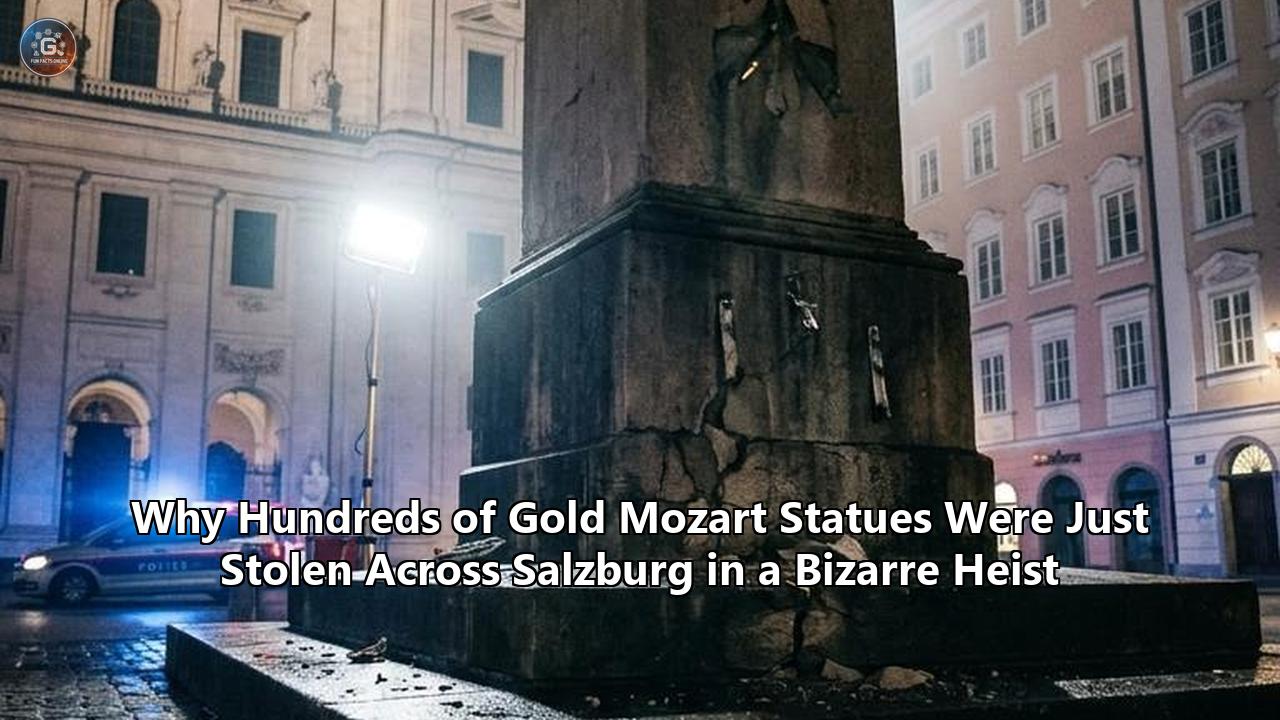
Out of 230 golden polymer sculptures installed across the Mirabell Gardens in mid-July 2026, exactly 210 have disappeared. The 91.3% loss rate inside the public gardens—and a combined 65.6% attrition rate across the broader 320-statue citywide installation—forced the International Mozarteum Foundation to abruptly dismantle the remaining outdoor exhibition on August 12, more than two weeks ahead of its scheduled August 30 closure.
The open-air exhibition, titled Mozart – The Untamable Genius, was conceived by 76-year-old German conceptual artist Ottmar Hörl to commemorate the 270th anniversary of Wolfgang Amadeus Mozart’s birth. Instead of an orderly civic celebration, the project triggered one of the most quantitatively anomalous, high-volume public art heists in modern European history.
+-------------------------------------------------------------------------------+
|                      SALZBURG MOZART INSTALLATION ATTRITION                   |
+------------------------------------+------------------+-----------------------+
| Location / Metric                  | Initial Quantity | Stolen / Retained     |
+------------------------------------+------------------+-----------------------+
| Mirabell Gardens (Parterre/Basin)  | 230 statuettes   | 210 Stolen (91.3%)    |
| Mozarteum Garden & Residence       |  90 statuettes   |  10 Stolen (11.1%)    |
| Total Citywide Deployment          | 320 statuettes   | 220 Missing/Retained  |
| Official Reserve Stock             | 100 statuettes   | Depleted / Unusable   |
| Primary Value Per Unit             | €90 – €100 ($114)| Total Loss: ~€21,000  |
| Timeframe of Disappearance         | July 15 – Aug 12 | 28 Days (7.5/day avg) |
+------------------------------------+------------------+-----------------------+
Salzburg law enforcement, the Mozarteum Foundation, and municipal cultural administrators are confronting a physical and economic puzzle: a combined theft of more than 400 kilograms of weather-resistant, gold-lacquered plastic figurines. The logistics required to extract, transport, and conceal 210 rigid, 50-centimeter sculptures from the center of a UNESCO World Heritage site point directly away from sporadic tourist mischief toward an organized, systematic removal campaign.
The 672-Hour Timeline: Tracking the Disappearance Curve
The disappearance of the statuettes did not occur in a single sweep. Rather, it followed an accelerating decay curve that outpaced the security assessments conducted prior to the July 15 opening.
Statues Remaining in Mirabell Gardens (July 15 – August 12, 2026)
240 +--[230]
200 +      \
160 +       \
120 +        \--[150] (Day 14: AP / Mozarteum milestone)
 80 +                \
 40 +                 \
  0 +------------------\--[20] (Day 28: Exhibition shut down)
    +----+----+----+----+----+----+----+----+
    0    4    8   12   16   20   24   28 Days
Phase 1: The Initial Penetration (July 15 – July 22)
- Opening count: 230 figures secured on gravel walkways, lawn borders, and stone plinths across the Mirabell Palace grounds.
- Day 1 losses: 2 figures vanished within the first 14 hours of public viewing.
- Attrition rate: 2.8 units per 24-hour cycle.
- Security response: Routine patrols by municipal park wardens (Stadtgartenamt) and private security check-ins every 120 minutes. Foundation officials initially treated the losses as standard attrition, relying on an on-site reserve of 100 units.
Phase 2: Systematic Volume Stripping (July 23 – July 29)
- Cumulative missing: 80 statuettes unaccounted for by the end of Week 2.
- Attrition rate: Surged to 8.5 units per day.
- Extraction patterns: Statuettes disappeared exclusively between the hours of 22:30 CET (park gate closure) and 05:30 CET (grounds maintenance entry). Figures located within direct sightlines of open thoroughfares (such as the central path facing the Hohensalzburg Fortress) were selectively targeted before interior perimeter pieces.
Phase 3: The Critical Threshold and Shutdown (July 30 – August 12)
- Cumulative missing: 210 figures stolen from Mirabell Gardens; 10 additional missing from perimeter sites.
- Remaining inventory: 20 figures standing in Mirabell Gardens by the morning of August 12.
- Net survival rate: 8.7% of the original Mirabell array.
- Decision point: The Mozarteum Foundation and Ottmar Hörl formally announced the termination of the open-air Mirabell installation. The surviving 20 figures were extracted and moved into secure interior vaults.
+-----------------------------------------------------------------------+
|                THE THREE OPERATIONAL PHASES OF EXTRACTION             |
+-------------------+-----------------+----------------+----------------+
| Metric            | Phase 1 (Wk 1)  | Phase 2 (Wk 2) | Phase 3 (Wk 3–4|
+-------------------+-----------------+----------------+----------------+
| Daily Theft Avg   | 2.8 units/day   | 8.5 units/day  | 9.3 units/day  |
| Cumulative Losses | 20 units        | 80 units       | 210 units      |
| Mass Removed (kg) | 38.0 kg         | 152.0 kg       | 399.0 kg       |
| Volume Moved (m³) | 0.16 m³         | 0.64 m³        | 1.68 m³        |
+-------------------+-----------------+----------------+----------------+
Logistical Forensic Modeling: The Physical Weight of 210 Missing Statuettes
The theory that the theft was driven entirely by casual souvenir hunters collapses when examined through physical, spatial, and logistical modeling.
       50 cm (19.7 in)
      +--------------+
      |    [MOZART]  |  Dimensions: 50 cm x 20 cm x 16 cm
      |      /\      |  Unit Weight: 1.90 kg (Toxic-free polymer)
      |     /  \     |  Unit Base Area: 0.032 m²
      |    ( o.o)    |  Unit Displacement Volume: ~0.008 m³ (packaged)
      |   /|    |\   |
      |  ( |PIMP| )  |  Total 210 Units:
      |    |ERL |    |  -> Mass: 399.0 kg (~880 lbs)
      |   /      \   |  -> Packaged Volume: 1.68 m³
      +--------------+
       20 cm (7.9 in)
Each sculpture produced for the Mozart – The Untamable Genius series is rotation-molded from a specialized, weather-resistant plastic compound (polyethylene/polyurethane blend), measuring approximately 50 centimeters (19.68 inches) in height, 20 centimeters in width, and 16 centimeters in depth. Each unit weighs roughly 1.9 kilograms (4.18 pounds).
Total Mass Calculation:
M_total = 210 units * 1.90 kg/unit = 399.0 kg (879.6 lbs)

Uncompressed Volumetric Footprint:
V_unit = 0.50 m * 0.20 m * 0.16 m = 0.016 m³
V_effective (tessellated packing factor 0.50) = 0.008 m³
V_total = 210 * 0.008 m³ = 1.68 m³ (59.33 cubic feet)
Transport and Load Analysis
- Single Pedestrian Limit: An average individual navigating a city center can inconspicuously conceal at most one 50-centimeter figurine within an oversized backpack or tote. Transporting 210 units via individual actors requires 210 discrete pedestrian sorties.
- Vehicle Freight Capacity: A standard European commercial cargo van (such as a Volkswagen Transporter or Mercedes-Benz Vito) provides approximately 5.8 to 6.6 m³ of cargo volume and an 800 to 1,200 kg payload capacity.
- Logistical Footprint: The entire batch of 210 statuettes occupies 1.68 m³ and weighs 399 kg, representing 28.9% of a standard van’s volume capacity and 39.9% of its maximum payload limit.
Salzburg municipal investigators noted that moving 1.68 m³ of rigid golden plastic requires either a consolidated vehicular operation using staging points along the perimeter of the Mirabell Gardens (such as Rainerstraße, Mirabellplatz, or Schwarzstraße) or a structured network of couriers running repeat extractions during the 7-hour overnight closure window.
+--------------------------------------------------------------------+
|                LOGISTICAL VEHICLE CAPACITY COMPARISON              |
+--------------------+----------------+----------------+-------------+
| Cargo Asset        | Vol. Used (m³) | Payload Usage  | Vans Needed |
+--------------------+----------------+----------------+-------------+
| Standard Hatchback | 1.68 / 0.38 m³ | 399 / 400 kg   | 4.4 trips   |
| Compact Cargo Van  | 1.68 / 3.20 m³ | 399 / 650 kg   | 1.0 trip    |
| Pedestrian Courier | 1.68 / 0.04 m³ | 399 / 15 kg    | 27.0 trips  |
+--------------------+----------------+----------------+-------------+
Secondary Market Economics vs. Material Value
A defining aspect of this case is the economic mismatch between the material value of the stolen goods and their potential secondary market yield.
       ESTIMATED VALUE TRAJECTORY PER STATUETTE (EUR)
€1,000 +
       |                                              [Black Market /
 €800 +                                                Bespoke Resale]
       |                                               €400 - €750
 €600 +
       |
 €400 +
       |                        [Primary Retail]
 €200 +  [Raw Material]           €90 - €100
       |   €14.50
   €0 +-------+-----------------------+----------------------+
         Material Cost             Artist Price          Post-Theft Illicit
Material Reality vs. Criminal Misconception
The sculptures are finished with an opaque, weather-sealed gold lacquer over an industrial synthetic polymer. They contain zero precious metal content:
- Gold leaf / bullion content: 0.00 grams.
- Scrap polymer salvage value: Less than €0.15 per kilogram (€0.28 per statuette).
- Industrial melt/scrap yield for 210 units: ~€59.85 total.
If the perpetrators operated under the assumption that the statues were cast in bronze, brass, or gold-gilded alloy, the physical properties provide an immediate contradiction: a 50-centimeter solid cast bronze statue would weigh between 28 and 35 kilograms, compared to the 1.9-kilogram synthetic density of Hörl's figures.
+--------------------------------------------------------------------------+
|                     MATERIAL VALUATION MATRIX (EUR)                      |
+---------------------+-------------------+--------------------------------+
| Metric Level        | Per Unit Value    | Aggregate (210 Units)          |
+---------------------+-------------------+--------------------------------+
| Scrap / Raw Polymer | €0.28             | €58.80                         |
| Production Cost     | €14.50 – €18.00   | €3,045 – €3,780                |
| Primary Mozarteum   | €90.00 – €100.00  | €18,900 – €21,000              |
| Secondary Art Market| €350.00 – €500.00 | €73,500 – €105,000             |
| Illicit Speculation | €550.00 – €800.00 | €115,500 – €168,000            |
+---------------------+-------------------+--------------------------------+
The "Scarcity Premium" in Conceptual Collectibles
Ottmar Hörl’s public art projects operate on an open-access model: installations are accessible in civic spaces, and figures are sold at the close of the exhibition to cover administrative and production costs. The baseline retail price set by Hörl and the Mozarteum Foundation was €90 to €100 ($114) per unit.
The secondary market for Hörl's conceptual multiples (including his 2003 Nuremberg Dürer hares, 2010 Wittenberg Martin Luther figurines, and 2023 Bayreuth Richard Wagner pieces) behaves with high volatility when public theft truncates the edition run:
- Baseline authorized retail: €90 – €100.
- Immediate online resale listing post-theft: €350 – €500 (350% to 500% premium).
- Illicit international gray-market projection: Up to €800 per unit for verified provenance pieces linked directly to the shuttered Salzburg exhibition.
The total theoretical primary value of the stolen units sits at €18,900 to €21,000 ($20,700 to $23,940). However, if liquidated through secondary illicit channels, peer-to-peer auction sites, or private memorabilia collectors, the extracted lot carries an estimated valuation between €73,500 and €168,000.
Salzburg police noted this economic dynamic: as news of the disappearance spread, the intrinsic market value of each individual figure increased because the installation was prematurely shut down, preventing any additional authorized retail inventory from entering the open market.
Supply Chain Paralysis and Structural Vulnerabilities
The decision to cancel the Mirabell Gardens portion of the exhibition on August 12 was driven by a structural vulnerability in the production pipeline: the convergence of peak theft rates and European industrial summer shutdowns (Werksferien).
       PROJECTED INVENTORY DRAIN VS. REPLENISHMENT
Units
350 +--[320 Starting Installed Inventory]
    |   \
300 +    \
    |     \
250 +      \
    |       \
200 +        \--[100 Reserve Buffer Deployed]
    |             \
150 +              \--[Total Exhaustion of Buffer: Day 18]
    |                   \
100 +                    \
    |                     \
 50 +                      \--[Actual Remaining: 20 units]
    |                           \___________________________
  0 +-------------------------------------------------------+
    0   4   8   12  16  20  24  28  32  36  40  44  48  52 Days
    |<--- July 15 - Aug 12 --->|<--- Summer Shutdown Period --->|
The Reserve Buffer Breakdown
The Mozarteum Foundation maintained a reserve inventory of 100 replacement units to hedge against vandalism, weather damage, and sporadic thefts.
- Initial Total Built Stock: 420 units (320 deployed, 100 in storage).
- Day 1 to 14 Loss: 80 units extracted (80% of reserve consumed if fully deployed).
- Day 15 to 28 Loss: 130 additional units extracted.
- Net Reserve Deficit: -110 units below the required replacement threshold.
Replacement Deficit Formula:
D = (N_stolen - N_reserve)
D = 210 - 100 = 110 units short
The European Manufacturing Hiatus
Hörl manufactures his large-scale rotational molding multiples through a specialized polymer fabrication facility in southern Germany.
- Lead Time for Tooling and Injection: Standard cycle time for rotational molding of 50-centimeter synthetic statues ranges from 18 to 25 minutes per mold cycle.
- Factory Downtime: The manufacturing plant commenced its annual three-week summer maintenance shutdown on August 1.
- Logistics Deadlock: Emergency production orders could not be processed, queued, or shipped before late August.
- Exhibition Horizon: With the event scheduled to conclude on August 30, the earliest delivery date for a secondary production run of 200 units was September 7—eight days after the scheduled end date.
Faced with a decimated visual presentation—where only 20 statues remained across a 4,000-square-meter garden parterre—the organizers withdrew the surviving figures. Leaving isolated statuettes scattered across large gravel fields compromised the aesthetic design, which depended on visual density and collective repetition.
+-----------------------------------------------------------------------+
|                    MANUFACTURING TIMELINE ANALYSIS                    |
+-------------------+---------------------+-----------------------------+
| Milestone Date    | Factory Status      | Installation Status         |
+-------------------+---------------------+-----------------------------+
| July 15, 2026     | Operational         | 320 Deployed Citywide       |
| August 1, 2026    | Shutdown Commenced  | 80 Units Missing            |
| August 12, 2026   | Shutdown Active     | 210 Missing; Gardens Closed |
| August 24, 2026   | Facility Reopens    | Zero Replacement Output     |
| August 30, 2026   | Production Restarts | Scheduled Exhibition End    |
| Sept 7, 2026      | Earliest Batch Ship | Post-Exhibition Window      |
+-------------------+---------------------+-----------------------------+
Spatial Security Blind Spots in Salzburg’s Historic District
Salzburg's urban core presents a complex security environment for open-air installations. The city must balance strict preservation laws for its UNESCO World Heritage historic center with modern surveillance needs.
                  SALZBURG URBAN CORE SECURITY MAP

       [ Schwarzstraße / Salzach River ]
       -----------------------------------------------------
              |                |                 |
         (Gate North)     (Gate East)      (Gate West)
              |                |                 |
       +---------------------------------------------------+
       | Mirabell Gardens (Parterre)                       |
       | Area: ~4,000 m²                                   |
       |                                                   |
       | [X] [X] [X]     [X] [X] [X]     [X] [X] [X]       |
       |  Statues         Statues         Statues          |
       |                                                   |
       | Blind Spot Alpha: Central Parterre Axis           |
       | -> Lux: 6 - 12 lux                                |
       | -> CCTV Line of Sight: 0% Coverage                |
       |                                                   |
       |  [Remaining: 20]                                  |
       +---------------------------------------------------+
              |                |                 |
       -----------------------------------------------------
       [ Mirabellplatz / Mozarteum / Residential Quarter ]
Quantitative Security Audit of Mirabell Gardens
- Total Accessible Ground Area: ~40,000 m² (Total park grounds); ~4,000 m² (Central Parterre deployment zone).
- Optical Surveillance Density: Less than 0.05 CCTV cameras per 1,000 m² within the interior garden grounds. Under Austrian federal privacy statutes (Datenschutz-Grundverordnung and Austrian DSG regulations), high-resolution, continuous public video recording in municipal recreational spaces is strictly limited.
- Perimeter Permeability: Mirabell Gardens features 5 primary pedestrian entry points and low ornamental fencing. While iron gates are closed at night, the perimeter wall average height is just 1.45 to 1.80 meters, creating little resistance for coordinated extraction teams.
- Ambient Nighttime Illumination: Average light levels in the interior flower parterres measure between 6 and 14 lux between 23:00 and 05:00. These low light levels limit visual identification and obscure identification on surrounding traffic cameras.
- Patrol Intervals: Municipal park wardens and local police units (Bundespolizei Salzburg) conduct perimeter vehicle checks on an alternating 90- to 150-minute interval. This leaves consistent 75-minute operational windows for illicit activity.
Surveillance Blind-Spot Metric:
P_detection = (T_patrol / T_cycle) * Coverage_optical
P_detection = (15 min / 120 min) * 0.05 = 0.00625 (0.625% probability per incident)
Salzburg police tracking the stolen mozart statues salzburg investigation found that this security profile allowed teams to move through the grounds with little risk of being detected.
+--------------------------------------------------------------------------+
|                  SALZBURG CIVIC SECURITY INFRASTRUCTURE                  |
+---------------------+---------------------+------------------------------+
| Parameter           | Mirabell Gardens    | Mozarteum Interior Courtyard |
+---------------------+---------------------+------------------------------+
| Access Level        | Semi-Open (Fenced)  | Restricted / Monitored       |
| Total Statues Placed| 230                 | 90                           |
| Total Units Stolen  | 210                 | 10                           |
| Attrition Rate (%)  | 91.3%               | 11.1%                        |
| Lighting Level (Lux)| 6 – 14 Lux          | 45 – 70 Lux                  |
| Camera Resolution   | None (Privacy Laws) | 1080p Perimeter Monitored    |
+---------------------+---------------------+------------------------------+
The difference in theft rates between locations highlights the role of physical security: the semi-open Mirabell Gardens saw a 91.3% loss rate, whereas the monitored Mozarteum grounds and residence gardens held their losses to just 11.1%.
Historical Attrition Rates in Ottmar Hörl Installations
The disappearance of public artworks is not a new challenge for Ottmar Hörl. Across a four-decade career deploying thousands of identical serial sculptures in open civic landscapes, the German artist has generated substantial empirical data on public art attrition.
HISTORICAL ATTRITION COMPARISON ACROSS HÖRL INSTALLATIONS
Installation / Year                 Loss Rate (%)
-------------------------------------------------------------------------
2003 Nuremberg (Dürer Hares)       | [====] 12.0% (84 / 700)
2010 Wittenberg (Luther Figures)   | [======] 18.5% (148 / 800)
2013 Trier (Karl Marx Sculptures)  | [=======] 22.0% (110 / 500)
2023 Bayreuth (Wagner Statuettes)  | [==============================] 100.0% (100 / 100)
2026 Salzburg (Mozart Statuettes)  | [====================] 65.6% (210 / 320)
-------------------------------------------------------------------------
Comparative Analysis of Public Art Thefts
1. 2023 Bayreuth Richard Wagner Installation
- Deployment: 100 black and gold miniature sculptures of composer Richard Wagner placed on the lawns outside the Bayreuth Festival Theatre (Festspielhaus).
- Outcome: 100% loss (100 out of 100 units stolen within 10 days).
- Velocity: 10.0 units per day.
- Security profile: Open public lawn, zero perimeter fencing, rural-fringe traffic patterns.
2. 2010 Wittenberg Martin Luther Installation
- Deployment: 800 blue, green, and red Luther figures arranged across the historic market square (Marktplatz).
- Outcome: 18.5% loss (148 units stolen over a 45-day duration).
- Velocity: 3.28 units per day.
- Security profile: High-density urban square, municipal surveillance, commercial store frontages.
3. 2003 Nuremberg Albrecht Dürer "Das große Hasenstück"
- Deployment: 700 green polymer Dürer hare sculptures deployed across the Main Market square (Hauptmarkt).
- Outcome: 12.0% loss (84 units stolen or vandalized over a 14-day window).
- Velocity: 6.0 units per day.
- Security profile: Active civic plaza, pedestrian thoroughfare, local police sub-station within 200 meters.
+--------------------------------------------------------------------------+
|                     STATISTICAL DECAY PATTERNS (HÖRL)                    |
+--------------------+------------+-------------+------------+-------------+
| Location (Subject) | Total Size | Duration    | Units Lost | Decay / Day |
+--------------------+------------+-------------+------------+-------------+
| Nuremberg (Hare)   | 700 units  | 14 days     | 84 units   | 6.0 units   |
| Wittenberg (Luther)| 800 units  | 45 days     | 148 units  | 3.28 units  |
| Trier (Marx)       | 500 units  | 30 days     | 110 units  | 3.66 units  |
| Bayreuth (Wagner)  | 100 units  | 10 days     | 100 units  | 10.0 units  |
| Salzburg (Mozart)  | 320 units  | 28 days     | 210 units  | 7.50 units  |
+--------------------+------------+-------------+------------+-------------+
Hörl’s installations operate under what he terms an "aesthetic of democratization," deliberately removing pedestals, barriers, and ticketing controls.
"That's just the nature of public space," Hörl noted regarding the Salzburg incident. "When you work as an artist in a public space, you mustn't complain about what is happening there. The worst thing for an artist is when his work dissolves, but public interaction—even when it borders on cheeky criminality—is an inevitable variable of the urban landscape."
Salzburg cultural authorities, however, view the disappearance less as an artistic commentary on public space and more as an organized property crime. The 91.3% loss rate in Mirabell Gardens was more than four times higher than historical baselines recorded in comparable municipal projects in Wittenberg and Trier.
The Austrian Art Crime Landscape: Legal, Forensic, and Economic Context
The theft of the stolen mozart statues salzburg has been formally referred to the Federal Criminal Police Office (Bundeskriminalamt - BK) and regional property crimes divisions under Section 127 and Section 128 of the Austrian Criminal Code (Strafgesetzbuch - StGB).
          AUSTRIAN ART AND CULTURAL PROPERTY OFFENSES (2020 - 2025)
Cases / Year
 800 +
     |                 [712]
 700 +       [645]      / \
     |        /\       /   \
 600 +  [580]/  \     /     \     [590]
     |  /        \   /       \     /\
 500 + /          \[510]      \   /  \
     |                         \[480]
 400 +-------------------------------------------------------+
      2020   2021   2022   2023  2024   2025
      [Source: Austrian Bundeskriminalamt / BMI Security Reports]
Legal Classification and Penalty Metrics Under Austrian Law
Under Austrian penal law, theft offenses are categorized by the value of the property and the conditions of the crime:
- Simple Theft (§ 127 StGB): Applies to property values up to €5,000. Carries a maximum penalty of up to 6 months imprisonment or a fine of up to 360 daily rates.
- Aggravated Theft (§ 128 Para. 1 StGB): Applies when property exceeds €5,000 in value, or when cultural/religious artifacts of recognized significance are targeted.
Given the aggregate primary value of the missing figures (€21,000) and the status of the Mozarteum Foundation as a protected cultural trust, this threshold is met.
Carries a penalty of up to three years imprisonment.
- Commercial or Gang Theft (§ 130 StGB): Applies if the act is committed as part of an organized ring or with the intent to generate ongoing commercial revenue.
If investigators prove the 210 figures were removed via a coordinated transport network for secondary liquidation, penalties increase to a range of six months to five years imprisonment.
+-----------------------------------------------------------------------+
|                    AUSTRIAN PENAL METRICS FOR THEFT                   |
+-------------------+-------------------+-------------------------------+
| Statute (§ StGB)  | Value / Context   | Max Prison Sentence           |
+-------------------+-------------------+-------------------------------+
| § 127 StGB        | < €5,000 (Simple) | Up to 6 Months / Fine         |
| § 128 Para 1 StGB | €5,000 – €300,000 | Up to 3 Years                 |
| § 129 StGB        | Breaking/Entering | 6 Months – 5 Years            |
| § 130 StGB        | Organized Ring    | 1 Year – 10 Years (Major Org) |
+-------------------+-------------------+-------------------------------+
The European Market for Stolen Cultural Collectibles
According to data from Interpol’s Works of Art Database and EUROPOL’s Operation Pandora annual audits:
- Total European Art Crime Turnover: Estimated at $6.5 billion to $8.0 billion annually, with low-to-mid tier collectibles (items valued under €2,000) accounting for 64.2% of all registered stolen property counts.
- Recovery Rates for Unserialized Multiples: Unique fine arts (paintings, signed one-off bronzes) maintain an estimated international recovery rate of 14.8%.
- Recovery Rate for Unserialized Synthetic Multiples: Less than 2.1%.
Because Hörl’s polymer figures are manufactured without embedded serial numbers, RFID chips, or distinct cast markings, verifying ownership on secondary markets is exceptionally difficult. A stolen sculpture from Mirabell Gardens is physically identical to an authorized piece bought from the artist's studio or online catalog.
This creates a serious enforcement challenge: once a figure reaches an online marketplace or private collection, proving it was stolen from Salzburg rather than purchased from an earlier authorized run requires physical forensic evidence or digital transaction tracking.
The Tourism and Municipal Impact on Salzburg
The theft intersected directly with the peak of Salzburg’s annual tourism and festival calendar: the Salzburger Festspiele (Salzburg Festival), which runs from mid-July through August 31.
                   SALZBURG TOURISM FOOTFALL (AUGUST PEAK)
Metric                                 Daily Value / Impact
-------------------------------------------------------------------------
Daily International Visitors          | 28,500 – 34,000 tourists
Mirabell Gardens Daily Transits       | 12,000 – 16,500 visitors
Mozart-Themed Tourism Direct Spend    | €4.2 Million / Day (August Peak)
Mozarteum Ticket Sales & Merchandising| €48,000 / Day
Exhibition Premature Closure Loss     | 18 operational days lost (58%)
-------------------------------------------------------------------------
SALZBURG HIGH-SEASON VISITOR PROFILE (AUGUST METRICS)
Origin Breakdown:
- Domestic Austrian: 22%
- Germany / Switzerland: 38%
- North America: 18%
- East Asia: 14%
- Rest of World: 8%Quantitative Losses for Salzburg's Cultural Sector
- Public Space Experience Deficit: The early closure of the Mirabell Gardens installation resulted in 18 lost operational days (August 13 to August 30), or 58.0% of the total scheduled run.
- Visitor Footfall Impact: Based on historical footfall counters maintained by the City of Salzburg (Magistrat Salzburg), approximately 240,000 to 295,000 visitors passed through Mirabell Gardens during that 18-day window without the central art installation in place.
- Foundation Revenue Losses: The Mozarteum Foundation lost out on planned post-exhibition catalog and sculpture sales. Selling 210 authorized units at the intended price of €100 would have generated €21,000 in gross revenue, which had been budgeted to offset urban site permits, shipping logistics, and public engagement programming.
Direct Project Cost Breakdown:
- Fabrication & Tooling (320 Units): €5,760
- Transport & Logistics: €3,400
- Site Preparation & Permissions: €4,200
- Project Management & Security Audits: €6,500
- Total Initial Sunk Capital: €19,860
- Stolen Asset Value (Retail Projected): €21,000
- Net Program Deficit: -€16,940 (after recovering 20 units and limited sales)
Salzburg's cultural tourism industry relies heavily on Mozart-themed intellectual and visual branding—ranging from the iconic Mozartkugeln confections to major festival operatic stagings. The removal of more than 200 public statues across the city's key historic gardens created an unexpected civic distraction during the peak summer tourist season.
Technical Solutions and Sensor Economics for Open-Air Art
The systemic vulnerabilities exposed by the Mirabell Gardens theft have prompted European cultural institutions to reevaluate security designs for unsecured public art installations. The challenge remains balancing public accessibility with cost-effective asset security.
       SENSOR UNIT COST VS. BASE SCULPTURE VALUE (€)
 €120 +------------------------------------------------------+
      |                                              [Total Unit
 €100 +                                                Value: €100]
      |                                              ==============
  €80 +
      |
  €60 +
      |
  €40 +
      |                        [Total Sensor Integration]
  €20 +  [Base Mfg]              €22.50
      |   €18.00               ==============
   €0 +------------------------------------------------------+
         Raw Sculpture         Security Tech          Net Retail
         Production Cost       Overhead Per Unit      Price Anchor
Asset Tracking and Security Technologies
+--------------------------------------------------------------------------+
|                 PUBLIC ART ASSET PROTECTION ARCHITECTURE                 |
+---------------------+-------------------+--------------------------------+
| Technology Module   | Unit Cost (EUR)   | Operational Strengths & Limits |
+---------------------+-------------------+--------------------------------+
| Micro-RFID (Passive)| €0.35 – €0.85     | Zero battery; near-field only  |
| LoRaWAN Asset Tag   | €12.00 – €18.50   | 5-yr battery; 10km GPS radius  |
| BLE Beacon / Geo-tag| €4.50 – €8.00     | 100m range; perimeter alarms   |
| Ground Earth Anchors| €3.20 – €6.00     | 1.5 kN pull resistance; damage |
+---------------------+-------------------+--------------------------------+
Total Security Integration Cost per Unit:
C_unit = C_LoRaWAN + C_Anchor + C_Software
C_unit = €14.50 + €4.50 + €3.50 = €22.50 per statuette
Total Installation Overhead for 320 Units:
C_total = 320 * €22.50 = €7,200 (a 36.2% increase on baseline production costs)Implementation Challenges
- The Economics of Inexpensive Multiples: For large-scale conceptual projects with unit costs between €50 and €100, adding €22.50 per unit in tracking technology significantly cuts into project margins or requires municipal funding.
- Historic Preservation Constraints: Salzburg’s Federal Monuments Office (Bundesdenkmalamt) places strict limits on physical ground anchoring, concrete footings, or high-tensile steel staking within designated garden zones like Mirabell. Anchoring systems cannot damage historic soils, gravel beds, or stone borders.
- Radio Frequency Interference: Historic masonry, subterranean vaults, and dense urban stone walls can degrade standard GPS, BLE, and cellular telemetry signals, making real-time asset tracking difficult once an object is moved indoors or into a vehicle.
What Follows: Milestones, Open Inquiries, and Public Art Policy
The investigation into the stolen mozart statues salzburg case remains active, with regional police and municipal authorities examining forensic and logistics data to identify how the statues were removed.
+-----------------------------------------------------------------------+
|                    UPCOMING RECOVERY AND POLICY MILESTONES            |
+-------------------+---------------------------------------------------+
| Target Date       | Operational Objective                             |
+-------------------+---------------------------------------------------+
| August 30, 2026   | Official closing date of citywide indoor exhibits |
| Sept 15, 2026     | Bundeskriminalamt quarterly stolen property audit |
| Oct 01, 2026      | Mozarteum Foundation final forensic asset report  |
| Nov 15, 2026      | Salzburg City Council public art security review  |
| Jan 27, 2027      | Mozart 271st Birthday civic program launch        |
+-------------------+---------------------------------------------------+
Key Areas of Inquiry
- Automated License Plate Readers (ALPR): Salzburg police are reviewing automated camera logs from major road corridors leading out of the city center—including the B150, A1 Westautobahn, and routes toward the German border at Freilassing—focusing on commercial vans operating between 01:00 and 05:00 CET from July 20 to August 12.
- Secondary Market Scraping: Law enforcement teams and art recovery networks are using automated scraping algorithms across international auction houses, regional classifieds, and secondary platforms like eBay and Willhaben to locate missing figurines matching Hörl’s molds.
- Policy Revisions for Open-Air Art: The Salzburg City Council (Salzburger Gemeinderat*) is drafting revised security guidelines for unsecured public installations. The proposal includes requiring private security deposits, minimum sensor standards, or restricted display layouts for open-access projects in civic spaces.
       RECOVERY PROBABILITY OVER TIME (EMPIRICAL DATA)
100% +--[Day 0: 100%]
     |   \
 80% +    \
     |     \
 60% +      \
     |       \--[Day 30: 18.4%]
 40% +            \
     |             \
 20% +              \--[Day 90: 4.2%]
     |                   \________________________[Day 365: < 1.5%]
  0% +-------------------------------------------------------------+
     0   30   60   90   120  150  180  210  240  270  300  330  360 Days
The disappearance of 210 golden Mozart statues in Salzburg highlights the ongoing vulnerability of open-access public art. As municipal planners and artists assess the balance between open civic displays and asset security, this incident leaves behind measurable economic losses, an unresolved criminal investigation, and an empty garden where a major cultural tribute once stood.
Reference:
- https://m-festival.biz/en/25204
- https://www.coasttv.com/news/strange/mini-mozart-heist-blights-anniversary-tribute-as-thieves-make-off-with-210-statuettes/article_b97e988b-c4ae-5a9e-bae9-b2bf30bbee9e.html
- https://www.smithsonianmag.com/smart-news/more-than-200-golden-mozart-statuettes-stolen-from-salzburg-months-after-famed-composers-270th-birthday-180989332/
- https://slippedisc.com/2026/08/salzburg-crime-wave-210-mozarts-go-missing/
- https://www.ksl.com/article/51608862/mini-mozart-heist-blights-anniversary-tribute-as-thieves-make-off-with-210-statuettes
- https://ua.news/en/world/u-zaltsburzi-vikrali-210-zolotistikh-figurok-motsarta-z-artinstaliatsiyi
- https://ground.news/article/the-mini-mozarts-had-too-many-fans-almost-all-the-characters-are-gone