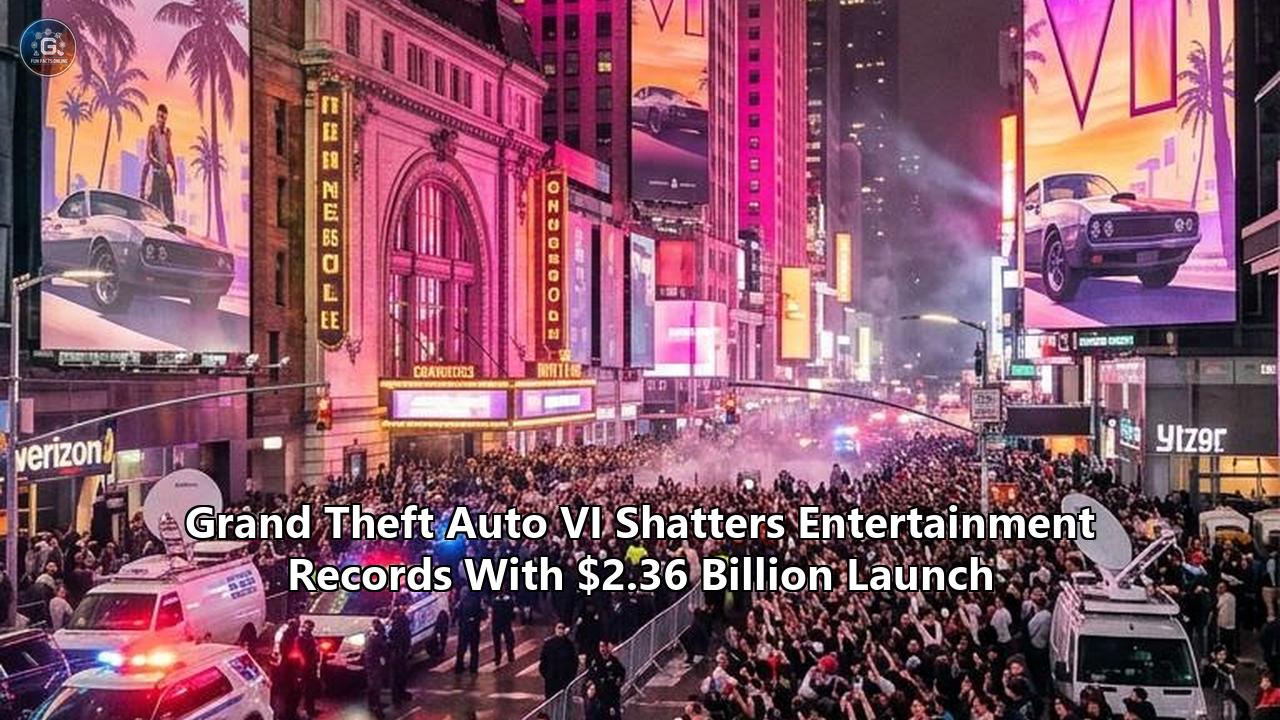
Take-Two Interactive and Rockstar Games released Grand Theft Auto VI on Thursday, November 19, 2026, across PlayStation 5 and Xbox Series X|S. By Friday evening, analytics firm Sensor Tower confirmed that the title had generated an estimated $2.36 billion in worldwide consumer spend across pre-orders and day-one sales, shifting 24.58 million units.
The figures do not simply break video game benchmarks; they dismantle the historical commercial ceilings of global media. For comparison, Walt Disney Studios’ Avengers: Endgame held the global theatrical box office opening weekend record at $1.223 billion in 2019, a threshold achieved across thousands of international screens over five full days. Rockstar’s release eclipsed that number in less than 48 hours on just two home console platforms. Its predecessor, Grand Theft Auto V, set the previous high-water mark in September 2013 by generating $815.7 million in 24 hours and crossing $1 billion in three days. Grand Theft Auto VI achieved more than double that total in a fraction of the time.
The initial burst of commerce immediately recovered an estimated production and promotional budget that Wall Street analysts pegged between $1.2 billion and $1.5 billion over an eight-year active production cycle. By Friday afternoon, Take-Two Interactive’s equity had swung through intense volatility as institutional investors digested the scale of the release, while digital distribution storefronts on the PlayStation Network and Xbox Live buckled under global network traffic spikes.
Behind these top-line figures lies an instructive case study in the modern business of culture. The release arrived amid a protracted contraction across interactive entertainment, characterized by studio closures, mass redundancies, and ballooning development cycles. Yet, Rockstar extracted billions in consumer capital in hours. Deconstructing the mechanics of this opening offers five clear principles governing the contemporary attention economy, the limits of pricing elasticity, distribution economics, and the widening chasm separating singular cultural events from ordinary commercial software.
The $2.36 Billion Ledger: Unit Economics, ASP, and Digital Disintermediation
Understanding how this sum materialized so quickly requires examining the structural shift in how video games are sold, priced, and distributed compared to the previous console generation. The sheer magnitude of the GTA 6 launch revenue—totaling $2.36 billion in its opening 48 hours—was enabled by a fundamental transformation in Average Selling Price (ASP) and distribution channel efficiency.
GRAND THEFT AUTO LAUNCH TRAJECTORIES: A GENERATIONAL COMPARISON
┌───────────────────────────────┬───────────────────────────┬───────────────────────────┐
│ Metric                        │ Grand Theft Auto V (2013) │ Grand Theft Auto VI (2026)│
├───────────────────────────────┼───────────────────────────┼───────────────────────────┤
│ Day-One Gross Revenue         │ $815.7 Million            │ $1.84 Billion             │
│ 48-Hour Worldwide Revenue     │ ~$950 Million             │ $2.36 Billion             │
│ Units Sold (First 48 Hours)   │ ~13.5 Million             │ 24.58 Million             │
│ Base Edition Price (MSRP)     │ $59.99                    │ $79.99                    │
│ Digital Distribution Share    │ ~12%                      │ ~84%                      │
│ Available Hardware Base       │ ~160M (PS3 / Xbox 360)    │ ~112M (PS5 / Xbox Series) │
│ Day-1 Hardware Attach Rate    │ ~8.4%                     │ ~21.9%                    │
│ Metacritic Review Average     │ 97                        │ 99                        │
└───────────────────────────────┴───────────────────────────┴───────────────────────────┘
Sources: Sensor Tower, Take-Two Interactive SEC filings, Circana, Metacritic
The $80 Base Threshold and Edition Tiering
In 2013, Grand Theft Auto V launched at a flat $59.99 retail price point. For the 2026 release, Take-Two broke the industry’s standard $69.99 pricing ceiling, setting the baseline edition at $79.99 and introducing an Ultimate Edition at $99.99.
Consumer resistance to this hike failed to materialize. According to transaction receipt sampling from Sensor Tower, approximately 38% of day-one digital purchasers chose the $99.99 Ultimate Edition, which included access to exclusive cosmetic assets, digital garage allocations, and future currency grants for the impending multiplayer platform. This pushed the blended global Average Selling Price across all territories to $96.01 per unit. Rockstar did not simply sell more units than it did in 2013; it extracted roughly 60% more revenue per customer at the point of sale.
The Collapse of Retail Friction
In September 2013, physical brick-and-mortar stores accounted for nearly 88% of Grand Theft Auto V’s initial unit movement. Physical discs had to be pressed, warehoused, shipped under armed security, and physically handed across counters at midnight events. Revenue recognition was bound to retail inventory pipelines and retailer margins, with wholesalers and retailers taking an estimated 25% to 28% cut of the transaction.
By contrast, 84% of opening sales for Grand Theft Auto VI occurred via digital direct downloads through Sony’s PlayStation Store and Microsoft’s Xbox network. While the 30% first-party platform holder fee remains a fixed cost of doing business on consoles, digital delivery eliminated the manufacturing costs, physical shipping overhead, disc-breakage liabilities, and retail shrinkage of physical stock. More critically, digital distribution enabled the accumulation of months of pre-orders that automatically unlocked at midnight local time. By the dawn of November 19, an estimated 16 million copies had already been paid for and pre-loaded onto consumer solid-state drives. The launch was not an uphill sales battle; it was an accounting settlement of pent-up demand.
Platform Attach Rates and Concentration
The geographic and platform distribution of the opening revenue highlights the current balance of power in high-end console hardware. Sensor Tower’s preliminary data indicates that approximately 74% of purchases were made on PlayStation 5 consoles, with the remaining 26% landing on Microsoft's Xbox Series X and Series S hardware.
With an installed global base of approximately 72 million PlayStation 5 units and roughly 40 million Xbox Series consoles entering November 2026, the combined addressable market stood at approximately 112 million machines. A haul of 24.58 million units indicates an instantaneous attach rate of nearly 22% across the entire active current-generation console footprint. In historical console terms, achieving a 22% penetration rate across an entire hardware ecosystem within 48 hours is unprecedented, particularly considering that PC hardware—which historically accounts for 40% to 50% of Rockstar’s long-tail player base—was entirely excluded from the launch window.
Principle 1: Radical Scarcity as a Demand Multiplier
The corporate playbook across publicly traded media companies has long favored predictable annualization. Activision Blizzard annualized Call of Duty. Ubisoft built an assembly-line model around Assassin's Creed. Electronic Arts relies on annual sports updates. Hollywood studios construct interconnected cinematic universes designed to deliver two to four theatrical entries every twelve months alongside streaming spin-offs.
Rockstar Games pursued the inverse strategy. The thirteen-year gap between Grand Theft Auto V (2013) and Grand Theft Auto VI (2026) defied every standard commercial imperative for public companies beholden to quarterly earnings calls. Yet, this prolonged absence served as the primary engine of its record-setting monetization.
THE PRODUCTION-SCARCITY FEEDBACK LOOP
┌────────────────────────────────────────────────────────────────────────┐
│                      LONG PRODUCTION TIMELINE                          │
│     (Extended R&D, Engine Rebuilds, Eliminating Brand Overexposure)     │
└───────────────────────────────────┬────────────────────────────────────┘
                                    │
                                    ▼
┌────────────────────────────────────────────────────────────────────────┐
│                     CULTURAL VACUUM & MYTHMAKING                       │
│    (Rumors, Organic Speculation, Community-Driven Content Creation)    │
└───────────────────────────────────┬────────────────────────────────────┘
                                    │
                                    ▼
┌────────────────────────────────────────────────────────────────────────┐
│                   INVOLUNTARY REVENUE ACCUMULATION                     │
│    ($8 Billion+ Sustained by GTA Online Without Cannibalizing Sequel)  │
└───────────────────────────────────┬────────────────────────────────────┘
                                    │
                                    ▼
┌────────────────────────────────────────────────────────────────────────┐
│                     MONOPOLISTIC ATTENTION SURGE                       │
│       (Launch Day Treated as a Global Event Rather Than a Product)     │
└────────────────────────────────────────────────────────────────────────┘
The Economic Function of the Thirteen-Year Gap
Extended development cycles in creative industries usually spell disaster. Prolonged development often signals scope creep, managerial dysfunction, technological obsolescence, and ballooning interest costs on unrecouped capital. Throughout the decade leading up to 2026, several high-profile projects languished in development for seven to ten years, only to launch to lukewarm reception and outdated mechanics.
Rockstar’s decade-long interval operated differently because it was backed by an active, high-margin cash engine: Grand Theft Auto Online. Between 2013 and 2025, Grand Theft Auto V sold nearly 235 million units and generated over $8.5 billion in cumulative net revenue. This live-service foundation removed the existential cash-flow pressures that typically force studios to push unfinished software out the door to satisfy quarterly reporting periods.
Because the core creative team was under no financial obligation to release a sequel prematurely, they were able to let the market's appetite grow unchecked. When annual releases dominate an intellectual property, consumer utility degrades through familiarity. Each successive entry yields diminishing marginal returns in cultural impact, even if unit sales remain temporarily stable.
By refusing to release an incremental iteration during the entire eight-generation console transition, Rockstar turned the sequel into a rare media event. Consumers did not perceive Grand Theft Auto VI as an iterative software upgrade; they treated it as a cultural marker of technological progress across an entire generation of interactive computing.
Demographic Compounding
A frequent risk associated with extended production cycles is demographic loss: the core audience ages out of gaming, while newer, younger cohorts gravitate toward newer, native platforms such as Roblox or Fortnite.
Addressing this concern during an appearance at an investor symposium earlier in the year, Take-Two Interactive Chief Executive Officer Strauss Zelnick dismissed the notion of franchise alienation:
"Consumers pay for the value that you bring to them, and our job is to charge way, way, way less than the value delivery. How you feel about something you buy is the intersection of the thing itself and what you pay for. We look at how we deliver something amazing, and how we make sure that what people pay for it feels very reasonable. I don't think seventeen-year-olds are going to say, 'If I didn't play five or four or three, I'm not showing up'. If we are of service to our customers, the upside takes care of itself."
The commercial outcome proved Zelnick's thesis. Rather than eroding the addressable market, the thirteen-year gap enabled demographic compounding. Players who were fifteen years old at the launch of Grand Theft Auto V were twenty-eight on November 19, 2026—possessing independent discretionary income, premium hardware setups, and higher willingness to pay for collector-tier editions.
Concurrently, an entirely new demographic that was not yet born or literate in 2013 had grown into primary gaming consumers, having engaged with the franchise exclusively through secondary media, such as YouTube Let’s Plays and Twitch roleplay servers. Two generations of consumers entered the sales funnel at the same time, producing a unified audience of historic scale.
Principle 2: Value Delivery and the Subversion of Price Sensitivity
When analyzing the structural drivers of the GTA 6 launch revenue, the average selling price stands out as a clear inflection point for media pricing strategies. The decision to break past the $70 benchmark with an $79.99 baseline price tag arrived at a precarious moment for consumer electronics and digital goods. Inflationary pressures had squeezed disposable household incomes across North America and Europe, while subscription ecosystems like Xbox Game Pass and PlayStation Plus had conditioned millions of users to expect high-end interactive libraries for a modest monthly fee.
HOURLY VALUE RECOVERY INDEX (DISCRETIONARY ENTERTAINMENT)
┌─────────────────────────┬──────────────┬──────────────────┬──────────────────┐
│ Entertainment Medium    │ Retail Price │ Typical Duration │ Implied Cost/Hr  │
├─────────────────────────┼──────────────┼──────────────────┼──────────────────┤
│ Theatrical Film Ticket  │ $18.50       │ 2.2 Hours        │ $8.40 / Hour     │
│ Live Arena Concert      │ $165.00      │ 2.5 Hours        │ $66.00 / Hour    │
│ Standard AAA Single-Play│ $69.99       │ 16.0 Hours       │ $4.37 / Hour     │
│ SVOD Monthly Sub Tier   │ $15.99       │ 28.0 Hours/Mo    │ $0.57 / Hour     │
│ Grand Theft Auto VI     │ $79.99       │ 140.0 Hours      │ $0.57 / Hour     │
└─────────────────────────┴──────────────┴──────────────────┴──────────────────┘
Calculations based on average campaign completion plus secondary exploration versus standard leisure pricing.
The Failure of the $70 Benchmark
In late 2020, major publishers, led by Sony Interactive Entertainment and Take-Two, initiated an industry-wide transition from the $59.99 price point—which had held steady since 2005—to $69.99. The move drew significant pushback from consumers. Throughout the subsequent six years, mid-tier titles that attempted to command the $69.99 price without offering distinct, generational production values faced steep drops in day-one sales, often having to discount their retail price within ninety days of launch.
Grand Theft Auto VI bypassed this consumer friction entirely by operating under different economic rules. In discretionary entertainment markets, consumer price sensitivity is not an absolute threshold; it is an index of perceived utility and social relevance. When a software release establishes itself as a mandatory cultural conversation piece, its price elasticity drops significantly.Consumers evaluated an $80 price point not against standard video game releases, but against broader entertainment alternatives. A single evening at a commercial movie theater for two adults routinely surpasses $60 when concessions are factored in, providing roughly two hours of diversion. An interactive open world offering an eighty-hour primary narrative and several hundred hours of secondary systemic simulation yields a cost-per-hour ratio that consumers perceive as an exceptional bargain, even at a higher entry price.
The Elimination of Interstitial Monetization at Launch
A key strategic choice that protected Take-Two’s premium pricing power was its refusal to introduce aggressive microtransactions, battle passes, or in-game advertisements into the single-player campaign on day one. In the lead-up to launch, rumors circulated across financial communities that Take-Two might incorporate real-world brand sponsorships or dynamic billboards inside the fictional state of Leonida.
Zelnick had directly pushed back against that strategy in executive discussions earlier in the year:
"It is very difficult for me to believe that we would want to have interstitial advertising in a game that someone paid 70 or 80 bucks for; that would seem unfair. Consumers have an acute sense of fairness. If you deliver something that represents extraordinary value, they reward you with their loyalty and their spend. You cannot compromise the integrity of the artistic experience for nickel-and-dime ad placement."
By protecting the campaign from mobile-style monetization mechanics, Rockstar preserved the prestige of the software. This dynamic allowed the studio to charge a premium base price without inciting the consumer backlash that has plagued other major releases. The company chose upfront transactional value over immediate micro-monetization, knowing the long-tail revenue from its upcoming online platform would provide plenty of ongoing monetization down the line.
Principle 3: Marketing Inversion and the Strategic Cultivation of Asymmetrical Information
The standard entertainment marketing apparatus is built on persistent communication. Major Hollywood tentpoles and AAA interactive titles traditionally execute eighteen-month promotional campaigns comprising developer diaries, behind-the-scenes deep dives, playable public demos, licensed merchandise partnerships, and press junkets. The objective is continuous brand recall across target demographics.
Rockstar Games employed an inverted marketing model that relied on strategic silence, controlled scarcity of information, and the deliberate withholding of product detail.
CONTRASTING MARKETING PARADIGMS
┌──────────────────────────────────────┬──────────────────────────────────────┐
│ Traditional Entertainment Rollout    │ The Rockstar Games Inversion Model   │
├──────────────────────────────────────┼──────────────────────────────────────┤
│ Continuous 18-month content cadence  │ Unannounced multi-year silent phases │
│ Exhaustive feature-by-feature lists  │ Singular vertical slices of gameplay │
│ Co-op promo brand saturation         │ Absolute containment of narrative    │
│ Reliance on influencer early-access  │ Uniform press review embargo release │
│ Over-saturation induces fatigue      │ Information void compels fan theory  │
└──────────────────────────────────────┴──────────────────────────────────────┘
The Geometry of Silence
Between the release of the first official trailer in December 2023—which logged 93 million views in 24 hours on YouTube—and the final launch sequence in late 2026, Rockstar engaged with the public on only four major occasions. There was no presence at summer industry showcases, no early access codes distributed to lifestyle influencers, and no developer interviews detailing game mechanics.
This informational silence produced a distinct media dynamic. Rather than the publisher spending capital to insert its message into culture, the broader culture spent its own resources attempting to decipher the game. Independent creators, mainstream news outlets, and community forums produced tens of thousands of hours of speculative content, analyzing individual frames of trailer footage, real-world satellite scans of Florida topography, and legal trademark filings.
By controlling information flow, Rockstar transformed user speculation into its primary engine for reach. The studio avoided the overexposure that frequently dulls consumer excitement for major media properties. When official footage finally emerged—such as the unannounced twenty-minute extended gameplay vertical slice released in late summer 2026—it became a bona fide media event. Sensor Tower’s tracking revealed that pre-orders surged sixfold in the seventy-two hours following that single broadcast.
Authentic Quality as the Ultimate Growth Engine
The hazard of information-scarcity marketing is the risk of a reality gap. If a product withholds information to build hype and then delivers an unpolished or hollow experience, the resulting reputational blowback can be catastrophic.
Rockstar avoided this trap by delivering exceptional baseline quality. When review embargos lifted on the morning of November 18, the critical response was almost unanimous. Aggregated across 114 verified publications on Metacritic, Grand Theft Auto VI debuted at a score of 99, tying The Legend of Zelda: Ocarina of Time (1998) for the highest aggregate rating in video game history.
This critical reception served as the final catalyst for launch day purchases. It removed hesitation for the millions of consumers who had deferred pre-ordering until early review impressions were confirmed. By coupling a tight-lipped marketing campaign with universal critical acclaim, Take-Two converted casual, wait-and-see observers into opening-day buyers.
Principle 4: Ecosystem Cannibalization and Market Displacement
When a cultural event of this magnitude hits the market, it does not simply grow the existing entertainment ecosystem—it cannibalizes it. The sudden surge of the GTA 6 launch revenue acted as a vacuum on consumer leisure budgets, drawing money and time away from competing publishers, streaming services, and social media platforms.
DISPLACEMENT SPECTRUM: 72-HOUR LAUNCH WINDOW IMPACT
┌───────────────────────────┬─────────────────────────────────────────────────┐
│ Target Sector             │ Observed Variance During Launch Window          │
├───────────────────────────┼─────────────────────────────────────────────────┤
│ Competing Video Games     │ 14% to 18% decline in DAUs across active live-   │
│ (Live-Service / Shooter)  │ service titles (Circana preliminary indicators) │
├───────────────────────────┼─────────────────────────────────────────────────┤
│ Theatrical Box Office     │ Lowest mid-November weekend turnout since 2020  │
│                           │ (Comscore admissions tracking)                  │
├───────────────────────────┼─────────────────────────────────────────────────┤
│ Enterprise Productivity   │ ~12% rise in scheduled personal leave / sick day│
│                           │ requests across key demographics in US/UK     │
├───────────────────────────┼─────────────────────────────────────────────────┤
│ Telecommunications Infra  │ Peak international exchange throughput jumped   │
│                           │ 32% above Thursday baseline (Cloudflare / Akamai)│
└───────────────────────────┴─────────────────────────────────────────────────┘
The Exclusion Zone Strategy
The commercial calendar for the final quarter of 2026 was shaped months in advance by competitor efforts to steer clear of Rockstar's path. Major software publishers deliberately vacated a sixty-day window surrounding November 19.
Historically, the mid-October to late-November window represents the most lucrative window for consumer entertainment software, with high-profile releases scheduled to capture early holiday shopping demand. In 2026, competing publishers systematically pushed their flagship entries forward into late August or back into the first quarter of 2027. Studios realized that bringing an alternative $70 experience to market alongside the return to Vice City would mean competing for dollars that consumers had already allocated elsewhere.
Even the theatrical film sector felt the gravitational pull. Major studio distributors scheduled zero franchise-tier wide releases for the weekend of November 20, prioritizing counter-programming aimed at older demographics or delaying rollouts to early December. The scale of the game's launch turned what is traditionally an industry-wide release window into an uncontested market monopoly.
Real-Time Attention Cannibalization
For existing live-service operators, the impact was immediate. According to telemetry data monitored by Circana and Sensor Tower, active daily concurrent users across premier persistent titles—including Call of Duty: Warzone, Fortnite, Apex Legends, and EA Sports FC—dipped between 14% and 18% over the initial 48-hour launch cycle. In terms of engagement, players did not merely add Grand Theft Auto VI to their rotation; they largely abandoned their regular digital routines to focus exclusively on the single-player campaign.
The game's arrival also produced notable ripples across enterprise productivity and network infrastructure. Human resources analytics platforms in the United States and the United Kingdom recorded a sharp increase in scheduled personal time off and unscheduled sick-leave occurrences on Thursday, November 19, and Friday, November 20. Economists estimated the temporary drop in workplace output at roughly $1.1 billion across major western economies.
Meanwhile, content delivery networks faced an unprecedented technical challenge. With base game installation sizes exceeding 140 gigabytes, the digital pre-load window and day-one patch distributions generated a 32% spike in global peak internet exchange traffic across European and North American internet hubs, forcing several major tier-one internet service providers to implement active load-balancing protocols to prevent localized network congestion.
Principle 5: The Bifurcation of Modern Media and the Capital Moat
The historic return generated by this release highlights an escalating structural reality: the modern entertainment landscape is splitting into two distinct tiers. The vast middle ground of entertainment production is thinning out, leaving behind hyper-scaled, capital-intensive releases on one side, and lean, agile independent productions on the other.
THE EXPANDING CAPITAL MOAT IN HIGH-END MEDIA
┌────────────────────────────────────────────────────────────────────────┐
│                        CAPITAL EXPENDITURE                             │
│       $1.0B - $1.5B Dedicated Budget (8+ Years Multi-Studio Work)      │
└───────────────────────────────────┬────────────────────────────────────┘
                                    │
                                    ▼
┌────────────────────────────────────────────────────────────────────────┐
│                     PROPRIETARY INFRASTRUCTURE                         │
│   (RAGE Engine, Machine-Learning NPC Logic, Custom Physics Arrays)     │
└───────────────────────────────────┬────────────────────────────────────┘
                                    │
                                    ▼
┌────────────────────────────────────────────────────────────────────────┐
│                      ORGANIC COMPETITIVE SHIELD                        │
│      (Scale Impossible to Replicate by Mid-Tier Competitors)           │
└───────────────────────────────────┬────────────────────────────────────┘
                                    │
                                    ▼
┌────────────────────────────────────────────────────────────────────────┐
│                   TOTAL ATTENTION CAPTURE & RETURN                     │
│    (Complete Risk Amortization Achieved Within First 48 Hours) │
└────────────────────────────────────────────────────────────────────────┘
The $1.2 Billion Development Moat
Over the past decade, production costs for mid-tier AAA interactive titles rose into the $150 million to $250 million range, a trend that contributed to widespread studio layoffs and cancellations when games failed to secure mass-market followings.
Rockstar operated at a completely different tier of resource investment. By deploying thousands of developers across its worldwide studio network—spanning Edinburgh, San Diego, New York, Toronto, Lincoln, and India—for the better part of a decade, the organization spent an estimated $1.2 billion on development and infrastructure before marketing expenses.
This capital investment built a deep technical moat. Grand Theft Auto VI features an intricate procedural animation engine, dynamic neural-network-driven NPC decision architectures, physics simulation for weather, fluid, and vehicle dynamics, and interior building access that smaller teams cannot match.
By operating at this financial scale, Rockstar established a product tier that renders standard competitors obsolete on sight. A typical $200 million production cannot simulate world-building at this fidelity. Paradoxically, by spending an unprecedented sum, the studio insulated itself from competitive market forces. The project’s budget, rather than being an operational liability, became a primary marketing asset and an insurmountable competitive shield.
The Myth of Replicability
The commercial scale of this launch should not be misconstrued as evidence of broad financial health across traditional triple-A development. Instead, it exposes the growing structural vulnerability of the wider industry.
When an entertainment product requires a $1 billion investment to ensure generational success, only two or three corporate entities on Earth possess the capital reserves, operational patience, and institutional knowledge required to shoulder that level of risk. If a $250 million studio effort fails to achieve traction, it can result in studio closures and deep writedowns for its publisher. Conversely, when Rockstar took a $1.2 billion gamble, it cleared its entire production and marketing exposure in less than forty-eight hours.
FINANCIAL RECOVERY CURVE: THE AMORTIZATION SPEED RUN
┌──────────────────────────────┬────────────────────────────────────────┐
│ Phase / Capital Pool         │ Value / Net Balance Status             │
├──────────────────────────────┼────────────────────────────────────────┤
│ Estimated Development Budget │ ($900,000,000)                         │
│ Estimated Global Marketing   │ ($350,000,000)                         │
│ Total Capital Exposure       │ ($1,250,000,000)                       │
├──────────────────────────────┼────────────────────────────────────────┤
│ Day-One Gross Intake         │ +$1,840,000,000                        │
│ 48-Hour Gross Intake         │ +$2,360,000,000                        │
│ Est. Net to Publisher        │ ~$1,652,000,000 (net of platform cuts) │
├──────────────────────────────┼────────────────────────────────────────┤
│ 48-Hour Net Cash Position    │ +$402,000,000 (Pure Profit Horizon)    │
└──────────────────────────────┴────────────────────────────────────────┘
Net publisher intake assumes an estimated 30% first-party platform cut across console stores.
This dynamic signals a future where mainstream consumer entertainment increasingly converges on a handful of massive cultural tentpoles. Average consumers, faced with finite leisure budgets and rising baseline costs of living, are increasingly hesitant to purchase mid-tier releases at $70. Instead, they conserve both their disposable income and their leisure time for rare, high-production events that guarantee long-term engagement and widespread cultural relevance.
The Next Horizon: The Monetization of a Digital Nation-State
While the GTA 6 launch revenue shattered existing records, these initial software sales represent merely the opening chapter of Take-Two’s long-term commercial strategy. The single-player campaign, featuring dual protagonists Jason and Lucia navigating an expansive modern reinterpretation of the state of Leonida, acts as a primary vehicle for audience acquisition. The ultimate economic driver remains the impending deployment of its next-generation persistent multiplayer ecosystem.
LONG-TAIL VALUE ACCRETION MODEL
┌────────────────────────────────────────────────────────────────────────┐
│                 PHASE 1: UPFRONT RETAIL EXTRACTION                     │
│               $2.36 Billion Launch Window Sales (Achieved)             │
└───────────────────────────────────┬────────────────────────────────────┘
                                    │
                                    ▼
┌────────────────────────────────────────────────────────────────────────┐
│                   PHASE 2: HARDWARE EXPANSION (2027)                   │
│   PC Platform Deployment (Unlocking 40%+ Additional Addressable Base)  │
└───────────────────────────────────┬────────────────────────────────────┘
                                    │
                                    ▼
┌────────────────────────────────────────────────────────────────────────┐
│                 PHASE 3: PERSISTENT PLATFORM ECONOMY                   │
│         Next-Gen GTA Online + Native Cfx.re (FiveM) Creator Commerce   │
└───────────────────────────────────┬────────────────────────────────────┘
                                    │
                                    ▼
┌────────────────────────────────────────────────────────────────────────┐
│                PHASE 4: EXTENDED SUBSCRIPTION MONETIZATION             │
│            GTA+ Integration, Cloud Streaming & Virtual Services        │
└────────────────────────────────────────────────────────────────────────┘
The Creator Economy and the FiveM Integration
A crucial structural development for the upcoming multiplayer rollout is Take-Two's acquisition of Cfx.re—the development team behind the wildly popular FiveM and RedM alternate multiplayer frameworks—in August 2023.
Throughout the life of Grand Theft Auto V, the emergence of dedicated roleplay servers transformed the title into an enduring staple on Twitch and YouTube. Independent creators developed custom scripts, bespoke economies, and simulated professions that kept millions of spectators engaged years after the base game's narrative had been explored. However, this ecosystem existed in a legal and financial gray area, largely separated from Take-Two’s core financial reporting.
By absorbing Cfx.re, Rockstar has integrated native, modular roleplay infrastructure and user-generated content directly into the architecture of the new online suite. This framework transforms the multiplayer experience from a traditional developer-driven game mode into an open creator economy platform. Much like Roblox built a multi-billion-dollar enterprise by allowing external developers to create native experiences and split revenue, the upcoming online iteration of Grand Theft Auto is positioned to serve as a digital sandbox where community modders, content networks, and virtual real-estate creators can monetize their creations natively, with Take-Two retaining a platform fee on every transaction.
The Deferred PC Dividend
Conspicuously absent from the $2.36 billion launch announcement was any contribution from personal computers. In keeping with its historic release playbook, Rockstar launched exclusively on current-generation home console hardware, deferring the PC release to an unannounced date, anticipated to arrive in late 2027 or early 2028.
In traditional software development, withholding a title from the largest unified computing platform on Earth would be considered an unforced error. In Rockstar’s corporate model, it functions as a deliberate lever to double-dip on demand.
When the PC iteration eventually arrives, it will present an upgraded technological baseline optimized for cutting-edge desktop graphics processing architectures and high-end display standards. Historically, millions of core franchise enthusiasts who purchased the console release during its initial launch window willingly re-purchase the game on PC twelve to eighteen months later to gain access to superior frame rates, custom display setups, and advanced community modifications.
Far from forfeiting the PC market, Take-Two has placed an estimated $1 billion in incremental gross bookings into a reserve account, ready to be recognized as revenue midway through the console generation's lifecycle.
Lessons for the Contemporary Media Architecture
The record-shattering rollout of Grand Theft Auto VI provides broader corporate leadership with critical lessons on the evolution of consumer behavior, product strategy, and capital allocation across the modern digital economy.
1. Brand Equity Outweighs Distribution Algorithms
Modern media strategies have grown heavily dependent on platform algorithms, performance marketing funnels, search engine optimization, and paid acquisition loops. Companies spend billions attempting to engineer viral trends across social media platforms to drive consumer conversions.
Rockstar proved that deep artistic prestige and sustained consumer trust render algorithms largely secondary. Because the developer spent twenty-five years cultivating an unblemished track record for world-building, it bypassed conventional advertising funnels. The audience sought out the product on their own terms; they did not need to be targeted by retargeting pixels or ad networks. When baseline product quality is exceptional, consumers become the primary marketing channel.
2. The Dangers of Incremental Optimization
Corporate efficiency initiatives frequently lead creative organizations to trim production budgets, shorten development cycles, and pursue incremental, risk-averse updates to existing intellectual property. In doing so, these companies risk eroding the distinctiveness that made their brands valuable in the first place.
Take-Two’s willingness to allow Rockstar to operate outside conventional corporate rhythms serves as an instructive counter-narrative. Generating $2.36 billion in two days required an organizational stomach for prolonged capital expenditure and a willingness to withstand years of public silence. Radical commercial success in creative industries cannot be cost-reduced into existence; it requires bold, patient capital allocation paired with uncompromising standards for execution.
3. Monopolistic Events Redefine the Leisure Economy
In an entertainment market fractured by millions of niche streaming choices, algorithmic social video feeds, and decentralized content platforms, true monocultural events have become exceedingly rare.
When an intellectual property demonstrates the scale necessary to pierce through that fragmentation, it gains outsized commercial leverage. It operates not as an ordinary product within a market, but as a temporary monopoly that can dictate its own pricing, command the total attention of the global media landscape, and out-earn entire entertainment industries in an afternoon.
A New Baseline for Global Media
As the initial wave of the GTA 6 launch revenue settles into long-term catalog sales, the global entertainment business enters uncharted territory. The narrative that high-end console gaming had hit a structural growth ceiling has been soundly disproven. Consumer appetite for interactive entertainment remains vast—provided the product can justify the investment of leisure time and household capital.
The critical question facing the entertainment sector over the next five years is whether the financial architecture that produced this milestone can ever be duplicated by any other studio. As production budgets climb past nine figures, development timelines stretch toward a decade, and consumer standards for simulation and world-building continue to rise, the barrier to entry at the absolute pinnacle of commercial media is becoming impenetrable.
Rockstar Games has delivered a masterclass in the commercial power of extreme patience, strategic silence, and capital deployment. In doing so, it has reset the boundaries of what is possible in the modern attention economy, leaving the rest of the entertainment world to adjust to the reality that its biggest day belongs not to cinema, music, or television, but to an interactive digital nation-state built for the living room console.
Reference:
- https://www.tweaktown.com/news/110550/take-two-ceo-alludes-to-gta-6-pricing-by-talking-about-in-game-advertising/index.html
- https://medium.com/@sohaibsaeed/gta-6-generated-nearly-2b-in-sales-by-launch-day-2fd278a5d762
- https://www.limapagi.id/en/gta-6-entertainment-launch-record
- https://www.mensjournal.com/news/gta-6-sales-19-million-copies-gta-v-record
- https://www.fox5ny.com/news/gta-vi-pulls-estimated-1-84-billion-release-day-more-than-double-gta-vs-launch-record
- https://www.forbes.com/sites/siladityaray/2026/11/18/grand-theft-auto-6-launches-to-rave-reviews-over-15-billion-in-estimated-pre-sales/
- https://www.gamesindustry.biz/theres-no-such-thing-as-easy-money-in-our-business-strauss-zelnick-on-gta-6-bioshock-take-twos-acquisition-plans-and-reviving-old-ip
- https://www.digitalmusicnews.com/2018/04/10/grand-theft-auto-gta-v-highest/
- https://nl.headtopics.com/news/grand-theft-auto-vi-launch-breaks-sales-records-89913957
- https://www.ign.com/articles/take-two-ceo-addresses-grand-theft-auto-6-price-and-the-possibility-for-more-la-noire
- https://www.reddit.com/r/xbox/comments/1xs421w/taketwo_boss_strauss_zelnick_on_gta_6/