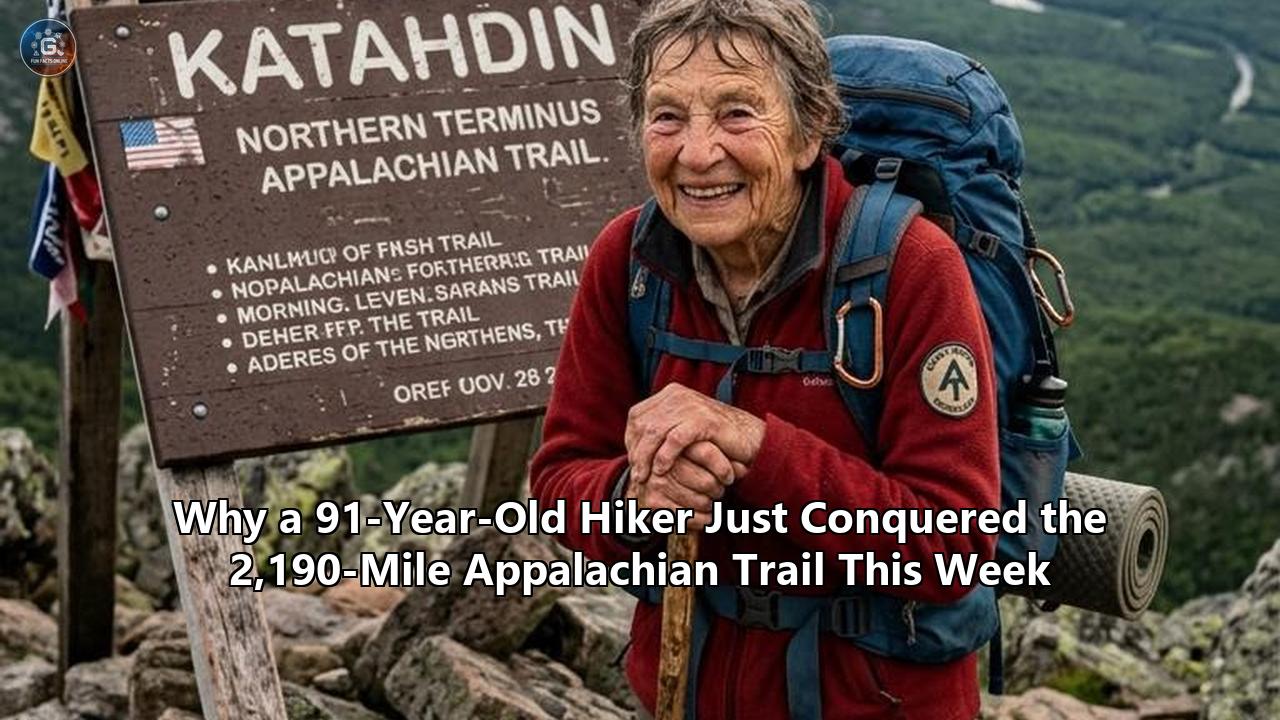
At 11:44 a.m. on Monday, August 31, 2026, 91-year-old Dale "Grey Beard" Sanders placed his trekking poles onto the boulder-strewn summit of Mount Katahdin in Maine, collapsed into a brief prayer of gratitude against the summit sign, and officially reclaimed the world record as the oldest person Appalachian Trail history has ever seen complete a thru-hike.
Sanders completed the 2,193-mile trek across 14 states in 359 days, having initiated his journey on September 6, 2025, at Harpers Ferry, West Virginia. His arrival atop Baxter Peak did not simply rewrite the record books; it fundamentally dismantled prevailing assumptions regarding human physiological limits in nonagenarians. Over the course of nearly twelve months on the trail, Sanders suffered 71 documented falls, sustained six severe impact injuries, survived a hospitalization in Millinocket, Maine, and took a hard tumble just 200 yards before reaching his final destination.
================================================================================
DALE "GREY BEARD" SANDERS: 2025–2026 APPALACHIAN TRAIL EXPEDITION
================================================================================
Hiker Age:                91 years old (Born 1935)
Total Distance:           2,193 miles (Springer Mountain, GA to Mt. Katahdin, ME)
Total Duration:           359 days (September 6, 2025 – August 31, 2026)
Elevation Gain / Loss:    ~464,000+ vertical feet (Equivalent to scaling Everest 16x)
Total Falls Recorded:     71 falls (6 classified as severe / high-impact)
Logistical Framework:     Flip-flop sectional thru-hike; "Base Camp on Wheels" support
Verification Method:      SPOT Satellite GPS telemetry, physical witness logbooks,
                          time-stamped video evidence (Guinness World Records standard)
================================================================================
The accomplishment marks the second time Sanders has captured this specific milestone. He first secured the title in 2017 at age 82, only to see it claimed four years later by his close friend and fellow endurance icon M.J. "Sunny" Eberhart (known on trail as "Nimblewill Nomad"), who finished the trail at age 83 in 2021. In an extraordinary demonstration of collaborative rivalry, the 87-year-old Eberhart served as Sanders’ support driver for the first 800 miles of this comeback campaign, actively assisting the man seeking to break his own record.
Analyzing Sanders' feat through a case-study framework provides a rare look into high-risk endurance management, nonagenarian physiological preservation, mobile base-camp logistics, and the psychological mechanics of late-life agency. His journey exposes the precise operational, physical, and psychological principles that allow an individual to perform extreme multi-month physical labor at an age when standard actuarial models anticipate acute immobility.
The Anatomy of an Unprecedented Expedition: Data, Timeline, and Metrics
Understanding how a 91-year-old traverses 2,190 miles of rugged alpine and temperate forest terrain requires moving past romantic narratives of perseverance and looking directly at logistical design. Sanders did not execute a traditional, single-direction "pure" thru-hike carrying a 40-pound pack from Georgia to Maine; doing so at 91 would have presented severe risks of musculoskeletal failure or fatal trauma. Instead, his expedition was engineered as an adaptive, flip-flop thru-hike under the formal definitions established by the Appalachian Trail Conservancy (ATC), which recognizes any complete traverse of all 2,190+ miles finished within a consecutive 12-month window.
                SANDERS' EXPEDITION TIMELINE & STRATEGIC ROUTE

  [Harpers Ferry, WV] ──(Autumn 2025: Southbound)──> [Springer Mtn, GA]
          │
          └──[Winter Holiday Pause & Recovery: Dec 2025 – Feb 2026]
                    │
                    └──(Spring–Summer 2026: Northbound / Flip-Flops)──> [Mt. Katahdin, ME]
                                                                        August 31, 2026
Route Segmentation and Seasonal Timing
Sanders initiated his hike on September 6, 2025, in Harpers Ferry, West Virginia. Rather than battling the punishing summer humidity of the mid-Atlantic or the brutal climbs of New England out of the gate, he walked south. This choice was deliberate: it allowed him to chase temperate autumn weather and descending foliage southward toward Springer Mountain, Georgia.
- Phase 1: Autumn Southern Push (September–November 2025): Traversed the Virginia Blue Ridge and southern sections toward Georgia, maintaining a target pace of 10 to 12 miles per day with one mandatory rest day per week.
- Phase 2: Strategic Winter Recess (December 2025–February 2026): Sanders paused his trek during the dead of winter to avoid hypothermic conditions, frozen trail surfaces, and respiratory risks, returning home to Memphis, Tennessee, for targeted indoor conditioning and family recovery.
- Phase 3: Northern Flip and Mountain Push (March–August 2026): Re-entering the trail system in the spring, Sanders tackled the mid-Atlantic, the rocky ridgelines of Pennsylvania, New York, and Vermont, before entering the high-consequence zones of the White Mountains in New Hampshire and the 100-Mile Wilderness in Maine.
- Phase 4: High-Peak Conclusion (August 2026): Navigating the boulder fields of Maine, Sanders completed missed segments in the Great Smoky Mountains National Park before making his final ascent up the Hunt Trail to Baxter Peak on Mount Katahdin.
================================================================================
EXPEDITION COMPARISON: SANDERS 2017 VS. SANDERS 2026
================================================================================
Metric                      2017 Thru-Hike (Age 82)     2026 Thru-Hike (Age 91)
--------------------------------------------------------------------------------
Total Elapsed Time:         ~280 days                   359 days
Support Infrastructure:     Passenger Van (Solo/Ad-hoc) "Base Camp on Wheels" Camper
Support Personnel:          Minimal / Intermittent      Rotating Volunteer Team
Weight Management:          Dropped to 135 lbs (Severe) Stable via Daily Hot Meals
Documented Falls:           ~20 falls                   71 falls
Pacing Strategy:            14–18 miles/day             8–12 miles/day
Guinness Verification:      Standard ATC Thru-Hike      SPOT Tracker, Logs, Video
================================================================================
Verification and Record Standardization
Because the thru-hiking community relies on an honor system, Sanders took extraordinary steps to ensure this attempt withstood absolute international scrutiny. To establish an undeniable benchmark with Guinness World Records, his team implemented a rigorous evidence-collection protocol:
- Satellite Telemetry: Continuous active ping tracking via a SPOT satellite GPS device carried on his body, logging coordinates at regular intervals.
- Physical Witness Logs: Written, signed statements from hikers, ridgerunners, hostel owners, and park rangers collected at every road crossing, trail shelter, and resupply depot.
- Time-Stamped Visual Media: Daily, geo-located video recordings and photographs at identifiable trail milestones, elevation markers, and state borders.
This systematic operational oversight transformed an idiosyncratic attempt into an empirical case study of extreme geriatric human capability.
Physiological Frontiers: How a 91-Year-Old Body Withstands 2,190 Miles
The primary barrier to extreme physical exertion in the tenth decade of life is cellular and systemic senescence. In the average sedentary human, the process of aging after 40 involves a progressive decline in maximum oxygen uptake ($VO_2\text{ max}$), loss of skeletal muscle mass (sarcopenia), degradation of joint cartilage, reduced bone mineral density (osteopenia), and neurological slowdowns in balance and proprioception.
       CELLULAR & SYSTEMIC FACTORS IN NONAGENARIAN ENDURANCE

  ┌─────────────────────────────────────────────────────────────┐
  │ 1. SARCOPENIA RESISTANCE                                    │
  │    Preservation of slow-twitch Type I muscle fibers allows  │
  │    continuous low-cadence force generation over months.    │
  ├─────────────────────────────────────────────────────────────┤
  │ 2. PROPRIOCEPTIVE REDUNDANCY                                │
  │    Dual-pole trekking redistributes 15–20% of joint loading │
  │    and provides a 4-point sensory-stability network.        │
  ├─────────────────────────────────────────────────────────────┤
  │ 3. METABOLIC EFFICIENCY & ADENOSINE CLEARANCE               │
  │    2-minute micro-naps clear neurological fatigue and       │
  │    prevent metabolic bonking during sustained output.       │
  ├─────────────────────────────────────────────────────────────┤
  │ 4. BONE DENSITY PRESERVATION VIA LIFETIME LOADING           │
  │    Decades of impact sports prevent catastrophic fracture   │
  │    during repeated high-frequency trail falls.             │
  └─────────────────────────────────────────────────────────────┘
Sanders’ physiological survival on the Appalachian Trail offers valuable data on how continuous, lifelong physical conditioning modulates this biological trajectory.
Sarcopenia and Muscle Fiber Composition
Sarcopenia disproportionately destroys Type II (fast-twitch) muscle fibers, which are responsible for explosive power and rapid corrective contractions during sudden slips. However, Type I (slow-twitch) endurance fibers exhibit remarkable preservation over time when consistently stimulated.
Throughout his life, Sanders maintained an active baseline: he was an accomplished spearfisherman in his 30s, an avid swimmer, an acrobat, and a long-distance paddler who canoed the entire 2,340-mile length of the Mississippi River at ages 80 and 87. This multi-decade stimulus preserved a deep foundation of oxidative muscle fibers. While Sanders lacked the explosive torque to rapidly catch himself when his center of gravity shifted—leading directly to his 71 falls—his Type I fibers retained the endurance capacity to generate low-level, continuous force for 8 to 10 hours daily without entering irreversible catabolic breakdown.
                     VO2 MAX TRAJECTORY OVER TIME

   VO2 max
   (mL/kg/min)
      60 ┼───────● (Sanders at Age 30: High Athletic Baseline)
         │        \
      50 ┼         \
         │          \───● Typical Sedentary Decline (~10% per decade)
      40 ┼               \
         │                \───● Sanders' Preserved Trajectory
      30 ┼                     \
         │                      \───● Typical 90-Year-Old (~12–15)
      20 ┼                           \
         │                            └───● Sanders at Age 91 (~22–25)
      10 ┼───────────────────────────────────(Sustained Trail Viability)
         └───────┬─────────┬─────────┬─────────┬─────────┬─────────>
                Age 30    Age 45    Age 60    Age 75    Age 90
Proprioceptive Deficits and Pole Biomechanics
In human balance systems, visual, vestibular, and somatosensory inputs work synchronously to maintain stability. In a 91-year-old, peripheral nerve conduction velocities slow down, and mechanoreceptors in the feet attenuate. On a technical surface like the Appalachian Trail—strewn with wet granite slabs, slick roots, and shifting scree—this sensory delay makes falling an inevitable mathematical event.
Sanders compensated for this reality by using dual trekking poles as an external nervous system and mechanical scaffolding. By using two poles continuously, he transformed his bipedal gait into a quad-point contact system:
- Load Distribution: Redistributed 15% to 20% of knee and hip impact forces to the shoulder girdle, latissimus dorsi, and triceps on descents.
- Mechanical Catchment: Used poles to probe unstable mud, test loose boulders, and create pre-emptive structural tripods before committing his center of mass forward.
- Fall Mitigation: Even though he fell 71 times, the poles frequently absorbed the initial kinetic energy of the slip, converting what would have been high-velocity head or hip impacts into lower-energy tumbling slides.
         BIPEDAL VS. QUAD-POINT GAIT MECHANICS ON TECHNICAL TRAIL

        Standard Bipedal Stance                 Sanders' Quad-Point System
               (Unstable)                               (Stabilized)

                  O   Head/Torso                           O   Head/Torso
                 /|\                                      /|\
                / | \                                   /  |  \
                  |                                    /   |   \
                 / \                                  /   / \   \
                /   \                                /   /   \   \
               |     |                              /   |     |   \
              [L]   [R]                            ▼   [L]   [R]   ▼
            (2 Contact Points)                   Poles: (4 Contact Points)
       High rotational fall risk             Tripod base, distributed impact
Metabolic Management and Restorative Micro-Naps
One of the most revealing field observations during Sanders' trek through Maine occurred north of Monson in late July 2026. Nearing the end of a demanding 12-mile section through dense woods, Sanders began displaying signs of systemic central fatigue and ataxia (wobbliness). Instead of pushing through neuromuscular failure, Sanders laid directly down on the dirt trail bed, informed his accompanying team that he required a power nap, fell sound asleep within seconds, and woke up precisely two minutes later fully coherent, stabilized, and ready to hike.
┌─────────────────────────────────────────────────────────────────────────────┐
│                   THE NEUROLOGY OF THE 2-MINUTE TRAIL NAP                   │
├─────────────────────────────────────────────────────────────────────────────┤
│ 1. Adenosine Dissipation: Brief sleep states reduce homeostatic sleep       │
│    pressure in the basal forebrain, clearing acute mental fog.              │
│ 2. Parasympathetic Surge: Immediate drop in heart rate and cortisol allows  │
│    rapid muscle perfusion and lactate processing.                           │
│ 3. Neuromuscular Reset: Alleviates motor-cortex fatigue, restoring the      │
│    proprioceptive firing required to navigate high-consequence terrain.     │
└─────────────────────────────────────────────────────────────────────────────┘
This tactical reliance on immediate, high-efficiency recovery windows highlights a major rule of geriatric athletics: metabolic recovery must be continuous, not just nocturnal. Sanders did not view fatigue as a psychological hurdle to be ignored, but as an immediate physical state requiring fast intervention.
The Logistics of Mobile Support: Base Camps, Nutrition, and Co-opetition
The primary reason Sanders succeeded in 2026 where many hikers fail in their twenties is that he treated the Appalachian Trail as a complex systems engineering problem rather than a test of ascetic endurance.
The Evolution from Van Support to "Base Camp on Wheels"
During his initial 2017 hike at age 82, Sanders attempted to manage logistics out of a passenger van. That system suffered from severe flaws: inadequate refrigeration, inconsistent cooking facilities, and poor thermal regulation led to severe digestive illness and dehydration. By the time Sanders completed the trail in 2017, his body weight had dropped to a dangerous 135 pounds, threatening organ function.
                      SUPPORT ECOSYSTEM INFRASTRUCTURE

   ┌──────────────────────────────────────────────────────────────┐
   │                   "BASE CAMP ON WHEELS"                      │
   │              Heavy-Duty Truck Camper Platform                │
   └──────────────────────────────┬───────────────────────────────┘
                                  │
          ┌───────────────────────┼───────────────────────┐
          ▼                       ▼                       ▼
    [Nutrition]             [Sleep/Recovery]         [Crew System]
  Hot, high-protein       Climate-controlled       Rotating drivers
  meals at road gaps;     mattress bed; zero       manage supply lines;
  micro-nutrient control  tent pitching strain     gear swaps on demand
For the 2025–2026 campaign, Sanders upgraded his infrastructure to a heavy-duty truck camper labeled "Base Camp on Wheels". This setup yielded several critical operational advantages:
- Slackpacking Efficiency: By having a rotating crew of volunteer support drivers move the vehicle from road crossing to road crossing, Sanders hiked with minimal base pack weight—carrying only hydration fluids, cold-weather clothing, safety tracking equipment, and emergency rations. This reduced compressive loading on his spine and hips by roughly 70%.
- Caloric and Electrolyte Homeostasis: Rather than surviving on ultra-processed, sodium-heavy, shelf-stable freeze-dried trail foods that impair elderly kidney function, Sanders consumed freshly prepared, nutrient-dense hot meals rich in bioavailable proteins, healthy fats, and complex carbohydrates at the conclusion of nearly every hiking day.
- Sleep Optimization: Sleeping inside a temperature-controlled camper bed eliminated the severe physical tolls of sleeping on cold ground pads, erecting tents in rainstorms, and enduring joint stiffness from moisture and sub-freezing temperatures.
================================================================================
NUTRITIONAL & BIOCHEMICAL STRATEGY (DAILY VALUES)
================================================================================
Nutritional Metric        Standard Backpacker Diet     Sanders' Supported Protocol
--------------------------------------------------------------------------------
Caloric Intake:           3,500 – 4,500 kcal           3,800 – 4,200 kcal
Primary Protein Source:   Soy/Jerky/Dehydrated Powders Fresh Poultry, Eggs, Whole Dairy
Hydration Monitoring:     Ad-hoc stream filtration     Monitored electrolyte solutions
Micronutrient Focus:      Minimal                      High Magnesium, Potassium, D3
Inflammatory Profile:     High (Refined carbohydrates) Managed (Whole foods, omega-3s)
================================================================================
Collaborative Rivalry: The Nimblewill Nomad Dynamic
Among the most remarkable elements of this record-breaking campaign was the personal involvement of M.J. "Sunny" Eberhart (Nimblewill Nomad). When Eberhart broke Sanders’ record in 2021 at age 83, Sanders personally traveled to Massachusetts to walk sections with him and hand him a custom hiking stick at the finish line. When Sanders decided at age 90 to mount a campaign to take the title back, Eberhart did not guard his achievement. Instead, the 87-year-old Eberhart stepped into the driver’s seat of the "Base Camp on Wheels," managing the logistical road support for the first 800 miles of Sanders’ attempt.
       CHRONOLOGY OF THE SANDERS-EBERHART AGE RECORD EXCHANGE

  2017: Dale Sanders sets record at age 82
        │
  2021: M.J. "Nimblewill Nomad" Eberhart breaks record at age 83
        (Sanders hikes with Eberhart to encourage him to finish)
        │
  2025: Sanders launches campaign at age 90 to reclaim title
        (Eberhart drives support vehicle for first 800 miles)
        │
  2026: Sanders summits Katahdin at age 91, setting new world record
"Can you believe that?" Sanders noted during the hike. "The guy that broke my age record is with me, helping me break his record."
Eberhart explained the deep bond simply: "Perhaps there's one other person in the world that understands what Greybeard is going through." Upon Sanders' successful completion, Eberhart remarked, "We shared a few short tears of gratefulness of God's protection and endurance given to both of us over the years."
This dynamic illustrates how elite late-life achievement relies on community. Sanders and Eberhart replaced isolation with mutual accountability, turning an individual record attempt into a shared exploration of human potential.
Risk Budgeting and Fall Management: Analyzing the 71-Fall Metric
In contemporary medicine and public health, falls are recognized as the single greatest risk to longevity in adults over 65. The Centers for Disease Control and Prevention (CDC) documents that more than 14 million older Americans fall each year, with one out of every five falls causing a serious injury such as broken bones or head trauma. In nonagenarians, a hip fracture carries a one-year mortality rate exceeding 30% due to surgical complications, infection, and sudden loss of mobility.
Against this clinical backdrop, Sanders’ tally of 71 documented falls stands out as an extraordinary piece of data.
                     SANDERS' 71-FALL BREAKDOWN

      [Total Falls: 71]
             │
             ├── 65 Low-Impact Slips & Slides (Managed via tumbling mechanics)
             │
             └── 6 Severe / High-Impact Falls
                   ├── 1 Hospitalization (Millinocket, ME - soft tissue/trauma)
                   ├── 1 Final Approach Fall (200 yards from Katahdin sign)
                   └── 4 Heavy Trail Impacts (Resolved with rest and icing)
Deconstructing the Fall Mechanics
Why did 71 falls on rocky terrain fail to break Sanders' skeleton? The answer lies in a convergence of three factors:
- Acrobatic Falling Muscle Memory: In his youth, Sanders trained as an acrobat and competitive diver. When balance is lost, untrained individuals tense their musculature and extend a rigid arm—leading to Colles' fractures of the wrist, dislocated shoulders, or direct hip impact. Sanders retained an instinctive kinetic ability to yield to momentum, rounding his back, pulling his limbs inward, and distributing impact force across large muscular areas rather than rigid joints.
- Bone Mineral Density via Lifetime Impact: Bone remodels dynamically according to Wolff’s Law, which states that bone grows thicker in response to mechanical stress. Sanders’ uninterrupted lifetime of weight-bearing sports, underwater diving, trail walking, and paddling meant his bone mineral density was far higher than typical sedentary age-matched peers.
- Low Pack Mass: By slackpacking without a heavy 40-pound load, Sanders kept his center of gravity close to his natural anatomical position. When he tripped, he only had to absorb the kinetic energy of his own bodyweight rather than a massive pack driving him into the rocks.
             WOLFF'S LAW & IMPACT MITIGATION AT AGE 91

      [Lifelong Impact Loading] ──> Higher Bone Mineral Density
                                               │
      [Youth Acrobatic Instinct] ──> Rotational Tumbling Mechanics
                                               │
      [Slackpacking Configuration] ──> Low Total Kinetic Impact Force
                                               │
                                               ▼
                         RESULT: 71 Falls Without Fracture
The Near-Fatal Setback in Maine
Despite his resilient mechanics, the cumulative physical toll nearly ended the journey just miles from the finish line. In late July 2026, while navigating technical boulder paths in Maine, Sanders sustained a heavy fall that aggravated internal soft tissues and caused systemic complications. Just 54 miles shy of Katahdin and 147 miles from completing the entire trail network, he was evacuated from the backcountry and admitted to a hospital in Millinocket, Maine.
┌─────────────────────────────────────────────────────────────────────────────┐
│                    THE CRISIS IN MAINE: AUGUST 2026                         │
├─────────────────────────────────────────────────────────────────────────────┤
│ • Location: North of Monson / Approach to 100-Mile Wilderness               │
│ • Incident: Severe high-impact fall on granite terrain                      │
│ • Clinical Action: Backcountry extraction; emergency hospitalization in     │
│   Millinocket, ME                                            │
│ • Decision Matrix: Medical evaluation -> Overnight monitoring -> Home      │
│   convalescence -> Completion of remaining southern segment -> Final ascent │
└─────────────────────────────────────────────────────────────────────────────┘
The medical team stabilized him, and Sanders took a brief trip home to Tennessee to rest. Where most individuals would have conceded to injury, Sanders used the structural flexibility of the ATC’s thru-hike rules. After clearing medical checks, he returned south to knock out a missed section in the Great Smoky Mountains National Park, allowing his contusions to heal on softer forest paths before returning to Maine to finish the final climb up Katahdin.
His final fall occurred exactly 200 yards from the Katahdin summit sign. Shaking off the dust, Sanders stood back up on his feet, adjusted his trekking poles, and walked the final 600 feet to secure his place as the oldest person Appalachian Trail history has recorded.
The Psychology of Late-Life Agency: Purpose and Social Accountability
The physical capacity to hike 2,190 miles means little without the psychological drive to endure months of discomfort, isolation, and pain. Gerontological literature frequently notes a loss of social agency and purpose among nonagenarians, who often find their world systematically shrinking due to institutionalization, loss of peers, and societal low expectations. Sanders flipped this psychological paradigm completely on its head.
       THE PSYCHOLOGICAL ENGINE: AGENCY VS. SENESCENT PASSIVITY

  ┌─────────────────────────────────────────────────────────────┐
  │ 1. THE COMPETITIVE IMPERATIVE                               │
  │    Refusing to accept passive decline; setting explicit     │
  │    measurable global records into the tenth decade.         │
  ├─────────────────────────────────────────────────────────────┤
  │ 2. EXTERNALIZED ACCOUNTABILITY                              │
  │    Transforming the hike from a selfish personal milestone  │
  │    into a symbolic public mission for older adults globally.│
  ├─────────────────────────────────────────────────────────────┤
  │ 3. THE RELATIONAL MOTIVATION LOOP                           │
  │    "I want to finish for the people who put faith in me."   │
  │    Peer-support networks fuel psychological resilience.     │
  └─────────────────────────────────────────────────────────────┘
Externalized Purpose Over Ego
When asked by journalists in Maine what drove him to climb over slippery roots through rainstorms after experiencing dozen of hard falls, Sanders pointed outward rather than inward:
"When I started planning it after I turned 90, that was nine years since I did it before, and I thought it would be just a little harder maybe, but it's turned out to be a world of difference," Sanders admitted. "The latest couple of months here, I've been basically motivated by finishing because of those people that are putting so much faith in me. I want to finish for them."
               MOTIVATIONAL ARCHITECTURE COMPARISON

     Internal/Ego Motivation               External/Relational Motivation
   (High Vulnerability to Pain)              (High Resilience to Pain)
                │                                       │
     "I want this personal glory"            "People are counting on me"
                │                                       │
                ▼                                       ▼
    High quit-rate when physical            Commitment outlasts individual
     discomfort exceeds reward               pain threshold and fatigue
By framing his thru-hike as a symbolic public mission to prove that life past 90 can remain active, adventurous, and capable, Sanders created an externalized accountability loop. Quitting was no longer just abandoning a personal goal; it meant letting down the community of supporters, followers, and older adults drawing inspiration from his daily progress.
Lifelong Identity as an Outlier
Sanders' mental framework was built over nine decades of deliberate physical self-testing:
- Born in Kentucky in 1935—two full years before the Appalachian Trail was officially completed—he was bullied as a child for his small physical stature.
- He reacted by throwing himself into solo sports requiring extreme discipline: acrobatics, diving, spearfishing, and swimming.
- He served in the U.S. Navy, worked for decades in municipal parks and recreation, and upon retiring in 2002, refused to enter sedentary retirement.
================================================================================
DALE SANDERS' MULTI-DECADE RECORD-SETTING TIMELINE
================================================================================
Year   Age   Discipline             Achievement / Record Established
--------------------------------------------------------------------------------
1965   30    Spearfishing           U.S. National Spearfishing Championship Gold Medal
2015   80    Distance Paddling      Oldest person to canoe the Mississippi River (2,340 mi)
2017   82    Thru-Hiking            Oldest person to thru-hike the Appalachian Trail
2020   85    Endurance Hiking       Completed 335-mile Pinhoti Trail (Age Record)
2022   87    Canoe / Ultra-Hiking   Paddled Mississippi River again (87 days on 87th birthday);
                                    Grand Canyon Rim-to-Rim-to-Rim record holder
2026   91    Thru-Hiking            Reclaims record: Oldest person to thru-hike the AT
================================================================================
This sequence illustrates that Sanders’ performance at 91 was not an accidental medical miracle. It was the predictable outcome of a deliberate 60-year behavioral habit of constantly resetting goals to outrun the physical and mental traps of aging.
Core Principles Extracted from the Sanders Case Study
The logistical, biological, and psychological frameworks that enabled Sanders to complete the Appalachian Trail at 91 yield actionable insights for sports science, gerontology, and outdoor operations.
┌─────────────────────────────────────────────────────────────────────────────┐
│                 FIVE PILLARS OF HIGH-AGE ENDURANCE CAPACITY                 │
├─────────────────────────────────────────────────────────────────────────────┤
│ 1. Adaptive Modular Logistics: Replace rigid purism with flexible pacing.   │
│ 2. Sensory & Mechanical Redundancy: Use external tools (poles) as a backup. │
│ 3. Asymmetric Risk Budgeting: Accept high minor-fall rates; avoid fracture. │
│ 4. Immediate Micro-Rest Interventions: Rapid recovery halts systemic debt. │
│ 5. Co-opetition Support Networks: Shared community goals outlast solo ego.  │
└─────────────────────────────────────────────────────────────────────────────┘
1. Decouple Operational Strategy from Purist Dogma
Traditional thru-hiking culture historically celebrated continuous, unassisted, northbound backpacking (Springer to Katahdin in one push carrying all gear). Had Sanders followed that rigid orthodoxy, he would have likely suffered an early career-ending injury.
By embracing an adaptive flip-flop schedule, slackpacking with a mobile support base, and strategically avoiding winter weather, he matched his operational plan to his physiological constraints. Lesson: Longevity in complex endurance endeavors requires ditching dogmatic methods in favor of intelligent, adaptive strategies.
2. Build Physical Redundancy Before the Age of Crisis
Sanders’ ability to survive 71 falls without breaking a bone was not lucky chance; it was the direct biological result of decades spent loading his skeleton through sports, acrobatics, and paddling. Lesson: High-impact bone density and motor coordination must be built early and maintained consistently to provide a structural safety net against late-life trauma.
3. Treat Falls as Statistical Probabilities, Not Existential Failures
Most older adults allow the psychological fear of falling to restrict their physical activity, which paradoxically accelerates muscle loss, balance decay, and fall risk. Sanders accepted falling as an unavoidable statistical cost of moving across technical terrain. He budgeted for it by training how to fall safely, ditching heavy packs, using dual poles, and assessing injuries calmly. Lesson: Managing risk through preparation and mitigation is far more empowering and protective than living in passive avoidance.
                 TRADITIONAL AVOIDANCE VS. SANDERS' RISK BUDGETING

      Sedentary Aging Model                 Sanders' Active Athlete Model
   ┌──────────────────────────┐             ┌──────────────────────────┐
   │ Fear of falling          │             │ Accept fall probability  │
   │           │              │             │           │              │
   │ Reduced movement         │             │ Train tumbling mechanics │
   │           │              │             │           │              │
   │ Muscle loss & stiffening │             │ Maintain bone loading    │
   │           │              │             │           │              │
   │ Severe injury on 1st fall│             │ 71 falls: Zero fractures │
   └──────────────────────────┘             └──────────────────────────┘
4. Rely on Micro-Interventions for Energy Management
Sanders’ habit of taking two-minute naps directly on the trail when hit by central fatigue provides an important tactical template. Pushing past neuromuscular exhaustion in high-consequence environments creates coordination failure and traumatic injury. Lesson: Micro-recoveries taken immediately at the onset of fatigue clear mental fog and protect long-term physical capacity.
5. Build Intergenerational and Peer Support Ecosystems
Endurance athletics is often idealized as an isolated pursuit of personal grit. Yet Sanders' success was heavily driven by a broad support network: his wife, volunteer support drivers, and his primary competitive rival, Nimblewill Nomad. Lesson: Sustained high-level output requires an intentional community that shares the burden of logistics, accountability, and psychological support.
The Shifting Frontier of Extreme-Age Athletics
Sanders’ successful finish on Mount Katahdin forces a major rethink of geriatric physiology and long-distance hiking. As average life expectancies rise, the demographic profile of world trail systems is shifting rapidly. The Appalachian Trail Conservancy, Pacific Crest Trail Association, and Continental Divide Trail Coalition are seeing a steady surge in retirees taking on long-distance sections.
================================================================================
OLDEST RECORD-HOLDERS: TRIPLE CROWN TRAIL SYSTEMS
================================================================================
Trail System               Record Holder            Age Recorded  Year
--------------------------------------------------------------------------------
Appalachian Trail (AT)     Dale "Grey Beard" Sanders     91       2026
Continental Divide (CDT)   M.J. "Nimblewill Nomad"       78       2007
Pacific Crest Trail (PCT)  Multiple Section Hikers      76–80     Various
================================================================================
Sanders has made it clear that this record summit of Katahdin does not mark his retirement from competitive endurance. He has already announced his next ambitious target: returning to the American Southwest at age 92 to take the age record for a single-day crossing of the Grand Canyon Rim-to-Rim.
                 WHAT COMES NEXT: UPCOMING ENDURANCE MILESTONES

  [August 31, 2026] ──> Summit of Katahdin (AT Record Reclaimed at 91)
          │
  [Planning 2027]   ──> Grand Canyon Single-Day Rim-to-Rim Attempt (Target: Age 92)
          │
  [Future Dynamic]  ──> Anticipated counter-response from M.J. Eberhart (Nimblewill Nomad)
Meanwhile, his longtime friend and rival Eberhart, currently 87, will reach 91 in four years—and has playfully warned Sanders that he may step back onto the trail to take the record back once more.
      "I'm blazin' new ground hiking long distances like this at 91.
       I'm not going to stop unless physically I simply cannot do it anymore."

                                     — Dale "Grey Beard" Sanders
When Dale Sanders stood atop Mount Katahdin on Monday, looked back across the 2,190 miles of mountains rolling south toward Georgia, and smiled through his white beard, he did more than cap off an incredible athletic feat. He established an enduring blueprint for functional longevity, proving that tactical intelligence, resilient physical habits, adaptive logistics, and purposeful resolve can carry the human body through the most grueling wilderness in North America, even deep into a tenth decade of life.
Reference:
- https://www.theguardian.com/us-news/2026/aug/31/oldest-hiker-appalachian-trail
- https://thetrek.co/appalachian-trail/dale-grey-beard-sanders-91-becomes-oldest-person-to-thru-hike-the-appalachian-trail/
- https://www.the-independent.com/news/world/americas/dale-sanders-appalachian-trail-oldest-hiker-grey-beard-b3042278.html
- https://www.ktvb.com/article/news/nation-world/91-year-old-reclaims-record-oldest-person-to-thru-hike-appalachian-trail/507-fd38bb20-3845-4114-a0ea-f8bb1cedf098
- https://thefantasticlife.com/2025/10/07/the-oldest-person-to-hike-the-appalachian-trail/
- https://www.wcnc.com/article/news/nation-world/91-year-old-reclaims-record-oldest-person-to-thru-hike-appalachian-trail/507-fd38bb20-3845-4114-a0ea-f8bb1cedf098
- https://accounts.outsideonline.com/oidc/o/authorize/?prompt=none&response_type=code%20id_token&response_mode=query&state=%7B%22token%22%3A%22fd1e1f2ec1c172c4d9da3f6267af50e6be0060a56688eb693ad030ec7358312853dd16fcdac7658e56cf70e4612cd93ab5ea8034dffd8bf97f5495e2f9c098d632cc2a12af70d168cb05c623e582dd7c95afa09c2400b626bc425edb76fbe302ed697ee8d4a947f62b267fcf7e590ebcb3feee6102ff9f35b7f2e9bd3c47cf3da1b7470055afadd8f2f247c6b2d7cf4b33c82fc05b8108570e10bf94ad53abd88c28ce008a57644b88a97539c8114d7b511912e07495367d79a1de9edfa886eaa1c116184e4e4bf1dd%22%2C%22iv%22%3A%223db390ec526035fd6de1b598%22%7D&nonce=b0f39c58-a6ad-4434-a397-52f8748cd604&client_id=zW6ji0kF1tAJjnFx9Ey9xtRlS7AHK6dpgbkmtNrf&redirect_uri=https%3A%2F%2Fwww.backpacker.com%2Fauthorize
- https://www.independent.co.uk/news/world/americas/dale-sanders-appalachian-trail-oldest-hiker-grey-beard-b3042278.html
- https://www.wbir.com/article/news/great-smoky-mountains-national-park-tn/91-year-old-sets-record-oldest-person-thru-hike-the-appalachian-trail/51-505a2465-7717-429a-a396-8f8b7f41129d
- https://thetrek.co/appalachian-trail/90-year-old-dale-grey-beard-sanders-sets-out-to-reclaim-at-age-record-meet-the-man-behind-the-legend/
- https://www.wboc.com/news/national/at-91-dale-grey-beard-sanders-reclaims-record-as-oldest-hiker-to-complete-the-appalachian/article_be371d0e-6368-5067-8293-353322ce4304.html
- https://www.ksl.com/article/news/features/odds-and-ends/at-91-dale-grey-beard-sanders-reclaims-record-as-oldest-hiker-to-complete-the-appalachian-trail/51618285
- https://www.latimes.com/lifestyle/story/2026-08-31/at-91-dale-grey-beard-sanders-reclaims-record-as-oldest-hiker-to-complete-appalachian-trail