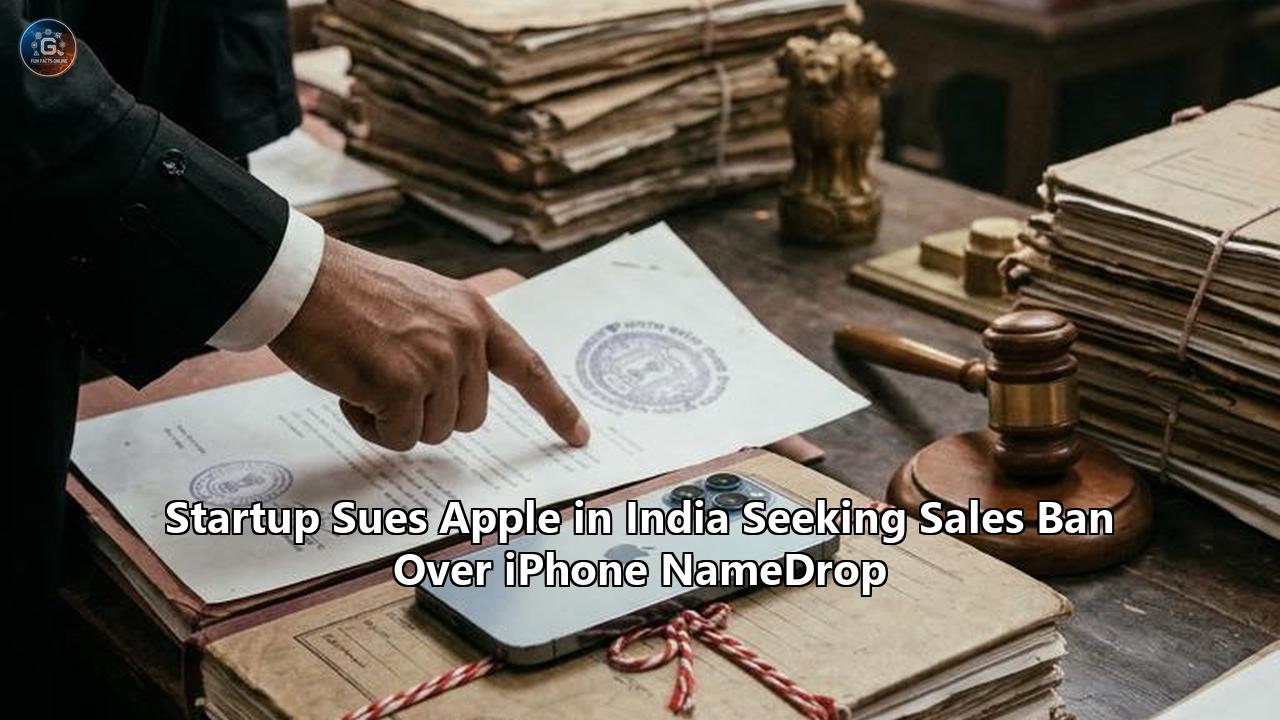
A 781-page patent infringement suit filed in the Commercial Division of the Bombay High Court has escalated tensions between global platform operators and cross-border startups. Santa Monica-based technology company GG Technologies has sued Apple Inc., seeking ₹1,500 crore (approximately $161.9 million) in damages alongside an interlocutory injunction aimed at barring the import and sale of iPhones and Apple Watches equipped with the tech giant’s native NameDrop feature across India.
The lawsuit, initiated in late October following the collapse of mandatory pre-institution mediation in September, targets technology Apple introduced at its Worldwide Developers Conference in June 2023. Integrated into iOS 17 and watchOS 10.1, NameDrop allows users to exchange contact cards and localized digital identity posters by bringing the top edges of two compatible devices into close proximity. GG Technologies asserts that this native utility infringes Indian Patent No. 546169, titled "Method and System for Proximity-Based Contact Transfer," which the Indian Patent Office granted to the startup in July 2024 following an application filed in 2021.
The case is not an isolated local grievance. Founded in 2018 by Gaurav Goel, an Indian Institute of Technology Delhi alumnus and former Goldman Sachs investment banker, GG Technologies previously launched StayTouch, a cross-platform proximity contact-exchange application, in 2019. The Indian action follows parallel litigation filed by the startup in the United States District Court and an active Section 337 investigation initiated in August by the U.S. International Trade Commission (USITC).
By deploying its patent portfolio directly into India—a market that has rapidly transformed from an ancillary retail territory into Apple's primary hardware manufacturing hedge outside China—GG Technologies has mounted a textbook case study in asymmetric intellectual property leverage. The Apple NameDrop lawsuit provides a window into the evolving dynamics of platform-developer competition, cross-border forum shopping, and the strategic mechanics startups must deploy when their proprietary concepts are absorbed into core mobile operating systems.
Dissecting the Dispute: StayTouch vs. NameDrop Architecture
To understand the legal collision in Mumbai, one must examine the specific technical architecture governing proximity-based ad-hoc data exchange. For over a decade, consumer smartphones relied on clunky pairing protocols—manual Bluetooth discovery, pairing PINs, or visual QR code scanning—to transfer personal contact data. Both StayTouch and NameDrop emerged to solve this UX friction, but they navigate the discovery, authorization, and transmission stack through distinct technical pathways.
                     PROXIMITY EXCHANGE ARCHITECTURES

[GG Technologies / StayTouch]
   [Device A]                                         [Device B]
       │                                                   │
       ├── Proximity Discovery (BLE/Location) ────────────┤
       ├── Unpaired Mutual Identity Ping                   │
       │                                                   │
       └── Encrypted Relay via Cloud / Local Handshake ────┘
           (Focus: Profile Sync, Cloud CRM, Cross-Platform)

─────────────────────────────────────────────────────────────────

[Apple / NameDrop]
   [Device A]                                         [Device B]
       │                                                   │
       ├── Physical Nearness (<cm) Triggered via NFC ──────┤
       ├── U1/U2 Ultra-Wideband Relative Spatial Vector    │
       ├── Ephemeral BLE Ad-Hoc Channel Negotiation        │
       │                                                   │
       └── Direct P2P Wi-Fi (AirDrop Daemon Transfer) ─────┘
           (Focus: Local Ephemeral vCard, Contact Poster, Sandbox)
GG Technologies' Indian Patent No. 546169 describes a system where two communication devices establish a temporary, proximity-triggered communication channel to exchange identity tokens and profile details without requiring pre-configuration or permanent hardware pairing. According to filings presented to the court, the patent covers:
- Automated spatial and environmental discovery between unregistered mobile nodes.
- Cryptographic handshake mechanisms that permit mutual identification while preserving privacy.
- A selective, field-level disclosure interface where users determine precisely which contact data (e.g., corporate email versus personal phone number) is transferred across the temporary link.
- Dual-mode transmission architectures that accommodate both direct device-to-device transfers and cloud-mediated payload synchronization.
Apple’s NameDrop operates as a specialized extension of its proprietary AirDrop subsystem. When two iPhones running iOS 17 are placed within centimeters of one another, Near Field Communication (NFC) transceivers embedded in the top chassis detect the mutual field excitation. This triggers a localized system daemon that queries the onboard Ultra-Wideband (U1 or U2) spatial awareness chip to confirm relative orientation.
Once alignment is confirmed, the operating system bypasses manual pairing by automatically negotiating an ephemeral Bluetooth Low Energy (BLE) link to display the shared interface: a fluid, haptic visual animation presenting each user's custom Contact Poster. Upon mutual confirmation, the underlying payload—formatted as a vCard enriched with encrypted metadata—is transferred over a direct, peer-to-peer Wi-Fi connection through the native Apple Wireless Direct Link (AWDL) protocol.
In its 781-page filing, GG Technologies claims that Apple’s end-to-end user flow mirrors the fundamental claims of its granted patent. The startup engaged two independent computer science experts to dissect Apple’s public developer documentation, iOS runtime behaviors, and peripheral radio handshakes. These reports allege substantial structural overlap in how NameDrop identifies proximate devices, handles identity tokens, obtains two-way user consent, and selectively parses user-designated contact fields.
Apple's standard defense in these matters centers on claim construction and prior art invalidation. Proximity data exchange has deep historical roots in consumer computing. In the late 2000s, applications like Bump Technologies (which used accelerometer spikes matched with time-stamped cloud location data to swap contacts) established early paradigms for tap-to-share interactions. Android Beam, introduced by Google in 2011 with Android 4.0 Ice Cream Sandwich, previously utilized NFC to trigger Bluetooth or Wi-Fi Direct data transfers. Apple will almost certainly argue that its implementation relies on distinct proprietary protocols—specifically AirDrop, AWDL, and hardware-enforced Secure Enclave tokenization—that differentiate it from GG Technologies' patent disclosures.
The Platform Paradox: When Native Utility Absorbs Third-Party Innovation
The dispute between GG Technologies and Apple exposes a persistent structural friction in modern software ecosystems: platform-driven feature assimilation. In Silicon Valley jargon, this phenomenon is widely known as "Sherlocking"—a reference to Apple's early-2000s Mac OS X search tool that incorporated the interface and capabilities of Karelia Software’s third-party utility, Watson.
For mobile-first startups, the platform paradox represents an existential hazard. An independent developer identifies an unaddressed friction in consumer behavior, builds an application to solve it, and scales a user base within the confines of an operating system's public application programming interfaces (APIs). If the solution proves successful, it inadvertently validates market demand for the platform owner itself.
                    THE ASSIMILATION LIFECYCLE

    ┌────────────────────────────────────────────────────────┐
    │ 1. Innovation Stage:                                   │
    │    Third-party startup identifies user friction.        │
    │    Builds app via restricted public APIs (StayTouch).   │
    └───────────────────────────┬────────────────────────────┘
                                │
                                ▼
    ┌────────────────────────────────────────────────────────┐
    │ 2. Platform Observation:                               │
    │    Platform operator monitors usage metrics, telemetry,│
    │    and App Store engagement patterns.                  │
    └───────────────────────────┬────────────────────────────┘
                                │
                                ▼
    ┌────────────────────────────────────────────────────────┐
    │ 3. Kernel Assimilation ("Sherlocking"):                │
    │    Feature rebuilt natively at the OS/hardware layer   │
    │    (iOS NameDrop with background NFC polling).         │
    └───────────────────────────┬────────────────────────────┘
                                │
                                ▼
    ┌────────────────────────────────────────────────────────┐
    │ 4. Ecosystem Extinction & Litigation:                  │
    │    Third-party distribution collapses;                 │
    │    Founder pivots to patent portfolio monetization     │
    │    and multi-jurisdictional enforcement.               │
    └────────────────────────────────────────────────────────┘
The platform owner can implement the feature natively at the kernel or system layer, bypassing the strict sandbox constraints imposed on third parties. While GG Technologies' StayTouch was constrained by Apple's strict background processing limits, CoreNFC developer entitlement restrictions, and mandatory manual app launches, Apple could build NameDrop directly into the lock screen and system daemons. The resulting user experience feels immediate and frictionless, instantly undermining the commercial viability of the third-party predecessor.
This cycle has played out across multiple product categories:
- F.lux vs. Night Shift: F.lux pioneered dynamic, time-based display color-temperature adjustments to reduce eye strain, requiring users to jailbreak their iPhones. Apple subsequently integrated Night Shift natively into iOS 9.3, rendering F.lux's iOS ambitions dead on arrival.
- Tile vs. AirTag: Tile established the consumer Bluetooth tracking ecosystem, operating via an opt-in network of running apps. Apple unveiled the AirTag in 2021, leveraging its global, system-level Find My network of nearly one billion active iPhones without needing third-party software installed.
- Duet Display vs. Sidecar: Built by ex-Apple engineers, Duet Display turned an iPad into a secondary Mac display via USB or Wi-Fi. Apple subsequently introduced Sidecar natively into macOS Catalina, absorbing the functionality into the desktop operating system.
- Masimo Corp. vs. Apple Watch: Masimo developed specialized pulse oximetry technology, holding extensive patent estates. After executive meetings and talent recruitment, Apple launched native blood-oxygen sensing in the Apple Watch Series 6, culminating in a historic legal battle that temporarily banned U.S. imports of infringing hardware.
For GG Technologies, the consequences of this dynamic were severe. Founded by Goel to replace paper business cards in corporate networking, the startup had raised $3.2 million from European family offices and institutional backers—including Cyrille Bolloré and Prisca Clarins—and was preparing a subsequent $3.3 million funding round. In its court filings, the startup noted that prospective enterprise partners and institutional investors grew reluctant to deploy capital or integrate StayTouch once Apple released NameDrop as a native, zero-cost utility in iOS 17.
When a startup's software distribution vector is severed by an operating system update, its remaining economic asset is often its intellectual property portfolio. Patent litigation ceases to be merely a defensive measure; it becomes the primary vehicle for enterprise value recovery.
Strategic Forum Shopping: Why Mumbai Is Apple's Soft Underbelly
The decision by a Santa Monica startup to file a high-stakes patent lawsuit in Mumbai, rather than confining the battle to the Eastern District of Texas or the District of Delaware, illustrates a masterclass in cross-border forum selection.
For decades, international patent enforcement followed a rigid, predictable track: plaintiffs filed suit in the United States to capture outsized damages awards, supplemented by filings in Germany (Munich or Mannheim Regional Courts) to secure rapid injunctive pressure. India was rarely viewed as a primary jurisdiction for high-stakes technology patent litigation, largely due to perceptions of protracted judicial backlogs.
That calculus has fundamentally shifted. The enactment of the Commercial Courts Act, 2015, established specialized Commercial Divisions within Indian High Courts, complete with strict procedural timelines, specialized IP benches, and mandatory pre-institution mediation frameworks. Simultaneously, the economic realities of Apple’s corporate footprint have transformed India into one of the Cupertino company's most sensitive operational chokepoints.
                 APPLE'S DUAL-EXPOSURE PROFILE IN INDIA

    OPERATIONAL / MANUFACTURING VECTOR      CONSUMER MARKET / REVENUE VECTOR
    ──────────────────────────────────      ────────────────────────────────
    • Up to 20-25% of global iPhone         • Fastest-growing market globally
      production located in India             (revenue exceeding $8 billion)
    • Manufacturing hubs: Foxconn,          • Expanding retail footprint
      Pegatron, and Tata Electronics          (flagships in Mumbai, Delhi)
    • Key export pipeline to Europe,        • Low market share (<10%),
      Middle East, and North America          representing massive runway
                    │                                      │
                    └───────────────────┬──────────────────┘
                                        │
                                        ▼
    ┌──────────────────────────────────────────────────────────────────────┐
    │ THE INJUNCTION THREAT:                                               │
    │ An interlocutory order barring sale OR import of infringing devices   │
    │ disrupts not just domestic consumer retail, but upstream supply      │
    │ chains, localized firmware flashing, and export trade logistics.      │
    └──────────────────────────────────────────────────────────────────────┘
Apple's exposure in India is bifurcated across two mission-critical pillars:
1. The Global Manufacturing Hedge
Under the Government of India’s Production Linked Incentive (PLI) scheme, Apple has aggressively diversified its device assembly away from China. Through key contract manufacturing partners—Foxconn's facilities in Sriperumbudur, Pegatron in Tamil Nadu, and the Tata Group’s acquisition of Wistron’s operations in Karnataka alongside its massive casing facility in Hosur—India now accounts for approximately 15% to 20% of global iPhone output, with internal targets aiming for 25%. Devices assembled in India are not merely sold to local consumers; they are exported worldwide to Europe, the Middle East, and North America.
2. High-Growth Consumer Monetization
India represents Apple’s fastest-growing major consumer smartphone market. While iPhones hold less than a 10% volume share in a market dominated by Android-based budget hardware from Samsung, Xiaomi, and Vivo, Apple commands a dominant position in the ultra-premium segment (devices priced above ₹65,000 / $800). Annual revenues from India surged past $8 billion, driven by the rollout of company-owned retail flagships in Mumbai (Apple BKC) and Delhi (Apple Saket), with additional stores slated for Pune, Bengaluru, and Noida.
By requesting an order that explicitly restricts Apple from "selling or importing iPhones and Apple Watches preloaded with NameDrop in India," GG Technologies struck at this intersection.
In Indian jurisprudence, High Courts possessing Ordinary Original Civil Jurisdiction—principally Bombay, Delhi, and Madras—have established a robust track record of issuing robust interlocutory relief in patent cases. Landmark standard-essential patent (SEP) litigations brought by Telefonaktiebolaget LM Ericsson against domestic and foreign smartphone manufacturers (including Micromax, Intex, and Xiaomi) established that Indian judges are willing to grant interim injunctions or mandate substantial security deposits (often calculated as a percentage of device net sales) during early stages of litigation to safeguard a patentee's rights.
In this context, the Apple NameDrop lawsuit in Mumbai carries operational implications far exceeding a localized sales dispute. A preliminary injunction or an adverse judicial observation in the Bombay High Court threatens Apple’s domestic inventory logistics, disrupts retail rollouts, and introduces legal uncertainty into manufacturing facilities operating under strict production quotas.
Navigating Section 3(k): The Indian Patentability Hurdle
While GG Technologies holds a granted Indian patent, sustaining an infringement suit against Apple in an Indian court requires navigating one of the most restrictive and heavily debated statutory provisions in global intellectual property law: Section 3(k) of the Indian Patents Act, 1970.
Section 3(k) states that the following are not patentable inventions within the meaning of the Act:
"A mathematical or business method or a computer programme per se or algorithms;"
The critical phrase "per se" has served as the battleground for software-implemented innovations in India for over two decades. Historically, the Indian Patent Office (IPO) rejected software claims outright if they were implemented through general-purpose processors, microcontrollers, or conventional wireless transceivers.
               SECTION 3(k) PATENT ELIGIBILITY FILTER

             [Patent Application: Software Method]
                               │
                               ▼
            ┌─────────────────────────────────────┐
            │ Is it a computer program "per se"?  │
            └──────────────────┬──────────────────┘
                               │
                ┌──────────────┴──────────────┐
                │ YES                         │ NO
                ▼                             ▼
    ┌────────────────────────┐   ┌───────────────────────────────┐
    │ STATUTORY REJECTION    │   │ Does it demonstrate a         │
    │ Pure business method,  │   │ "Technical Effect" or         │
    │ algorithm, or code.    │   │ "Technical Contribution"?     │
    └────────────────────────┘   └──────────────┬────────────────┘
                                                │
                                 ┌──────────────┴──────────────┐
                                 │ YES                         │ NO
                                 ▼                             ▼
                     ┌───────────────────────┐    ┌────────────────────────┐
                     │ ELIGIBLE UNDER 3(k)   │    │ REJECTED UNDER 3(k)    │
                     │ Tying code to physical│    │ Mere convenience or    │
                     │ hardware performance  │    │ routine processing step│
                     │ (e.g., radio control).│    │ (BlackBerry precedent).│
                     └───────────────────────┘    └────────────────────────┘
However, Indian judicial doctrine has evolved significantly. In landmark rulings such as Ferid Allani v. Union of India (2019) and Microsoft Technology Licensing v. Assistant Controller of Patents (2023), the Delhi High Court established that computer-related inventions (CRIs) are eligible for patent protection if the claimed software produces a demonstrable "technical effect" or offers a substantive "technical contribution". If an invention improves the functioning of hardware, enhances communication efficiency, optimizes data compression, or introduces novel cryptographic and hardware-level handshakes, it escapes the Section 3(k) bar.
Conversely, the boundary remains tightly policed. In BlackBerry Limited v. Controller of Patents and Designs (April 2026), the Delhi High Court rejected a BlackBerry patent application covering a method of manipulating commands on handheld devices. The court clarified that mere user-interface convenience, routine step execution, or simplification of tasks for an end-user does not equate to a patentable technical contribution under Section 3(k).
In the Bombay High Court, Apple’s defense team will almost certainly deploy a dual-track strategy rooted in Section 3(k):
- Counter-Claim for Revocation under Section 64: Apple is expected to file an application to invalidate Indian Patent No. 546169, asserting that the claims directed toward "Method and System for Proximity-Based Contact Transfer" are essentially abstract business workflows or algorithms for swapping digital cards, masquerading as a technical communication system.
- The Non-Infringement Argument: Apple will argue that even if the patent survives Section 3(k), its scope must be interpreted narrowly. Under this interpretation, the patent can only cover specific, specialized hardware-software combinations disclosed by GG Technologies, thereby excluding Apple's distinct, kernel-level AWDL and Secure Enclave pairing methods.
How the Bombay High Court interprets the technical contribution of proximity radio handshakes will establish an important precedent for India’s software and mobile communications industry.
The Global Encirclement: USITC, Federal Courts, and Cross-Border Coordination
The filing in Mumbai represents one prong of an internationally coordinated litigation strategy. GG Technologies did not launch an ad-hoc, isolated lawsuit in an emerging market; it constructed a multi-front legal encirclement designed to exert simultaneous pressure on Apple’s corporate leadership.
                     GG TECHNOLOGIES' MULTI-FRONT CAMPAIGN

   UNITED STATES DISTRICT COURT         U.S. INTERNATIONAL TRADE COMM.        BOMBAY HIGH COURT (INDIA)
   ────────────────────────────         ──────────────────────────────        ─────────────────────────
   • Case filed: April 2026             • Complaint filed: July 2026          • Suit filed: October 2026
   • Supplemental: Nov 2026             • Investigation opened: Aug 2026      • Remedy sought: ₹1,500 Cr
     (US Pat. No. 12,784,009)           • Target: Section 337 Exclusion         ($162M) + Sales Ban
   • Primary remedy: Monetary             Order (Hardware Import Ban)         • Strategic lever: Supply
     damages, ongoing royalties         • Status: 100-day early review          chain & high-growth market
   • Current state: Stayed                on domestic industry requirement      exposure
In the United States, GG Technologies initiated formal proceedings in April 2026, alleging patent infringement across Apple’s mobile device lineup. It escalated that effort on November 3, 2026, by filing a second federal suit asserting a newly issued patent, U.S. Patent No. 12,784,009. However, U.S. federal district court litigation is often slow, frequently subject to procedural stays pending Inter Partes Review (IPR) petitions before the Patent Trial and Appeal Board (PTAB)—a standard defensive mechanism deployed by major technology companies to invalidate asserted patents.
Recognizing these timeline challenges, GG Technologies simultaneously lodged a complaint under Section 337 of the Tariff Act of 1930 with the U.S. International Trade Commission. On August 28, 2026, the USITC instituted a formal investigation (naming Apple as the sole respondent) to determine whether imports of iPhones and Apple Watches containing NameDrop infringe valid U.S. patents.
The USITC is a formidable administrative venue: it does not award financial damages, but it holds the authority to issue exclusion orders, effectively directing U.S. Customs and Border Protection to seize infringing goods at ports of entry. Because nearly all Apple devices sold in the U.S. are manufactured abroad, an exclusion order presents an immediate threat to hardware distribution. In this case, the USITC directed an administrative law judge to conduct a 100-day early proceeding to scrutinize whether GG Technologies meets the statutory "economic domestic industry" requirement—a high bar for early-stage software startups that must demonstrate sufficient licensing, research, or operational investment within the United States.
This multi-pronged posture reveals why the Indian lawsuit was timed so precisely. When the U.S. federal case was paused in September due to parallel proceedings, and as the USITC's initial 100-day review proceeded, GG Technologies activated its Indian intellectual property assets.
This sequence highlights a sophisticated playbook in international technology litigation:
- The U.S. District Court targets enterprise-wide financial recovery through long-term damages calculations.
- The USITC applies domestic import pressure via the threat of exclusion orders.
- The Bombay High Court targets the defendant's primary international growth engine and alternative manufacturing base, circumventing standard U.S. procedural stays.
Through this coordinated pressure across independent legal systems, the plaintiff ensures that a dispute cannot be easily compartmentalized or deferred.
Strategic Principles for Tech Founders, Corporate Counsel, and Platform Operators
The unfolding Apple NameDrop lawsuit provides actionable lessons for participants across the technology ecosystem. Whether operating as an early-stage startup, managing intellectual property for an enterprise platform, or evaluating venture risk, leadership teams can extract clear principles from this clash.
                      STRATEGIC LESSONS ACROSS STAKEHOLDERS

   ┌────────────────────────────────────────────────────────────────────────┐
   │ FOR STARTUPS & VENTURE CAPITAL:                                        │
   │ • Build a Jurisdictional Fortress: File patents in manufacturing hubs  │
   │   (India, China, Vietnam), not just consumption markets.               │
   │ • Design IP for "Sherlocking" Contingencies: Formulate claims around    │
   │   kernel-to-application interactions, not basic software workflows.   │
   └────────────────────────────────────────────────────────────────────────┘
                                      │
   ┌──────────────────────────────────┴─────────────────────────────────────┐
   │ FOR PLATFORM OPERATORS & TECH GIANTS:                                  │
   │ • Implement Modular Feature Decoupling: Ensure operating systems can   │
   │   disable disputed utilities regionally via server-side toggles.       │
   │ • Re-evaluate Cross-Border Patent Clearance: Monitor national patent   │
   │   offices in countries where high-value hardware is assembled.         │
   └────────────────────────────────────────────────────────────────────────┘
                                      │
   ┌──────────────────────────────────┴─────────────────────────────────────┐
   │ FOR IP LITIGATORS & IN-HOUSE COUNSEL:                                  │
   │ • Utilize Pre-Institution Mediation: Treat mandatory negotiation       │
   │   windows as structured discovery to map the adversary's posture.      │
   │ • Align Administrative and Judicial Tracks: Harmonize ITC exclusions   │
   │   with foreign interlocutory injunctions to accelerate settlement.     │
   └────────────────────────────────────────────────────────────────────────┘
1. Build a Multi-Jurisdictional Patent Fortress
Startups frequently allocate limited IP budgets solely to domestic utility patents, predominantly through the United States Patent and Trademark Office (USPTO). This creates a structural blind spot. If an infringement occurs, the startup is confined to a single, slow legal system.
GG Technologies’ decision to file an Indian patent application in 2021—shortly after its initial 2019 U.S. provisional filings—is the sole reason it possesses leverage against Apple in Mumbai.
Principle: In hardware-dependent software sectors, founders must map global manufacturing corridors. Securing granted patents in jurisdictions where tech giants assemble devices (India, China, Vietnam) or clear imports (the European Union) provides disproportionate settlement leverage compared to operating solely within U.S. borders.2. The Architectural Decoupling Defense
For platform operators, the primary operational risk in patent litigation is that a software-level utility dispute can disrupt multi-billion-dollar hardware shipments. When Masimo challenged Apple's pulse oximetry sensor, Apple was forced to disable the blood-oxygen measurement algorithms entirely in newer Apple Watch Series 9 and Ultra 2 models sold in the U.S. to avert an active import ban.
Principle: Big tech engineering teams must build modular architectures that allow native operating system features to be decoupled remotely without disrupting underlying hardware compliance. If the Bombay High Court threatens an injunction against devices running NameDrop, Apple's legal and engineering teams must be prepared to demonstrate that the feature can be suppressed regionally through over-the-air carrier bundles or localized firmware updates, thereby preserving base hardware sales and assembly pipelines.3. Pre-Institution Mediation as an Information Asset
Under Section 12A of India's Commercial Courts Act, commercial suits that do not contemplate urgent interim relief cannot be instituted unless the plaintiff exhausts mandatory pre-institution mediation.
GG Technologies entered mediation with Apple in April, concluding without an agreement in September. While mediation failed to yield a commercial settlement, it served as an institutional testing ground where both parties mapped out claim constructions, technical distinctions, and financial expectations.
Principle: Rather than treating statutory mediation as a procedural checkbox, sophisticated litigants use this structured window to evaluate the adversary’s appetite for prolonged cross-border litigation, assess potential licensing terms, and pressure corporate risk committees before public dockets expose sensitive operational vulnerabilities.4. Overcoming the "Abstract Idea" Minefield
Proximity sharing lives dangerously close to the boundary of patent-ineligible subject matter. In every major market—under 35 U.S.C. § 101 in the United States or Section 3(k) in India—courts routinely reject claims that describe abstract human activities (e.g., swapping business cards, sharing telephone numbers) accomplished through generic computational steps.
Principle: To survive patent examination and subsequent court scrutiny, patent claims must focus squarely on the technical implementation: the specific sequencing of radio frequency states, novel cryptographic exchanges, token parsing algorithms, and hardware subsystem interactions. An innovation is defensible only when framed as an objective technical solution to an objective technical limitation.What to Watch as the Docket Opens
As the Commercial Division of the Bombay High Court lists the Apple NameDrop lawsuit for its preliminary hearings, the dispute enters its most critical phase. Patent enforcement actions involving cross-border technology giants rarely proceed in a linear, predictable fashion, and several upcoming milestones will determine how this battle reshapes corporate behavior.
                     IMMEDIATE DOCKET MILESTONES

    [Q4 2026 - Q1 2027]
    • Bombay High Court: Listing and Preliminary Injunction Hearings
      - Apple to challenge interim relief and question Section 3(k) eligibility
      - GG Technologies to push for conditional bank guarantees / royalty deposits

    [Q1 2027]
    • USITC Administrative Law Judge: 100-Day Domestic Industry Determination
      - Critical ruling on whether GG Technologies maintains sufficient U.S. operations

    [Mid-2027]
    • Apple Counter-Attacks: Section 64 Revocation in India & PTAB IPRs in the U.S.
      - Parallel attempts to invalidate Indian Patent No. 546169 and U.S. counterparts
Key developments will guide the trajectory of the litigation:
1. The Interlocutory Injunction Ruling
The first major procedural test will center on GG Technologies’ application for interim relief. Indian courts evaluate interim injunctions across a traditional three-part test: a prima facie case, the balance of convenience, and the threat of irreparable injury.
Because an absolute sales ban on iPhones would severely disrupt regional supply chains, employment, and consumer availability, the court may hesitate to grant a complete hardware injunction at the outset. Instead, the bench could explore intermediate equitable remedies, such as requiring Apple to provide a substantial bank guarantee or deposit a court-determined royalty percentage pending final adjudication—a model frequently adopted in complex Indian telecom and electronics litigations.
2. Apple’s Invalidation Counter-Offensive
Apple's legal response in India will extend beyond defending NameDrop's code. The company is expected to challenge the validity of Indian Patent No. 546169 under Section 64 of the Patents Act, arguing that the IPO erred in granting the patent over prior proximity-transfer art (such as early Bluetooth profile exchanges, NFC Forum data exchange specifications, and Android Beam protocols).
Simultaneously, Apple will likely file Inter Partes Review petitions against GG Technologies’ U.S. patents before the USPTO’s Patent Trial and Appeal Board, seeking to dismantle the domestic foundations of the startup's global enforcement campaign.
3. The USITC Domestic Industry Ruling
In Washington, the outcome of the USITC’s 100-day early review concerning GG Technologies’ domestic industry status will have immediate ripple effects in Mumbai. If the administrative law judge finds that GG Technologies lacks sufficient qualifying U.S. capital investment, licensing infrastructure, or technical operations, the USITC investigation could be terminated, removing the immediate threat of a U.S. hardware import ban.
Conversely, if the startup clears the domestic industry threshold, Apple will confront real risk on its home turf, substantially increasing its incentive to explore an overarching global settlement.
4. Settlement Dynamics and Licensing Calculus
Historically, the vast majority of high-profile patent actions brought by early-stage tech ventures against platform operators end in private, confidential cross-licensing or patent acquisition settlements. While GG Technologies has claimed ₹1,500 crore in damages, the ultimate figure that resolves such disputes is typically negotiated based on running royalty rates, litigation cost projections, and the disruption value of avoiding regional software alterations.
The Mumbai filing signals that the geography of intellectual property risk has permanently shifted. As global technology manufacturing and consumer monetization migrate east, the forums where tech platforms must defend their software design choices are diversifying. The conflict over a tap-to-share contact feature underscores a broader reality: when proprietary ideas are integrated into global operating systems, the legal challenges will unfold simultaneously in the high-stakes venues of both East and West.
Reference:
- https://the420.in/apple-namedrop-patent-lawsuit-india/
- https://mlq.ai/news/staytouch-maker-sues-apple-in-india-for-162-million-seeking-a-namedrop-ban-on-iphones/
- https://finance.biggo.com/news/ef25c757-59e7-4365-bb44-a824a9fb725f
- https://indiantelevision.com/itv-news/apple-faces-rs-1500-crore-patent-lawsuit-over-namedrop-in-india/
- https://indianexpress.com/article/technology/tech-news-technology/apple-namedrop-feature-lawsuit-india-10973502/
- https://timesofindia.indiatimes.com/business/india-business/iit-delhi-alumnus-startup-sues-apple-for-rs-1500-crore-over-namedrop-feature/articleshow/136074433.cms
- https://finance.biggo.com/news/ef25c757-59e7-4365-bb44-a824a9fb725f
- https://gadgetsnow.indiatimes.com/tech-news/apple-namedrop-patent-row-the-iit-delhi-graduate-who-claims-he-had-the-idea-first/amp_articleshow/136028044.cms
- https://www.tradingview.com/news/binance_news:7f7247da2094b:0-u-s-startup-gg-technologies-sues-apple-in-india-alleging-namedrop-patent-infringement/
- https://www.reddit.com/r/indianstartups/comments/1y2td1c/an_iit_delhi_alumnusfounded_startup_is_suing/
- https://shattered.io/gg-technologies-sues-apple-namedrop-bombay-high-court-1500-crore/
- https://indianstartupnews.com/news/apple-faces-rs-1500-crore-patent-suit-in-india-as-staytouch-seeks-curbs-on-iphones-with-namedrop-12829027
- https://www.invntree.com/blog/the-section-3k-ai-patentability-master-guide-for-india-strategy-case-law-drafting-and-global-alignment
- https://www.itsiptime.com/patentability-computer-related-inventions-section-3k-india/
- https://www.wipo.int/ip-development/en/agenda/flexibilities/details.jsp?id=8825
- https://www.iiprd.com/software-patents-in-india-understanding-section-3k-of-the-patents-act/
- https://www.khuranaandkhurana.com/software-patentability-in-india-a-comparative-legal-analysis