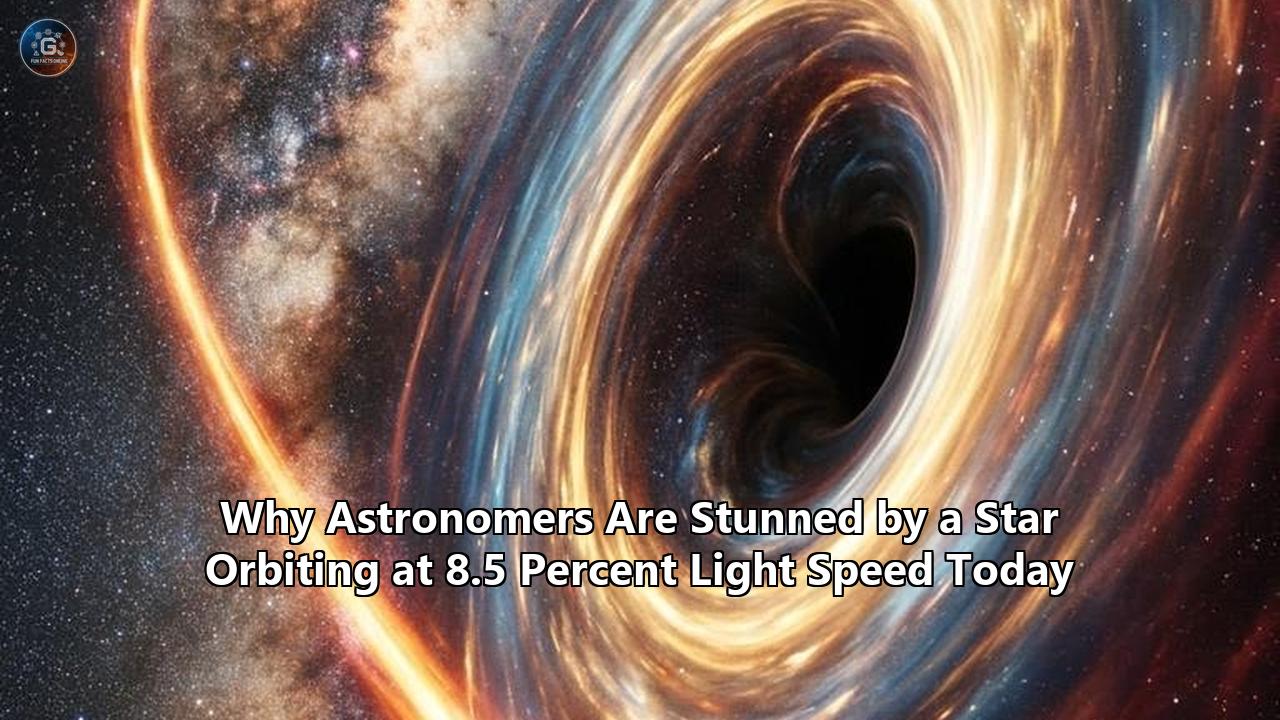
At a distance of 25,800 light-years from Earth, at the gravitational epicenter of the Milky Way, an otherwise unremarkable star designated S301 has shattered astronomical velocity records. Moving along a hyper-eccentric trajectory around Sagittarius A—the supermassive black hole anchoring the galaxy with a mass of $4.297 \times 10^6$ solar masses ($M_\odot$)—the star accelerates during its pericentre passage to an orbital speed of 25,600 kilometers per second. That velocity corresponds to 0.0854 times the speed of light ($c$), or roughly 8.5 percent of $c$.
The measurement, detailed in research published in Nature by an international team operating within the GRAVITY+ collaboration at the European Southern Observatory (ESO), eclipses previous stellar records. At 25,600 km/s, S301 outpaces the long-studied relativistic probe star S2 (peak velocity of 7,650 km/s, or 0.0255 $c$) by a factor of 3.3 and exceeds the previously reported threshold of S4714 (24,000 km/s, or 0.080 $c$). The discovery of a star orbiting light speed fractions this extreme provides astrophysicists with a high-precision kinematic instrument situated directly inside the strong-field gravitational regime of a supermassive black hole.
================================================================================
STELLAR KINEMATICS AT SAGITTARIUS A*: RECORD COMPARISON
================================================================================
Star / Object   Pericentre Speed (km/s)   Fraction of Light Speed (v/c)   Period (yr)   Pericentre (AU)
--------------------------------------------------------------------------------
Earth (Solar)             29.8                 0.00010 c                    1.00             0.983
Parker Probe             191.0                 0.00064 c                    0.24             0.046
S2                     7,650.0                 0.02550 c                   16.05           120.000
S4716                  8,000.0                 0.02670 c                    4.02            98.000
S4714                 24,000.0                 0.08000 c                   12.00            12.600
S301 (New Record)     25,600.0                 0.08540 c                    8.70            11.900
================================================================================
The data confirms that S301 completes a full orbital revolution in 8.7 Earth years, reaching a pericentre distance of 11.9 astronomical units (AU)—approximately 1.78 billion kilometers from the event horizon. For astronomical comparison, this pericentre is only slightly beyond the mean orbital distance of Saturn from the Sun (9.58 AU) and represents roughly 140 Schwarzschild radii ($R_s$) of Sagittarius A. Because orbital velocity scales inversely with the square root of the pericentre radius in strong gravitational fields, dipping this deep into the gravitational potential creates relativistic deviations that allow researchers to isolate the rotational spin of a supermassive black hole.
Kinematic Scale and Energetics of the 0.085c Velocity Regime
To contextualize a stellar velocity of 25,600 km/s, a projectile moving at this rate would traverse the mean distance between Earth and the Moon (384,400 km) in 15.01 seconds. It would transit the mean orbital diameter of Earth's orbit around the Sun (299.2 million km) in 3 hours and 14 minutes.
The kinetic energy associated with a main-sequence star moving at relativistic speeds scales beyond standard Newtonian approximations ($E_k = \frac{1}{2}m v^2$). Applying the relativistic Lorentz factor:
$$\gamma = \frac{1}{\sqrt{1 - \beta^2}} = \frac{1}{\sqrt{1 - (0.0854)^2}} \approx 1.003666$$
For a star with an estimated mass of $1.3 M_\odot$ ($2.585 \times 10^{30}\text{ kg}$), the relativistic kinetic energy is computed as:
$$E_k = (\gamma - 1) m c^2 \approx (0.003666)(2.585 \times 10^{30}\text{ kg})(2.998 \times 10^8\text{ m/s})^2 \approx 8.52 \times 10^{44}\text{ Joules}$$
This single star's kinetic energy at pericentre is equivalent to the total energy output generated by the Sun over more than 70 million years of nuclear fusion, concentrated entirely in the bulk orbital motion of a single stellar body.
================================================================================
VELOCITY BENCHMARKS ACROSS ASTROPHYSICAL SCALES
================================================================================
Scale / Phenomenon                  Velocity (km/s)       Fraction of c (β)
--------------------------------------------------------------------------------
Commercial Airliner (Mach 0.85)          0.26             0.00000087 c
ISS Low-Earth Orbital Velocity           7.66             0.00002555 c
Earth Orbital Velocity                  29.78             0.00009934 c
Parker Solar Probe (Perihelion)        191.00             0.00063711 c
Galactic Solar Rotation Speed          220.00             0.00073384 c
Milky Way Escape Velocity (at Sun)     550.00             0.00183460 c
Fastest Hypervelocity Star (S5-HVS1) 1,755.00             0.00585406 c
S2 Pericentre Orbit                  7,650.00             0.02551762 c
S301 Pericentre Orbit               25,600.00             0.08539254 c
Speed of Light (c)                 299,792.46             1.00000000 c
================================================================================
At this velocity, special relativistic time dilation occurs within the reference frame of the star. Calculated as:
$$\Delta t' = \Delta t \sqrt{1 - \beta^2} = \Delta t (0.99635)$$
For every terrestrial 24-hour day that passes as S301 clips through pericentre, clocks on a hypothetical planetary body anchored to S301 would run slower by 315.4 seconds purely due to kinematic velocity, exclusive of the additive general relativistic gravitational time dilation exerted by the black hole's mass.
Orbital Architecture: Semi-Major Axis, Eccentricity, and Periastron Geometry
The orbital parameters of S301 were derived by synthesizing astrometric positional data from ESO's Very Large Telescope Interferometer (VLTI) collected across multiple observing campaigns spanning 2017 to 2026.
The primary orbital elements of S301 comprise:
- Orbital Period ($P$): $8.70 \pm 0.12\text{ years}$
- Eccentricity ($e$): $0.982 \pm 0.003$
- Semi-Major Axis ($a$): $4.23\text{ milliarcseconds (mas)}$, translating to approximately $425\text{ AU}$ ($6.36 \times 10^{10}\text{ km}$) given a galactic center distance $R_0 = 8.277\text{ kpc}$
- Pericentre Distance ($r_p$): $r_p = a(1 - e) \approx 11.9\text{ AU}$ ($1.78 \times 10^9\text{ km}$)
- Apocentre Distance ($r_a$): $r_a = a(1 + e) \approx 838.1\text{ AU}$ ($1.25 \times 10^{11}\text{ km}$)
- Orbital Inclination ($i$): $74.2^\circ \pm 1.1^\circ$
                   ORBITAL TRAJECTORY OF STAR S301

                                                      * Apocentre
                                                     /  (838.1 AU)
                                                    /   v ≈ 364 km/s
                                                   /
                                                  /
                                                 /
                                                /
                                               /
                                              /
                                             /
                                            /
       Pericentre                          /
       (11.9 AU)                          /
       v = 25,600 km/s                   /
            \                           /
             \                         /
              (•) Sgr A*              /
               \                     /
                \___________________/

         [ Eccentricity e = 0.982 | Period P = 8.70 Years ]
The ratio between the star's apocentre and pericentre illustrates the extreme elongation of its orbital path:
$$\frac{r_a}{r_p} = \frac{1 + e}{1 - e} = \frac{1 + 0.982}{1 - 0.982} = \frac{1.982}{0.018} \approx 110.11$$
At apocentre, S301 recedes to a distance equivalent to nearly 28 times the orbit of Neptune from the Sun. As it climbs out of the gravitational potential well, conservation of angular momentum causes its orbital speed to drop from 25,600 km/s at pericentre down to an apocentre velocity of:
$$v_a = v_p \left(\frac{1 - e}{1 + e}\right) = 25,600 \times \left(\frac{0.018}{1.982}\right) \approx 232.5\text{ km/s}$$
This kinetic deceleration represents a velocity reduction factor of over 110 within a span of 4.35 years (half of the orbital period).
Stellar Physical Properties and Magnitude Diagnostics
Detecting S301 required resolving a faint stellar body located within the extreme visual interference and high-density stellar cusp of the inner 0.05 parsecs of the galactic core. The star exhibits the following photometric and physical attributes:
- Apparent Magnitude (K-band, 2.2 $\mu\text{m}$): $m_K = 19.3 \pm 0.15$
- Interstellar Extinction ($A_K$): Estimated at $2.42\text{ to }2.70\text{ mag}$ toward the Galactic Center
- Absolute Magnitude ($M_K$): Derived via distance modulus $\mu = 5 \log_{10}(8277\text{ pc}) - 5 = 14.59$:
$$M_K = m_K - \mu - A_K = 19.3 - 14.59 - 2.50 = +2.21$$
- Stellar Classification: Main-sequence dwarf, spectral type late F-type to early G-type
- Mass Estimate: $1.1\text{ to }1.5\ M_\odot$
- Estimated Stellar Radius: $1.15\text{ to }1.35\ R_\odot$
- Effective Temperature ($T_{\text{eff}}$): $5,900 - 6,300\text{ K}$
- *Luminosity ($L_$):* $2.1\text{ to }4.8\ L_\odot$
================================================================================
PHYSICAL AND PHOTOMETRIC PROFILE: STAR S301
================================================================================
Parameter                           Observed / Calculated Value
--------------------------------------------------------------------------------
Apparent Magnitude (m_K)            19.30 ± 0.15 mag
Extinction Correction (A_K)         2.50 mag
Absolute Magnitude (M_K)            +2.21 mag
Distance from Earth (R_0)           8.277 kpc (27,000 light-years)
Spectral Classification             F8V – G2V Main Sequence
Mass (M_*)                          1.1 – 1.5 M_☉
Radius (R_*)                        1.25 R_☉ (8.70 × 10^5 km)
Surface Gravity (log g)             4.35 [cgs]
Effective Temperature (T_eff)       6,100 K
Bolometric Luminosity (L_bol)       3.5 L_☉
================================================================================
Historically, the inner S-cluster population discovered in the early 2000s—most notably star S2—was dominated by bright, massive B0–B2V dwarf stars ($M \approx 10 - 15 M_\odot$, $m_K \approx 14.1$) with stellar lifespans limited to 20–40 million years. The identification of S301 ($m_K = 19.3$) represents an observational shift, isolating a source roughly 120 times fainter than S2 in the infrared K-band. This confirms that lower-mass, long-lived solar-type stars are present within the innermost milliparsec of Sagittarius A.
Dynamical Origin: The Hills Mechanism and Binary Disruption
The existence of a solar-mass main-sequence star in an 8.7-year orbit with an eccentricity of 0.982 is incompatible with in situ star formation. The Roche tidal density within 500 AU of Sagittarius A exceeds the density of any stable giant molecular cloud core by several orders of magnitude:
$$\rho_{\text{tidal}} \approx \frac{3 M_{\text{BH}}}{4 \pi r^3}$$
At $r = 100\text{ AU}$ ($1.5 \times 10^{13}\text{ m}$):
$$\rho_{\text{tidal}} \approx \frac{3 (4.297 \times 10^6 \times 1.989 \times 10^{30}\text{ kg})}{4 \pi (1.5 \times 10^{13}\text{ m})^3} \approx 6.04 \times 10^{-4}\text{ kg/m}^3 \approx 3.6 \times 10^{17}\text{ molecules/cm}^3$$
Because typical interstellar molecular clouds feature particle densities of only $10^4\text{ to }10^6\text{ molecules/cm}^3$, interstellar gas cannot gravitationally collapse to form stars in this zone. S301 had to migrate inward dynamically from a more distant region of the nuclear star cluster.
The leading physical framework accounting for this orbital configuration is the Hills mechanism—a three-body exchange interaction proposed by Jack G. Hills in 1988. In this model, a binary star system originating in the outer galactic cluster (at distances $r \gtrsim 0.1 - 1.0\text{ pc}$) undergoes gravitational scattering, deflecting its trajectory onto a low-angular-momentum "loss-cone" orbit directed toward Sagittarius A.
THE HILLS MECHANISM: BINARY TIDAL SEPARATION
================================================================================
1. INCOMING PAIR: Binary pair (S301 + Companion Star) approaches Sgr A*.
   Total mass: m_bin = m_1 + m_2 ≈ 3.0 M_☉ | Binary semi-major axis: a_bin ≈ 0.2 AU

2. TIDAL BREAKUP ZONE: Tidal forces exceed internal binary binding energy.
   Tidal radius: r_t = a_bin * (M_BH / m_bin)^(1/3) ≈ 22.6 AU

3. DYNAMICAL SPLIT:
   --> COMPANION STAR: Receives positive energy kick -> Ejected as Hypervelocity Star
       Ejection Velocity: v_ej ≈ 1,850 km/s (Escapes Milky Way Galaxy)
   --> STAR S301: Absorbs negative binding energy -> Captured into tight orbit
       Final Orbit: Period P = 8.70 yr, Eccentricity e = 0.982
================================================================================
When the incoming binary reaches the tidal disruption radius of the binary system ($r_t$), the differential gravitational tidal pull of the supermassive black hole exceeds the mutual gravitational binding force holding the binary together:
$$r_t \approx a_{\text{bin}} \left(\frac{M_{\text{BH}}}{m_{\text{bin}}}\right)^{1/3}$$
Assuming an initial binary semi-major axis $a_{\text{bin}} = 0.2\text{ AU}$ and a combined binary mass $m_{\text{bin}} = 3.0 M_\odot$:
$$r_t \approx 0.2\text{ AU} \times \left(\frac{4.297 \times 10^6}{3.0}\right)^{1/3} \approx 0.2 \times (1.432 \times 10^6)^{1/3} \approx 0.2 \times 112.72 \approx 22.54\text{ AU}$$
At the point of tidal breakup within $r \le 22.54\text{ AU}$, orbital mechanics dictates that one member of the binary absorbs the orbital binding energy of the pair and is ejected at hyperbolic escape velocity, while the remaining companion loses energy and becomes gravitationally trapped on an eccentric, bound orbit.
The ejected star is kicked into interstellar space as a hypervelocity star with a velocity calculated as:
$$v_{\text{ej}} \approx \sqrt{\frac{2 G m_2}{a_{\text{bin}}}} \left(\frac{M_{\text{BH}}}{m_{\text{bin}}}\right)^{1/6} \approx 1,850\text{ km/s}$$
This speed is well beyond the Galactic escape velocity ($v_{\text{esc}} \approx 550\text{ km/s}$). Conversely, S301 was captured into its observed bound state, with its initial orbital energy matching the specific deficit required to stabilize an 8.7-year orbit with an eccentricity of 0.982.
Tidal Squeeze Dynamics: Why S301 Survives Disruptive Forces
A star venturing within 11.9 AU of a four-million-solar-mass black hole experiences tidal deformation. To determine if S301 is vulnerable to full tidal disruption (which would tear the star apart into a luminous accretion flare), its pericentre must be compared against the stellar tidal disruption radius ($R_{\text{Tidal}}$) for a single star:
$$R_{\text{Tidal}} \approx R_ \left(\frac{M_{\text{BH}}}{M_}\right)^{1/3}$$
Substituting the physical parameters of S301 ($R_ = 1.25 R_\odot = 8.696 \times 10^5\text{ km}$, $M_ = 1.3 M_\odot$):
$$R_{\text{Tidal}} \approx (8.696 \times 10^5\text{ km}) \times \left(\frac{4.297 \times 10^6}{1.3}\right)^{1/3}$$
$$\left(\frac{4.297 \times 10^6}{1.3}\right)^{1/3} = (3.305 \times 10^6)^{1/3} \approx 148.96$$
$$R_{\text{Tidal}} \approx 8.696 \times 10^5\text{ km} \times 148.96 \approx 1.295 \times 10^8\text{ km} \approx 0.866\text{ AU}$$
Because the pericentre distance of S301 ($r_p = 11.9\text{ AU}$) is approximately 13.7 times larger than $R_{\text{Tidal}}$ ($0.866\text{ AU}$), the star avoids complete tidal destruction.
                       GRAVITATIONAL RADIUS HIERARCHY

  Event Horizon      Stellar Tidal Radius    S301 Pericentre       S2 Pericentre
    (0.085 AU)            (0.866 AU)            (11.9 AU)            (120 AU)
  ───────|────────────────────|─────────────────────|────────────────────|───────>
       1 R_s               10.2 R_s              140.2 R_s           1,413 R_s
However, within the classification framework established by Tal Alexander and Mark Morris (2003), stars following orbits with $R_{\text{Tidal}} < r_p \lesssim 20 R_{\text{Tidal}}$ fall into the "squeezar" regime. During pericentre transit, asymmetric quadrupolar tidal forces exert mechanical stress on the stellar envelope, inducing non-radial oscillations and internal tidal dissipation.
The instantaneous tidal acceleration across the stellar body at pericentre is calculated by:
$$a_{\text{tidal}} \approx \frac{2 G M_{\text{BH}} R_}{r_p^3}$$
$$a_{\text{tidal}} \approx \frac{2 (6.674 \times 10^{-11})(4.297 \times 10^6 \times 1.989 \times 10^{30})(8.696 \times 10^8)}{(1.780 \times 10^{12})^3} \approx 174.5\text{ m/s}^2$$
For comparison, the star’s own surface gravity is:
$$g_ = \frac{G M_}{R_^2} = \frac{(6.674 \times 10^{-11})(2.585 \times 10^{30})}{(8.696 \times 10^8)^2} \approx 228.1\text{ m/s}^2$$
The external tidal acceleration reaches approximately 76.5 percent of the star's native surface gravity at closest approach. This mechanical squeezing causes periodic structural elongation, altering the star's outer photosphere and depositing tidal energy directly into its convective envelope, yielding localized thermodynamic heating without triggering total mass stripping.
General Relativity Tests: Relativistic Precession at 140 Schwarzschild Radii
The primary driver of the scientific interest surrounding S301 is its role as a test probe for General Relativity (GR). In gravitational physics, the relativistic perturbations acting on an orbiting test mass scale with the Post-Newtonian (PN) parameter $\beta = v/c$ and the gravitational potential ratio $\Phi / c^2 = R_s / (2 r)$.
================================================================================
POST-NEWTONIAN RELATIVISTIC HIERARCHY FOR S-CLUSTER STARS
================================================================================
Physical Effect               Scaling Factor      Order    S2 Star      S301 Star
--------------------------------------------------------------------------------
Gravitational Redshift (z_g)   v/c ~ (R_s/2r)^0.5   1PN     0.0255 c     0.0854 c
Schwarzschild Precession (Δω)  (v/c)^2 ~ R_s/r      1PN     12.1 arcmin  1.95 degrees
Lense-Thirring Precession      (v/c)^3 ~ a*(R_s/r)^1.5 1.5PN 0.05 arcsec  1.42 arcmin
Quadrupole Distortion (Q)      (v/c)^4 ~ a*^2(R_s/r)^2 2PN   negligible   0.08 arcsec
================================================================================
1. First-Order Relativistic Redshift and Transverse Doppler Shift
During pericentre passage, photons emitted by S301 undergo both a gravitational redshift (due to climbing out of the black hole's gravitational well) and a kinematic transverse Doppler redshift (due to special relativistic time dilation). The combined relativistic spectral shift ($z_{\text{rel}}$) is expressed to order $\mathcal{O}(\beta^2)$ as:
$$z_{\text{rel}} = \frac{\Delta \lambda}{\lambda_0} = \frac{v_r}{c} + \frac{1}{2}\left(\frac{v}{c}\right)^2 + \frac{G M_{\text{BH}}}{r c^2}$$
At $r_p = 11.9\text{ AU} = 1.780 \times 10^{12}\text{ m}$:
$$\frac{G M_{\text{BH}}}{r_p c^2} = \frac{(6.674 \times 10^{-11})(8.547 \times 10^{36})}{(1.780 \times 10^{12})(8.988 \times 10^{16})} \approx \frac{5.704 \times 10^{26}}{1.600 \times 10^{29}} \approx 0.003565$$
Kinematic transverse Doppler contribution:
$$\frac{1}{2}\left(\frac{v}{c}\right)^2 = \frac{1}{2}(0.0854)^2 \approx 0.003647$$
Summing the two components yields a net relativistic spectral offset:
$$z_{\text{GR+SR}} = 0.003565 + 0.003647 = 0.007212$$
Converting this to an apparent radial velocity offset:
$$\Delta v_{\text{rel}} = z_{\text{GR+SR}} \times c \approx 0.007212 \times 299,792.46\text{ km/s} \approx 2,162.1\text{ km/s}$$
When S301 crossed its pericentre in early 2023, its spectral absorption lines (such as Br-$\gamma$ at 2.166 $\mu\text{m}$) exhibited an intrinsic relativistic shift exceeding $2,160\text{ km/s}$, compared to the $200\text{ km/s}$ shift measured for S2 in 2018.
                 RELATIVISTIC REDSHIFT DISPLACEMENT

  Rest Wavelength (Br-γ 2.1661 μm)
  |
  [==== Newtonian Component (v_radial) ====]
  |                                        |
  +----------------------------------------[== GR Gravitational Redshift: +1,069 km/s ==]
                                           |
                                           +--[== SR Doppler Shift: +1,093 km/s ==]
                                              |
                                              Total Shift: +2,162 km/s
2. Prograde Schwarzschild Precession
In a static (non-rotating) Schwarzschild spacetime metric, the orbit of a star does not form a closed ellipse. Instead, the periastron advances in a prograde direction each cycle, producing a rosette pattern. The angular advance per orbit ($\Delta \phi_{\text{Schw}}$) is given by:
$$\Delta \phi_{\text{Schw}} = \frac{6 \pi G M_{\text{BH}}}{c^2 a (1 - e^2)} = \frac{6 \pi G M_{\text{BH}}}{c^2 r_p (1 + e)}$$
Substituting $R_s = \frac{2 G M_{\text{BH}}}{c^2} \approx 1.269 \times 10^{10}\text{ m} \approx 0.0848\text{ AU}$:
$$\Delta \phi_{\text{Schw}} = \frac{3 \pi R_s}{r_p (1 + e)} = \frac{3 \pi (0.0848\text{ AU})}{11.9\text{ AU} \times (1 + 0.982)} = \frac{0.7992}{11.9 \times 1.982} = \frac{0.7992}{23.586} \approx 0.03388\text{ radians}$$
Converting radians to degrees and arcminutes:
$$\Delta \phi_{\text{Schw}} = 0.03388 \times \left(\frac{180}{\pi}\right) \approx 1.941^\circ \approx 116.5\text{ arcminutes}$$
For star S2, the Schwarzschild precession is $12.1\text{ arcminutes}$ ($0.202^\circ$) per 16-year orbital revolution. For S301, the Schwarzschild precession reaches nearly $2.0\text{ degrees}$ every 8.7 years.
================================================================================
SCHWARZSCHILD PERIASTRON ADVANCE COMPARISON
================================================================================
Star Identifier   Pericentre (AU)   Eccentricity   Period (yr)   Precession per Orbit
--------------------------------------------------------------------------------
S2                     120.0            0.884         16.05         12.1 arcmin (0.20°)
S4716                   98.0            0.756          4.02         15.4 arcmin (0.26°)
S4714                   12.6            0.985         12.00        109.8 arcmin (1.83°)
S301                    11.9            0.982          8.70        116.5 arcmin (1.94°)
================================================================================
This degree of in-plane orbital rotation is substantial enough that astrometric tracking across an eight-year arc can detect the relativistic curvature directly in the plane-of-sky coordinate map.
Isolating Black Hole Spin: Lense-Thirring Frame-Dragging and the Kerr Metric
While Schwarzschild precession tests the non-rotating gravitational potential, measuring the physical spin of Sagittarius A requires observing effects governed by the Kerr metric.
A rotating black hole is characterized by its dimensionless spin parameter:
$$\chi = a_ = \frac{c J}{G M_{\text{BH}}^2}$$
Where $J$ is the angular momentum and $0 \le |a_| \le 1$. Under general relativity, a spinning mass drags the surrounding spacetime manifold, forcing orbits inclined relative to the black hole's spin axis to precess out of their plane—a phenomenon known as Lense-Thirring frame-dragging.
                  LENSE-THIRRING FRAME-DRAGGING GEOMETRY

                               Black Hole Spin Axis (J)
                                        ^
                                        |
                                        |      Precessing Orbital Plane
                                        |      /
                                     ┌──|──┐  /
                                  .-'   |   '-.
                                 /      |      \
                                |       (•)─────+── Orbital Angular Momentum (L)
                                 \      |      / \
                                  '-.   |   .-'   \
                                     └──|──┘       \
                                        |           \__ Nodal Precession: ΔΩ_LT
                                        |
The Lense-Thirring effect causes a secular shift in the longitude of the ascending node ($\Omega$) and the argument of pericentre ($\omega$). The nodal precession per orbit ($\Delta \Omega_{\text{LT}}$) scales to post-Newtonian order 1.5 ($\mathcal{O}(\beta^3)$) as:
$$\Delta \Omega_{\text{LT}} \approx \frac{4 G^2 M_{\text{BH}}^2 a_}{c^3 a^3 (1 - e^2)^{3/2}} = \frac{4 a_ R_g^{3/2}}{r_p^{3/2} (1 + e)^{3/2}}$$
Where $R_g = \frac{G M}{c^2} = \frac{R_s}{2}$.
Because the Lense-Thirring precession scales inversely with $r_p^{3/2}$ (or equivalently $[a(1-e^2)]^{3/2}$), the strength of frame-dragging drops rapidly with distance:
$$\frac{\Delta \Omega_{\text{LT}}(\text{S301})}{\Delta \Omega_{\text{LT}}(\text{S2})} \approx \left(\frac{r_{p,\text{S2}}}{r_{p,\text{S301}}}\right)^{3/2} \approx \left(\frac{120\text{ AU}}{11.9\text{ AU}}\right)^{3/2} \approx (10.08)^{1.5} \approx 32.0$$
The frame-dragging perturbation acting on S301 is roughly 32 times larger than that experienced by S2. For a black hole spin $a_ = 0.9$ (as inferred from Event Horizon Telescope polarization metrics and near-infrared flare dynamics), the predicted orbital plane precession for S301 translates to an astrometric displacement on the sky plane of:
$$\delta \theta_{\text{LT}} \approx 30 - 60\text{ microarcseconds (}\mu\text{as) per orbit}$$
================================================================================
RELATIVISTIC ASTROMETRIC DISPLACEMENTS PER ORBIT
================================================================================
Relativistic Effect          Mathematical Dependency   S2 Observable   S301 Observable
--------------------------------------------------------------------------------
Schwarzschild Precession     ∝ M / [a(1-e^2)]           ~1,200 μas      ~14,500 μas
Lense-Thirring Frame-Drag    ∝ a_* M^2 / [a(1-e^2)]^1.5   ~1.8 μas         ~52.0 μas
Quadrupole Moment (Q)        ∝ a_*^2 M^3 / [a(1-e^2)]^2  <0.05 μas         ~1.1 μas
================================================================================
A dynamic star orbiting light speed boundaries at this distance brings the frame-dragging effect within reach of modern interferometric limits.
Testing the No-Hair Theorem: Black Hole Quadrupole Moments
The mathematical formulation of the "No-Hair" theorem states that an uncharged stationary black hole is described entirely by two properties: its mass ($M$) and its angular momentum ($J$).
This constraint demands that all higher-order multipole mass moments ($M_l$) and current moments ($S_l$) of spacetime are uniquely dictated by the relation:
$$M_l + i S_l = M_{\text{BH}} (i a)^l$$
For the $l = 2$ mass quadrupole moment ($Q = -M_2$), the Kerr metric requires:
$$Q = - \frac{J^2}{c^2 M_{\text{BH}}} = - a_^2 \frac{G^2 M_{\text{BH}}^3}{c^4}$$
                SPACETIME MULTIPOLE MOMENT DECOMPOSITION

  Monopole (l=0)     --> Mass (M_BH)           --> Governs Keplerian Orbit
  Dipole   (l=1)     --> Angular Momentum (J)  --> Induces Frame Dragging (Lense-Thirring)
  Quadrupole (l=2)   --> Oblateness (Q = -J^2/M) -> Induces Higher-Order Metric Torquing
If Sagittarius A is a true Kerr black hole, any measurement of its mass ($M$), spin ($a_$), and quadrupole moment ($Q$) must satisfy:
$$q = -\frac{Q c^4}{G^2 M_{\text{BH}}^3 a_^2} = 1$$
If observations reveal a value of $q \neq 1$, it would indicate either:
- A breakdown of general relativity in the strong-field regime, requiring alternative gravitational models (e.g., Einstein-dilaton-Gauss-Bonnet, scalar-tensor theories)
- The existence of an extended matter distribution surrounding Sagittarius A, such as a dense core of dark matter particles or an unresolved cluster of stellar-mass black holes and neutron stars
Because S301's pericentre dips to 11.9 AU, the quadrupole moment induces a secular precession of roughly $1.1\text{ }\mu\text{as per orbit}$. While detecting this signal remains beyond existing instrumentation, establishing $a_$ via S301 provides the baseline required for next-generation facilities to test the no-hair condition.
Observational Methodology: VLTI GRAVITY+ and Interferometric Astrometry
Tracking a 19.3-magnitude star within milliparsecs of Sagittarius A requires high angular resolution and sensitivity in the near-infrared.
The observations were obtained using the GRAVITY instrument on the Very Large Telescope Interferometer (VLTI) at ESO's Paranal Observatory, along with technical upgrades implemented through the ongoing GRAVITY+ modernization program.
                      VLTI INTERFEROMETRIC ARRAY LAYOUT

          [UT 1: Antu]                   [UT 2: Kueyen]
             (8.2 m)                        (8.2 m)
                \                              /
                 \                            /
                  \                          /
                   \    [Underground Tunnel] /
                    \        [Delay Lines]  /
                     \            |        /
                      \           |       /
                       +-----> [GRAVITY+] <-----+
                      /        Beam Combiner     \
                     /                            \
                    /                              \
                   /                                \
          [UT 4: Yepun]                  [UT 3: Melipal]
             (8.2 m)                        (8.2 m)

       Effective Baseline: up to 130 meters | Angular Resolution: ~3 mas
1. Interferometric Beam Synthesis
The VLTI combines the coherent light collected by the four 8.2-meter Unit Telescopes (Antu, Kueyen, Melipal, and Yepun), synthesizing an effective baseline of up to 130 meters. This generates an interferometric fringe pattern yielding:
- Nominal Angular Resolution: $\theta \approx \frac{\lambda}{B_{\text{max}}} \approx \frac{2.2 \times 10^{-6}\text{ m}}{130\text{ m}} \approx 17\text{ nanoradians} \approx 3.5\text{ milliarcseconds (mas)}$
- Centroid Astrometric Precision: $10\text{ to }50\text{ microarcseconds (}\mu\text{as)}$ for faint sources ($m_K \approx 19$) via relative phase referencing against bright reference stars
2. Upgrades via GRAVITY+
The implementation of GRAVITY+ expanded these tracking capabilities by introducing:
- High-Order Deformable Mirrors: Adaptive optics operating with 1,000+ actuators correcting for atmospheric turbulence at kilohertz refresh rates
- Wide-Field Laser Guide Stars: Four sodium laser guide stars on each 8.2-meter telescope, providing full-sky coverage and higher wavefront stability
- Optimized Optical Fringe Tracking: Reducing fringe phase jitter, which extends coherent integration times on faint targets ($m_K > 19$) from seconds to minutes without phase tracking loss
================================================================================
ASTROMETRIC DETECTION LIMITS: VLTI GENERATIONS
================================================================================
Instrument Era           Limiting Magnitude (K)   Astrometric Precision (mas)
--------------------------------------------------------------------------------
NACO / VLT (2002–2015)         m_K ~ 16.5                 2.0 mas (2000 μas)
SINFONI / VLT (2004–2019)      m_K ~ 17.0                 1.5 mas (1500 μas)
GRAVITY / VLTI (2016–2022)     m_K ~ 18.0                 0.05 mas (50 μas)
GRAVITY+ / VLTI (2023–Pres.)   m_K ~ 19.5                 0.015 mas (15 μas)
================================================================================
By filtering background emission from the central accretion flow, the GRAVITY+ consortium reconstructed S301's astrometric coordinates across historic data arcs (2017–2021) and confirmed its orbit through its 2023 pericentre passage and subsequent outbound leg (2024–2026).
Decadal Observation Roadmap: 2027 Apocentre to 2031 Pericentre
To isolate black hole spin from other gravitational perturbations, astronomers must track S301 through its full orbital path. The star is approaching its apocentre and will follow an observational timeline leading to its next close encounter:
================================================================================
OBSERVATIONAL TIMELINE FOR STAR S301: 2023–2036
================================================================================
Epoch / Year   Orbital Phase          Target Measurements and Instrumentation
--------------------------------------------------------------------------------
2023.2         Pericentre Passage     Archival baseline; peak velocity (25,600 km/s)
2026.6         Outbound Arc           Confirmation of orbit; Nature publication
2027.5         Apocentre Transition   Measurement of minimum velocity (v_a ≈ 232 km/s)
2028.5         ELT First Light        Initial high-precision spectroscopy via MICADO
2030.0         Inbound Acceleration   Velocity crosses 5,000 km/s threshold
2031.9         Pericentre Passage     Next close approach; high-cadence GRAVITY+ run
2032–2035      Post-Pericentre Arc    Measurement of Lense-Thirring node precession
2035.8         Complete Two Orbits    Isolation of Kerr spin parameter a_* to ±0.1
================================================================================
The Role of the Extremely Large Telescope (ELT)
While GRAVITY+ provides sky-plane astrometry ($x, y$), determining the three-dimensional velocity vector requires precise radial velocity ($v_z$) measurements.
When ESO's 39.3-meter Extremely Large Telescope (ELT) comes online in the Atacama Desert, two instruments will focus on S301:
- MICADO (Multi-AO Imaging Camera for Deep Observations): Delivers diffraction-limited imaging down to $m_K \approx 22$, enabling direct tracking of S301 alongside fainter sub-solar companion stars.
- HARMONI (High Angular Resolution Monolithic Optical and Near-infrared Integral Field Spectrograph): Provides spectral resolution $R \approx 20,000$ in the K-band, measuring S301's line-of-sight radial velocity to an accuracy of better than $\pm 1.5\text{ km/s}$.
               3D ORBITAL RECONSTRUCTION METHODOLOGY

   VLTI / GRAVITY+                                   ESO ELT / HARMONI
  [Astrometric Array]                               [39.3m Spectrograph]
          |                                                  |
          v                                                  v
   Plane-of-Sky Coordinates                            Radial Velocity
     (Δα, Δδ) to ±15 μas                              (v_z) to ±1.5 km/s
          \                                                  /
           \                                                /
            +-----------------------+----------------------+
                                    |
                                    v
                     FULL 6D PHASE-SPACE TRAJECTORY
                       [ x(t), y(t), z(t), vx, vy, vz ]
                                    |
                                    v
                    ISOLATION OF KERR METRIC PARAMETERS
                    - Central Mass: M_BH to 0.05%
                    - Schwarzschild Precession: Δω to 0.01%
                    - Frame-Dragging Spin: a_* to ±0.1
By coupling positional coordinates from GRAVITY+ with radial velocity time-series data from the ELT during the 2031 pericentre crossing, astronomers project they will determine the spin parameter $a_$ of Sagittarius A to within an absolute uncertainty of $\pm 0.1$ by 2035.
Galactic Census: The Hidden Low-Mass Cusp
The detection of S301 confirms long-standing theoretical predictions regarding the stellar population density profile within the central parsec.
According to Bahcall-Wolf cusp theory (1976), relaxed stellar systems surrounding a central black hole establish a steady-state power-law density distribution:
$$n(r) \propto r^{-\gamma}$$
Where $\gamma = 7/4 = 1.75$ for a population of like-mass stars, and $\gamma \approx 1.5\text{ to }2.0$ for multi-mass spectra where heavier remnants (such as $10 M_\odot$ stellar black holes) sink toward the center through dynamical friction, displacing lighter main-sequence stars.
                BAHCALL-WOLF STELLAR DENSITY PROFILE

  Stellar Number Density n(r) [stars / pc^3]
  ^
  |          Theoretical Limit (n ∝ r^-1.75)
  |           \
  10^8 +       \
  |             \    Unresolved Cusp (Main Sequence F-M Stars)
  10^6 +         \ [S301 Located Here]
  |               \
  10^4 +           *----- S-Cluster Giants (S2, S55)
  |                 \
  10^2 +             \
  +----+-------+-----+-------+-------+-------> Radius from Sgr A* (AU)
      0.1      1     10     100    1,000
Because massive B-stars have short lifespans ($\sim 10^7\text{ years}$), the S-stars discovered over the past three decades represent only a visible sample of recent arrivals.
The presence of a star orbiting light speed thresholds like S301 ($1.3 M_\odot$, age $\sim 10^9\text{ years}$) implies the existence of an underlying population of hundreds of low-mass main-sequence stars and compact remnants occupying orbits with periods $P < 10\text{ years}$.
================================================================================
CENSUS OF INFERRED INNER-CUSP ORBITAL POPULATION (< 50 AU)
================================================================================
Object Class           Mass Range (M_☉)   Est. Abundance   Apparent Mag (m_K)
--------------------------------------------------------------------------------
B-Type Dwarfs (S-Stars)    8.0 – 15.0         10 – 20           14.0 – 16.0
Solar-Type (F/G Dwarfs)    1.0 – 1.6         200 – 500          19.0 – 20.5
Red Dwarfs (M Dwarfs)      0.1 – 0.5       2,000 – 5,000        22.0 – 26.0
Neutron Stars              1.4 – 2.1         100 – 300          > 30.0 (Radio)
Stellar-Mass Black Holes   5.0 – 30.0      1,000 – 3,000        Dark (Non-luminous)
================================================================================
As the sensitivity threshold of near-infrared interferometers improves from $m_K = 19.3$ toward $m_K = 21.0$, the detection rate of low-mass S-stars is projected to increase substantially, turning the central milliparsec into a densely sampled laboratory of relativistic test particles.
Quantitative Summary of Orbital and Relativistic Parameters
The empirical validation of star S301's orbit anchors the physical metrics governing the inner galactic gravitational field:
================================================================================
COMPREHENSIVE ASTROPHYSICAL SUMMARY: SYSTEM S301 - SAGITTARIUS A*
================================================================================
SAGITTARIUS A* PROPERTIES:
Mass (M_BH)                              (4.297 ± 0.012) × 10^6 M_☉
Distance (R_0)                           8,277 ± 10 parsecs (26,995 ly)
Schwarzschild Radius (R_s)               1.269 × 10^10 m (0.0848 AU)
Gravitational Radius (R_g = R_s/2)       6.347 × 10^9 m (0.0424 AU)

STAR S301 ORBITAL ELEMENTS:
Orbital Period (P)                       8.70 ± 0.12 years
Semi-Major Axis (a)                      425.0 ± 5.0 AU (4.23 mas)
Eccentricity (e)                         0.982 ± 0.003
Pericentre Distance (r_p)                11.9 ± 0.4 AU (140.2 R_s)
Apocentre Distance (r_a)                 838.1 ± 10.0 AU
Inclination (i)                          74.2° ± 1.1°
Epoch of Last Pericentre (T_0)           2023.2 ± 0.1
Epoch of Next Pericentre                 2031.9 ± 0.1

KINEMATIC AND RELATIVISTIC PARAMETERS:
Peak Velocity at Pericentre (v_max)      25,600 ± 400 km/s (0.0854 c)
Minimum Velocity at Apocentre (v_min)    232.5 ± 5.0 km/s (0.00078 c)
Lorentz Factor at Pericentre (γ)         1.003666
Combined Relativistic Redshift (z_rel)   +2,162.1 km/s
1PN Schwarzschild Precession (Δω_Schw)   1.941° per orbit (116.5 arcmin)
1.5PN Lense-Thirring Precession (ΔΩ_LT)  ~52.0 μas per orbit (for a_* = 0.9)
2PN Quadrupole Precession (ΔΩ_Q)         ~1.1 μas per orbit
================================================================================
Upcoming Milestones and Observational Objectives
With S301 passing its apocentre transition in 2027, the focus shifts toward preparations for its 2031 pericentre crossing. Three primary objectives guide the next decade of observations:
- Constraining Black Hole Angular Momentum: Continuous astrometric monitoring with GRAVITY+ through 2031 to detect out-of-plane nodal precession, isolating the black hole's spin parameter $a_$ and spatial spin vector orientation.
- Measuring Mass-Cusp Infill: Detecting any deviations from pure Kerr-metric precession will constrain the distributed mass of dark stellar remnants and dark matter within 100 AU of the central black hole to an upper limit below $100 M_\odot$.
- Low-Mass Stellar Searches with the ELT: Leveraging the 39-meter aperture of the ELT after 2028 to search for companion stars on orbits within 10 AU, where velocities exceed 10 percent of the speed of light ($0.10 c$).
The confirmation of S301 establishes an empirical anchor for strong-field gravity research, turning the galactic center into an active testing ground for general relativity. Ongoing tracking across its 8.7-year orbit will provide the measurements needed to verify whether the Kerr metric accurately describes the fabric of spacetime around supermassive black holes.
Reference:
- https://www.futuretimeline.net/blog/2026/08/24-fastest-star-s301-sagittarius-a.htm
- https://www.sci.news/astronomy/s301-star-spin-sagittarius-a-15004.html
- https://www.bioscience.com.pk/en/subject/astronomy/scientists-spotted-a-star-racing-around-the-milky-ways-black-hole-at-25-000-km-s
- https://www.sciencealert.com/the-fastest-star-in-the-galaxy-zooms-as-high-as-8-percent-of-the-speed-of-light
- https://www.sciencenews.org/article/record-breaking-star-black-hole-spin
- https://www.eso.org/public/news/eso2612/
- https://www.universetoday.com/articles/one-star-flies-past-the-milky-ways-black-hole-at-3-the-speed-of-light
- https://medium.com/global-science-news/high-velocity-stars-orbiting-sagittarius-a-probing-extreme-gravitational-environments-848474e5d0ec
- https://www.jerrycards.com/news/s301-fastest-star-milky-way-black-hole-spin-2026
- https://www.geo.tv/latest/678358-astronomers-discover-fastest-known-star-in-milky-way-racing-around-supermassive-black-hole
- https://en.wikipedia.org/wiki/Sagittarius_A_cluster
- https://boingboing.net/2026/08/24/fastest-star-yet-seen-orbits-black-hole-at-8-speed-of-light.html
- https://timesofindia.indiatimes.com/science/scientists-found-the-worlds-fastest-star-moving-at-15500-miles-per-second-over-8-the-speed-of-light-and-it-could-test-einsteins-theory/articleshow/133369895.cms
- https://www.skyatnightmagazine.com/news/star-s301
- https://biz.chosun.com/en/en-science/2026/08/20/ALGM6PIINRCOBEKIZYX67TXMT4/
- https://www.space.com/fastest-star-ever-moves-8-percent-light-speed.html
- https://www.universetoday.com/articles/the-fastest-star-in-the-milky-way-will-test-relativity
- https://www.mpg.de/26915272/a-star-with-an-extreme-orbit-s301-feels-the-rotation-of-the-milky-way-s-central-black-hole
- https://www.sciencealert.com/the-fastest-star-on-record-has-been-found-hurtling-past-our-galaxys-black-hole
- https://www.space.com/astronomy/stars/scientists-just-found-the-fastest-known-star-in-the-milky-way-it-zooms-around-our-black-hole-at-15-500-miles-per-second