Late on the evening of March 29, 2026, the telemetry feed from a single spacecraft flying 560 kilometers above the Earth abruptly went dark. Satellite 34343, a recently deployed V2 Mini Optimized unit belonging to SpaceX’s sprawling Starlink constellation, ceased communicating with ground stations. In the tightly monitored operational theater of low Earth orbit (LEO), satellites experience transient software glitches or radiation-induced reboots with some regularity. But the silence from 34343 was permanent.
Within hours, a phased-array radar installation in the Azores, operated by the independent space-tracking firm LeoLabs, painted the volume of space where the intact satellite should have been. Instead of a single, distinct radar cross-section returning to the receivers, the system detected a diffuse scatter. LeoLabs analysts rapidly classified the incident not as a mere communications failure, but as a "fragment creation event".
The satellite had broken apart.
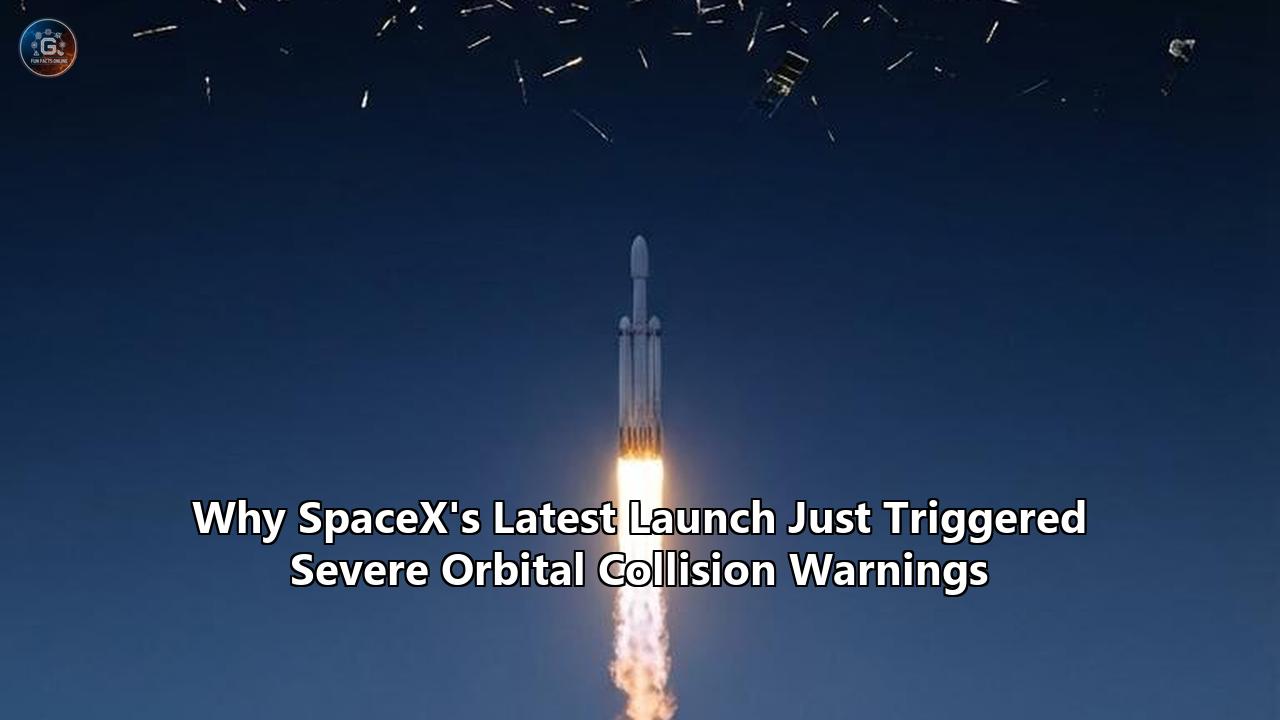
Radar systems immediately cataloged "tens of objects" diverging from the spacecraft’s original trajectory, forming a high-velocity shrapnel cloud traveling at roughly 17,000 miles per hour. SpaceX quickly issued a statement acknowledging an "anomaly on-orbit" and asserted that initial analyses showed the event posed no new risk to the International Space Station (ISS), its crew, or the impending launch of NASA’s Artemis II mission.
However, the reality of orbital mechanics dictates that the destruction of a 1,700-pound spacecraft is never an isolated incident. The fragmentation of Starlink 34343 acts as a catalyst, sending shockwaves through a regulatory and operational framework that is already straining under the weight of human ambition. This event was not a collision with a rogue piece of Russian rocket body or a defunct Soviet weather satellite. The data points firmly to an internal energetic failure—likely a ruptured propulsion tank or a catastrophic battery explosion.
More alarmingly, this is the second time in less than four months that a Starlink satellite has turned itself into a debris field.
As the commercial space industry aggressively populates the orbital commons, the calculus of risk is shifting from theoretical models to imminent, daily threats. An investigative review of satellite telemetry, internal regulatory filings, and radar tracking data reveals a startling picture of low Earth orbit. We are witnessing the weaponization of orbital altitudes, the limits of automated collision avoidance, and a rapidly shrinking margin for error.
The Anatomy of an Orbital Fragmentation
To understand why the destruction of Satellite 34343 triggered immediate and severe warnings across the aerospace sector, one must look closely at the altitude of the event.
On December 17, 2025, a different Starlink satellite—unit 35956—experienced a similar internal anomaly. That spacecraft suffered a propulsion tank venting event that shattered parts of the vehicle, releasing a cluster of trackable fragments. But that event occurred at an altitude of 418 kilometers. At that relatively low height, the Earth’s thermosphere still exerts a tangible, albeit microscopic, drag on objects. The friction of sparse atmospheric molecules acts as a natural custodial mechanism, dragging debris downward until it incinerates harmlessly in the denser atmosphere within a matter of weeks.
Satellite 34343, however, fragmented at 560 kilometers.
"The 560-kilometer altitude of this fragmentation event distinguishes it critically from its predecessor," notes a recent analysis from the orbital tracking community. At 560 kilometers, atmospheric drag is exponentially thinner. A piece of shredded aluminum or a shattered composite strut generated at this altitude will not decay in weeks. It may persist for months, or even years, slicing through some of the most congested orbital real estate in human history.
Jonathan McDowell, an astrophysicist and leading independent monitor of orbital objects, immediately challenged the absolute certainty of SpaceX’s safety declarations regarding the ISS and the Artemis II launch. "I don't see how the risks can be nil," McDowell stated. "They are low because all the debris is expected to reenter quickly. But I'd like to hear more about why they assess the risk as zero".
McDowell’s skepticism is rooted in the physical reality of satellite fragmentation. When an internal component like a high-pressure argon tank or a lithium-ion battery ruptures in the vacuum of space, it does not politely split the spacecraft in two. The release of stored energy violently ejects material in all directions. While LeoLabs' global radar network quickly identified "tens" of trackable objects, current ground-based radar technology generally struggles to track objects smaller than 10 centimeters.
A one-centimeter bolt traveling at orbital velocities possesses the kinetic energy of an anvil dropped from a skyscraper. It is fully capable of penetrating a neighboring satellite's fuel lines, severing critical wiring harnesses, or shattering a solar array—which in turn creates more debris. The fragments we cannot see represent the true, unquantifiable danger of the March 29 anomaly.
By adding an unpredictable cloud of shrapnel to the 560-kilometer shell, the event temporarily raised the probability of conjunction events for all neighboring resident spacecraft by an estimated 10 percent. It forced operators across the globe to adjust their automated evasion algorithms, absorbing the sudden presence of newly cataloged, fast-moving hazards.
The Automated Evasion Engine
The quiet reality of modern spaceflight is that the orbital environment is no longer managed by human air traffic controllers. The sheer volume of traffic has necessitated a transition to algorithmic, autonomous survival.
To grasp the scale of the SpaceX orbital collision risk, one must examine the company's own mandatory disclosures to the Federal Communications Commission (FCC). Between December 2024 and May 2025, SpaceX reported that its Starlink constellation executed a staggering 144,404 collision avoidance maneuvers.
Translate that figure into operational reality: an average of 800 times a day, or roughly once every two minutes, a Starlink satellite fired its thrusters to dodge a lethal intersection with another object.
"It is just incredible," observed Hugh Lewis, a space debris expert at the University of Birmingham. "And that's for a constellation that is one-fifth the size that it's going to be".
SpaceX has engineered perhaps the most sophisticated autonomous collision avoidance system in aerospace history. The system continuously ingests tracking data from the U.S. Space Force’s 18th Space Defense Squadron, calculates the probability of impact for thousands of active satellites, and autonomously executes thruster burns when the risk exceeds a specific threshold. Over the past two years, SpaceX has progressively tightened this safety margin. The company currently commands its satellites to dodge if the probability of collision is greater than 3 in 10 million—a threshold far more conservative than the industry standard of 1 in 10,000.
"There's no business case for it," Lewis noted regarding the extreme 3-in-10-million threshold. "The only thing I can guess is that it's a safety issue, to maintain the safety of their constellation at a particular level".
While this conservative approach ostensibly prevents collisions, it masks a deeply concerning underlying trend: the maneuvers are growing exponentially. In the six-month reporting period prior to the 144,404 figure, Starlink satellites executed 50,666 maneuvers. The traffic density is compounding, forcing the constellation into a state of perpetual, fuel-burning agitation.
Every time a satellite fires its thrusters to avoid a piece of debris, it expends a finite reserve of propellant. When a satellite exhausts its fuel, it can no longer maintain its orbit or avoid future collisions, effectively becoming a piece of high-mass debris itself. SpaceX mitigates this by aggressively deorbiting satellites based on long-term reliability forecasts, preferring to incinerate a perfectly functional satellite early rather than risk it failing and becoming an uncontrollable hazard.
However, the automated system relies on a fundamental assumption: that the objects it needs to dodge have predictable, stable trajectories.
When Satellite 34343 exploded on March 29, it violated that assumption. The sudden creation of an unmapped debris cloud injects chaos into the highly deterministic models used by collision avoidance systems. Algorithms require hours or days of radar tracking to establish accurate orbital parameters for new fragments. During that lag time, the automated systems are flying blind against the new threats, relying purely on the statistical hope that the space between satellites remains vast enough to absorb the shrapnel without incident.
The Kessler Whisperers and the Tipping Point
The anxiety rippling through the aerospace community following the March fragmentation is inextricably linked to a decades-old theoretical concept known as the Kessler Syndrome. Proposed by NASA scientist Donald Kessler in 1978, the syndrome describes a critical density of objects in low Earth orbit where a single collision creates a cascade of debris, which in turn causes further collisions, eventually rendering specific orbital bands entirely impassable.
For years, the Kessler Syndrome was viewed as a distant, worst-case scenario. Today, among orbital dynamicists, the tone has shifted from theoretical caution to active alarm.
An independent report evaluating the space environment in 2025 explicitly asserted that in certain heavily trafficked orbits, "the Kessler syndrome is already underway". The European Space Agency’s highly anticipated April 2026 Space Environment Report validated these fears, documenting that the 500-to-600-kilometer shell is nearing a critical congestion threshold, with debris density driving a sharp jump in collision probabilities.
The math is unforgiving. With over 10,000 active Starlink satellites in orbit, representing the vast majority of all functional spacecraft, SpaceX effectively owns the low Earth orbit environment. The company plans to expand this network to a staggering 42,000 satellites. At that density, the constellation is not just navigating the environment; it is the environment.
This statistical reality amplifies the threat of internal anomalies. The V2 Mini Optimized model, to which Satellite 34343 belonged, represents the bleeding edge of SpaceX’s manufacturing. There are currently more than 3,500 of these specific models in orbit. If the fragmentation was caused by a systemic design flaw—a weakness in a battery casing, a software error managing thermal loads, or a structural defect in the high-pressure propulsion tanks—the implications are staggering.
Two fragmentations in four months within a fleet of 10,000 equates to a failure rate of 0.02 percent. In the automotive industry, a 0.02 percent catastrophic failure rate would trigger a global recall. In the orbital environment, a recall is physically impossible. Operators can push software updates to mitigate thermal risks or lower battery charge limits, but the hardware is inaccessible. If a bad batch of argon tanks is circling the Earth at Mach 22, the only mitigation strategy is to lower their altitude and wait for the atmosphere to drag them down.
In a quiet admission of this escalating vulnerability, SpaceX has fundamentally altered its long-term deployment strategy. Throughout 2026, the company initiated a massive orbital restructuring, beginning the process of lowering approximately 4,400 satellites from their original 550-kilometer shells down to a new operational altitude of 480 kilometers.
This strategic descent is a direct response to the compounding SpaceX orbital collision risk. By moving the bulk of the constellation into a denser layer of the thermosphere, SpaceX ensures that any future dead satellites or unexpected fragmentation debris will experience rapid atmospheric decay, burning up quickly rather than lingering as multi-year threats.
It is a sound engineering decision rooted in planetary defense. But in the ruthless, multi-billion-dollar race to dominate the space-based internet market, this altitude adjustment has ignited a fierce, high-stakes regulatory war.
Weaponizing the Collision Risk
Low Earth orbit is infinite in a vacuum, but the usable, economically viable bands for telecommunications are strictly finite. The restructuring of the Starlink constellation effectively dropped a dense web of 4,400 hyper-kinetic spacecraft directly across the flight paths of its biggest competitor.
Enter Project Kuiper, the multi-billion-dollar satellite internet initiative funded by Amazon.
In early April 2026, the simmering tension between the two corporate monoliths erupted into public view through a series of sharply worded filings submitted to the FCC. The dispute centered not on radio frequencies or market access, but on the literal physical space required to launch and deploy hardware.
SpaceX launched the first regulatory salvo, accusing Amazon of blatantly violating the orbital debris mitigation guidelines attached to its broadband license. According to SpaceX’s filing, an Amazon deployment mission executed by an Ariane 6 rocket in February inserted dozens of Kuiper satellites at altitudes ranging from 460 to 490 kilometers.
SpaceX claimed this insertion altitude forced its own Starlink satellites into a massive, disruptive sequence of emergency collision avoidance maneuvers. The company alleged that Amazon was operating recklessly, failing to provide predicted maneuver plans for the newly deployed hardware, and creating an unmitigable crisis that threatened dozens of operational spacecraft. SpaceX effectively weaponized its own collision avoidance data, using the high volume of automated dodges to paint Amazon as an irresponsible actor actively degrading the safety of the orbital commons.
Amazon’s counter-filing laid bare the strategic reality of the dispute. Amazon vigorously denied violating its deployment license, noting that its authorized procedure always involved dropping satellites into lower parking orbits before using onboard thrusters to raise them to their final operational altitude of roughly 600 kilometers.
The friction, Amazon argued, was entirely manufactured by SpaceX. Amazon pointed out that its deployment altitudes were only causing interference because SpaceX had recently decided to move thousands of its Starlink satellites down to the 475-to-485-kilometer range. By lowering its constellation to mitigate its own debris persistence, SpaceX had effectively built a heavily trafficked, 17,000-mile-per-hour barricade between Amazon’s launch insertion points and their final orbital destinations.
The institutional dynamics at play are unprecedented. The FCC, an agency traditionally tasked with managing terrestrial radio spectrum, finds itself adjudicating a high-stakes real estate dispute in the vacuum of space.
Both companies are leveraging the language of space sustainability to achieve anti-competitive goals. SpaceX’s legitimate concerns regarding the SpaceX orbital collision risk are deeply intertwined with a clear financial incentive to make Amazon’s deployment schedule as chaotic, expensive, and difficult as possible. By crowding the 480-kilometer shell, SpaceX forces Amazon to expend massive amounts of fuel and engineering resources just to safely thread its newly launched satellites through the Starlink gauntlet.
As other global competitors like China’s Geespace and the state-backed Guowang constellation begin injecting their own hardware into these specific orbital bands, the lack of an internationally recognized space traffic management authority becomes a glaring global vulnerability.
If Amazon’s automated avoidance systems and SpaceX’s automated avoidance systems simultaneously detect a potential conjunction between two of their satellites, how do the algorithms interact? Without a unified, open-source protocol for "right of way" in space, there is a severe risk of the "double dodge"—where both satellites maneuver into the exact same escape vector, inadvertently causing the very high-speed collision they were programmed to avoid.
While Geespace has claimed to actively maintain communication with U.S. operators, and SpaceX frequently coordinates with NASA and the Space Force, these are ad-hoc, bilateral arrangements. The global aerospace framework is currently relying on gentleman's agreements to manage a hyper-velocity environment that is growing denser by the hour.
The Blind Spots and Data Deficits
The effectiveness of any collision avoidance regime is strictly bounded by the quality of the data feeding it. As the Starlink 34343 anomaly proved, the space industry’s vision is distinctly limited.
LeoLabs operates one of the most capable commercial radar networks on the planet, utilizing S-band phased array systems positioned globally from Costa Rica to the Azores. Their ability to immediately detect the March 29 fragmentation and characterize it as a "fragment creation event" rather than an external collision is a testament to the sophistication of their technology.
Yet, even LeoLabs analysts are forced to qualify their findings. The initial assessment of "tens of objects" is always followed by the caveat that analysis is ongoing, and smaller fragments may remain undetected.
SpaceX has been highly vocal about the lack of transparency from other operators. In previous filings, the company explicitly called out competitors who license their constellations outside the United States, effectively bypassing the FCC’s stringent public reporting requirements regarding collision avoidance maneuvers. SpaceX argues that it cannot safely navigate its constellation if competing networks refuse to share their automated flight paths and daily telemetry.
This data deficit transforms collision avoidance from a precise mathematical science into an exercise in statistical probability. When a satellite operator knows a localized debris field exists but cannot track the individual shrapnel pieces, they must inflate the physical "bounding box" around their satellites, effectively treating the spacecraft as much larger than it physically is to guarantee safety.
But as the orbits fill with more satellites, expanding these bounding boxes results in continuous overlap. The algorithms begin to perceive threats everywhere. A system trapped in a state of perpetual high alert will rapidly deplete satellite lifespans through constant thruster usage, leading to premature deorbiting, which requires more launches to replenish the constellation, which in turn introduces more hardware and further congestion.
It is a vicious, self-perpetuating cycle constrained only by the physical limits of chemical propulsion and launch cadence.
Investigating the Energetic Source
Returning to the exact mechanism that destroyed Satellite 34343, the consensus points away from a collision and entirely toward an "internal energetic source". This phrasing, used carefully by tracking agencies, covers a multitude of engineering nightmares.
Modern satellites are densely packed machines operating in an environment of extreme thermal gradients. In the sunlight, temperatures soar; in the Earth's shadow, they plunge to cryogenic levels. The V2 Mini Optimized Starlink satellites utilize powerful argon Hall-effect thrusters for propulsion and massive lithium-ion battery banks to store energy collected by their solar arrays.
If a battery cell experiences thermal runaway—a cascading failure where a short circuit generates heat that rapidly ignites adjacent cells—the resulting explosion will violently blast the aluminum chassis apart. Alternatively, the pressurized argon tanks used for the thrusters could suffer a structural failure due to micrometeoroid degradation or a manufacturing defect. The sudden depressurization of the tank acts exactly like a bomb, blowing the satellite into dozens of radar-reflective pieces.
SpaceX has noted previously that its engineering teams rapidly deploy software mitigations when such anomalies occur, increasing protections against systemic failures. They can limit battery charge states or proactively vent fuel lines if a satellite shows signs of distress. But software cannot fix a cracked weld on a pressure vessel.
The immediate reaction to the December 2025 anomaly of Satellite 35956 and the March 2026 destruction of Satellite 34343 highlights a fundamental tension in mega-constellation management. SpaceX insists that its aggressive strategy of deorbiting older satellites prevents the accumulation of dead mass. However, if the active, newly launched satellites are prone to sudden, violent fragmentation within their first year of operation, the proactive deorbiting strategy is insufficient.
A satellite cannot be safely commanded to lower its altitude if its communications array and propulsion systems are vaporized by an internal battery explosion. The resulting shrapnel is entirely at the mercy of natural orbital decay.
The Implications for Human Spaceflight
While robotic satellites can be replaced, the presence of fragile, pressurized human habitats in low Earth orbit fundamentally alters the risk calculus.
The International Space Station operates at an average altitude of roughly 400 to 420 kilometers. The debris from the March 29 fragmentation event originated at 560 kilometers. Over the coming months, atmospheric drag will slowly pull that shrapnel cloud downward. As the debris descends, it must inevitably pass through the 400-kilometer shell occupied by the ISS.
SpaceX’s rapid assurance that the debris poses "no new risk" to the Space Station is technically accurate only in the immediate, short-term timeframe. The fragments will not instantly intersect the station's path. But as the debris loses altitude, it spreads out, forming an expanding shell of untrackable hazards. The ISS frequently conducts its own collision avoidance maneuvers, firing thrusters to dodge known debris. But it cannot dodge what radar cannot see.
Furthermore, the timing of the Satellite 34343 fragmentation coincided unnervingly with the preparations for NASA’s Artemis II mission. Scheduled to launch around April 1, 2026, Artemis II represents the first crewed lunar mission in over half a century.
The Orion spacecraft carrying the Artemis crew must transit entirely through low Earth orbit, punching through the densely populated Starlink shells to reach a trans-lunar injection trajectory. Launch windows for missions like Artemis are calculated down to the second, heavily relying on predicted orbital traffic.
When a satellite explodes two days before a launch, generating unmapped debris, it injects severe uncertainty into the launch parameters. While SpaceX and NASA maintain a tight operational relationship, independent analysts remain deeply critical of the speed at which the "zero risk" assessments are generated following these anomalies.
The aerospace community is being forced to accept a new paradigm where the baseline level of lethal risk for human spaceflight is noticeably higher today than it was a decade ago, simply due to the sheer volume of aluminum, argon, and lithium currently circling the planet.
Looking Ahead: The Escalation of the Orbit
The investigation into the dual fragmentations of Starlink 35956 and 34343 yields a complex, multi-layered reality. The data clearly demonstrates that the SpaceX orbital collision risk is not an abstract future threat; it is an active, daily crisis managed through brute-force computation and staggering volumes of automated thruster firings.
As 2026 progresses, several critical milestones will dictate the long-term viability of low Earth orbit.
First, the industry must closely monitor the failure rate of the V2 Mini Optimized Starlink satellites. If a third spontaneous fragmentation occurs within the year, the statistical anomaly becomes a systemic hardware crisis. Such an event would likely force the FCC or the Federal Aviation Administration to formally intervene, potentially halting further Starlink deployments until the root cause of the internal energetic events is conclusively identified and engineered out of the production line.
Second, the regulatory battle between Amazon’s Project Kuiper and SpaceX will set a precedent for how orbital altitude is governed. If the FCC allows SpaceX to aggressively lower its constellation into the 480-kilometer shell, effectively barricading the deployment altitudes used by competitors, it will establish a "first-mover takes all" doctrine in space. This would heavily incentivize other international actors to rapidly launch hardware to claim and physically occupy specific altitudes before Western corporations can dominate them, drastically accelerating the launch cadence and the resulting congestion.
Third, the impending operational maturity of SpaceX’s fully reusable Starship vehicle threatens to alter the scale of deployment entirely. Currently, Falcon 9 rockets launch a few dozen Starlink satellites at a time. Starship is designed to deploy hundreds in a single mission. If the current regulatory and automated avoidance systems are struggling under the weight of 10,000 active satellites executing 144,404 dodges in six months, the introduction of a vehicle capable of doubling the constellation size in a matter of months could collapse the existing safety architecture.
The destruction of Satellite 34343 was a localized energetic event, a fleeting flash of light and shattered metal high above the Azores. But its implications cascade downward through the entire space economy. It exposed the limitations of ground radar, highlighted the immense strain on automated evasion algorithms, and revealed how collision risks are being utilized as weapons in corporate regulatory warfare.
The sky is vast, but the specific highways we rely on to navigate it are narrowing with every launch. As tracking arrays continue to sweep the darkness for microscopic fragments of shattered satellites, the aerospace community faces a stark, unresolved question: Will the global framework adapt to the realities of a hyper-congested orbit, or will physics simply force the issue through an uncontainable cascade of metal? The radar screens are constantly updating, the thrusters are continually firing, and the margin for error has effectively vanished.
Reference:
- https://satnews.com/2026/03/30/spacex-loses-contact-with-starlink-satellite/
- https://finance.biggo.com/news/202604010223_Starlink-satellite-breaks-apart-in-orbit-anomaly
- https://fodnews.com/starlink-satellite-debris-cloud-560km/
- https://timesofindia.indiatimes.com/technology/tech-news/as-starlink-satellite-disappeared-at-560-km-above-earth-tech-company-leolabs-tells-elon-musks-company-time-to-give-more-clarity-to-these-/articleshow/130198996.cms
- https://earthsky.org/space/starlink-satellite-breaks-up-debris-artemis-risk/
- https://rntfnd.org/2025/10/19/have-we-reached-a-space-junk-tipping-point-ieee-spectrum/
- https://www.advanced-television.com/2025/07/30/starlink-explains-real-risks-of-orbital-collision/
- https://aerospaceamerica.aiaa.org/features/heavy-traffic-ahead/
- https://gizmodo.com/a-starlink-satellite-is-tumbling-toward-earth-after-a-strange-anomaly-in-orbit-2000701874
- https://spacedaily.com/sd-n-the-orbital-turf-war-how-spacex-and-amazon-are-turning-collision-avoidance-into-a-regulatory-weapon/