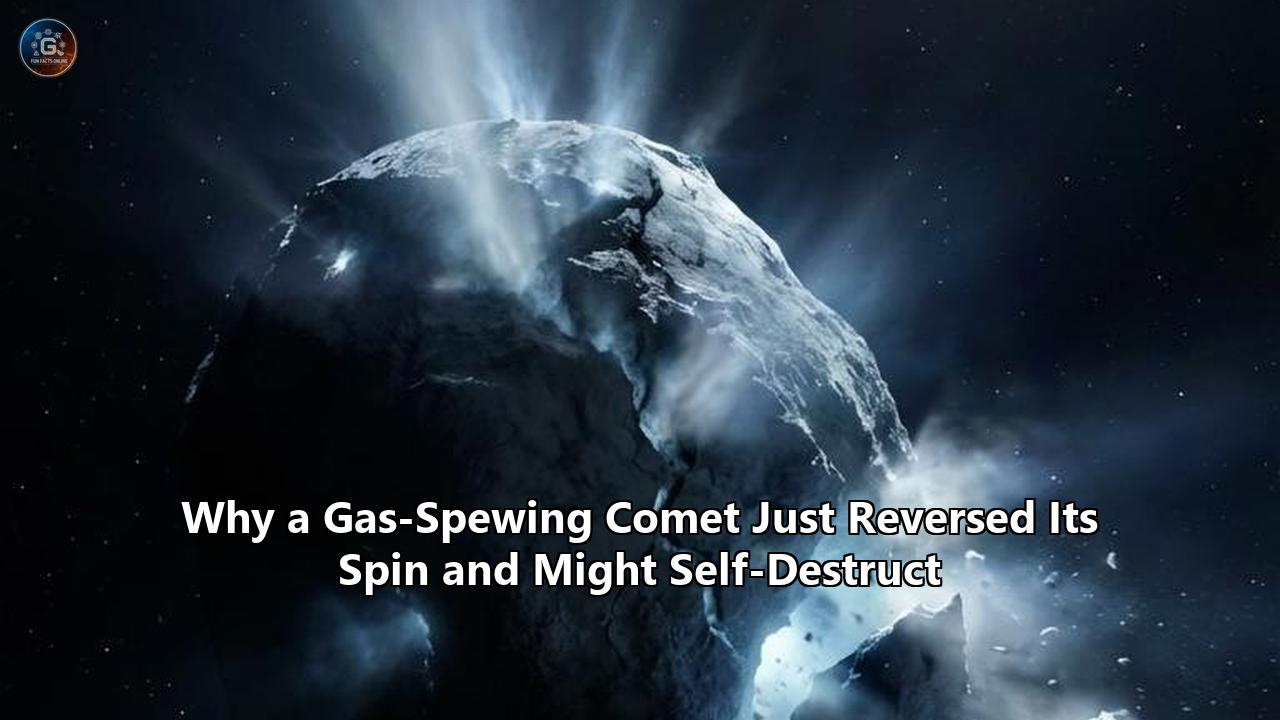
Between March and December of 2017, the Jupiter-family comet 41P/Tuttle-Giacobini-Kresák executed a maneuver never before recorded in the history of observational astronomy. Approaching the sun at a blistering velocity, the 1-kilometer-wide mass of ice and dust decelerated its rotational spin from a steady 20-hour cycle, came to a near-complete halt, and then violently twisted in the opposite direction. By the time it emerged from the sun’s glare, it was spinning backward with a period of just 14 hours.
This unprecedented cosmic event, detailed in a newly published late-March 2026 study in The Astronomical Journal by University of California, Los Angeles astronomer David Jewitt, provides definitive evidence of a phenomenon long hypothesized but never directly tracked to this extreme: a complete comet spin reversal. Driven by highly pressurized, localized outgassing jets acting as asymmetric thrusters, the rotational torque exerted on 41P was so severe that researchers now project the comet is on a rapid trajectory toward total structural failure.
The physical lifetime required for this small nucleus to spin up to a lethal threshold is remarkably short compared to its 1,500-year tenure in its current orbit. If the outgassing torques continue to amplify the comet's rotational momentum at the current measured rate, the centrifugal forces generated by its rapid spin will inevitably overcome its fragile internal gravity. The icy body will tear itself apart.
The Quantitative Evidence: Tracking a Rotational Collapse
The empirical timeline of 41P’s rotational collapse relies on a highly synchronized sequence of observations from three distinct telescope platforms. The dataset reveals an acceleration profile that defies the traditional models of gradual cometary evolution, proving that these volatile bodies can undergo radical structural shifts within a matter of months.
In March 2017, as 41P approached its perihelion—the closest point to the sun in its 5.4-year orbit—researchers utilizing the 4.3-meter Lowell Discovery Telescope in Arizona measured the comet’s baseline rotation. Through precise tracking of its lightcurve, they established that the nucleus was completing one full rotation every 20 hours.
By May 2017, data retrieved from NASA’s Neil Gehrels Swift Observatory indicated a catastrophic drop in angular momentum. The rotation period had elongated to between 46 and 60 hours. This represented an average deceleration of 0.53 hours per day over a 60-day window. Prior to this, the most extreme cometary spin-down ever recorded belonged to comet 103P/Hartley 2, which saw its rotation slow from 17 to 19 hours over a 90-day period. Comet 41P decelerated more than ten times as much in two-thirds the time.
The most jarring data point emerged from archival Hubble Space Telescope imaging captured in December 2017, after the comet had passed behind the sun and reappeared. Photometric variations across the Hubble data yielded a two-peaked, rotationally symmetric lightcurve with a 0.4-magnitude amplitude. This specific lightcurve signature translates to a rotation period of 0.60 ± 0.01 days, or roughly 14 hours. The only physical mechanism capable of bridging the 60-hour near-halt in May to the 14-hour high-speed rotation in December is a complete comet spin reversal. The rotational velocity crossed zero, flipped its orientation, and accelerated dramatically in a retrograde sequence.
The Mechanics of Outgassing Torque
To understand how a 500-meter-radius celestial body can reverse its spin, the physics of sublimation and angular momentum must be quantified. Comets are not solid spheres of uniform rock; they are highly porous, low-density amalgamations of dust, rock, and volatile ices (predominantly water, carbon dioxide, and carbon monoxide).
When 41P crossed the frost line and approached the sun, extreme solar heating triggered the sublimation of sub-surface ices. Because a comet's surface is irregular and heavily cratered, this gas does not vent uniformly. Instead, it erupts through localized fissures, creating highly directional jets of material shooting out into the vacuum of space. According to Newton’s third law of motion, the ejection of this mass produces a proportional recoil force on the comet's nucleus.
In the case of 41P, these jets behaved like misaligned thrusters on a spacecraft. Jewitt’s 2026 analysis calculates the dimensionless moment arm of 41P—a metric of how effectively outgassing exerts torque on the body—at $k_T = 0.013$. This value is roughly twice the median for short-period comets. The excessive torque is a direct function of the comet's diminutive mass. With an estimated diameter of just 1 kilometer, 41P possesses an incredibly low moment of inertia.
- Baseline Mass: Assuming a standard cometary bulk density of $500 \text{ kg/m}^3$, a 1-kilometer spherical nucleus contains roughly $2.6 \times 10^{11} \text{ kg}$ of mass.
- Mass Loss Rate: During its 2017 perihelion, 41P exhibited a mass loss rate of approximately $90 \text{ kg/s}$.
- Thermal Velocity: The ejected gas and dust achieved a thermal escape velocity of $500 \text{ meters per second}$.
When $90 \text{ kg}$ of material is ejected every second at $500 \text{ m/s}$ from a highly localized vector on a body with such a small radius, the resulting recoil force exerts a massive rotational influence. The jets aggressively pushed against the comet's original prograde rotation. Over the span of eight weeks, the persistent asymmetric thrust successfully canceled out the comet's angular momentum, stalling it at roughly 60 hours per rotation. Because the solar heating persisted, the jets continued firing, pushing the comet past the zero-point and spinning it up to 14 hours in the opposite direction.
Structural Vulnerability and the Rotational Fission Limit
The discovery of this comet spin reversal directly intersects with the physical limits of cometary structural integrity. Comets are essentially "rubble piles"—loose aggregates of material held together by micro-gravity and weak van der Waals forces, rather than solid monolithic tensile strength.
Models of Jupiter-family comets indicate they possess a tensile strength of no more than 10 to 25 Pascals. This makes them exceedingly vulnerable to centrifugal forces. If a comet spins too rapidly, the outward centrifugal acceleration at its equator will exceed the inward pull of its own gravity. When this threshold—known as the rotational fission limit—is breached, the comet undergoes catastrophic fragmentation.
For a body with the density of 41P ($500 \text{ kg/m}^3$), the critical fragmentation limit sits at a rotation period of approximately 5 hours. At its current 14-hour retrograde spin, 41P is well within the safety margin. However, outgassing torque is a runaway process. As the comet rotates faster, the centrifugal forces begin to deform its shape, stretching it outward. This elongation alters the moment of inertia, exposing new fissures and fresh ice to solar radiation, which in turn fuels more volatile outgassing jets.
The mathematical trajectory is unforgiving. If 41P experiences a similar degree of rotational acceleration during its upcoming perihelion passes, its spin period could easily drop below the 5-hour critical limit. At that precise juncture, the equatorial material will reach escape velocity. The nucleus will shed mass in a cascading landslide of ice and dust, eventually splitting into multiple fragments that will rapidly disintegrate in the solar wind. "I expect this nucleus will very quickly self-destruct," Jewitt stated upon reviewing the torque parameters.
A History of Anomalous Activity and Mass Depletion
The intense rotational dynamics of 41P are heavily contextualized by its long-term observational history. Discovered in 1858 by Horace Parnell Tuttle, and independently rediscovered by Michel Giacobini in 1907 and L'ubor Kresák in 1951, the comet is a known volatile actor in the inner solar system.
Orbital mechanics models trace its current 5.4-year trajectory back to a severe gravitational perturbation by Jupiter roughly 1,500 years ago. Since being locked into this tighter orbit, 41P has been subjected to intense, cyclic solar radiation, gradually stripping away its outer layers.
The comet is famous for producing massive, unpredictable outbursts of material. In 1973, it suddenly brightened by 9 magnitudes—a ten-thousand-fold increase in luminosity—indicating a massive rupture in its crust and a sudden venting of sub-surface pressure. Similar, though less extreme, outbursts were recorded during its 2001 and 2006 apparitions.
However, the 2026 data analysis reveals a stark secondary narrative: 41P is running out of fuel. The calculated "active fraction" of the comet's nucleus—the percentage of its surface area actively sublimating ice into gas—dropped from a highly elevated 2.4 in 2001 to a mere 0.14 during the 2017 reversal event. This 17-fold decrease in activity suggests that the comet's near-surface volatile ices are severely depleted, or that the remaining ice has been insulated under thick layers of inactive dust.
This creates a paradox that astronomers are currently trying to reconcile. If 41P's outgassing torques are powerful enough to execute a comet spin reversal in a single season, the comet's rotation should have breached the 5-hour fission limit centuries ago. The physical lifetime required to spin up a nucleus of this size is vastly shorter than the 1,500 years it has spent in its current orbit.
Two primary hypotheses have emerged from the latest data to explain this survival:
- The Observation Anomaly: The 2017 outgassing event captured by Hubble was an anomalous spike in activity, causing astronomers to overestimate the average mass-loss rate and the average outgassing torque over the comet's lifetime.
- The Remnant Parent Body Theory: 41P is merely the surviving core of a once-massive comet. When it originally entered its current orbit, its radius was significantly larger, providing a high moment of inertia that effectively resisted outgassing torques. Over the centuries, solar ablation stripped the mass away. Only recently has the comet become small enough—shrinking to its current 1-kilometer diameter—to become susceptible to rapid spin reversals and rotational instability.
The Observational Triangulation: Translating Light into Spin
The confirmation of the spin flip required precise photometric techniques, specifically the translation of lightcurves into rotational geometry. Because a 1-kilometer nucleus cannot be resolved as a physical sphere by terrestrial or orbital telescopes at distances of tens of millions of miles, astronomers measure the periodic brightening and dimming of the reflected light.
As an asymmetric, potato-shaped comet rotates, the amount of surface area reflecting sunlight toward Earth changes. When the broad side of the nucleus faces Earth, the lightcurve peaks; when the narrow end faces Earth, the lightcurve dips.
During the December 2017 Hubble observations, the comet's coma (the cloud of gas surrounding the nucleus) was subtracted using digital aperture techniques, isolating the solid body. The isolated nucleus exhibited a strict 0.4-magnitude variation. By mathematically mapping this variation, astronomers determined that the comet possesses a projected axis ratio of at least 1.4 to 1. This means the comet is 40% longer than it is wide—a highly prolate ellipsoid.
The symmetry of the lightcurve—displaying two distinct peaks and two distinct troughs per rotation—confirmed the 14-hour period. But the true confirmation of the comet spin reversal required cross-referencing this geometry with the non-gravitational acceleration data. By tracking exactly how far 41P deviated from a pure gravitational orbit due to the thrust of its jets, researchers could mathematically verify the exact vectors of the outgassing. The combination of the 0.53 hour/day deceleration in May and the 14-hour terminal velocity in December locked the reversal model into place.
Comparative Cometary Death: The Fate of Small Icy Bodies
The structural vulnerability exhibited by 41P is not an isolated phenomenon; it represents a documented terminal phase in the lifecycle of small comets. The solar system is currently providing real-time case studies of cometary disintegration driven by thermal and rotational stress. The first half of 2026 has been particularly rich in observational data regarding cometary death.
In late 2025, the Hubble Space Telescope caught the disintegration of Comet C/2025 K1 (ATLAS). Originally estimated at five miles across, K1 fragmented into a debris field just days after its perihelion passage. High-resolution imagery from February 2026 revealed that K1's breakup was sequential—a classic signature of rotational fission where the primary body sheds smaller fragments that subsequently disintegrate.
Even more recently, in April 2026, the highly anticipated "sungrazer" comet C/2026 A1 (MAPS) was obliterated during a close solar flyby. Traveling at over 1 million mph, the 0.25-mile-wide comet succumbed to extreme thermal and gravitational shearing. Time-lapse telemetry from the Solar and Heliospheric Observatory (SOHO) recorded the comet approaching the sun and emerging on the other side as a "headless wonder"—a ghostly plume of gas and dust with no solid nucleus remaining.
A historical precedent closely mirroring 41P’s predicted fate is Comet 157P/Tritton. Observations of 157P between 2022 and 2024 showed continuous fragmentation events directly correlated with outgassing outbursts. The comet spun up to the point of rotational instability, shedding 20-meter fragments into space at separation velocities of roughly 1 meter per second—exactly mirroring the escape velocity of a standard cometary body.
These comparative examples establish a measurable baseline for 41P’s future. Sub-kilometer comets with high outgassing torque modifiers rarely survive extended tenures in the inner solar system. The rapid increase in rotation triggers a feedback loop: increased spin causes mass shedding, which reduces the total mass, which further lowers the moment of inertia, making the remaining body even more susceptible to outgassing torques.
Measuring the Torque: The $k_T$ Parameter and Future Projections
To accurately project the remaining lifespan of 41P, astronomers rely on the dimensionless moment arm coefficient, $k_T$. This variable represents the asymmetry of the outgassing thrust relative to the center of mass. A perfectly spherical comet with uniformly distributed ice would have a $k_T$ of 0, meaning the gas escapes perfectly radially, resulting in zero rotational torque.
The median $k_T$ for observed short-period comets is approximately 0.006. Comet 41P’s measured $k_T$ is 0.013. This extreme asymmetry suggests that the active vents on 41P are heavily concentrated on one hemisphere or positioned at extreme angles relative to its center of mass.
If this $k_T$ value remains constant, the rotational momentum injected into the comet during its next solar encounter can be precisely calculated. 41P orbits the sun every 5.4 years. Following its 2017 reversal, it passed perihelion again in 2022, though unfavorable observation angles prevented the kind of high-resolution photometric tracking achieved by Hubble five years prior.
The critical milestone will be the comet's next perihelion in 2028. At that point, terrestrial and orbital observatories will deploy a synchronized tracking grid to measure the new rotation period.
- Scenario A (Stagnation): The 17-fold drop in the active fraction observed in 2017 indicates the comet has exhausted its volatile ices. The outgassing ceases entirely. The comet becomes a dormant, rocky asteroid-like body, maintaining its 14-hour retrograde spin indefinitely.
- Scenario B (Continued Acceleration): Deep sub-surface pockets of ice are exposed as solar radiation penetrates the crust. The $k_T = 0.013$ torque modifier holds true. The retrograde spin accelerates from 14 hours down to the 5-hour rotational fission limit.
- Scenario C (Secondary Reversal): The ablation of the surface alters the topography so radically that the prevailing jets shut down, and new vents open on the opposite side, triggering a secondary comet spin reversal.
Given the structural mechanics of rubble-pile comets, Scenario B remains the most statistically probable outcome if outgassing persists. The centrifugal forces ($F = m\omega^2\rho$) will scale exponentially as the angular velocity ($\omega$) increases. Once the equatorial centripetal acceleration exceeds the gravitational binding energy, the 1.4-to-1 prolate nucleus will snap along its weakest fault line.
The Broader Implications for Solar System Evolution
The definitive recording of 41P’s torque-driven reversal forces a recalculation of cometary population models. For decades, astronomers have noted a statistical deficit of sub-kilometer comets in the inner solar system. The models predict a certain influx of small bodies from the Kuiper Belt, yet observational surveys consistently yield lower numbers.
The mechanics observed in 41P provide a highly quantifiable solution to this missing population. If small comets are uniquely susceptible to outgassing torques—experiencing massive spin-ups and reversals that quickly push them past the fragmentation limit—they are systematically destroying themselves shortly after entering Jupiter-family orbits. The outgassing acts as an invisible filtration mechanism, grinding down sub-kilometer bodies into diffuse dust streams long before they can be cataloged by terrestrial surveys.
The Hubble data from 2017, synthesized and published in the spring of 2026, transitions the concept of rotational fission from a theoretical model into a directly observed, mathematically verified process. Comet 41P/Tuttle-Giacobini-Kresák is currently functioning as a live physics laboratory, suspended millions of miles away.
As the astronomical community prepares for the 2028 perihelion, the tracking metrics are already established. The 14-hour rotation, the 1.4-to-1 axis ratio, and the $0.013$ torque coefficient provide a rigid mathematical framework. The next dataset will reveal whether the volatile icy body has stabilized its erratic spin, or if the centrifugal forces are actively tearing the remaining 1-kilometer nucleus into a terminal debris field.
Reference:
- https://avi-loeb.medium.com/is-the-observed-spin-reversal-of-the-comet-41p-tuttle-giacobini-kres%C3%A1k-a-technological-signature-adab2dc8c096
- https://faculty.epss.ucla.edu/~jewitt/papers/2026/J26.pdf
- https://www.discovermagazine.com/hubble-captured-comet-41p-reversing-its-spin-after-passing-by-the-sun-getting-twisted-in-the-opposite-direction-48885
- https://science.nasa.gov/missions/hubble/nasas-hubble-detects-first-ever-spin-reversal-of-tiny-comet/
- https://arxiv.org/html/2501.02645v1
- https://science.nasa.gov/missions/hubble/nasas-hubble-detects-first-ever-spin-reversal-of-tiny-comet/
- https://arxiv.org/abs/1707.02133
- https://www.livescience.com/space/comets/farting-comet-seen-reversing-its-spin-for-the-first-time-ever-and-it-may-soon-self-destruct
- https://www.gadgets360.com/science/news/nasa-spots-comet-that-reversed-its-spin-for-the-first-time-11273791
- https://www.researchgate.net/publication/400583569_Reversal_of_Spin_Comet_41PTuttle-Giacobini-Kresak
- https://avi-loeb.medium.com/is-the-observed-spin-reversal-of-the-comet-41p-tuttle-giacobini-kres%C3%A1k-a-technological-signature-adab2dc8c096
- https://arxiv.org/pdf/1801.03870
- https://thedebrief.org/we-knew-this-was-something-really-really-special-nasas-hubble-space-telescope-captures-a-comets-destruction/
- https://www.livescience.com/space/comets/rip-comet-maps-watch-the-superbright-sungrazer-become-a-headless-wonder-after-being-ripped-apart-by-the-sun
- https://gizmodo.com/this-tiny-comet-pulled-off-a-first-of-its-kind-spin-flip-2000721172
- https://gizmodo.com/this-tiny-comet-pulled-off-a-first-of-its-kind-spin-flip-2000721172