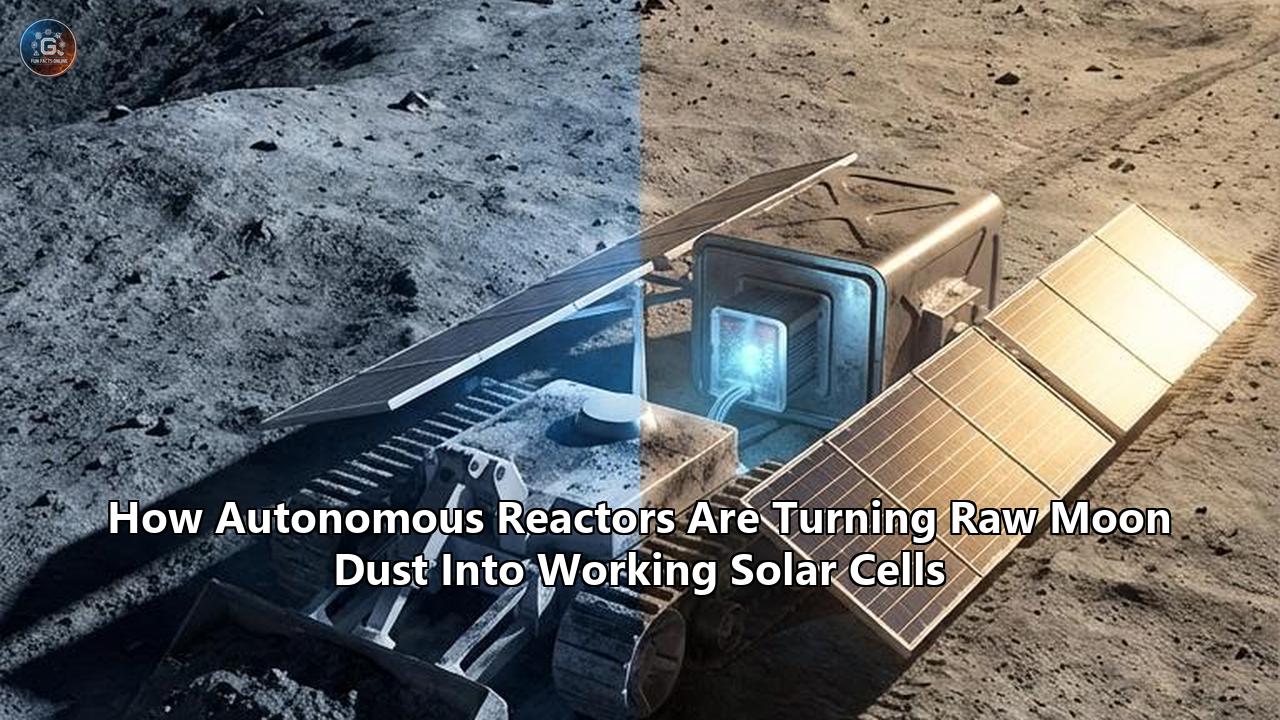
Right now, inside a high-security laboratory in Washington state, a reactor no larger than a standard shipping container is being prepared to eat dirt and spit out electricity.
In late 2025, Blue Origin’s space resources division quietly passed the Critical Design Review (CDR) for "Blue Alchemist," an end-to-end manufacturing system designed to ingest raw lunar soil and produce fully functional solar panels. Now, in 2026, the project has entered its most unforgiving phase: a full-scale autonomous demonstration inside a thermal vacuum chamber that perfectly mimics the dead, irradiated, freezing environment of the Moon.
Simultaneously, a separate breakthrough out of the University of Potsdam in Germany, published in the journal Device, successfully demonstrated how scientists can melt simulated lunar dirt into "moonglass". By pairing this glass with highly efficient photovoltaic crystals, researchers have proven that moon dust solar cells are not just a theoretical concept—they are a verifiable reality.
The timing is critical. In January 2026, NASA and the U.S. Department of Energy signed a memorandum of understanding to deploy a fission surface power system on the Moon by 2030, directly supporting the Artemis program’s goal of permanent human settlement. But while nuclear reactors will keep the lights on during the brutal 14-day lunar night, building a sprawling, continent-wide industrial base requires infinite, scalable power. We cannot launch a new nuclear reactor every time the lunar base needs to expand.
To build a permanent presence off-world, we must sever the supply chain tying us to Earth. We have to build our infrastructure out of the very ground we land on. The transition from theoretical chemistry to autonomous manufacturing reactors marks the exact moment space exploration shifts from a logistics challenge to an industrial one.
Here is the complex science, harsh economics, and metallurgical engineering behind how autonomous reactors are turning pulverized lunar rock into grid-scale electricity.
The Tyranny of the Rocket Equation
To understand why engineers are spending tens of millions of dollars trying to print solar panels out of moon dust, you have to look at the physics of getting anything off the Earth.
The rocket equation is notoriously unforgiving. Every kilogram of cargo you want to land on the lunar surface requires exponentially more fuel to lift it out of Earth’s gravity well, push it across the cislunar void, and execute a controlled, propulsive landing. Even with the advent of reusable super-heavy launch vehicles, delivering raw mass to the Moon remains staggeringly expensive.
Currently, the solar arrays used on spacecraft and the International Space Station are metallurgical marvels. They routinely achieve energy conversion efficiencies of 30% to 40%. However, they are fragile, heavy, and shielded by thick, Earth-manufactured cover glass to protect against radiation and micrometeorite impacts.
If NASA, the European Space Agency (ESA), or private companies want to build habitats, run fleets of pressurized rovers, and operate ice-mining plants at the lunar South Pole, they will need megawatts of power. A one-megawatt solar farm on Earth can weigh upwards of 50 metric tons, including the heavy glass, silicon, and aluminum racking. Launching 50,000 kilograms of delicate solar arrays to the Moon would require a fleet of heavy-lift rockets and billions of dollars in freight costs alone.
Felix Lang, lead researcher on the University of Potsdam study, summarized the problem bluntly: lifting these heavy, glass-covered cells into space at the scale required for a lunar city is mathematically and economically impossible.
The alternative is In-Situ Resource Utilization (ISRU)—living off the land. If you launch a 1,000-kilogram autonomous reactor instead of 1,000 kilograms of solar panels, that reactor can spend the next decade manufacturing 500,000 kilograms of solar arrays. It is the ultimate return on investment. You are no longer launching infrastructure; you are launching the seeds of infrastructure.
The Chemistry of the Regolith
The raw material feeding these autonomous reactors is lunar regolith. To call it "dirt" is a vast understatement. Lunar regolith is a hyper-abrasive, jagged, statically charged powder born from billions of years of micrometeorite impacts pulverizing volcanic rock in a total vacuum. Because there is no wind or water on the Moon to erode and smooth the edges, each grain of dust is like a microscopic shard of glass. During the Apollo missions, it shredded spacesuit joints, scratched visors, and caused respiratory irritation when tracked back into the lunar module.
Yet, to a metallurgical engineer, this abrasive powder is a buffet of refined industrial materials waiting to be separated.
While the exact composition varies between the lunar highlands and the maria (the dark, basaltic plains), regolith is essentially a collection of metal oxides. By weight, it is composed of roughly 40% to 45% oxygen, 20% silicon, 10% aluminum, and varying amounts of iron, magnesium, and calcium.
The ingredients for a complete electrical grid are sitting directly on the surface. Silicon is the semiconducting heart of the solar cell. Aluminum provides the structural framing and the electrical wiring to transmit the current. The oxygen bound up in the rocks can be captured for life support or liquefied for rocket propellant. The challenge is not finding the materials; the challenge is violently ripping them apart.
The Mechanics of Molten Regolith Electrolysis
On Earth, extracting and purifying these elements requires massive industrial supply chains, immense amounts of fresh water, and highly toxic chemicals. To separate aluminum from its ore, Earth-based foundries use the Hall-Héroult process, which relies on consumable carbon anodes that burn away and release massive quantities of carbon dioxide into the atmosphere. To purify silicon for solar panels, the terrestrial industry uses the Siemens process, which requires extreme heat, hydrochloric acid, and volatile trichlorosilane gas.
None of these elements—water, carbon, or complex acids—exist in usable quantities on the lunar surface. The Moon demands a closed-loop, dry, zero-emission process.
Enter Molten Regolith Electrolysis (MRE), the technological heart of the Blue Alchemist system.
The process begins when autonomous rovers scoop raw regolith and dump it into the reactor's hopper. The reactor heats the rock to temperatures exceeding 1,600 degrees Celsius (nearly 3,000 degrees Fahrenheit), melting the abrasive dust into glowing, liquid magma.
Once the regolith is completely liquefied, an electrical current is passed through the melt. This is where the chemistry breaks down. The application of high-voltage electricity forces the strong ionic bonds holding the metal oxides together to snap. Negatively charged oxygen ions migrate toward the anode, where they form pure oxygen gas and bubble up to the surface. Positively charged metal ions—iron, silicon, and aluminum—migrate toward the cathode, where they pool as liquid metal alloys.
Because the Earth-standard carbon anodes would burn up instantly in a 1,600-degree bath of bubbling oxygen, Blue Origin had to invent entirely new, non-consumable inert anodes capable of surviving the most corrosive environment imaginable. This metallurgical breakthrough allows the reactor to run continuously without requiring replacement parts from Earth.
Purifying Silicon in a Vacuum
Extracting raw silicon from the magma is only the first step. For a solar cell to function, the silicon cannot just be pure; it must be "solar grade." If the silicon crystal grid contains impurities—stray iron or aluminum atoms—the electrons excited by sunlight will become trapped, and the cell will not generate electricity. Solar-grade silicon requires a purity of 99.999%.
Achieving "five-nines" purity without Earth's chemical baths requires exploiting the physics of the lunar environment. Because the Moon exists in a hard vacuum, certain impurities will boil off and outgas at specific temperatures. Furthermore, because different metals reduce at different electrical voltages within the molten bath, the MRE reactor can sequentially extract them. Iron separates out first, followed by silicon, and finally aluminum.
Once the silicon is isolated, it undergoes a process called directional solidification. In a controlled vacuum chamber, the molten silicon is slowly cooled from the bottom up. Because impurities have a different solubility in solid silicon than in liquid silicon, the advancing wave of crystallization pushes the microscopic impurities upward into the remaining liquid. Once the entire block has cooled, the top layer—containing the concentrated impurities—is physically sheared off, leaving behind a hyper-pure silicon ingot ready to be sliced, doped, and manufactured into a photovoltaic cell.
Blue Origin's reactor accomplishes this entire sequence autonomously. It extracts the metal, purifies the silicon, prints the cell, and extrudes the aluminum wiring required to daisy-chain the cells together into a functioning array.
The Moonglass and Perovskite Alternative
While the pure silicon route pursued by the Blue Alchemist project is highly effective, it requires vast amounts of thermal energy to melt and crystallize the silicon. Other researchers are hunting for methods that bypass silicon entirely, focusing on advanced materials that require less heat and energy to manufacture.
In April 2025, the University of Potsdam study introduced a radical alternative: bypassing traditional silicon wafers and using perovskites paired with locally manufactured "moonglass".
Perovskites are a class of synthetic crystals that have taken the terrestrial solar industry by storm. They possess a unique crystallographic structure that is incredibly efficient at converting photons into electrons. More importantly, unlike silicon—which must be grown in large, rigid ingots and sliced with diamond wire—perovskites can be dissolved in a solution and painted or printed onto a surface as an ultra-thin film at relatively low temperatures.
However, perovskites have a fatal flaw on Earth: they degrade quickly when exposed to moisture and oxygen. Ironically, the Moon possesses neither. The lunar vacuum is arguably the perfect environment for perovskite solar cells, provided they are protected from the intense radiation of the solar wind.
The Potsdam researchers demonstrated that by taking a lunar regolith simulant and melting it at high temperatures, they could cast a highly durable, transparent glass substrate. They then deposited the active perovskite layer directly onto this "moonglass." The resulting moon dust solar cells are exceptionally lightweight and boast a high tolerance to the high-energy protons and cosmic rays that steadily degrade traditional space-grade solar panels.
By shifting to this hybrid manufacturing model, the researchers calculated that a future lunar mission could cut the launch mass of its power systems by an astonishing 99.4%, eliminating 99% of the associated transport costs.
The Oxygen Byproduct: Breathing and Flying on Lunar Air
Turning moon dirt into power grids solves the electricity problem, but the true brilliance of Molten Regolith Electrolysis lies in what it leaves behind.
When the MRE reactor strips the metals out of the regolith to make solar cells, the "waste" product is pure elemental oxygen gas. By weight, lunar regolith is nearly half oxygen. For every kilogram of silicon or aluminum the reactor yields, it releases a massive volume of breathable air.
This completely alters the economics of cislunar logistics. Currently, every ounce of oxygen astronauts breathe on the International Space Station must be continuously recycled or hauled up from Earth. But breathing is only a fraction of the demand. The vast majority of a rocket’s mass is not payload; it is propellant. Specifically, modern launch vehicles rely heavily on Liquid Oxygen (LOX) to combust their fuel.
If a lunar lander departs Earth, lands on the Moon, and must return to orbital rendezvous, it currently has to carry its return fuel with it. This creates a cascading weight penalty: you need fuel to land the fuel you need to take off.
By capturing, compressing, and liquefying the oxygen bubbling out of the Blue Alchemist reactor, the lunar surface suddenly becomes a refueling depot. Blue Origin estimates that refueling landers and fuel cell batteries with regolith-derived oxygen will make lunar landings up to 60% cheaper. The system designed to power the colony also provides its life support and its transportation fuel, entirely organically.
Solar vs. Nuclear: The Dual-Track Power Strategy
As autonomous solar reactors inch closer to deployment, they do not exist in a vacuum. They are part of a highly calculated, dual-track power strategy spearheaded by NASA.
On January 13, 2026, NASA and the Department of Energy formally solidified plans to deploy a fully functional fission surface power system on the Moon by 2030. This initiative directly supports the December 2025 executive order mandating American technological leadership in space infrastructure. The goal is a compact nuclear reactor capable of producing at least 100 kilowatts of continuous electrical energy.
This raises an obvious question: if autonomous reactors can print infinite acres of solar panels out of dirt, why invest billions in sending a nuclear reactor to the Moon?
The answer lies in orbital mechanics. Unlike the Earth, which rotates every 24 hours, the Moon takes about 28 Earth days to complete one rotation. This means that any base located near the lunar equator will experience 14 continuous days of blinding sunlight, followed by 14 continuous days of absolute, freezing darkness. Even at the lunar South Pole—the target for the Artemis missions due to the presence of water ice—local topography creates extended periods of deep shadow.
Current battery technology is nowhere near energy-dense enough to store 14 days of life-support power for an entire lunar habitat. If the solar arrays go dark for two weeks, the habitat freezes, and the astronauts perish.
Nuclear fission provides the baseline survival power. A 100-kilowatt reactor operates independently of the sun, radiating constant heat and electricity to keep the life-support systems, communications relays, and core habitat functions alive through the long lunar night.
However, 100 kilowatts is only enough to keep a small base alive. It is a fraction of the power required to run heavy industrial equipment. Ice mining, water purification, propellant liquefaction, and running the MRE reactors themselves require megawatts of energy.
This is where the two technologies merge into a singular grid. The nuclear reactor provides the unbreakable safety net. But printing moon dust solar cells provides the massive, scalable daytime energy needed for industrial activities. You land the fission reactor first. You use its baseline power to turn on the Blue Alchemist system. The Alchemist system begins processing dirt and laying down solar panels. You plug those new panels back into the Alchemist. Now infused with solar power, the Alchemist runs hotter, processes more dirt, and lays down panels faster. The energy grid begins to build itself.
The Exponential Economics of In-Situ Manufacturing
This bootstrapping process fundamentally rewrites the economic rules of space exploration. Historically, space architecture has been linear: design a payload, launch a payload, use the payload until it breaks or runs out of fuel, and abandon it.
Autonomous manufacturing reactors introduce the concept of compound interest to space infrastructure.
Once the initial reactor and its attendant robotic rovers are deployed, the marginal cost of the next solar panel drops to zero. The materials are free. The energy to run the system is drawn from the panels the system just built. The oxygen and aluminum byproducts are harvested and stored.
This is why the 2026 autonomous demonstrations are so heavily scrutinized by the aerospace industry. The goal of the 2026 simulated lunar tests is to prove that the robotic arms can load the hopper, run the melt, extract the metal, form the cell, and wire it up without a single human intervention. If an actuator jams with abrasive dust, or if the thermal cycling causes a printed aluminum wire to snap, the system fails. On the Moon, there are no technicians available to walk outside with a wrench and clear a jammed gear. The engineering tolerances required for full autonomy are brutal.
If Blue Origin, Lunar Resources, or university consortiums can prove that their systems can operate for months without maintenance in a thermal vacuum, the floodgates of private capital will open. The exact cost of a lunar base plummets the moment you no longer have to ship its construction materials from Florida.
What to Watch For Next
As 2026 unfolds, several overlapping milestones will dictate the pace of this off-world industrial revolution.
First, the aerospace community is waiting on the final data from Blue Origin's autonomous simulated environment tests. Passing a Critical Design Review proves the math works; surviving a physical thermal vacuum test proves the hardware works. Engineers will be watching closely to see how the non-consumable anodes hold up after hundreds of hours in the 1,600-degree oxygen bath, and how effectively the autonomous robots handle the abrasive simulant dust.
Second, the geopolitical timeline is accelerating. With China actively working on its International Lunar Research Station (ILRS) and aiming to deploy its own power systems, the pressure on NASA’s Artemis program to transition from "planting flags" to "pouring concrete" is intense. The upcoming Artemis II mission, which will carry humans around the Moon, serves as the final proving ground for the orbital logistics required to land these heavy autonomous reactors in the 2028-2030 window.
Finally, keep an eye on materials science developments akin to the Potsdam study. While heavy MRE reactors offer a robust silicon-and-aluminum pathway, the rapid evolution of space-grade perovskites could lead to secondary, ultra-lightweight manufacturing tools that require less heat and less energy to initiate.
We are watching the blueprint of a multi-planetary economy being drawn in real time. The ability to scoop up the dead, grey dust of a hostile world and autonomously forge it into living electricity is not just an engineering trick. It is the exact mechanism by which a visiting species becomes a permanent resident.
Reference:
- https://medium.com/predict/blue-origin-is-positioning-itself-as-an-end-to-end-lunar-transportation-and-resource-company-a38812326266
- https://www.blueorigin.com/news/blue-alchemist-hits-major-milestone-toward-permanent-sustainable-lunar-infrastructure
- https://www.universetoday.com/articles/blue-alchemist-is-one-step-closer-to-creating-sustainable-infrastructure-on-the-moon
- https://scitechdaily.com/moon-dust-to-power-the-solar-tech-that-could-fuel-spaces-next-giant-leap/
- https://www.sciencedaily.com/releases/2025/04/250403122628.htm
- https://waselandwasel.com/articles/nuclear-reactors-on-the-moon-nasa-and-dept-of-energy-take-first-step-with-mou/
- https://www.youtube.com/watch?v=L7kYkoO4oRc
- https://www.techsteel.net/blue-origin-to-develop-solar-systems-from-moons-regolith-with-nasa/
- https://www.ans.org/news/2025-11-14/article-7542/the-race-to-put-a-nuclear-reactor-on-the-moon/
- https://jatan.space/moon-monday-issue-245/
- https://moonvillageassociation.org/three-companies-to-help-nasa-advance-solar-array-technology-on-the-moon/