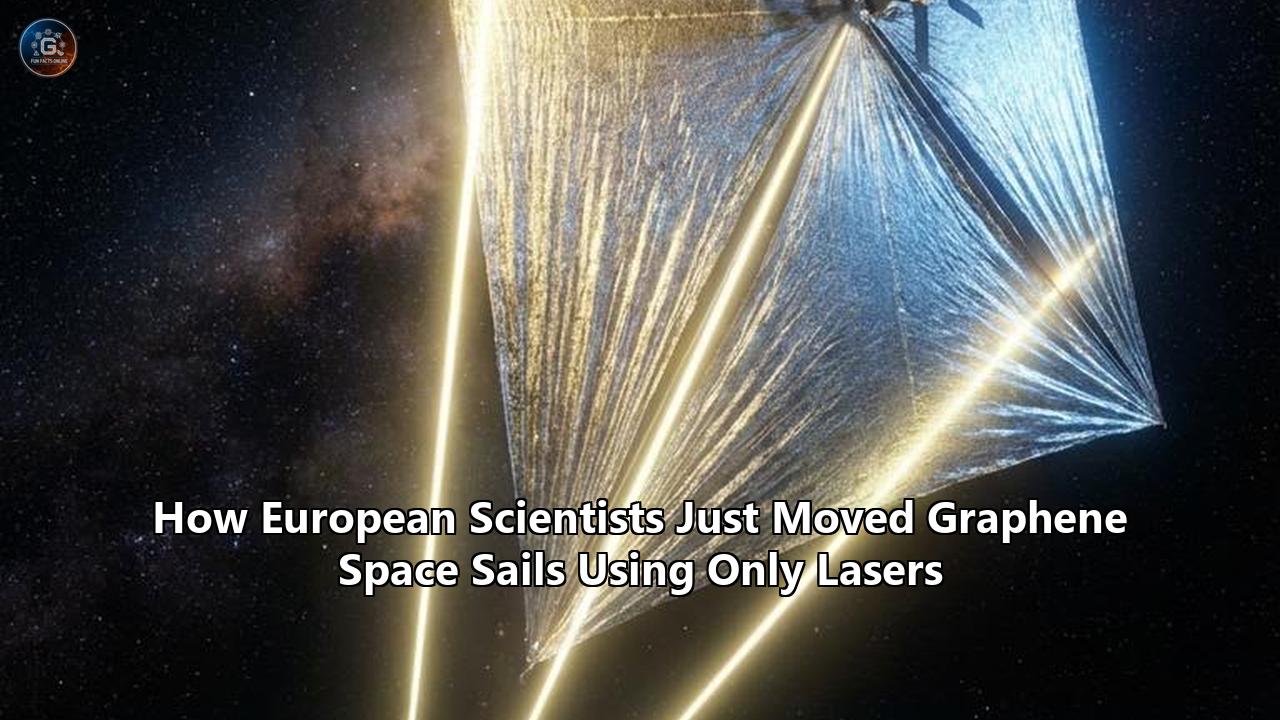
The European Space Agency (ESA) has successfully demonstrated that ultralight graphene aerogels can be propelled entirely by light in microgravity, proving the viability of propellant-free spacecraft acceleration.
During ESA’s 86th parabolic flight campaign, an international team of researchers from the Université Libre de Bruxelles (ULB) in Belgium and Khalifa University in the United Arab Emirates placed three small cubes of graphene aerogel into a vacuum chamber. In the brief periods of simulated zero gravity, the team subjected the cubes to a continuous laser beam. The material accelerated instantly. According to the findings published this month in Advanced Science, the experimental runs lasted just 30 milliseconds, during which the aerogels exhibited massive, immediate acceleration directly correlated to the intensity of the light.
"The reaction was fast and furious," said Marco Braibanti, ESA's project scientist for the experiment. "Before you could even begin to blink, the graphene aerogels experienced large accelerations".
On Earth, under normal gravitational conditions, the exact same graphene aerogels barely registered any movement when subjected to the laser. However, the microgravity environment eliminated the frictional and gravitational barriers that previously masked the material’s true kinetic potential. The research team also proved that the propulsion is entirely tunable: increasing the laser's intensity directly proportionally increased the acceleration of the aerogel.
The successful demonstration of graphene laser propulsion marks a hard pivot in aerospace engineering. By moving away from chemical propellants and heavy fuel tanks, space agencies are now looking at a future where a spacecraft's mass is almost entirely dedicated to scientific payloads rather than the fuel required to move them.
"We are opening the path to a propellant-free propulsion future," said Ugo Lafont, ESA’s materials physics and chemistry engineer. "Ultralight graphene aerogels are the perfect example of an innovative material created in the lab that could save us large amounts of fuel and hardware in space".
Who is Affected by the Breakthrough
The immediate stakeholders in this development span multiple sectors of the global aerospace and advanced materials industries.
Satellite manufacturers and operators stand at the front line of this technological shift. Currently, orbital hardware requires onboard chemical thrusters or heavy momentum wheels to maintain attitude control and adjust positioning. These systems dictate the lifespan of a satellite; when the propellant runs out, the multi-million-dollar asset becomes dead weight, regardless of whether its sensors and communication arrays are still fully functional. The integration of graphene aerogels into satellite architecture introduces the possibility of using onboard or ground-based lasers to continuously adjust a satellite’s position indefinitely, effectively uncoupling a satellite's operational lifespan from its fuel capacity.
Commercial launch providers, such as SpaceX, Rocket Lab, and Arianespace, will also feel the impact of this shift. Launch economics are dictated by mass. If satellite operators can strip hundreds of kilograms of highly volatile chemical propellant and heavily pressurized storage tanks from their designs, the cost to orbit drops precipitously. Launch providers will need to adapt to a market where spacecraft are substantially lighter, potentially allowing for massive rideshare missions that deploy dozens or hundreds of aerogel-equipped probes simultaneously.
The advanced materials sector, particularly companies and research institutions focused on nanomaterials, will see a surge in demand and funding. Graphene has long been touted for its theoretical properties, but practical, large-scale industrial applications have been slow to materialize. The synthesis of graphene aerogels—which involves freezing and drying graphene oxide into a highly porous, three-dimensional structure—will move from a niche laboratory process to a critical aerospace manufacturing requirement. Facilities capable of producing consistent, defect-free graphene aerogels at scale will become vital nodes in the aerospace supply chain.
Deep space research institutions, including NASA’s Jet Propulsion Laboratory and the Japan Aerospace Exploration Agency (JAXA), are heavily affected. These organizations design missions that take years or decades to reach their destinations. The ability to utilize external light sources—whether the Sun or massive orbital laser arrays—to push a spacecraft continuously alters the fundamental mathematics of mission planning.
The Material Science: Why Graphene Aerogel Changes the Equation
To understand why graphene laser propulsion represents such a leap over previous light sail concepts, it is necessary to examine the physical limitations of earlier materials and the unique structural advantages of aerogels.
Light sails rely on radiation pressure. Photons have no mass, but they do possess momentum. When a photon strikes a reflective or highly absorptive surface, it transfers that momentum to the object. Because the momentum of a single photon is infinitesimally small, an effective light sail must have an enormous surface area while maintaining an incredibly low mass.
Previous iterations of solar sails, such as JAXA’s IKAROS launched in 2010 and The Planetary Society’s LightSail 2 launched in 2019, successfully proved that radiation pressure can propel a spacecraft. However, these missions utilized polyimide and Mylar—polyester films that, while thin, still possess significant mass when scaled up to the thousands of square meters required for rapid acceleration. Furthermore, traditional thin-film plastics are susceptible to thermal degradation and possess limited structural integrity when subjected to the harsh radiation and micrometeoroid impacts of deep space.
Graphene, a two-dimensional lattice of carbon atoms exactly one atom thick, offers a vastly superior strength-to-weight ratio. It is highly flexible, exceptional at conducting heat, and highly resistant to mechanical tearing. Yet, standard single-layer graphene is difficult to manipulate and deploy as a macroscopic structure in space.
This is where the aerogel architecture fundamentally alters the material's viability. Aerogels are synthetic, highly porous ultralight materials derived from a gel, in which the liquid component has been replaced with a gas. By structuring graphene into a 3D aerogel, the ULB and Khalifa University researchers created a macroscopic object that retains the exceptional electrical and thermal conductivity of pure graphene but features a density only slightly higher than air.
When the laser pulse hits the graphene aerogel, the material absorbs the light energy with extreme efficiency. The highly porous nature of the aerogel means that the mass being accelerated is extraordinarily low, allowing the transferred photon momentum to yield an immediate and sharp spike in velocity. Because graphene is also an exceptional thermal conductor, the intense heat generated by the laser is rapidly dissipated across the aerogel lattice, preventing the material from vaporizing under the targeted energy beam. This combination of low density, high momentum transfer efficiency, and thermal survivability is what allowed the cubes in the ESA experiment to survive the 30-millisecond laser blasts while accelerating so violently.
Short-Term Consequences: Re-Engineering Orbital Mechanics
In the immediate one-to-five-year window, the consequences of this research will manifest not in interstellar travel, but in low Earth orbit (LEO) operations and satellite design.
The most pressing application is the replacement of conventional reaction control systems (RCS) in CubeSats and micro-satellites. Currently, small satellites rely on miniaturized cold gas thrusters or electrically powered reaction wheels to maintain their orientation. Reaction wheels are prone to mechanical failure, and cold gas thrusters run out of fuel. By incorporating small panels of graphene aerogel on the exterior of a satellite, operators can use low-power onboard lasers—or carefully targeted ground-based lasers—to apply minute, precise forces to the spacecraft. This allows for continuous attitude control without any moving parts or consumable propellants.
Furthermore, the European space sector will likely double down on orbital testing. The parabolic flight campaign was a crucial first step, providing 22-second windows of microgravity. The immediate next step involves deploying a graphene aerogel test article into actual orbit. We can expect ESA to integrate a small aerogel sail payload into an upcoming Vega-C or Ariane 6 launch within the next three years. This orbital test will verify how the material handles sustained solar radiation pressure over months, rather than the millisecond bursts of laser light used in the drop-towers and parabolic flights.
The short-term timeframe will also force a rapid maturation of optical targeting technologies. For laser propulsion to work on an actively deployed satellite, the laser must maintain a perfect lock on the aerogel target. Misaligning a high-powered laser could easily damage the satellite's delicate optical sensors or solar panels. Consequently, aerospace engineering firms will need to develop highly precise, automated beam-steering mechanisms capable of tracking small, rapidly accelerating objects in orbit.
We will also see immediate shifts in how the materials science industry scales production. Synthesizing small graphene aerogel cubes for a vacuum chamber experiment is a specialized, artisanal process. Producing multi-square-meter sheets of graphene aerogel that can survive the intense acoustic and vibrational loads of a rocket launch requires industrialization. Chemical vapor deposition (CVD) techniques and freeze-drying processes will need to be optimized to remove microscopic defects that could cause the aerogel structure to fracture under intense laser acceleration.
Breaking the Tyranny of the Rocket Equation
To grasp the full magnitude of this shift, one must analyze what aerospace engineers refer to as the "tyranny of the rocket equation." Formulated by Konstantin Tsiolkovsky in 1903, the rocket equation dictates that to move a certain mass of payload, you need a specific mass of fuel. However, that fuel also has mass, meaning you need additional fuel to lift the initial fuel, which requires even more fuel, resulting in an exponential mass penalty.
Modern chemical rockets are terribly inefficient by this metric. The Saturn V rocket, which took humans to the Moon, weighed nearly 3 million kilograms on the launch pad. Only a fraction of one percent of that mass actually made it back to Earth; the rest was almost entirely propellant burned just to escape Earth's gravity well and execute translunar injection.
Even modern ion thrusters, which are vastly more efficient than chemical rockets and provide a much higher specific impulse, still require a heavy onboard supply of inert gas, usually xenon or krypton, to function. Once the xenon is depleted, the ion thruster is dead.
Graphene laser propulsion removes the fuel mass from the spacecraft entirely. The energy source—the laser array—remains completely decoupled from the vehicle. Whether the laser is situated on Earth, on the Moon, or in a stable orbit, the power generation infrastructure does not travel with the payload. This effectively bypasses the exponential mass penalty of the rocket equation. The spacecraft only consists of the payload and the aerogel sail.
This decoupling alters the core economics of spaceflight. If an orbital laser array can continuously beam power to a graphene sail, the spacecraft can achieve continuous acceleration. In the vacuum of space, continuous acceleration—even at a low rate—builds up to staggering velocities. A chemical rocket burns for a few minutes and then coasts; a laser-driven sail can accelerate for months or years, ultimately reaching speeds that chemical rockets cannot mathematically achieve without violating mass constraints.
Long-Term Consequences: Deep Space Logistics and Interstellar Horizons
Looking ten to fifty years ahead, the maturation of graphene aerogel materials and space-based laser arrays will fundamentally alter humanity's footprint in the solar system and beyond.
The most profound long-term consequence is the realistic possibility of reaching the outer planets and neighboring star systems within a human lifetime. Currently, reaching Pluto or the Kuiper Belt requires complex gravitational assist maneuvers around Jupiter or Saturn, adding years to mission timelines. A probe utilizing a massive graphene aerogel sail, continuously pushed by an orbital laser installation, could theoretically travel straight to the outer solar system without relying on planetary alignments, drastically reducing transit times.
This technology serves as the foundational material science required for concepts like Breakthrough Starshot, a theoretical project aiming to send a fleet of light-sail spacecraft to Alpha Centauri, the nearest star system, situated 4.37 light-years away. To reach Alpha Centauri in a viable timeframe—approximately 20 years—a spacecraft must travel at roughly 20 percent of the speed of light. No chemical or nuclear thermal rocket can achieve this. However, a highly focused gigawatt laser array pushing an ultralight, highly thermally conductive graphene sail could achieve these relativistic speeds. The ESA parabolic flight results provide hard, empirical proof that graphene structures can endure sharp acceleration spikes from intense laser pulses in a vacuum without disintegrating.
In the realm of inner-solar-system logistics, this technology enables continuous, high-speed cargo routes between Earth and Mars. Instead of waiting for the optimal Hohmann transfer window every 26 months, automated supply vessels equipped with aerogel sails could be continuously pushed toward Mars by lunar-based lasers. This capability is critical for establishing a permanent human presence on Mars, as it ensures a constant supply chain of equipment, food, and medical supplies that is not strictly bound by orbital mechanics.
Furthermore, we will see the rise of orbital infrastructure dedicated entirely to propulsion. Just as terrestrial highways feature gas stations and power grids, Earth orbit will eventually host massive solar-powered laser arrays whose sole function is to act as "pushers" for outgoing deep-space probes. These arrays will capture solar energy, convert it into highly focused laser beams, and track departing aerogel sails, providing them with the necessary momentum to leave the Earth-Moon system.
The Physics of Aerogel Survivability and Thermal Dissipation
The transition from theoretical physics to practical graphene laser propulsion requires solving intense thermal management issues. When a high-powered laser strikes a surface, it does not just transfer momentum; it transfers massive amounts of thermal energy.
Standard materials fail under these conditions. If you point a continuous, high-wattage laser at a Mylar light sail in a vacuum, the localized heating will melt or vaporize the plastic. In a vacuum, there is no air to carry away heat via convection. The material can only shed heat through thermal radiation, which is often insufficient to prevent a catastrophic structural failure at the strike point.
Graphene possesses one of the highest known thermal conductivities of any material—significantly higher than copper or diamond. In a 3D aerogel structure, this property is weaponized against the laser's heat. When the laser hits the aerogel cube, the thermal energy is instantly wicked away from the focal point and distributed throughout the entire porous matrix of the object. The aerogel then radiates this heat evenly into space.
This thermal distribution is why the 30-millisecond laser pulses in the ESA experiment resulted in pure acceleration rather than incineration. The material's ability to remain structurally sound while absorbing and radiating massive amounts of energy means that engineers can hit the sail with much more powerful lasers than previously modeled. The greater the laser power, the faster the acceleration. By confirming that graphene aerogels can survive these rapid energy transfers in microgravity, ESA has effectively raised the speed limit for future light-driven spacecraft.
Economic and Supply Chain Implications
The aerospace economy will experience a profound restructuring as light-driven propulsion moves from the laboratory to the launchpad. The current space economy is heavily skewed toward launch vehicle manufacturing and propellant logistics. The cost per kilogram to low Earth orbit has dropped significantly over the past decade, largely due to reusable rocket technology, but the fundamental bottleneck remains the mass of the spacecraft itself.
Graphene aerogel manufacturing will become a highly lucrative sub-sector. Currently, synthesizing defect-free graphene requires highly controlled environments, utilizing techniques like chemical vapor deposition (CVD) where carbon atoms are deposited onto a substrate. To create an aerogel, the graphene must be chemically assembled into a hydrogel and then undergo critical point drying or freeze-drying to remove the liquid without collapsing the delicate carbon lattice.
Companies that can scale this process to produce industrial quantities of graphene aerogel will command premium valuations. We will likely see intense merger and acquisition activity as major aerospace contractors like Lockheed Martin, Airbus, and Thales Alenia Space acquire specialized nanotechnology firms to secure exclusive access to aerogel production pipelines.
Furthermore, the demand for optical components will skyrocket. The lasers required to propel a spacecraft across vast distances are not off-the-shelf industrial cutters. They require immense power, flawless adaptive optics to correct for atmospheric distortion (if fired from the ground), and highly precise tracking gimbals. The companies producing these high-power photonic arrays will see a massive influx of government and private capital.
Navigating the Bottlenecks: Diffraction, Deployment, and Debris
Despite the extraordinary success of the parabolic flight tests, several severe engineering hurdles remain before massive graphene sails navigate the solar system.
The first major challenge is beam divergence and diffraction. A laser beam does not remain perfectly parallel indefinitely; over vast distances, the light spreads out. If a laser is fired from Earth orbit to push a spacecraft near Jupiter, the beam will have spread significantly by the time it reaches the target. If the beam becomes wider than the sail itself, the energy is wasted, and the acceleration drops. To counter this, engineers must develop immensely large optical arrays or phased laser arrays capable of maintaining a tightly focused beam over millions of kilometers.
The second bottleneck is deployment mechanics. Packing a massive, delicate aerogel structure into the fairing of a rocket and unfolding it in zero gravity without tearing is a monumental engineering challenge. While aerogels are structurally robust for their weight, they are brittle compared to flexible polymers. The deployment mechanisms cannot rely on heavy mechanical booms, as that would defeat the purpose of using an ultralight sail. Instead, researchers are exploring centrifugal deployment—spinning the spacecraft so that the sail unfolds naturally via centrifugal force, a method pioneered by JAXA's IKAROS mission.
The third challenge involves the harsh environment of space itself: micrometeoroids and space debris. A traditional chemical rocket has thick metal walls that can absorb microscopic impacts. An ultralight graphene aerogel sail is highly vulnerable. While a small puncture in a massive sail will not cause the entire structure to fail—unlike a pressurized fuel tank—thousands of micro-impacts over a decade-long mission could slowly degrade the aerogel's structural integrity and optical efficiency. The porous nature of the aerogel might actually serve as an advantage here, allowing microscopic dust to pass through without shattering the broader lattice, but long-duration exposure testing in low Earth orbit is required to confirm this behavior.
The Geopolitical Shift in Space Dominance
The geopolitical implications of mastering graphene laser propulsion cannot be ignored. Historically, dominance in space has been defined by heavy lift capability—which nation possesses the rockets capable of putting the heaviest payload into orbit. The United States and China are currently locked in a race driven by super-heavy launch vehicles like Starship and the Long March 9.
Europe, through the European Space Agency, has historically taken a different approach, focusing heavily on deep science, advanced instrumentation, and collaborative engineering. The breakthrough by ULB and Khalifa University positions Europe—and its strategic partners in the UAE—at the forefront of next-generation propulsion.
If Europe can commercialize and scale graphene aerogel sails, it bypasses the heavy-lift arms race entirely. A nation does not need a massive rocket to explore the solar system if its probes weigh only a few kilograms and are propelled by orbital lasers. This democratizes deep space exploration, allowing smaller space agencies to execute missions that previously required NASA-level budgets and infrastructure.
Furthermore, the technology inherently possesses dual-use characteristics. The high-powered tracking lasers required to propel a spacecraft could, theoretically, be used defensively or offensively in orbit. The ability to precisely target and hit a fast-moving object with a continuous laser beam has obvious applications for orbital debris mitigation, as well as satellite defense. Consequently, we can expect heavy defense sector interest in the tracking and optical arrays being developed alongside the aerogel sails.
What Happens Next: The Path to Orbital Implementation
The immediate roadmap following the publication of these results in Advanced Science involves moving from short-burst microgravity simulations to sustained orbital testing.
Researchers at ULB and Khalifa University are already analyzing the telemetry and high-speed footage from the vacuum chamber. The precise measurement of how the aerogels slowed down after the sharp acceleration peak will provide vital data for calculating continuous thrust models.
Watch for the European Space Agency to announce a technology demonstration mission within the next 24 months. This mission will likely involve a small CubeSat deployed into low Earth orbit, equipped with graphene aerogel panels. Instead of a high-powered external laser, the first tests will rely purely on solar radiation pressure—testing how the aerogel holds up to raw sunlight over weeks and months in the vacuum of space.
Concurrently, expect an influx of research grants aimed at the industrial scaling of aerogel manufacturing. The laboratory processes that created the three test cubes must be scaled up to produce continuous sheets or larger volumetric blocks of the material.
The successful 30-millisecond sprint in ESA’s parabolic flight is more than just a successful physics experiment; it is the definitive proof of concept that chemical combustion is no longer the only way to navigate the void. As the advanced materials sector races to scale up production and optical engineers refine space-based laser arrays, the timeline for propellant-free exploration has rapidly accelerated. The era of the heavy, fuel-laden spacecraft is beginning to close, making way for a future where vehicles surf on concentrated light.
Reference:
- https://gizmodo.com/wild-experiment-suggests-lasers-and-graphene-could-propel-future-spacecraft-2000744002
- https://quantumzeitgeist.com/graphene-aerogels-esa-milliseconds/
- https://www.esa.int/ESA_Multimedia/Videos/2026/04/Graphene_and_lasers_for_space_propulsion
- https://graphene-flagship.eu/materials/uses/2dm-applications/solar-sails
- https://www.graphene-info.com/researchers-demonstrate-laser-propulsion-graphene-sails-microgravity
- https://www.esa.int/ESA_Multimedia/Images/2020/05/Graphene_light_sail
- https://materialdistrict.com/article/sailing-galaxy-graphene-solar-sail/