An unprecedented data dump just fundamentally altered humanity’s map of the solar system. In April 2026, astronomers announced that a staggering 11,000 previously unknown asteroids had been identified and confirmed by the International Astronomical Union’s Minor Planet Center. The massive haul includes 380 trans-Neptunian objects lurking at the icy fringes of our solar neighborhood, and 33 new Near-Earth Objects (NEOs) whose orbits cross dangerously close to our own.
This was not the result of decades of painstaking manual observation. It was the product of a mere month and a half of engineering tests conducted in the summer of 2025 by the Vera C. Rubin Observatory in Chile. Before its primary 10-year mission has even officially begun, this single facility is already proving that the era of artisanal asteroid hunting is over.
“What used to take years or decades to discover, Rubin will unearth in months,” said Mario Jurić, a University of Washington astronomy professor who leads the observatory’s solar system team.
The sheer volume of this new telescope asteroid discovery is difficult to contextualize. For perspective, prior to this facility coming online, the global astronomical community collectively found roughly 20,000 asteroids per year using a patchwork of ground and space-based instruments. During its brief optimization run, the Rubin Observatory found more than half that annual global average in a matter of weeks, while simultaneously locking down the precise mathematical orbits of 80,000 previously known space rocks that had been "lost" to science due to degraded tracking data.
The implications stretch from planetary defense to the economics of space mining, and from the origins of the solar system to the search for an undiscovered ninth planet. To understand how one facility can suddenly mass-produce astronomical discoveries, we have to look under the hood of the most complex optical machine ever built.
The Problem with Looking Up
For centuries, astronomy has been constrained by a fundamental geometric trade-off: you can look deeply into space, or you can look widely, but you cannot easily do both.
Traditional flagship telescopes like Hubble or the James Webb Space Telescope are built for depth. They possess massive mirrors that collect ancient, faint photons from the edge of the observable universe. However, their field of view is microscopically narrow. Looking through JWST is akin to staring at the sky through a drinking straw. If an asteroid happens to fly across that tiny patch of sky, the telescope will see it, but relying on narrow-field instruments to map local space rocks is like trying to map the migration patterns of birds by looking through a keyhole.
Conversely, wide-field sky surveys traditionally relied on much smaller lenses. They could capture large swaths of the sky, but they lacked the light-gathering power to see small, faint, or fast-moving objects. An asteroid measuring 140 meters across—large enough to level a major metropolitan area—reflects very little sunlight. By the time it is close enough and bright enough to be spotted by older wide-field surveys, it might already be on a terminal trajectory toward Earth.
Astronomers recognized that mapping the solar system required a new paradigm: a "synoptic" survey capable of capturing massive, wide-angle images with the deep-space sensitivity of a flagship observatory. This operational requirement drove the design of the Vera C. Rubin Observatory, a joint initiative funded by the U.S. National Science Foundation (NSF), the U.S. Department of Energy (DOE), and private donors including software billionaire Charles Simonyi and Microsoft founder Bill Gates.
Engineering a Behemoth: The Simonyi Survey Telescope
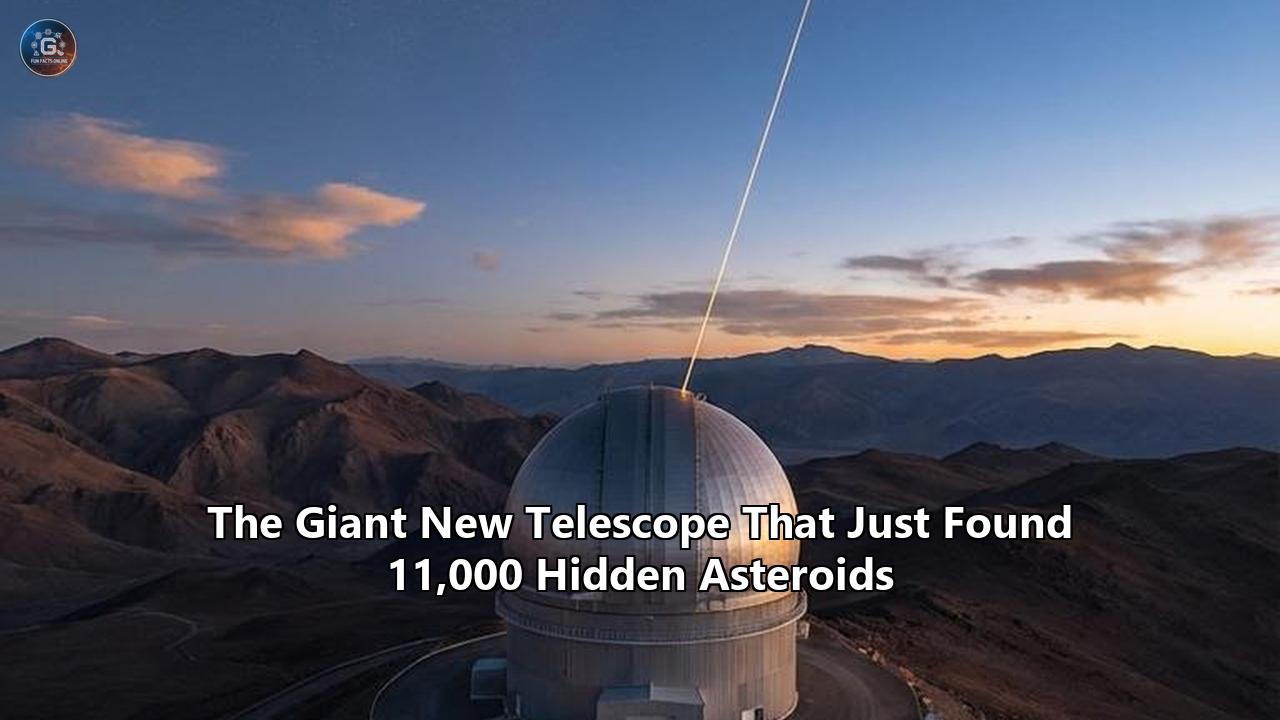
Perched 8,737 feet above sea level on the El Peñón peak of Cerro Pachón in the Chilean Andes, the environment surrounding the Rubin Observatory is harsh, dry, and exceptionally clear. The thin atmosphere minimizes the blurring effect of air currents, a necessity for the precision tracking of distant rocks.
The centerpiece of the facility is the Simonyi Survey Telescope, an instrument that breaks almost every rule of conventional telescope design. Most large research telescopes use a two-mirror Ritchey–Chrétien design, which bounces light from a large primary mirror to a smaller secondary mirror and down into a sensor. While excellent for narrow targets, a two-mirror system naturally produces optical aberrations—specifically coma and astigmatism—at the edges of a wide image. Stars at the periphery appear stretched or blurred, making precise astrometry (measuring the exact positions of objects) impossible.
To solve this, optical engineers resurrected and modified a three-mirror design originally conceptualized by Maurice Paul and James G. Baker. The Paul-Baker anastigmat design forces incoming starlight to bounce three times: off an 8.4-meter primary mirror, up to a 3.4-meter secondary mirror, and back down to a 5.0-meter tertiary mirror before reaching the camera. This triple-bounce flattens the focal plane and corrects for optical distortions, allowing the telescope to produce razor-sharp images across a staggering 9.6-square-degree field of view. For scale, a single image from this telescope covers an area of the sky equivalent to 40 full moons.
Building this optical layout presented a severe mechanical challenge. Aligning three massive, heavy mirrors perfectly while the telescope rapidly pivots to track the sky is a mechanical nightmare. The solution developed by the Richard F. Caris Mirror Lab at the University of Arizona was to physically merge two of the mirrors. The primary and tertiary mirrors were cast from a single continuous piece of Ohara E6 low-expansion borosilicate glass.
Fabricating this monolithic "M1M3" mirror took seven years. Chunks of raw glass were loaded into a giant, rotating oven located under the bleachers of the university's football stadium. As the oven heated the glass to a liquid state, it spun at a precise speed. Centrifugal force pushed the molten glass outward, naturally forming a parabolic curve. The glass then had to cool at an agonizingly slow rate over several months to prevent the formation of microscopic stress fractures. Once cooled, it underwent years of polishing until its surface was smooth to within a few nanometers.
Because a solid block of glass that size would be too heavy to move, the mirror is built with a honeycomb core, making it 80% hollow while retaining its structural rigidity. Even so, as the telescope tilts, gravity microscopically warps the glass. To counter this, an Active Optics System (AOS) utilizes a network of pneumatic actuators beneath the glass to push and pull the mirror shape in real-time, correcting for both gravitational sag and thermal expansion.
The Eye: Inside the 3.2-Gigapixel LSSTCam
A telescope mirror only funnels light; the actual recording is done by the camera. To capture the massive field of view provided by the Simonyi telescope, engineers at the SLAC National Accelerator Laboratory in California had to build the largest digital camera in human history.
Weighing 3,060 kilograms (roughly the size of a small SUV), the LSSTCam is a 3,200-megapixel (3.2 gigapixel) behemoth. Its focal plane is constructed from a mosaic of 189 highly sensitive Charge-Coupled Devices (CCDs). To view a single uncompressed image produced by this camera at full resolution, you would need 378 ultra-high-definition 4K televisions arranged in a grid.
The sensitivity of these sensors introduces a secondary problem: thermal noise. At room temperature, the inherent heat of the electronics would cause electrons to randomly register on the sensors, burying the faint signals of distant asteroids in digital static. To prevent this, the entire focal plane is sealed in a vacuum chamber and cryogenically cooled to -100 degrees Celsius (-148 degrees Fahrenheit).
Every 40 seconds, the telescope executes a highly choreographed mechanical dance. It exposes the camera to the sky for 15 seconds, rapidly reads out the 3.2 gigabytes of digital data in just two seconds, and smoothly slews to an adjacent patch of sky to begin the next exposure. Over a single night, this relentless mechanical rhythm generates 20 terabytes of raw data.
This is the physical infrastructure that made the new telescope asteroid discovery possible. But gathering the light is only half the battle. Finding an 11,000-asteroid needle in a 20-terabyte haystack requires an entirely different kind of engineering.
HelioLinc3D: The Algorithm That Linked the Dots
When you look at a photograph of the night sky, an asteroid looks exactly like a star: a single, bright pixel. The only way to differentiate a rock inside our solar system from a fusion reactor light-years away is through motion. Against the static background of the cosmos, an asteroid moves.
Historically, astronomers found asteroids by taking two photographs of the same patch of sky a few hours apart and rapidly flipping between them—a device called a blink comparator. The stars remained stationary, while the asteroid would appear to jump back and forth. This manual technique is how Clyde Tombaugh discovered Pluto in 1930.
By the late 20th century, computers automated this process. Traditional asteroid detection software relies on capturing at least four images of the same patch of sky within a single night. If the software detects a dot moving in a straight, predictable line across those four frames, it flags it as a "tracklet."
The Rubin Observatory's observing cadence deliberately breaks this traditional model. To photograph the entire southern hemisphere sky every three nights, the telescope cannot afford to stare at one patch of sky long enough to take four images. It only takes two images per field per night. Traditional asteroid-hunting algorithms fail completely under these conditions; two points of light are not enough to definitively calculate a velocity and trajectory to rule out digital artifacts or cosmic rays.
To solve the software bottleneck, a team led by researchers at the University of Washington’s Data-Intensive Research in Astrophysics and Cosmology (DiRAC) Institute developed a revolutionary piece of open-source code called HelioLinc3D. Built by astronomers Mario Jurić, Ari Heinze, Siegfried Eggl, and graduate student Jacob Kurlander, the algorithm abandons the single-night requirement.
Instead of demanding four images in a single night, HelioLinc3D performs "multi-night linking". It identifies pairs of moving dots on a Tuesday, and connects them with pairs of moving dots seen on a Friday. Because the asteroid has moved significantly over three days, the algorithm must computationally simulate every possible orbit that could connect those temporal data points, all while factoring in the gravitational pull of the Sun and the planets.
“Current operating asteroid surveys... aim to get enough data in one night to discover an asteroid based on that single night’s data,” Ari Heinze explained. "But Rubin plans to image each field only twice to cover more areas of the sky... That means that if there were an unknown asteroid there, you would have only two images of it on that night".
HelioLinc3D requires immense computing power, processing millions of potential trajectory permutations per second. By computationally subtracting the stationary stars, measuring the brightness and position of the remaining anomalies, and linking them across the geometry of the solar system, the software extracted 11,000 hidden asteroids from the summer 2025 optimization data.
“Even with just early, engineering-quality data, Rubin discovered 11,000 asteroids and measured more precise orbits for tens of thousands more,” Heinze stated in April 2026. “It seems pretty clear this observatory will revolutionize our knowledge of the asteroid belt".
Breaking Down the Haul: Main Belt, TNOs, and Solar System Archaeology
Of the 11,000 newly confirmed objects, the vast majority reside within the main asteroid belt located between the orbits of Mars and Jupiter. To the general public, asteroids are often viewed merely as hazards. To astrophysicists, they are pristine, frozen time capsules that hold the geological secrets of the protoplanetary disk that formed our solar system 4.6 billion years ago.
The rocks in the main belt are the unused building blocks of planets. Jupiter's massive gravitational tides prevented this material from coalescing into a single terrestrial world. By cataloging the exact orbits of millions of these objects, scientists can run mathematical simulations backward in time.
Asteroids clump into distinct "families"—such as the Flora, Koronis, and Eos families—which share similar orbital characteristics and chemical compositions. These families are the shattered debris of larger parent bodies that collided millions of years ago. Furthermore, the distribution of these rocks is not uniform; there are empty regions known as Kirkwood gaps, which have been swept clean by orbital resonances with Jupiter.
By mapping the precise edges of these gaps and the distribution of asteroid families, astrophysicists can track how Jupiter and Saturn migrated inward and outward during the early, chaotic days of the solar system. The 11,000 new main-belt asteroids provide thousands of new gravitational data points for this ongoing mathematical reconstruction.
Even more scientifically potent are the 380 newly discovered Trans-Neptunian Objects (TNOs). These are ancient, icy bodies orbiting in the permanent deep freeze beyond the eighth planet. Discovering them is exceptionally difficult; because they are so far from the Sun, they receive very little light, and because they are so far from Earth, the light that bounces back is infinitesimally faint.
Among the TNOs identified in the April 2026 data drop are two extreme objects, temporarily designated 2025 LS2 and 2025 MX348. These highly eccentric bodies possess orbits that take them up to 1,000 Astronomical Units (AU) away from the Sun—meaning their aphelion (farthest point) is 1,000 times the distance between the Earth and the Sun. Objects with such extreme, elongated orbits are crucial to deep-space astronomy because their trajectories act as gravitational sensors. If a massive, unseen "Planet Nine" exists in the outer solar system, its gravity will subtly group the orbits of extreme TNOs into specific alignments. Discovering hundreds of new TNOs rapidly expands the dataset required to either prove or disprove the existence of an undiscovered planet in our cosmic backyard.
The Problem of the "Lost" Rocks
Alongside the 11,000 entirely new discoveries, the Rubin data provided updated, high-precision orbits for 80,000 previously known asteroids. A significant fraction of these were classified as "lost."
Losing a mountain-sized rock in space seems counterintuitive, but it is a common problem in celestial mechanics. When an astronomical survey spots an asteroid, it usually only tracks it for a few days—a short "observation arc." Using that short arc, computers estimate the object's full multi-year orbit around the Sun.
However, space is not a vacuum devoid of physical forces. Asteroids are constantly subjected to gravitational perturbations from Jupiter and Mars. They also experience the Yarkovsky effect, a thermal phenomenon where the sunlit side of a rotating asteroid absorbs heat and radiates it away as infrared photons as it turns into the night side. This radiation exerts a minuscule but continuous physical thrust on the asteroid, subtly pushing it off its predicted path.
If decades pass without a follow-up observation, these minor variables compound. The object's calculated position becomes an expanding probability cone until astronomers no longer know where it is. By imaging the entire sky so rapidly, the Simonyi telescope intercepted thousands of these lost rocks, locking down their modern trajectories and erasing the mathematical uncertainty.
The Planetary Defense Imperative: Finding the City-Killers
While the scientific value of main-belt rocks and icy TNOs is immense, the immediate geopolitical urgency behind this new telescope asteroid discovery lies in the 33 newly identified Near-Earth Objects (NEOs).
An NEO is broadly defined as any small solar system body whose orbit brings it within 1.3 Astronomical Units of the Sun (where 1 AU is the Earth-Sun distance). These are the rocks that cross our planetary lane. None of the 33 newly discovered NEOs pose a threat to Earth in the foreseeable future. However, their discovery proves the viability of the Rubin Observatory as humanity's primary early-warning system for planetary defense.
The historical record makes the necessity of such a system abundantly clear. In 1908, a 50-to-60-meter asteroid detonated in the atmosphere over Tunguska, Siberia, flattening 80 million trees across 2,150 square kilometers. In 2013, a comparatively tiny 20-meter rock exploded over Chelyabinsk, Russia, with the force of 500 kilotons of TNT, blowing out windows and injuring over 1,400 people.
Recognizing the statistical inevitability of future impacts, the United States Congress passed the George E. Brown Jr. Near-Earth Object Survey Act in 2005. The law mandated that NASA detect, track, and catalog 90 percent of all NEOs larger than 140 meters by the year 2020. An object of 140 meters is considered the threshold for a "city-killer"—an asteroid capable of penetrating the atmosphere and devastating a massive regional area.
NASA missed the 2020 deadline by a wide margin, largely because the necessary wide-field, deep-space optical technology did not yet exist. The Rubin Observatory was built, in large part, to finally fulfill that congressional mandate.
Finding these objects early is the singular requirement for planetary defense. In 2022, NASA's Double Asteroid Redirection Test (DART) successfully impacted the asteroid moonlet Dimorphos, proving that humans can alter the trajectory of a celestial body via kinetic impact. But kinetic deflection is a game of orbital geometry; you need years, preferably decades, of lead time. Pushing an asteroid by a fraction of a millimeter per second ten years before impact will cause it to miss Earth by thousands of miles. Trying to push it a month before impact is physically impossible with current propulsion technology.
By pushing the boundaries of detection, the Rubin Observatory buys the planet time. The facility is projected to discover up to 90,000 new NEOs over the coming decade, increasing the known catalog of potentially hazardous asteroids by an order of magnitude.
The Economics and Logistics of Big Data Astronomy
Operating an $800 million facility atop a remote Chilean mountain is a massive logistical undertaking. Yet, when measured by the sheer volume of data produced, the economics of the Rubin Observatory represent a radical shift in how astronomical research is funded and executed.
In traditional astronomy, researchers write proposals competing for a few hours of viewing time on a flagship telescope. If the proposal is accepted, the astronomer directs the telescope to a specific target, collects the data, and retains proprietary rights to analyze it before publishing.
The Rubin Observatory operates on a completely different model. It does not accept targeting requests. It is a relentless machine executing a pre-programmed, continuous sweep of the entire southern sky. The data it gathers is not locked behind a proprietary period; it is processed and distributed globally.
When the telescope captures an image and HelioLinc3D or other processing pipelines detect a "transient event"—something that has moved or changed brightness, such as a near-Earth asteroid, a supernova explosion, or a tidal disruption event—the software packages that data into an alert. Within 60 seconds of the shutter closing, that alert is broadcast to the global astronomical community.
This open-data pipeline effectively crowdsources planetary defense and solar system observation. While Rubin discovers the 11,000 asteroids, it relies on a global network of secondary observatories to follow up. When Rubin broadcasts the coordinates of a newly discovered, fast-moving NEO, professional and amateur astronomers globally pivot their smaller telescopes to that exact patch of sky to gather additional tracking data, helping the Minor Planet Center refine the orbital calculations.
As the volume of discoveries scales up, the marginal cost per discovery plummets. Finding a single asteroid using dedicated time on a traditional large telescope costs tens of thousands of dollars in operational expenses. When Rubin is discovering thousands of asteroids in a single week, the cost per rock drops to a fraction of a cent.
Navigating a Crowded and Bright Sky
Despite its advanced optical engineering and software architecture, the Rubin Observatory faces a severe, man-made operational hazard: satellite mega-constellations.
Since the telescope's design phase in the early 2000s, the orbital environment around Earth has changed drastically. Companies like SpaceX (Starlink), Amazon (Project Kuiper), and OneWeb are in the process of launching tens of thousands of low-Earth orbit (LEO) telecommunications satellites.
These satellites reflect sunlight down to Earth, particularly during the critical observing hours just after dusk and just before dawn. Because the Simonyi telescope has a massive 9.6-square-degree field of view and is extraordinarily sensitive to light, a single satellite passing overhead leaves a blindingly bright streak across the CCD sensors. These streaks can saturate the pixels, creating digital bleeding that obscures faint background asteroids and galaxies.
The astronomical community and satellite operators are currently locked in a tense adaptation process. Companies are experimenting with darkening the chassis of their satellites or equipping them with visors to reduce albedo (reflectivity). Simultaneously, the Rubin software team is developing advanced masking algorithms to automatically identify satellite streaks and computationally remove the corrupted pixels from the image data before it is analyzed by HelioLinc3D.
Furthermore, the telescope's scheduling software uses orbital telemetry data from the U.S. Space Force to predict exactly when and where specific satellites will cross its field of view, allowing the telescope to dynamically adjust its pointing schedule to avoid the densest satellite clusters. It is an ongoing battle to ensure that humanity's attempt to connect the globe via the internet does not blind our ability to watch the local solar system.
The Legacy Survey of Space and Time: Scaling Up to Millions
The April 2026 announcement of 11,000 newly discovered asteroids and 80,000 refined orbits is not the culmination of a project. It is merely the calibration phase.
These discoveries were extracted from early engineering data, taken while technicians were still fine-tuning the active optics, calibrating the vacuum seal on the 3.2-gigapixel camera, and testing the thermal limits of the servers processing the 20 terabytes of nightly data.
Later this year, the facility will officially begin its primary mission: The Legacy Survey of Space and Time (LSST). Over the next 10 years, the telescope will image the entire visible southern sky every three to four nights, taking over 800 repeated exposures of every single coordinate. It will generate a massive, decade-long, full-color cinematic time-lapse of the universe.
The statistical projections for the LSST are staggering. Over the course of the 2020s and 2030s, the Rubin Observatory is expected to catalog over 5 million asteroids, tripling the number of known space rocks currently recorded in human history. On an average night, the automated pipeline is projected to identify thousands of moving objects.
This level of detailed mapping extends beyond academic science and planetary defense; it sets the foundational infrastructure for a future cislunar and deep-space economy. Space agencies and commercial mining startups require heavily vetted targets. Launching a robotic probe to intercept an asteroid requires exact orbital parameters and a clear understanding of the rock's chemical composition (which can be inferred from how it reflects different wavelengths of light captured by Rubin's multi-color optical filters). By identifying millions of main-belt rocks and thousands of NEOs, this facility is effectively drafting the topological map that future autonomous mining drones will use to navigate.
The successful implementation of this new telescope asteroid discovery pipeline forces a shift in how we perceive the night sky. For millennia, the stars were viewed as a static, unchanging tapestry. By applying industrial-scale data processing to optical astronomy, we now see the sky for what it actually is: a dynamic, chaotic, and heavily populated local neighborhood.
As the Simonyi telescope begins its decade-long survey, the daily flood of new data will permanently alter the landscape of astrophysics. The 11,000 rocks found in the summer of 2025 prove that the hardware works, the software can keep up, and the solar system is far more crowded than we ever mapped. The coming years will not just add entries to a database; they will complete humanity's inventory of our own cosmic backyard.
Reference:
- https://www.geekwire.com/2026/rubin-observatory-11000-new-asteroids/
- https://www.discovermagazine.com/the-vera-c-rubin-observatory-recently-spotted-around-11-000-asteroids-and-this-is-just-beginning-48926
- https://www.space.com/astronomy/asteroids/the-powerful-new-rubin-observatory-just-found-11-000-new-asteroids-and-measured-tens-of-thousands-more
- https://www.washington.edu/news/2026/04/02/rubin-observatory-11000-new-asteroids/
- https://en.wikipedia.org/wiki/Vera_C._Rubin_Observatory
- https://noirlab.edu/public/news/noirlab2411/
- https://noirlab.edu/public/programs/vera-c-rubin-observatory/simonyi-survey-telescope/
- https://www.optica-opn.org/home/articles/volume_35/february_2024/features/the_vera_c_rubin_observatory/
- https://www.lsst.org/about/tel-site/optical_design
- https://www.lsst.fr/wp-content/uploads/2020/10/LSST_2020VRO_final_ok1020_BD.pdf
- https://rubinobservatory.org/slideshows/making-a-telescope-mirror
- https://arxiv.org/html/2406.04656v1
- https://indico.global/event/8709/contributions/84037/attachments/38795/72261/Slides_Andr%C3%A9s_Plazas.pdf
- https://astrospace-page.blogspot.com/2018/02/lsst-large-synoptic-survey-telescope-chile.html
- https://www.astronomy.com/science/the-vera-c-rubin-observatory-shows-its-flair-for-asteroid-detection/
- https://rubinobservatory.org/news/new-algorithm-asteroid
- https://www.forbes.com/sites/jamiecartereurope/2026/04/04/11000-asteroids-have-been-found---and-33-are-near-earth-objects/
- https://www.gadgets360.com/science/news/rubin-observatory-discovers-over-11000-asteroids-within-weeks-of-imaging-11317546