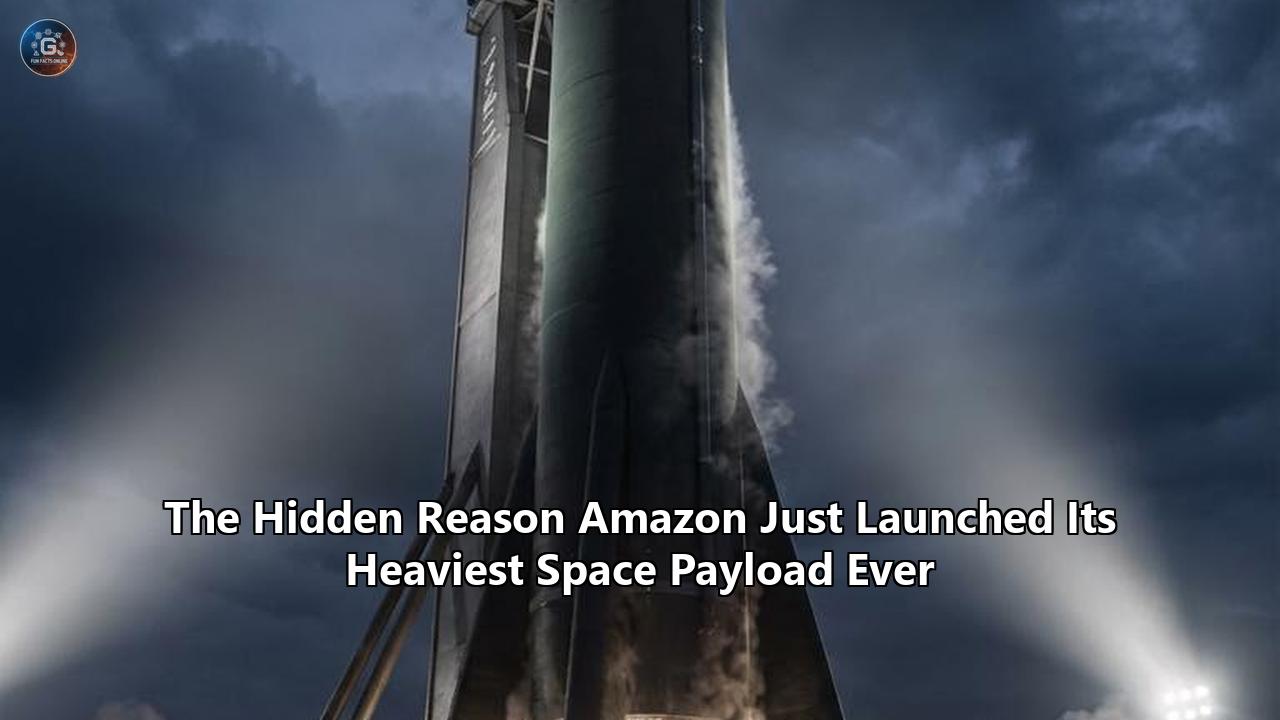
On April 4, 2026, at 1:46 a.m. EDT, a United Launch Alliance (ULA) Atlas V rocket illuminated the Florida coastline, lifting off from Space Launch Complex 41 carrying 18 tons of highly advanced silicon, metal, and proprietary communication arrays. Designated as the LA-05 mission, this flight represented a highly specific technical achievement: it was the Amazon heaviest space payload launched to date. By squeezing 29 broadband satellites into the 5-meter payload fairing—two more than the standard 27-satellite configuration flown on previous Atlas V missions—Amazon and ULA maximized the exact lifting capacity of the venerable Atlas V 551 rocket.
Four days later, on April 8, Amazon capitalized on this orbital delivery by officially initiating the commercial enterprise beta phase of its satellite internet network, newly operating under the brand Amazon Leo (formerly Project Kuiper). The technology conglomerate began onboarding a select group of enterprise, telecommunications, and government clients. This service offers data speeds of up to 400 Mbps for standard terminals, while specialized maritime and aviation units are achieving speeds exceeding 1 Gbps.
This sequence of events—a maximum-capacity rocket launch immediately followed by a commercial rollout—signals the definitive end of Amazon's research and development phase. The company has moved aggressively into full-scale production and commercial execution, aiming to dismantle the near-monopoly held by SpaceX's Starlink in the Low Earth Orbit (LEO) broadband market. The ripples of this deployment will structurally alter global telecommunications, reshape the aerospace supply chain, and permanently shift the economics of orbital infrastructure.
The Engineering Behind the Capacity Upgrade
To understand the broader market impact, one must first examine the mechanics of the LA-05 mission. Pushing a launch vehicle past its standard operational parameters requires intense engineering validation. The Atlas V 551 configuration, affectionately known in aerospace circles as the "Bruiser," utilizes five solid rocket boosters and a Centaur upper stage.
For the first four operational Amazon flights, this vehicle lofted 27 satellites. Pushing that number to 29 added immense mass, bringing the total payload to 18 tons. To accommodate the Amazon heaviest space payload, engineers from Amazon Leo and ULA collaborated to utilize a higher-performing version of the RL10C engine on the Centaur upper stage. While this engine variant had flown on previous non-Amazon missions, LA-05 marked the first time the program completed the exhaustive safety and trajectory analysis required to pair it with the enlarged satellite dispenser.
Adding two satellites per launch might seem like an incremental gain, but multiplied across a multi-billion dollar launch manifest, the efficiencies compound aggressively. It eliminates the need for entirely separate rocket launches down the line, saving tens of millions of dollars in vehicle hardware and, critically, conserving weeks of launch pad turnaround time.
The Regulatory Clock: The 2026 FCC Mandate
The desperation to maximize every single payload fairing stems directly from federal regulations. When the Federal Communications Commission (FCC) granted Amazon the spectrum license to operate its 3,236-satellite constellation in July 2020, the approval included a rigid, non-negotiable timeline. Amazon is legally mandated to deploy and operate exactly half of its planned constellation—1,618 satellites—by July 30, 2026. The remaining half must reach orbit by July 30, 2029. Failure to meet the 2026 milestone threatens the spectrum rights that form the foundation of the entire enterprise.
As of the successful LA-05 deployment, Amazon has placed 241 production satellites into orbit. With the July 2026 deadline looming roughly three months away, the mathematics dictate a monumental logistical challenge: the company must launch over 1,370 satellites in slightly more than 100 days.
This explains why the Kirkland, Washington satellite manufacturing facility has been operating at its absolute peak cadence. Built to support rapid industrial scaling, the facility boasts the capacity to manufacture up to 30 satellites per week, or roughly five per day. Satellites are rolling off the assembly line and being immediately shipped to processing facilities in Cape Canaveral, Florida, and Kourou, French Guiana. The recent $200 million infrastructure upgrade at the Florida facility allows engineers to stack and encapsulate up to 200 satellites concurrently, preparing them for rapid-fire integration with incoming rockets.
The Immediate Fallout: Who is Affected Right Now?
The April 8 enterprise beta launch bypasses the direct-to-consumer market entirely. Instead, Amazon is aggressively targeting sectors where high-margin corporate contracts can immediately justify the massive capital expenditure required to build the network.
Enterprise and Cloud Integration
By integrating Amazon Leo directly with Amazon Web Services (AWS), the company offers a closed-loop data ecosystem. Multinational corporations operating in remote or infrastructure-poor areas—such as mining conglomerates in Western Australia, agricultural operations in the Brazilian Amazon, or oil rigs in the North Sea—can beam data directly from their sites into AWS data centers without their traffic ever touching the public internet. This architecture dramatically reduces latency, tightens cybersecurity protocols, and heavily incentivizes enterprise clients to lock themselves deeper into the Amazon cloud ecosystem.
The Maritime and Aviation Industries
The beta phase places significant emphasis on the maritime and aviation sectors. Commercial shipping fleets, luxury cruise lines, and commercial airlines are chronically starved for reliable, high-bandwidth connectivity. Amazon Leo’s specialized terminals, capable of gigabit speeds, directly challenge legacy geostationary satellite operators like Viasat, HughesNet, and Inmarsat. Amazon has already secured a high-profile contract with Delta Air Lines to power in-flight Wi-Fi starting in 2028. Proving the network's capabilities in early 2026 allows Amazon to secure multi-year contracts before the service reaches total global capacity.
Government and Defense Sectors
The U.S. Department of Defense and allied intelligence agencies maintain a voracious appetite for proliferated LEO architectures. Modern military operations require secure, highly redundant communications that cannot be disabled by a single localized anti-satellite weapon. While SpaceX has dominated military LEO contracts recently through its Starshield initiative, the Pentagon structurally prefers to avoid relying on a single vendor. Amazon Leo provides the exact vendor redundancy the defense supply chain requires, creating immediate competition for lucrative government data-routing contracts.
Straining the Global Aerospace Supply Chain
The urgency driving the deployment of the Amazon heaviest space payload is creating unprecedented bottlenecks across the global aerospace supply chain. To guarantee access to orbit, Amazon executed the largest commercial launch procurement in history in 2022, securing up to 83 heavy-lift rocket launches across three providers: ULA, Arianespace, and Jeff Bezos's Blue Origin.
However, aerospace development timelines rarely adhere to corporate schedules. Delays in the certification of ULA's Vulcan Centaur, Arianespace's Ariane 6, and Blue Origin's New Glenn forced Amazon to adapt. In a move that underscored the severity of the FCC deadline, Amazon purchased multiple Falcon 9 flights from its direct rival, SpaceX. (This procurement also effectively settled a 2023 shareholder lawsuit which alleged that Amazon leadership breached their fiduciary duties by initially excluding SpaceX due to the personal rivalry between Jeff Bezos and Elon Musk).
This multi-provider strategy tests the physical limits of global launch infrastructure. ULA is simultaneously managing the retirement of the Atlas V while attempting to ramp up the Vulcan Centaur. Arianespace recently began flying the Ariane 64 configuration, successfully lofting 32 Amazon satellites in February 2026 (the LE-01 mission). Blue Origin is under immense pressure to bring the massive New Glenn rocket into operational cadence to lift the largest payloads in the manifest.
The sheer volume of Amazon's cargo ensures that these launch providers have guaranteed revenue for the rest of the decade, heavily subsidizing the development of next-generation heavy-lift vehicles. Yet, it also crowds out smaller commercial operators, scientific probes, and academic payloads. Satellite operators seeking medium-to-heavy lift capacity before 2028 face entirely booked manifests. Amazon has effectively bought out the market's lifting capacity.
Fracturing the LEO Monopoly
For the past half-decade, SpaceX has operated with absolute impunity in the high-speed LEO broadband sector. Starlink boasts over 10,000 active satellites and millions of subscribers globally, dictating market pricing and hardware standards. The activation of the Amazon Leo commercial beta formally shatters this monopoly.
Competition at this scale forces structural changes across telecommunications. Historically, terrestrial internet service providers (ISPs) operating in rural or geographically isolated areas lacked the financial incentive to upgrade aging copper wire or DSL infrastructure. Starlink initiated the pressure on these terrestrial monopolies, but a fierce duopoly between SpaceX and Amazon will trigger aggressive global price wars.
Wall Street projections indicate that Amazon anticipates up to $20 billion in annual revenue from its satellite division by 2030. To achieve that market share, Amazon will likely leverage its massive retail logistics network to heavily subsidize the cost of consumer user terminals. While early satellite antennas cost thousands of dollars to manufacture, Amazon has engineered a proprietary phased-array antenna design that costs less than $400 to produce. The company is expected to sell these terminals to consumers at a loss, mirroring the successful hardware strategy deployed with the Kindle e-reader and Echo smart speakers. Furthermore, analysts expect Amazon to bundle Leo connectivity with Amazon Prime subscriptions, creating a comprehensive digital value proposition that standalone ISPs simply cannot match.
Navigating the Logistics of Orbital Mass
Over the next three months, the launch cadence from the Space Coast of Florida and the Guiana Space Centre will border on the frantic. To deploy the necessary 1,377 remaining satellites before the July 30 deadline, Amazon must execute an average of roughly 10 launches per month.
This operational tempo leaves zero margin for anomaly. A single catastrophic rocket failure—whether an Atlas V, a Falcon 9, or an Ariane 6—would trigger mandatory safety investigations, grounding that specific vehicle fleet for months. Given the tight timeline, a prolonged grounding of any major launch provider could mathematically guarantee that Amazon misses the FCC mandate.
Weather presents an equally volatile variable. In October 2025, a SpaceX Falcon 9 carrying Amazon satellites (mission KF-03) suffered multiple delays due to unfavorable weather conditions off the Florida coast. Scheduling massive rockets is perpetually at the mercy of upper-level winds and lightning rules. To mitigate weather risks, Amazon relies heavily on the geographical diversity of its contracted launch sites, utilizing Cape Canaveral, Vandenberg Space Force Base in California, and Kourou near the equator.
The Long-Term Consequences: Orbital Traffic and Kessler Syndrome
As Amazon transitions from launching prototypes to executing full-scale deployments like the Amazon heaviest space payload, the physical environment of low Earth orbit is becoming highly congested. The Amazon Leo constellation is designed to occupy three specific orbital shells: 590 kilometers, 610 kilometers, and 630 kilometers above the Earth.
SpaceX's Starlink satellites primarily operate slightly lower, around the 550-kilometer mark. Injecting 3,236 Amazon satellites just above the Starlink shells dramatically increases the complexity of orbital traffic management. The satellites are equipped with highly efficient Hall-effect thrusters for precise maneuvering and collision avoidance. However, the autonomous dodging algorithms processing these maneuvers must now account for tens of thousands of active objects, dead satellites, and thousands of pieces of tracked orbital debris.
Astronomers continue to raise severe alarms regarding the visual pollution caused by megaconstellations. While Amazon has incorporated specialized darkening treatments and sunshades on its satellite chassis to reduce albedo (reflectivity), the sheer volume of metal crossing the night sky creates streaks that interfere with ground-based optical and radio astronomical surveys. The long-term consequence of these commercial constellations is a forced shift of advanced astronomy to space-based telescopes—a transition that requires billions of dollars in public funding.
Additionally, LEO satellites operate with a finite lifespan, typically lasting five to seven years before their fuel depletes or components degrade. To maintain the 3,236-satellite constellation, Amazon will need to launch hundreds of replacement satellites annually well into the 2030s. The planned, controlled deorbiting of older satellites means a continuous rain of vaporized aluminum, titanium, and other heavy metals entering the Earth's upper atmosphere. Atmospheric scientists are currently actively studying how the long-term accumulation of these metallic particles might alter the reflectivity of the upper atmosphere or interact with the ozone layer.
The Geopolitical Dimension of Data Routing
The global reliance on internet connectivity has elevated broadband from a consumer luxury to critical national infrastructure. Recent geopolitical conflicts, particularly the war in Ukraine, demonstrated precisely how LEO satellite networks provide highly resilient communications when terrestrial cellular towers and fiber optic cables are targeted and destroyed by artillery.
Prior to Amazon Leo's activation, SpaceX exercised immense geopolitical leverage due to its unilateral control over Starlink. By bringing a fully functional secondary network online, sovereign nations, non-governmental organizations, and international militaries gain a vital alternative. The U.S. government benefits strategically from having two distinct domestic mega-constellations, ensuring that the infrastructure powering global digital economies remains firmly under American regulatory oversight and technical jurisdiction.
European nations, acutely aware of the dangers of relying entirely on American corporate infrastructure, have accelerated their own sovereign satellite internet project, IRIS², specifically to avoid total dependency on Silicon Valley. China is also rapidly deploying its Guowang constellation to secure its own orbital data routing. The successful scaling of Amazon's network accelerates a new, highly specific space race—one centered not on lunar landings or scientific exploration, but on the absolute control of orbital data pipelines. In the modern era, the entity that controls the physical routing of data wields immense influence over the global economy.
Technological Hurdles: The Optical Mesh Network
While the rockets deliver the mass, the true technological marvel of the Amazon Leo system lies in its software and optical routing. To achieve the low-latency metrics promised in the enterprise beta, the constellation relies on optical inter-satellite links (OISLs). These space lasers allow data to hop from satellite to satellite across the vacuum of space, bypassing the need to bounce data down to a ground station and back up again.
The software managing this mesh network must dynamically route petabytes of data through thousands of nodes moving at 17,000 miles per hour. It must account for network congestion over densely populated areas like New York or Tokyo, adjust for weather patterns that might interfere with ground-station downlinks, and perfectly align lasers across hundreds of kilometers of empty space. The April 8 beta launch serves as the primary stress test for this routing architecture. If the algorithms fail to manage packet loss or latency spikes during this beta phase, enterprise clients will simply revert to terrestrial fiber optics.
Financial Viability and Capital Expenditure
Project Kuiper’s initial capital commitment was publicly stated at $10 billion, but independent aerospace analysts expect the true cost of manufacturing, launching, and operating the full deployment to exceed that figure significantly. Launch costs alone, despite bulk discounts negotiated by Amazon, run into the billions. The Kirkland manufacturing facility, the Florida processing upgrades, the global network of telemetry and tracking ground stations, and the engineering overhead require sustained, massive capital expenditure.
Investors have occasionally scrutinized this spending, particularly during quarterly earnings calls where capital expenditures (CapEx) are heavily debated. However, the financial logic driving Amazon's executive board remains resolute. If Amazon captures even a small fraction of the projected $20 billion annual satellite broadband market, the network generates massive free cash flow.
More importantly, Amazon does not view Leo purely as a standalone ISP. It operates as an acquisition channel for the broader Amazon ecosystem. Connecting the estimated 2.6 billion people globally who currently lack reliable internet access—particularly in rural Africa, South America, and Southeast Asia—creates millions of new potential customers for Amazon’s core e-commerce platform, Prime Video streaming services, and AWS cloud hosting. In this context, the billions spent on rockets and satellites are effectively global customer acquisition costs.
What to Watch for Next
As the telemetry data from the LA-05 mission confirms the operational health of the 29 newly deployed satellites, the engineering teams in Redmond are already monitoring the next payloads undergoing final fairing encapsulation. Two more major launches are scheduled before the end of April 2026, including mission LA-06 from Florida and mission LE-02 on an Arianespace Ariane 64 rocket out of French Guiana, which is expected to carry 32 satellites.
The pace required to meet the FCC’s mandate ensures that the aerospace industry will operate in a state of hyper-drive through the summer. Several critical variables remain unresolved as the enterprise beta progresses.
First, the industry is waiting to see the final consumer pricing model when the network opens to the general public in late 2026. Will Amazon leverage its retail dominance to severely undercut Starlink's hardware and subscription costs, triggering a race to the bottom for LEO broadband pricing?
Second, the operational readiness of Blue Origin’s New Glenn rocket remains a massive wildcard. Jeff Bezos’s heavy-lift vehicle is mathematically critical to lifting the largest remaining batches of the Leo constellation. If New Glenn encounters unexpected delays in its early flight manifest, Amazon will be forced to rely entirely on ULA, Arianespace, and SpaceX to cross the finish line.
The launch of the Amazon heaviest space payload and the immediate initiation of commercial beta services confirm that the theoretical phase of the megaconstellation space race is over. The hardware is physically in orbit, the data is flowing to enterprise clients, and the global telecommunications market is actively restructuring around the reality of a space-based duopoly. For the next three months, the skies above Cape Canaveral, Vandenberg, and Kourou will feature an unprecedented cadence of heavy-lift rockets, each one carrying the physical infrastructure of a new, orbital internet.
Reference:
- https://www.space.com/space-exploration/launches-spacecraft/ula-atlas-v-amazon-leo-5-internet-satellite-launch
- https://www.aboutamazon.com/news/innovation-at-amazon/project-kuiper-satellite-internet-first-launch
- https://smartmaritimenetwork.com/2026/04/07/amazon-leo-passes-240-satellites-deployed-with-latest-launch/
- http://markets.chroniclejournal.com/chroniclejournal/article/marketminute-2026-4-8-amazons-project-kuiper-goes-live-enterprise-beta-begins-as-amazon-eyes-20b-satellite-revenue
- https://nationaltoday.com/us/wa/seattle/news/2026/04/08/amazon-launches-project-kuiper-enterprise-beta/
- https://www.youtube.com/watch?v=50MzmS2whmk
- https://www.youtube.com/watch?v=Kw96eOC2iPs
- https://en.wikipedia.org/wiki/Amazon_Leo
- https://www.aboutamazon.com/news/amazon-leo/amazon-leo-plans-double-launch-rate-20-missions
- https://spaceflightnow.com/2025/07/15/live-coverage-spacex-to-launch-24-amazon-project-kuiper-satellites-on-a-falcon-9-rocket-from-cape-canaveral/
- https://en.wikipedia.org/wiki/Atlas_V
- https://spaceflightnow.com/2025/10/09/live-coverage-spacex-to-launch-24-project-kuiper-satellites-for-amazon-from-cape-canaveral/