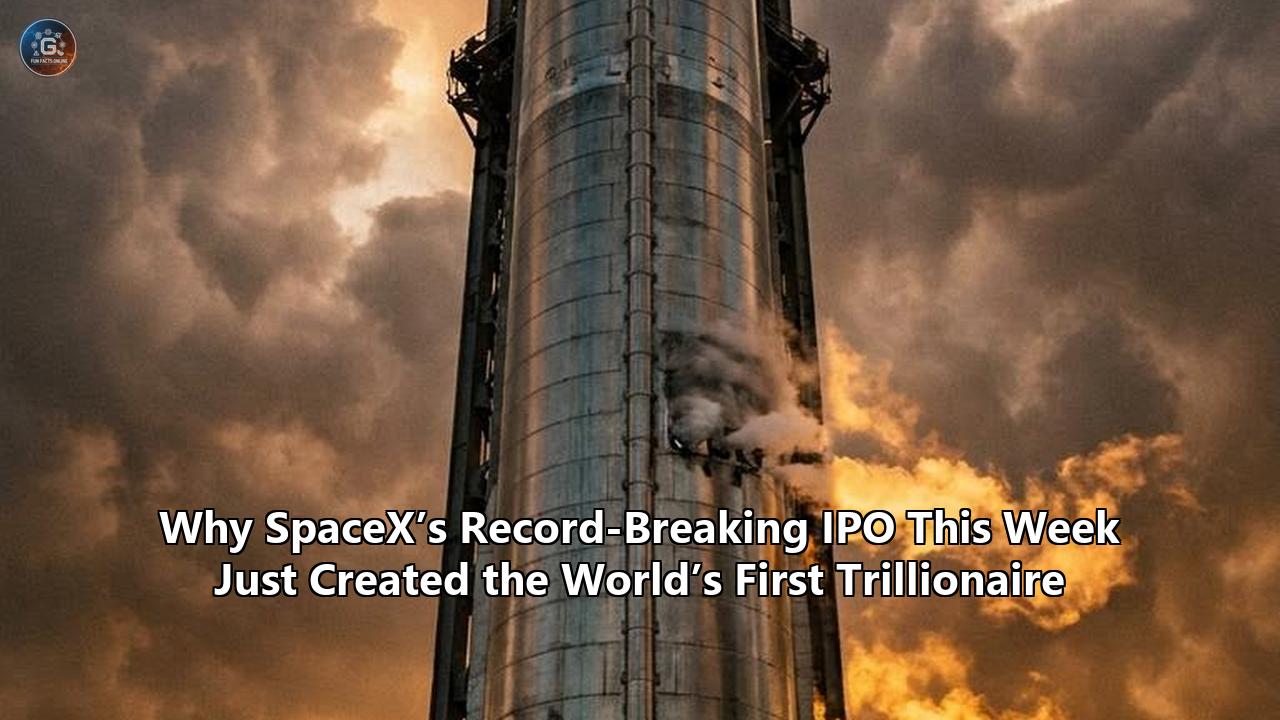
The global financial order has been permanently redrawn. On Friday, June 12, 2026, Space Exploration Technologies Corp. made its historic public market debut on the Nasdaq, executing the largest initial public offering in corporate history. Trading under the ticker symbol SPCX, the rocket, satellite, and artificial intelligence company saw its shares surge from an initial offering price of $135 to close the day at just over $161, vaulting the company's total market capitalization past the $2.1 trillion threshold.
This massive public market reception did more than just establish SpaceX as the fifth-most valuable corporation in the United States. It officially minted its founder, majority shareholder, and CEO, Elon Musk, as the world’s first-ever trillionaire. With Forbes estimating his net worth at $1.1 trillion by the close of Friday’s trading session, Musk has entered an economic stratosphere completely without precedent in modern history.
The market debut was marked by high drama and immense physical scale. At the Nasdaq exchange in New York, company executives rang the opening bell as Elton John’s "Rocket Man" played across the trading floor. Simultaneously, 1,200 miles to the south at Cape Canaveral Space Force Station in Florida, a Falcon 9 rocket roared off the pad at 9:30 AM Eastern Time, successfully delivering another batch of 29 Starlink satellites into low-Earth orbit.
“It is certainly hard to believe that a little company that started in a warehouse in El Segundo is now going public with the largest IPO ever,” Musk said during a morning address to employees at the company's Hawthorne headquarters. He reiterated that the capital raised is designed to fulfill the company’s ultimate objective: "to make humanity multiplanetary and take the fiction out of science fiction".
SPCX First-Day Trading Summary (June 12, 2026)
┌───────────────────────┬─────────────────────────┐
│ Metric                │ Value                   │
├───────────────────────┼─────────────────────────┤
│ Fixed IPO Price       │ $135.00                 │
│ Nasdaq Opening Price  │ $150.00                 │
│ Intraday High         │ $176.00                 │
│ Market Closing Price  │ $161.00                 │
│ First-Day Gain (%)    │ +19.26%                 │
│ Ending Market Cap     │ $2.10 Trillion          │
└───────────────────────┴─────────────────────────┘
The sheer scale of the SpaceX IPO has sent shockwaves through global capital markets, testing the mechanics of passive indexing and forcing Wall Street to re-evaluate the valuation of pre-revenue deep-tech ventures. By combining a high-margin global satellite broadband network with the heavy-lift capacity of the Starship program and the computing power of the recently merged xAI, SpaceX has constructed an investment thesis that transcends traditional aerospace and telecommunications.
Anatomy of the Largest Stock Market Debut in History
The SpaceX IPO was notable not only for its size, but also for its highly unusual structure. Rather than following the standard institutional bookbuilding process, where underwriters market a stock within an indicative price range over several weeks to gauge demand, SpaceX and its lead left underwriter, Goldman Sachs, opted for a fixed-price, accept-it-or-leave-it model.
The company offered exactly 555.6 million newly issued shares at a flat price of $135 per share. This pricing valued the business at $1.77 trillion prior to the commencement of public trading. There was no secondary offering or "Offer for Sale" component; every dollar of the $75 billion raised goes directly onto SpaceX’s balance sheet to fund Starship development, Starlink constellation expansion, and high-performance orbital AI data centers.
Top Global IPOs by Capital Raised (USD)
1. SpaceX (2026): $75.0 Billion
2. Saudi Aramco (2019): $25.6 Billion (raised to $29.4 Billion via overallotment)
3. Alibaba Group (2014): $21.8 Billion (raised to $25.0 Billion via overallotment)
4. SoftBank Corp (2018): $21.3 Billion
5. Agricultural Bank of China (2010): $19.2 Billion
By raising $75 billion, the transaction represents a historic milestone, nearly tripling the $25.6 billion raised by Saudi Aramco in December 2019. According to filing data from the SEC, the offering attracted more than $250 billion in institutional and retail demand by the time the order book closed on Wednesday, June 10, making it more than three-and-a-half times oversubscribed.
This intense demand translated into immediate upward pressure when trading opened at midday on Friday. The stock bypassed its $135 starting price entirely, opening at $150 and climbing as high as $176 during afternoon trading before profit-taking settled the price at $161 at the closing bell.
The massive capital injection was managed by a powerhouse syndicate of 21 major investment banks. While Goldman Sachs acted as the lead stabilization agent, Morgan Stanley, JPMorgan Chase, and Citigroup played major roles in allocating the massive blocks of stock. Crucially, the company allocated an unprecedented 30% of the total float directly to retail investors through domestic brokerage platforms, allowing everyday market participants access to the primary offering at the $135 issue price—a luxury typically reserved for elite institutional clients.
The Dual Engines of Valuation: Starlink Cash Flows and the xAI Premium
To understand how SpaceX achieved a valuation that surpasses the combined market capitalization of Boeing, Lockheed Martin, Northrop Grumman, and Airbus several times over, analysts point to two distinct corporate engines: the global recurring revenue of Starlink and the high-performance computing capabilities of xAI.
SpaceX Consolidated Revenue Composition (FY 2025)
┌─────────────────────────────────┬───────────────────┐
│ Segment                         │ Revenue (USD)     │
├─────────────────────────────────┼───────────────────┤
│ Starlink Satellite Broadband    │ $11.4 Billion     │
│ Launch Services (Falcon/Dragon) │ $5.1 Billion      │
│ National Security / Starshield  │ $1.4 Billion      │
│ xAI & Orbital Compute Services  │ $0.8 Billion      │
├─────────────────────────────────┼───────────────────┤
│ Total Revenue                   │ $18.7 Billion     │
└─────────────────────────────────┴───────────────────┘
Starlink: The Commercial Cash Engine
While rocket launches capture public attention, Starlink is the financial foundation of the company’s capital structure. In fiscal year 2025, SpaceX reported total revenues of $18.7 billion. Of this, Starlink accounted for $11.4 billion, or approximately 61% of all top-line revenue.
With millions of active subscribers globally, Starlink has transitioned from a capital-intensive infrastructure project into a highly efficient cash generator. Its user base spans residential consumers in rural markets, enterprise-grade maritime shipping fleets, commercial aviation giants, and critical national defense agencies through the dedicated "Starshield" business unit.
The launch economics of Starlink are structurally unmatched. Because SpaceX owns the Falcon 9 and Falcon Heavy launch vehicles, its internal cost to put a satellite into orbit is approximately 90% lower than that of any commercial competitor. This vertical integration allows SpaceX to continuously refresh its low-Earth orbit constellation with V3 satellites, increasing bandwidth and reducing latency while keeping capital expenditures far below those of legacy telecom networks.
The xAI Integration: Why Wall Street Paid a Tech Premium
The true catalyst for the $2 trillion valuation, however, was the corporate restructuring that took place in February 2026. In a move that shocked both Silicon Valley and Wall Street, SpaceX completed an all-stock merger with Elon Musk’s artificial intelligence startup, xAI, in a deal that valued the combined private entity at $1.25 trillion.
The logic behind the merger is both operational and physical. AI supercomputing requires massive amounts of electrical power and cooling, which has led to severe regulatory and environmental battles on Earth—such as the recent pushback over xAI’s Colossus data center facility in Memphis. By absorbing xAI, SpaceX revealed its plans to deploy high-density, liquid-cooled AI supercomputers directly into orbit, powered by massive solar arrays and cooled by the ambient temperature of space.
These orbital data centers will utilize Starlink's laser-mesh network to provide low-latency, off-grid AI inference capabilities to governments and corporate enterprises globally. The integration of Grok—xAI’s flagship generative model—into the Starlink enterprise software suite has allowed SpaceX to market itself not merely as an aerospace manufacturer, but as a sovereign cloud and AI infrastructure provider.
"Elon deserves an extreme premium because of his track record and his vision for calling technology trends early," said Shaun Maguire, a partner at Sequoia Capital. Sequoia, which had invested over $2 billion in SpaceX during its private rounds, saw the value of its holdings jump to more than $20 billion upon Friday's close.
The Paradox of a $2 Trillion Valuation and Staggering Losses
Despite the euphoric market reception, the financial reality of SpaceX is highly complex, prompting intense debate among fundamental analysts. While the other members of the exclusive $2 trillion club—Apple, Microsoft, and Nvidia—generate tens of billions of dollars in free cash flow and net profits every quarter, SpaceX is operating at a massive net loss.
According to the S-1 prospectus filed with the SEC, SpaceX posted a net loss of $4.94 billion for the full year of 2025. The financial bleeding accelerated in the first quarter of 2026, with the company reporting a single-quarter net loss of $4.28 billion, alongside an accumulated deficit of $41.3 billion.
SPCX Net Income vs. Peer Group (LTM as of Q2 2026)
┌───────────────────┬──────────────────────┬──────────────────────────┐
│ Company           │ Market Capitalization│ Net Income (Loss)        │
├───────────────────┼──────────────────────┼──────────────────────────┤
│ Microsoft (MSFT)  │ $3.15 Trillion       │ +$88.1 Billion           │
│ Nvidia (NVDA)     │ $3.08 Trillion       │ +$61.9 Billion           │
│ Apple (AAPL)      │ $2.95 Trillion       │ +$100.3 Billion          │
│ SpaceX (SPCX)     │ $2.10 Trillion       │ ($9.22 Billion)          │
└───────────────────┴──────────────────────┴──────────────────────────┘
The primary driver of these losses is the immense capital expenditure required to fund the company’s three highly ambitious initiatives:
- Starship Development: The massive, fully reusable rocket system designed to replace the Falcon 9 and eventually carry humans to Mars. Starship testing and infrastructure construction at Starbase in Boca Chica, Texas, consume an estimated $3.5 billion annually.
- Next-Generation Starlink Constellation: Manufacturing and launching thousands of heavier Starlink V3 satellites, which require the larger payload capacity of Starship to deploy at scale.
- Orbital AI Compute Clusters: The development of space-rated silicon and specialized orbital cooling arrays for xAI, a division that is currently burning cash at an estimated rate of $2.5 billion per quarter.
This extreme cash burn has divided Wall Street into two distinct camps. On one side are the traditional value investors and fundamental analysts. Morningstar published a pre-IPO report suggesting that based on discounted cash flow models of the core launch and telecom businesses, SpaceX’s fair value was closer to $780 billion. Furthermore, CFRA Research initiated coverage on Friday with a "sell" rating, warning that the company's price-to-sales ratio, which stands at an astronomical 94 based on 2025 revenues, leaves no margin for error.
On the other side are growth managers and visionaries who argue that applying backward-looking multiples to SpaceX is a fundamental analytical error.
“This is not a name you're buying based on fundamentals. For me, the analogy is Amazon,” said Nancy Tengler, Chief Executive Officer and Chief Investment Officer of Laffer Tengler Investments. “This was a company that changed the way we live. If the stock drops to $100, that’s not ideal, but it wouldn’t change our long-term view. We want to participate”.
John Belton, a portfolio manager at Gabelli Funds, drew a direct line between SpaceX and Tesla's historical market runs. “The best comparable to SpaceX is Musk's electric vehicle company Tesla, as each has an established business and a moonshot opportunity on the other side,” Belton observed. “For Tesla, that's things like humanoid robotics and other future applications. For SpaceX, it's the AI business”.
The Passive Indexing Conundrum and Nasdaq's "Fast Entry"
The massive scale of the SpaceX IPO has created unprecedented operational headaches for passive index managers. Because SpaceX listed directly with a market cap of over $1.7 trillion, it instantly became one of the largest corporate entities in the United States. Under normal circumstances, mega-cap companies must wait for quarterly index reconstitutions before they can be added to major benchmarks, giving passive funds months to slowly acquire shares.
However, to accommodate the modern wave of mega-IPOs, several major index providers recently altered their rulebooks. Most notably, the Nasdaq exchange implemented a "Fast Entry" rule, effective May 1, 2026. This rule allows newly listed companies that rank within the top 40 of all Nasdaq-listed equities by market capitalization (a threshold currently around $100 billion) to be added to the Nasdaq-100 index in just 15 trading days.
Key Index Inclusion Timelines for SPCX
┌─────────────────────────┬──────────────────────────┬─────────────────────────────────┐
│ Index Provider          │ Inclusion Mechanism      │ Effective Target Date           │
├─────────────────────────┼──────────────────────────┼─────────────────────────────────┤
│ Nasdaq-100              │ Fast Entry (15 Days)     │ July 3, 2026                    │
│ S&P 500 (SPDJI)         │ Regular Seasoning        │ Post-4 Consecutive Profitable   │
│                         │ (No Fast Entry)          │ Quarters (Est. 2028 or later)   │
│ CRSP (Vanguard)         │ Accelerated Mega-Cap     │ 5 Trading Days (June 19, 2026)  │
└─────────────────────────┴──────────────────────────┴─────────────────────────────────┘
Furthermore, Nasdaq eliminated its traditional 10% minimum free-float requirement, allowing low-float stocks to receive a weighting multiplier of up to three times their actual float. Because Elon Musk owns 42% of SpaceX’s equity and controls 85% of the voting rights through Class B super-voting shares, the actual public float of SPCX is relatively small compared to its total valuation. Under the new rules, passive mutual funds and Exchange-Traded Funds (ETFs) tracking the Nasdaq-100 will be forced to buy billions of dollars of SPCX shares to match their benchmark weights, regardless of the stock's valuation or lack of earnings.
This dynamic has created intense concern among institutional traders, who warn that the price discovery process for SpaceX is being driven more by structural liquidity imbalances than by underlying financial performance. Passive tracking funds are essentially forced buyers, meaning that any upward movement in the stock price could trigger a feedback loop of mandatory buying, driving the price even higher.
Conversely, S&P Dow Jones Indices (SPDJI) has taken a much more conservative approach. Following an intensive market consultation that concluded on May 28, 2026, SPDJI decided to maintain its strict financial viability screens for the S&P 500. Under these rules, a company must have a track record of cumulative positive earnings over the most recent four quarters to be eligible for S&P 500 inclusion. Because SpaceX is projected to remain unprofitable through at least 2027 due to its heavy CapEx cycle, it will be excluded from the S&P 500 for the foreseeable future, creating a massive tracking divergence between Nasdaq-focused and S&P-focused investment products.
From El Segundo Warehouse to a Multiplanetary Balance Sheet
To fully appreciate the significance of this week’s public listing, it is necessary to trace the path SpaceX has traveled since its founding in 2002. Gwynne Shotwell, the company's long-time President and Chief Operating Officer, stood on the balcony of the Nasdaq exchange and reflected on the company's operational journey.
“Today, we make history again. We have a history of making history,” Shotwell told the crowd of traders.
SpaceX Historical Milestones (2002–2026)
• 2002: Founded by Elon Musk in El Segundo, California.
• 2008: Falcon 1 becomes the first privately developed liquid-fuel rocket to reach orbit.
• 2012: Dragon spacecraft becomes the first commercial vehicle to berth with the ISS.
• 2015: First successful vertical landing of an orbital-class rocket booster (Falcon 9).
• 2019: First operational launch of Starlink satellites; Saudi Aramco sets previous IPO record.
• 2020: First commercial crewed mission (Demo-2) launches NASA astronauts.
• 2026: Merges with xAI in February; launches record-breaking IPO on June 12.
The transformation of SpaceX from a highly speculative venture-backed startup into a sovereign-scale defense and communications provider is one of the most remarkable stories in industrial history. For the first two decades of its existence, the company relied on private capital markets, raising billions through sequential funding rounds that saw its private valuation climb from $30 billion in 2018 to $800 billion by late 2025.
The transition to public markets was designed to solve a critical structural bottleneck: the need for infinite capital. While venture capital firms have deep pockets, the sheer scale of building a permanent city on Mars and deploying hundreds of artificial intelligence data centers in space requires liquidity that only public equity markets can provide.
Furthermore, the IPO has acted as a massive wealth redistribution event for SpaceX’s workforce. Over the past decade, SpaceX frequently paid its engineers, technicians, and operations staff in stock options and restricted stock units (RSUs). While the company hosted semi-annual tender offers to allow employees to sell shares back to the company, these private transactions were highly restricted and subject to strict valuation caps.
With Friday's public listing, those employee-owned shares have been converted into fully liquid Nasdaq-traded stock. Analysts estimate that the IPO has turned more than 8,000 current and former SpaceX employees into paper millionaires, creating a localized economic boom in aerospace hubs like Hawthorne, California; Brownsville, Texas; and Cape Canaveral, Florida.
The Sovereign Wealth of Elon Musk: The World's First Trillionaire
While the IPO has enriched thousands of employees, its most historic consequence is the concentration of wealth at the very top of the company. With a net worth now eclipsing $1.1 trillion, Elon Musk’s personal fortune has reached a scale that invites comparison to historical figures like John D. Rockefeller or Augustus Caesar, rather than his modern tech peers.
The World's Wealthiest Individuals (Estimated Net Worth as of June 13, 2026)
1. Elon Musk (CEO, SpaceX / Tesla / xAI): $1.10 Trillion
2. Jeff Bezos (Founder, Amazon): $225 Billion
3. Bernard Arnault & Family (LVMH): $210 Billion
4. Mark Zuckerberg (CEO, Meta Platforms): $195 Billion
5. Bill Gates (Co-Founder, Microsoft): $160 Billion
To put Musk’s $1.1 trillion net worth into perspective, his personal wealth is now larger than the annual Gross Domestic Product (GDP) of nations such as Saudi Arabia, Turkey, Switzerland, and Argentina. If Musk were a sovereign state, his personal balance sheet would rank as the 18th largest economy on earth.
This wealth concentration is driven by his unique ownership structure within SpaceX. Unlike many tech founders who see their ownership stakes diluted to single-digit percentages by the time their companies go public, Musk retained a massive 42% equity stake in SpaceX. He accomplished this by personally funding the company during its early, high-risk years and structured his subsequent compensation packages around aggressive, valuation-based stock awards.
The creation of the world's first trillionaire has reignited fierce geopolitical and economic debates. Critics argue that such an extreme concentration of wealth in a single individual is a symptom of a deeply flawed global tax code and represents a threat to democratic governance. Indeed, Musk’s financial influence now extends far beyond the corporate sphere; through Starlink, he effectively controls the satellite communications infrastructure of multiple sovereign nations, and his personal decisions can directly impact regional conflicts and global security frameworks.
Supporters, however, argue that Musk's capital is not being hoarded in static trusts or luxury real estate, but is instead being deployed into high-risk, capital-intensive endeavors that governments have either abandoned or underfunded.
"Musk is essentially acting as a one-man sovereign wealth fund for the advancement of human technology," said Nancy Tengler. "Whether you look at electric vehicles, orbital communications, neural interfaces, or Mars colonization, these are projects with multi-decade paybacks that traditional public markets would never fund on their own. He is bypassing government bureaucracy by using his personal capital to force these industries into existence."
The $28.5 Trillion Market Opportunity: Risks and the Road Ahead
As SpaceX begins its journey as a publicly traded entity, the market's attention is turning toward the strategic targets outlined in the company’s S-1 prospectus. In its investor pitch, SpaceX claimed that its total addressable market (TAM) spans a staggering $28.5 trillion—a figure it called "the largest market opportunity in human history".
This addressable market is built on several key phases of expansion:
Phase 1: Global Broadband and Sovereign Defense (2026–2030)
The near-term priority is the complete monopolization of global satellite communications. SpaceX intends to use the proceeds of the IPO to double the size of the Starlink constellation, deploying direct-to-cell technologies that will allow standard smartphones to connect directly to satellites without the need for specialized hardware.
Simultaneously, the company is rapidly expanding its "Starshield" defense division, securing multi-billion-dollar contracts with the U.S. Department of Defense and allied nations to provide secure, jam-resistant orbital reconnaissance and communications networks.
Phase 2: Orbital Supercomputing and AI Infrastructure (2028–2035)
By leveraging the physical infrastructure of Starlink and the software model of xAI, SpaceX plans to offer commercial "Compute-as-a-Service" from low-Earth orbit. These orbital data centers will target multinational corporations, financial institutions, and research agencies that require high-velocity data processing free from terrestrial power constraints, cooling limitations, and domestic data-localization laws.
Phase 3: The Multiplanetary Economy (2030 and Beyond)
The most speculative, yet highly capitalized, segment of the business involves the development of industrial infrastructure on the Moon and Mars. The S-1 filing outlines plans for "Moonbase Alpha"—a permanent lunar research and extraction facility—as well as the deployment of automated manufacturing facilities to process local Martian resources.
However, the prospectus contains several highly unusual "Mars Colony" disclosures and risk factors that have raised eyebrows among securities lawyers:
- Sovereignty Risks: The S-1 explicitly warns that SpaceX does not recognize the jurisdiction of terrestrial laws on Mars, stating that the company will govern its Martian settlements through a system of self-appointing councils and smart contracts, which may lead to unprecedented international legal conflicts with earthbound governments.
- Atmospheric Entry Failures: The document notes that any systemic failure in Martian atmospheric entry technology would result in the complete loss of crew and cargo, potentially halting the Mars program indefinitely.
- Resource Utilization Risks: The financial viability of Martian colonization depends on the successful extraction of local water ice and carbon dioxide to synthesize methane rocket fuel. The failure to establish these automated chemical plants would trap returning Starships on the Martian surface.
What to Watch Next
As SPCX enters its second week of trading, the financial community will be watching several key milestones to determine if the stock can sustain its historic $2.1 trillion valuation:
- The 180-Day Lockup Expiration: Inside investors, early venture backers, and employees are currently bound by a standard 180-day lockup agreement, preventing them from selling their shares on the open market. When this period expires in December 2026, a massive wave of supply could hit the market, testing the depth of institutional demand.
- Starship's Rapid Reusability Milestones: The financial model of the company assumes that Starship will achieve full, rapid reusability—allowing the booster and ship to land, refuel, and launch again within hours. Any setback in this operational loop will significantly increase launch costs and delay the deployment of next-generation Starlink and xAI hardware.
- Geopolitical Regulatory Pushback: With SpaceX now controlling a public utility of global scale, antitrust regulators in the United States and the European Union are expected to increase scrutiny. Specifically, the integration of Starlink's distribution network with xAI's software suite may face swift legal challenges from terrestrial tech rivals such as Google, Meta, and Microsoft.
By combining the commercial dominance of Starlink with the high-risk, high-reward promise of artificial intelligence and deep-space exploration, SpaceX has forced the financial world to embrace an entirely new dimension of asset valuation. Whether this historic IPO represents a massive market bubble or the opening chapter of humanity's expansion into the solar system, one reality is undeniable: the era of the trillion-dollar corporation has given way to the era of the trillion-dollar individual, and the race for the stars is now fully fueled by the engines of Wall Street.
Reference:
- https://www.theguardian.com/science/2026/jun/12/spacex-stock-price-ipo-spcx
- https://www.zacks.com/featured-articles/741/spacex-ipo
- https://www.fool.com/investing/how-to-invest/stocks/how-to-invest-in-spacex-stock/
- https://www.bnnbloomberg.ca/business/technology/2026/06/12/after-record-ipo-musks-spacex-faces-next-test-in-market-debut/
- https://cleartax.in/s/spacex-ipo-spcx-2026
- https://www.bitmex.com/blog/spacex-ipo-guide
- https://intellectia.ai/blog/spacex-ipo-2026-starlink-valuation