Stanford University physicists have recorded the first direct, real-time observation of a quantum jump in sound. The experiment, published in Science, tracks an individual phonon—the fundamental unit of mechanical vibration—as it abruptly drops out of existence inside a microscopic resonator.
For centuries, acoustic physics has treated the decay of sound as an unbroken, continuous decline. Strike a bronze bell or pluck a guitar string, and the vibrations slowly bleed away into the surrounding atmosphere, smoothly decaying until the object returns to rest.
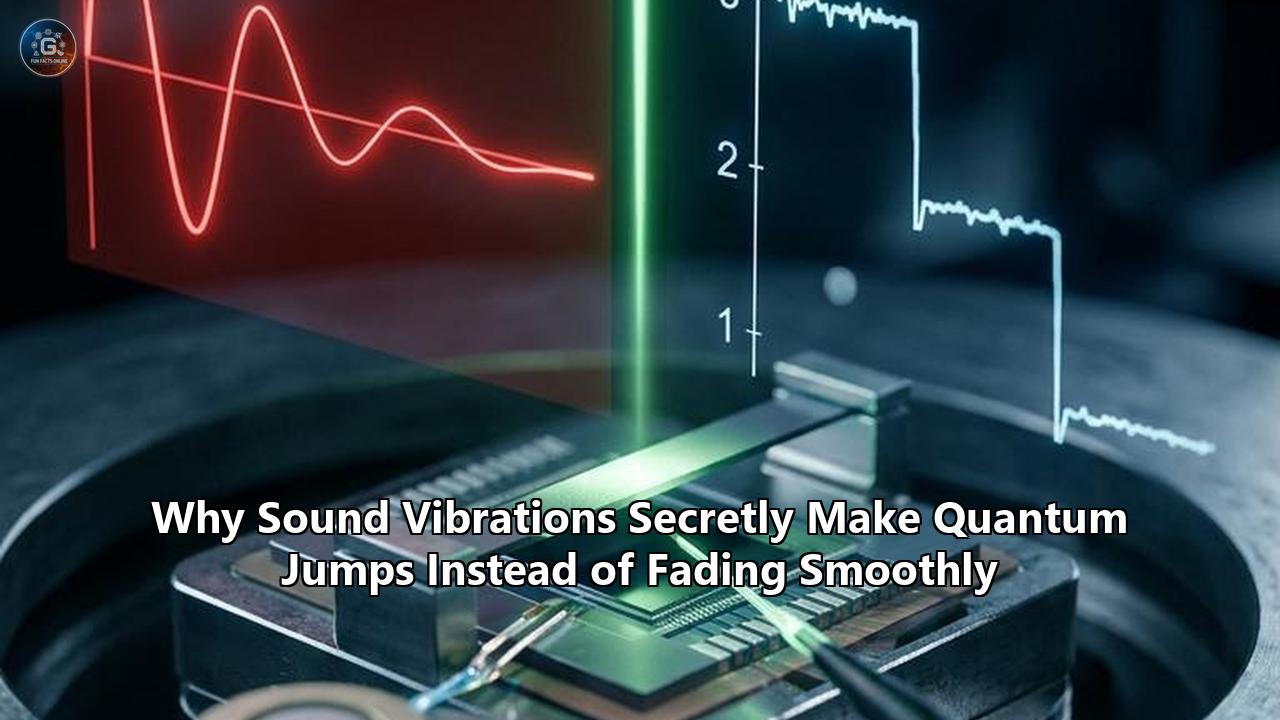
The new data from Stanford dismantles that classical picture at the fundamental limit. When cooled to near absolute zero and isolated inside a microchip, sound does not fade gradually. A mechanical resonator containing a single quantum of vibrational energy does not glide through fractions of a vibration. Instead, it vibrates with full intensity at the single-phonon level for an unpredictable duration, then drops instantaneously to zero.
Classical View (Smooth Decay):
Energy |----------------\
       |                 \
       |                  \___________
       +------------------------------> Time

Quantum Reality (Discontinuous Jump):
Phonon |
State  |
 |1>   |-----------------------+
       |   (persists randomly) |
 |0>   |                       +------> Time (instantaneous drop)
The achievement bridges a historic 113-year trajectory in quantum physics. Sudden quantum transitions have been observed in orbital electrons and electromagnetic photons, but phonons represent an entirely different physical category: the coordinated, collective motion of trillions of atoms bound inside a solid material. Observing this process required solving an engineering paradox that had stalled the field of quantum acoustics for decades—namely, how to detect an acoustic quantum without absorbing the vibration or destroying the state through measurement backaction.
"What this study shows will allow us to move forward with developing new quantum technologies with sound," said Amir Safavi-Naeini, associate professor of applied physics at the Stanford School of Humanities and Sciences, who led the research team. "We have seen that vibrating objects can exhibit quantum behavior, which is the prerequisite for many of the operations needed by quantum computing and sensing."
The path to this moment represents a systematic climb across a century of theoretical disputes, cryogenic innovations, and nanofabrication leaps.
1913–1926: The Theoretical Friction Over Discontinuous Leaps
The concept of a quantum jump was born as a radical departure from classical continuum physics. In 1913, Danish physicist Niels Bohr proposed his model of the atom to explain why orbiting electrons did not continuously radiate energy and spiral catastrophically into the atomic nucleus. Bohr postulated that electrons occupy fixed, quantized orbits. When transitioning between orbits, they do not pass through intermediate space; they leap instantaneously from one discrete energy level to another, emitting or absorbing a single photon of light.
The physics community divided sharply over Bohr’s proposal. Erwin Schrödinger, whose continuous wave equation became the bedrock of non-relativistic wave mechanics in 1926, rejected the concept of sudden leaps. Schrödinger argued that physical reality must evolve continuously and smoothly, declaring: "If we have to go on with these damned quantum jumps, then I'm sorry that I ever got involved with quantum theory."
Schrödinger, Albert Einstein, and Max Born debated whether these transitions were genuine physical discontinuities or merely mathematical bookkeeping that hid an underlying, continuous dynamical process. For decades, the debate remained strictly academic. In bulk matter and macroscopic instruments, Avogadro-scale numbers of particles averaged out any quantum fluctuations. In macroscopic acoustics, James Jeans and Lord Rayleigh had established sound as a continuous thermodynamic pressure wave.
Even as Igor Tamm (in 1930) and Felix Bloch (in 1932) introduced the concept of the phonon—treating quantized elastic lattice vibrations mathematically like photons—the prevailing assumption remained that mechanical motion at human scales was inherently classical. The continuous decay of sound described by Newton's laws and Navier-Stokes acoustics appeared impervious to quantum discontinuities.
1986–2007: First Proofs in Isolated Matter and Trapped Light
The escalation toward observing mechanical quantum jumps began not in solids, but in high-vacuum ion traps and mirror-lined cavities.
The turning point for atomic systems arrived in 1986. Three independent teams—Hans Dehmelt's group at the University of Washington, David Wineland's team at the National Bureau of Standards (now NIST) in Boulder, and Warren Nagourney's laboratory—succeeded in isolating a single barium or mercury ion in an electromagnetic Paul trap. By illuminating the isolated ion with two laser beams driving distinct electronic transitions (a strong fluorescent transition and a weak shelving transition), the researchers witnessed something unprecedented. The ion's bright fluorescence flashed continuously, suddenly went dark for a fraction of a second, and then abruptly switched back on.
The telegraph-like blinking provided the first empirical confirmation of Bohr's leaps: the electron was jumping between energy levels, completely halting fluorescence whenever it was shelved into a metastable state.
Ion Fluorescence Telegraph Signal (1986):
Signal |
Bright |---¬     ┌---¬     ┌-------¬
       |   |     |   |     |       |
  Dark |   └-----┘   └-----┘       └------> Time
Two decades later, in 2007, Serge Haroche and his colleagues at the École Normale Supérieure in Paris extended this reality from matter to light. Haroche’s group trapped microwave photons inside a superconducting Fabry-Pérot cavity made of niobium mirrors cooled to 0.8 Kelvin. The cavity mirrors were polished to such high reflectivity that a single photon could bounce back and forth for over a tenth of a second—traveling a distance equivalent to circling the Earth's equator.
To measure the trapped photons without absorbing them, Haroche sent a beam of circular Rydberg rubidium atoms through the cavity. The atoms interacted dispersively with the cavity field: the presence of photons shifted the quantum phase of the atom's wave function without causing the atom to absorb any light. By measuring this phase shift via Ramsey atomic interferometry, Haroche watched individual photons appear and disappear, registering quantum jumps of light.
These twin milestones established the baseline experimental framework for quantum jumps mechanics in atomic and optical domains. Yet sound remained stubborn. Photons are pure electromagnetic field excitations, and trapped ions are isolated single particles. A phonon is fundamentally different. It is a quasiparticle, an emergent excitation consisting of trillions of lattice nuclei and electrons displacing collectively. To bring a macroscopic mechanical object into the quantum regime and isolate a single acoustic quantum appeared, to many, to be prevented by thermal noise and environmental decoherence.
2010–2018: Cooling the Macroscopic to the Zero-Point
The bridge between quantum electronics and macroscopic mechanical motion was built in Santa Barbara, California. In 2010, Andrew Cleland and John Martinis at the University of California, Santa Barbara, achieved a long-sought milestone: cooling a human-made mechanical oscillator to its quantum mechanical ground state.
Their device was a microscopic piezoelectric aluminum nitride plate resonator, vibrating at a frequency of 6 gigahertz. At room temperature, thermal energy ($k_B T$) vastly exceeds the energy of a single gigahertz vibrational quantum ($h f$):
$$\frac{k_B T}{h f} \gg 1$$
At room temperature (300 K), a 6 GHz resonator contains an average thermal population of roughly 1,000 phonons, fluctuating wildly. To purge these thermal phonons, Cleland and Martinis cooled the resonator inside a dilution refrigerator to 25 millikelvin. At this temperature, the probability of finding a thermal phonon drops below 1 percent:
$$P_{\text{thermal}} = \frac{1}{e^{hf / k_B T} - 1} \approx 0$$
The oscillator was effectively frozen into its quantum ground state ($|0\rangle$), where its motion is dominated entirely by zero-point fluctuations. Cleland and Martinis then coupled the mechanical device to a superconducting phase qubit. By driving resonant energy swaps between the qubit and the resonator, they deterministically deposited a single phonon into the oscillator and confirmed its quantum state.
The 2010 UCSB experiment proved that mechanical motion could be quantized. However, it could not track a single phonon jumping in real time. The coupling was resonant, meaning the qubit absorbed the phonon to measure it. The act of measuring demolished the quantum state.
Furthermore, the mechanical resonator suffered from rapid energy dissipation. Its mechanical quality factor ($Q$) was modest, and the phonon survived for only about 6 nanoseconds before leaking into the substrate. Detecting a quantum jump requires the ability to watch a state continuously without destroying it, on a timescale far longer than the measurement itself. A 6-nanosecond lifetime was far too brief to permit repeated quantum non-demolition (QND) interrogations.
Following the Santa Barbara experiment, research accelerated along two distinct tracks:
- Cavity Optomechanics: Teams led by Tobias Kippenberg at EPFL, Markus Aspelmeyer at the University of Vienna, and Oskar Painter at Caltech used radiation pressure inside optical cavities to laser-cool micro-mirrors and silicon nanobeams.
- Superconducting Electromechanics: Konrad Lehnert and John Teufel at NIST integrated vibrating aluminum drums with superconducting microwave resonators, generating squeezed states and quantum entanglement between macroscopic motion and electrical currents.
Yet, across these systems, direct detection of mechanical motion relied on measuring position or momentum quadratures ($\hat{x}$ or $\hat{p}$). Measuring a mechanical oscillator's continuous displacement produces an averaged classical signal that smoothly decays according to an exponential envelope. The discrete, discontinuous nature of the underlying quantum jumps mechanics remained hidden beneath displacement noise and quantum backaction.
2019–2024: The Rise of Circuit Quantum Acoustodynamics
To observe sound jumping instead of fading, physicists had to invent a completely new domain: circuit quantum acoustodynamics (cQAD). The approach abandoned continuous position measurements, borrowing instead the non-destructive dispersive readout techniques pioneered in cavity quantum electrodynamics.
The critical turning point came through high-overtone bulk acoustic wave resonators (HBAR) and phononic crystal engineering. In 2017 and 2018, a research group led by Yiwen Chu, then working at Yale University and subsequently at ETH Zurich, coupled superconducting transmon qubits to bulk acoustic sound waves trapped inside sapphire crystals.
The HBAR architecture allowed sound to bounce inside the crystal with quality factors reaching tens of millions. Because the sapphire crystal lacked intrinsic piezoelectricity, Chu's team integrated a thin piezoelectric transducer film at the surface, converting mechanical strain into electrical charge that could interact with an adjacent superconducting circuit.
By 2022, Chu’s team demonstrated that they could achieve the "strong dispersive regime" of quantum acoustics. In this regime, the mechanical resonator and the superconducting qubit are intentionally detuned from one another in frequency. They do not exchange energy directly. Instead, their interaction is governed by a dispersive Hamiltonian:
$$\hat{H}_{\text{disp}} = \hbar \omega_r \hat{a}^\dagger \hat{a} + \frac{1}{2}\hbar \left( \omega_q + 2\chi \hat{a}^\dagger \hat{a} \right) \hat{\sigma}_z$$
Here:
- $\omega_r$ is the mechanical resonance frequency.
- $\omega_q$ is the bare transition frequency of the superconducting qubit.
- $\hat{a}^\dagger \hat{a} = \hat{n}$ is the phonon number operator.
- $\chi$ is the dispersive cross-Kerr shift.
The equation reveals the core trick: the qubit’s resonance frequency shifts by a precise, measurable amount, $2\chi$, for every single phonon added to the mechanical resonator. If the resonator contains zero phonons ($n=0$), the qubit rings at frequency $\omega_q$. If it holds exactly one phonon ($n=1$), the qubit’s frequency shifts to $\omega_q + 2\chi$.
Crucially, this frequency shift occurs without the qubit absorbing the phonon. The measurement probes the quantum state of the sound wave non-destructively.
In 2023, the ETH Zurich group made headlines by preparing macroscopic "Schrödinger cat" states of sound—superpositions of counter-propagating acoustic waves involving billions of atoms. Yet, even with these advances, resolving individual phonon transitions in real time remained impossible. The acoustic lifetimes in planar chips were still too short, or the dispersive shifts were too weak relative to the qubit’s decoherence rate.
Physicists could obtain snapshot spectroscopy of phonon Fock states, but they could not construct a temporal film of a single phonon living, waiting, and vanishing.
2025: The Stanford Bottleneck and Nanofabrication Redesign
By the spring of 2025, Amir Safavi-Naeini's laboratory at Stanford University had assembled a setup designed to break this deadlock.
The primary barrier was acoustic leakage. In conventional micromechanical devices, gigahertz sound waves rapidly leak away through the physical anchor points connecting the resonator to the chip substrate. Every lost vibration constitutes an unmonitored channel of dissipation, converting the sharp quantum jump into an unresolved, blurry decay.
Safavi-Naeini, alongside co-first authors Takuma Makihara and Erik Szakiel, turned to thin-film lithium niobate, a material renowned for its strong piezoelectric coupling. But lithium niobate is notorious in quantum engineering: its material defects and piezoelectric properties routinely introduce severe dielectric loss into superconducting circuits, poisoning the coherence of nearby qubits.
To eliminate this crosstalk, the Stanford team developed a separate-die fabrication and transfer-printing technique. They fabricated the lithium niobate mechanical resonator on one substrate and the superconducting transmon qubit on a separate chip, physically bonding and integrating them with micro-precision.
To trap the sound, Makihara and Szakiel etched a 1D phononic crystal directly into the suspended lithium niobate membrane. The phononic crystal consists of a periodic array of nanoscale cross-slits and holes that create an acoustic bandgap—a mechanical frequency range where acoustic waves cannot propagate.
Stanford Phononic Crystal Resonator Architecture:
[Acoustic Mirror] === [ Central Defect (Sound Trap) ] === [Acoustic Mirror]
(Phononic Bandgap)        (Gigahertz Vibration)           (Phononic Bandgap)
       \                                                         /
        +------ Traps Sound for ~2 Milliseconds ----------------+
                                   |
                Dispersively Coupled via Electric Field
                                   |
                     [ Superconducting Qubit ]
The central defect in this crystal acted as an acoustic cavity, flanked by acoustic mirrors on either side that reflected gigahertz phonons back and forth without letting them escape into the silicon chip.
In the spring of 2025, the Stanford team captured their first experimental traces. The setup produced hints of discrete telegraph signals, but the signal-to-noise ratio was marginal.
"Amir told us that you had to squint to see the jumps," recalled Makihara. The background microwave thermal noise, stray electromagnetic coupling, and parasitic qubit dephasing were obscuring the phonon readout.
The researchers made a calculated decision: instead of rushing to publish an ambiguous result, they held back, spent more than a year re-engineering the fabrication pipeline, and stripped out every extraneous source of loss. They reshaped the phononic crystal mirrors to push acoustic reflection to unprecedented limits, extended the mechanical ringdown time, and refined the microwave readout filtering inside the cryostat.
When the redesigned chips were mounted in the dilution refrigerator in early 2026, the mechanical resonator achieved an intrinsic acoustic lifetime of approximately two milliseconds at gigahertz frequencies.
A two-millisecond lifetime is brief in human terms, but for a solid-state structure oscillating billions of times per second, it represents a remarkable duration. Safavi-Naeini drew an evocative comparison: if an ordinary handheld tuning fork retained its vibrational energy as effectively as their microscopic lithium niobate beam, it would ring continuously for several hours after being struck once.
September 2026: The Direct Observation of Quantum Jumps in Sound
With a 2-millisecond acoustic window and a dispersive shift $\chi$ far outstripping the measurement noise, the Stanford team initiated continuous non-demolition monitoring of the mechanical mode. The findings were released in the journal Science.
Inside a gold-plated dilution refrigerator cooled to 15 millikelvin, the researchers used calibrated microwave pulses to prepare the mechanical resonator in its first excited Fock state: the $|1\rangle$ state, containing exactly one quantum of vibrational energy.
Once the single phonon was initialized, the superconducting qubit acted as a vigilant, non-destructive observer. The qubit probed the resonator using continuous parity checks. Because the system was configured in the strong dispersive regime, the qubit interrogated the mechanical state via state-dependent phase rotations without absorbing the acoustic quantum.
During the single 2-millisecond ringdown period, the team carried out roughly 170 consecutive QND parity measurements. The measurement sequence achieved a 99 percent quantum non-demolition fidelity. This enabled the researchers to interrogate the system over and over, recording a step-by-step temporal record of a single mechanical quantum trajectory.
Experimental Readout Sequence:
Time (μs)   Qubit Parity Measurement    Inferred Phonon State
  0                Odd                         |1>
  10               Odd                         |1>
  20               Odd                         |1>
  ...              ...                         ...
  840              Odd                         |1>
  850              Odd                         |1>
====================== QUANTUM JUMP OCCURS ======================
  860              Even                        |0>
  870              Even                        |0>
  880              Even                        |0>
The measurement record showed that the single phonon did not decay along an exponential slope. The displacement amplitude did not decline into three-quarters of a phonon, half a phonon, or a quarter of a phonon. For hundreds of microseconds—through thousands of individual wave cycles—the mechanical resonator remained locked at energy state $n=1$.
Then, within a time window shorter than the resolution of a single measurement step, the state collapsed: the phonon disappeared, and the system dropped cleanly to the ground state $n=0$.
The telegraph signal was clear and direct. The team repeated the protocol thousands of times, compiling individual trajectories. While the exact jump time for any individual trial was strictly random—governed by the probabilistic nature of quantum measurement and environmental coupling—the statistical average across all individual step-functions reproduced the smooth classical exponential decay curve seen in macroscopic acoustics.
"When they showed me the results from the new chip, it was clear that we had the result; I was extremely excited," Safavi-Naeini recounted. "This is something I had wanted to see since I was a graduate student."
Co-first author Erik Szakiel highlighted the engineering breakthrough required to make the detection possible: "We had to continually develop new processes to make this extremely long-lived, vibrating object and then integrate it with the qubit, which is our little electrical detector—without ruining either subsystem."
The Core Physics: Why Everyday Sound Appears Continuous
The Stanford experiment resolves a fundamental physics paradox: why does human auditory experience perceive sound as smoothly fading, when the underlying quantum jumps mechanics dictates that mechanical energy drops in discontinuous leaps?
The answer lies in the interplay between quantum expectation values, macroscopic occupation numbers, and environmental decoherence.
1. The Large Number of Quanta ($n \gg 1$)
When a piano key strikes a string or an alarm sounds, the vibration contains an immense number of phonons. The acoustic energy $E$ of a classical vibration at frequency $\omega$ is given by:
$$E = \left(n + \frac{1}{2}\right) \hbar \omega$$
For an audible acoustic wave at 1 kHz carrying just one microwatt of acoustic power for a fraction of a second, the phonon occupation number $n$ easily exceeds:
$$n \sim 10^{18} \text{ phonons}$$
When an object loses energy from an initial state of $10^{18}$ phonons, it undergoes $10^{18}$ individual quantum jumps to reach the ground state. A drop of $\Delta n = 1$ constitutes an energy shift of:
$$\frac{\Delta E}{E} \sim 10^{-18}$$
No human ear and no classical sensor can register a change of one part in a quintillion. At macroscopic scales, the staircase of discrete steps is so tightly packed that it mimics a perfectly smooth incline—a direct manifestation of Niels Bohr’s Correspondence Principle.
2. Ensemble Averaging Versus Single Trajectories
In an ordinary acoustics laboratory, sensors measure the expectation value of the displacement operator, $\langle \hat{x}(t) \rangle$, or the average energy $\langle \hat{H}_{\text{mech}} \rangle$.
The master equation describing a damped harmonic oscillator coupled to a thermal reservoir gives the time evolution of the average phonon number:
$$\frac{d\langle \hat{n} \rangle}{dt} = -\gamma (\langle \hat{n} \rangle - n_{\text{th}})$$
Integrating this equation yields the standard exponential decay familiar to every mechanical engineer:
$$\langle \hat{n}(t) \rangle = n(0) e^{-\gamma t}$$
Until now, laboratory instruments recorded only this ensemble average, $\langle \hat{n}(t) \rangle$, which is smooth and continuous.
The Stanford experiment bypassed ensemble averaging by conducting continuous, condition-dependent quantum measurements on a single quantum system. In quantum measurement theory, the state vector $|\psi(t)\rangle$ does not evolve according to the deterministic Lindblad master equation; it follows a stochastic Schrödinger equation conditioned on the measurement record:
$$d|\psi\rangle = -i \hat{H}_{\text{eff}} |\psi\rangle dt + \left( \frac{\hat{c} |\psi\rangle}{\|\hat{c} |\psi\rangle\|} - |\psi\rangle \right) dN(t)$$
where $\hat{c} = \sqrt{\gamma} \hat{a}$ is the jump operator associated with phonon loss, and $dN(t)$ is a Poisson random variable that equals 0 almost everywhere, but spikes to 1 at the precise, unpredictable instant the quantum jump occurs.
By measuring the discrete eigenvalue spectrum rather than continuous displacement, Makihara, Szakiel, and Safavi-Naeini forced the acoustic system to reveal its stochastic trajectory, demonstrating that the classical decay curve is nothing more than the statistical sum of millions of discontinuous leaps.
Comparison of Readout Paradigms:
1. Ensemble / Classical Displacement Measurement:
   Signal = Average over millions of cycles
   Trace: Smooth exponential decay [ exp(-γt) ]

2. Single-Trajectory Quantum Non-Demolition Measurement:
   Signal = Real-time eigenvalue tracking
   Trace: Discrete stochastic step-function [ |1> -> |0> ]
Escalation of Capability: Comparing Milestones
The direct observation of quantum jumps across physical media demonstrates how quantum control has systematically expanded across larger, more complex physical platforms.
| Year | Physical System | Fundamental Medium | Experimental Leaders | Detection Technique | Primary Coherence Bottleneck |
|---|---|---|---|---|---|
| 1986 | Single trapped ions ($Ba^+, Hg^+$) | Electronic internal state | Dehmelt, Wineland, Nagourney | Electron shelving and optical fluorescence blinking | Laser frequency jitter, trap rf noise |
| 2007 | Microwave photons | Trapped electromagnetic field | Haroche, Raimond, Brune (ENS Paris) | Non-destructive circular Rydberg atom phase shift | Mirror absorption, thermal cavity photons |
| 2010 | Bulk nanomechanical resonator | Macroscopic acoustic vibration | Cleland, Martinis (UCSB) | Resonant absorption via superconducting phase qubit | Short phonon lifetime (6 ns), substrate loss |
| 2023 | High-overtone bulk acoustic resonator (HBAR) | Macroscopic bulk sound | Chu et al. (ETH Zurich) | Dispersive spectroscopy, cat state preparation | Readout backaction, interface strain dephasing |
| 2026 | Thin-film lithium niobate phononic crystal | Localized acoustic phonons (sound) | Safavi-Naeini, Makihara, Szakiel (Stanford) | Real-time QND dispersive tracking via transmon qubit (~170 checks/lifetime) | Piezoelectric dielectric loss, fabrication defects |
Practical Ramifications: The Quantum Computing and Sensing Frontier
Catching a single phonon mid-leap is more than an answer to a century-old foundational question in quantum physics. The ability to isolate, monitor, and manipulate sound at the single-quantum limit opens critical practical pathways for next-generation technology.
                 PRACTICAL HORIZONS OF QUANTUM ACOUSTICS
                                    |
      +-----------------------------+-----------------------------+
      |                                                           |
      v                                                           v
[ Quantum Computing Hardware ]                             [ Quantum Metrology & Sensing ]
  • Compact Bosonic Memories                                 • Single-Molecule Mass Spectrometry
    (Sound is 10^5 times slower than light)                    (Caltech collaboration: cell proteins)
  • Autonomous Error Detection                               • Ultra-Precise Accelerometers & Gyroscopes
    (Real-time tracking of jump syndromes)                     (Inertial navigation without GPS)
1. Sound-Based Quantum Memories and Error Correction
In modern quantum computing architectures, a central challenge is the physical footprint of hardware and the rapid loss of coherence. Microwave photons travel at approximately $300,000 \text{ km/s}$. Storing an electromagnetic wave inside a cavity requires physical structures on the millimeter-to-centimeter scale.
Acoustic waves, by contrast, propagate through solids at approximately $3,000 \text{ to } 5,000 \text{ m/s}$—roughly five orders of magnitude slower than light.
Because sound moves so slowly, an acoustic wave packet has a wavelength tens of thousands of times smaller than a microwave photon of the identical frequency. This enables ultra-compact quantum memories:
- Thousands of mechanical modes can be etched into a lithium niobate chip the size of a fingernail.
- These modes can store quantum states as long-lived phonon packets.
Critically, the Stanford experiment solves the monitoring problem in bosonic error correction. In bosonic codes (such as cat codes or GKP codes), computational errors arise primarily from single-phonon loss events ($|n\rangle \to |n-1\rangle$). Until now, hardware could not detect exactly when a loss event happened without wiping out the stored data.
By achieving continuous, 99 percent non-demolition monitoring, researchers can use the underlying quantum jumps mechanics as a real-time error-syndrome detector. The moment an acoustic memory register makes a quantum jump, the monitoring qubit flags the event, allowing the system to apply a recovery pulse before phase coherence completely dissolves.
2. High-Precision Biological and Molecular Sensing
Because mechanical motion is directly modulated by mass, strain, and gravitational force, a single-phonon resonator represents an extraordinarily sensitive physical probe.
Safavi-Naeini’s group is actively collaborating with Michael Roukes’ laboratory at the California Institute of Technology to deploy this platform for nanoscale mass spectrometry.
When an individual biological molecule—such as an antibody, protein complex, or virus—binds to the surface of the vibrating lithium niobate beam, the added mass shifts the resonator's mechanical frequency:
$$\Delta \omega = -\frac{\omega_0}{2 M_{\text{eff}}} \Delta m$$
Because the effective mass ($M_{\text{eff}}$) of the Stanford resonator is exceptionally small, the adsorption of a single protein shifts the frequency enough to be registered by the coupled qubit. Tracking the device at the quantum jump limit could allow biophysicists to identify individual macromolecules within living cells without chemical fluorescent tagging, by weighing them one by one.
3. Next-Generation RF Surface Acoustic Wave Devices
Beyond specialized quantum computing, sound waves are already the unsung workhorses of modern telecommunications. Every modern 5G smartphone relies on dozens of Surface Acoustic Wave (SAW) and Bulk Acoustic Wave (BAW) filters to slice the electromagnetic spectrum, isolate radio bands, and block wireless interference.
Szakiel pointed out that mastering sound at its absolute physical boundary feeds back directly into classical materials science: "This shows we can have incredibly fine-tuned control of sound, which might mean that devices that use sound as a fundamental technology can get much better."
Understanding acoustic dissipation at the single-phonon level helps engineers identify the precise chemical and structural defects that cause insertion loss in commercial micro-acoustic filters, leading to more power-efficient mobile hardware and clearer satellite communication links.
What to Watch: The Next Frontiers in Quantum Sound
The demonstration of real-time quantum jumps in sound closes an important chapter in quantum mechanics, but it initiates several challenging experimental programs that researchers are preparing to tackle next:
- Multiphonon Escalation: The Stanford team has observed the $|1\rangle \to |0\rangle$ transition. The immediate next challenge is tracking the multi-quanta cascade: initializing states with $n=2$, $n=3$, or higher Fock numbers and watching the sequential staircase of jumps in real time ($|3\rangle \to |2\rangle \to |1\rangle \to |0\rangle$). Observing how decay rates scale with phonon number ($\Gamma_n = n \gamma$) will test macroscopic quantum coherence limits.
- Catching and Reversing the Jump Mid-Flight: In 2019, an atomic physics team led by Zlatko Minev and Michel Devoret at Yale showed that quantum jumps in superconducting circuits are not truly instantaneous, but continuous, coherent excursions that can be intercepted and reversed mid-flight using real-time feedback. Applying this to a macroscopic sound wave would require microsecond-scale feedback loops to detect an impending acoustic jump and reverse it before the phonon vanishes.
- Multi-Resonator Entanglement and Acoustic Networks: Scaling up the transfer-printing fabrication will allow researchers to link multiple long-lived mechanical resonators through a shared superconducting bus on a single chip. This architecture will test whether macroscopic entangled states of sound can be sustained and routed across a microchip network.
- Searching for Dark Matter and Gravity-Induced Collapse: Because mechanical resonators couple directly to mass, macroscopic quantum states of sound are prime candidates for testing foundational physics. Ultracold mechanical resonators operating at the single-phonon limit could serve as terrestrial detectors for high-frequency gravitational waves or light dark-matter candidates (such as dark photons) that impart minute, discrete momentum kicks to atomic lattices. Furthermore, increasing the physical mass of the vibrating resonator may test Roger Penrose's and Lajos Diósi’s theories of gravitationally induced quantum state reduction, probing whether gravity itself forces macroscopic systems to collapse into classical certainty.
Sound, which began in the classical physics of antiquity as a simple mechanical pressure wave, has now completed its journey into the quantum fold. The smooth fade of a vibrating crystal is officially unmasked: underneath the silence, sound steps into nothingness, one quantum jump at a time.
Reference:
- https://www.discovermagazine.com/scientists-catch-sound-making-a-quantum-jump-with-a-microscopic-tuning-fork-49708
- https://www.eweek.com/news/stanford-first-real-time-quantum-jump-sound/
- https://en.socportal.info/en/news/physicists-have-observed-a-quantum-leap-in-sound-in-real-time-for-the-first-time/
- https://sciencesprings.wordpress.com/2026/09/22/from-the-stanford-school-of-humanities-and-sciences-via-the-brighter-side-of-news-scientists-catch-sound-making-a-quantum-jump-with-a-microscopic-tuning-fork/
- https://www.thebrighterside.news/post/stanford-physicists-observe-a-quantum-jump-of-sound-for-the-first-time/
- https://www.facebook.com/61560066990109/posts/scientists-in-the-united-states-have-directly-observed-quantum-jumps-in-sound-fo/122233875284335566/
- https://www.sciencedaily.com/releases/2026/09/260921081054.htm
- https://en.socportal.info/en/news/physicists-have-observed-a-quantum-leap-in-sound-in-real-time-for-the-first-time/
- https://humsci.stanford.edu/feature/researchers-observe-first-real-time-quantum-jump-sound
- https://pubs.aip.org/aapt/ajp/article-pdf/70/3/332/7530823/332_1_online.pdf
- https://arxiv.org/pdf/1002.4055
- https://espace.library.uq.edu.au/view/UQ:227119
- https://sciencesprings.wordpress.com/2026/09/22/from-the-stanford-school-of-humanities-and-sciences-via-the-brighter-side-of-news-scientists-catch-sound-making-a-quantum-jump-with-a-microscopic-tuning-fork/
- https://www.discovermagazine.com/scientists-catch-sound-making-a-quantum-jump-with-a-microscopic-tuning-fork-49708
- https://thegoodpress.news/article/stanford-quantum-jump-sound-phonon-2026
- https://humsci.stanford.edu/feature/researchers-observe-first-real-time-quantum-jump-sound
- https://quantumzeitgeist.com/stanford-humanities-quantum-jump-sound-captures/
- https://daily.dev/posts/researchers-observe-first-real-time-quantum-jump-in-sound-1uiy1lu4i
- http://www.sciencedaily.com/releases/2026/09/260921081054.htm
- https://cfp.physics.northwestern.edu/documents/1999_Peil_Steve.pdf