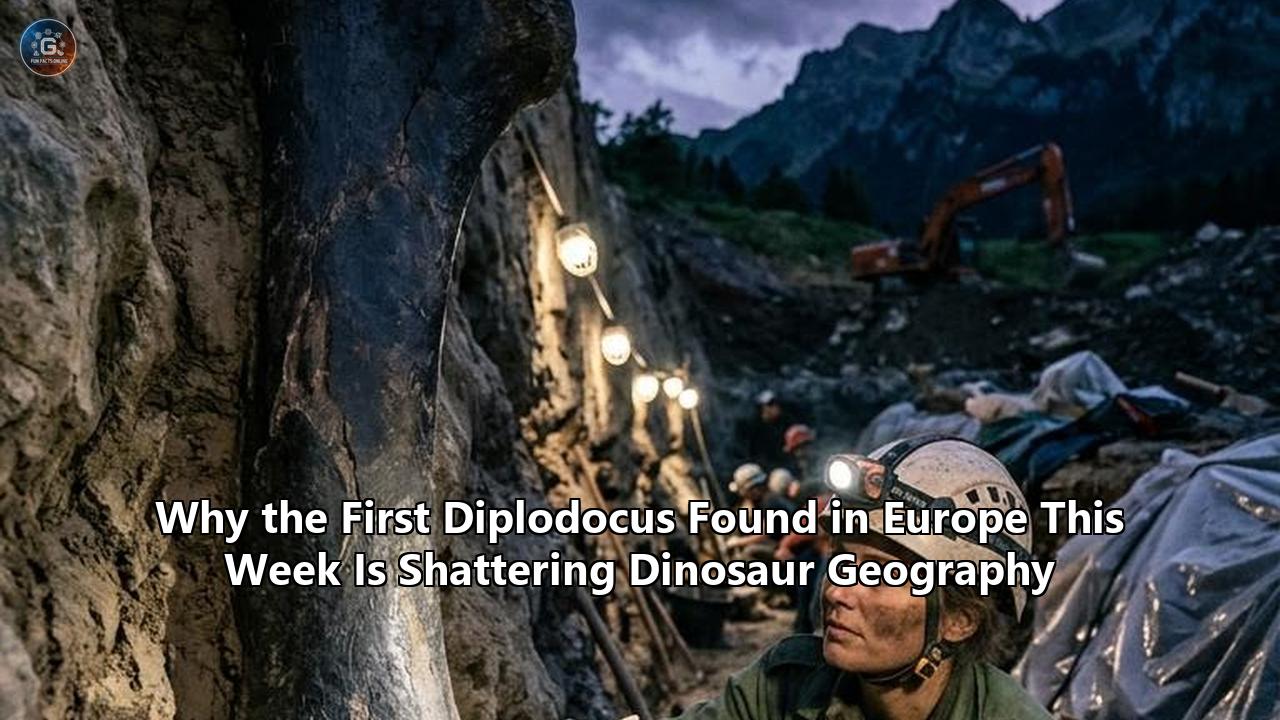
Fourteen tail vertebrae unearthed from the mudstones of eastern Spain have officially redrawn the map of the prehistoric world. In a study published in the Journal of Vertebrate Paleontology, researchers from the Fundación Conjunto Paleontológico de Teruel-Dinópolis confirmed that fossil remains excavated at the La Tejería site near El Castellar belong to the genus Diplodocus.
Dating back approximately 150 million years to the Kimmeridgian-Tithonian transition of the Late Jurassic period, the fossilized tail bones and associated chevrons represent the first diplodocus in Europe.
For 148 years, ever since Benjamin Mudge and Samuel Wendell Williston first pulled its long-tailed silhouette from the soil of Cañon City, Colorado, Diplodocus has stood as the quintessential symbol of the American West. Every valid specimen discovered between 1877 and the present day originated within the Morrison Formation, a massive sweep of sedimentary rock spanning Wyoming, Colorado, Utah, and Montana. The sudden, verified presence of this 25-meter-long, whip-tailed giant in the Iberian Peninsula strips the Morrison of its most famous proprietary resident.
This is not merely an expanded pin on a museum distribution map. The confirmation of the first diplodocus in Europe delivers tangible fossil evidence of dry-land dispersal corridors traversing the early Atlantic Ocean. It directly challenges long-held paleogeographic reconstructions that depicted Europe as an isolated marine archipelago completely cordoned off from North American megafauna.
By anchoring a verified Diplodocus to the eastern margin of the Iberian plate, the discovery forces a systemic reassessment of Late Jurassic plate tectonics, coastal sea-level regressions, and the ecological dynamics governing the largest animals to ever walk on land.
The Osteological Case: How 14 Tail Bones Solved a Transatlantic Mystery
The fossil sequence at the center of the study, cataloged as CT-30, does not include a skull, limbs, or cervical columns. In vertebrate paleontology, diagnosing a genus solely from caudal vertebrae can be hazardous. Yet the mid-to-rear tail sequence recovered at the La Tejería site—encompassing vertebrae 22 through 35 alongside multiple V-shaped chevron bones—preserves a very specific suite of diagnostic markers.
Specimen CT-30 Diagnostic Features:
├── Caudal Vertebrae (Positions 22–35)
│   ├── Markedly elongated vertebral centra without lateral ridges
│   ├── Deep longitudinal ventral grooves spanning the underside
│   └── Extensive pneumatic depressions tied to the respiratory air-sac system
└── Hemal Arches (Chevrons)
    ├── Symmetrical, distinctively bifurcated anterior and posterior branches
    └── Deep longitudinal hollows across the medial internal surfaces
During the initial excavations in 2008, the Dinópolis field crew recovered five articulated vertebrae. Subsequent digs conducted across 2014 and 2015 added nine more vertebrae and associated chevrons to the sequence. As the lab technicians mechanically prepped the matrix away from the bone surfaces, anatomical traits distinct to the subfamily Diplodocinae began to emerge.
"It was an exciting and continuous process of seeing the pieces of the puzzle gradually fall into place," said lead author Sergio Sánchez Fenollosa, a doctoral researcher in evolutionary biology at the Dinópolis Foundation. "From the early stages of the osteological study, we noticed strong similarities with several diplodocine sauropods. As we looked more closely at the anatomy, we began to identify a combination of features characteristic of Diplodocus species. With each new result, the picture became clearer: we were looking at a Diplodocus."
To establish definitive taxonomy, the research team coded 23 morphological characters observed across CT-30 into a comprehensive sauropod matrix comprising 489 cranial and postcranial anatomical characters evaluated across 36 distinct taxa. The matrix was subjected to both maximum parsimony analysis and tip-dated Bayesian phylogenetic inference.
Both analytical methods returned the same topological result: CT-30 resolved inside the genus Diplodocus, placed as a sister taxon to Diplodocus hallorum (the massive species once designated as Seismosaurus).
The Spanish animal stretched roughly 25 meters from its snout to the tip of its whip-like tail, weighing an estimated 15 to 20 metric tons. It lived along coastal floodplains preserved in what geologists classify as the Villar del Arzobispo Formation, an Upper Jurassic sedimentary succession characterized by carbonate ramps, deltaic mudflats, and alluvial plains.
Shattering the Endemic Archipelago Model
To comprehend why the discovery disrupts Mesozoic paleontology, one must understand how the Late Jurassic world was historically mapped.
For much of the late 20th century, paleogeographers treated the Kimmeridgian and Tithonian stages (roughly 155 to 145 million years ago) as an era of continental divorce. Pangea had fractured. The young central North Atlantic Ocean was actively unzipping, spreading seafloor crust and driving North America westward while Eurasia remained to the east.
Standard textbook models characterized Europe as a semi-submerged, fragmented island chain—the European Archipelago—surrounded by the Tethys Ocean to the south and the developing Atlantic seaway to the west. Under this model, European sauropods were expected to be insular endemics: unique lineages that evolved in isolation, such as the dwarf titanosaurs seen in Cretaceous Romania, or localized holdovers such as the primitive Turiasaurus.
Finding a textbook North American giant like Diplodocus nestled inside Iberian sediments destroys the narrative of complete Jurassic isolation.
Dispersal Vectors: Theropod Footing vs. Sauropod Bulk
Before the El Castellar discovery, paleontologists observed hints of faunal continuity across the Atlantic, but the evidence was contested or confined to more mobile organisms:
- The Megatheropods: Fossils belonging to apex predators such as Allosaurus, Ceratosaurus, and the colossal megalosaur Torvosaurus had previously been documented within Portugal's Lourinhã Formation.
- The Armor-Plated Herbivores: In 2007, an isolated skeleton assigned to Stegosaurus ungulatus was identified in Portugal, giving the first hard evidence that plated ornithischians operated on both landmasses.
Skeptics in paleogeography, however, routinely pushed back against transoceanic continuity. Predatory theropods possessed lighter, bipedal builds, theoretically enabling them to swim across narrow channels or follow transient coastlines. Furthermore, several European sauropod bones originally labeled as diplodocids during the 19th and early 20th centuries were later debunked as non-diplodocid eusauropods or indeterminate scraps upon modern re-examination.
A 25-meter, 20-ton quadrupedal sauropod cannot swim across deep marine troughs. It cannot raft on floating mats of vegetation. It cannot negotiate hyper-saline inland seas without vast, continuous corridors of fresh water, abundant soft foliage, and firm substrate capable of supporting hundreds of metric tons of herd biomass.
The presence of Diplodocus in Teruel confirms that the oceanic gap between the North American landmass and the Iberian plate was bridged by emergent, uninterrupted, subaerial land bridges during the Late Jurassic.
Geodynamic Mechanism of Late Jurassic Interchange:
[North American Landmass (Morrison Basin)]
                      │
   Thermal/Tectonic Uplift & Ocean Crust Rifting
                      ▼
[Subaerial Corridor / Ephemeral Land Bridge across Proto-Atlantic]
  (Exposed during ~154–150 Ma Eustatic Regressions)
                      ▼
[Iberian Landmass (Villar del Arzobispo Basin)]
Geological analyses indicate that between 154 and 151 million years ago, tectonic uplift linked to the early rift shoulders of the Grand Banks and the Iberian margin coincided with major eustatic marine regressions—global drops in sea level.
These falling seas exposed transient ribbons of land connecting the eastern reaches of modern Newfoundland and the western shelf of the Iberian microplate. Dinosaurs did not cross an ocean; they simply followed emerging vegetated lowlands across a corridor that opened and shut as sea levels rose and fell.
Who Is Affected: Shifting the Scientific and Cultural Stakes
The identification of this specimen immediately reverberates across multiple professional disciplines, historical institutions, and regional communities.
1. Structural Biogeographers and Stratigraphers
Tectonic modelers can no longer reconstruct the North Atlantic rift basin solely through marine sediment cores and magnetic anomalies on the ocean floor. The presence of the first diplodocus in Europe supplies a concrete, non-negotiable terrestrial boundary condition. Stratigraphers must now match the specific depositional phases of the Morrison Formation’s Brushy Basin Member with the Villar del Arzobispo Formation in Spain, pinpointing the exact temporal windows when sea levels dropped enough to permit transcontinental crossing.
2. Mesozoic Paleoecologists
The discovery fundamentally alters the food-web models constructed for the Late Jurassic Iberian ecosystem. Eastern Spain was not merely a local haven for indigenous curiosities; it was an overlapping theater of global sauropod megafauna.
Paleoecologists now have to quantify how a massive, low-to-mid-tier browser like Diplodocus integrated into an ecosystem already packed with competing giants. The Villar del Arzobispo and underlying formations preserve:
- Turiasaurus riodevensis: One of the most massive animals ever found in Europe, weighing up to 40 metric tons, possessing broad, heart-shaped teeth suited for crushing tough plant matter.
- Losillasaurus giganteus: Another endemic turiasaurian adapted to intermediate canopy exploitation.
- Indeterminate macronarians and camarasaurids: Sauropods equipped with robust, spoon-shaped spatulate teeth designed for high-browsing fibrous vegetation.
Adding a diplodocine—specialized in broad-arc, ground-level grazing and stripping gymnosperm foliage using peg-like, pencil-shaped teeth—means Iberian Mesozoic landscapes maintained an extraordinarily refined degree of ecological niche partitioning.
Niche Partitioning in the Iberian Late Jurassic:
┌──────────────────────────┬─────────────────────────────┬──────────────────────────┐
│ Sauropod Group           │ Dental Morphology           │ Target Vegetation Tier   │
├──────────────────────────┼─────────────────────────────┼──────────────────────────┤
│ Turiasauria              │ Broad, spatulate,           │ Mid-tier canopy, fibrous │
│ (*Turiasaurus*)          │ heart-shaped crowns         │ woody gymnosperms        │
├──────────────────────────┼─────────────────────────────┼──────────────────────────┤
│ Macronaria               │ Stout, chisel-shaped,       │ High canopy, tough       │
│ (Camarasaurids)          │ interlocking crowns         │ conifers and cycads      │
├──────────────────────────┼─────────────────────────────┼──────────────────────────┤
│ Diplodocinae             │ Slender, pencil-like,       │ Low-to-ground sweep,     │
│ (*Diplodocus* CT-30)     │ forward-raking teeth        │ ferns, soft gymnosperms  │
└──────────────────────────┴─────────────────────────────┴──────────────────────────┘
3. Museum Curators and Scientific Heritage
Culturally, few dinosaurs carry the weight of Diplodocus. When industrialist Andrew Carnegie financed the excavation of Diplodocus carnegii in Sheep Creek, Wyoming, in 1899, he manufactured plaster replicas and gifted them to crowned heads and state museums across Europe, Latin America, and Asia.
For over a century, London’s Natural History Museum, the Muséum National d’Histoire Naturelle in Paris, and the Museo de Ciencias Naturales in Madrid presented "Dippy" as an exotic North American curiosity brought across the sea to teach Europeans about foreign deep time.
The discovery upends that century-old narrative. Diplodocus is no longer an American export visiting Europe; it is a native European taxon. The real fossil bones of CT-30 have already been installed in the dinosaur gallery at the Aragonese Museum of Paleontology in Teruel, reframing the region as an evolutionary crossroads rather than a peripheral backwater.
What Changes: Systemic Revisions in Dinosaur Paleontology
The confirmation of Diplodocus at El Castellar dismantles several assumptions that have structured vertebrate paleontology for decades.
Dismantling the "Morrison Exclusivity" Assumption
Historically, whenever fragmentary sauropod fossils emerged from Late Jurassic deposits outside North America showing elongated neck or tail vertebrae, taxonomic conservatism kicked in. Paleontologists routinely assigned them to new, distinct local genera (Dinheirosaurus, Supersaurus cousins, or unnamed eusauropods) under the assumption that true Diplodocus could not exist outside the Morrison depositional basin.
This regional exclusivity bias skewed evolutionary trees. Researchers often forced phylogenies to assume that geographical barriers automatically bred generic distinctions. The placement of CT-30 demonstrates that the genus Diplodocus had a pan-Laurasian distribution, stretching thousands of kilometers from modern-day Utah all the way to modern-day Aragon.
Historical Model:
[North American Interior Basin]  --->  Strict Endemism (*Diplodocus*)
[European Archipelago Shelf]    --->  Distinct Genera (*Dinheirosaurus*, Turiasaurs)

Revised Post-Discovery Model:
[Continuous Laurasian Faunal Province]
├── Western Sector: Morrison Formation (*Diplodocus*, *Allosaurus*, *Stegosaurus*)
└── Eastern Sector: Iberian Formations (*Diplodocus*, *Allosaurus*, *Stegosaurus*)
Re-evaluating Sauropod Locomotion and Range Sizes
Large extant mammals like the African elephant (Loxodonta africana) operate across massive home ranges to satisfy metabolic and caloric requirements. A fully grown Diplodocus, clocking in at three to four times the mass of an adult bull elephant, required massive swathes of productive land to maintain viable population genetics.
If Diplodocus existed on both sides of the juvenile North Atlantic, individual home ranges must have linked across continental corridors. This discovery changes how biomechanists calculate minimum viable habitat space for sauropods. These animals were not sedentary swamp dwellers or localized river-valley feeders; they were continental voyagers capable of traversing trans-oceanic rift systems the moment an ecological corridor emerged.
Short-Term Consequences: An Audit of European Museum Basements
The immediate, practical fallout from the Teruel paper will unfold within fossil preparatory labs, museum drawers, and academic journals over the next 12 to 36 months.
The Fragmentary Fossil Re-Analysis
Across natural history collections in Lisbon, London, Paris, and Madrid sit hundreds of isolated sauropod caudal vertebrae, ribs, and limb fragments gathered over the past two centuries. Many are labeled vaguely as Cetiosaurus, Ornithopsis, Pelorosaurus, or simply "Sauropoda indet."
Research teams are already assembling plans to re-examine these historical collections using the character matrix validated on CT-30.
Particular scrutiny will land on:
- The Lourinhã Formation of Portugal: Several isolated diplodocid vertebrae discovered near Torres Vedras will now face rigorous micro-CT scanning and re-coding.
- The Kimmeridge Clay and Wealden deposits of the United Kingdom: Scattered historic tail bones stored in the British Geological Survey archives will be reassessed to see if Diplodocus ranged northward into the British portion of the Laurasian landmass.
- The Charentes Basin of South-Western France: French Late Jurassic excavations that yielded mid-sized sauropod chevrons can now be benchmarked directly against the bifurcated chevron anatomy identified at El Castellar.
Funding and Excavation Priorities in Iberia
The Maestrazgo Basin and the South Iberian Basin in eastern Spain have suddenly vaulted to the top of international paleontological priorities. Because the Spanish specimen was found in an articulated, sequential state (vertebrae 22 through 35 resting in anatomical order), taphonomic logic dictates that more of the individual skeleton may remain encased within the surrounding limestone and clay layers at the La Tejería site.
Field resources will be directed toward expanding the quarry footprint. Finding a skull, cervical vertebrae, or a pelvic girdle of the Spanish Diplodocus would resolve whether CT-30 belongs to an existing North American species (such as Diplodocus hallorum) or represents a fully distinct, endemic European sister species: Diplodocus sp. nov.
Long-Term Consequences: Geodynamics, Macroevolution, and the K-J Boundary
Looking further down the pipeline, the confirmation of the first diplodocus in Europe sets off a chain reaction across larger Earth-system sciences, transforming how researchers model macroevolution, climate pulses, and plate movements across deep time.
Long-Term Scientific Impacts:
├── Geodynamic Calibration: Provides biological proof for early opening rates of the Atlantic
├── Sequence Stratigraphy: Links dinosaur crossing events to orbital Milankovitch cycles
└── Faunal Turnover Studies: Tracks the sudden decline of diplodocids leading into the Cretaceous
1. Recalibrating Atlantic Geodynamic Rifting Models
Geophysicists modeling the breakup of Pangaea use paleomagnetic striping and seismic reflection data to estimate when continental rifting transitions into true oceanic seafloor spreading. Yet tectonic models frequently feature temporal margins of error stretching across several million years.
The survival of terrestrial megafauna acts as a biological stopwatch. Because the Spanish Diplodocus dates precisely to the terminal Jurassic (~150 Ma), it proves that an uninterrupted continental or shallow-shoal land route remained physically passable at that exact moment.
If the Atlantic spreading center had already inundated the northern proto-rift with deep, continuous abyssal water by 152 million years ago, a 20-ton land-dwelling sauropod could not have reached Teruel. Geodynamicists will have to calibrate their rift-opening models to accommodate this subaerial window, revising the timing of deep oceanic separation between Iberia and the North American Grand Banks downward into the Early Cretaceous.
2. Linking Terrestrial Dispersal to Milankovitch Climate Pulses
Dinosaurs crossing continents did not happen randomly. Dispersal events relied on sequence stratigraphy: the rise and fall of sea levels driven by orbital cycles and glacio-eustasy (or aquifer-eustasy, the storage of water in continental groundwater reservoirs).
The presence of Diplodocus in Spain allows stratigraphers to connect terrestrial vertebrate evolution directly with marine sequence stratigraphy. By matching the Villar del Arzobispo horizons with Morrison Formation sequences, scientists can correlate the migration of giant sauropods with global marine transgressive-regressive cycles. Dinosaurs essentially followed falling sea levels across exposed continental shelves, retreating and becoming isolated when highstands returned.
3. The Enigma of the Jurassic-Cretaceous Faunal Turnover
Perhaps the deepest macroevolutionary question impacted by this find is why diplodocids disappeared so dramatically shortly after this interchange.
During the Late Jurassic (150 million years ago), diplodocids were the most abundant, successful, and ecologically dominant herbivores on Earth, inhabiting both North America and Europe. Yet by the Berriasian stage of the Early Cretaceous (roughly 145 million years ago), true diplodocids were virtually eradicated from the northern hemisphere, replaced by emerging iguanodontian ornithopods and titanosaurian sauropods.
Proving that Diplodocus successfully colonized Europe right before this crisis provides a critical baseline. It shows that their subsequent extinction across Laurasia was not a localized North American phenomenon driven by regional drought in the Morrison basin.
Instead, whatever environmental, floral, or climatic disruption caused the demise of the diplodocids was a systemic, cross-continental catastrophe that wiped out populations simultaneously in the American interior and the European shelf.
The Road Ahead: Crucial Milestones to Watch
While the study in the Journal of Vertebrate Paleontology permanently changes dinosaur distribution maps, several core questions remain open, presenting an active roadmap for paleontologists over the coming years.
Upcoming Milestones & Open Inquiries:
[2026–2027 Fieldwork at La Tejería] ──> Uncovering appendicular/cranial fossils
                                           │
[Geochemical Isotope Sourcing]       ──> Strontium analysis of enamel/bone matrix
                                           │
[Pan-European Collections Audit]     ──> Identification of misclassified diplodocids
                                           │
[Definitive Species Determination]   ──> Morphological split: *D. hallorum* vs. sp. nov.
Is It a Migrant, or an Endemic Species?
The study designates the specimen as Diplodocus sp. because tail vertebrae alone cannot definitively differentiate between a known species (Diplodocus carnegii or Diplodocus hallorum) and an entirely new, geographically distinct species.
The primary task for the Dinópolis team will be the recovery of limb elements or, ideally, teeth and basicranial elements. Cranial structures hold the most diagnostic power in sauropod taxonomy. If forthcoming excavations reveal skull elements bearing anatomical divergences from the American skulls housed in Pittsburgh and Denver, the Iberian dinosaur will gain its own species name, formally establishing Europe's own domestic lineage of the iconic genus.
Tracking the Route via Isotope Geochemistry
Field researchers are already preparing to apply strontium (^87Sr/^86Sr) and oxygen (^18O) isotope analyses to the crystalline structures of CT-30's bone apatite.
Strontium isotope signatures reflect the geochemical composition of the bedrock that an animal drank from and consumed vegetation upon while its bones were actively remodeling. If the Spanish Diplodocus possesses an isotopic signature matching the Appalachian or Canadian Shield uplands of North America, it would imply that individual animals made transcontinental journeys during their single lifespans.
If the bones match the local isotopic ratios of eastern Spain's Jurassic carbonate aquifers, it will prove that a self-sustaining, multigenerational breeding population of Diplodocus was living, reproducing, and dying on European soil.
The Search for the "Missing" Intermediates
If Diplodocus crossed the proto-North Atlantic into Spain, it did not take a direct flight. The migration route had to pass through land corridors stretching across what is now offshore maritime Canada, Greenland, or the UK-Irish landmasses.
Geologists are refocusing attention on Late Jurassic exposures in:
- The Scotian Basin and Grand Banks (offshore eastern Canada): Evaluating core samples and seismic reconstructions to locate exposed paleo-land surfaces.
- The Hebrides Basin of Scotland: Looking closely at sauropod trackways and bone beds in places like the Isle of Skye, where Late Jurassic sauropod tracks are preserved in tidal sediments.
- The Lusitanian Basin of Portugal: Re-analyzing early Tithonian strata that sit between the Morrison and Villar del Arzobispo formations to chart the directionality of the dispersal wave.
The discovery at La Tejería ends a 150-year-old geographic monopoly. By establishing that the iconic giant walked through the coastal forests of prehistoric Spain, the verified confirmation of the first diplodocus in Europe dismantles continental boundaries, restores a lost terrestrial bridge across the early Atlantic, and permanently alters how science views the geography of the Jurassic world.
Reference:
- https://www.sci.news/paleontology/spanish-diplodocus-15064.html
- https://www.zmescience.com/science/paleontology/paleontologists-in-spain-found-the-first-diplodocus-ever-discovered-outside-north-america/
- https://www.thebrighterside.news/post/first-diplodocus-found-outside-north-america-rewrites-dinosaur-migration-history/
- https://www.sciencedaily.com/releases/2026/09/260918024807.htm
- https://blog.everythingdinosaur.com/blog/_archives/2026/09/17/caudal-vertebra-reveal-diplodocus-in-europe.html
- https://www.facebook.com/gmanews/posts/spanish-scientists-find-first-evidence-of-diplodocus-dinosaur-in-europe/1698428125662171/
- https://english.elpais.com/science-tech/2026-09-15/first-diplodocus-found-outside-north-america-discovered-in-spain.html
- https://en.socportal.info/en/news/diplodocus-has-been-confirmed-outside-north-america-for-the-first-time/
- https://discover.swns.com/2026/09/fossilised-diplodocus-found-in-europe-for-the-first-time/
- https://www.ancientpages.com/2026/09/16/iconic-diplodocus-discovered-in-spain-first-evidence-outside-north-america/
- https://www.discoverwildlife.com/dinosaurs/diplodocus-spain