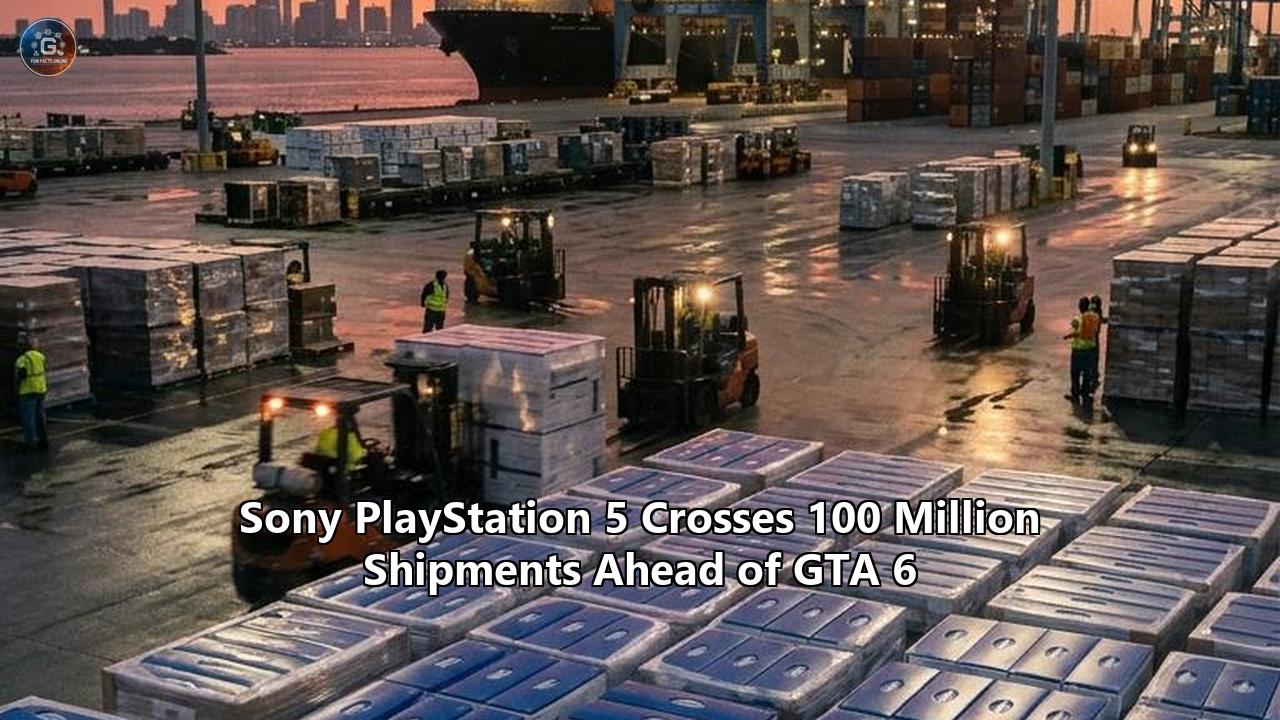
Sony Interactive Entertainment officially crossed the 100-million threshold for PlayStation 5 shipments on November 10, 2026, an internal milestone recorded in the company’s corporate business data just forty-eight hours before the console’s sixth anniversary.
The achievement arrives at an unprecedented strategic inflection point for the electronic entertainment industry. With Rockstar Games’ Grand Theft Auto VI scheduled for worldwide release on November 19, 2026, Sony has pushed 2.1 million consoles into retail channels within forty days following the close of its second fiscal quarter, rapidly closing the gap from 97.9 million cumulative shipments logged on September 30. The sudden surge in retail stocking reflects an aggressive campaign to secure living rooms before the release of what industry projections indicate will be the highest-grossing entertainment rollout in history.
The accomplishment places the PlayStation 5 in rarefied territory. It becomes only the eighth dedicated gaming platform across half a century to ship 100 million units, joining the PlayStation 2, PlayStation 4, original PlayStation, Nintendo Switch, Nintendo DS, Game Boy, and Nintendo Wii. It also solidifies Sony’s commercial dominance over its primary rival, Microsoft, whose Xbox Series X and Series S hardware sits at an estimated lifetime shipment tally of roughly 38 million units.
Yet the trajectory that brought the PlayStation 5 to 100 million shipments has violated almost every historical precedent of console product lifecycles. Rather than following the traditional curve of early manufacturing bottlenecks giving way to rapid component cost deflation and retail price reductions, the PlayStation 5 survived catastrophic global supply shortages, weathered unprecedented component cost hikes, absorbed mid-generation hardware price increases, and sustained its momentum through structural changes in the wider gaming software economy.
Tracing the escalation from its chaotic November 2020 arrival to its 100-million milestone illuminates how an embattled hardware launch transformed into the most profitable console generation in Sony Group’s history.
The Escalation Timeline
November 2020 ────► Launch under pandemic lockdowns and severe component deficits
July 2021     ────► Fastest console to hit 10M shipments despite retail stockouts
August 2022   ────► Unprecedented global hardware price hike amid inflation
January 2023  ────► Supply crisis declared over; production hits historic pace
December 2023 ────► System crosses 50M shipments during record fiscal quarter
November 2024 ────► Mid-generation pivot: PS5 Pro debuts at $699 premium price
September 2026────► Q2 FY2026 finishes at 97.9M; shipments slow to 2.6M per quarter
October 2026  ────► GTA 6 pre-order wave triggers retail pipeline ramp (2.1M in 40 days)
November 2026 ────► PlayStation 5 crosses 100M shipments 9 days ahead of GTA 6
2020–2021: The Scarcity Crucible and Semiconductor Strangulation
The PlayStation 5 arrived on November 12, 2020, under commercial conditions without historical parallel. Amid global pandemic lockdowns, consumer demand for interactive entertainment reached historic highs, while global manufacturing and maritime shipping networks fractured under labor shortages, component deficits, and container dislocations.
At the core of the bottleneck was the console's custom silicon: a 308-square-millimeter system-on-chip manufactured on TSMC's 7-nanometer FinFET node, combining AMD's Zen 2 central processing architecture with an RDNA 2 graphics engine capable of 10.28 teraflops. Automotive manufacturers, consumer electronics conglomerates, and enterprise server operators found themselves competing for the same constrained silicon foundry capacity. Beyond the primary processor, simple power management integrated circuits (PMICs) and display interface controllers became critical choke points, halting assembly lines across Sony's partner manufacturing facilities in China and Japan.
+-----------------------------------------------------------------------------+
| INITIAL RUN HARDWARE SPECIFICATIONS: PLAYSTATION 5 (CFI-1000)               |
+-----------------------------------------------------------------------------+
| System Silicon     | Custom AMD Oberon (TSMC 7nm FinFET, 308 mm²)           |
| CPU Architecture   | 8-Core / 16-Thread Zen 2 @ variable freq. up to 3.5 GHz|
| GPU Architecture   | 36 CUs RDNA 2 @ variable frequency up to 2.23 GHz      |
| Compute Capacity   | 10.28 TFLOPs FP32                                      |
| System Memory      | 16 GB GDDR6 (256-bit bus, 448 GB/s bandwidth)          |
| Storage Subsystem  | 825 GB Custom NVMe SSD (5.5 GB/s raw read bandwidth)   |
| Liquid Thermal     | Liquid Metal TIM interface across monolithic die       |
| Base Launch MSRP   | $499.99 (Standard Disc) / $399.99 (Digital Edition)     |
+-----------------------------------------------------------------------------+
Consumer distribution broke down almost immediately. The inability of brick-and-mortar retailers to conduct physical midnight launches forced allocations into online store portals. Scalping syndicates armed with automated checkout scripts stripped retail inventories within seconds. In secondary markets, consoles traded for double and triple their retail MSRP.
In Tokyo’s Akihabara electronics district, retail outlets such as Yodobashi Camera abandoned first-come, first-served sales after physical brawls erupted, shifting entirely to proprietary lottery point systems.
Despite an acute supply ceiling, early demand indicators signaled an unprecedented commercial reception. By the end of its first partial fiscal year on March 31, 2021, Sony had shipped 7.8 million consoles. By July 18, 2021—just 249 days post-launch—Sony Interactive Entertainment confirmed that global retail sales had crossed 10 million units. At that specific historical juncture, the PlayStation 5 stood as the fastest-selling console in company history, pacing ahead of the PlayStation 4 despite bare physical store shelves across North America, Europe, and Asia.
First 10 Million Shipments Velocity Comparison
─────────────────────────────────────────────────────────────
PlayStation 5   █████████████████████████ 249 Days
PlayStation 4   ████████████████████████████ 270 Days
Nintendo Switch ██████████████████████████████████ 344 Days
PlayStation 2   ████████████████████████████████████████ 417 Days
─────────────────────────────────────────────────────────────
"We cannot make them fast enough," then-SIE Chief Executive Jim Ryan stated during an investor call in late 2021. "Our manufacturing partners are working round the clock, but we are managing an unprecedented structural supply deficit that will take quarters to unravel."
The first phase established the core paradox of the generation: high consumer demand paired with a structural ceiling on production. The platform was setting retail sell-through records whenever units trickled into stock, but millions of prospective owners were left locked out of the generational transition.
2022: Motherboard Redesigns, Freight Pivots, and Unprecedented Price Hikes
By early 2022, the semiconductor crisis had deepened rather than dissipated, aggravated by rolling logistics bottlenecks at West Coast American ports and soaring spot-market freight prices. Shipping a standard 40-foot cargo container from Shenzhen to Long Beach, which cost roughly $2,000 prior to 2020, spiked past $15,000. For hardware manufacturers operating on razor-thin operating margins, these logistical realities threatened corporate profitability.
Sony’s engineering divisions executed an aggressive internal hardware overhaul to decouple the console from scarce components and strip weight from air-freight logistics.
In mid-2021, the company deployed chassis revision CFI-1100, which re-engineered the original copper-heavy cooling assembly, reducing hardware weight by 300 grams without degrading thermal dissipation. By late 2022, revision CFI-1200 entered production lines, introducing an entirely revised internal motherboard that migrated the core Oberon chip to TSMC's 6-nanometer process node (Oberon Plus). This die-shrink reduced the chip area from 308 mm² to roughly 260 mm², raising silicon yield per wafer by nearly 20% while cutting total system operational power consumption by roughly 10%.
Concurrently, Sony charter-hired commercial cargo aircraft to bypass snarled maritime ports during peak calendar windows, air-freighting hundreds of thousands of consoles directly to regional distribution hubs in North America and Western Europe.
+-----------------------------------------------------------------------------+
| HARDWARE ESCALATION & ARCHITECTURAL ITERATIONS                              |
+-----------------------------------------------------------------------------+
| Model Group | Node  | Weight | Die Size | Thermal System Redesign           |
+-------------+-------+--------+----------+-----------------------------------+
| CFI-1000    | 7nm   | 4.5 kg | 308 mm²  | Monolithic Fin-Heatsink           |
| CFI-1100    | 7nm   | 4.2 kg | 308 mm²  | Stripped Copper Fin Stack         |
| CFI-1200    | 6nm   | 3.9 kg | 260 mm²  | Redesigned Sub-Chassis & Heatpipe |
| CFI-2000    | 6nm   | 3.2 kg | 260 mm²  | Modular Disc, Dual Side Covers    |
| CFI-7000    | 4nm   | 3.1 kg | ~300 mm² | PSSR Machine Learning Co-Engine   |
+-----------------------------------------------------------------------------+
Then came an industry shock. Historically, the fourth and fifth years of a console’s life cycle brought aggressive price drops designed to penetrate broader mass-market demographics. The original PlayStation, PlayStation 2, and PlayStation 4 all dropped below their entry prices over time.
On August 25, 2022, Sony broke that historical pattern. Citing global macroeconomic headwinds, surging inflation, and adverse currency volatility, the company raised the recommended retail price of the PlayStation 5 in key markets worldwide, including Europe, the United Kingdom, Japan, China, Australia, Mexico, and Canada. In Europe, the standard disc model jumped from €499.99 to €549.99; in the UK, from £449.99 to £479.99; and in Japan, the console saw multiple successive price hikes that eventually drove its standard retail price up by more than 20% over launch tiers. The United States was the sole major market spared.
August 2022 Regional Price Adjustments
─────────────────────────────────────────────────────────────
Region         Original MSRP        Adjusted MSRP      Delta
─────────────────────────────────────────────────────────────
Eurozone       €499.99              €549.99            +€50.00
United Kingdom £449.99              £479.99            +£30.00
Japan          ¥49,980              ¥60,478            +¥10,498
Canada         CAD $629.99          CAD $649.99        +CAD $20
Australia      AUD $749.95          AUD $799.95        +AUD $50
United States  USD $499.99          USD $499.99        $0.00
─────────────────────────────────────────────────────────────
Financial analysts warned that raising hardware prices mid-generation risked stalling platform adoption, particularly as cost-of-living pressures hit consumer discretionary spending. Yet demand absorbed the increases. Lifetime shipments crossed 20 million units in June 2022.
The supply chain re-engineering executed by Sony’s logistics command proved to be a decisive turning point: it built the operational capacity required for an explosive retail rebound once semiconductor supply lines finally cleared.
2023: The Floodgates Open and Peak Production Velocity
At the Consumer Electronics Show in Las Vegas in January 2023, Jim Ryan walked onto the keynote stage to deliver a long-awaited corporate declaration: "Everyone who wants a PS5 should have a much easier time finding one at retailers globally, starting from this point forward."
The platform had passed 30 million shipments. The supply shortages were over.
What followed throughout the remainder of calendar 2023 was the most aggressive hardware manufacturing and retail fulfillment push Sony had ever attempted. The company set a public target to ship 25 million consoles in fiscal year 2023 (April 1, 2023 to March 31, 2024)—a volume never achieved by any home console in a twelve-month period.
Production lines operated at maximum capacity throughout the year:
- July 2023: Sony crossed 40 million lifetime shipments, matching the pace of the PlayStation 4 despite having lost nearly two years to pandemic-era component allocation limits.
- October 2023: Sony introduced the PlayStation 5 "Slim" (CFI-2000 series), reducing hardware volume by more than 30% and gross weight by up to 24%, while introducing a modular, detachable Ultra HD Blu-ray disc drive and expanding internal solid-state storage to a full 1 terabyte.
- December 2023: Driven by the release of Marvel’s Spider-Man 2, which sold over 2.5 million copies in its first 24 hours, the PlayStation 5 crossed 50 million lifetime shipments.
PlayStation 5 Quarterly Shipment Progression (FY2020 - FY2026)
(Units in Millions Shipped to Retail Channels)

  10.0 ┤
   9.0 ┤                                       [9.5]
   8.0 ┤                                                 [7.9]
   7.0 ┤                             [7.1]
   6.0 ┤
   5.0 ┤
   4.0 ┤                   [3.9]           [4.9]   [3.8]   [4.0]
   3.0 ┤         [2.3][3.3]      [2.4][3.3]                    [2.6]
   2.0 ┤
   1.0 ┤
   0.0 ┴───────────────────────────────────────────────────────
         Q3'20   Q2'21   Q4'21   Q2'22   Q4'22   Q2'23   Q4'23   Q2'24   Q4'24   Q2'25   Q4'25   Q2'26
In the single three-month span of Q3 FY2023 (October to December 2023), Sony shipped an astounding 9.5 million consoles. It was the highest quarterly shipping figure in PlayStation brand history.
Although Sony ultimately concluded fiscal year 2023 with 20.8 million units—revising down its initial target of 25 million—the platform proved its hardware capacity. The pent-up demand accumulated over two years of retail scarcity had been fulfilled.
However, the conclusion of the 2023 hardware push also signaled the approaching peak of the traditional hardware adoption curve. Sony leadership acknowledged to investors that the hardware cycle was transitioning into its mature, back-half phase. Moving forward, the mandate shifted from raw box volume to extracting high-margin ecosystem revenue.
2024–2025: Late-Cycle Economics, The $699 PS5 Pro, and Platform Monetization
Entering 2024, the gaming industry ran headlong into structural cost pressures. In previous generations, the cost of processing silicon dropped sharply over time, following Dennard scaling and traditional Moore's Law dynamics. A manufacturer could reliably count on shrinking a chip's die area every two to three years, slashing silicon manufacturing costs in half, and passing those savings to consumers through price cuts.
In the sub-7-nanometer era, that economic formula collapsed. Wafer prices on TSMC's cutting-edge nodes climbed sharply. Simultaneously, high-bandwidth GDDR6 memory chips, solid-state storage NAND flash, and advanced multi-layer printed circuit boards faced intense price competition from an enterprise AI infrastructure buildout.
Far from falling, the bill of materials required to assemble a baseline PlayStation 5 remained stubborn.
Sony’s corporate strategy adapted to these structural constraints through two major shifts: monetizing its active user base and introducing higher-tier premium hardware options.
+-----------------------------------------------------------------------------+
| ECOSYSTEM REVENUE METRICS: FY2024 VS FY2026 INTERIM                         |
+-----------------------------------------------------------------------------+
| Metric                             | Q2 FY2024          | Q2 FY2026         |
+------------------------------------+--------------------+-------------------+
| Quarterly Hardware Volume          | 3.8 Million        | 2.6 Million       |
| PlayStation Network MAU            | 116 Million        | 127 Million       |
| Total Software Unit Volume         | 67.0 Million       | 88.2 Million      |
| Digital Software Download Ratio    | 70%                | 78%               |
| Segment Operating Margin           | 8.2%               | 18.1%             |
| Quarterly Segment Operating Profit | ¥42.1 Billion      | ¥622.3 Billion    |
+------------------------------------+--------------------+-------------------+
In late 2024, Sony launched the PlayStation 5 Pro (CFI-7000) at an enthusiast-tier price of $699.99 / €799.99, deliberately eschewing the bundled disc drive to manage baseline bill-of-materials costs while capturing high-margin upgrade sales.
The PS5 Pro integrated a GPU featuring a 67% increase in Compute Units over the standard console, faster GDDR6 memory, custom ray tracing hardware offering up to three times the throughput of the launch console, and a proprietary neural processing architecture powering PlayStation Spectral Super Resolution (PSSR)—a hardware-accelerated machine-learning upscaler designed to resolve high-fidelity 4K output at sustained 60-frame-per-second refresh rates.
Comparing PlayStation 5 Hardware Architectures
─────────────────────────────────────────────────────────────
Feature              Base PS5 (2020)       PS5 Pro (2024)
─────────────────────────────────────────────────────────────
GPU Compute Units    36 CUs (RDNA 2)       60 CUs (RDNA 3/Hybrid)
FP32 Peak Compute    10.28 TFLOPs          16.7 TFLOPs
Memory Bandwidth     448 GB/s              576 GB/s (+28%)
Ray Tracing Engines  1st Gen Hardware      2nd/3rd Gen Hybrid (2-3x)
Upscaling Engine     Software Temporal     PSSR (Neural ML Core)
Internal Storage     825 GB (Launch) / 1TB 2 TB Custom NVMe SSD
Launch Price Point   $499 / $399           $699 (Digital Only)
─────────────────────────────────────────────────────────────
Industry commentators questioned whether a $699 console lacking a disc drive could find traction in an inflationary economic environment. Yet the console met its targeted enthusiast quota, creating a dual-tier hardware offering: a baseline system for general players and an elite machine for dedicated enthusiasts.
More importantly, Sony's broader gaming division became a software and services juggernaut:
- Digital Ratio Acceleration: The share of full-game software unit sales distributed digitally via the PlayStation Store climbed from 70% in mid-2024 to 78% by late 2026, cutting out physical retail margins and packaging overhead.
- Subscription Layering: The restructured three-tier PlayStation Plus service (Essential, Extra, and Premium) raised average revenue per user (ARPU), offsetting the plateau in overall hardware adoption.
- First-Party and Direct Ecosystem Margin: Software titles such as Ghost of Yōtei and Marvel’s Wolverine—which sold 2.4 million units in its initial weeks following its September launch—delivered direct margin expansion.
The strategy shielded Sony from the typical late-generation margin drop. Even as quarterly hardware unit shipments began their expected late-lifecycle decline—dropping from 4.0 million in Q2 FY2025 to 2.6 million in Q2 FY2026—divisional profitability set new company records.
The platform had built a resilient user base. It now required the single cultural spark that would pull the final holdouts of the eighth generation forward into the ninth.
2026: The GTA 6 Catalyst and the 40-Day Sprint to 100 Million
The decisive inflection point arrived when Rockstar Games and Take-Two Interactive locked in November 19, 2026, as the worldwide release date for Grand Theft Auto VI.
Rockstar had previously confirmed that Grand Theft Auto VI would launch exclusively on ninth-generation home consoles—the PlayStation 5 and Xbox Series X/S. A personal computer version was excluded from the initial release window, with trade reporting pointing to an eventual rollout in 2027.
+-----------------------------------------------------------------------------+
| GRAND THEFT AUTO VI: PLATFORM STATUS AT LAUNCH                              |
+-----------------------------------------------------------------------------+
| Launch Platform       | Technical Status / Deployment                       |
+-----------------------+-----------------------------------------------------+
| PlayStation 5 Base    | Native Hardware Launch (Dynamic 1440p-4K / 30fps)   |
| PlayStation 5 Pro     | Enhanced via PSSR (Reconstructed 4K / Ray Tracing)  |
| Xbox Series X         | Native Hardware Launch                              |
| Xbox Series S         | Constrained Memory Footprint Profile                |
| PC (Windows/Steam)    | Excluded from Launch Window (Projected 2027)        |
| Cloud Platforms       | Select Virtualized Instances (Xbox Cloud Gaming)    |
+-----------------------+-----------------------------------------------------+
That platform distribution decision fundamentally altered hardware market dynamics throughout 2026. For an addressable global audience of tens of millions of PC gamers and tens of millions of players still using eighth-generation hardware (the PlayStation 4 and Xbox One), waiting was no longer an option. Experiencing Leonida and Vice City on November 19 required owning a ninth-generation console.
Take-Two’s public guidance outlined the financial scale of the impending rollout. In its November 9 financial disclosures, the company reiterated a net bookings forecast between $3.35 billion and $3.5 billion for its fiscal third quarter (October–December 2026)—a projection that exceeded its cumulative revenues from the preceding six months combined. Industry estimates placed global software pre-orders for the title at 9.69 million units by early November, making it the most pre-ordered software release in entertainment history.
Crucially for Sony, internal platform data indicated that roughly 74% of all platform-attributed console pre-orders for Grand Theft Auto VI were placed within the PlayStation 5 ecosystem.
Sony capitalized on this asymmetric momentum by deploying co-marketing rights worldwide, integrating "Plays Best on PS5" branding alongside gameplay asset reveals and mounting coordinated retail supply operations.
Global Pre-Order Platform Distribution: Grand Theft Auto VI
─────────────────────────────────────────────────────────────
PlayStation 5 Platform Ecosystem   ████████████████████ 74%
Xbox Series X|S Ecosystem         ███████ 26%
─────────────────────────────────────────────────────────────
(Source: Industry Market Tracking Estimates / Circana / GSD)
The operational impact on Sony's hardware supply lines unfolded rapidly:
September 30, 2026: The Baseline
Sony closes its second fiscal quarter reporting 2.6 million consoles shipped for the three-month period, down from 4.0 million in the same quarter the previous year. Cumulative lifetime shipments reach 97.9 million units. The narrative in financial trade outlets suggests the console may not cross the 100-million milestone until the final days of the holiday quarter.
October 1 to November 5, 2026: The Retail Mobilization
Retail distribution centers across North America, Europe, and the Asia-Pacific region place massive inventory orders to prepare for hardware demand driven by the game's release and upcoming Black Friday promotions. Retail chains establish hardware inventory banks, ordering standard Slim models, Digital Editions, and PS5 Pro units.
November 5, 2026: The Executive Forecast
During the Q2 FY2026 earnings conference call, Sony Chief Financial Officer Lin Tao informs analysts that while the console has moved into its natural late-cycle deceleration, holiday channel fulfillment is running ahead of plan. Tao notes that hardware profitability remains stable despite elevated memory and fabrication prices, citing favorable foreign exchange adjustments and aggressive supply chain scheduling ahead of third-party software releases.
November 10, 2026: Crossing 100 Million
Sony Interactive Entertainment quietly updates its public Business Data & Sales registry. The line entry for PlayStation 5 hardware cumulative sell-in is updated to: "More than 100 million".
The revised corporate figure meant Sony had pushed 2.1 million consoles into retail distribution channels in roughly 40 days—an exceptional shipment rate for an autumn window ahead of peak Black Friday sales.
The 40-Day Hardware Sprint: Autumn 2026
─────────────────────────────────────────────────────────────
September 30, 2026 (End of Q2 FY26)   :  97.9 Million
Retail Pipeline Inflow (40 Days)     :  +2.1 Million
─────────────────────────────────────────────────────────────
November 10, 2026 (Official Crossing): 100.0+ Million
─────────────────────────────────────────────────────────────
The milestone was secured. With nine days remaining before Grand Theft Auto VI arrived at retail, Sony stood on the field with a massive installed base of 100 million consoles shipped into global commerce.
Decoding the Official PS5 Sales Figures: Sell-In Dynamics vs. Player Adoption
Analyzing the official PS5 sales figures requires understanding the structural distinction between sell-in volume and sell-through volume, as well as the unique economics of this console cycle.
In gaming corporate accounting, "shipments" refer to sell-in: the volume of physical hardware units that Sony Interactive Entertainment has manufactured, packaged, invoiced, and delivered into global retail channels, distributor warehouses, and direct consumer pipelines (such as PlayStation Direct). It does not indicate that 100 million individual players have purchased and unboxed a console.
However, historically, sell-in serves as the definitive industry benchmark for platform reach. In mature, highly digitized retail environments, modern inventory management systems avoid accumulating idle hardware inventory. Retailers like Amazon, Walmart, Target, Best Buy, and MediaMarkt do not order millions of $500 units to sit in storage unless point-of-sale data supports that throughput.
+-----------------------------------------------------------------------------+
| LIFETIME SHIPMENTS: THE EXCLUSIVE 100-MILLION CONSOLE CLUB                 |
+-----------------------------------------------------------------------------+
| Platform                     | Manufacturer | Launch | Total Shipments      |
+------------------------------+--------------+--------+----------------------+
| PlayStation 2                | Sony         | 2000   | 160.0 Million        |
| Nintendo Switch              | Nintendo     | 2017   | 157.2 Million        |
| Nintendo DS                  | Nintendo     | 2004   | 154.0 Million        |
| Game Boy / Game Boy Color    | Nintendo     | 1989   | 118.7 Million        |
| PlayStation 4                | Sony         | 2013   | 117.2 Million        |
| PlayStation (Original)       | Sony         | 1994   | 102.5 Million        |
| Nintendo Wii                 | Nintendo     | 2006   | 101.6 Million        |
| PlayStation 5                | Sony         | 2020   | 100.0+ Million       |
+------------------------------+--------------+--------+----------------------+
When evaluating the official PS5 sales figures against Sony’s corporate history, the platform ranks as the fourth PlayStation system to clear the milestone, outpacing the PlayStation 3 (which finished its lifetime run at 87.4 million units). It is now poised to overtake both the Nintendo Wii (101.63 million) and the original PlayStation (102.49 million) before the current fiscal year concludes on March 31, 2027.
The speed at which the platform arrived at 100 million units offers critical context:
- PlayStation 4: Launched in November 2013, the PS4 crossed 100 million cumulative shipments in June 2019, requiring 5 years and 7 months (approximately 67 months).
- PlayStation 2: Launched in March 2000 in Japan, the PS2 reached the milestone in 5 years and 9 months.
- PlayStation 5: Launched in November 2020, the PS5 crossed the threshold in 5 years and 11 months (72 months).
Time Elapsed to Reach 100 Million Shipments
─────────────────────────────────────────────────────────────
PlayStation 4   ████████████████████████ 5 Yrs, 7 Mos
PlayStation 2   █████████████████████████ 5 Yrs, 9 Mos
PlayStation 5   ██████████████████████████ 5 Yrs, 11 Mos
Nintendo Wii    ████████████████████████████ 6 Yrs, 8 Mos
PlayStation 1   █████████████████████████████████ 9 Yrs, 6 Mos
─────────────────────────────────────────────────────────────
While the PlayStation 5 trailed the PlayStation 4's sprint by roughly four months, that variance is explained by the catastrophic production deficits of 2020 through 2022, when Sony lost millions of units of potential production to global component shortages.
More importantly, analyzing historical PS5 sales figures reveals that the platform generated dramatically higher revenue and operating profits than the PlayStation 4 achieved across the identical stage of its lifecycle.
Financial Performance at 100M Milestone Alignment
─────────────────────────────────────────────────────────────
Metric                     PS4 (at June 2019)    PS5 (at Nov 2026)
─────────────────────────────────────────────────────────────
Baseline Hardware Price    $299 (Discounted)     $499 - $699
Average Network MAU        94 Million            127 Million
Quarterly Digital Ratio    53%                   78%
Cumulative Software Sales  ~1.0 Billion Units    1.795 Billion Units
Generation Profit Profile  Profitable            Most Profitable Ever
─────────────────────────────────────────────────────────────
Sony reached 100 million PS5 shipments while selling its hardware at a significantly higher average selling price (ASP). Where the PlayStation 4 was regularly discounted to $299 and bundled with games by its fourth year, the standard PlayStation 5 entered its sixth year commanding $499 to $549, flanked by a digital system starting at $449 to $499, and a premium tier at $699.
The underlying metrics also reflect high consumer engagement. Active user accounts on the PlayStation Network hit a record 127 million monthly active users (MAUs) as of September 30, 2026, up by 8 million users year-over-year.
Cumulative software unit sales across the PlayStation 4 and PlayStation 5 libraries surpassed 1.795 billion units.
Consumers are not merely buying the hardware; they are spending more on software, digital add-ons, and recurring subscriptions than in any prior generation.
Macroeconomics and the New Console Business Model
The PlayStation 5’s path to 100 million units highlights a structural shift in consumer electronics economics: the end of hardware deflation.
For decades, the console industry operated on a razor-and-blade model:
- Launch advanced hardware at a loss.
- Rely on silicon manufacturing shrinkage every two years to rapidly lower assembly costs.
- Pass those savings to players through price cuts that broadened mass adoption.
- Recoup platform margins through software royalties and physical disc sales.
Traditional Console Lifecycle Model (Generations 1–7)
High Launch Cost ──► Silicon Shrink ──► Price Drops ──► Mass Adoption ──► High Software Sales

The Ninth-Generation Reality (Generation 9)
High Launch Cost ──► Rising Node Costs ──► Price Increases ──► Stable Ecosystem ──► Digital Monetization
In the ninth generation, that traditional dynamic broke down:
- Rising Silicon Wafer Costs: Moving from TSMC’s 7nm node down to 6nm, 5nm, and 4nm nodes yields diminishing cost-per-transistor benefits. Foundry wafer processing costs climbed substantially with the introduction of extreme ultraviolet (EUV) lithography systems.
- Component Competition: Console manufacturers no longer hold singular leverage over dynamic random-access memory (DRAM) and flash storage markets. The enterprise expansion of cloud data centers and AI processing clusters created fierce competition for high-speed GDDR memory and high-capacity storage controllers, keeping wholesale component pricing volatile.
- Inflation and Logistics: Elevated baseline shipping costs, increased labor rates in packaging facilities, and persistent currency fluctuations eliminated the cost reductions required to support a $199 or $249 mass-market entry point.
Sony navigated this economic shift by moving away from hardware price drops. Instead of cutting console prices to expand market reach, the company prioritized retaining existing, high-value players within its digital ecosystem.
The transition to a 78% digital download ratio transformed gross margins on full-game sales. On a standard $69.99 third-party digital purchase on the PlayStation Store, Sony retains a platform fee of roughly 30% ($21) with near-zero marginal manufacturing or physical distribution costs.
Under the old retail paradigm, a physical disc sale generated less than half that margin for the platform holder after accounting for wholesale cuts, retail margins, disc pressing, and freight logistics.
Digital vs. Physical Platform Margin Flow ($69.99 Retail Price)
─────────────────────────────────────────────────────────────
Digital Storefront Purchase:
├── Sony Platform Fee (30%)     : $21.00
└── Publisher/Developer Cut     : $48.99

Physical Disc Retail Purchase:
├── Retail Store Margin (25%)   : $17.50
├── Disc Pressing & Packaging   : $ 3.50
├── Shipping, Freight, Handling : $ 2.50
├── Sony Platform Royalty (~15%): $10.50
└── Publisher Net Cut           : $35.99
─────────────────────────────────────────────────────────────
With monthly active users reaching 127 million across the connected PlayStation ecosystem, this digital shift enabled Sony's Game & Network Services division to post record quarterly operating profits of ¥622.3 billion ($3.9 billion) in early November 2026, up 45% year-over-year, despite lower unit hardware volume.
The total installed base no longer needs to grow at a blistering pace every quarter for the platform to expand its business.
The Strategic Balance Sheet: PlayStation vs. Xbox in Late 2026
The PlayStation 5 crossing 100 million shipments solidifies an asymmetric competitive balance against Microsoft's gaming division.
Console Market Competitive Positions (As of November 2026)
─────────────────────────────────────────────────────────────
Hardware Platform       Estimated Global Shipments     Market Share
─────────────────────────────────────────────────────────────
PlayStation 5 Family    100.0+ Million                72.5%
Xbox Series X|S Family   38.0 Million                 27.5%
─────────────────────────────────────────────────────────────
(Ratio: ~2.6 to 1 in Favor of PlayStation 5)
At approximately 38 million lifetime shipments, the Xbox Series X and Series S hardware platforms sit at roughly a 2.6-to-1 deficit against the PlayStation 5 globally. In key continental European markets, independent supply tracking firms indicate the sales gap regularly exceeds 5-to-1.
This installed-base disparity triggered major shifts in platform strategy:
- Third-Party Publishing Normalization: Microsoft expanded its distribution strategy by publishing former first-party exclusives—including Sea of Thieves, Hi-Fi Rush, and subsequent major releases—directly onto the PlayStation 5 platform. Rather than maintaining software boundaries, Microsoft's gaming leadership chose to monetize Sony’s 100-million user base to support its high software development expenditures.
- Subscription Growth Ceilings: While Xbox Game Pass established a major footprint on PC and console, subscription user growth slowed as console sales leveled off. The PlayStation model, anchored by premium upfront game sales supplemented by layered subscriptions, proved more profitable in this economic environment.
- Developer Priority and Optimization: For third-party publishers managing high modern production budgets, the PlayStation 5 became the default target hardware platform. Development teams regularly build, profile, and optimize for PlayStation architecture first before allocating secondary resources to alternative systems.
The disparity is particularly visible in the distribution of Grand Theft Auto VI pre-orders. With roughly three-quarters of console pre-orders routing through PlayStation channels, Sony has positioned itself as the primary home for the generation’s biggest cultural moment.
What Comes Next: The GTA 6 Horizon, Platform Milestones, and the Road to PS6
With the 100-million milestone secured, Sony Interactive Entertainment heads into the November–December 2026 holiday quarter with significant market momentum. Several critical markers will shape the remainder of the console’s operational lifecycle.
+-----------------------------------------------------------------------------+
| UPCOMING PLATFORM MILESTONES & INDUSTRIAL ROADMAP                           |
+-----------------------------------------------------------------------------+
| Date / Milestone       | Event / Significance                               |
+------------------------+----------------------------------------------------+
| November 12, 2026      | PlayStation 5 Sixth Anniversary of Global Launch   |
| November 19, 2026      | Global Street Date: Grand Theft Auto VI (Rockstar) |
| December 2026          | Peak Holiday Shopping & Black Friday Retail Surge  |
| Q3 FY2026 Results      | Expected Pass of Nintendo Wii (101.6M) and PS1     |
| Calendar 2027          | Pursuit of PlayStation 4 Lifetime Record (117.2M)  |
| Fiscal 2028 Horizon    | Target Sunset of Physical Disc Production Lineups  |
| 2027–2028 Window       | Transition to Next-Generation Platform (PS6)       |
+------------------------+----------------------------------------------------+
The GTA 6 Holiday Impact
The immediate focal point is the fourth calendar quarter of 2026. Hardware sales traditionally peak between November and December. During the corresponding period in 2025, Sony moved 7.9 million consoles.
With Grand Theft Auto VI launching mid-November, channel analysts project that the holiday quarter could surpass recent hardware benchmarks, despite the console entering its sixth year on the market.
The critical commercial test is whether the game's release will sustain elevated hardware throughput through early 2027, driven by players who deferred upgrading until the game was on store shelves.
The All-Time Hardware Rankings
At 100 million shipments, the PlayStation 5 needs minimal additional volume to overtake both the Nintendo Wii (101.63 million) and the original PlayStation (102.49 million), an outcome almost certain to occur when Sony reports third-quarter earnings in early 2027.
Catching the PlayStation 4’s lifetime total of 117.2 million units will demand another 17 million consoles over the next 18 to 24 months.
Reaching the heights of the PlayStation 2 (160 million) or Nintendo Switch (157.2 million) remains mathematically improbable given the console’s late-lifecycle trajectory, higher price points, and the absence of steep price cuts to spur late-generation adoption.
The Next-Generation Horizon
During Sony Group's November 5 earnings call, Chief Financial Officer Lin Tao confirmed that long-term engineering investments for next-generation hardware architecture are "progressing as scheduled."
Industry sources point toward a transition to next-generation architecture (PlayStation 6) around late 2027 or 2028, matching the standard seven-to-eight-year generational cycle.
Furthermore, Sony's internal roadmap points toward phasing out new disc-based software manufacturing by calendar 2028, cementing the platform's transition into a fully digital distribution ecosystem.
The PlayStation 5 reaching 100 million shipments marks the end of an extraordinary recovery. A console that entered the market under severe semiconductor shortages and broken supply lines has transformed into a resilient platform on the eve of the biggest game launch in history.
When Grand Theft Auto VI unlocks across millions of living rooms on November 19, the ecosystem waiting to receive it will be an entrenched, profitable, 100-million-strong gaming empire.
Reference:
- https://www.levelup.com/en/news/the-gta-vi-effect-is-real-ps5-has-sold-100-million-units-becoming-one-of-sonys-most-successful-consoles/
- https://www.globalbrandsmagazine.com/ps5-100-million-milestone/
- https://beebom.com/ps5-surpasses-100-million-units-sold-worldwide/
- https://en.wikipedia.org/wiki/Grand_Theft_Auto_VI
- https://www.thurrott.com/games/343745/sony-has-shipped-more-than-100-million-playstation-5-consoles-after-6-years
- https://www.gamespot.com/articles/ps5-is-closing-in-on-100-million-sales-despite-getting-more-expensive/
- https://ixbt.games/en/news/2026/11/11/sony-otgruzila-v-magaziny-bolse-100-mln-playstation-5.html
- https://egamers.io/sonys-ps5-shipments-climb-past-97-million-despite-price-hikes/
- https://sonyinteractive.com/en/our-company/business-data-sales/
- https://gamingbolt.com/ps5-reaches-97-9-million-lifetime-shipments
- https://finance.biggo.com/news/633ee2c6-039d-4dc8-aa2e-ba8a1ffcb87e
- https://finance.biggo.com/news/adb1e986-bddc-47b8-ae62-2f8c50919a59
- https://ir.take2games.com/node/32311/pdf
- https://www.stocktitan.net/articles/gta-6-release-date-take-two-holiday-sales-2026
- https://fanboydestroy.com/games/playstation-5-passes-100-million-console-sales-sony/
- https://www.notebookcheck.net/PlayStation-5-reaches-100-million-shipments-almost-six-years-after-launch.1448180.0.html