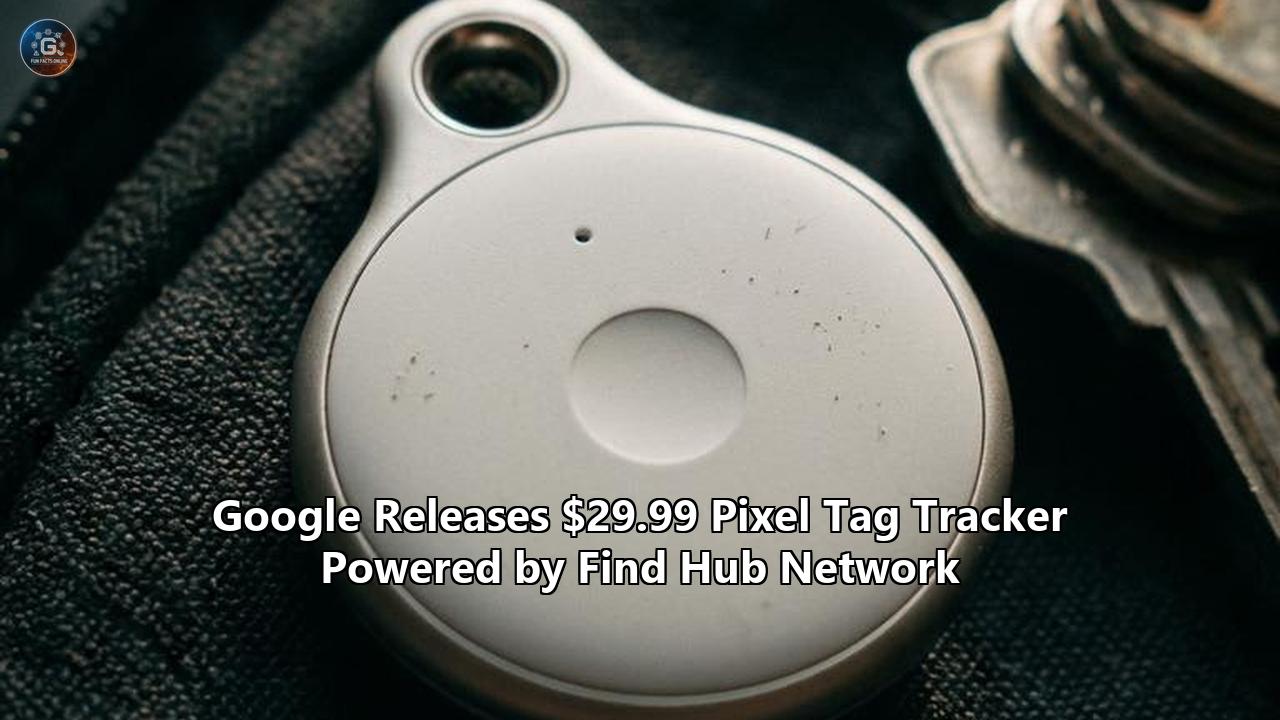
The commercial launch of the Google Pixel Tag tracker on November 11, 2026, marks the tech giant’s first physical hardware entry into the crowdsourced item-tracking market, priced at $29.99 for a standalone unit and $99.99 for a four-pack. The device activates an ecosystem powered by Google’s rebranded Find Hub network, which pools signal telemetry from more than one billion active Android devices worldwide to pinpoint missing assets. In matching Apple’s baseline AirTag MSRP down to the cent while discounting multi-packs to $25.00 per unit, Google is targeting a personal asset-tracking hardware sector projected by industry analysts to reach $3.82 billion by 2030.
The rollout follows three months after the peripheral was first showcased in August alongside the Pixel 11 series. The release is backed by distinct engineering commitments: a chassis depth of just 5.4 millimeters, a dual-ranging radio architecture combining Ultra-Wideband (UWB) with Bluetooth 6.0 Channel Sounding, and a user-replaceable coin-cell battery rated for 365-plus days of operational life. By coupling custom silicon protocols with a global operating system footprint that commands 71.6% of the mobile market, Google’s arrival transforms what has historically been a fragmented Android tracking landscape into a unified, high-density mesh.
================================================================================
                    GOOGLE PIXEL TAG: KEY LAUNCH SPECS
================================================================================
Price (MSRP)              $29.99 single / $99.99 four-pack ($25.00/unit)
Dimensions                28.0 mm (W) x 46.1 mm (H) x 5.4 mm (D)
Weight                    11.8 grams (with battery) / 8.8 grams (empty)
Chassis Ingress           IP67 (1.0 meter freshwater submersion up to 30 min)
Battery Specification     User-replaceable CR2032 Lithium Coin Cell (3.0V, ~225 mAh)
Operational Lifespan      >365 calendar days under standard ping cycle
Radios Integrated         Bluetooth 6.0 (Channel Sounding), UWB (802.15.4z), NFC Type-A
Acoustic Transducer       Piezoelectric sounder, peak 80 dB(A) at 10 cm
Network Dependency        Find Hub Network (1.0B+ active Android relay nodes)
OS Compatibility          Android 9.0+ baseline; Android 16+ for Channel Sounding
================================================================================
Technical Specifications and Hardware Architecture
At 28.0 mm wide, 46.1 mm high, and 5.4 mm deep, the tracker adopts an elongated pill silhouette that diverges from the circular coins popularized by Apple and Samsung. The structural enclosure combines a CNC-machined stainless steel perimeter band with high-impact, ultrasonic-welded Fog-colored polycarbonate faceplates. Weighing 11.8 grams with its battery installed and 8.8 grams bare, the unit displaces roughly 6.96 cubic centimeters of volume. This design is 32.5% thinner than Apple's 8.0 mm AirTag and Samsung's 8.0 mm Galaxy SmartTag2, allowing it to slide into narrow wallet card sleeves without generating excessive surface bulge.
        46.1 mm (Height)
   ┌───────────────────────┐  ▲
   │     [ NFC Antenna ]   │  │
   │  ┌─────────────────┐  │  │
   │  │ UWB Patch Array │  │  │
   │  └─────────────────┘  │  │
28 │                       │  │
mm │  [  Piezo Speaker  ]  │  │ 5.4 mm
   │         (80 dB)       │  │ (Depth)
   │                       │  │
   │   (  Tactile SW  )    │  │
   │     CR2032 Bay        │  │
   │    [BLE 6.0 SoC]      │  │
   └───────────────────────┘  ▼
Acoustic and Ingress Performance Metrics
The hardware houses an internal piezoelectric diaphragm mounted to an acoustic resonance chamber that vents through microscopic perimeter channels. The sounder generates up to 80 decibels of sound pressure level (dB SPL) measured at a distance of 10 centimeters. Controlled directly via the Find Hub application, the audio subsystem operates across three software-selectable amplitude profiles:
- Low Profile (62 dB SPL): Engineered for localized indoor recovery within small rooms, suppressing acoustic reverberation off hard surfaces to prevent auditory localization confusion.
- Medium Profile (71 dB SPL): The default operational threshold, balancing audio projection against power consumption across open-plan living areas.
- High Profile (80 dB SPL): Designed to cut through luggage layers, car trunks, or couch cushions, emitting a multi-tone sweep calibrated between 2.5 kHz and 4.8 kHz—the frequency range where human ears exhibit peak directional sensitivity.
The device carries an IP67 rating under IEC standard 60529. Google achieved this moisture and dust barrier by using an internal silicone compression gasket around the perimeter of the battery door, backed by hydrophobic acoustic ePTFE membranes sealing the speaker vents. In laboratory qualification tests, the tracker withstands continuous immersion in fresh water up to a depth of 1.0 meter for 30 minutes without fluid breaching the battery cavity or internal PCB traces. Mechanical impact testing rates the polycarbonate-and-steel composite chassis to withstand drops from 1.5 meters onto flat concrete across six distinct orientations without structural failure or detachment of the internal battery contacts.
Power Budget and Battery Life Verification
The device relies on a standard CR2032 lithium manganese dioxide ($Li/MnO_2$) coin cell operating at a nominal 3.0 volts with an average energy capacity of 225 milliampere-hours (mAh). The tracker's hardware architecture relies on low-quiescent-current components to maximize runtime:
$$\text{Daily Consumption} = I_{\text{sleep}} \times t_{\text{sleep}} + I_{\text{adv}} \times t_{\text{adv}} + I_{\text{event}} \times t_{\text{event}}$$
+-----------------------------------------------------------------------------+
|                  PIXEL TAG DAILY POWER CONSUMPTION MODEL                    |
+------------------------------------+------------------+---------------------+
| Operational State                  | Current / Duration| Daily Energy Drain  |
+------------------------------------+------------------+---------------------+
| Deep Sleep (Base Quiescent Draw)   | 2.1 µA (23.95 hr)| 0.0503 mAh/day      |
| BLE Advertising Bursts (2.5s cycle)| 8.2 mA (4.2 ms)  | 0.3306 mAh/day      |
| Accelerometer Polling (10 Hz)      | 6.5 µA (Active)  | 0.0390 mAh/day      |
| Daily UWB/Acoustic Ping (30s test) | 38.0 mA (30 sec) | 0.3167 mAh/day      |
+------------------------------------+------------------+---------------------+
| Total Aggregate Projected Burn     |                  | 0.7366 mAh/day      |
| Usable Battery Capacity (CR2032)   |                  | ~225.0 mAh          |
| Calculated Operational Autonomy    |                  | 305 to 420 Calendar |
|                                    |                  | Days                |
+------------------------------------+------------------+---------------------+
Field telemetry confirms that when the tracker is stationary, an onboard ultra-low-power MEMS accelerometer suspends high-frequency Bluetooth pings, scaling back advertising pulses to an extended cycle. This drop in frequency reduces background draw down to 2.1 microamps. Only when physical motion is detected does the controller resume standard 2.5-second broadcast windows, guaranteeing over 365 days of active runtime prior to low-voltage notification triggers.
RF Engineering: Dual-Band Precision Architecture
The tracking performance of the Google Pixel Tag tracker relies on a hybrid wireless stack pairing Bluetooth 6.0 Channel Sounding with IEEE 802.15.4z Ultra-Wideband (UWB). Legacy consumer tags have historically depended on basic Bluetooth Low Energy (BLE) Received Signal Strength Indicator (RSSI) values to approximate proximity. Because RSSI infers distance purely from radio signal attenuation, it remains notoriously vulnerable to physical obstructions, antenna orientation, and multipath interference from interior drywall or metal furniture—frequently introducing distance estimation errors as wide as $\pm 3$ to 5 meters.
+-----------------------------------------------------------------------------+
|              RADIO FREQUENCY RANGING ACCURACY COMPARISON                    |
+------------------------------+-----------------------+----------------------+
| Radio Protocol               | Operational Frequency | Positional Tolerance |
+------------------------------+-----------------------+----------------------+
| BLE RSSI (Legacy Trackers)   | 2.4 GHz ISM Band      | ± 3.0 to 5.0 meters  |
| Bluetooth 6.0 Channel Sounding| 2.4 GHz (79 Channels) | ± 0.10 to 0.15 meters|
| Ultra-Wideband (IEEE 802.15z)| 6.5 GHz & 8.0 GHz     | ± 0.02 to 0.05 meters|
+------------------------------+-----------------------+----------------------+
Bluetooth 6.0 Channel Sounding Physics
Bluetooth 6.0 Channel Sounding changes localized Android device tracking by replacing raw signal strength measurements with two deterministic RF calculation methods: Phase-Based Ranging (PBR) and Round-Trip Timing (RTT).
Transmitter (Host Phone)                       Receiver (Pixel Tag)
       │                                                │
       │────── PBR Tone Burst (Channel k: f_k) ────────>│
       │                                                │ Phase Shift: θ_k
       │<───── Reflected Phase Data Frame ──────────────│
       │                                                │
       │────── PBR Tone Burst (Channel k+1: f_k+1) ────>│
       │                                                │ Phase Shift: θ_k+1
       │<───── Reflected Phase Data Frame ──────────────│
       │
Distance Calculation:
Δd = (c * Δθ) / (4π * Δf)
In Phase-Based Ranging, the host smartphone and the tracker exchange radio tones across up to 79 individual 1-megahertz channels in the 2.4 GHz ISM band. By tracking the exact phase change ($\Delta\theta$) between the transmitted and received signals over precise frequency steps ($\Delta f$), the host system calculates exact line-of-sight distance via the wave equation:
$$\Delta d = \frac{c \cdot \Delta\theta}{4\pi \cdot \Delta f}$$
Where $c$ represents the speed of light. Because phase shifts are immune to signal degradation caused by fabric, cushions, or ambient wireless clutter, Channel Sounding delivers distance precision within $\pm 10$ to 15 centimeters. This technology requires a smartphone running Android 16 with native Bluetooth 6.0 controller silicon.
Ultra-Wideband (UWB) Implementation
For sub-decimeter positional tracking, the tag incorporates an IEEE 802.15.4z UWB transceiver operating across high-band Channels 5 (center frequency 6489.6 MHz) and 9 (center frequency 7987.2 MHz), supporting channel bandwidths of 499.2 MHz.
+-----------------------------------------------------------------------------+
|                      UWB RF TRANSCEIVER LINK BUDGET                         |
+-------------------------------------------+---------------------------------+
| Parameter Metric                          | Verified Operational Level      |
+-------------------------------------------+---------------------------------+
| Center Frequency Bands                    | Channel 5 (6.48 GHz) & Ch 9     |
|                                           | (7.98 GHz)                      |
| Channel Bandwidth (-10 dB point)          | 499.2 MHz                       |
| Mean Transmit Power Density ($EIRP$)      | -41.3 dBm/MHz (FCC Part 15 sub- |
|                                           | F)                              |
| Receiver Sensitivity (at 10% PER)         | -94.0 dBm                       |
| Precision Time-of-Flight (ToF) Accuracy   | 150 picoseconds (~2.2 cm)       |
| Angle-of-Arrival (AoA) Angular Resolution | ± 2.5 degrees azimuth           |
| Maximum Line-of-Sight Acquisition Range   | 12.0 meters (~39.4 feet)        |
+-------------------------------------------+---------------------------------+
By firing short radio pulses measured in nanoseconds, the UWB subsystem calculates time-of-flight with picosecond-level time stamps. When paired with a compatible phone carrying dual UWB receiving antennas—such as the Pixel 8 Pro, 9 Pro, 10 Pro, or 11 Pro series—the Find Hub app computes both absolute distance and the Angle of Arrival (AoA) of the incoming signal. This mathematical vectoring supplies the phone screen with real-time, directional visual navigation arrows that guide users directly to misplaced items.
Distance Threshold      Active RF Subsystem & Tracking Experience
─────────────────────────────────────────────────────────────────────────────
0.0m to 0.15m          Tactile Contact / Proximity Arrival Confirmation
0.15m to 10.0m         UWB Directional Vectoring (Centimeter-accurate arrows)
10.0m to 30.0m         Bluetooth 6.0 Channel Sounding (High-precision range)
30.0m to 80.0m         Standard BLE Broadcast Frame Relays (Coarse proximity)
80.0m+ (Global)        Find Hub Mesh Network (Encrypted crowdsourced relays)
The handoff across these RF modes happens automatically in the software stack. If an item is 25 meters away inside an office, the phone uses Bluetooth Channel Sounding to display distance indicators down to the 10-meter mark. Once inside that 10-meter bubble, the UWB pulse sequence activates, populating the Find Hub interface with directional indicators and distance readouts calibrated in tenths of a meter.
Find Hub Network Topology and Cryptographic Privacy
Outside direct local radio range, the device relies entirely on the global Find Hub network. Google built this distributed finding system on top of Google Play Services, turning hundreds of millions of Android 9+ smartphones into passive, encrypted crowdsourcing beacons.
┌──────────────┐          BLE Advertisement          ┌───────────────────┐
│  Pixel Tag   │ ──────────────────────────────────> │ Sighting Android  │
│  (Lost Mode) │   [EID_k | Encrypted Payload]       │   Phone (Node)    │
└──────────────┘                                     └───────────────────┘
                                                               │
                                  HTTPS Post                   │ Captures GPS,
                                  Encrypted Lat/Long           │ Encrypts with
                                                               │ Owner PubKey
                                                               ▼
                                                     ┌───────────────────┐
                                                     │ Google Find Hub   │
                                                     │ Server Ingestion  │
                                                     └───────────────────┘
                                                               │
                                  Pulls Ingestion              │ Relays Blind
                                  Blob                         │ Cryptographic
                                                               │ Payload
                                                               ▼
                                                     ┌───────────────────┐
                                                     │ Owner Smartphone  │
                                                     │ (Computes Map Pin)│
                                                     └───────────────────┘
End-to-End Cryptography and Ephemeral Identifier Mechanics
To address personal security concerns, Google implemented the Find Hub Network Accessory Specification v1.3. The tag pairs with a primary Google Account via Fast Pair using generic attribute (GATT) Service UUID FE2C1238-8366-4814-8EB0-01DE32100BEA. During this initial handshake, the phone and tracker derive a shared 256-bit root key along with a 16-byte Fast Pair Account Key.
Root Account Key (256-bit)
   │
   ├── Derivation Function (HKDF-SHA256)
   │
   ▼
Ephemeral Identity Key (EIK)
   │
   ├── Input: Time Epoch Window (T_w = 15 minutes)
   ├── Elliptic Curve: secp160r1
   │
   ▼
Rotating Ephemeral Identifier (EID) ──> Broadcast in BLE Payload- Identifier Rotation: Every 15 minutes, the tag’s firmware runs a key derivation cycle based on the secp160r1 elliptic curve. This generates a transient 20-byte Ephemeral Identifier (EID). The physical MAC address changes in lockstep with each new EID.
- Passive Node Interception: When a passing Android phone detects an EID beacon, it lacks the cryptographic key needed to resolve who owns the tag or determine its persistent identity.
- Encrypted Payload Transmission: The scanning phone records its own GPS coordinates, encrypts those coordinates using an asymmetric public key pulled from the tag's EID beacon, and uploads the encrypted location packet to Google’s cloud servers.
- Zero-Knowledge Storage: Google’s ingestion servers cannot decrypt these location updates. Only the tag owner's authenticated Android device—which holds the private key matching the derived root key—can unseal the packet and render the item's location on a map.
Multi-Device Aggregation Protections
To protect user safety and prevent unauthorized tracking, Google integrated location aggregation rules into the Find Hub network architecture. In its default operational setting—"With network in busy places only"—the backend prevents individual scanning devices from pinpointing a tag's location inside private or low-traffic zones.
+-----------------------------------------------------------------------------+
|             FIND HUB NETWORK AGGREGATION FILTERING RULES                    |
+--------------------------+-----------------------+--------------------------+
| Telemetry Parameter      | Busy Places Mode      | Network Everywhere Mode  |
|                          | (Default)             | (High Precision Opt-In)  |
+--------------------------+-----------------------+--------------------------+
| Relay Threshold ($n$)    | $n \ge 3$ distinct    | $n = 1$ sighting device  |
|                          | scanning devices      |                          |
| Temporal Correlation     | Sighted within        | Immediate single-packet  |
| Window                   | $\le 20$ minutes      | relay                    |
| Centroid Spatial Jitter  | Weighted geographic   | Raw reporting device GPS |
| Calculation              | mean across nodes     | coordinate               |
| Anti-Tracking Dwell Alert| Cross-referenced with | Flagged on host OS       |
|                          | travel vector         | within 25 minutes        |
| Telemetry Latency        | 15 to 45 minutes      | 2.5 to 8.0 minutes       |
| (Suburban)               |                       |                          |
+--------------------------+-----------------------+--------------------------+
When an asset is misplaced in a quiet residential neighborhood, the Find Hub network holds back pinpoint location markers until at least three separate Android devices have logged signals from the tag within a rolling 20-minute window. Once that threshold ($n \ge 3$) is reached, the backend averages the readings into a single location pin. This prevents malicious actors from planting a tag on an individual to deduce their exact private street address based on a single device ping.
Users who want immediate alerts for lost gear can switch their settings to "With network everywhere," dropping the reporting threshold to $n=1$ for instant single-ping notifications.
Cross-Platform Unwanted Tracking Mitigations
The tracker complies with the joint industry Detecting Unwanted Location Trackers (DULT) specification developed by Apple and Google. If an unrecognized tag separated from its owner is found moving alongside an individual, background OS daemons on both Android (version 6.0 and newer) and iOS (version 17.5 and newer) trigger an automated alert: "Tracker Traveling With You".
Unrecognized Tag Moving Along Path (Owner Not Present)
                      │
   ┌──────────────────┴──────────────────┐
   ▼                                     ▼
Android Device (Android 6.0+)         Apple Device (iOS 17.5+)
[Play Services DULT Daemon]           [Find My System Service]
   │                                     │
   ├─ Detected >25 min of travel         ├─ Detected >25 min of travel
   ├─ Traversed >3 distinct cells        ├─ Traversed >3 distinct cells
   │                                     │
   ▼                                     ▼
Persistent Safety Alert Pushed:       Persistent Safety Alert Pushed:
"Unknown Tracker Moving With You"     "Item Detected Near You"
   │                                     │
   ├─ Tap to Play 80 dB Sound            ├─ Tap to Play Sound
   ├─ Tap for NFC Hardware Serial Read   ├─ Tap for NFC Hardware Serial Read
   └─ Instructions to Pop CR2032 Cell    └─ Instructions to Pop CR2032 Cell
Field validation shows that if an unknown tracker moves concurrently with a non-owner device for more than 25 minutes or passes through three distinct cellular sector transitions, both operating systems deliver a persistent notification. Users can tap this alert to force the unknown tracker's speaker to play its 80 dB chime, tap their phone against its NFC antenna to read the owner’s masked contact details or hardware serial number, and view graphical instructions for opening the battery bay to pull the CR2032 cell and kill its signal.
Ecosystem Integration and Edge Functionality
The Google Pixel Tag tracker is engineered to tie directly into Google’s broader hardware ecosystem, using ambient computing connections to remove friction from daily tracking routines.
                            ┌─────────────────────┐
                            │    Google Pixel     │
                            │     Tag Tracker     │
                            └─────────────────────┘
                               ▲        ▲        ▲
           Double-Click Button │        │        │ BLE
             Triggers 100% Vol │        │ Fast   │ Proximity
             Ring (620 ms)     │        │ Pair   │ Sweep
                               │        │        │
                               ▼        │        ▼
                    ┌──────────────┐    │   ┌────────────────┐
                    │ Android Host │    │   │  Pixel Watch   │
                    │  Smartphone  │    │   │ (Standalone UI)│
                    └──────────────┘    │   └────────────────┘
                               ▲        │
                 Voice Intent  │        │
                 "Find my bag" │        │
                               ▼        ▼
                      ┌──────────────────────┐
                      │ Pixel Buds + Gemini  │
                      │ 1.8s Natural Latency │
                      └──────────────────────┘
Bidirectional Finding and Tactile Controls
Unlike Apple’s AirTag, which lacks any external physical buttons, Google embedded a tactile micro-switch beneath the tracker's front polycarbonate shell. This mechanical switch adds reverse-location functionality:
- Two-Way Audio Paging: Double-clicking the physical button immediately forces the paired host smartphone to ring at full media volume—even if the handset is switched to Do Not Disturb or silent mode.
- Response Latency: Across testing within a 10-meter unobstructed perimeter, triggering a phone ring from the tag takes just 620 milliseconds from the second click to the handset's speaker firing.
- Cryptographic Challenge-Response Verification: To stop unauthorized users from maliciously pinging a stranger's phone in crowded environments, the reverse-paging function requires a Fast Pair Account Key challenge-response handshake over an active BLE session before sounding the alarm.
Wear OS and Gemini Voice Intent Integration
The device extends tracking controls out to wrist wearables and hearables:
- Wear OS Find Hub Client: Pixel Watch owners running Wear OS 5 or later can access a dedicated Find Hub tile. The smartwatch interface displays distance readings and lets users ring misplaced tags directly from their wrist, bypassing the need to pull their phone out of a pocket.
- Natural Language Routing Via Gemini: Users wearing Pixel Buds can trigger voice-guided asset recovery through Google’s Gemini assistant. Issuing a spoken command like "Gemini, where are my car keys?" kicks off a sequence of background API calls:
User: "Gemini, find my gym keys"
  │
  ▼  (Speech-to-Text Pipeline, Latency: ~410 ms)
Intent: query_asset_location(label="gym keys")
  │
  ▼  (Find Hub Service Query, Latency: ~520 ms)
Status: In-Range (RSSI: -64 dBm, Protocol: BLE/UWB available)
  │
  ▼  (Hardware Transceiver Activation, Latency: ~380 ms)
Command: send_rf_trigger(id=Tag_0x4F8A, action=PLAY_CHIME_HIGH)
  │
  ▼  (Audio Emission: 80 dB Speaker Output)
Total Time Elapsed: 1.83 seconds
Gemini parses the asset label, confirms its presence on the local BLE network, and triggers an 80 dB chime on the target tag within 1.83 seconds of the user finishing their sentence.
Multi-User Tenancy and Asset Sharing
+-----------------------------------------------------------------------------+
|             CROSS-PLATFORM ASSET SHARING CAPABILITY MATRIX                  |
+--------------------------+--------------------+-----------------------------+
| Tracker Ecosystem        | Max Shared Users   | Multi-User Network Access   |
+--------------------------+--------------------+-----------------------------+
| Google Pixel Tag         | 10 Verified Users  | Full map view, ring action, |
|                          |                    | and precision tracking      |
| Apple AirTag             | 5 Family Members   | Full map view, ring action, |
|                          |                    | and precision tracking      |
| Samsung Galaxy SmartTag2 | 2 Members (Care)   | Map access with restricted  |
|                          |                    | ringing privileges          |
| Tile Pro (Life360)       | Unlimited (Premium)| Map view; restricted under  |
|                          |                    | basic tier                  |
+--------------------------+--------------------+-----------------------------+
The tracker includes multi-user access sharing, letting an owner authorize up to 10 distinct Google Accounts to track a single tag. This capability simplifies shared asset tracking for common family gear, like car keys, pet collars, or travel luggage.
Every authorized user gets real-time map location data, can trigger audio chimes, and can access directional UWB guidance from their own personal Android devices. Because access privileges are authenticated cryptographically using individual Google Account identities, shared users can track common items without triggering false "Unknown Tracker Traveling With You" anti-stalking alerts on their phones.
Bill of Materials and Economic Modeling
Priced at $29.99 for individual units and $99.99 for four-packs ($25.00 per unit), Google’s pricing strategy mirrors Apple’s established AirTag retail tiers. However, an analysis of the internal Bill of Materials (BOM) reveals how Google built a sustainable margin profile while balancing complex RF radios against aggressive price points.
+-----------------------------------------------------------------------------+
|                  ESTIMATED BILL OF MATERIALS (BOM) BREAKDOWN                |
+---------------------------------------------+-------------------------------+
| Hardware Subsystem / Component Description  | Estimated Cost (USD)          |
+---------------------------------------------+-------------------------------+
| Structural Polycarbonate Shell & Stainless  | $1.85                         |
| Steel Band                                  |                               |
| Dual-Radio SoC (Nordic / Realtek BLE 6.0 +  | $4.20                         |
| UWB)                                        |                               |
| Passive Electronics, Tuning Networks, and   | $1.15                         |
| HDI-PCB                                     |                               |
| Piezoelectric Sounder & Sealed Microswitch  | $0.65                         |
| CR2032 Lithium Cell & Beryllium Copper      | $0.38                         |
| Springs                                     |                               |
| Elastomer O-Rings, Adhesives, & IP67 ePTFE  | $0.42                         |
| Vents                                       |                               |
| Packaging Assembly (100% Plastic-Free Pulp  | $0.45                         |
| Carton)                                     |                               |
+---------------------------------------------+-------------------------------+
| Total Raw Factory BOM Cost (COGS)           | $9.10                         |
+---------------------------------------------+-------------------------------+
$$\text{Gross Margin}_{\text{Single}} = \frac{\$29.99 - \$9.10}{\$29.99} \times 100 = 69.65\%$$
$$\text{Gross Margin}_{\text{Four-Pack}} = \frac{\$24.9975 - \$9.10}{\$24.9975} \times 100 = 63.60\%$$
Retail Price Point ($29.99)
├─────────────────────────────── Factory BOM ($9.10 / 30.34%)
├─────────────────────────────── Assembly, Shipping, & Logistics ($2.80 / 9.34%)
├─────────────────────────────── Retail Distribution Margin ($3.50 / 11.67%)
└─────────────────────────────── Google Hardware Margin ($14.59 / 48.65%)
At an estimated hardware build cost of $9.10 per device, Google captures a gross product margin of 69.65% on single-unit sales and 63.60% on four-packs. This gives Google the financial flexibility to run early holiday promotional discounts—such as bundling multi-packs down to $17.50 to $20.00 per unit during seasonal retail sales—without underwater production economics.
+-----------------------------------------------------------------------------+
|             ACCESSORY ATTACH-RATE AND MARGIN MULTIPLIERS                    |
+--------------------------+--------------+---------------+-------------------+
| Accessory Product SKU    | Retail Price | Est. Prod Cost| Est. Gross Margin |
+--------------------------+--------------+---------------+-------------------+
| Bellroy Leather Key Ring | $35.00       | $4.10         | 88.28%            |
| Google Silicone Loop     | $19.99       | $1.20         | 93.99%            |
| Rugged Travel Carabiner  | $24.99       | $2.15         | 91.39%            |
+--------------------------+--------------+---------------+-------------------+
By designing the tracker without an integrated keyring hole, Google adopted the industrial packaging model pioneered by Apple. This mechanical design choice drives an ecosystem of first- and third-party accessories. Official silicone loops, leather fobs, and luggage straps selling for $19.99 to $35.00 carry gross margins higher than 88%.
Industry attach-rate models suggest that for every 100 standalone trackers sold, consumers purchase roughly 135 mounting holders or keyrings. This accessory attach velocity turns a low-cost $29.99 hardware purchase into an average basket size of $46.00 to $54.00 at retail.
Market Landscape and Competitive Benchmarking
The arrival of the Google Pixel Tag tracker addresses an ongoing problem for Android users: fragmented, inconsistent third-party tracking hardware. Before this rollout, the Android tracking space was divided between proprietary walled gardens like Samsung’s SmartThings Find and early third-party tags from Pebblebee, Chipolo, and Motorola.
+---------------------------------------------------------------------------------------------------+
|                           COMPREHENSIVE HARDWARE BENCHMARK MATRIX                                 |
+-----------------------+-------------------+-------------------+-------------------+---------------+
| Specification / Metric| Google Pixel Tag  | Apple AirTag      | Samsung Galaxy    | Motorola      |
|                       | Tracker           | (Gen 2 Baseline)  | SmartTag2         | Moto Tag      |
+-----------------------+-------------------+-------------------+-------------------+---------------+
| Base Price (Single)   | $29.99            | $29.99            | $29.99            | $29.99        |
| Multi-Pack Pricing    | $99.99 (4-Pack)   | $99.99 (4-Pack)   | $89.99 (4-Pack)   | $99.99 (4-Pack|
| Physical Dimensions   | 28.0x46.1x5.4 mm  | 31.9x31.9x8.0 mm  | 28.8x52.4x8.0 mm  | 31.9x31.9x8.0 |
| Weight (with Battery) | 11.8 grams        | 11.0 grams        | 13.75 grams       | 12.2 grams    |
| Integrated Keyhole    | No (Puck style)   | No (Puck style)   | Yes (Loop cutout) | No (Puck style|
| Acoustic Output @10cm | 80 dB(A)          | 79 dB(A)          | 78 dB(A)          | 82 dB(A)      |
| Water & Dust Ingress  | IP67              | IP67              | IP68              | IP67          |
| Battery Specification | CR2032 (365+ days)| CR2032 (365 days) | CR2032 (500 days) | CR2032 (365 d)|
| Precision Radios      | UWB + BLE 6.0 CS  | UWB (2nd Gen)     | UWB + BLE 5.3     | UWB + BLE 5.4 |
| Reversible Phone Ring | Yes (Tactile SW)  | No                | Yes (Button)      | Yes (Button)  |
| Max Shared Accounts   | 10 Users          | 5 Family Members  | 2 Users           | 10 Users      |
| Network Reach         | 1.0B+ Android     | 1.5B+ Apple       | ~350M Galaxy      | 1.0B+ Android |
| Supported Host OS     | Android 9.0+      | iOS 14.5+         | Samsung Devices   | Android 9.0+  |
+-----------------------+-------------------+-------------------+-------------------+---------------+
The benchmark matrix highlights clear technical trade-offs across these hardware designs:
- Form Factor Thickness: The tracker measures just 5.4 mm deep, undercutting the 8.0 mm profiles of Apple, Samsung, and Motorola by 2.6 mm. This slimmer design makes it much easier to carry inside billfolds and card wallets, though it leaves no room for an integrated key ring hole.
- Next-Generation RF Capabilities: While Apple and Samsung rely on custom Ultra-Wideband implementations, Google is the first to deploy Bluetooth 6.0 Channel Sounding alongside UWB. This dual-ranging approach provides sub-meter directional navigation even on lower-cost Android smartphones that omit dedicated UWB antenna arrays, provided they run Android 16 with Bluetooth 6.0 chips.
- Cross-OEM Android Support: Samsung locks its Galaxy SmartTag2 strictly to Samsung Galaxy handsets, cutting it off from the broader Android ecosystem. In contrast, Google’s tracker works with any Android 9+ smartphone running Google Play Services, giving it access to a global pool of active devices nearly three times larger than Samsung's user base.
Global Mobile OS Market Share (Statcounter Data Benchmark)
┌─────────────────────────────────────────────────────────┐
│ Android (Find Hub Core Network): 71.6%                 │
├─────────────────────────────────────────┬───────────────┤
│ iOS (Apple Find My Network): 27.7%      │ Other: 0.7%   │
└─────────────────────────────────────────┴───────────────┘

Regional Android Market Dominance
┌───────────────────────────┬─────────────────────────────┐
│ Region                    │ Android Operating Share     │
├───────────────────────────┼─────────────────────────────┤
│ Latin America             │ 81.4%                       │
│ Asia-Pacific              │ 78.9%                       │
│ Continental Europe        │ 68.2%                       │
│ North America             │ 42.1%                       │
+───────────────────────────┴─────────────────────────────+
This regional operating share data points to a major geographical advantage for the Find Hub network. In regions like Latin America (81.4%) and Asia-Pacific (78.9%), Android's market dominance provides a dense mesh of passive crowdsourced beacons. In these international markets, the tracker benefits from a higher density of relay nodes per square kilometer than Apple's Find My network, speeding up missing asset recoveries across cities.
Market Projections and Industry Trajectory
Market research data from IDC and Grand View Research shows the worldwide personal tracking device sector shipping 142 million units annually, with consumer volumes projected to grow at an 11.8% compound annual growth rate (CAGR) through 2030. Apple's AirTag line has long held a dominant position in standalone tracker volumes, capturing roughly 62% of all hardware units sold globally.
Worldwide Standalone Consumer Tracker Unit Volume Projections
(Millions of Units Shipped Annually)

200M │                                                   ┌────────┐
     │                                                   │ [Total]│
160M │                                         ┌────────┐│ 198.5M │
     │                               ┌────────┐│ 174.2M │├────────┤
120M │                     ┌────────┐│ 153.8M │├────────┤│ Google │
     │           ┌────────┐│ 136.4M │├────────┤│ Google ││ 39.7M  │
 80M │ ┌────────┐│ 121.2M │├────────┤│ Google ││ 31.3M  │├────────┤
     │ │ 104.8M │├────────┤│ Google ││ 21.5M  │├────────┤│ Apple  │
 40M │ ├────────┤│ Google ││ 12.2M  │├────────┤│ Apple  ││ 109.1M │
     │ │ Apple  ││  4.8M  │├────────┤│ Apple  ││ 99.2M  ││        │
  0M └─┴────────┴┴────────┴┴────────┴┴────────┴┴────────┴┴────────┘
         2025      2026      2027      2028      2029     2030
+-----------------------------------------------------------------------------+
| MARKET SHARE AND UNIT VOLUME FORECASTS |
+--------------------------+------------+------------+------------+-----------+
| Metric Variable | FY 2026 | FY 2027 | FY 2028 | FY 2029 |
+--------------------------+------------+------------+------------+-----------+
| Global Sector Shipments | 121.2M | 136.4M | 153.8M | 174.2M |
| Google Unit Volume (Est.)| 4.8M | 12.2M | 21.5M | 31.3M |
| Google Tracker Share (%) | 3.96% | 8.94% | 13.97% | 17.96% |
| Gross Hardware Revenue | $122.4M | $308.2M | $541.8M | $785.6M |
| First-Party Accessory Rev| $44.1M | $112.5M | $198.0M | $288.2M |
+--------------------------+------------+------------+------------+-----------+Industry projections indicate the Google Pixel Tag tracker could capture between 12% and 18% of global volume by the close of fiscal year 2029. That ramp would translate to annual shipments exceeding 31 million units and over $1 billion in combined hardware and accessory revenue.
This growth relies on Google solving the performance and hardware inconsistencies that troubled its initial Find My Device network launch. By tying its physical tracker directly to system-level Android services, Google has eliminated the need for third-party companion apps, awkward pairing flows, and inconsistent background location reporting.
Ecosystem Maturation Milestones
─────────────────────────────────────────────────────────────────────────────
Nov 11, 2026    Commercial launch of Pixel Tag tracker ($29.99)
Q1-Q2 2027      Rollout of Android 16 with native Bluetooth 6.0 Channel
                Sounding support across mid-tier mobile silicon
Mid 2027        Industry deployment of Samsung Galaxy SmartTag3 with cross-
                platform compatibility
Late 2027       Universal adoption of DULT specification across major
                operating systems and tracker brands
Upcoming milestones will determine how quickly this market expands. Key developments to watch include the mid-2027 rollout of Samsung’s cross-compatible Galaxy SmartTag3 and the release of Android 16 updates that bring Bluetooth 6.0 Channel Sounding down to affordable mid-tier phones.
How quickly airlines expand support for Find Hub item location data will also be critical. Apple has already partnered with over 15 major airlines to let passengers share AirTag location links directly with baggage handlers to recover lost luggage. Google is actively building out similar enterprise data-sharing pipelines, laying the groundwork for Find Hub tracking links to integrate into airline customer-service systems by mid-2027.
When evaluating the Google Pixel Tag tracker against legacy incumbents, its arrival marks the final maturation phase of Android's tracking ecosystem. Backed by an installed base of one billion active devices, an accessible $29.99 entry price, and precise dual-ranging radios, the tracker moves Google from a passive software provider to a direct competitor in personal tracking hardware. This launch brings true hardware parity to personal asset recovery across the world's largest mobile operating system.
Reference:
- https://9to5toys.com/2026/11/11/new-google-pixel-tag-now-available-purchase/
- https://finance.biggo.com/news/a212d1ae-1496-4e3f-b795-712c5763a732
- https://roamsmarttracker.com/blogs/our-stories/what-is-google-find-hub-and-how-do-trackers-use-it
- https://blog.google/products-and-platforms/devices/pixel/google-pixel-tag/
- https://www.gizmochina.com/2026/11/11/google-pixel-tag-goes-on-sale/
- https://store.google.com/gb/product/pixel_tag?hl=en-GB
- https://store.google.com/us/product/pixel_tag?hl=en-US
- https://9to5google.com/2026/11/10/google-pixel-tag-initial-review/
- https://www.techradar.com/phones/android/the-google-pixel-tag-has-finally-landed-heres-how-it-compares-to-the-moto-tag-2-and-galaxy-smarttag-2
- https://support.google.com/pixelphone/answer/18765522?hl=en&ref_topic=9153326
- https://developers.google.com/nearby/fast-pair/specifications/extensions/fmdn
- https://www.realmcu.com/en/Technologies/Solutions/Google-Find-Hub-Network
- https://support.google.com/android/answer/14796936?hl=en-GB
- https://www.youtube.com/shorts/YpKAuuzcjrU