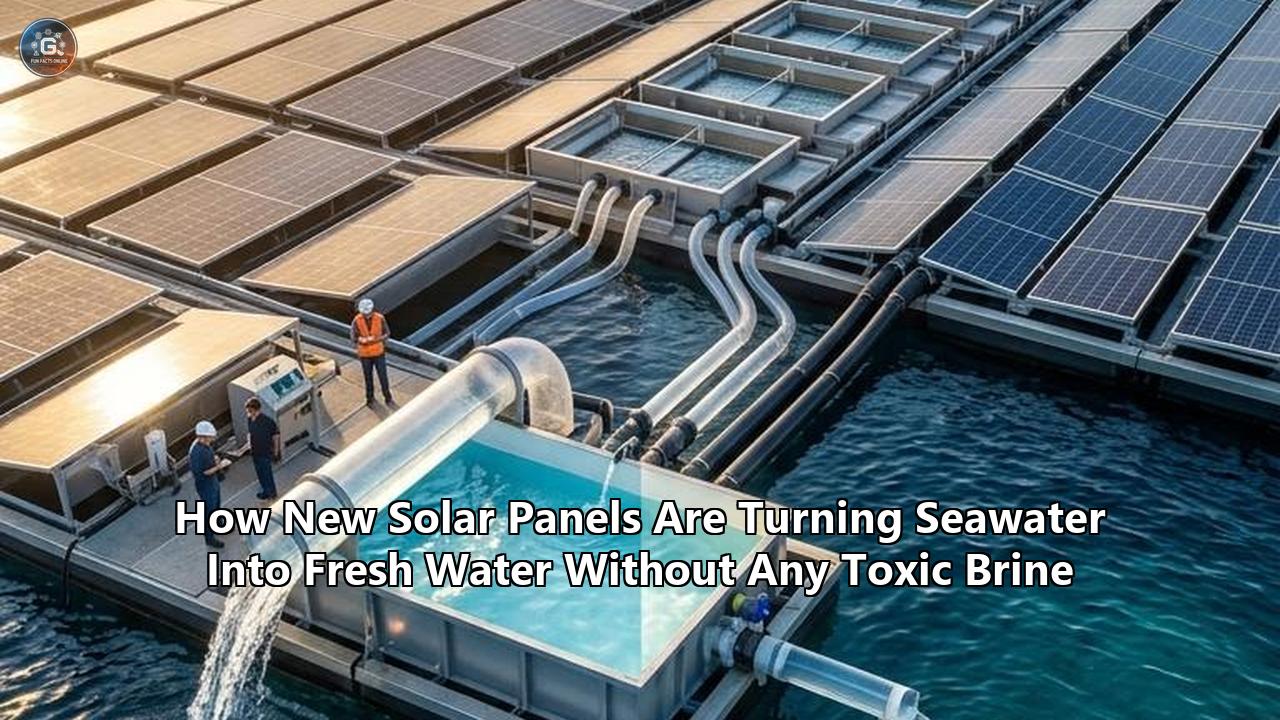
Researchers at the University of Rochester’s Institute of Optics and Laboratory for Laser Energetics have demonstrated an optical-thermal panel that converts seawater to fresh water while precipitating dissolved salts entirely as dry, harvestable solids. Detailed in findings published in Light: Science & Applications and the Journal of Materials Chemistry A, the team led by optics and physics professor Chunlei Guo deployed femtosecond laser-machined metallic surfaces to drive high-flux interfacial evaporation without releasing a single drop of toxic liquid brine.
The development directly targets the most persistent operational dilemma in desalination. More than 16,000 industrial desalination plants operate across 177 countries, yielding roughly 100 million cubic meters of potable water each day. Yet for every cubic meter of potable water recovered, standard commercial installations reject an average of 1.5 cubic meters of hypersaline liquid waste. Discharged globally at a rate exceeding 140 million cubic meters daily, this concentrated liquid effluent carries antiscalant chemicals, heavy metals, and elevated thermal energy directly into coastal ecosystems.
By manipulating capillary dynamics and solar-thermal energy localization, Guo’s laboratory bypassed the standard thermodynamic cycle of membrane separation. Instead of pumping pressurized brine back into marine environments, their laser-textured black metal absorbs nearly all available solar irradiance, wicks oceanic saline feedstocks across micro-grooved channels, and isolates dried mineral salts along dedicated evaporation boundaries.
The achievement arrives at a time of escalating divergence across the desalination sector. As municipal utilities pour billions into expanding high-pressure reverse osmosis networks, academic institutions and industrial consortia are fractured across three distinct technical trajectories: passive thermohaline convection systems that reject salt back into bulk liquid reservoirs, hybrid photovoltaic-membrane distillation architectures that co-generate electricity and water, and solid-state crystallizing evaporators that pursue absolute zero liquid discharge (ZLD). Evaluating these competing strategies reveals the fundamental compromises between energetic efficiency, capital expenditure, mechanical complexity, and ecological survival.
The Ecological Ledger: Why Liquid Brine Has Reached Its Limit
For over six decades, the industrial conversion of seawater to fresh water has relied on an unyielding operational compromise: extract the purest molecules from the incoming stream and use the remainder to flush waste out of the system. In standard Seawater Reverse Osmosis (SWRO), which accounts for roughly four-fifths of worldwide desalination capacity, intake water is pressurized to between 60 and 80 bar to surpass the natural osmotic pressure of the ocean. This process forces water through semi-permeable aromatic polyamide thin-film composite membranes.
The effluent resulting from this process—termed concentrate or brine—typically reaches salinity levels between 65,000 and 85,000 milligrams of dissolved solids per liter, roughly double the baseline salinity of open seawater. The environmental damage inflicted by this effluent stems from its chemistry as much as its salt density:
- Antiscalants and Dispersants: Facilities dose polyacrylic acids, phosphonates, and polymaleic acids into feedstreams to prevent calcium carbonate, barium sulfate, and silica scaling on delicate membrane surfaces. These compounds remain within the discharge, chelating essential trace metals in coastal waters and disrupting phytoplankton nutrient intake.
- Biocidal Cleansers: To combat biological fouling caused by marine bacteria and algae, operators intermittently flush feeds with sodium hypochlorite (chlorine) and subsequently neutralize them with sodium bisulfite. Incomplete neutralization causes toxic halogenated byproducts, such as trihalomethanes, to settle over shallow benthic zones.
- Hypoxic Floor Plumes: Hypersaline brine possesses a significantly higher specific gravity than normal ocean water. Upon discharge through coastal outfalls, the plume sinks to the seabed rather than mixing readily with surface water. These dense, unmixed layers act as physical barriers that impede vertical dissolved oxygen transfer, creating suffocating, localized anoxic conditions that wipe out seagrass beds (Posidonia oceanica) and benthic fauna.
- Coagulants and Heavy Metals: Ferric chloride and aluminum sulfate, deployed during primary coagulation, produce hydroxide sludges that increase water turbidity. Concurrently, corrosion from high-pressure stainless-steel pipework introduces copper, nickel, chromium, and molybdenum directly into the outfall current.
Thermal desalination plants—such as Multi-Stage Flash (MSF) and Multi-Effect Distillation (MED) systems that still dominate energy-rich Gulf states—compound these chemical stresses by discharging brine at temperatures 5 to 15 degrees Celsius above ambient marine baselines, causing mass coral bleaching and disrupting coastal fish breeding cycles. The regulatory and ecological cost of liquid brine management has become an unsustainable overhead, sparking a sprint to build systems that produce no liquid effluent at all.
Laser-Etched Interfacial Evaporation: Inside the Rochester Architecture
The University of Rochester’s platform departs fundamentally from pressure-driven membranes and bulk thermal evaporators. Rather than heating a large reservoir of water from beneath or forcing liquid through nanometer-scale pores, the device restricts phase change to a microscopically thin boundary layer at the interface between the open air and the absorber surface.
                     Incident Sunlight (~1 kW/m²)
                                  ↓↓↓↓↓
  ┌─────────────────────────────────────────────────────────────────┐
  │         LASER-TEXTURED "BLACK METAL" ACTIVE EVAPORATION REGION   │
  │     (Hierarchical micro/nanogrooves absorb >95% solar spectrum) │
  └───────────────────────────────┬─────────────────────────────────┘
                                  │ Capillary wicking
                                  ▼
                     Thin Water Film (<100 μm)
                                  │
         ┌────────────────────────┴────────────────────────┐
         │                                                 │
         ▼                                                 ▼
Potable Water Vapor                                 Concentrated Ions
 (Condenses on passive surface)                  (Driven outward by Marangoni
                                                 & capillary coffee-ring flows)
                                                           │
                                                           ▼
                                                Passive Peripheral Zone
                                                (Solids crystallize dry;
                                                 zero liquid brine discharge)
The underlying hardware consists of metallic plates—such as aluminum, copper, or titanium—processed with femtosecond laser pulses. This ultrafast laser processing induces Laser-Induced Periodic Surface Structures (LIPSS) paired with complex, hierarchical micro-scale grooves and nanoscale redeposition mounds. This physical transformation alters the metal’s optical and fluid mechanical properties in two fundamental ways:
- Broadband Plasmonic Light Trapping: The laser-machined nanoscale landscape creates light-trapping cavities that extinguish internal reflection. As a result, the treated metal absorbs between 95% and 99% of incoming solar radiation across ultraviolet, visible, and near-infrared wavelengths, turning ordinary light-reflective sheet metal into an ultra-dark solar sponge.
- Superhydrophilic Capillary Pumping: The microscopic grooves establish extreme capillary wicking forces. When an edge of the plate contacts a saline supply, capillary pressure draws a uniform, micro-thin liquid film across the illuminated active surface without requiring mechanical pumps or auxiliary electrical power.
Operating under natural one-sun illumination (1,000 W/m²), the localized heat does not diffuse downward into a deep water body. It remains trapped within the micro-thin water layer, maximizing the phase change from liquid to vapor directly at the illuminated interface.
The technical obstacle that historically defeated this approach is mineral scaling. In standard interfacial solar stills, as water molecules evaporate, the localized salt concentration rapidly exceeds the saturation limits of sodium chloride, calcium sulfate, and magnesium compounds. The resulting mineral scale coats the absorber, blocks incoming photons, closes capillary pores, and shuts down distillation within hours or days.
The Rochester researchers overcame this limitation by engineering fluid pathways that exploit the coffee-ring effect. When a droplet of liquid containing suspended or dissolved solids evaporates, the rate of evaporation is higher at the perimeter than in the center. This gradient drives an outward convective flow from the core of the droplet to its perimeter, carrying solids with it.
Guo’s team engineered spatial capillary and thermal gradients across the laser-textured panel. The active evaporation zone is confined to the center of the plate, while unheated, non-evaporating surfaces sit at the perimeter. As water vaporizes above the active core, intense capillary and Marangoni flows transport saturated salt ions outward into the unheated passive perimeter.
Once beyond the solar absorption zone, water ceases to evaporate rapidly, and the dissolved ions drop out of solution, precipitating on the outer borders as solid, dry crystals. The central optical engine remains clean, self-clearing, and free of scale indefinitely. The device was validated against feedstocks from the Atlantic, Pacific, and Indian Oceans, consistently generating potable water compliant with World Health Organization salinity guidelines while discharging zero liquid effluent.
Architectural Showdown: Solid Crystallization vs. Passive Thermohaline Convection
The zero-liquid-discharge solid-state approach developed at the University of Rochester stands in sharp contrast to the high-profile passive desalination model designed by engineering teams at the Massachusetts Institute of Technology (MIT) and Shanghai Jiao Tong University.
Led by Lenan Zhang and Evelyn Wang, the MIT-SJTU initiative deliberately discarded wicks, capillary structures, and solid crystallizers altogether. Published in Joule, their multi-stage solar evaporator addresses salt buildup by copying thermohaline convection—the natural planetary circulation engine that drives deep ocean currents.
┌─────────────────────────────────────────────────────────────────────────────┐
│                       COMPETING PASSIVE SOLAR PARADIGMS                     │
├──────────────────────────────────────┬──────────────────────────────────────┤
│    ROCHESTER SOLID-STATE METHOD      │         MIT THERMOHALINE METHOD      │
├──────────────────────────────────────┼──────────────────────────────────────┤
│ • Capillary super-wicking metal      │ • Wick-free bulk fluid chambers      │
│ • "Coffee-ring" outward ion drive    │ • Natural gravity-driven convection  │
│ • End product: Fresh water + Dry     │ • End product: Fresh water + Highly  │
│   solid salts                        │   diluted/circulating liquid brine   │
│ • Zero liquid environmental outfall  │ • Requires continuous liquid outfall │
│ • Harvests industrial minerals       │ • Zero mineral harvesting capacity   │
│ • Vulnerable to physical dust/wear   │ • Highly durable against scaling     │
└──────────────────────────────────────┴──────────────────────────────────────┘
The MIT architecture relies on a tilted, multi-stage modular box. Sunlight enters through an insulated transparent cover, striking an upper solar absorber layer that heats a top stratum of seawater. When the water begins to evaporate, the salt left behind sharply increases the density of the localized water layer.
Because denser, colder, and saltier water naturally sinks under gravity, the MIT team engineered vertical convective chambers that induce small, circulating eddies. Saturated, high-density saline fingers sink downward through these eddies, while less dense, fresher seawater from a lower reservoir is pulled upward to replace it.
This buoyancy-driven eddy current circulates salt out of the evaporation chamber continuously, keeping the salt suspended in liquid solution and entirely preventing crust formation on the solar absorber. Scaled to a compact suitcase-sized unit, the MIT multi-stage system demonstrated an impressive water production rate of 4 to 6 liters per hour, achieving solar-to-vapor conversion efficiencies exceeding 300% through the internal recycling of latent heat across its tiered condensation stages.
Comparing the two systems highlights critical engineering tradeoffs:
Salt Fate and Environmental Impact
The fundamental point of divergence between the two paradigms lies in where the salt ends up. The MIT device rejects salt by washing it away, flushing concentrated brine back into the bulk water source. If deployed in an off-grid bay, lagoon, or inland brackish pond, it continuously increases the salinity of the intake source, eventually altering the surrounding water's density and local ecology.
Conversely, the Rochester system completely severs the link between desalination and liquid marine outfall. By converting 100% of the diverted water into either pure vapor or dry crystalline solids, it eliminates the coastal mixing zone entirely.
Mechanical Longevity vs. Material Manufacturing
The MIT system’s primary advantage is its structural simplicity. It uses no micro-grooves, capillary wicks, or nano-coatings that could degrade, clog with silt, or suffer from biological fouling over years of operation. Its fluid dynamics rely solely on fluid physics, gravity, and thermal expansion.
The Rochester panel, meanwhile, depends on the structural integrity of its laser-textured nano-patterns. If mechanical abrasion, bio-film accumulation, or suspended particulate matter damages these delicate capillary tracks, the coffee-ring transport flow halts, leading to catastrophic scaling on the active zone.
Producing large areas of laser-textured metal requires specialized femtosecond laser systems, presenting a manufacturing bottleneck compared to assembling plastic frames and standard heat absorbers.
Photovoltaic-Thermal (PV-MD) Hybrids vs. Standalone Solar Evaporation
A third competing philosophy rejects passive thermal stills altogether. Pioneered by Peng Wang and colleagues at King Abdullah University of Science and Technology (KAUST), this school combines water production directly with electricity generation in Photovoltaic-Thermal Membrane Distillation (PV-MD) devices.
Silicon solar cells inherently lose performance as their operating temperatures climb, dropping in conversion efficiency by roughly 0.4% for every degree Celsius above 25°C. Under direct summer sunlight, photovoltaic panels regularly operate at 60°C to 75°C, wasting up to 80% of absorbed solar energy as unharvested heat.
The KAUST system mounts a multi-stage membrane distillation (MSMD) stack directly to the back of a commercial silicon PV panel. The waste heat generated by the solar cell conducts through the rear backing sheet, warming a saline feed channel. The water vaporizes, crosses a microporous hydrophobic membrane (typically polytetrafluoroethylene, or PTFE), and condenses on a chilling plate, releasing its latent heat to warm the subsequent distillation stage.
       Incoming Sunlight
             ↓↓↓↓↓
┌───────────────────────────────┐
│     Silicon Solar Cell        │ ──► Generates Electricity (15–20% efficiency)
└──────────────┬────────────────┘
               │ Dissipates Waste Heat (~70–80% of solar input)
               ▼
┌───────────────────────────────┐
│ Thermal Conduction Layer      │
├───────────────────────────────┤
│ Saline Water Feed Chamber     │
├ - - - - - - - - - - - - - - - ┤
│ Porous Hydrophobic Membrane   │ ──► Rejects Liquid / Permits Water Vapor
├───────────────────────────────┤
│ Condensation Plate (Stage 1)  │ ──► Collects Pure Fresh Water
├───────────────────────────────┤
│ Latent Heat Transfer          │ ──► Warms Feed Chamber in Stage 2...
└───────────────────────────────┘
The PV-MD model achieves staggering resource efficiency: it generates up to 1.64 liters of clean water per square meter per hour while operating the photovoltaic cell at higher electrical efficiencies due to the continuous water cooling.
When contrasted with the Rochester laser-etched approach, the operational tradeoffs emerge clearly:
- System Value Proposition: The KAUST device delivers two critical utilities simultaneously—potable water and electricity—making it exceptionally attractive for off-grid operations that require power for lighting, communication, and small-scale refrigeration. The Rochester panel produces clean water and salt minerals, yielding zero electrical output.
- Membrane Vulnerabilities: PV-MD systems inherit all the classic vulnerabilities of membrane engineering. The hydrophobic PTFE or PVDF barriers rely on microscopic pore surface tension to block liquid water while passing vapor. If surfactants, organic fats, or oil residues enter the feedwater, they lower water's surface tension, wetting out the membrane pores. Once this occurs, raw saline water floods the clean condensation channels, contaminating the output.
- The Brine Penalty: Just like reverse osmosis, multi-stage membrane distillation cannot evaporate to completion without fouling the membrane matrix. It must reject an ongoing stream of hot, highly concentrated liquid brine. The Rochester device handles raw, unfiltered oceanic water without hydrophobic barriers or chemical pretreatments, avoiding membrane fouling entirely.
Electrochemical and Membrane Counterpoints: The Salinity Bottleneck
Beyond thermal mechanisms, a separate class of emerging technologies seeks to process saline water using electrochemistry. These systems are led by Capacitive Deionization (CDI) and Redox Flow Desalination (RFD), with prominent research teams at institutions like NYU Tandon and MIT scaling these architectures.
┌─────────────────────────────────────────────────────────────────────────────┐
│                 DESALINATION PERFORMANCE BY SALINITY REGIME                 │
├──────────────────────────┬──────────────────────────┬───────────────────────┤
│ TECHNOLOGY TYPE          │ OPTIMAL SALINITY BAND    │ FAILURE/COST MODE AT  │
│                          │                          │ HIGH OCEAN SALINITY   │
├──────────────────────────┼──────────────────────────┼───────────────────────┤
│ Capacitive Deionization  │ Low Brackish             │ Electrical resistance │
│ (CDI)                    │ (<5,000 mg/L)            │ spikes; electrode     │
│                          │                          │ saturation occurs in  │
│                          │                          │ minutes               │
├──────────────────────────┼──────────────────────────┼───────────────────────┤
│ Reverse Osmosis          │ Brackish to Standard     │ Exceeds practical     │
│ (SWRO)                   │ Ocean (35,000 mg/L)      │ osmotic pressures     │
│                          │                          │ (>85 bar); requires   │
│                          │                          │ heavy membrane arrays │
├──────────────────────────┼──────────────────────────┼───────────────────────┤
│ Solid-State Solar Thermal│ Ocean to Saturated Brine │ Independent of ionic  │
│ (Rochester / Interfacial)│ (35,000–300,000+ mg/L)   │ strength; operates to │
│                          │                          │ full crystallization  │
└──────────────────────────┴──────────────────────────┴───────────────────────┘
Capacitive Deionization operates by routing saline water between two porous carbon electrodes held under a low direct-current electric potential (typically 1.2 to 1.4 volts). Positively charged sodium ions ($Na^+$) migrate toward the negative electrode, while negatively charged chloride ions ($Cl^-$) migrate toward the positive electrode, extracting the ions and leaving purified water to exit the channel.
Once the electrodes are saturated with salt, the electrical polarity is reversed, releasing the ions into a waste flush stream to regenerate the system.
Redox Flow Desalination takes this concept further by using liquid electrolytes containing active redox couples (such as ferro/ferricyanide or organic quinones) that circulate through flow cells. These systems serve a dual purpose, functioning as rechargeable redox-flow batteries that can store renewable electricity on the grid while desalinating water during their charge-discharge cycles.
However, the thermodynamic reality of electrochemical separation makes it ill-suited for handling high-salinity seawater:
- Direct Energetic Scaling: In membrane separation and thermal evaporation, the energy required scales with the volume of water recovered, largely independent of slight fluctuations in salt concentration. In CDI and electrochemical systems, the energy required scales linearly with the number of ions removed. Removing the 35,000 ppm of salt found in standard seawater requires massive electrode surface areas, long cycle times, and substantial electrical current. Consequently, CDI remains energetically restricted to low-salinity brackish waters (under 5,000 ppm).
- Electrode Degradation: Under the high current densities required to treat seawater, carbon electrodes suffer from faradaic side reactions, including anodic oxidation and carbon corrosion. Over repeated cycles, the electrode pore structures collapse, cutting salt storage capacity in half over just a few hundred operational hours.
- Inability to Eliminate Brine: Electrochemical regeneration requires a fluid stream to carry away the discharged ions. These systems produce high volumes of liquid concentrate and cannot operate to full dryness.
The laser-structured solar-thermal panel operates completely agnostic to feed salinity. Because interfacial evaporation removes the water from the salt rather than extracting the salt from the water, the energetic barrier to evaporate a liter of hypersaline brine (200,000 ppm) is only marginally higher than evaporating a liter of brackish water (5,000 ppm). This fundamental thermodynamic difference allows solar-thermal evaporators to thrive in high-salinity environments where electrochemical and membrane processes fail.
Detailed Comparative Matrix: Tradeoffs Across Modern Paradigms
Navigating the engineering choices within modern desalination requires analyzing how each system balances energy consumption, material maintenance, ecological footprint, and capital expenditure:
| Parameter | Rochester Laser-Treated Solar Panel | MIT Thermohaline Multistage Solar Distiller | KAUST Photovoltaic-Membrane Distillation (PV-MD) | Industrial SWRO (State-of-the-Art Plant) | Industrial SWRO + Thermal Crystallizer (ZLD) |
|---|---|---|---|---|---|
| Primary Energy Source | Solar Irradiance (Thermal absorption) | Solar Irradiance (Thermal absorption) | Solar Irradiance (Photovoltaic + Waste Heat) | Grid Electricity / PV Electric Array | Grid Electricity + High-Grade Steam |
| Energy Input per $\text{m}^3$ Produced | ~0 electrical; relies on passive solar flux (~1 kW/m²) | ~0 electrical; relies on passive solar flux (~1 kW/m²) | Co-generates ~15-20% electricity while desalinating | 2.8 – 3.5 kWh(e) per $\text{m}^3$ | 30 – 65 kWh(e) equivalent per $\text{m}^3$ |
| Effluent Physical State | Zero Liquid Discharge; dry crystalline solid salts | Concentrated Liquid Brine (diluted continuously back to ocean) | Concentrated Liquid Brine stream | Dense Liquid Brine (65,000–85,000 ppm) | Zero Liquid Discharge; dry solid cake |
| Chemical Pretreatment | Zero additives or antiscalants required | Zero additives required | Surfactant filtration, scale control required | Coagulants, biocides, antiscalants, bisulfite | Extensive multi-stage chemical softening (lime/soda ash) |
| Primary Failure Mechanism | Capillary surface fouling, mechanical micro-abrasion | Thermal radiation loss, biofilm buildup on glass | Membrane pore wetting, scaling, surfactant intrusion | Membrane compaction, scaling, organic biofouling | Heat exchanger scaling, severe mechanical wear |
| Mineral Recovery Potential | High; passive crystallization enables selective extraction | Zero (ions remain in liquid state) | Low to Zero (requires auxiliary downstream units) | Low; brine is discarded as contaminated waste | High; but minerals are often co-contaminated with pre-treatment chemistry |
| Footprint / Scalability | Expansive land/surface area; decentralized | Expansive land/surface area; decentralized | Expansive land/surface area; decentralized | Compact, vertical; centralized municipal megaproject | Large centralized industrial complex |
| Capital Cost Driver | Femtosecond laser machining of metallic plates | Precision multi-stage tiered condensation enclosures | Micro-porous hydrophobic membranes + PV silicon | High-pressure pumps, pressure exchangers, membranes | High-alloy titanium evaporators, vapor compressors |
This comparison highlights why the solid-state solar approach is so disruptive. To achieve zero liquid discharge today, municipal and industrial plants must construct massive thermal brine crystallizers and mechanical vapor recompression (MVC) units behind their reverse osmosis systems. These thermal crystallizers are capital-intensive energy hogs, consuming between 30 and 65 kilowatt-hours of equivalent energy for every single cubic meter of water recovered.
The Rochester design achieves the identical environmental milestone—pure water separated completely from solid mineral salts—without external electrical pumps, high-pressure piping networks, or chemical dosing.
Thermodynamic and Footprint Realities
Despite its zero-brine performance, solar-thermal interfacial evaporation faces hard thermodynamic and spatial limitations that prevent it from outright replacing reverse osmosis for large-scale coastal cities.
The fundamental metric governing water desalination is the minimum thermodynamic work of separation. For typical seawater containing 35,000 ppm TDS at standard temperature and 50% recovery, the theoretical minimum energy requirement is approximately 1.06 kilowatt-hours per cubic meter.
Because modern SWRO facilities operate without undergoing a liquid-to-vapor phase transition, they bypass the high energy barrier known as the latent heat of vaporization—which consumes a massive 2.26 megajoules (roughly 0.63 kWh) for every single liter of water converted to steam.
By employing highly efficient isobaric Energy Recovery Devices (ERDs) that capture hydraulic pressure from outgoing brine and feed it back into incoming seawater, modern reverse osmosis plants operate at an energy intensity between 2.8 and 3.5 kWh per cubic meter. This places them within three to four times the theoretical thermodynamic limit, making SWRO an extraordinarily power-efficient process.
┌─────────────────────────────────────────────────────────────────────────────┐
│                 THERMODYNAMIC SPLIT: PHASE CHANGE VS. PRESSURE              │
├─────────────────────────────────────────────────────────────────────────────┤
│  REVERSE OSMOSIS: Pressure-Driven Mechanical Filtration (No Phase Change)   │
│  ─────────────────────────────────────────────────────────────────────────  │
│  Thermodynamic Target: Overcome Osmotic Pressure (~27–30 bar baseline)     │
│  Energy Consumed: 2.8 to 3.5 kWh per cubic meter of clean water             │
│  Footprint: Extremely dense, modular vertical racks                         │
│                                                                             │
│  INTERFACIAL SOLAR: Thermal Phase Change (Liquid to Vapor to Liquid)        │
│  ─────────────────────────────────────────────────────────────────────────  │
│  Thermodynamic Target: Satisfy Latent Heat of Vaporization (2,260 kJ/kg)    │
│  Energy Consumed: Zero electricity, but requires ~630 kWh thermal per m³    │
│  Footprint: Strictly limited by solar insolation (~1,000 W/m² maximum)      │
└─────────────────────────────────────────────────────────────────────────────┘
Because passive interfacial devices must supply the latent heat of vaporization via incoming sunlight, they are bounded by a solar flux ceiling of approximately 1,000 watts per square meter under ideal, peak noon conditions. Under standard single-stage solar evaporation, vaporizing 1 liter of water requires about 1 square meter of illuminated surface operating for roughly an hour.
Even with advanced multi-stage heat recovery arrays that capture and recycle the latent heat released during condensation, state-of-the-art passive systems produce between 2 and 6 liters of water per square meter per hour under full sun.
To understand what this spatial limitation means for municipal scale:
- A mid-sized SWRO facility, like the Carlsbad Desalination Plant in California, produces roughly 200,000 cubic meters of potable water daily within a compact industrial footprint of several acres.
- Generating that same 200,000 cubic meters using single-stage solar interfacial panels would require a solar collection footprint spanning between 20 and 40 square kilometers.
Therefore, the solid-state solar approach is not designed to replace high-volume urban water grids. Its real niche lies in decentralized, off-grid coastal and agricultural communities, remote islands, military installations, and industrial zero-liquid-discharge facilities. In these environments, land is available, electrical grid infrastructure is scarce or nonexistent, and fragile coastal ecosystems cannot tolerate toxic brine plumes.
From Waste Liability to Profit Center: Ocean Mineral Mining
The most economically disruptive aspect of the Rochester system lies beyond the purified water itself: it fundamentally shifts how operators handle what is left behind. In standard desalination operations, the concentrated brine stream represents an environmental liability and an expensive disposal cost. In the Rochester paradigm, the solid mineral precipitate is transformed into a direct secondary revenue stream.
                     RAW SEAWATER INPUT
                             │
                  [ Interfacial Evaporation ]
                             │
              ┌──────────────┴──────────────┐
              ▼                             ▼
       Potable Water                   Dry Minerals
    (Immediate Use/Grid)                    │
                                ┌───────────┼───────────┐
                                ▼           ▼           ▼
                           Industrial   Magnesium   Critical Trace
                              NaCl      & Calcium     Materials
                           (Chemical    Carbonates   (Lithium, etc.)
                            Industry)   (Industrial)
Seawater contains nearly all elements found in the periodic table, holding an estimated 50 quadrillion metric tons of dissolved mineral salts. The challenge has always been that extracting these elements from liquid brine requires expensive chemical precipitation cascades and high-energy concentration systems.
By using localized evaporation and capillary coffee-ring transport, Guo’s system accomplishes fractional crystallization directly on the panel's passive regions:
- Fractional Solubility Splitting: Minerals drop out of solution based on their individual solubility constants ($K_{sp}$). As the water evaporates, less-soluble salts like calcium carbonate ($CaCO_3$) and calcium sulfate ($CaSO_4$) precipitate first, directly at the edge of the active heating zone. Highly soluble sodium chloride ($NaCl$) migrates further down the capillary tracks before precipitating, naturally separating the compounds into concentric, semi-pure mineral zones.
- The Lithium Harvest: In a study published in the Journal of Materials Chemistry A, researchers demonstrated that by carefully tuning the panel's interfacial evaporation rate and operational surface temperature, this architecture can process complex, mineral-rich brines like those from the Great Salt Lake and high-salinity natural reservoirs. The system recovered up to 50% of the dissolved lithium salts as solid residues without requiring chemical precipitants.
With battery manufacturers forecasting persistent lithium supply deficits over the coming decades, extracting battery-grade lithium carbonate and hydroxide from high-salinity resources has become a high-value priority.
Transforming a water treatment installation into a modular mineral-mining platform completely alters project economics:
$$\text{Net Plant Revenue} = \text{Value of Potable Water} + \text{Market Value of Harvested Minerals} - \text{Capital/Operating Costs}$$
In municipal reverse osmosis, brine disposal accounts for up to 15% of total operating expenses due to monitoring requirements, outfall pipeline maintenance, and environmental discharge permits.
By replacing those ongoing environmental penalties with a steady harvest of refined, industrial-grade salts, magnesium, and battery-grade lithium, zero-liquid-discharge interfacial systems establish a self-funding economic model for communities lacking the capital expenditure to process seawater to fresh water through centralized plants.
Scale, Durability, and the Engineering Road Ahead
While the underlying physics of femtosecond laser-machined interfacial panels is proven, transitioning this technology from laboratory benches to commercial shorelines requires clearing several difficult engineering hurdles.
┌─────────────────────────────────────────────────────────────────────────────┐
│                    CRITICAL SCALE-UP CHOKEPOINTS                            │
├───────────────────────────────┬─────────────────────────────────────────────┤
│ 1. Laser Texturing Throughput │ Femtosecond rastering is historically slow; │
│                               │ requires high-throughput roll-to-roll text- │
│                               │ uring or nanostamped functional equivalents │
├───────────────────────────────┼─────────────────────────────────────────────┤
│ 2. Mechanical Mineral Harvest │ Automated, non-destructive scrapers or vi-  │
│                               │ brating arrays must sweep away dry solids   │
│                               │ without scouring off micro/nanostructures   │
├───────────────────────────────┼─────────────────────────────────────────────┤
│ 3. Biological & Silt Fouling  │ Unfiltered ocean feeds bring suspended silts│
│                               │ and biofilms that risk choking micro-grooved│
│                               │ capillary wicking pathways                  │
└───────────────────────────────┴─────────────────────────────────────────────┘
The first obstacle is industrial fabrication. Femtosecond laser processing involves blasting a material with light pulses lasting a few quadrillionths of a second. This ultrafast energy deposition ablates the metal clean without creating heat-affected zones, forming microscopic self-organized structures.
However, rastering a focused laser spot across square kilometers of sheet metal is an extraordinarily slow, cost-prohibitive manufacturing bottleneck. To achieve commercial scale, production must shift toward high-speed roll-to-roll laser texturing, roll-to-roll nano-imprint lithography, or chemical etching equivalents capable of producing similar micro-grooves across square kilometers of metal at industrial speeds.
The second design challenge is managing continuous solid harvesting. In the University of Rochester’s laboratory prototypes, dried minerals were periodically removed by manual scraping or batch rinsing. In an unattended commercial array operating under desert sun, hundreds of kilograms of abrasive, crusty mineral salts will precipitate across the panel's passive zones every week.
Engineers must develop automated mechanical clearing systems—such as vibrating piezoelectric scrapers, automated wiper blades, or non-stick sacrificial coatings—that can clear dense salt cakes daily without wearing down the delicate, micrometer-thin laser-etched structures underneath.
Finally, operators must contend with complex ocean feedwater chemistry. While the system operates without chemical antiscalants, raw coastal seawater contains heavy loads of organic matter, suspended marine silt, and microscopic algae. Over months of direct exposure, these organic particulates can settle into the micro-grooves, reducing capillary action and blinding the surface to incoming sunlight.
Researchers are investigating whether superhydrophobic or photocatalytic self-cleaning properties can be laser-machined directly into the metal along with the wicking grooves, enabling the panel to break down organic contaminants under ambient sunlight without requiring biocidal washes.
The Horizon Scan
The emergence of zero-brine solar desalination marks an important step toward realigning clean water production with ecological balance. As coastal water districts face strict environmental regulations and community opposition over marine brine outfalls, zero-liquid-discharge architectures will increasingly capture market share.
Over the coming operational horizon, watch for these milestones:
- Field-Scale Pilot Testing: The deployment of containerized, field-scale laser-textured solar evaporator arrays across coastal zones in the Middle East, North Africa, and the American Southwest to establish long-term salt removal rates, mineral yield purities, and capital paybacks under real-world operating conditions.
- Hybrid Retrofits for Industrial SWRO Plants: The integration of solid-state interfacial panels as secondary concentrators for existing reverse osmosis facilities. Instead of pumping rejected SWRO brine back into the ocean, plants could divert this hot, pressurized waste directly onto solar-thermal crystallizers, capturing the final 20% to 30% of lost water and transitioning legacy facilities to true zero-liquid discharge.
- High-Salinity Critical Mineral Extraction: Commercial validation of selective mineral mining from high-salinity brines. Early pilot facilities will focus specifically on lithium and magnesium extraction from inland terminal lakes and industrial mining wastewater, using high mineral commodity prices to subsidize the deployment of clean water infrastructure.
- Regulatory Shifts in Coastal Outfall Permissions: Evolving environmental mandates from regulatory bodies—including the California Coastal Commission and environmental agencies across the European Union and the Gulf Cooperation Council—that may place stricter caps on hyper-saline discharges, making zero-liquid-discharge capabilities an operational necessity rather than an optional upgrade.
By turning the ocean's salt load from a toxic waste byproduct into a dry, harvestable resource, the shift toward zero-liquid-discharge solid-state solar panels marks a necessary evolution in water infrastructure. As research teams resolve manufacturing bottlenecks and scale these self-cleaning platforms, the process of turning seawater to fresh water will finally move beyond the compromises that have anchored clean water access to damaged oceans for more than half a century.
Reference:
- https://www.techbriefs.com/component/content/article/55387-clean-water-no-chemicals-the-new-solar-desalination-process-from-urochester
- https://www.sciencedaily.com/releases/2026/05/260530053418.htm
- https://www.anthropocenemagazine.org/2026/06/scientists-devised-a-solar-powered-system-that-extracts-freshwater-and-lithium-from-the-sea/
- https://energiesmedia.com/solar-panels-desalination-drinking-water/
- https://www.sciencedaily.com/releases/2026/09/260915100137.htm
- https://see.news/new-technology-produces-freshwater-without-conventional-brine
- https://environmentenergyleader.com/stories/desalination-is-closing-the-gap-between-water-and-energy,140188
- https://news.mit.edu/2023/desalination-system-could-produce-freshwater-cheaper-0927
- https://news.mit.edu/2022/solar-desalination-system-inexpensive-0214
- https://electrek.co/2023/10/02/mit-solar-power-drinking-water/
- https://impactful.ninja/how-laser-treated-panels-turn-seawater-into-fresh-water-with-zero-brine/
- https://www.scilit.com/publications/11f28e3cb081800794bfb6981b9b0a7c