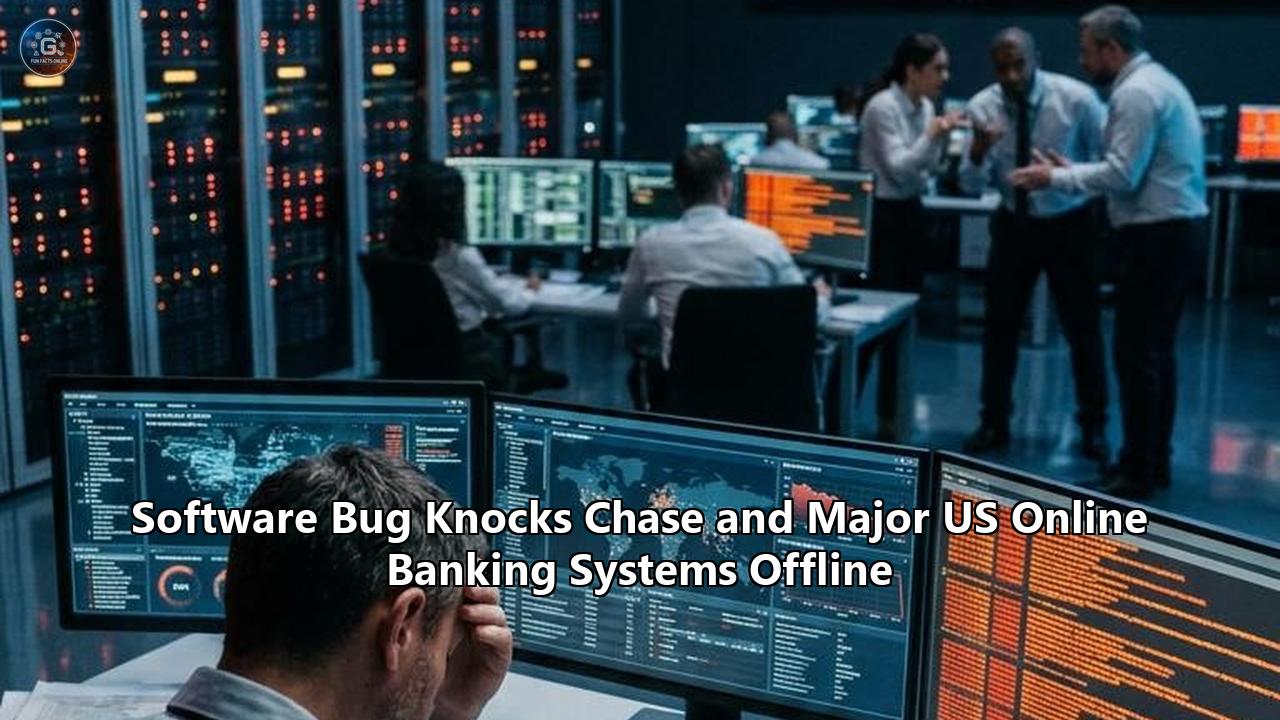
On Monday, November 16, 2026, a sudden technical failure at JPMorgan Chase cascaded across the American financial sector, locking thousands of retail depositors out of their digital accounts, delaying corporate payroll runs, and choking transaction traffic between competing commercial lenders. The disruption rippled into peer institutions—including Bank of America, Wells Fargo, and U.S. Bank—as well as consumer payment networks like Zelle, highlighting the acute vulnerability of an interconnected banking ecosystem running on complex infrastructure.
JPMorgan Chase moved quickly to clarify the scope of the incident. In statements issued as customer error reports crested past 4,800 on tracking platforms like Downdetector, bank leadership attributed the failure to an internal software defect affecting on-premises hardware rather than a distributed denial-of-service attack or foreign cyber intrusion.
"JPMorganChase has experienced a temporary issue related to a software bug in on-premise hardware systems—there is no evidence this is cyber-related," bank spokesperson Joe Evangelisti confirmed. "It is taking longer than usual to service some customers. Where we were party to a transaction involving other banks, those banks may have been impacted, but this is not a systemic issue".
While banking services began normalizing late Monday evening and transactions posted normally by Tuesday morning, the incident exposed a glaring operational paradox: modern retail banking presents a sleek, cloud-native digital storefront, yet it remains bound to legacy on-premise hardware systems. When one foundational node fails, the ripple effect behaves less like an isolated technical hiccup and more like a localized liquidity freeze.
This breakdown did not occur in a vacuum. It struck during a week plagued by foundational technical failures across the United States, following a multi-day Microsoft cloud blackout that crippled enterprise communications in dozens of countries and an air traffic control network failure that triggered a nationwide commercial ground stop. Together, these episodes have forced corporate leaders, enterprise architects, and financial regulators to confront the widening gulf between rapid digital transformation and physical infrastructural resilience.
The Ripple Effect: How a Single Defect Froze Counterparty Rails
The initial signs of distress emerged shortly before 10:00 a.m. Eastern Time on Monday. Customers opening the Chase mobile app or desktop portal encountered blank balance screens, recurring session-timeout notifications, or persistent alerts warning that specific core services were temporarily unavailable. At physical branch locations across several metropolitan markets, tellers found their internal terminal interfaces lagging or unable to process counter withdrawals.
Within two hours, the problem bled past Chase's customer perimeter. Users at Wells Fargo reported balance inconsistencies and failed outbound wires. Customers of Bank of America and Truist flooded social channels with complaints that personal transfers sent via Zelle were vanishing into processing queues without crediting the recipient's ledger.
                     +---------------------------------------+
                     |    JPMorgan Chase On-Premise Core     |
                     |  (Internal Hardware / Microcode Bug)  |
                     +-------------------+-------------------+
                                         |
                       Synchronous Queue Blockage / Retries
                                         |
         +-------------------------------+-------------------------------+
         |                               |                               |
         v                               v                               v
+------------------+           +-------------------+           +------------------+
|   Chase Mobile   |           |  Interbank Rails  |           |      Zelle       |
|    & Branches    |           |    (ACH / RTP)    |           |  (Early Warning) |
| (Interface Lag)  |           | (Counterparty Lag)|           | (Payment Delays) |
+------------------+           +---------+---------+           +---------+--------+
                                         |                               |
                                         v                               v
                               +-------------------+           +------------------+
                               | Peer Institutions |           | End Users at BofA|
                               | (Wells Fargo, US  |           | Wells, US Bank   |
                               | Bank Balances)    |           | (Pending Funds)  |
                               +-------------------+           +------------------+
The issue was not that every commercial bank had crashed simultaneously. Instead, Chase’s position as the nation's largest depository institution—holding over $3.9 trillion in consolidated assets and serving roughly 80 million consumers—means it acts as the primary counterparty to an enormous fraction of daily domestic financial volume.
When Chase’s internal validation and routing services slowed to a crawl, transactions entering from external networks hit dead ends. Counterparty banks were forced to hold transactions in suspense. In financial software systems, an unacknowledged message often triggers automatic polling retries. As thousands of external applications retried their calls against Chase's bogged systems, transaction queues backed up across the broader interbank fabric.
The high-profile Chase bank outage, which peaked on Monday afternoon, sent shockwaves through payment aggregators that rely on continuous synchronous settlement. Zelle, operated by Early Warning Services, a bank-owned consortium whose members include JPMorgan Chase, Bank of America, and Wells Fargo, was caught in the middle.
"Zelle is operating as it should," said Eric Blankenbaker, vice president of communications at Early Warning Services. "An issue at the financial institutions may be impacting broader services, including Zelle payments, for some of their customers".
Jeff Shelman, senior vice president and head of enterprise external communications at U.S. Bank, issued a similar clarification to reassure anxious depositors: "U.S. Bank systems are not directly impacted. However, clients attempting to send or receive Zelle payments with another financial institution may experience transaction delays".
The incident highlighted how public-facing outage trackers can distort digital reality. When an individual attempts to transfer rent money from a Bank of America account to a landlord using Chase, and the transaction fails to settle, the user files an incident report against Bank of America. As Downdetector graphs spiked simultaneously across five major lenders, consumer panic flared over the possibility of a coordinated cyber offensive against the financial system. The reality was less cinematic, but technically troubling: a self-inflicted flaw inside the hardware layers of a single institution effectively jammed the digital pipes of retail commerce.
Anatomy of the Glitch: The Hardware-Software Interconnect
JPMorgan Chase’s confirmation that the root cause traced to "a software bug in on-premise hardware systems" points to one of the most operationally challenging domains in enterprise computing: the interface between low-level firmware or device drivers and core transactional software.
Mainstream discourse tends to imagine modern banking as fully transitioned to public cloud hyperscalers like Amazon Web Services, Microsoft Azure, or Google Cloud. While Tier-1 institutions have migrated significant analytics, consumer interfaces, and secondary services to public cloud environments, their primary core banking engines—the systems of record responsible for continuous ledger consistency, interest calculation, and account debits—often remain anchored to on-premises mainframe and distributed bare-metal server infrastructure.
+-----------------------------------------------------------------------+
|                     Modern Digital Interface Layer                    |
|       (Public Cloud Hyperscalers / Mobile APIs / Web Frontends)       |
+-----------------------------------------------------------------------+
                                   |
                         High-Latency Gateway
                                   |
+-----------------------------------------------------------------------+
|                   On-Premises Hybrid Infrastructure                   |
|   +---------------------------------------------------------------+   |
|   |         Hardware Abstraction Layer / Device Drivers           |   |
|   +---------------------------------------------------------------+   |
|   |   SAN Controllers / High-Throughput Storage Fabric (NVMe/FC)  |   |
|   +---------------------------------------------------------------+   |
|   |               Low-Level Microcode & Hypervisors               |   |
|   |        [CRITICAL BUG: Locking Contention / Queue Stall]       |   |
|   +---------------------------------------------------------------+   |
|   |          IBM zSystems Mainframes / Bare-Metal Racks           |   |
|   |            Core Ledger & Transaction Processors               |   |
|   +---------------------------------------------------------------+   |
+-----------------------------------------------------------------------+
These enterprise environments rely on specialized high-throughput storage area networks (SANs), hardware management consoles (HMCs), and enterprise servers running deeply optimized transactional operating systems like IBM z/OS or customized Linux kernels. In these on-premises environments, a "software bug in hardware systems" typically stems from one of several failure modes:
- Microcode and Firmware Regression: Upgrades pushed to storage controller microcode or network switch firmware that introduce memory leaks or race conditions under high transactional concurrency.
- Driver-Level Mutex Deadlocks: A low-level driver update failing to release a mutual exclusion lock (mutex) during input/output operations, causing downstream application threads to freeze while awaiting hardware access.
- Buffer Invalidation Errors: Failures within hardware-assisted caching algorithms that corrupt in-flight transaction records, forcing databases into aggressive rollback cycles.
- Queue Depth Exhaustion: Unchecked retries triggered by transient packet drops that fill hardware-level input/output queues, causing upstream API gateways to reject new requests with generic HTTP 504 Gateway Timeout errors.
Unlike software errors occurring within stateless containers hosted in the public cloud—where automated orchestration systems like Kubernetes can destroy and replace degraded nodes within seconds—on-premise hardware-software defects are difficult to isolate and remediate under live operating conditions.
When a core storage fabric or transaction processing unit experiences thread locking or storage controller contention, engineering teams cannot simply roll back a line of application code. Remediating bare-metal faults often requires isolating physical rack units, power-cycling affected server blades, rebuilding disrupted transactional queues, and running consistency checks across distributed relational databases to verify that balances have not diverged.
During the height of the Chase bank outage, account balances registered blank or failed to update precisely because safety protocols functioned as designed. In transactional financial systems, the primary engineering mandate is the preservation of ACID properties:
- Atomicity: Transactions must completely succeed or completely fail; half-finished transfers cannot exist.
- Consistency: Data must conform to all validation rules across ledgers at all times.
- Isolation: Concurrent transactions cannot access data in a half-finished state.
- Durability: Once committed, records survive system failures.
If low-level hardware bugs introduce latency into database writes, the database engine deliberately restricts access rather than serving unverified balance figures. The resulting slowdown protected customers against phantom debits and fraudulent duplicate spending, but it produced an immediate freeze in interface usability that consumers perceived as a total system crash.
Compounding Failures and the Myth of System Independence
Analyzing the Chase bank outage requires separating the physical infrastructure layer from the digital networks built on top of it. The disruption arrived during an extraordinarily fragile stretch for domestic technological infrastructure.
Four days prior, on Thursday, a widespread configuration fault within Microsoft's cloud infrastructure knocked Outlook, Teams, and Copilot services offline for millions of users across 74 countries. On Friday, an overloaded telecommunications router within the Federal Aviation Administration's flight operations network degraded radar and communication data streams, prompting the agency to execute a four-hour nationwide ground stop that stranded hundreds of thousands of commercial travelers. By Monday afternoon, alongside the banking gridlock, United Airlines grappled with a concurrent software outage that delayed hundreds of domestic flights.
While corporate representatives insisted these incidents were technically unrelated, their concurrency pointed to a deeper common vulnerability.
"When we dig into the details, each one has an explanation that makes sense on its own, but they all point to a common theme: the complexity and fragility of the systems that we depend on every day," observed Mike Chapple, professor of IT, Analytics, and Operations at the University of Notre Dame. "In each of these cases, what started as an issue in one small part of a larger system quickly spread, causing massive disruptions nationwide".
This compounding fragility stems from tight coupling. Over two decades, enterprise systems have been optimized for throughput, real-time response, and balance-sheet efficiency, often at the direct expense of slack and isolation. In theoretical system dynamics, tightly coupled systems possess few shock absorbers:
- Time dependencies are rigid (processes cannot wait).
- The sequence of operational steps is invariant (step B must follow step A instantly).
- There is only one path to a successful outcome (no alternate routes).
- Subsystems cannot be isolated without stopping the entire operational machine.
Retail digital payments embody tight coupling. When a consumer initiates a peer-to-peer transfer, the user interface queries identity directories, verifies fund availability via core banking APIs, interfaces with interbank messaging networks (such as Early Warning Services, The Clearing House's Real-Time Payments network, or the Federal Reserve's FedNow service), and updates local ledgers—all within a target window of 1,500 milliseconds.
+---------------------------------------------------------------------------------+
|                           Synchronous Payment Flow                              |
+---------------------------------------------------------------------------------+
|                                                                                 |
|  [Initiator] ---> [Directory Lookup] ---> [Balance Check] ---> [Interbank Rail] |
|                                                                       |         |
|  Latency Target: <1,500ms                                             |         |
|  (Failure at any single step terminates or hangs entire transaction)  v         |
|                                                                 [Chase Core]    |
|                                                                 (UNRESPONSIVE)  |
|                                                                       |         |
|  [Failure Alert] <--- [Timeouts Cascade] <--- [Suspense Queue] <------+         |
|                                                                                 |
+---------------------------------------------------------------------------------+
If the counterparty node on that chain is unresponsive due to an on-premise hardware bug, the transaction cannot complete. Because consumer software applications rarely provide detailed contextual error codes, users assume their home bank has failed. The psychological and operational blast radius of an outage expands exponentially, dragging structurally healthy institutions into the reputational mud.
The Operational and Human Cost: When Main Street Friction Hits Capital Markets
The operational fallout of the Chase bank outage serves as a stark blueprint for what regulators call systemic operational risk. Although the technical disruption was largely contained within an eight-to-twelve-hour window, the economic frictions it introduced generated lingering downstream consequences for small enterprises, mortgage closings, and hourly workers.
For corporate accounts running mid-month payrolls through automated clearing house (ACH) batch files, the slowdown created acute operational stress. Batch files submitted on Monday morning that failed to receive timely processing confirmations triggered panic among payroll administrators. Had those batches missed standard settlement cut-off windows, hundreds of small-to-medium enterprises would have faced statutory penalties or left contract employees unpaid heading into mid-week.
In real estate transactions, where same-day wire transfers are mandatory for closing escrow, title companies were forced to delay property settlements. When a Tier-1 bank cannot clear an outbound Fedwire transfer or verify incoming ledger updates, escrow officers cannot release deeds. For home buyers stranded at closing tables, the technical error translated into immediate hotel costs, rescheduling fees for commercial movers, and potential breach-of-contract penalties.
+----------------------------------------------------------------------+
|                     Main Street Economic Impact                      |
+----------------------------------------------------------------------+
|                                                                      |
|  1. Escrow & Real Estate Closings                                    |
|     * Wire settlement windows missed                                 |
|     * Closing postponements and contract extension penalties         |
|                                                                      |
|  2. Small-to-Medium Enterprise Liquidity                             |
|     * ACH payroll batch submission delays                            |
|     * Supplier invoice processing frozen at settlement gateways      |
|                                                                      |
|  3. Retail Consumer Transactions                                     |
|     * Accidental duplicate payment submissions                       |
|     * Inability to verify real-time available funds for essentials   |
|                                                                      |
|  4. Counterparty Reputational Overhead                               |
|     * Surge in support calls at unaffected peer banks (BofA, Wells)  |
|     * Increased queue load on Zelle partner customer service desks   |
|                                                                      |
+----------------------------------------------------------------------+
The consumer landscape experienced immediate, compounding confusion. When digital balance screens displayed zero-dollar balances or generic error screens, consumer anxiety surged.
A recurring hazard during online banking outages is the "retry amplification" behavior exhibited by anxious users. Believing an initial transfer failed because the user interface threw an uninformative error, consumers frequently attempt the same payment a second, third, or fourth time.
Once backend processing pipelines clear the obstruction, these queued transactions can execute sequentially. This drains checking accounts, triggers overdraft penalties, and ties up consumer funds in settlement reconciliations that can take days to reverse.
Architectural Remedies: How Financial Engineering Is Responding
To prevent single-node software bugs from metastasizing into industry-wide outages, software architects and infrastructure engineers across the financial sector are developing and deploying architectural interventions. The focus has pivoted away from the unrealistic promise of "zero-bug code" toward defensive architecture: engineering systems that anticipate component failure and restrict its blast radius.
+--------------------------------------------------------------------+
|                Graceful Degradation Architecture                   |
+--------------------------------------------------------------------+
|                                                                    |
|  [Mobile / Web Frontend]                                           |
|            |                                                       |
|            v                                                       |
|  [Edge API Gateway]                                                |
|            |                                                       |
|            +---> [Health Check / Latency Monitor: Normal]          |
|            |           |                                           |
|            |           v                                           |
|            |     [Live Core Banking Engine (ACID Read/Write)]      |
|            |                                                       |
|            +---> [Health Check / Latency Monitor: FAILING]         |
|                        |                                           |
|                        v                                           |
|                  [CIRCUIT BREAKER OPENS]                           |
|                        |                                           |
|                        v                                           |
|                  [Cached Read-Only Replica]                        |
|                  * Serves "Balance as of 09:00 AM"                 |
|                  * Prevents interface crash                        |
|                        |                                           |
|                        v                                           |
|                  [Asynchronous Intent Queue]                       |
|                  * Accepts transfer intent securely                |
|                  * Resolves idempotently once core recovers        |
|                                                                    |
+--------------------------------------------------------------------+
1. Decoupling Interface Availability from Core Transaction Execution
The most critical engineering pivot is dismantling the architectural pattern where customer mobile interfaces require real-time, synchronous confirmation from on-premise transactional mainframes merely to render an account page.
Leading institutions are deploying edge-cached read replicas and event-sourced balances. Under this design, the mobile application reads from a localized, highly available read-only cache that reflects the account's state as of the latest completed batch.
If a low-level hardware or microcode bug freezes the primary transactional core, the frontend does not crash with an error code. Instead, it shifts transparently into an informational mode, displaying a balance marked with a clear timestamp: "Balance accurate as of 9:45 AM; new transactions currently processing."
Outbound payment requests are accepted as "pending intents" and routed into persistent, cryptographically verified asynchronous queues rather than being executed synchronously. This shields the user interface from backend latency and avoids panic-inducing crashes.
2. Implementation of Distributed Circuit Breakers and Backpressure Regulators
To insulate peer institutions from counterparty failures, interbank payment gateways are integrating advanced circuit breaker patterns (such as those pioneered in distributed microservices frameworks like Resilience4j and Envoy proxy meshes).
When an external destination node (such as Chase's receiving gateway) fails to acknowledge requests within a predefined threshold (for example, if 5% of requests time out over a 30-second window), the circuit breaker transitions from Closed to Open.
  Normal Operation             Threshold Exceeded             Recovery Probing
+-------------------+        +--------------------+        +-------------------+
|      CLOSED       | -----> |        OPEN        | -----> |     HALF-OPEN     |
| Requests pass     |        | Requests fail fast;|        | Canary calls sent |
| through normally  |        | fallbacks engage   |        | to probe health   |
+-------------------+        +--------------------+        +-------------------+
         ^                                                           |
         |-----------------------------------------------------------+
                                  Success
While Open, the calling system no longer hammers the degraded counterparty with doomed transaction packets. Instead, it immediately rejects or defers the transfer at the source edge, informing the consumer upfront: "Transfers to this specific institution are temporarily delayed. Your funds have not been deducted."
This protects the initiating bank's own internal queues from clogging, preserves server capacity, and stops retry storms from overloading recovering hardware.
3. Canary Deployments for On-Premise Infrastructure and Firmware
While continuous integration and continuous deployment (CI/CD) pipelines with canary testing are standard for web applications, extending these practices to bare-metal hardware and storage controllers has lagged. Financial infrastructure engineering is now adapting these models for physical hardware layers:
- Cell-Based Architecture: Splitting the core ledger not into one monolithic hardware cluster, but into hundreds of isolated operational "cells" (e.g., partitioning accounts by region or hashed account ID). A hardware or software bug introduced during a system update affects only a single cell (e.g., 1% of customer volume), allowing engineers to identify anomalies and halt deployment before an outage affects the entire enterprise.
- Hardware-in-the-Loop (HIL) Simulation: Emulating peak Monday-morning transactional throughput within isolated physical testing laboratories that mirror production storage area networks and mainframe controllers, catching locking bugs prior to production cutover.
- Immutable Firmware Baselines: Utilizing infrastructure-as-code (IaC) to manage bare-metal switch and server configurations, enabling instantaneous single-command rollback to known-good firmware versions if hardware metrics deviate post-deployment.
Regulatory Reckoning: Transforming Operational Resilience into Law
The regulatory apparatus governing American banking has focused on capital adequacy—ensuring institutions maintain sufficient equity and liquidity buffers to absorb credit losses, as formalized in Basel III and the Dodd-Frank Wall Street Reform and Consumer Protection Act. Yet incidents like Monday’s outage highlight that an institution can possess pristine capital ratios and pristine liquidity coverage, yet still trigger systemic market friction through operational collapse.
+---------------------------------------------------------------------------------------+
|                    The Shifting Paradigm of Banking Supervision                       |
+---------------------------------------------------------------------------------------+
|                                           |                                           |
|       TRADITIONAL CAPITAL OVERSIGHT       |       EMERGING OPERATIONAL OVERSIGHT      |
|                                           |                                           |
|  * CCAR Stress Testing                    |  * Severe-but-Plausible IT Scenarios      |
|  * Tier 1 Equity Ratios                   |  * Impact Tolerances for Disruption       |
|  * Liquidity Coverage Ratios (LCR)        |  * Maximum Tolerable Downtime (MTD)       |
|  * Focus: Credit & Market Solvency        |  * Focus: System Availability & Plumbing  |
|                                           |                                           |
+---------------------------------------------------------------------------------------+
Regulators are increasingly shifting toward treating operational resilience with the same quantitative rigor historically reserved for balance sheet solvency.
The Federal Regulatory Response
In Washington, the Federal Reserve Board, the Office of the Comptroller of the Currency (OCC), and the Federal Deposit Insurance Corporation (FDIC) have moved to step up enforcement of their joint Sound Practices to Strengthen Operational Resilience.
Following the series of disruptions, federal examiners are narrowing their focus on "impact tolerances"—the maximum acceptable level of operational disruption to a critical business service, measured by duration, volume of impacted transactions, and counterparty contagion.
Federal regulators are pressing large institutions to document:
- How long their core ledgers can remain offline before triggering irreversible counterparty settlement defaults.
- The presence of distinct, physically and logically out-of-band alternative processing pathways capable of operating if their primary systems stall.
- Quantitative proof that third-party core software updates undergo rigorous blast-radius containment before production deployment.
The Consumer Financial Protection Bureau (CFPB) is reviewing the incident through the lens of consumer compliance. Under the Electronic Fund Transfer Act (EFTA) and Regulation E, consumers possess clear rights regarding access to funds and the accurate resolution of billing errors.
If internal software failures misrepresent available funds, cause check or debit rejections, or lock consumers out of transaction access for sustained periods, regulators can levy substantial fines for unfair, deceptive, or abusive acts or practices (UDAAP).
International Contrast: The DORA Precedent
The European Union’s Digital Operational Resilience Act (DORA) serves as an influential model for the future of American financial oversight. DORA established a unified, binding statutory framework that mandates financial entities not merely document their risk management, but continuously stress-test their digital systems using threat-led penetration testing and advanced digital mapping.
Crucially, DORA subjects critical ICT (information and communication technology) third-party providers—including cloud hyperscalers and key hardware/software vendors—to direct oversight by financial regulatory authorities. In the United States, by contrast, vendor management oversight remains largely indirect, routed through the supervised financial institutions themselves under the Bank Service Company Act.
The recurring nature of infrastructure breakdowns across multiple enterprise sectors has spurred calls in Congress to introduce comprehensive operational resilience legislation mirroring the EU model, granting regulators direct audit and enforcement authority over the software and hardware supply chains servicing Tier-1 lenders.
Technical Solutions Comparison: Resiliency Frameworks
To navigate the engineering tradeoffs inherent in hardening core banking infrastructure, financial engineering teams weigh several competing technical approaches:
| Engineering Strategy | Implementation Mechanism | Primary Advantages | Critical Tradeoffs & Limitations |
|---|---|---|---|
| Monolithic Active-Passive On-Premises | Hot standby mainframe/server clusters running synchronized storage replication. | Absolute data consistency; strict ACID compliance; zero divergence risk under normal operations. | Susceptible to shared-state software bugs; a bug updating the active node replicates instantly to the passive node. |
| Cell-Based Autonomous Architecture | Sharding infrastructure into small, fully independent end-to-end units serving subsets of customers. | Restricts blast radius of any hardware or firmware defect to a fraction of users (e.g., 1–3%). | High architectural complexity; complex inter-cell routing layers; elevated infrastructure management overhead. |
| Hybrid Cloud Read-Decoupling | Edge-caching account balances across distributed public clouds while keeping write-cores on premise. | Preserves front-end interface availability and informational access during core backend failures. | Introduces eventual consistency; displays stale balance data requiring user-facing latency notices. |
| Distributed Circuit Breaking & Backpressure | API-level proxies that detect counterparty latency spikes and immediately halt downstream calls. | Prevents cascading interbank retry storms; keeps local systems operational during counterparty outages. | Requires industry-wide protocol adoption; payments must be queued asynchronously or rejected at the edge. |
Practical Blueprint for Affected Stakeholders
When a major interbank disruption strikes, distinct cohorts within the financial ecosystem must execute targeted playbooks to safeguard capital, operational integrity, and consumer trust.
+---------------------------------------------------------------------------------+
|                        Crisis Response Action Framework                         |
+---------------------------------------------------------------------------------+
|                                                                                 |
|  [Enterprise Treasurers & FinTechs]                                             |
|   |--> Switch outward transaction flows to secondary rails (FedNow/ACH)         |
|   |--> Enforce client-side idempotency keys to prevent duplicate execution     |
|                                                                                 |
|  [Peer Commercial Lenders]                                                      |
|   |--> Trip API circuit breakers for degraded counterparty endpoints   |
|   |--> Display dynamic frontend banners detailing specific counterparty delays  |
|                                                                                 |
|  [Retail Banking Customers]                                                     |
|   |--> Cease redundant payment retry attempts to prevent multiple debits|
|   |--> Preserve screenshots of timestamped error dialogs and account states    |
|                                                                                 |
+---------------------------------------------------------------------------------+
For Corporate Treasurers and Financial Operations Teams
- Maintain Multi-Rail Redundancy: Avoid reliance on a single clearing channel or settlement bank. Ensure treasury management systems maintain active routing pathways across multiple rails—including traditional ACH, Fedwire, and modern real-time rails like RTP and FedNow.
- Enforce Idempotency Protocols: Configure corporate payment engines to generate cryptographically unique idempotency keys for every outbound transaction. If an API call to a partner bank times out, subsequent retries bearing the same idempotency key ensure the destination ledger processes the payment once, preventing catastrophic duplicate payments during recovery phases.
- Establish Dynamic Counterparty Limits: Implement automated rules that monitor return-code velocity and latency metrics for major counterparties. When a partner institution exceeds normal response thresholds, automatically throttle non-critical transaction traffic.
For Peer Banking Institutions and FinTech Operators
- Deploy Transparent User Communications: Avoid displaying generic "system error" modals when counterparty integrations fail. If an outbound transfer to another bank cannot be completed because that counterparty's API is unresponsive, inform the user with precise interface messaging: "Transfers to Chase accounts are temporarily experiencing delays due to partner system issues. Your funds remain safe in your account".
- Activate Defensive Rate Limiting: Isolate outbound queues directed at degraded counterparties. Applying backpressure algorithms prevents external timeouts from tying up internal worker threads required to service normal intra-bank operations.
- Validate In-Flight Settlement Queues: Prepare reconciliation teams to run automated transaction validation audits against Federal Reserve and Clearing House settlement journals as soon as counterparty connectivity normalizes, identifying orphaned debits or credits before end-of-day clearing.
For Retail Banking Consumers
- Halt Payment Retries: If an app displays a spinning loader, an error code, or an unconfirmed transfer message during a known outage, do not repeatedly submit the request. Multiple clicks often translate into multiple valid transfers once backend processing resumes.
- Document Interface States: Capture timestamped screen captures of balance information and error alerts. If unexpected overdraft charges or late-payment penalties arise from delayed settlement, these records serve as evidence for fee-waiver requests under federal consumer protection guidelines.
- Maintain Secondary Payment Mechanisms: Keep alternative payment methods available—such as an account at a secondary, independent depository institution or a physical credit card issued on a distinct processing network—to handle critical transactions during core online banking outages.
The Road Ahead: Confronting the Physical Limits of Software
The software bug that disrupted JPMorgan Chase and its interbank partners highlights an uncomfortable technical truth: the financial system cannot abstract away its physical foundations.
While the consumer layer of finance operates with frictionless immediacy, the underlying plumbing remains anchored to complex bare-metal servers, storage networks, and low-level firmware instructions. These physical components demand physical maintenance, and they are inherently vulnerable to software flaws.
Over the coming quarters, watch for three critical developments:
- Federal Reserve and OCC Operational Audits: Regulatory examiners are scheduled to conduct targeted operational resilience reviews across all US Global Systemically Important Banks (G-SIBs), focusing explicitly on firmware update validation, on-premises change-management protocols, and automated blast-radius containment.
- Modernization of Interbank Settlement Messaging: The ongoing industry transition to the ISO 20022 messaging standard will face increased pressure to incorporate structured fallback indicators, allowing institutions to process rich contextual metadata that explains processing delays without forcing endpoints to fail.
- Accelerated Adoption of Cell-Based Architectures: Tier-1 lenders will accelerate multi-year infrastructure redesigns aimed at breaking monolithic core ledgers into isolated operational cells, limiting future hardware or software bugs to small, contained customer cohorts.
The lesson of November 2026 is that operational resilience is not simply an internal IT concern; it is a prerequisite for financial stability. As financial infrastructure grows increasingly tightly coupled, the margin for error within low-level code shrinks to near zero.
Until the financial industry redesigns its architectures to decouple digital interfaces from hardware-bound transactional cores, the next unexpected line of errant code will continue to threaten the digital commerce of Main Street and Wall Street alike.
Reference:
- https://www.theguardian.com/business/2026/nov/16/us-bank-outage-chase-wells-fargo
- https://fish4news.co.uk/chase-bank-outage-software-bug-transactions-restored-november-2026/
- https://www.forbes.com/sites/conormurray/2026/11/16/customers-report-outages-at-major-banks-chase-bank-of-america-wells-fargo-impacted/
- https://mashable.com/tech/major-us-banks-experiencing-online-banking-outages-nov-16-2026
- https://www.aljazeera.com/news/2026/11/17/us-bank-outage-what-caused-chase-problems-and-zelle-payment-delays
- https://edition.cnn.com/2026/11/16/business/bank-outage-chase-us-bank-bank-of-america
- https://www.cbsnews.com/news/banks-online-service-outages-jpmorgan-chase-bank-of-america-wells-fargo/
- https://www.aljazeera.com/news/2026/11/16/thousands-report-difficulties-accessing-accounts-online-at-major-us-banks
- https://www.cnet.com/news-live/chase-bank-outage-11-16-2026/
- https://www.businessinsider.com/chase-other-major-banks-hit-by-online-outages-2026-11