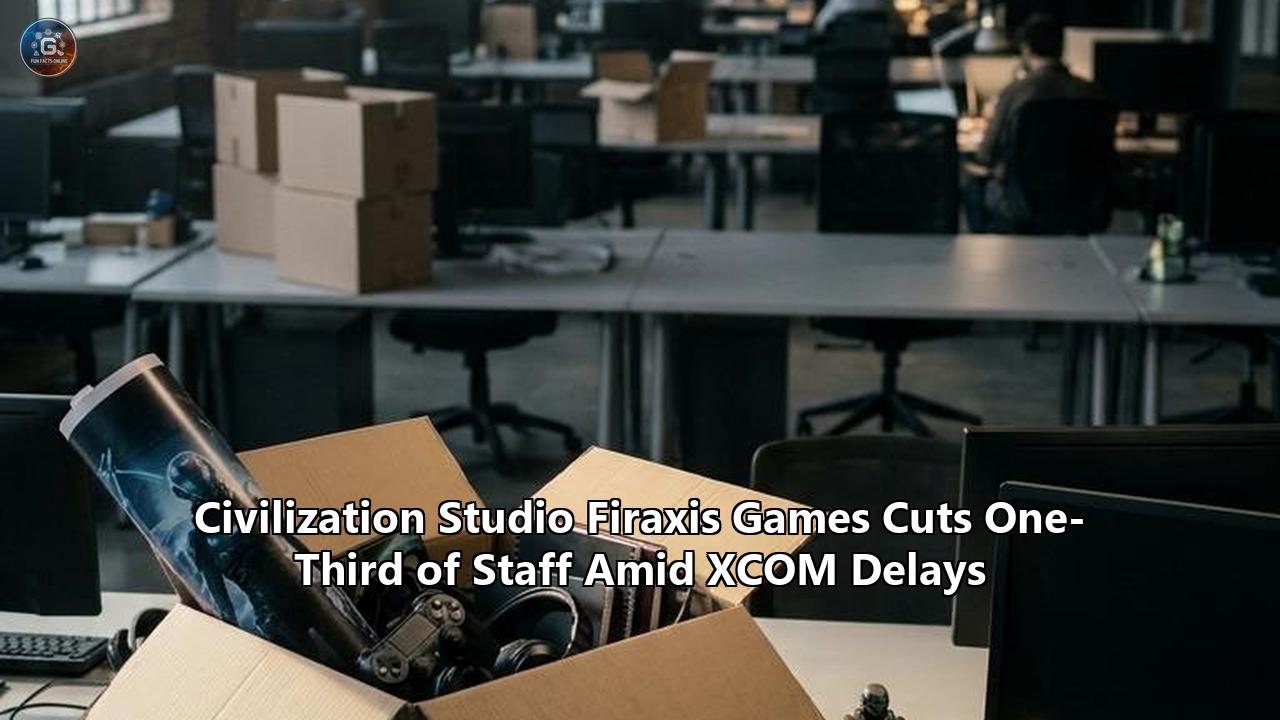
At 9:15 a.m. on Tuesday, November 17, 2026, the calendar invites began quietly overwriting the schedules of engineers, level designers, and production staff across Firaxis Games’ red-brick headquarters in Sparks, Maryland. Titled simply “Department Operational Update,” the 15-minute individual videoconference slots offered no agenda and permitted no responses. By noon, the studio behind Sid Meier’s Civilization and XCOM had terminated roughly 60 employees—slashing approximately one-third of its entire workforce in a single morning.
Among those out the door was Heather Hazen, the studio head appointed in early 2023 to guide the storied developer into a modern operational era.
The public explanation from parent company Take-Two Interactive and its publishing subsidiary, 2K Games, was couched in familiar corporate rhetoric. A company spokesperson stated that the cuts were part of an effort to “restructure and recenter around the studio’s core strength—designing world class strategy games that have set the industry standard for the genre for the last 30 years,” adding that reducing the studio’s size was an “essential” measure to “focus on design, technology, and player experience”. On Hazen’s departure, 2K claimed she had determined this was “the right, deliberate moment to hand over the reins to ensure the next studio leader has full ownership of this new era”.
The reality inside the studio tells a radically different story.
Interviews with more than a dozen current and former Firaxis employees, publishing insiders at 2K, and video game production specialists reveal that the Firaxis Games layoffs were the direct culmination of a two-year operational crisis. The breaking point was not merely macroeconomic headwinds, but the quiet collapse of an ambitious, unannounced mainline entry in the XCOM franchise. The project missed an existential development milestone over the summer of 2026 after struggling through two years of creative discord, repeated mechanical reboots, and crippling engine instability.
Compounding that failure was the protracted, expensive salvage operation required for Sid Meier’s Civilization VII. Following its launch in February 2025, the flagship title fractured its player base, stumbled to a 51 percent positive user rating on Steam, and tied down dozens of senior developers who had to rebuild core mechanics rather than transition to new revenue-generating projects.
When the mid-year audit arrived from Take-Two’s executive offices in New York, the math for Sparks was unsentimental. Firaxis, long treated as the dependable, slow-cooking artisan workshop of 2K’s portfolio, had burned through its reputational capital.
The Secret Project: Anatomy of a Summer Milestone Failure
For four years, strategy enthusiasts asked a single question: where was XCOM 3?
Following the 2020 experimental spin-off XCOM: Chimera Squad and the departure of franchise creative director Jake Solomon in February 2023, the franchise appeared to enter cryo-sleep. In truth, Firaxis had spun up a full-scale tactical team in late 2023 under a shroud of non-disclosure agreements. The mandate delivered by 2K leadership was clear: construct a proper generational leap for the premier turn-based sci-fi tactical combat series, but build it with retention systems designed to generate recurring player engagement.
According to three developers who worked directly on the project, the production unravelled under conflicting visions from its inception.
“After Jake left, there was an existential identity crisis,” says a senior systems designer who spoke on the condition of anonymity to avoid industry blacklisting. “Jake had an ironclad sense of what an XCOM game felt like—the brutal board-game math, the emotional cruelty of permadeath, the tactile rhythm of taking cover and taking shots. When the new leads took over, the publishing side wanted something broader. They wanted procedural, persistent global campaigns, live seasonal incursions, deeper character customization, and real-time strategic meta-layers. It was classic scope creep, but driven by a mandate to justify a modern AAA budget.”
To accommodate these ambitions, Firaxis abandoned its heavily customized, proprietary version of Unreal Engine 3.5—the battle-tested technical foundation that had powered XCOM: Enemy Unknown (2012) and XCOM 2 (2016). The team migrated wholesale to Unreal Engine 5.
On paper, the engine switch promised state-of-the-art volumetric lighting, dynamic environmental destruction, and modular asset streaming. In practice, it turned into an engineering sinkhole.
Turn-based tactical combat relies on precise grid systems, deterministic hit-calculation logic, line-of-sight pathfinding, and procedural level generation. Unreal Engine 5’s physics systems and high-density geometry pipelines, designed primarily for real-time action titles, fought Firaxis’s custom tactical tools at every step. Destructible multi-story buildings—a signature hallmark of XCOM 2—frequently broke turn-sequencing scripts, desynchronized visual camera angles from grid coordinates, and caused catastrophic memory leaks during procedural map stitching.
“Procedural map generation in a turn-based tactics game is one of the hardest engineering problems in software,” explains an engine programmer who worked on Firaxis systems for five years. “Every building piece, every half-cover wall, every extraction zone has to be procedurally assembled while maintaining valid navigation meshes for AI, accurate line-of-sight checks, and balanced cover density. In UE5, we were essentially rewriting custom low-level tactical code while the core engine itself was receiving major version updates from Epic. By late 2025, half the combat engineering team was doing nothing but trying to stop the procedural generator from placing alien pods inside solid geometry or generating second floors that collapsed under gravity before the first turn even started.”
These technical hurdles converged on what internal schedules designated the “Alpha Evaluation Gate”—a high-stakes milestone scheduled for July 2026. To clear the gate and unlock the next tranche of production funding from Take-Two, the team was required to present a stable vertical slice: a fully playable, three-mission procedural tactical chain, complete with an operational base-building management hub and functional soldier progression trees.
The presentation to 2K executives in late July was disastrous.
According to two sources present during executive reviews, the build suffered multiple hard desktop crashes during dynamic line-of-sight calculations. Frame rates in procedural urban sectors dipped into the low teens during high-particle explosive sequences. More damningly, 2K’s publishing representatives concluded that the gameplay experience itself had lost its soul: the high-stakes tactical dread of XCOM had been diluted by unwieldy base-management mini-games and an incoherent, live-service-styled loot system that felt bolted on to appease corporate focus groups.
The project missed the milestone. Funding was frozen pending what 2K executives termed a “strategic portfolio re-evaluation”.
For the tactical team in Sparks, the writing was on the wall. The game was not outright canceled, but it was ordered back to pre-production prototyping with a skeleton crew. Dozens of artists, narrative writers, level scripters, and gameplay engineers who had spent 18 months building assets for a sprawling tactical epic suddenly had nowhere to go.
Anatomy of a Crisis: How Delays and Missteps Sparked the Firaxis Games Layoffs
In a healthy studio ecosystem, developers displaced by a paused project are redeployed onto other active productions or live games. But when the summer milestone collapsed, Firaxis had no safety net left.
The historical financial pillar of Firaxis Games has always been Sid Meier’s Civilization. Over 35 years and six mainline iterations, the franchise had achieved the status of an evergreen annuity, surpassing 80 million units sold worldwide. In the volatile video game business, Civilization was the bedrock: an intellectual property that generated tens of millions of dollars in steady revenue year after year through base games, high-margin expansion packs, and steady digital catalog sales.
Civilization VII, released in February 2025, was supposed to secure the studio’s finances for the next decade. Instead, it became an operational quagmire.From the day of its reveal, Civilization VII took daring structural swings. Creative Director Ed Beach and the lead design team sought to solve the age-old "late-game slog" that had afflicted the 4X genre for decades—the tendency of matches to become tedious once a player's snowballing empire made victory inevitable. Their solution was a radical structural break: dividing human history into discrete "Ages" (Antiquity, Exploration, and the Modern Age), with players forced to transition between different historical factions as eras changed. A player might begin as the Roman Empire, morph into Norman England during the Exploration Age, and conclude as modern America.
For a substantial segment of the Civilization player base, this broke the central fantasy of the franchise: shepherding a single chosen culture to "stand the test of time".
The critical backlash was immediate, but the commercial response was worse. While mainstream critics awarded respectable review scores, user reviews on Steam plummeted. Players rebelled against the faction-switching mechanic, pilloried the launch user interface—which was clearly designed to accommodate touchscreens and console gamepads at the expense of PC power-users—and criticized an aggressive post-launch monetization strategy that offered day-one cosmetic packs and locked leaders behind premium tiers.
Within three months of release, Civilization VII was bleeding players at an alarming rate. By the summer of 2026, daily concurrent player counts on Steam revealed an unprecedented reality: more people were routinely playing 2016’s Civilization VI and even 2010’s Civilization V than the newly launched Civilization VII. The game’s positive review score hovered at 51 percent—a devastating metric for a premier PC strategy franchise that relied heavily on algorithmic store placement and word-of-mouth recommendations.
The commercial underperformance was acknowledged at the highest corporate level. In May 2026, Take-Two Interactive CEO Strauss Zelnick conceded during an interview with Stephen Totilo’s Game File that Firaxis had miscalculated.
“The game is a really good game. And it's certainly a profitable enterprise for us. But this is one where I think what we tried to do was a bridge too far, from the consumer's perspective,” Zelnick admitted. “Every time there's a new Civ, the team at Firaxis thinks about: 'How do we push the envelope far enough that it makes sense to buy this new game? And how do we preserve what people love enough so that they're not disaffected?' And we got it wrong with Civ VII, but it wasn't for want of trying. And again, I take responsibility for it”.
Zelnick’s public admission was paired with private demands: Firaxis had to fix the game, and fix it immediately.
What followed was an 18-month emergency salvage effort that consumed the Sparks studio. Between the spring of 2025 and autumn of 2026, the Civilization team engaged in a grueling series of fundamental system rewrites. They overhauled the UI, rebalanced diplomacy, retuned technological progression, and eventually introduced options allowing players to carry a single culture across multiple eras—a change that creative director Ed Beach candidly admitted was “personally challenging” because it directly contradicted the foundational design philosophy upon which Civilization VII had been built.
In September 2026, Firaxis hosted an elaborate 35th-anniversary broadcast detailing its road ahead: a massive “Atomic Age” content patch designed to modernize late-game warfare, alongside the announcement of the game’s first paid expansion pack, Earthrise, slated for late 2027.
The triage had stabilized the patient, but the operational cost was staggering. The emergency re-engineering of Civilization VII had sucked up nearly all of Firaxis’s discretionary engineering bandwidth. Senior technical staff who should have been assisting the struggling XCOM team with Unreal Engine 5 rendering bottlenecks and multithreaded AI pipelines were instead glued to their desks in Sparks, writing hotfixes and re-architecting faction data schemas for Civ VII.
By October 2026, the studio faced an impossible budgetary situation: its flagship product (Civ VII) had generated a fraction of its projected recurring revenue and required sustained developer maintenance, while its second major production line (XCOM) was stuck in pre-production after failing a core milestone.
The Firaxis Games layoffs became the mechanism 2K selected to balance the studio's ledger.
FIRAXIS GAMES DEVELOPMENT & TIMELINE: 2020–2026

April 2020:
  • XCOM: Chimera Squad releases as an experimental spin-off.

December 2022:
  • Marvel's Midnight Suns launches to high reviews but low commercial sales.

February 2023:
  • Longtime studio head Steve Martin departs after 25 years.
  • Tactical director Jake Solomon leaves Firaxis.
  • Heather Hazen appointed Studio Head; announces Civ VII.

May 2023:
  • Round 1 Cuts: Firaxis lays off ~30 employees following Midnight Suns shortfall.

February 2025:
  • Sid Meier's Civilization VII launches; receives mixed user reception (51% Steam).
  • Unannounced XCOM project encounters severe UE5 integration issues.

September 2025:
  • Round 2 Cuts: Quiet staff reductions hit several production departments.

May 2026:
  • Take-Two CEO Strauss Zelnick publicly admits they "got it wrong with Civ 7."

July 2026:
  • Unannounced XCOM project fails the "Alpha Evaluation Gate" milestone.
  • 2K leadership freezes production funding; mandates strategic review.

November 17, 2026:
  • Round 3 Cuts: Firaxis lays off ~60 workers (one-third of studio).
  • Studio Head Heather Hazen steps down amid leadership vacuum.
The Long Shadow of Marvel’s Midnight Suns
To fully understand why Firaxis had so little financial cushion when Civilization VII faltered and XCOM stalled, one must look back to December 2022 and the release of Marvel’s Midnight Suns.
Historically, Firaxis was an exceptionally conservative, low-overhead studio. It operated out of a suburban office park 20 miles north of Baltimore, far removed from the hyper-competitive talent markets of San Francisco, Seattle, or London. Its development budgets were moderate; its games—turn-based strategy titles with high intellectual challenge and modest visual effects requirements—could be produced with teams of 80 to 140 people.
Marvel’s Midnight Suns completely shattered that structural discipline.Spurred by the immense commercial success of XCOM 2 and the cultural dominance of the Marvel Cinematic Universe, 2K greenlit a sprawling superhero tactical role-playing game directed by Jake Solomon. The project grew into the most expensive production in Firaxis history. It required a massive licensed soundtrack, expensive motion-capture pipelines, hundreds of thousands of words of fully voiced dialogue, and a deeply complex "Abbey" social-simulation hub where players could hang out, converse, and build friendships with Iron Man, Wolverine, and Captain Marvel.
The production was grueling, suffering multiple delays as the design team struggled to balance tactical deckbuilding combat with third-person exploration.
When Midnight Suns finally arrived in early December 2022, critics praised its ingenious combat mechanics, but the broader marketplace looked away. Sandwiched between holiday releases and burdened by an awkward marketing campaign that confused casual comic fans with card-battle mechanics, the game stumbled hard at retail.
In February 2023, Strauss Zelnick told investors that Midnight Suns was a critical darling that had suffered a "commercial shortfall," attributing the weak sales to an imperfect release window. Within days, the structural pillars of Firaxis began to fracture.
Steve Martin, who had served as Firaxis’s studio head and president for over 25 years, exited. Jake Solomon, the creative force who had spent over two decades at the company and personally revived XCOM, walked away, later establishing his own studio, Midsummer Studios, to build life-simulation games. Garth DeAngelis, the lead producer who had stewarded the franchise for a generation, followed him out the door.
In May 2023, Firaxis cut roughly 30 employees—its first significant round of downsizing in modern history.
The failure of Midnight Suns did not just burn tens of millions of dollars; it permanently altered Firaxis’s standing inside Take-Two’s balance sheet. Under Martin and Solomon, Firaxis had operated with exceptional creative autonomy. They had earned the right to run their studio like a Midwestern craft guild: building quirky, intricate systems, iterating slowly, and trusting that the final product would find a devoted, long-tail audience.
After Midnight Suns, 2K’s corporate oversight tightened dramatically. Publishing executives stepped in with spreadsheets and operational metrics. Firaxis was no longer seen as an untouchable boutique hitmaker; it was an expensive cost center that had fumbled a major Disney license and needed to be brought into lockstep with modern corporate publishing disciplines.
Heather Hazen, promoted from Chief Operating Officer to Studio Head in February 2023, was tasked with walking this razor-thin wire. Her background was in production logistics and live operations, having worked on Fortnite at Epic Games and Plants vs. Zombies at PopCap. Hazen was tasked with modernizing Firaxis: instituting agile milestone tracking, speeding up development cycles, expanding the live-service footprint of Civilization, and establishing multi-project production pipelines so that Firaxis could produce two major games in parallel.
"Heather was put in an impossible position," says a former department director who departed in late 2025. "She was handed a studio that had just lost its primary creative directors, whose morale had been hit by the Midnight Suns flop, whose veteran staff was deeply skeptical of corporate top-down management, and she was told by 2K: 'Deliver Civ VII, build XCOM 3, make them both live-service cash cows, and do it without blowing up your operating margins.' You can’t transform an artisan, turn-based PC development studio into a high-efficiency content factory overnight. The gears were going to strip."
The Human Cost: The November Purge in Sparks
The consequence of those stripped gears was laid bare on November 17, 2026.
The 60 employees fired during the Firaxis Games layoffs represented a devastating cross-section of institutional memory. While corporate restructuring announcements often target duplicative human resources and administrative roles, the Sparks cuts tore straight through core development disciplines.
According to internal lists compiled by departing employees, the layoffs hit:
- Tactical Combat Designers: Nearly the entirety of the mid-level systems design team dedicated to the struggling XCOM project.
- Engine & Tools Programmers: Veteran software engineers who built and maintained the internal scripting toolsets used to balance combat formulas and procedural map assembly.
- Narrative and World-Building Staff: Writers who had authored civilopedia entries, historical scenario dialogues, and character interactions for Civilization VII and its upcoming expansions.
- Quality Assurance & Balance Teams: Internal testing units whose detailed statistical runs ensured that strategy games with millions of variables didn’t collapse into degenerate exploit strategies.
- Concept & 3D Environment Artists: Visual artists whose work had been front-loaded for both Civ VII DLC and the paused tactical title.
For many of those laid off, the severance notifications arrived with chilling brevity. Workers who arrived at the Sparks facility were escorted to their desks to retrieve personal belongings; those working remotely had their Slack access, Google accounts, and Perforce code repository permissions severed while the termination calls were still concluding.
"You give a decade of your life to a studio, you work 60-hour weeks leading up to the Civ VII launch, you spend your weekends writing hotfixes to address player complaints, and then you get a 10-minute Zoom call from an HR representative you’ve never met who reads off a script," says a laid-off senior environment artist. "They tell you your severance package is contingent on signing a non-disparagement agreement, they thank you for your 'passion,' and your screen goes black. That's it. Thirty years of studio heritage boiled down to an HR PDF."
The timing of the cuts added an unmistakable layer of corporate cynicism.
Take-Two Interactive authorized the purge of 60 developers in Sparks just 48 hours before the worldwide launch of Grand Theft Auto VI—a title developed by sister studio Rockstar Games that industry analysts projected would generate between $1.5 billion and $2 billion in its first weekend alone.
"Take-Two is about to experience the largest cash windfall in the history of human entertainment," says Michael Pachter, Managing Director of Equity Research at Wedbush Securities. "From an executive perspective on Wall Street, this is precisely when you sweep the house. You look at every subsidiary across your publishing empire, you identify divisions that are not meeting their projected margins or that have projects sitting in development stagnation, and you clean out the balance sheet. By cutting Firaxis’s headcount right before the GTA VI earnings deluge, the restructuring charges, severance costs, and project impairment write-downs disappear entirely into the financial roar of Rockstar’s revenue. It's ruthless corporate hygiene."
TAKE-TWO INTERACTIVE CORPORATE FOOTPRINT (Selected Studios, Nov 2026)

┌─────────────────────────────────────────────────────────────────────────┐
│                       TAKE-TWO INTERACTIVE                              │
│                      (Strauss Zelnick, CEO)                             │
└───────────────────┬─────────────────────────────────┬───────────────────┘
                    │                                 │
     ┌──────────────┴──────────────┐   ┌──────────────┴──────────────┐
     │       ROCKSTAR GAMES        │   │          2K GAMES           │
     │  (Grand Theft Auto, RDR)    │   │ (NBA 2K, BioShock, Mafia)   │
     └──────────────┬──────────────┘   └──────────────┬──────────────┘
                    │                                 │
         Massive cash generator;            Portfolio reassessment:
         GTA VI launch week.                Tighter margins enforced.
                                                      │
                                       ┌──────────────┴──────────────┐
                                       │       FIRAXIS GAMES         │
                                       │    (Sparks, Maryland)       │
                                       ├─────────────────────────────┤
                                       │ • Cuts 1/3 of staff (~60)   │
                                       │ • Studio Head Hazen exits   │
                                       │ • XCOM project reset        │
                                       │ • Civ VII salvage ongoing   │
                                       └─────────────────────────────┘
The geographical isolation of Firaxis makes the human toll particularly acute. While a laid-off game developer in Montreal, Los Angeles, or Austin can often interview with dozens of nearby studios without uprooting their family, the Maryland game development ecosystem is exceptionally sparse. Firaxis, along with Bethesda Game Studios in Rockville and ZeniMax Online in Hunt Valley, represented one of the few AAA anchors in the region.
"People moved across the country to work at Firaxis because it was viewed as an oasis," says a former gameplay programmer who was let go on Tuesday. "This wasn't supposed to be a churn-and-burn sweatshop like some coastal studios. People bought homes in Baltimore County, enrolled their kids in local schools, and expected to stay here for 15 or 20 years. Sid Meier’s name was on the door. There was a sense of institutional permanence. Today, that illusion is completely dead. We're looking at selling our house because there simply are no other strategy game programming jobs within a hundred miles."
The Technical Quagmire: Why Modern Strategy Games Defy AAA Production
Behind the human tragedy and corporate maneuvers lies a deeper, systemic dilemma that the Firaxis Games layoffs have brought to light: the modern AAA video game production model is fundamentally breaking the turn-based strategy genre.
For the first twenty years of Firaxis’s existence, strategy game development scaled cleanly with technological advances. Expanding an XCOM or a Civilization meant adding more historical civilizations, refining combat calculations, designing new tech trees, and improving tactical enemy AI. Graphics were functional, clean, and secondary to the underlying mechanical mathematics.
Over the past decade, however, the visual, cinematic, and budgetary expectations placed on 2K’s premiere titles escalated exponentially.
Modern publishers now demand that turn-based tactical games offer high-fidelity 4K assets, cinematic over-the-shoulder action cameras, fully voiced narrative branching, dynamic environmental physics, and seamless multiplatform parity across PC, PlayStation 5, Xbox Series X, and next-generation mobile hardware.
The technical complexity required to achieve these presentation standards has created an engineering crisis known within production circles as the "Combinatorial Explosion."
"In a linear action game, if you change an animation, you test it in a corridor," says Daniel Perez, a veteran technical lead and video game architecture consultant. "In a turn-based tactical game like XCOM, every mechanical change multiplies across thousands of unpredictable player states. A single soldier might take a shot from an elevated half-cover position, on a procedurally generated rooftop, through dynamic smoke, while an alien pod is on Overwatch, triggered by a psychic buff from a teammate three turns ago. If you render that in high-end engines with full physics destruction, you aren't just calculating hit math—you are dealing with thousands of potential failure points where visual cameras clip through walls, physics engines miscalculate ragdoll trajectories, or dynamic lighting shaders crash the rendering pipeline."
THE STRATEGY PRODUCTION BOTTLENECK

  Traditional AAA Action Title:
  [Linear Environment] ──> [Scripted Event] ──> [Fixed Camera] ──> Deterministic
  * Engineering focus: High visual fidelity, streaming assets, linear performance.

  Modern AAA Tactical/4X Strategy:
  [Procedural Generation] ──> [Physics Destruction] ──> [AI Decision Matrix]
             │                            │                       │
             ▼                            ▼                       ▼
    Thousands of tiles           Collapsing geometry        Dozens of units
    with line-of-sight checks    breaking pathfinding       evaluating moves
             │                            │                       │
             └────────────────────────────┼───────────────────────┘
                                          │
                                          ▼
                         [Combinatorial Explosion of Bugs]
                         Requires massive QA & custom tools.
                         UE5 standard pipelines fight these systems.
Perez points out that while production budgets have quadrupled to meet these cinematic standards, the addressable audience for hardcore turn-based PC tactics has remained comparatively stable.
"The fundamental mistake 2K and Firaxis made was assuming that XCOM could be scaled into a mass-market, cinematic live-service juggernaut without losing the structural elegance that made it work in the first place," Perez notes. "When you push a turn-based game into a $100 million-plus budget tier, you are forced to chase mainstream action audiences. You add cutscenes, you add social hubs, you soften tactical friction, you build monetization schemes. But the core fans don't want cinematic fluff; they want rock-solid mathematical systems and modding support. And casual audiences don't want to spend 45 minutes thinking about their next three moves in a tactical grid. You end up alienating your base while spending a fortune failing to attract anyone else."
This tension was equally responsible for the design failure of Civilization VII.
Internal sources confirm that the decision to implement the controversial "Ages" mechanic—forcing civ switches at the end of each era—was partially driven by executive pressure to make matches faster and more consumable for cross-platform play, specifically for console players and streaming audiences who rarely finished standard 12-hour Civilization marathons. The design team sought to create artificial "restart points" that would keep players engaged across shorter bursts.
Instead of expanding the audience, it broke the emotional continuity that core 4X players cherished. Firaxis found itself trapped: it had spent millions building complex era-transition cinematic sequences and narrative faction adaptations that core players actively disliked and demanded the ability to toggle off.
What Remains of Firaxis: The Road Ahead
Following the purge of 60 employees and the exit of Heather Hazen, Firaxis Games enters its 30th anniversary year in 2026 hollowed out, rudderless, and facing an existential identity crisis.
2K Games has installed an interim management committee to oversee operations while conducting an executive search for a new studio head. But those who remain inside the Sparks studio describe an atmosphere of profound paralysis.
"Nobody knows who is making creative decisions right now," says a veteran level designer still with the studio. "Heather was the shield between us and 2K corporate. With her gone, 2K’s publishing producers are effectively running production reviews directly. Morale isn't just low; it's non-existent. Everyone with an updated resume is actively interviewing elsewhere. People are coming into the office, staring at their monitors, doing the bare minimum to keep their health insurance, and waiting to see if Take-Two just decides to roll whatever is left of us directly into 2K core operations."
The immediate priorities for the diminished studio are stark:
1. The Civilization VII Salvage Operation
The remaining team has an inescapable contractual mandate to deliver the post-launch roadmap promised to consumers and investors. Firaxis must finish the "Atomic Age" system update scheduled for early 2027 and maintain production on the paid expansion Earthrise.
The studio’s leadership is gambling that it can replicate the historical redemption arcs of Civilization IV, Civilization V, and Civilization VI—all of which launched to varying degrees of critical skepticism and fan discontent before high-caliber expansions (Beyond the Sword, Brave New World, Gathering Storm) comprehensively redesigned core systems and cemented their status as masterworks.
However, Firaxis must now attempt that massive design overhaul with roughly 30 percent fewer engineers, QA testers, and content designers than it had when Civilization VII shipped.
2. The XCOM Shakeup and Downscaling
Despite the milestone failure and the elimination of substantial portions of its development staff, 2K insists that the XCOM franchise remains an active piece of its intellectual property portfolio.
However, sources confirm that the vision of a sprawling, high-budget, live-service tactical epic has been thoroughly discarded. What remains of the project is being completely stripped down and restructured.
"If that game ever sees the light of day, it will not be what was pitched in 2024," says a former production lead. "It’s going to be scaled way back. The live-service ambitions are dead. The open-ended procedural meta-layers are being cut. If it survives, it will be a much tighter, more focused, lower-budget tactical title—more in line with what XCOM: Enemy Unknown was in 2012, or even a glorified expansion pack. Take-Two is not going to gamble another $80 million on turn-based tactical combat after what happened with Midnight Suns and this summer’s milestone".
FIRAXIS GAMES: CURRENT OPERATIONAL STATUS (Late 2026)

  Production Pillar 1: Sid Meier's Civilization VII
  • Status: Active recovery & expansion production.
  • Short-term goal: Deploy Atomic Age system update (Q1 2027).
  • Long-term goal: Launch "Earthrise" expansion; win back core Steam audience.
  • Vulnerability: Depleted engineering staff; ongoing negative user sentiment.

  Production Pillar 2: Unannounced XCOM Title
  • Status: Production freeze; deep structural redesign.
  • Scope: Downscaled from AAA live-service epic to tight tactical title.
  • Vulnerability: Loss of key systems designers; complete loss of original vision.

  Production Pillar 3: Studio Leadership & Identity
  • Status: Interim committee oversight following Heather Hazen's exit.
  • Search: 2K actively seeking new Studio Head to enforce publisher targets.
  • Culture: Complete erosion of traditional Sparks studio autonomy.
3. The Sid Meier Dilemma
Looming over the entire wreckage is the question of Sid Meier himself.
The 72-year-old co-founder and industry icon remains with Firaxis, carrying the title of Director of Creative Development. Meier still maintains an office in the Sparks facility, occasionally testing early prototype builds, offering gentle design philosophy critiques, and serving as the benign grandfather figure of the company he founded alongside Jeff Briggs and Brian Reynolds in 1996.
Yet Meier’s day-to-day involvement in the industrial machinery of modern AAA production has been largely symbolic for over a decade. His name remains on the packaging of Civilization, but the studio that bears his name is now governed by the relentless financial logic of public holding companies, milestone audits, quarterly earnings guidance, and contractual risk management.
The generational transition that Firaxis attempted to execute over the past five years—transferring the creative mantle from veteran founders like Meier, Steve Martin, and Jake Solomon to a new generation of corporate-aligned leadership—has completely collapsed.
The studio finds itself caught in an unforgiving middle ground: too large and expensive to operate as a nimble, player-responsive indie strategy shop, yet too specialized, high-risk, and artistically stubborn to function as a predictable, churn-out assembly line for a modern corporate mega-publisher.
As the sun sets over the parking lots of Sparks, Maryland, the lights in Firaxis’s headquarters are dimming.
The 60 desks cleared out on Tuesday morning are a testament to an industry that has grown increasingly hostile to the slow, painstaking, delicate art of the strategy game. Firaxis taught generations of players that every choice carries consequences, that overextending your resources leads to civilizational collapse, and that a single bad calculation can leave your best soldiers dead in the dirt.
On November 17, 2026, the studio learned that those cold, uncompromising rules apply just as brutally to the developers who wrote them.
Reference:
- https://www.gamespot.com/articles/civilization-dev-lays-off-1-3-of-staff-new-xcom-game-facing-development-struggles-report/
- https://qz.com/firaxis-layoffs-take-two-civilization-xcom-hazen-111726
- https://www.pcgamer.com/gaming-industry/civilization-dev-firaxis-reportedly-lays-off-a-third-of-its-staff-studio-head-departs/
- https://kotaku.com/civilization-developer-firaxis-games-hit-by-mass-layoffs-as-new-xcom-reportedly-misses-milestone-2000757725
- https://www.ign.com/articles/firaxis-lays-off-one-third-of-its-workforce
- https://www.nintendolife.com/news/2026/11/civilization-developer-firaxis-games-cuts-a-third-of-its-staff-studio-head-departs
- https://www.eurogamer.net/firaxis-layoffs-civilization-xcom-heather-hazen