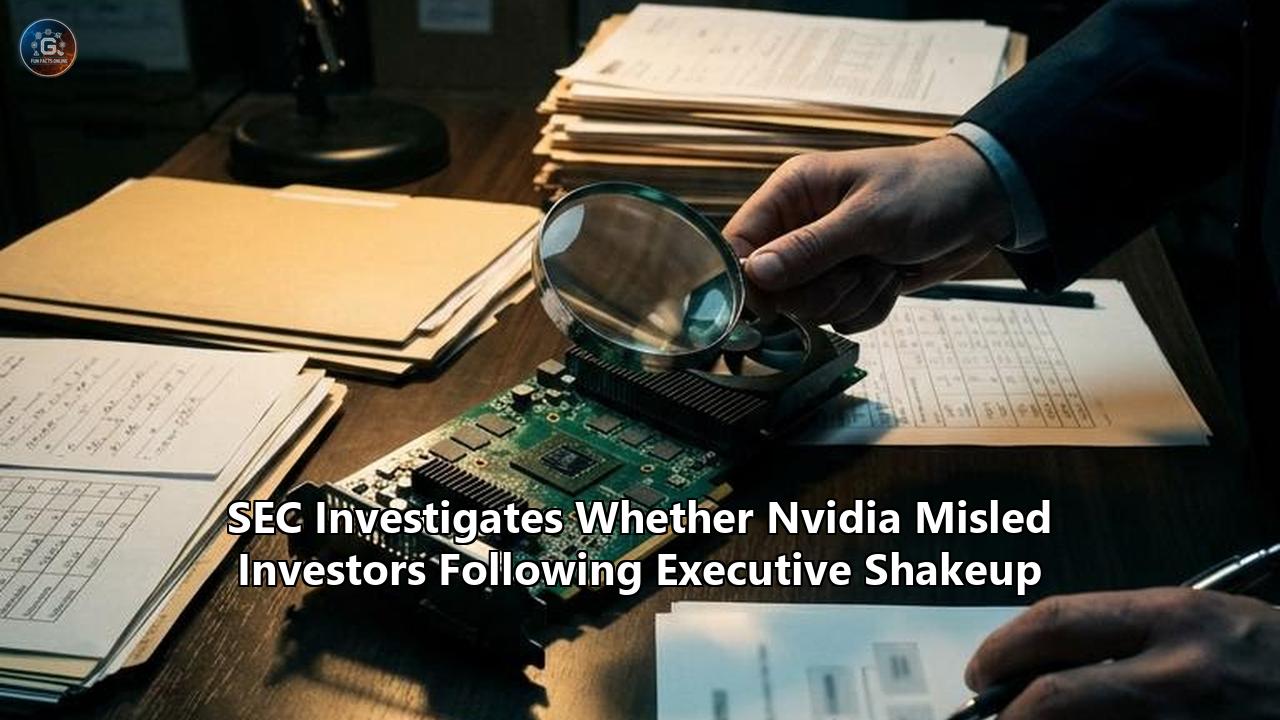
Federal regulators have opened a civil investigation into Nvidia Corporation, scrutinizing whether the semiconductor powerhouse intentionally misled shareholders regarding corporate governance risks, executive conduct, and the geographic routing of billions of dollars in artificial intelligence hardware.
The inquiry by the Securities and Exchange Commission’s Division of Enforcement follows the abrupt resignation of co-founder and longtime chief executive Jensen Huang, whose 33-year tenure atop the company collapsed amid counterintelligence scrutiny and undisclosed personal conflicts.
According to people familiar with the regulatory action, the Nvidia SEC investigation focuses on the accuracy and completeness of the company’s public filings leading up to and immediately following Huang’s departure on November 11. Investigators are probing whether company leadership concealed material information regarding Huang’s extramarital ties to Alice Huang—a former executive at Singapore-based cloud partner Megaspeed International whom United States intelligence agencies suspect of links to China’s Ministry of State Security—and whether prior public disclosures affirmatively mischaracterized the relationship between the chipmaker and third-party buyers in Southeast Asia.
The regulatory maneuver intensifies an unprecedented crisis for Nvidia. Within days, the Santa Clara, California-based firm has seen its iconic leader forced out, installed Chief Financial Officer Colette Kress as interim chief executive, created its first independent board chair in veteran director Harvey C. Jones, and shed hundreds of billions of dollars in market value.
With the Department of Justice, the Department of Commerce, and congressional committees pursuing parallel inquiries into potential export-control evasion, the SEC’s entrance transforms what Nvidia initially treated as a private personnel rupture into an expansive federal reckoning over disclosure fraud.
The Resignation and the Paper Trail
The investigative trail began to surface publicly on November 8, when Nvidia’s board released an extraordinary corporate statement acknowledging that an independent committee, backed by outside legal counsel, had been convened to investigate reports that Huang had been targeted in a foreign intelligence operation. In that disclosure, the company sought to reassure the market, maintaining it had no reason to believe proprietary trade secrets, customer intellectual property, or United States national security assets had been compromised.
Behind closed doors, the governance crisis was already beyond containment. Huang issued an internal memo apologizing to staff for personal infidelity, admitting to an extramarital affair without identifying his partners. Within 72 hours, investigative reporting revealed that Huang was not only entangled with Alice Huang (born Huang Le), the controlling figure behind Megaspeed, but was also involved in an undisclosed personal relationship with Kimberly Powell, Nvidia’s vice president of health care.
On the evening of November 11, the board accepted Huang’s immediate resignation as president, chief executive, and director.
The regulatory disclosure that followed on November 12 was notable for what it omitted. In an abbreviated Form 8-K filed under Item 5.02 with the SEC, Nvidia announced the immediate departure of the corporate titan who had guided the company from an obscure graphics designer founded at a San Jose Denny’s in 1993 into a global computing titan. The filing contained no narrative explanation for the resignation, mentioned no severance arrangements, referenced no separation agreement, and made no mention of the counterintelligence probe. Instead, it announced that Kress would assume the chief executive duties while retaining her position as chief financial officer, and that Jones, a board member since Nvidia’s founding year, would step into the newly established role of board chair.
┌────────────────────────────────────────────────────────────────────────┐
│                   NVIDIA CRISIS & DISCLOSURE TIMELINE                  │
├─────────────────┬──────────────────────────────────────────────────────┤
│ Late 2024       │ Commerce Dept opens inquiry into Megaspeed           │
│ May 2025        │ Commerce Dept subpoenas Nvidia on Megaspeed sales    │
│ June 2025       │ Nvidia internally blacklists Megaspeed as direct buyer│
│ Late 2025       │ Nvidia stops breaking out Singapore sales in 10-Q/Ks │
│ Nov 8, 2026     │ Board announces counterintelligence review           │
│ Nov 9, 2026     │ Shareholder class action filed in San Jose federal ct│
│ Nov 11-12, 2026 │ Jensen Huang resigns; Colette Kress named interim CEO│
│ Nov 15, 2026    │ Treasury Sec. Bessent sets 10-day export compliance  │
│                 │ deadline                                             │
│ Nov 17, 2026    │ SEC launches civil probe into investor disclosures   │
└─────────────────┴──────────────────────────────────────────────────────┘
Securities regulators are now forensically examining that sequence of events. Under federal securities laws, public corporations possess an affirmative duty to disclose information that a reasonable investor would consider material to making an investment decision.
"The issue confronting Nvidia isn’t whether an executive had an affair; personal relationships, on their face, are generally private matters," said James Park, a professor of securities regulation at UCLA School of Law and a former assistant attorney general in New York. "The legal liability triggers when personal entanglements compromise the integrity of corporate operations, create blatant conflicts of interest with major commercial partners, or expose the business to severe regulatory or national security blowback. If the board knew of these vulnerabilities and issued statements minimizing the risk, or delayed disclosure while insiders traded or major corporate milestones were cleared, Section 10(b) of the Exchange Act applies with full force."
The Singapore Conduit and Disappearing Sales Data
While Huang’s personal relationships precipitated the leadership collapse, the core of the Nvidia SEC investigation extends deep into the company’s financial engineering and international revenue reporting. SEC enforcement attorneys and forensic accountants are scrutinizing whether Nvidia’s revenue breakdowns accurately portrayed where its most advanced graphics processing units (GPUs) were ultimately going—or whether the company masked severe regulatory risks created by United States export controls.
Following the Department of Commerce’s initial export restrictions on high-performance artificial intelligence semiconductors to China in October 2022, and subsequent tightenings in October 2023 and early 2025, Nvidia repeatedly assured Wall Street that its business model was resilient. The company engineered export-compliant chips, such as the H20, specifically designed to stay below performance thresholds established by the Commerce Department’s Bureau of Industry and Security (BIS). When Washington subsequently clamped down on the H20 in April 2025, direct revenue recognized from customers billed in China plummeted.
Yet overall revenues for Nvidia’s data center segment continued an aggressive upward trajectory. Financial filings demonstrate an extraordinary anomaly: as revenue recognized from mainland China declined to between 4% and 5% of total sales, billing to Singapore experienced an unprecedented explosion.
In early fiscal 2024, Singapore-billed transactions accounted for approximately 15.5% of Nvidia’s quarterly revenue. By the quarter ending July 2025, Singapore-billed revenue surged to 21.7% of the company's total revenue, representing billions of dollars every quarter flowing through a city-state of fewer than six million inhabitants. In footnotes buried in its quarterly Form 10-Q filings, Nvidia explained that Singapore was utilized by multinational customers to centralize invoicing and billing, asserting that more than 99% of controlled data center computing hardware billed to Singapore was intended for United States-based customers or non-restricted global deployment.
Then, in late 2025, Nvidia abruptly altered its accounting disclosures. Without issuing an explanatory press release, the company eliminated the explicit regional breakout for Singapore from its international revenue tables, transitioning instead to a generalized categorization that grouped revenue by customer corporate headquarters. Under this newly adopted metric, revenue attributed to China rebounded in quarterly reports to 8.2%, while the massive Singapore conduit vanished into aggregate figures.
                 NVIDIA REVENUE DISCLOSURE PIVOT (2024-2025)

    Reported by Billing Location             Reported by Customer HQ
    ────────────────────────────             ────────────────────────
    Quarter to April 2024:                   Late 2025 Onward:
    • Singapore: 15.5% of Revenue            • Singapore line item ELIMINATED
    • China/HK:  Declining                   • China: Re-indexed to 8.2%
                                             • Aggregate metrics obscure
    Quarter to July 2025:                      shipment transit routes
    • Singapore: 21.7% of Revenue
    • China/HK:  Dropped to 5.9%
Federal regulators are now asking whether that disclosure change was designed to obfuscate the real destination of its hardware.
"When a public company sees a massive percentage of its revenue concentrate into an anomalous geographic hub that does not possess the domestic power grid or data center infrastructure to consume that hardware, you have an immediate red flag for trade compliance and disclosure fraud," says Diana Summers, a former senior enforcement attorney in the SEC’s Division of Corporation Finance. "If Nvidia altered its reporting metrics because it became aware that regulatory bodies were examining Singaporean billing conduits, that is not merely an accounting choice. That is active concealment under Rule 12b-20, which demands that companies provide any additional material information necessary to ensure that mandatory statements are not misleading."
The scrutiny intensified following statements from Treasury Secretary Scott Bessent, who publicly challenged the integrity of Nvidia’s foreign compliance infrastructure. In appearances on national television, Bessent accused the company of potentially tolerating illicit sales to bolster corporate balance sheets.
"I want to keep coming back to: What was the culture at Nvidia, and were they pressing these seemingly illicit sales to goose their revenues and their earnings?" Bessent stated, pointing out that intelligence assessments indicated only a tiny fraction of the high-end chips billed in Singapore remained in the country. Bessent issued a public ultimatum, demanding that Nvidia’s board and independent counsel provide detailed responses to Treasury regarding export-control compliance and intermediary due diligence within 10 days.
The Megaspeed Connection: Alice Huang and Grey-Market Clusters
At the center of both the national security panic and the SEC’s disclosure inquiry is Megaspeed International, a Singapore-headquartered enterprise that positioned itself as one of the fastest-growing artificial intelligence cloud infrastructure providers in Southeast Asia.
Corporate records in Singapore reveal a labyrinthine corporate structure. Megaspeed was originally incorporated in 2015 as 7Road International, serving primarily as the overseas operating arm of a Chinese online gaming studio. In March 2023, the entity underwent a total restructuring: it rebranded as Megaspeed International and transferred 100% of its equity to Huang Le Limited, a vehicle incorporated in the British Virgin Islands. Huang Le is the formal legal name of Alice Huang, a mainland Chinese businesswoman educated at Hong Kong Baptist University who transitioned from television broadcasting to managing private investment vehicles in Hong Kong and Shenzhen.
By November 2023, Alice Huang’s name was quietly scrubbed from directorship rolls in Singapore, and legal ownership of Megaspeed was reassigned to Swiftdata International, an entity managed by Singaporean national Tan Yong Pong. Yet according to federal investigators and an exhaustive forensic report published earlier this year by short-seller Culper Research, Alice Huang continued to function as Megaspeed’s primary operating executive, negotiating contracts and personally securing enterprise partnerships.
During this same period, Megaspeed achieved a commercial status that dozens of enterprise software firms spend years pursuing: it was designated an official Nvidia Cloud Partner (NCP). This status granted Megaspeed direct, prioritized allocation of restricted H100 and H200 HGX systems, bypassing standard distributor queues. Over a three-year span, Megaspeed procured between $4 billion and $5 billion worth of cutting-edge Nvidia hardware, deploying high-density server clusters across data facilities in Malaysia and Singapore.
Megaspeed publicly marketed access to these GPU clusters to Chinese corporate giants, including Alibaba Group, enabling Chinese engineers to remotely train and fine-tune large language models without technically importing the physical hardware across Chinese customs borders. Worse, intelligence officials uncovered evidence that physical server racks procured by Megaspeed were routinely broken down and illicitly re-routed into Shenzhen and Shanghai via third-party logistics firms, directly violating United States export restrictions.
                     THE ALLEGED ILLICIT GPU PIPELINE

       ┌────────────────────────┐
       │   Nvidia Corporation   │ (Santa Clara, CA)
       └───────────┬────────────┘
                   │ Priority allocation via Nvidia Cloud Partnership
                   ▼
       ┌────────────────────────┐
       │ Megaspeed Int'l / BVI  │ (Controlled by Alice Huang / Tan Yong Pong)
       └───────────┬────────────┘
                   │
         ┌─────────┴────────────────────────┐
         │                                  │
         ▼                                  ▼
┌──────────────────┐               ┌──────────────────┐
│ Southeast Asia   │               │ Physical Export  │
│ Cloud Clusters   │               │ Diversion Loop   │
│ (Remote compute  │               │ (Hardware routed │
│  access by PRC   │               │  via logistics   │
│  tech giants)    │               │  to Shenzhen)    │
└──────────────────┘               └────────┬─────────┘
                                            │
                                            ▼
                                   ┌──────────────────┐
                                   │ Controlled PRC   │
                                   │ End-Users & Labs │
                                   └──────────────────┘
The regulatory nexus to securities fraud sits in how Nvidia represented this relationship to its public investors. When rumors began circulating in early 2026 regarding potential export diversion through Megaspeed and questions arose regarding Jensen Huang’s personal proximity to Alice Huang, Nvidia dismissed the concerns, assuring market analysts that the company exercised rigorous end-use monitoring and that executive leadership held no conflicts of interest.
The SEC is now testing those denials against the factual timeline established by law enforcement. In a joint public disclosure issued to clarify press accounts, the Commerce Department and the Department of Justice revealed that Commerce investigators had formally approached Nvidia as early as May 2025, demanding internal sales records concerning all products sold directly or indirectly to Megaspeed. While Nvidia quietly added Megaspeed to its internal banned-customer list in June 2025, it never disclosed to shareholders that its premier cloud partner in Southeast Asia was the subject of an active federal export investigation. Nor did it disclose that its chief executive maintained an active romantic liaison with that partner's controlling shareholder.
"If a company knows its primary customer in a region is an evasion conduit under federal investigation, and that its CEO has an intimate personal conflict with that customer, you have a classic disclosure omission under SEC Rule 10b-5," explains Michael B. Greenwald, a former United States Treasury official. "Nvidia was selling high-margin silicon into an artificial demand vacuum created by export controls. If that demand was sustained by violating federal laws, the entire revenue stream is tainted by regulatory risk. Concealing that from the investing public constitutes a profound compliance failure."
Megaspeed, for its part, has denied intentional misconduct. In a statement released through outside counsel, the company maintained that it runs a "legitimate and lawful business" and stated that Alice Huang "left Megaspeed effective Aug. 30, 2025, and currently has no role with the company". However, Singapore’s Ministry of Home Affairs disclosed that authorities had confiscated Alice Huang’s passport for eight months starting in mid-2025 while investigating false declarations regarding server imports, ultimately barring her from re-entering the country after concluding she provided deceptive testimony to downplay her command of Megaspeed.
Governance Autocracy and the Key-Person Catastrophe
The corporate collapse has brought intense focus to Nvidia’s unique, highly centralized governance framework. For over three decades, Jensen Huang commanded Nvidia with near-total autonomy.
Unlike virtually every other company of comparable market valuation in the S&P 500, Nvidia operated without an independent chair of the board. Huang served concurrently as president, chief executive, and board director, presiding over a corporate hierarchy famous in Silicon Valley for its extreme flatness. Huang had roughly 60 executive direct reports, maintained no designated chief operating officer, and routinely handled micro-level commercial engagements directly with key customers.
                     NVIDIA'S HISTORICAL GOVERNANCE MODEL

                          ┌────────────────────────┐
                          │      JENSEN HUANG      │
                          │   CEO / President /    │
                          │ Board Director / Voice │
                          └───────────┬────────────┘
                                      │
         ┌────────────────────────────┼────────────────────────────┐
         │                            │                            │
         ▼                            ▼                            ▼
┌──────────────────┐        ┌──────────────────┐        ┌──────────────────┐
│  ~60 Direct Ops  │        │ Direct Customer  │        │ Board of         │
│  Reports         │        │ Negotiations &   │        │ Directors        │
│ (No COO layer)   │        │ Allocation Calls │        │ (No Indep. Chair)│
└──────────────────┘        └──────────────────┘        └──────────────────┘
This structural centralization created an acute, unhedged key-person exposure that Nvidia repeatedly brushed off in its annual proxy disclosures. In its fiscal 2026 proxy statement (DEF 14A), Nvidia assured shareholders that its board maintained active oversight of strategic, financial, and compliance risks through its audit and governance committees, asserting that its leadership structure was appropriate given Huang’s unrivaled command of accelerated computing markets.
The sudden implosion of Huang's leadership exposed that structure as an operational hazard.
"Nvidia’s governance model was built on an obsolete, founder-worshipping premise that cannot scale to a $3 trillion critical-infrastructure vendor," says Charles Elson, founding director of the Weinberg Center for Corporate Governance at the University of Delaware. "By consolidating complete executive authority without an independent chair, a COO, or a functional succession plan, the board allowed key-man risk to become existential risk. When Huang's personal conduct jeopardized the enterprise, there were no structural shock absorbers. The board was forced to invent an entire governance apparatus overnight."
That hastily erected apparatus is already showing signs of operational strain. Upon forcing Huang’s resignation, the board designated Harvey C. Jones as chair. Jones, a venture capitalist with Square Wave Ventures who has sat on Nvidia’s board since its inception in 1993, lacks the distance from Huang’s historical management decisions that institutional shareholders demand. Simultaneously, elevating CFO Colette Kress to interim CEO while keeping her in charge of the finance organization creates an immediate conflict: the person ultimately responsible for overseeing the company's responses to the SEC's accounting inquiry is the exact executive who signed off on the historical 10-Q and 10-K filings under scrutiny.
The board’s panic was laid bare on November 17, when Jensen Huang unexpectedly issued a public statement suggesting the leadership door remained open. Huang announced that he "would be honored" to return as chief executive if the board determined that his reinstatement served the interests of employees and shareholders.
The market response was chaotic, sending the stock through wild intraday swings. Nvidia’s board moved swiftly to quash the trial balloon, informing institutional stakeholders that Huang’s reinstatement was entirely off the table. To enforce separation, the board retained powerhouse corporate law firm Wachtell, Lipton, Rosen & Katz to steer the ongoing internal investigation, and contracted executive recruitment firm Heidrick & Struggles, headed by senior partner Jeff Sanders, to initiate an external search for a permanent successor.
Search consultants have reportedly approached external executives, including Rene Haas, chief executive of Arm Holdings and a former Nvidia vice president. Yet institutional investors remain deeply uneasy over whether any external chief can command Nvidia’s sprawling, bespoke software and hardware ecosystem without Huang’s technical direction.
Legal Exposure and Enforcement Precedents
The civil inquiry initiated by the SEC represents an escalating threat to Nvidia because of the federal agency’s sweeping subpoena power and relatively low burden of proof compared to criminal prosecutions. Unlike the Justice Department, which must establish willful intent beyond a reasonable doubt, the SEC can establish violations of Sections 17(a)(2) and 17(a)(3) of the Securities Act of 1933 under a simple negligence standard.
Legal specialists point out that this is far from the company's first collision with federal disclosure regulators. In May 2022, Nvidia agreed to pay a $5.5 million civil penalty to settle SEC charges that it violated Section 17(a)(2) and (3) and reporting provisions of the Exchange Act. In that enforcement action, the SEC established that throughout consecutive quarters in fiscal 2018, Nvidia failed to disclose that its explosive growth in gaming GPU sales was driven in substantial part by volatile cryptocurrency mining.
The SEC’s order found that Nvidia’s executives spoke publicly about gaming market growth while omitting internal data showing that cryptomining was cannibalizing consumer stock, leaving investors blind to how exposed the company was to a sudden crypto-market crash. Nvidia settled the charges without admitting or denying the findings.
                 NVIDIA'S REGULATORY ENFORCEMENT RECORD

  Year       Regulatory Body    Allegation & Resolution
  ───────────────────────────────────────────────────────────────────────
  2002       SEC                Financial restatement following Audit
                                Committee probe; supplier cost reductions
                                improperly recognized, inflating profits.

  2022       SEC                $5.5M civil settlement; omitted material
                                disclosures that explosive gaming GPU
                                growth was driven by volatile cryptomining.

  2026       SEC (Current)      Active civil investigation into executive
                                shakeup disclosures, national security
                                conflicts, and Asia/Singapore sales data.
"The 2022 cryptomining order established a clear pattern: Nvidia has previously been disciplined by the Commission for touting broad, legitimate market demand while concealing underlying, high-risk demand drivers," says Sarah Heaton, a former federal prosecutor specializing in corporate fraud. "In this current Nvidia SEC investigation, the playbook looks strikingly similar. The Commission will examine whether Nvidia was reporting pristine, diversified Southeast Asian enterprise demand while privately knowing that substantial volumes were being sucked into illicit Chinese conduits via a partner run by the CEO’s intimate companion. If internal emails show that executives discussed these export risks while reassuring the Street, the legal exposure is immense."
Parallel to the SEC’s inquiry, private civil litigation is rapidly mobilizing. On November 9, a punitive class-action lawsuit was filed against Nvidia and Jensen Huang in the U.S. District Court for the Northern District of California (San Jose).
Led by shareholder Mark Kirstenmacher, the complaint alleges that the defendants violated Sections 10(b) and 20(a) of the Securities Exchange Act of 1934 by concealing Huang’s conflicts of interest, disguising the vulnerability of the company's overseas distribution networks, and making materially misleading statements regarding compliance oversight. The lawsuit seeks class certification on behalf of all investors who purchased Nvidia shares during the run-up to Huang’s ouster, seeking billions of dollars in damages for the steep equity drop that wiped out over $400 billion in market value within days.
                  THE EXPANDING LEGAL & REGULATORY WEB

                       ┌────────────────────────┐
                       │   NVIDIA CORPORATION   │
                       └───────────┬────────────┘
                                   │
         ┌─────────────────────────┼─────────────────────────┐
         │                         │                         │
         ▼                         ▼                         ▼
┌──────────────────┐      ┌──────────────────┐      ┌──────────────────┐
│  Securities &    │      │  Department of   │      │  Private Civil   │
│  Exchange Comm.  │      │  Justice / Commerce│     │  Litigation      │
│ (Civil inquiry   │      │ (Criminal/export │      │ (Kirstenmacher   │
│  into misleading │      │  control evasion │      │  class action;   │
│  disclosures)    │      │  re: Megaspeed)  │      │  Rule 10b-5)     │
└────────┬─────────┘      └────────┬─────────┘      └────────┬─────────┘
         │                         │                         │
         └─────────────────────────┼─────────────────────────┘
                                   │
                                   ▼
                       ┌────────────────────────┐
                       │ Congressional Probes & │
                       │ Cabinet Interagency    │
                       │ Clashes (Bessent/GOP)  │
                       └────────────────────────┘
Compounding the private suits, California Attorney General Rob Bonta confirmed that state prosecutors have also initiated an independent review of the company's actions. Appearing on Bloomberg Television, Bonta noted that "red flags have been raised" regarding the alleged diversion of California-manufactured advanced technology to blacklisted foreign entities, adding that his office is determining whether state corporate oversight or consumer protection statutes were violated.
Interagency Warfare in Washington
The sudden disclosure of the Nvidia SEC investigation has landed squarely in the middle of a brutal, high-stakes political conflict within the presidential administration over how aggressively to decouple the United States technology ecosystem from China.
For months, an intense ideological and jurisdictional rivalry has brewed between Treasury Secretary Scott Bessent and Commerce Secretary Howard Lutnick. The Commerce Department, which houses the Bureau of Industry and Security, maintains exclusive authority over the implementation of the Export Administration Regulations (EAR) and the enforcement of the Entity List.
Documents and leaked memos indicate that the Treasury Department, the Defense Department, the State Department, and the Office of the U.S. Trade Representative had jointly pushed for Megaspeed to be formally designated on the Entity List as early as late 2024, citing intelligence that the company served as an active front for Chinese state-backed compute acquisition.
Lutnick, however, resisted designating Megaspeed or imposing broader restrictions on advanced chip variants for Southeast Asian hubs, reflecting a perspective shared by Huang that overly restrictive unilateral controls would harm American competitiveness and push foreign customers into the arms of indigenous Chinese competitors like Huawei. The dispute turned toxic following Huang’s resignation, culminating in a reported confrontation inside the White House Situation Room where Bessent directly accused Commerce of stalling critical enforcement actions.
                     WASHINGTON INTERAGENCY SPLIT

    THE HAWKISH COALITION                THE COMMERCE APPARATUS
    ─────────────────────                ──────────────────────
    • Treasury (Sec. Bessent)            • Commerce (Sec. Lutnick)
    • Department of Defense              • Historical position: Resisted
    • Department of State                  adding Megaspeed to Entity
    • U.S. Trade Representative            List; balanced controls
                                           against domestic commercial
    Demand: Total interdiction of          interests.
    Singapore intermediaries;
    immediate corporate sanctions.       Friction: Accused by Treasury
                                         of "holding the pen" and stalling
                                         enforcement actions.
"I am frustrated when President Trump made it very clear China should not receive any Nvidia chips above H100s," Bessent stated bluntly on CNBC. "Commerce has the pen, and you will have to ask them about their internal processes. My deputy has been pushing this for months".
Capitol Hill has seized on the administration's internal rift. Republican-led committees across both chambers of Congress have launched coordinated inquiries into the scandal. Senate Banking Committee Chair Tim Scott and House leadership have summoned Jensen Huang, Howard Lutnick, and members of Nvidia’s audit committee to deliver sworn testimony. Lawmakers have threatened subpoenas if Huang fails to appear, setting a rigid deadline for the former chief executive to explain what conversations took place regarding Megaspeed, Alice Huang, and export licenses.
The political firestorm leaves Nvidia isolated in Washington. Historically, Huang used his immense star power, deep political relationships, and personal meetings at the White House to successfully lobby against draconian hardware embargoes. With Huang ousted and his relationships cast as a security risk, Nvidia has lost its most potent political advocate just as Washington prepares an even more aggressive round of multilateral AI hardware restrictions.
Market Fallout and What to Watch Next
As Nvidia prepares to present its fiscal third-quarter earnings to the public, the company faces an investment community that has abruptly shifted from evaluating computational benchmarks to calculating legal, geopolitical, and executive governance discounts.
Interim chief executive Colette Kress faces a grueling challenge. When Nvidia reports its financial performance, the headline numbers may reflect historical momentum—analysts anticipate third-quarter fiscal 2027 revenue hovering near the guided target of $108 billion, plus or minus 2%. Yet Wall Street analysts on the post-earnings conference call will focus primarily on forward guidance, internal control audits, and the widening regulatory net.
Institutional investors are monitoring several critical inflection points:
- The Scope of the SEC Formal Order: Market participants will watch whether the SEC issues a formal order of investigation, granting enforcement staff nationwide subpoena power to compel depositions under oath from Kress, Chair Harvey Jones, and other board members regarding historical accounting entries and the timing of internal disclosures.
- Treasury’s 10-Day Audit Deadline: The clock set by Secretary Bessent on November 15 expires within days. Nvidia’s formal legal response to Treasury’s queries regarding its export-compliance architecture will reveal how deeply the company plans to challenge or cooperate with federal authorities.
- Congressional Depositions: Huang’s scheduled appearances before House and Senate committees will place the former chief executive under oath. Any divergence between Huang’s testimony and Nvidia’s official regulatory disclosures could provide immediate fuel for both SEC enforcement and the Kirstenmacher class-action plaintiffs.
- Permanent CEO Succession: The search steered by Heidrick & Struggles remains a primary test of corporate stability. If the board fails to recruit an established, external technology leader capable of untangling the flat management structure, executive attrition among core engineering vice presidents could accelerate.
- Southeast Asian Supply Interdictions: If the Commerce Department acts on Treasury's recommendations and formally blacklists Megaspeed and affiliated regional data entities, Nvidia could be forced to write down substantial hardware allocations and revise its international growth targets downward.
For three decades, Nvidia’s unprecedented equity ascent was fueled by single-minded execution, relentless architectural iteration, and the undisputed leadership of Jensen Huang. With the opening of the federal disclosure investigation, the company confronts a sobering reality. The technology that unlocked generative artificial intelligence can process quintillions of floating-point operations every second, but it cannot compute a simple escape from the fundamental requirements of corporate transparency, federal securities law, and geopolitical allegiance.
Reference:
- https://uk.investing.com/news/stock-market-news/nvidia-faces-sec-investigation-as-crisis-deepens-following-huang-resignation-4988749
- https://finance.biggo.com/news/852b76b1-ee0d-4fe3-a344-dca6d085a24f
- https://sec-api.io/insights/nvidia-nvda-jensen-huang-steps-down-ceo-transition-8-k-and-sec-filings-analysis
- https://fortune.com/2026/11/11/nvidia-oust-jensen-huang-spy-affairs/
- https://www.benzinga.com/news/politics/26/11/63279833/scott-bessent-gives-nvidia-10-days-to-explain-china-chip-concerns-calls-for-external-ceo-to-replace-jensen-huang-dramatic-shakeup
- https://datacentremagazine.com/news/nvidia-ceo-jensen-huang-resigns-as-colette-kress-steps-in
- https://edition.cnn.com/2026/11/12/tech/jensen-huang-nvidia-resigns
- https://www.pbs.org/newshour/world/megaspeed-says-alice-huang-left-in-2025-as-company-conducts-internal-probe-over-nvidia-fallout
- https://www.mescomputing.com/news/2026/ai/nvidia-s-ceo-shake-up-supply-pricing-and-roadmap-questions-for-it-buyers
- https://www.investmentnews.com/equities/embattled-nvidia-faces-sec-probe-as-california-attorney-general-mulls-action/269054
- https://mlq.ai/news/bessent-says-nvidia-should-hire-an-outside-ceo-and-questions-whether-china-sales-goosed-its-earnings/
- https://cryptobriefing.com/bessent-nvidia-board-export-controls-deadline/
- https://techcrunch.com/2026/11/17/sec-reportedly-investigating-nvidia-amid-huang-exit/
- https://investinglive.com/stocks/sec-reportedly-probes-nvidia-disclosures-as-bessent-demands-answers-within-10-days/
- https://www.theguardian.com/technology/2026/nov/16/megaspeed-company-breaks-slience-nvidia-jensen-huang-alice-huang
- https://en.wikipedia.org/wiki/Alice_Huang_(executive))
- https://finance.biggo.com/news/852b76b1-ee0d-4fe3-a344-dca6d085a24f
- https://apnews.com/article/nvidia-megaspeed-scott-bessent-howard-lutnick-17582a5098a5fb4c8fe866a084a6e52b
- https://www.aljazeera.com/news/2026/11/16/megaspeed-firm-at-centre-of-nvidia-scandal-says-alice-huang-left-in-2025
- https://www.scmp.com/week-asia/economics/article/3374256/megaspeed-ex-ceo-alice-huang-barred-singapore-amid-nvidia-scandal
- https://fr.tradingview.com/news/stocktwits:a42088109094b:0-nvidia-s-jensen-huang-resigns-as-ceo-with-cfo-colette-kress-to-step-in-analyst-compares-to-apple-s-steve-jobs-moment/
- https://www.shacknews.com/article/151390/sec-nvidia-investigation-jensen-huang
- https://www.investing.com/news/stock-market-news/nvidia-board-forms-committee-for-national-security-and-export-control-oversight-5032154
- https://cryptobriefing.com/sec-investigates-nvidia-investor-disclosures/
- https://www.sec.gov/enforcement-litigation/administrative-proceedings/34-48480
- https://www.pbs.org/newshour/politics/bessent-blames-lutnicks-commerce-department-for-not-restricting-nvidia-chips-to-china
- https://finance.biggo.com/news/9eff2a74-1825-4225-8f2d-60e685d0d3c2
- https://pluang.com/en/news-feed/nvidia-butuh-perubahan-dramatis-seiring-perusahaan-singapura-pindahkan-chip-7